Danger in transporting nuclear wastes from Lucas Heights, and ANSTO’s conflict of interest.

profoundly increased risks to the security of nuclear material that occur during transport, which are obviously minimised if they stay at Lucas Heights, and that’s one of the key reasons that we’re in favour of extended interim storage at Lucas Heights rather than anywhere else.
They [ANSTO] are a nuclear operator, so of course they’re organisationally, professionally, bureaucratically and budget-wise invested in nuclear technology.……..They have no expertise or interest, and no history, in alternative technologies. So I think, from an institutional point of view, there’s probably a pretty clear conflict of interest here. – Tilman Ruff
PARLIAMENTARY STANDING COMMITTEE ON PUBLIC WORKS Intermediate level solid waste storage facility, Lucas Heights, New South Wales (Public) MONDAY, 13 SEPTEMBER 2021 BEAVIS, Dr Margaret, Vice President, Medical Association for Prevention of War (Australia) [by audio link] RUFF, Dr Tilman, AO, Member, Medical Association for Prevention of War (Australia) [by audio link]
Dr Ruff: Very briefly, I want to add one important element for the committee’s deliberations that would support not just the proposed facility—as the previous witness and, I think, most of the submissions that you’ll be deliberating on today have supported—but ongoing interim storage of Australia’s intermediate-level nuclear waste at Lucas Heights, and whatever facilities are planned or put in train now should be amenable to implementing that capacity.
The particular reason I just want to draw your attention to is the profoundly increased risks to the security of nuclear material that occur during transport, which are obviously minimised if they stay at Lucas Heights, and that’s one of the key reasons that we’re in favour of extended interim storage at Lucas Heights rather than anywhere else. But it would be a major concern for reliance on a plan to shift that waste—uncertain, as highlighted—to anywhere else but particularly to somewhere as distant as South Australia with either very long road transport through multiple states or sea transport through ports.
The two global databases on nuclear accidents and trafficking are run out of the United States. The public one and the International Atomic Energy Agency both highlight, including in their most recent reports, that around half of the total reported incidents with nuclear materials occur during transport, and they highlight this as a particular vulnerability. Lucas Heights has, to my knowledge, been the subject of six publicly known terrorist threats. A couple of them have involved identification of explosive materials on or near the site. A couple have involved prosecutions of people with clear evidence of significant stages of planning. If that’s an issue at Lucas Heights, then the vulnerability of transport is particularly highlighted.
And it’s clear in both the reports that I mentioned that there are well-organised terrorist groups of various kinds around the world that are interested in, and have a demonstrated track record in seeking to acquire, nuclear materials suitable for, essentially, dirty radiological bombs, and intermediate-level nuclear waste would be very suitable for that purpose. So that’s one of the key factors why, from a health point of view, we’re particularly concerned that multiple handling and, particularly, long-distance transport of hazardous nuclear waste be minimised.
Dr Beavis: The recommendations of MAPW ask for an open and independent review of nuclear waste production and disposal, and also that the committee recommend inquiry and research into shifting to cyclotrons rather than reactor based production of isotopes for nuclear medicine in a phased and transition manner. We’re not talking about anything that would threaten nuclear medical supplies but, as rapidly as is feasible, to reduce the amount of waste that is produced.
Dr Beavis: It’s a very complex market. Every year, the OECD and Nuclear Energy Agency—they haven’t done it last year—put out a report on the supply of medical isotopes, and there’s been a recurring theme on the problems with full-cost recovery and the problems with supply security. I’ll just read you a bit from the 2019 report which I have in front of me which says that governments are not always aware of the extent to which molybdenum-99 production—that’s the technetium precursor—relies on subsidies. I think all of us are aware.
The report goes on: Some governments were essentially subsidising the production of Mo-99 that was exported to other countries, thus subsidising imaging services in importing countries. And this report is very keen for full-cost recovery, or FCR so they’re trying to stop countries heavily subsidising exports because it’s making the provision of new suppliers not cost competitive. I’ll read a little further: Other countries have decided to allow older facilities that were operating below FCR— that’s full-cost recovery— to cease operations and have not subsidised extensions of their working lifetime. While this increased the risk of insufficient supply or challenged reserve capacity, decisions to end the operation of facilities … have been helpful in achieving the six NEA— the Nuclear Energy Agency— policy principles … by removing subsidised services from the market. These actions also reduced the level of subsidised reserve capacity and reduced perceived overcapacity within the market.
I can read you more, but, basically, what they’re saying is that, because nuclear reactors are very, very expensive to set up, Australia is actually going down the path that Canada chose not to continue in the late 2000s. In 2009 and 2010, there was a massive global shortage of nuclear medicine for this technetium isotope. That was because the Canadian reactor supplied about 25 to 30 percent of the market. Canada has chosen not to replace those reactors for a number of reasons but not least because they were tired of accumulating all the nuclear waste from the export business of isotopes around the world.
In fact, the OECD and the NEA are advocating that we should not be continuing to subsidise these nuclear medicine suppliers. It also means that, if you rely on a reactor, when that reactor breaks down, your tendency to create havoc in the global markets is much greater. It would be much better if there were decentralised, much cleaner production of isotopes.
But, because we have a reactor and because ANSTO, as a business entity, has decided that it wishes to increase its market share—which, as a business entity, it’s certainly entitled to do—it means that the Australian public is left with a great deal of waste. It’s going to double the waste inventory, as you’ve heard, without really any social licence to do so.
Given that the OECD and the NEA are saying that we should not be continuing to subsidise this, I think what we need to do, as I said, is a phasing transition. We need a phased and coordinated reduction in Australia’s production isotopes for an export business, and, for Australian owned nuclear medicine suppliers, we actually need to decentralise. Cyclotrons are about the size of a four-wheel drive and cost in the order of—actually, I shouldn’t get into that, but it would be less than $5 million per cyclotron to have the work done and dusted. They are much cheaper to run, they don’t produce the waste, they don’t leave us with 10,000-year intermediate-level waste doubling in the next few decades. So I think it’s something Australia should be looking at. I think the huge subsidies that are going into this export business—I’ll backtrack. With new technologies and cyclotrons now being demonstrated to work in Canada, we need to have a review of how we produce our nuclear medicine so that we can have more reliable, safer and cleaner supplies.
Mr ZAPPIA: Again, Chair, I would have had lots, but I will ask just one question based on those last few comments. Doctor, why do you believe that ANSTO is not going down the path that Canada has gone down and the path that you’re recommending—that is, to increase the production of cyclotrons as opposed to isotopes?
Dr Beavis: I would be hesitant to second-guess how ANSTO thinks. I find that a difficult question. They may wish to increase the income that comes into ANSTO as a natural entity. I think they are not factoring in the cost of the waste. They’ve said explicitly they do not want responsibility for this waste that they are generating, and I think if you don’t have to worry about the waste, then putting subsidised material out into the global community—
Dr Ruff: If I could add to that very briefly: without wanting to speak for ANSTO, I think the institutional context is worth looking at. They are a nuclear operator, so of course they’re organisationally, professionally, bureaucratically and budget-wise invested in nuclear technology. Setting up a reactor is very expensive. The OPAL reactor cost at least $400 million, so there’s a very high upfront cost, and they, presumably, like most other reactor operators, want to operate it as long as possible. They have no expertise or interest, and no history, in alternative technologies. So I think, from an institutional point of view, there’s probably a pretty clear conflict of interest here.
That’s why we’re deeply concerned that, in Australia, we’re being left behind with emerging technologies. Australian medicine is very well placed. Cyclotrons are already dispersed in pretty much all of the major hospitals around capital cities because they produce isotopes for PET scans and other modern nuclear medicine interventions. But that’s probably not an enterprise that ANSTO would be essentially involved in, and I suspect that’s the context in which you’re not hearing a peep from them or any active interest in progressing and advancing implementation of much safer technologies of the future.
Mr ZAPPIA: , what is the significant objection to something that’s in the heart of Sydney, fundamentally, and that has been managed safely for a significant amount of time versus something in a far less densely populated area? What’s the basis for the objection?
Dr Beavis: I think the expertise and security at ANSTO is far greater. I also think the risks from this waste pale into insignificance compared to the risks of the nuclear reactor. So, if you’re going to be keeping one large facility secure, you may as well keep it all there. The regulator has said quite clearly that there’s sufficient space at Lucas Heights to store this waste for decades to come. https://parlinfo.aph.gov.au/parlInfo/download/committees/commjnt/cfc4f9dc-b73c-4166-b484-eeaddcab5bc0/toc_pdf/Parliamentary%20Standing%20Committee%20on%20Public%20Works_2021_09_13_9111.pdf;fileType=application%2Fpdf?fbclid=IwAR0ZzP4j5ukpfZOgyipP2ak92avAEz19B2wqC_Zz4bcbCDXGB9cRcT2siFo#search=%22Australian%20Nuclear%20Scie
Kimba nuclear waste dump is absolutely not a foregone conclusion – David Noonan.
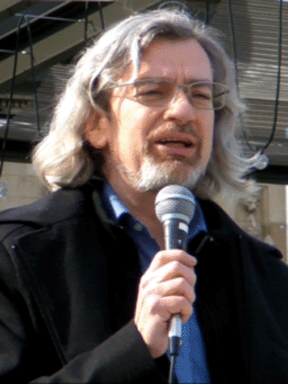
ANSTO have made decisions on the location of this new facility relative to the existing facility, and they’ve made that decision in terms of how much waste there will be and for how long they consider it to be their responsibility to retain those wastes on site. I think that those evaluations should have been made with the primary safety contingency in mind to retain not just existing waste and the next decade’s waste, but—if their intention is to operate the OPAL reactor through to 2057 under this existing licence—the full complement of waste that they intend to produce.
Parliamentary Standing Committee on Public Works 13/09/2021 Intermediate level solid waste storage facility, Lucas Heights, New South Wales, NOONAN, Mr David, Private capacity [by audio link]
Mr ZAPPIA: Mr Noonan, you expressed some concerns about the facility in South Australia proceeding. What are those concerns? That is, why do you believe that it is still not a foregone conclusion that that facility will be built?
Mr Noonan : In a number of respects it’s absolutely not a foregone conclusion. You should first consider prior evidence that with all of the power and influence of the Howard federal government, which tried between 1988 and 2004 to do, analogously, the same imposition of ANSTO nuclear waste on South Australia, and they failed. They had to abandon their plan and proposal. They recognised it was flawed and electorally unacceptable in the lead up to the 2004 federal election.
Secondly, it’s illegal in South Australia. The plan as proposed by ANSTO—the import, transport and storage of nuclear waste—was made illegal by the previous South Australian Liberal Premier, John Olsen AO. He passed legislation that prohibits the import, transport and storage of those wastes. So it’s against the law. It’s against the will of the parliament and the people in South Australia. It’s highly publicly contentious. The South Australian opposition ALP oppose the plan. They say that the process is flawed.
Federal Labor have raised some concerns about the double-handling and the failure of the government to further any proposal to reach a waste-disposal isolation capacity. There are significant concerns at the public level that it’s untenable and unacceptable, in terms of safety and security for SA, to simply bring ANSTO’s nuclear waste complement over to SA and store it above ground, potentially indefinitely—for up to 100 years, according to the regulator—in what is effectively a fancy shed in regional SA, on agricultural land, against the will of traditional owners, compared to the safety and security that is already provided for at Lucas Heights.
ARPANSA hold the deciding factor, essentially, on whether licences are ever granted in future to site, construct and operate the proposed store that ANSTO’s plans—the works before you—rely on. In terms of democracy within South Australia, and in terms of the consideration that your committee and ANSTO should have to give to not pre-empt ARPANSA’s future licensing decisions, I think there are multiple time lines and tests that would have to be passed by ANSTO’s plan to transfer waste to South Australia before that could ever be relied upon, and one of those tests is the South Australian election early next year.
…….. Mr PASIN: You’re obviously concerned about an engineering matter that would prevent it operating in the long term. I would have thought that, whether you’re storing waste for a short period or a long period, a facility like this would have to be engineered to similar standards, wouldn’t it?
Mr Noonan : For instance, ANSTO have made decisions on the location of this new facility relative to the existing facility, and they’ve made that decision in terms of how much waste there will be and for how long they consider it to be their responsibility to retain those wastes on site. I think that those evaluations should have been made with the primary safety contingency in mind to retain not just existing waste and the next decade’s waste, but—if their intention is to operate the OPAL reactor through to 2057 under this existing licence—the full complement of waste that they intend to produce. They should have to show a plan and a capacity to retain those wastes at Lucas Heights for the period required, and I don’t know if the existing works as proposed match that public purpose…. https://parlinfo.aph.gov.au/parlInfo/search/display/display.w3p;db=COMMITTEES;id=committees%2Fcommjnt%2Fcfc4f9dc-b73c-4166-b484-eeaddcab5bc0%2F0001;query=(Dataset%3Acommsen,commrep,commjnt,estimate,commbill%20SearchCategory_Phrase%3Acommittees)%20CommitteeName_Phrase%3A%22parliamentary%20standing%20committee%20on%20public%20works%22;rec=4
ARPANSA may not give licence for Kimba nuclear waste dump. Nuclear wastes best managed at Lucas Heights
 |
ANSTO’s proposed public works appear premised on an ill-considered, unassured and, arguably, untenable proposed transfer of intermediate-level waste into indefinite above-ground storage in South Australia. That’s a plan which may never come to fruition, just as the prior proposal by then Prime Minister Howard’s federal government to impose transfer and storage of ANSTO’s nuclear waste into South Australia, which was run between 1998 and 2004, had to be abandoned as a flawed proposal.
As the CEO of ARPANSA has said, nuclear waste can be safely managed at ANSTO at Lucas Heights for decades to come. With respect, that should be the premise on which your committee addresses the works before you.
Parliamentary Standing Committee on Public Works 13/09/2021 Intermediate level solid waste storage facility, Lucas Heights, New South Wales
NOONAN, Mr David, Private capacity [by audio link] Mr Noonan : I have nearly 25 years experience of following nuclear waste issues in Australia, both in capacity, working for non-government organisations, and more recently as an individual—an independent consultant and campaigner.
My first key point is that the primary premise that your committee should consider, evaluate and scrutinise of ANSTO’s proposed works is in terms of the safety contingency set by the independent regulator ARPANSA to retain ANSTO’s nuclear waste at Lucas Heights until the availability of a final isolation and disposal option. With respect, I think that should be the primary matter that should have been addressed by ANSTO in their submission to you and apparently was not.
My second key point is that, in contrast, ANSTO, as, with respect, a vested-interest proponent, presents a plan of proposed works that relies on proposed transfer of intermediate-level waste into indefinite above-ground storage in South Australia—potentially for up to 100 years. Firstly, I’d say that is arguably untenable, and I’d welcome a question line on that if it suits the committee. Secondly, it appears to pre-empt the proper role of ARPANSA licensing decision-making. ARPANSA have said that they will require separate licence processes to assess potential siting, construction and operation of a proposed store for ANSTO intermediate-level waste in South Australia. ANSTO don’t have a right, in the design of their plan and works toward you, to pre-empt a potential grant of outcome to that, and ARPANSA have been clear that they may or may not grant those licences in future.
Thirdly, your mandate as a committee goes to both scrutinising and assessing proposed works. But it holds a fundamental provision, in that you have a right to alter the proposed works—and I would ask you to consider doing so—to make them best comply with the suitability of the overarching purpose of meeting the best public value in the proposed works and the best cost-effectiveness in expenditure of public funds. With respect, I would say that that assessment and the scrutiny which you provide to ANSTO’s application should be in terms of their capacity and willingness to match the safety contingencies set by the independent regulator to retain intermediate-level waste on site at Lucas Heights until availability of a final isolation and disposal option.
Fourthly: I think the scrutiny that your committee would conduct is best served by the highest level of transparency. In that respect, I would call for you to ask ANSTO to publicly release two fundamentally important reports with regard to their planning and capacities to manage intermediate-level waste at Lucas Heights that were due under their licensing conditions. These reports were due to the independent regulator mid last year, in June. Those reports, as far as I’m aware, are not before your committee in the public evidence, and they should be. With respect, I think they should have been available for members of the public to scrutinise in their preparation of submissions to you. Further, in terms of transparency, it would be best if you could bring onto the public record ARPANSA’s evaluation of those ANSTO reports on their plans and capacities to manage intermediate-level waste at Lucas Heights. Preferably, you would hear from the regulator, ARPANSA, given their overarching role in these public interest issues. They would give evidence before you as a witness, for instance, or you could at least put questions to them.
In conclusion, I would present that ANSTO’s proposed plan fails to meet the proper safety contingency for extended storage of intermediate-level waste on site at Lucas Heights. This is, with respect, the primary purpose and warranted public interest measure by which their work should be scrutinised, assessed and evaluated by your committee. In my view and experience, ANSTO’s proposed public works appear premised on an ill-considered, unassured and, arguably, untenable proposed transfer of intermediate-level waste into indefinite above-ground storage in South Australia. That’s a plan which may never come to fruition, just as the prior proposal by then Prime Minister Howard’s federal government to impose transfer and storage of ANSTO’s nuclear waste into South Australia, which was run between 1998 and 2004, had to be abandoned as a flawed proposal.
The then Prime Minister gave assurances that it wouldn’t be renewed for South Australia, and yet we have to face this federal government’s policy agenda to transfer waste out of Lucas Heights unnecessarily when, arguably, it could be safely and securely managed. As the CEO of ARPANSA has said, nuclear waste can be safely managed at ANSTO at Lucas Heights for decades to come. With respect, that should be the premise on which your committee addresses the works before you…. https://parlinfo.aph.gov.au/parlInfo/search/display/display.w3p;db=COMMITTEES;id=committees%2Fcommjnt%2Fcfc4f9dc-b73c-4166-b484-eeaddcab5bc0%2F0001;query=(Dataset%3Acommsen,commrep,commjnt,estimate,commbill%20SearchCategory_Phrase%3Acommittees)%20CommitteeName_Phrase%3A%22parliamentary%20standing%20committee%20on%20public%20works%22;rec=4
To be internationally credible, ARPANSA (Australian Radiation Protection and Nuclear Safety Agency) needs to include detail on radionuclides in Intermediate Level nuclear waste


If it were included by ARPANSA in the latest edition of the Safety Guide for Classification of Radioactive Waste, Radiation Protection Series No. 20 (RPS 20) then ARPANSA would have been required at least on request to disclose the inventory and mobility of the radionuclides in the intermediate level waste which would be made extremely difficult for ANSTO to pursue a facility at Kimba and previously Hawker due to the lack of proper planning and design of the facility structure
It would have also made it difficult to keep claiming that the reprocessed waste from France was of intermediate level as classified by ANSTO when the French then and still now insisted that it was at lower end of high level waste
As pleasant as its people may be at ARPANSA it still has a long way to achieve international credibility .
In April 2010, ARPANSA published the Safety Guide for Classification of Radioactive Waste, Radiation Protection Series No. 20 (RPS 20). This guide sets out non-prescriptive, best-practice guidance for classifying radioactive waste and was based on the International Atomic Energy Agency (IAEA)’s General Safety Guide: Classification of Radioactive Waste, GSG-1 (IAEA 2009).
When talking about nuclear waste and radioactivity, blurring the figures is a good pro nuclear strategy!
Kazzi Jai Fight to stop nuclear waste dump in South Australia , 3 Oct 21, · Something which really ticks me off is when percentages are quoted WITHOUT giving the actual figures involved AS WELL!
Case in point – Hef Griffiths is quoted in the latest minutes (August 2021 Kimba City Council) as saying….
“Mr Griffiths said that there is a lot of information about ILW remaining radioactive for 10,000 years, however the material that remains from synroc and reprocessing that’s returned from France indicates that after 300 years 99% of the radioactivity will have decayed away. After 600 years, 99.9% will have decayed away.”
Okay – let us assume that the highest upper level of ILW classification is 10^4 TeraBequerels/m3….which is the same as 10^16 Becquerels/m3.
Now it is IAEA and ARPANSA who choose to use Becquerels, so we will stick with those units. Becquerels are the International Unit (SI Unit) for radioactivity activity. It is defined as the number of times each second a nucleus in radioactive material decays and releases radiation. The higher the number of Becquerels, the more radioactive the material is. However, it is a very small unit.
37 billion Becquerels = 1 Curie. It can be written as 3.7 x 10^10 Becquerels or disintergrations per second…… Be mindful that 1 Curie of any radioactivity – alpha, beta or gamma – will fry you.
Okay….so let’s use some easy figures to get my point across.
Let us use hypothetically for example 100 TeraBecquerels as the nuclear waste in question for ease of mathematics. This would technically fall within the category of ILW in Australia, under Australia’s criteria.
It is sitting there, in its shielded cask.
What Hef Griffiths is saying is that in 300 years (approximately 12 generations of future people from us today – or looking back BEFORE European Colonization of Australia – to put it in perspective) that 99% of that waste would have decayed away. I will give him the benefit of the doubt, since AGAIN this information IS NOT REFERENCED, but that means that 1% activity REMAINS! So….that 100 TeraBecquerels of nuclear waste now measures 1 TeraBecquerel!! That is by no means SAFE to handle without shielding EVEN AT THAT STAGE….AND IS NO WHERE NEAR BACKGROUND LEVELS!!
Hopefully that puts this type of PRESENTATION IN CONTEXT!!
Percentages are OFTEN used to HIDE REAL TIME FIGURES!
This is NOT unique to the Nuclear Industry – it is a ploy often used in Politics to HOODWINK people to thinking that the figures ARE NOT IMPORTANT AT ALL – when in fact THEY ARE!!
ALWAYS ASK FOR EXACT FIGURES, WHEN PERCENTAGES ARE QUOTED!!
This was the SAME CASE when it came to the “Community Support” assessment – PERCENTAGES AGAIN ONLY QUOTED!
When they do this – THEY ARE TRYING TO GET AWAY WITH SOMETHING!! https://www.facebook.com/groups/344452605899556
Napandee radioactive waste dump plan – a nuclear waste of money.
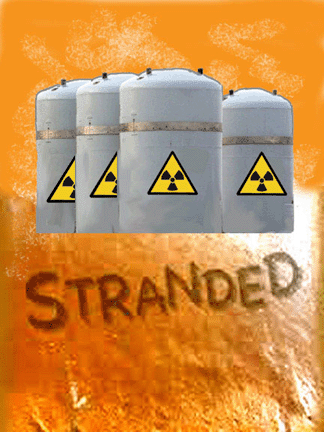
“A Nuclear waste of money – Greenies”The Advertiser 14Sept 2021 p.9 MICHELLE ETHERIDGE
RADIOACTIVE waste should be stored at an expanded nuclear medicine production site in Sydney, rather than shipped to Kimba, opponents of the Eyre Peninsula project say.
The federal government has set aside $59.8m over four years for an expansion of “temporary” nuclear waste storage at Lucas Heights, NSW. During a parliamentary committee hearing on Monday, conservation groups argued the project rendered unnecessary a plan to move intermediate-level waste to a new facility near Kimba, where it is to be stored for several decades.
The federal government says space for some types of nuclear waste at Lucas Heights will be exhausted by 2027 and the expansion will provide at least a further 10 years’ capacity until the new national radioactive waste site planned for Napandee, near Kimba, is operational about or after 2030. Conservation SA chief executive Craig Wilkins, said his organisation supported keeping the waste at Lucas Heights until a longterm deep geological (underground) repository was found.
“I and others are genuinely scratching our heads as to why this waste from ANSTO (Australian Nuclear Science and Technology) is being transferred from one temporary place that’s safe and secure to another place on an interim basis. This is … a phenomenal waste of money,” he said.
The Australian Conservation Foundation’s Dave Sweeney said waste could become stranded at Kimba in the absence of a long-term plan. ANSTO staff said the new Lucas Heights facility would have a life of about 50 years
Radioactive waste dump plan puts the Eyre Peninsula’s reputation at risk, lacks genuine community consent
Stock Journal, Terry Schmucker, Cootra 2nd September 2021 The radioactive waste site at Napandee does not have genuine community support. Farmers and farmland within as little as 20 kilometres from the radioactive waste dump at Napandee were not included in the official community vote.
Voting was centred on the Kimba local government area, which splits the community near the waste dump by the local council boundary. The vote also excluded Native Title holders because their traditional land extends beyond the council area and they live outside the district.Temporarily storing intermediate level waste at the headwaters of the Eyre Peninsula will seriously impact on the reputation of our prime food production from our agriculture and fisheries. https://www.facebook.com/groups/344452605899556
Agricultural land deserves protection from radioactive pollution
Barry Wakelin, Kimba. Stock Journal 2nd September 2021. The decision to place intermediate level waste at Kimba for a temporary period of a few decades makes it sound like the national green movement versus 54 per cent of the total Kimba community who said yes to a huge amount of taxpayer funding per vote.
There is just one farmer beneficiary for material that the Department of Defence says is too dangerous for its Woomera prohibited area and which 70pc of South Australians say no to .
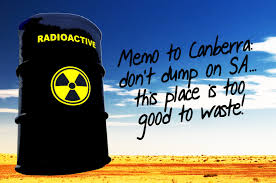
A 400-strong group with a focus on respect for and representation of agriculture to achieve no nuclear waste on SA agricultural land has fought a six-year campaign against Australia’s most powerful political machine, known as the Australian federal government, who are yet to explain why they are in defiance of their own National Health & Medical Research Council guidelines of placing nuclear waste on agricultural land, which is 4.5pc of SA
.
Why, never on their own federal government-controlled land? The federal parliament now has two “temporary sites” for Intermediate Level Nuclear Waste (ILW) , one at the government-owned nuclear reactor site until 2037 and one at Kimba, while never seeking a permanent disposal site for ILW, even though a promise was made to find that permanent site, prior to commissioning the OPAL nuclear reactor almost 15 years ago at Lucas Heights in Sydney. https://www.facebook.com/groups/344452605899556
Napandee nuclear waste site is in fact on farming land, and all too close to the town of Kimba
|
Roni Skipworth No nuclear waste dump anywhere in South Australia , 2 Sept 21,
Not many people know where the nominated site ‘Napandee property’ is. Let me assist with showing you where this property is, there is a purple cross showing this property on a map. The land is not a flat unproductive site as stated in many reports as last time we travelled pass there were many sheep eating its grass https://www.facebook.com/groups/1314655315214929

Scrutiny on possible fraud in the process of the government bribery grants for South Australian communities to accept a nuclear waste dump

Recently information has become available that has indicates a new path of attack against the planned nuclear waste dump in South Australia.
It is is being reported to the Federal Police Fraud Investigation Branch that several individuals made application for a
community grant fraudulently. These individuals participated in a conspiracy with a “resource agency” who
assisted in making application for the grant fraudulently on behalf of an “Aboriginal Corporation” that does not meet the requirements or criteria for the grant.
Grant approval was obtained successfully and was publicly announced. What this proves is that the entire process was rushed and the money grab that divided and separated local communities was able to be manipulated so easily that some unscrupulous people could illegally take advantage.
The federal police will have all the available evidence shortly (there is a lot) and the corporation and persons involved
in the fraudulent funding application will be held to account and prosecuted under federal law. A win for transparency in the local area.
But it will be a bigger win for the overall fight because it would put the entire grant bribery process and purpose under scrutiny. Hopefully it will lead to very publicly broadcasted news stories following the progress of the investigation and prosecution proceedings.
20 reasons why the Lucas Heights unviable production of medical isotopes is a sham and a dud.
The claim by Australian Nuclear Science and Technology Organisation (ANSTO) that it requires additional storage
capacity for intermediate level nuclear or radioactive waste at its Lucas Heights operations is completely false and consequently unjustified in all respects.
REASONS
- The present storage capacity at Lucas Heights is more than adequate for many years and even decades – this is the view of the Australian Radiation Protection and Nuclear Safety Agency (ARPANA) as the regulator and licensing authority
- The main undertaking representing 80% of its total operations and activity by ANSTO at Lucas Heights is the
production of nuclear medicineThe main undertaking representing 80% of its total operations and activity by ANSTO at Lucas Heights is theproduction of nuclear medicine - Only some 10% of this production annually is for local use in Australia
- The remainder is sold overseas but it is a very limited market
- The predominant purchasers of this production of nuclear medicine are third world countries
- These countries cannot afford to pay ANSTO for this nuclear medicine and hence it is treated as additional foreign aid by Australia
- The manufacture of nuclear medicine even in fully and proper commercial circumstances is a large loss making proposition
- It is estimated from authoritative overseas research that revenue from isotope production for nuclear medicine would likely offset only approximately 10% to 15% of the costs of the reactor used for the production and this does not include all the other costs associated with the production
9. Added to this ANSTO is regarded by world standards as an extremely high cost manufacturer of nuclear medicine
- ANSTO is fully funded as to its existence and operations by the federal government
11. On top of this ANSTO has proved to be a less than efficient producer of nuclear medicine due to the instances of shutting down of its reactor at Lucas Heights
- When this has occurred ANSTO purchased the nuclear medicine isotopes from overseas which has proved to be more efficient and cheaper than local production
- It was reported that ANSTO received $238 million last year as its annual funding from the federal government
- ANSTO because of this funding has no incentive or need to achieve profitability particularly in its production of nuclear medicine which represents its major undertaking and operational activity
- In any case there is a strong move in medicine throughout the world away from using nuclear medicine in all diagnosis and treatment due to its harmful nature
- Some countries are virtually banning nuclear medicine both in its manufacture and its use locally and for export because of its inherent dangerous nature
- An alternative permanent disposal would be better.
- The indisputable conclusion internationally is that the use of nuclear medicine generated by reactors is rapidly declining to a level where its future production will no longer be viable
- In view of the foregoing there are no justifiable or valid reasons or pretext for :
(a) the continued production by ANSTO of nuclear medicine by using a nuclear reactor for whatever reasons at Lucas Heights or elsewhere in Australia;
(b) the continuing loss making production of nuclear medicine by ANSTO at Lucas Heights for export overseas;
(c) the need to increase the storage capacity at Lucas Heights for intermediate level waste generated by the production of nuclear medicine; and
20 No pretext for the establishment whatsoever of the nuclear waste management facility by the federal government at Napandee
Inaccuracy on the land area for Napandee nuclear waste dump
After a somewhat shaky attempt by the Editor to recant the very convincing result in the Stock Journal last week, another Stock Journal article has just been released supposedly showing both sides of the argument regarding the proposed nuclear dump. Seems Mr Baldock doesn’t actually know how much land is involved- 158 hectares is NOT the size according to OFFICIAL DOCUMENTS – so what ELSE is being said which is considered being “flexible with the truth” do you think, putting it nicely? Good interview again however by Peter Woolford.
Farmer Jeff Baldock excited at prospect of nuclear waste dump on his land. Other nearby farmers not impressed

Lobbyists get ready to fight site approval, Stock Journal , Vanessa Binks, 28 Aug 2020 AFTER more than six years of deliberation, a regional radioactive waste storage site is less than 60 days away from potential approval and the site’s owner believes the long road has been “worth it”. The site at Napandee, near Kimba, was selected for final approval by federal Resources Minister Keith Pitt earlier this month.Landowner and mixed farmer Jeff Baldock said the approval of the site could save the town, and found the announcement of further consultation “frustrating”. The 158-hectare property is less than 2 per cent of Mr Baldock’s arable farming land [this figure is disputed] and the development is expected to provide a $8.5-million benefit to the community.”There is nothing else to consult about. The proposal has already survived two Senate inquiries and been scrutinised by a Parliamentary Committee and through a court process,” he said.”There has already been multiple rounds of consultation and another one will just cause delays.” Mr Baldock said offering his land to store radioactive waste was “not about money”…….. “Country towns are diminishing and Kimba has an opportunity to invest in its future and keep families or attract more residents,” Mr Baldock said. Site construction could begin by 2024. Lobbyists get ready to fight site approval A DIVISION within the Kimba community about whether or not a local radioactive waste site should be approved has spearheaded a response from the No Radioactive Waste on Agricultural Land in Kimba group to challenge the final approval in a judicial review process. The committee will be meeting in the coming weeks to discuss the next stages after the recently announced further 60-day consultation period has lapsed. Lobby group president Peter Woolford said all options would be examined going forward.”We are another step closer to SA becoming a dumping ground and one step closer to another court case,” he said. Mr Woolford was pleased about the announcement of further consultation and hoped those who disapproved of the site would voice their concerns.”I hope that people outside of the Kimba District Council are allowed to have their say this time – particularly neighbouring councils at Cleve and Wudinna who are also affected,” he said. Mr Woolford also said agriculture’s economic benefit to the region far exceeded the benefit from the development.”About $60 million worth of income is generated from agriculture in the district each year – this development will not even come close to that and it could impact agriculture’s future in the area as well,” he said.”The risk is too unknown. |
Stock Journal poll found that the overwhelming majority wanted more consultation on the government’s plan for Kimba nuclear waste dump
Is more nuclear consultation needed? | POLL
20 Aug 2021,
YES 74.8%
NO no 25.2%
Australia’s nuclear waste is best managed in interim storage at Lucas Heights, with an independent review on permanent disposal.
Australian Conservation Foundation overview comments on ANSTO Iintermediate Level Waste transport, 24 Aug 21,
The movement of long lived intermediate level waste from the reprocessing of spent nuclear fuel via multiple (rail-ship-road) transport platforms and across half the world is a significant logistical exercise with environmental and security risks and the proponent accepts (2.10) that the planned activity is a nuclear action under the EPBC Act.
This is a matter of high public interest and elevated scrutiny is important given that ANSTO is the proponent and not a disinterested party.
ANSTO’s assurances of ‘negligible impact’, a ‘very unlikely’ impact probability and ‘high levels’ of certainty and reliability need to be assessed, not merely accepted.
The proponents commitment to public consultation (1.13) is not consistent with the clear security limitations (1.2) and further places information control with the proponent, without a wider transparency mechanism.
The 2015 shipment of waste saw controversy and allegations of deficiencies in the transport ship (see attachment). ANSTO’s assertion that this will be ‘conducted by an experienced nuclear transport logistics provider’ (1.2) requires further scrutiny and verification. A June 2021 report (see attachment) iby the UK based NFLA (Nuclear Free Local Authorities) found that: The International Maritime Organisation should consider improved regulation on shipping that is transporting nuclear materials as part of other mixed shipments. The level of accidents in this area is alarming, and the NFLA is really concerned a major accident could cause significant and dangerous implications for communities…
ANSTO is not accurate in stating that the proposed action is not part of a staged development or a component of a larger project (1.15). The Australian Radioactive Waste Management Framework (April, 2018) confirms that the Commonwealth is the only jurisdiction in which spent fuel is managed. Clearly this ILW is a key component of the federal government’s current, and contested, National Radioactive Waste Management Project and should be seen in this wider framework.
This is a complex operation with multiple variables and exposure/risk pathways that requires enhanced attention
- ANSTO is the proponent and its assumptions need to be tested
- The 2015 shipment was dogged with controversy around the credibility and adequacy of the transport ship and this area needs further attention
- The planned activity is part of a wider project – the National Radioactive Waste Management Project
- The high level of public interest and concern is best addressed through increased scrutiny and transparency
- If this ILW transfer occurs this material should remain secured at ANSTO until a credible future management approach is agreed
The best environmental outcomes would be facilitated through enhanced assessment consistent with the environmental protection intent of the EPBC Act. ACF strongly supports an open, wholistic and independent review of Australia’s radioactive waste strategy.
ACF maintains that Australia’s ILW is best managed through extended interim storage at ANSTO, coupled with a dedicated options review into future management options. In the absence of a clear future management pathway there is no radiological or public health rationale for moving this ILW from a facility with high institutional control assets to a less resourced regional facility.
1 This month
To see nuclear-related stories in greater depth and intensity
– go to https://nuclearinformation.wordpress.com/


 Antinuclear