Weapons-makers set to gain more influence in defence operations

Global weapons companies could be more deeply integrated into Australian military operations after legislative reforms. This comes on top of public unease about Australia’s independence under AUKUS.
MICHELLE FAHY, APR 14, 2023 https://undueinfluence.substack.com/p/weapons-makers-set-to-gain-more-influence?utm_source=post-email-title&publication_id=297295&post_id=114686170&isFreemail=true&utm_medium=email
Activity in the defence domain has reached peak overload. On top of AUKUS and the submarines, the high-level nuclear waste dump, the Defence Strategic Review, and a slew of multi-billion-dollar arms procurements, the Defence Department is also undertaking consequential reform of the Defence Act 1903 and related legislation. In March, Defence published a consultation paper on the reforms calling for public feedback. The deadline for submissions is Friday 21 April.
Among other things, the reform initiatives foreshadow a more deeply integrated involvement by the globally dominant US arms industry in Australia’s defence and national security establishment, including military operations, especially in the modern ‘warfighting’ domains of cyber and space. This is a profoundly consequential proposition that demands careful consideration.
Notice of the intended reforms was quietly released by the defence portfolio’s junior minister, Matt Thistlethwaite, just days before the Albanese-Biden-Sunak AUKUS extravaganza in San Diego. Saturation media coverage and ongoing analysis of that event has kept the intended reform of Australia’s defence legislation out of the spotlight. This confluence in timing was likely intentional. As a result, much of the limited time granted to the public to consider and prepare submissions has already elapsed.
The public needs to pay attention now because the bipartisan-lockstep nature of defence ‘debate’ in Australia makes it probable that once the legislative amendments hit parliament they will zip through both houses into legislative reality with far less scrutiny than they demand.
The government says legislative reform is necessary to ‘better position the Australian Defence Force (ADF) as an agile, integrated, warfighting enterprise’. The reforms are also intended to create a ‘technology-neutral’ legislative framework.
The consultation paper outlines three key initiatives:
- support the full range of military activities and capabilities required to defend Australia and its national interests
- design the law for seamless interoperability with international allies and partners
- improve the security of Australia’s military capabilities, tangible and intangible.
The terms ‘integrated’, ‘seamless interoperability’, and ‘interchangeability’ appear throughout. The word ‘partner’ is used frequently and is undefined. It is often unclear to which type of entity it refers: foreign governments, foreign militaries, foreign intelligence services, or local or foreign arms industry entities. These distinctions are important, especially in a public consultation document, and the fact that they often aren’t clear creates considerable ambiguity.
Defence poses ten consultation questions for consideration. An important one is hinted at and needs to be made plain: What does the public think about the deeper integration of profit-making multinational weapons companies into Australian military operations across the breadth of operational domains, including cyber and space?
The AUKUS agreement is causing significant public unease about Australia’s ability to act independently of our major allies, and the loss of sovereignty this entails. Two former prime ministers have also expressed publicly their concerns about this. The shape of the proposed legislative reforms, the ambiguities in the consultation paper, and the muted manner of the document’s release add further cause for concern.
Worth adding in this futuristic context is the rapid development and significant funding of lethal autonomous weapons, occurring largely out of public view. (For the uninitiated, lethal autonomous weapons, known colloquially as ‘killer robots’, require no meaningful human involvement in the ‘kill chain’.) As yet, there is no international legal framework regulating their development or use. Such is the future we face.
If the above is not warning enough, we need only reflect on the US government’s outsourcing to defence contractors (and here) of parts of its morally bankrupt drone assassination program which has killed large numbers of civilians, including children, and instilled an abiding fear of clear skies in the populations of multiple countries. Pine Gap, part of the United States’ global surveillance network, has played a facilitative role in these killings.
This surely provides all the evidence we need that more time – and a vastly more transparent and genuine process of engagement – is needed from Defence for the public to consider and respond to its proposed initiatives for reform.
Download Defence’s consultation paper. Lodge your submission by 21 April.
This piece first appeared at John Menadue’s Pearl & Irritations on 14.4.23.
CONTAINING THE BOMB: AN ASSESSMENT OF NUCLEAR WEAPONS FREE ZONES – Australia is especially problematic

Australia poses a unique challenge to the SPNFZ due to its defensive alliance with the United States.
Australia is in a dilemma then of being a party to the SPNFZ and an ally of an NWS poised to potentially assist in a nuclear attack.
The Australia, New Zealand, and the United States Security Treaty (ANZUS) was signed in 1951, joining the three nations in a collective security arrangement.18 New Zealand banned nuclear-powered vessels in 1984 and later created its own nuclear-free zone with the passage of the New Zealand Nuclear Free Zone, Disarmament, and Arms Control Act 1987. In response, the Reagan Administration suspended New Zealand’s obligations under the ANZUS Treaty.19 Australia remains a party.
Center for International Maritime Security, By LtCol Brent Stricker
This article is part of a series that will explore the use and legal issues surrounding military zones employed during peace and war to control the entry, exit, and activities of forces operating in these zones. These works build on the previous Maritime Operational Zones Manual published by the predecessor of the Stockton Center for International Law, the International Law Department, of the U.S. Naval War College. A new Maritime Operational Zones Manual is forthcoming.
Nuclear Weapons Free Zones (NWFZ) are an attempt to prohibit the use or deployment of nuclear weapons within a nation’s territory. None of the signatories to these treaties possess nuclear weapons, where NFWZs stand as a pledge not to develop these weapons. The established nuclear powers of the world have similarly pledged to respect some NFWZs.1 It remains to be seen whether such pledges will be observed or dismissed as a simple “scrap of paper.”2
Background
The legality of the use of nuclear weapons is an unsettled issue. The International Court of Justice issued an advisory opinion stating the threat or use of nuclear weapons must be examined under the United Nations Charter Article 2(4) prohibition on the use of force and Article 51’s right of self-defense.3 The Court could not “conclude definitively whether the threat or use of nuclear weapons would be lawful or unlawful in an extreme circumstance of self-defense in which the very survival of the state was at stake.”4
The Nuclear Non-Proliferation Treaty (NPT) was an early attempt to limit and eventually eliminate nuclear weapons. Article 1 of the NPT prohibits Nuclear Weapons States (NWS) from transferring nuclear weapons to a Non-Nuclear Weapon State (NNWS) or encouraging a NNWS to develop nuclear weapons. Article 6 of the NPT requires states to “pursue negotiations in good faith on effective measures relating to cessation of the nuclear arms race at an early date and to nuclear disarmament, and on a treaty on general and complete disarmament under strict and effective international control.”
Since the signing of NPT, the number of NWS has expanded. Two of the newly acknowledged nuclear powers, India and Pakistan, never signed the treaty. North Korea signed and subsequently withdrew. Finally, Israel, a suspected and unacknowledged nuclear power, never signed the treaty.5……………………………………………………………………..
Current Nuclear Weapons Free Zones
There are currently nine NWFZs in existence. Five of these were created by regional agreements. Three of them were created by international treaty but only occur in unpopulated areas: Outer Space, the Moon, and the seabed. The last NWFZ was created unilaterally by Mongolia. NWFZs cover more than two billion people and 111 countries.13
African NWFZ (ANWFZ)
The Treaty of Pelindaba established the African NWFZ. It was opened for signature on April 11, 1996, and came into effect on July 15, 1990.[14] Article 3 of the treaty renounces nuclear weapons, and the signatories pledge “not to conduct research on, develop, manufacture, stockpile or otherwise acquire, possess or have control over any nuclear explosive device by any means anywhere” and “not to seek or receive any assistance in the research on, development, manufacture, stockpiling or acquisition, or possession of any nuclear explosive device.” Article 4 is a prohibition on stationing nuclear weapons on their territory, but it allows individual nations the ability to allow foreign aircraft and ships to visit or exercise innocent passage without reference to whether such aircraft and ships may be armed with nuclear weapons. This thereby creates a loophole allowing nuclear weapons within the NWFZ…………………………………………….
South Pacific NWFZ (SPNFZ)
The Treaty of Rarotonga established the South Pacific Nuclear Free Zone. It was signed on August 6, 1985, and came into effect on December 11, 1985. All five acknowledged NWS have signed onto its Protocols. Annex 1 to the treaty describes the South Pacific Nuclear Free Zone, which includes both territorial land, waters, and the high seas. Article 3 of the treaty pledges signatories “not to manufacture or otherwise acquire, possess or have control over any nuclear explosive device by any means anywhere inside or outside the South Pacific Nuclear Free Zone” and “not to seek or receive any assistance in the manufacture or acquisition of any nuclear explosive device.” Article 5 prohibits stationing nuclear weapons on the territory of signatory states.
Article 5 also includes a loophole allowing signatory states to allow visits and transit by foreign aircraft and ships that may be armed with nuclear weapons. Article 7 includes a prohibition on dumping radioactive matter within the SPNFZ.”16
A second loophole appears in Article 3(c) of the treaty. There is no prohibition on the research of nuclear weapons. This leaves signatories the option to research nuclear weapons. The most likely being Australia if it needs to rapidly develop such weapons for nuclear deterrence.17
Australia poses a unique challenge to the SPNFZ due to its defensive alliance with the United States. The Australia, New Zealand, and the United States Security Treaty (ANZUS) was signed in 1951, joining the three nations in a collective security arrangement.18 New Zealand banned nuclear-powered vessels in 1984 and later created its own nuclear-free zone with the passage of the New Zealand Nuclear Free Zone, Disarmament, and Arms Control Act 1987. In response, the Reagan Administration suspended New Zealand’s obligations under the ANZUS Treaty.19 Australia remains a party.
Australia has publicly stated in its 2017 Foreign Policy White Paper it would rely on the deterrence power of the United States’ nuclear weapons.20 Australia also hosts US military installations that are vital to worldwide command and control.21 Undoubtedly, these facilities would be part of the Communication, Command, Control, and Intelligence (C3I) the United States would rely on during a nuclear crisis. Australia is in a dilemma then of being a party to the SPNFZ and an ally of an NWS poised to potentially assist in a nuclear attack. The treaty does not address this issue of C3I by a signatory state, with Article 3(c) only prohibiting the manufacture or acquisition of nuclear weapons.22…………………
Southeast Asian NWFZ (SEANWFZ)
The Bangkok Treaty established the Southeast Asian Nuclear Weapon Free Zone. The treaty was signed on December 15, 1995, and went into effect on March 28, 1997. The ten members of the Association of South East Asian Nations (ASEAN) agreed not to “develop, manufacture or otherwise acquire, possess or have control over nuclear weapons; station or transport nuclear weapons by any means; test or use nuclear weapons.”23 The Treaty also prohibited control, stationing, or testing of nuclear weapons in the SEANWFZ.24 The Bangkok Treaty thus closed the visit, transit, research, and control loopholes for vessels and aircraft with nuclear weapons.
Finally, the Bangkok Treaty prohibited dumping or discharging into the atmosphere of radioactive material or waste.25
The SEANWFZ is striking due to the size of the zone defined in the treaty. The zone is expanded to include the continental shelf and exclusive economic zones of the signatory nations.26 The Zone embraces an area of strategic importance to maritime shipping. The treaty would prevent the 5 NWS from transporting nuclear weapons through this zone. This is likely why no NWS has signed onto the treaty’s protocols and provides a negative security assurance to the ASEAN signatories.27
Central Asian NWFZ (CANWFZ)
The Central Asian Nuclear Weapons Free Zone was created by the Treaty of Semipalatinsk. The treaty was signed on September 8, 2006, and went into effect on Mar 21, 2009. The CANWFZ is defined as the land, internal waters, and airspace of the signatories.28 Kazakhstan, Kyrgyzstan, Tajikistan, Turkmenistan, and Uzbekistan, all former Soviet Republics, agreed to prohibit research, development, manufacture, stockpiling, acquisition, possession, or control over any nuclear weapon. The treaty also prohibited the location of such weapons in the zone. ………………………
Kazakhstan, Kyrgyzstan, and Tajikistan have a similar problem to Australia noted above. They are members of the 1992 Tashkent Collective Security Treaty, which includes the Russian Federation, one of the five acknowledged NWS. Article 4 of the treaty requires the Member States to provide all assistance, including military assistance, if one member is attacked.29 It remains to be seen how this will affect the CANWFZ.
Mongolian NWFZ
The Mongolian Nuclear Weapons Free Zone is unique as a unilateral action by domestic law similar to the New Zealand Nuclear Free Zone noted above. Mongolia made this declaration in 1992 and called for a regional NWFZ.30 This seemed improbable as Mongolia is surrounded by the Russian and Chinese NWS. The Mongolian NWFZ was recognized with UN General Assembly Resolution 53/77 D.31
Mongolia’s history makes its NWFZ unique, considering it was caught between the two struggling NWS for most of its existence…………………………………………
Latin American and the Caribbean NWFZ
The Treaty of Tlatelolco created the Latin American NWFZ. It was signed on February 1967 and went into effect on April 25, 1969. Article 1 of the treaty prohibits “the testing, use, manufacture, production or acquisition, by any means, of any nuclear weapon [signatory states] by order of third parties or in any other way,” and “the receipt, storage, installation, location or any form of possession of any nuclear weapon, directly or indirectly, by [signatory states], by mandate to third parties or in any other way.”
The Latin American and Caribbean NWFZ has a similar problem shared by Australia and the CANWFZ due to the mutual defense obligations imposed by the Inter-American Treaty of Reciprocal Assistance. This treaty was signed in 1947 by all of the states in North and South America, including the nuclear-armed United States. While it may be in decline with the withdrawal of member states and attempts to replace this treaty with sub-regional treaties, it remains valid international law.
Antarctica, the Moon, and Seabed NWFZ
It is interesting to note that the first NWFZs were created in places that humans normally do not inhabit: Antarctica, Outer Space, and the deep seabed. Article V of the Antarctic Treaty prohibits nuclear explosions or the dumping of radioactive material on the continent. Article IV of the Outer Space Treaty prohibits the stationing of nuclear weapons or weapons of mass destruction in space or on celestial bodies. This prohibition also prohibits the militarization of celestial bodies. The Outer Space Treaty does not address military activities in orbit, though. Article I of the Seabed Arms Control Treaty prohibits the emplacement of nuclear weapons and other weapons of mass destruction including structures to test, launch, or store such devices on the deep seabed.
It has been speculated that support for these NWFZs by the five acknowledged NWS was to limit the area to deploy nuclear weapons and the increased pressure on the arms race this would impose.36 The strategic value of making Antarctica off-limits for nuclear weapons seems to belie this argument since all NWS, acknowledged or not, are located in the Northern Hemisphere. The future possibilities for weaponizing outer space may render the Space NWFZ irrelevant.
2017 United Nations Nuclear Prohibition Treaty
The Treaty on the Prohibition of Nuclear Weapons could create the largest NWFZ in the world. It was proposed on 23 December 2016 with UN General Assembly Resolution 71/258. It was open for signature on September 20, 2017, and in effect on January 22, 2021.37 The NWS acknowledged and unacknowledged, do not support the treaty.38
Under Article 1 of the treaty: “Each State Party undertakes never under any circumstances to:
(a) Develop, test, produce, manufacture, otherwise acquire, possess or stockpile nuclear weapons or other nuclear explosive devices;
(b) Transfer to any recipient whatsoever nuclear weapons or other nuclear explosive devices or control over such weapons or explosive devices directly or indirectly;
(c) Receive the transfer of or control over nuclear weapons or other nuclear explosive devices directly or indirectly;
(d) Use or threaten to use nuclear weapons or other nuclear explosive devices;
(e) Assist, encourage or induce, in any way, anyone to engage in any activity prohibited to a State Party under this Treaty;
(f) Seek or receive any assistance, in any way, from anyone to engage in any activity prohibited to a State Party under this Treaty;
(g) Allow any stationing, installation, or deployment of any nuclear weapons or other nuclear explosive devices in its territory or at any place under its jurisdiction or control.”
………………………………… more https://cimsec.org/containing-the-bomb-an-assessment-of-nuclear-weapons-free-zones/
Absolutely disingenuous – DARC – the Deep-Space Advanced Radar Capability – Australia to join USA’s plan for Space as a War-fighting Domain
“So, what worries me most is China’s use of space to complete the kill chain necessary to generate long-range precision strikes against the maritime and air components scheme of maneuver. That’s what concerns me the most,” Brig. Gen. Anthony Mastalir, commander of Space Forces Indo-Pacific, said.
By COLIN CLARKon April 07, 2023
SYDNEY — The vast landmass of Australia, possessed of clear skies free of city lights or pollution, is the perfect spot to place the most acute space situational awareness systems. Which is why Brig. Gen. Anthony Mastalir, the head of Space Forces Indo-Pacific says it’s “absolutely critical” to get a new radar system there as quickly as can be.
“When you look at a place like Australia as a landmass, you have a lot of opportunity to contribute to that space picture,” Mastalir told Breaking Defense during an interview during the Sydney Dialogue, put on by the Australian Strategic Policy Institute. “The Australians, the defense Space Command folks and the acquisition arms, they absolutely understand that, so they’re moving aggressively to embrace some of these opportunities and bring systems like DARC — deep space radar capability — here on the continent.”
DARC, officially the Deep-Space Advanced Radar Capability, was designed by Johns Hopkins Applied Physics Laboratory to provide global monitoring of geosynchronous orbits in all kinds of weather and during daylight. According to the APL, it relies heavily on commercial technology. The Space Force received DARC technology from APL last year, with demonstrations taking place at White Sands Missile Range in New Mexico.
Ultimately, the operational DARC program calls for three transmit/receive sites, spaced at mid-latitudes around the world, to detect and track satellites. Northrop Grumman won a $341 million contract from US Space Force’s Space Systems Command last February to begin building the global system, with the first location in Australia targeted for calendar year 2025. That will be followed by one in Europe and a third in the US, with those locations yet to be announced.
FY24 budget justification documents show $174M requested for DARC in the next fiscal year. It further states that “The total cost of the DARC Rapid Prototype Middle Tier of Acquisition (MTA) effort is 844.6M. DARC Site 1 is not fully funded across the Future Years Defense Program.” $40 million is set aside for early work on sites 2 and 3.
“The DARC program will field a resilient ground-based radar providing our nation with significantly enhanced space domain awareness for geostationary orbit,” Pablo Pezzimenti, vice president for integrated national systems at Northrop Grumman said in a statement announcing the first contract award. “While current ground-based systems operate at night and can be impacted by weather conditions, DARC will provide an all-weather, 24/7 capability to monitor the highly dynamic and rapidly evolving geosynchronous orbital environment critical to national and global security.”
Discussions are underway about where to locate the system in Australia once it’s ready. Before anything can be released officially, negotiations must conclude on a treaty level document known as the Technology Safeguards Agreement. Negotiations began in mid-2021. Mastalir declined to discuss the talks, noting they are led by the Department of Commerce.
Russia And China Remain Top Concerns
During the panel Mastalir appeared on at the Sydney Dialogue, the general said that Russia had clearly possessed space superiority at the beginning of the invasion of Ukraine but had lost it. After the panel, Breaking Defense asked him to explain his remarks.
“Russia clearly is a dominant space power, relative to Ukraine. So they entered that conflict in that position,” he said. “Now you see no less than seven or eight different commercial entities, everything from GPS jammer detection, communications to tactical ISR that are bringing products to bear to support the Ukrainians. And has Russia been able to deny the adversary, in this case, Ukraine, from benefiting from space? And the answer, I think, is no — not really.”
His assessment is that the two countries have reached perhaps the most dangerous state for two militaries slugging it out on the battlefield: parity.
“Now parity, parity is dangerous, right? Because when you have parity — and I think this is what we’re kind of seeing play out — you have these prolonged conflicts, and a lot of destruction and death. And that’s not a situation that we ever want to be in as the United States.”
Asked if there are lessons for the United States military and intelligence community in light of what he called “a potential paradigm shift.” the general said it raises many difficult policy and operational questions.
That includes the question of how commercial operators are protected, or not, by the government if they are being used for military operations.
“Number one, who’s going to defend those assets? Is there a responsibility for the United States to protect and defend commercial on-orbit capability that’s assisting the US military?” The related issue is, “to what extent should we integrate commercial across all of our space capabilities?”
Given these complexities, what keeps the general up at night in this region?
So, what worries me most is China’s use of space to complete the kill chain necessary to generate long-range precision strikes against the maritime and air components scheme of maneuver. That’s what concerns me the most,” Mastalir said. “I have to have the ability to deny China in this situation, as a potential adversary, the ability to do that. And so those are the kinds of things that that you know, worry me the most now.”
He stressed that the simple possession of such capabilities “doesn’t mean it’s wrong. But if you look at our efforts to maintain a free and open Indo-Pacific, you quickly run into a situation where our ends, and what we see in terms of behavior coming from China, their ends don’t necessarily align.”
Theresa Hitchens in Washington contributed to this report.
East coast nuclear submarine base decision likely to be made after next federal election
ABC News, By defence correspondent Andrew Greene and Kelly Fuller 3 Apr 23
Senior Labor figures say a decision on where to put a future submarine base on Australia’s east coast is unlikely to be made until after the next federal election, insisting locking in a location is not an immediate government priority.
Key points:
- Labor says a decision on where to put a future east-coast submarine base is unlikely to be made before next election
- Port Kembla appears to be the preferred option, though residents are wary of becoming a military target
- Officials claim they are in no rush and the new base is “not needed” until the 2040’s
Ahead of the formal unveiling of the AUKUS submarine plan in San Diego in March, the ABC revealed Port Kembla in New South Wales has firmed as the Defence Department’s preferred option following months of study examining three shortlisted sites, but the government says an announcement “won’t be rushed”.
Last year former prime minister Scott Morrison announced Port Kembla as one of three potential options for a new naval facility to house Australia’s future nuclear-powered submarines, along with Brisbane and the NSW city of Newcastle.
Revelations that the busy commercial harbour south of Wollongong was the military’s favoured location has been met with mixed reactions from unions and businesses in the Illawarra community………………………………. more https://www.abc.net.au/news/2023-04-04/east-coast-nuclear-submarine-base-decision-after-next-election/102181528
AUKUS Gets Awkward Down Under

A controversy threatens to blow the alliance’s nuclear submarine deal out of the water.
FP, By Maddison Connaughton 24 Mar 23
Even among Australia’s roll call of opinionated former prime ministers, Paul Keating stands out—not least for his unmatched ability to dress down those who oppose him. But few thought he would ever turn this skill on his own political party, the Australian Labor Party, which finally seized government in 2022 after a decade in the wilderness. That was until last week, when Keating publicly condemned the AUKUS defense pact between Australia, the United Kingdom, and the United States and Prime Minister Anthony Albanese for signing it.
That tripartite deal, details of which were announced with fanfare just two days earlier, was “the worst international decision by an Australian Labor government” since conscription was attempted during World War I, Keating said during an appearance at Australia’s National Press Club. The decision to purchase nuclear-powered submarines—at a cost of up to 368 billion Australian dollars ($245 billion)—would invariably draw Australia into any potential conflict between the United States and China, he warned.
No words were minced: “Signing the country up to the foreign proclivities of another country—the United States, with the gormless Brits, in their desperate search for relevance, lunging along behind is not a pretty sight.”
Another former prime minister, Malcolm Turnbull of the Liberal Party, also chimed in with concerns, though he put them slightly more delicately.
…………….Turnbull has questioned whether the use of U.S. submarines—employed as a stopgap until British-designed, Australian-built subs are complete—could compromise Australia’s sovereignty. ……………….
Sam Roggeveen, the director of the international security program at the Sydney-based Lowy Institute, told Foreign Policy that his sovereignty concerns regarding AUKUS stretch beyond personnel. “When you build a weapon system that is almost specifically designed to operate thousands of kilometers to our north, and which is perfectly suited to fighting a military campaign against China,” he said, “then at the final moment when the call comes from the White House—‘Will you take part in this war, or won’t you?’—it will be very difficult, almost impossible, for Australia to say no.”
………… Should this relationship continue to devolve, AUKUS could prove “very dangerous” to Australia, dragging the country into a conflict between the two great powers. Ultimately, more debate was needed about the deal, he said, particularly because Australia will bear all of its cost and risk………………………………………………………….
“Many rank-and-file [Labor] members would and do agree with Keating’s criticism, if not all aspects of his argument,”said Chris Wallace, a political historian and professor at the University of Canberra. And some local branches, the bedrock of the party, have recently been pushing back against the deal.
Similarly, the Nobel Peace Prize-winning International Campaign to Abolish Nuclear Weapons, which was founded in Australia in 2007, warned that AUKUS posed “both a major proliferation risk and could be seen as a precursor to Australia acquiring nuclear weapons.” The organization said the purpose of the submarines was, clearly, “to support the [United States] in a war in northeast Asia. Whether with China, North Korea or Russia, there is an alarming risk of any such war escalating to use of nuclear weapons.”
Recent polling suggests the Australian people may also be coming around to Keating’s point of view. Leading pollster Essential found this month that the public’s belief that AUKUS would make Australia more secure has fallen to just 40 percent, down from 45 percent when the pact was first announced back in 2021. On the question of the nuclear-powered submarines in particular, Essential reported that 55 percent of people surveyed either thought the purchase was unnecessary or too expensive.
…………………………………. “There is no rational basis for the Albanese government facilitating the withering expense of nuclear submarines,” Keating wrote, “other than to suit and comply with the strategic ambitions of the United States—ambitions which slice through Australia’s future in the community of Asia, the basis of our rightful and honourable residency.”
The backlash to the recent announcement, from adversaries and allies alike, Wallace said, should prompt the Albanese government to go back to the drawing board and actually vet whether the deal—including the procurement of submarines powered by weapons-grade uranium—was the best option for Australia. “Instead, the government made the announcement first and expected everyone to back in behind it,” she said. “They were dreaming.”
 |
https://foreignpolicy.com/2023/03/24/aukus-australia-submarine-deal-paul-keating/
|
To sign or not to sign. Australia’s dilemma over the UN Treaty on the Prohibition of Nuclear Weapons
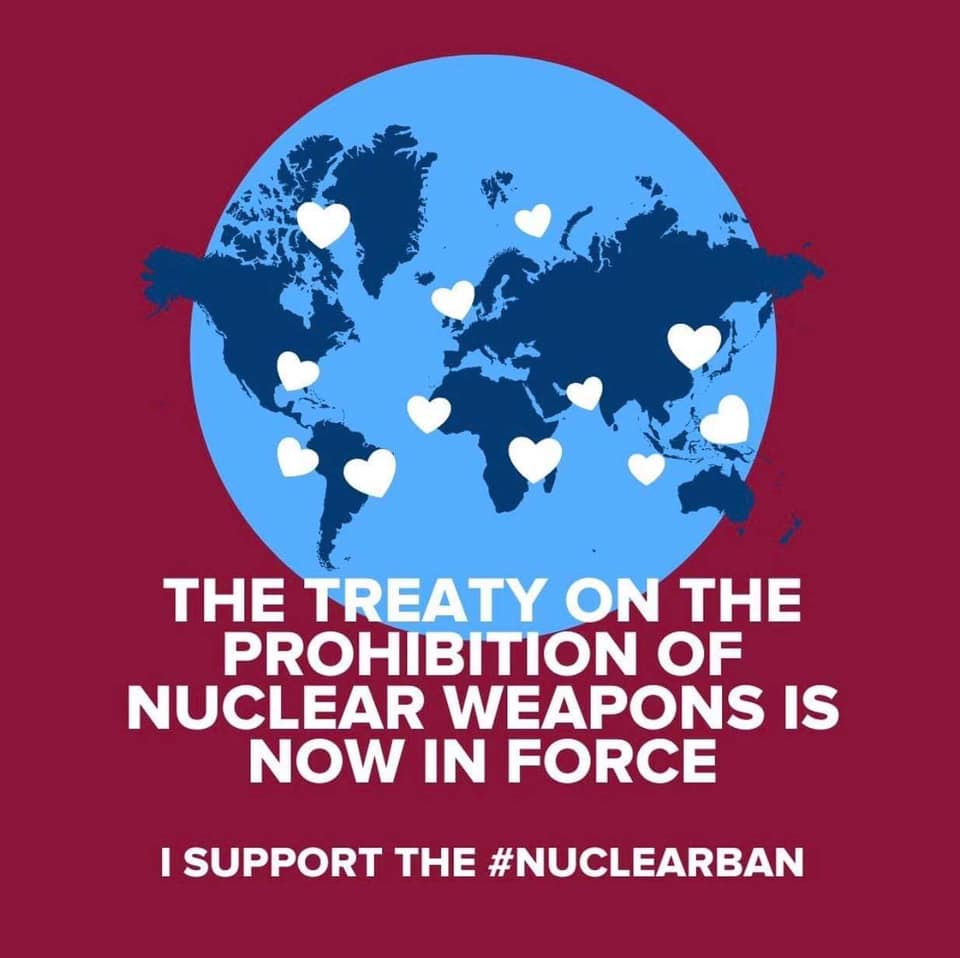
‘Would the US alliance survive?’ Signing nuclear weapons treaty comes with risk
SMH, By Matthew Knott and Paul Sakkal, April 4, 2023
The Albanese government is weighing whether to make a dramatic break with the United States and sign an anti-nuclear weapons treaty that would aggravate Washington and launch a new era in Australian security policy.
Anti-nuclear campaigners are urging the government to join over 90 countries and sign the Treaty on the Prohibition of Nuclear Weapons (TPNW) before the next election, a step that would see Australia abandon a key pillar of the US alliance by removing itself from America’s “nuclear umbrella” in the Asia-Pacific.
Labor’s national platform commits the party to signing and ratifying the treaty – which prohibits member states from participating in any nuclear weapon activities – but only after certain conditions are met.
Prime Minister Anthony Albanese has been a strong supporter of signing the treaty, describing the idea as “Labor at our best”.
The US strongly opposes the treaty and has previously urged friendly nations not to support it, on the grounds it would undermine peace and security.
……………………… A spokeswoman for Foreign Minister Penny Wong said the government will consider the treaty “systematically and methodically as a part of our ambitious agenda to advance nuclear non-proliferation and disarmament”.
“There are a number of complex issues to be considered,” she said.
…………………………………….. Gem Romuld, Australian director of the International Campaign to Abolish Nuclear Weapons, said “if the government is committed to non-proliferation and disarmament, it will sign the TPNW during this term of government”.
“That would be warmly welcomed by countries across the Asia-Pacific, most of which have already signed the treaty, as well as most of the Australian public,” she said.
Romuld acknowledged ratifying the treaty would represent a “big change for Australia, ending a practice we have had in our security policy for a couple of decades” by prohibiting Australia from hosting American assets armed with nuclear weapons, such as B-52 bombers.
………….. Romuld said the AUKUS pact – under which Australia will acquire a fleet of nuclear-powered submarines – does not prevent the government from signing the treaty. “In fact it only underlines the importance of it,” she said.
………………….
Labor MP Josh Wilson, the chair of the joint standing committee on treaties, said the TPNW represented a “much-needed jolt of momentum in the global nuclear disarmament effort”.
“In my view Australia should aspire to sign and ratify, while in the meantime being engaged, supportive, and open to incremental progress,” he said…………… https://www.smh.com.au/politics/federal/would-the-us-alliance-survive-signing-nuclear-weapons-treaty-comes-with-risk-20230403-p5cxo3.html
Australian Labor prepares return to disastrous Forward Defence doctrine

Pearls and Irritations, By Brian Toohey, Mar 31, 2023
Nearly everything the Labor government says about nuclear subs is ludicrous and highly damaging.
Despite Defence Minister Marles apparently saying Australia will not participate in a war over Taiwan, Hugh White (ex- Dep Head Defence) says the US would never sell nuclear submarines to Australia without guarantees they will always be used in a US war. The reason is that these subs are taken from off its own line of battle. They are not additional submarines from the production line. Once again, Australian sovereignty does not exist in the sense of being able to use US weapons how we want to do after buying them.
Marles now says the nuclear subs are not for war, but to protect Australian merchant shipping. A leading economist Percy Allan points out there are 26,000 cargo ship movements to and from Australia each year. Nuclear subs have terrible maintenance problems and if we buy the expected three second hand Virginia Class attack subs from America, only one might be operationally available at any time and probably none.
One sub, let alone none, can’t protect 26,000 cargo shipping movements, but mainstream journalists swallow this nonsense.
Before his sudden conversion to pacifism, Marles wanted to deploy the nuclear subs off the Chinese coast to fire long-range cruise missiles into the mainland. This represents a return to the Forward Defence doctrine that failed in Singapore in 1942, and later in Vietnam. Arthur Calwell gave a magnificent anti-war speech in 1965. He was fully vindicated when the Vietnamese won a war against a horrendously destructive invasion that was a war crime. Now, Albanese effectively supports war.
With Labor now returning to the disastrous Forward Defence doctrine, it’s worth remembering the Coalition defence minister in 1969 Allen Fairhall scrapped this doctrine and cut military spending by 5%, while there were still 7,000 Australian troops in Vietnam. The Coalition then switched to the direct defence of Australia. Whitlam, Fraser, Hawke and Keating all embraced the defence of Australia, not forward defence. Keating also adopted a long sighted policy of seeking our security in Asia, not from it.
Later, in the 2003 invasion of Iraq, Howard reverted to do America’s bidding in another war crime of aggression.
Australia’s best defence is it’s surrounded by water and a long way from China or India. There is no evidence either is a threat. If this changes for the worse, the Defence of Australia doctrine will come into its own.
Marles and Albanese will recklessly position nuclear subs off China. But that’s where China’s forces are concentrated. Because Marles and Albanese would be playing to China’s strengths, they would then be responsible for a disastrous military blunder when the subs are sunk.
It would be much better to play to our strengths, by defending the approaches to Australia by buying highly advanced, medium sized, submarines that are superior to nuclear subs.

Marles estimates his subs will cost up to $368 billion (realistically over $400b). As explained later, that includes the crazy decision to pay the UK to co-design 8 new submarines for Australia. This dwarfs the next highest defence acquisition —$17 billion for F-35 fighter jets.
The US Government Accountability Office and the Congressional Research Service have an outstanding record for exposing appalling waste and incompetence in US submarine shipyards. One Virginia sub was tied up at a jetty for five years before it could be fixed. The US has a military budget of $US880, yet Albanese is donating $3 billion to help improve the shipyards.
Marles did not take the responsible ministerial step and commission a cost-effectiveness study of the options before splurging $400 billion. Australia could get ten superior conventional submarines for a total $10-$15 billion from Japan, South Korea or Germany that could deter any hostile ships approaching Australia from a couple of thousand kilometres away. Submerged drones and mines could also help at a low cost.
Japan’s new Taigei subs use highly advanced batteries that run silently for several weeks without needing to surface to charge the batteries. South Korean and German submarines are about to get much improved batteries. These new subs can run silently on hydrogen fuel cells as well as batteries.
Nuclear subs are easier to detect. When they go at high-speed, they make a detectable wake. Being much bigger, they have a stronger magnetic impression than suitable conventional boats.
Like other subs, nuclear ones have to come to the surface to stick up periscopes and radar and electronic warfare equipment. They produce an easily detected infrared signal due to the reactor constantly boiling water for steam engines to propel the subs. (Nuclear power does not propel the sub. Puffing Billy does.)
Another huge problem with nuclear subs is the government has rightly said it will take all the highly enriched uranium waste at end of the sub’s life, then safely store it. This requires the waste to be vitrified overseas and returned in thick drums for burying deep in stable dry underground rock formations for hundreds of years and heavily guarded. Each reactor weighs 100 tons and contains 200 kg of highly radioactive uranium. When used in nuclear power stations, uranium is enriched to about 5%, the same as for French and Chinese nuclear submarines and 20% for Russian. It’s 93% for ours, greatly exacerbating the disposal problem.
I recently asked Australia’s principal nuclear safety organisation, the Australian Radiation Protection and Nuclear Safety Agency about how such waste could be safely stored. It refused to answer. Perhaps it was intimidated by Defence.
Marles exacerbated the problem by saying the waste uranium would be stored “on” defence land. It can’t be stored safely on top of the land. It must be stored deep underground. He’s not dealing with low-grade hospital nuclear waste.
Neither the US or the UK has a high-level underground nuclear waste repository. They could easily pressure Australia into securing their waste from their nuclear subs reactors here.
It seems likely the burial site will be on land in central Australia that is important to Australia’s indigenous population. Whatever happens, it is essential there is no repeat of the way the indigenous people were wilfully exposed to radiation during and after the British nuclear tests in the 1950s and 60s in Australia’s south and central desert areas…………………………………………………………….. more https://johnmenadue.com/labor-prepares-return-to-disastrous-forward-defence-doctrine/
AUKUS, the Australian Labor Party, and Growing Dissent
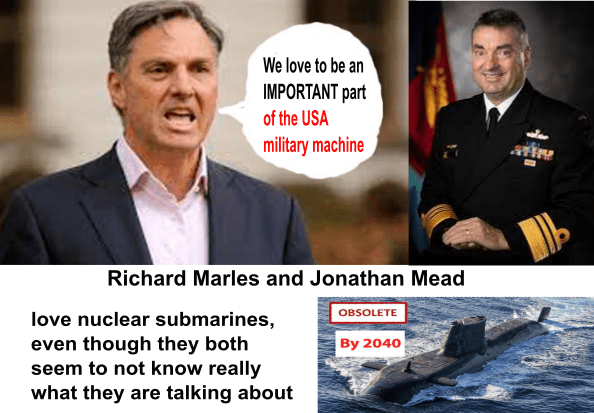
the Royal Australian Navy would be far better off acquiring between 40 to 50 of the Collins Class submarines to police the coastline rather than having nuclear powered submarines lying in wait off the Chinese shoreline.
March 25, 2023, by: Dr Binoy Kampmark https://theaimn.com/aukus-the-australian-labor-party-and-growing-dissent/
It was a sight to behold and took the wind out of the bellicose sails of the AUKUS cheer squad. Here, at the National Press Club in the Australian capital, was a Labor luminary, former Prime Minister of Australia and statesman, keen to weigh in with characteristic sharpness and dripping venom. Paul Keating’s target: the militaristic lunacy that has characterised Australia’s participation in the US-led security pact that promises hellish returns and pangs of insecurity.
In his March 15 address to a Canberra press gallery bewitched by the magic of nuclear-propelled submarines and the China bogeyman, Keating was unsparing about those “seriously unwise ministers in government” – notably Foreign Minister Penny Wong and Defence Minister Richard Marles, unimpressed by their foolish, uncritical embrace of the US war machine. “The Albanese Government’s complicity in joining with Britain and the United States in a tripartite build of a nuclear submarine for Australia under the AUKUS arrangements represents the worst international decision by an Australian Labor government since the former Labor leader, Billy Hughes, sought to introduce conscription to augment Australian forces in World War One.”
In terms of history, this was chilling to Keating. The AUKUS security pact represented a longing gaze back at the Mother Country, Britain, “shunning security in Asia for security in and within the Anglosphere.” It also meant a locking alliance with the United States for the next half-century as a subordinate in a containment strategy of Beijing. This was a bi-partisan approach to foreign policy that saw the US dominating East Asia as “the primary strategic power” rather than a balancing one.
For Keating, the impetus for such madness came from a defence establishment that dazzled the previous Prime Minister, Scott Morrison. That effort, he argues, was spearheaded by the likes of the US-funded Australian Strategic Policy Institute and Andrew Shearer of the Office of National Intelligence. They even, he argues, managed to convince PM Albanese, Marles and Wong to abandon the 20-month review period on the scope of what they were seeking.
The steamrolling Keating was also unsparing in attacking a number of journalists for their ditzy, adolescent belligerence. The sword, once produced, was never sheathed. Peter Hartcher, most notably, received a generous pasting as a war infatuated lunatic whose anti-China campaign at the Fairfax presses had been allowed for years.
In terms of the submarines themselves, Keating also expressed the view that the Royal Australian Navy would be far better off acquiring between 40 to 50 of the Collins Class submarines to police the coastline rather than having nuclear powered submarines lying in wait off the Chinese shoreline.
As we all should know, submarine policy is where imagination goes to expire, often in frightful, costly ways. For all Keating’s admiration for the Collins Class, it was a nightmarish project marred by fiascos, poor planning and organisational dysfunction within the defence establishment. At stages, two-thirds of the Australian fleet of six submarines was unable to operate at full capacity. The lesson here is that submarines and the Australian naval complex simply do not mix.
The reaction from the Establishment was one of predictable dismissal, denial and distortion, typical of what Gore Vidal would have called deranged machismo. Instead of being critical of the powers that are, they have turned their guns and wallets on spectres, ghosts and devilish images. The tragedy looms, and it will be, like many tragedies, the result of colossal, unforgivable stupidity.
At the very least, the intervention by Keating, notably in the Labor Party, has not gone unnoticed. Within the Labor caucus, tremors of dissatisfaction are being recorded, breaches growing. West Australian Labor backbencher Josh Wilson defied his own party’s dictates by telling colleagues in the House of Representatives how he was “not yet convinced that we can adequately deal with the non-proliferation risks involved in what is a novel arrangement, by which a non-nuclear weapons state under the NPT (Non-proliferation of Nuclear Weapons Treaty) comes to acquire weapons-grade material.”
Wilson’s views are not outlandish to the man. He is keen to challenge the notion of unaccountable executive war powers, a problem that looms large in the Westminster system. “To assume that such decision-making is already perfect, immutable, and beyond scrutiny,” he wrote in December last year, “puts Australia at risk of making the most dangerous judgments without the best institutional framework for doing so.”
A gaggle of former senior Labor ministers have also emerged, even if they initially proved sluggish. Peter Garrett, former environment minister and front man of Midnight Oil, while proving a bit squeamish about Keating’s invective, found himself in general agreement. “The deal stinks with massive cost, loss of independence, weaking nuke safeguards & more.”
Kim Carr, who had previously held ministerial positions in industry and defence materiel, revealed that the matter of AUKUS had never been formally approved in the Federal Labor caucus, merely noted. Various “key” Labor figures – again Marles and Wong – agreed to endorse the proposition put forth to them on September 15, 2021 by the then Coalition government.
He also expressed deep concern “about a revival of a forward defence policy, given our performance in Vietnam.” For Carr, the shadow cast by the Iraq War was long. “Given it’s 20 years since Iraq, you can hardly say our security agencies should not be questioned when they provide their assessments.”
For former foreign minister, Gareth Evans, there were three questions: whether the submarines are actually fit for purpose; whether Australia retained genuine sovereignty over them in their use; and, were that not the case, “whether that loss of agency is a price worth paying for the US security insurance we think we might be buying.”
Will these voices make a difference? They just might – but if so, Australia will have to thank that political pugilist and Labor veteran who, for all his faults, spoke in terms that will be considered, in a matter of years, treasonous by the Empire and its sycophants.
AUKUS – “These are the horrors”
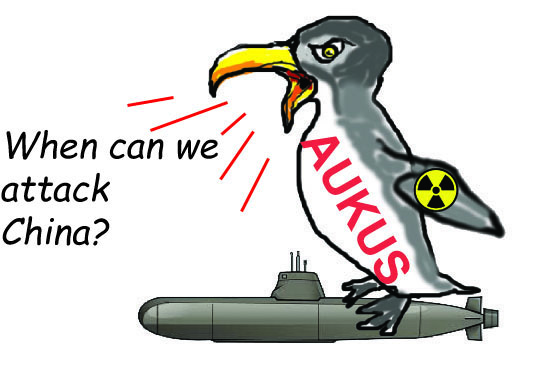
Instead of humiliatingly accepting the smirking American ‘we neither confirm nor deny the presence of nuclear weapons visiting your country’, the Albanese government could reassert a little of our lost sovereignty by stating up front, no nuclear weapons never.
The AUKUS submarines will not be here to defend Australia, but only to attack China in a subordinate role with the American forces.
Pearls and Irritations, By Richard Tanter, Mar 24, 2023
AUKUS. This is a horror for which I now fear for the lives of my children and their children. Every time a Labor member of parliament or senator puts foot outside their office to appear in public, turns up at a public meeting, we need to ask them: why have you betrayed us? Why have you allowed this to happen? What are you going to do?
Transcript of a speech at the Anti-AUKUS Rally, Naarm, State Library of Victoria lawn, 18 March 2023.
These are horrors.
This is a horror for which I now fear for the lives of my children and their children.
This is now changing the direction of Australia for the next forty or fifty years.
We have never seen anything like this in peacetime Australia. At any stage.
This must not stand.
But it’s with the suite of profound horrors that we must start with.
The horrors of AUKUS
Firstly, the automatic involvement in war.
We have already been tied to the United States by the bases – by Pine Gap, by North West Cape, by the Space Surveillance Telescope that take us into space warfare, by the many other Australian bases to which the US has access.
We are already tied in, hard-wired in many cases, to the American war machine.
And the ADF is barely an autonomous force today.
But AUKUS takes us very much further down that road.
We already know what the submarines are there for.
In a rational world I actually think submarines are very important for the defence of Australia – but not in the form of this politically-driven, call-from-Washington-inspired scheme for long-range, long-endurance nuclear-powered submarines whose only rational use is to attack China.
Not on their own – Keating’s right about that calling them toothpicks thrown at a mountain – but in concert with American submarines and carrier task forces.
Maybe not immediately nuclear-armed, but almost certainly capable of nuclear-attack as well.
The AUKUS submarines will not be here to defend Australia, but only to attack China in a subordinate role with the American forces.
The horror of that fiscal black hole.
What does that $368 billion actually amount to? As if we have any idea of what the value of a dollar will be in forty years time – the lifetime cost of AUKUS will be an order of magnitude higher, certainly two or even four trillion dollars.
But what that means in terms of the sacrifice from what’s needed from government for decent health and survival for the Australian people is itself horrific.
This moves us towards what I think is an almost irrevocable position of enmity as far as the Chinese are concerned.
Principally because the only rational strategic role for those submarines is to contribute, potentially, to an American existential threat to China.
Even if we stop tomorrow, is China going to forget that?
Why should they?
We’ve revealed our hand.
We have a Minister for Defence who is effectively the minister for Washington, and this is where we have come to.

The horror of the sacrifice zone that the high-level nuclear waste storage site that is to be somewhere built in Australia.
I have to say that of all things that have shocked me about this scheme, this is one that has shocked me most.
Not just because I made the mistake of thinking that Albanese might be halfway reasonable because in my role as a former president of ICAN I had relations with those people, and he pledged he would support a nuclear ban treaty.
Well, that’s not happening now unless we make it happen.
But the announcement of a nuclear waste dump for high-level toxic nuclear waste, radioactive for thousands of years, is another world all together.
I had foolishly thought that they would follow their own mantra for the past year of saying that ‘this will be a sealed reactor full of highly enriched uranium, and to prevent diversion to nuclear weapons, the US will deliver it sealed, and when the fuel is exhausted it will return to the United States sealed for disposal, somewhere safe, where no-one else can get at it …’
More fool me. More fool me.
They betrayed us again, and that nuclear sacrifice zone of high level waste is going to be a huge problem – and struggle – for decades and decades.
What really troubles me as someone who works on strategic issues and thinks that defence issues are real and important, is that this the largest defence expenditure – if we can use the word ‘defence’ with a straight face in this context – this massive defence expenditure actually disables our genuinely necessary defence capabilities.
There will be very little money left over for anything else in defence.
Worst of all, it disables the possibility of what we have come here today to call for – an independent defence and foreign policy – because there will be nothing left.
I heard one of those defence experts quoted in that authoritative source, Nine Entertainment’s Red Alert on the front pages of The Age – the same report that said yes, we have allies, we have Diego Garcia – all 27 square kilometres of it grabbed by the Brits and rented by the Americans, and we have Guam – the tiny American colony almost wholly taken up by US military bases – it would be funny if it wasn’t so awful and so telling about the government’s grasp of the actual facts – I saw that one of those experts said ‘we have to accept that if there is a war with China ‘that means Pine Gap goes’.
Actually I think that’s quite true, under certain circumstances. But the blitheness, the casualness with which that is said tells us a lot about how these people think.
Because if ‘Pine Gap goes’ in a nuclear missile attack, then Alice Springs and most of its 25,000 citizens ‘go’ too. No need to think about that, is there?
Just the casualness with which this is proposed and debated, apart from the ignorance, is stunning and revealing.
And the last part of the horror for me is the nuclear permissiveness which is now beginning to swell in discussions in Canberra security circles.
The momentum that is going to be built out of this first step of nuclear-powered submarine will mean we’re already going to have naval training for this; we’re going to have expanded nuclear engineering programs at places like the ANU.
We’re going to have military and naval careers built around this.
We’re going to have an industry here which has a deep interest in going the next step from naval nuclear propulsion to a civilian nuclear power industry.
We also know, because this is preceded by the US B-52 bombers at RAAF Tindal near Katherine in the Northern Territory – not nuclear-armed bombers at present, but quite definitely possibly nuclear-armed in the future at the stroke of a presidential pen –that those bombers will be used as part of an attack on China.
And what’s really important to understand now is that the South pacific Nuclear Weapon Free Zone, which Australia signed and says it’s proud of, has a loophole in it sponsored by the Australians to meet US needs, which says there are to be no nuclear weapons in the territories of the member states, like Australia, except in the case of ‘transits’ or ‘visits’.
Transits and visit in these days of American rotational deployments can cover an awful lot of interpretations.
The Albanese government could do one very simple thing to address this fear: it could declare that under no circumstances will any nuclear weapons from any country be allowed into Australia.
Not for a visit, not of layover in transit, just never.
No nuclear-armed aircraft, warships or submarines will ever be allowed to enter Australia.
The USS Asheville nuclear-powered attack submarine in Perth at the moment at Stirling Naval Base, and its successors, will never be allowed to return without a verifiable declaration that they come without nuclear weapons.
Instead of humiliatingly accepting the smirking American ‘we neither confirm nor deny the presence of nuclear weapons visiting your country’, the Albanese government could reassert a little of our lost sovereignty by stating up front, no nuclear weapons never.
The strategy of AUKUS
The strategic part of what’s happening at the American bases in Australia (aka ‘joint facilities’) is part of all this.
You know what is happening at Pine Gap, the giant American-built and American-paid for joint surveillance station outside Alice Springs.
You know about the wonderfully-named Harold E. Holt Naval Communications Station on the tip of North West Cape in Western Australia – a critical submarine communications base for American nuclear submarines and in the future for these AUKUS submarines. It’s immensely important, and probably another priority target, most likely nuclear under certain circumstances.
But just down the road the US has built a giant and highly advanced space telescope.
That doesn’t sound very much, does it.
But what it’s there for is our contribution to American plans for space warfare, to ensure what the US calls ‘space dominance’. And you understand perfectly well how critical space is for all militaries – and indeed our whole society – today.
We are deeply and increasingly plugged into that activity.
All governments have talked for the last thirty years about ‘the joint facilities’ – we don’t have any American bases, of which Australia has full knowledge and concurrence of any activities conducted at these bases.
When you peel that back, and when you talk to ministers – I can tell you I am continually shocked by their ignorance, as well as their deceptions………………………………………………………………………………………………………….. more https://johnmenadue.com/these-are-the-horrors-of-aukus/
Richard Marles’ ill-advised spending on completely inappropriate Tomahawk missiles for Australia’s existing submarines
Marles the drunken sailor: Rex Patrick on Defence Minister’s haste to defence spending waste
by Rex Patrick | Mar 22, 2023
News yesterday that our Collins Class submarines will get fitted with Tomahawks reveals a serious lack of understanding about the tactical use of land attack missiles on submarines. Exposing the blithe war enthusiasts of the Murdoch press, former submariner Rex Patrick explains why Tomahawks on a Collins is a dumb idea.
Richard Marles is behaving like a drunken sailor as he spends your money. Drunken sailors, most of whom are happy souls, buy things like several rounds for everyone in the bar, pink Hawaiian t-shirts for themselves and their families, or tattoos of the name of the girl they met the night before. Upon sobering up they realise that what they had purchased was a hole in their wallets.
And that’s what Mr Marles will discover in time. The Tomahawk missiles he’s purportedly buying for our Collins Class submarines, as reported in The Australian yesterday, are not a good match.
Let me explain why.
Submarines and Tomahawk Missiles
Just after noon on 19 January 1991, during operation “Desert Storm”, USS Louisville became the first submarine to launch a land attack missile in anger, when she fired eight missiles at targets in Iraq. She did this operating from the Red Sea. Shortly afterwards, USS Pittsburgh became the second submarine to launch Tomahawks when she fired four more missiles from the Mediterranean Sea.
Submarines have subsequently fired land attack missiles in a number of other operations.
USS Miami fired some into Iraq In 1998 at the start of “Desert Fox” (the 4 day bombing operation undertaken in response to Iraq’s failure to comply with UN Security Council resolutions). USS Albuquerque, USS Miami and HMS Splendid fired some into Kosovo a year later as part of “Allied Force” during the Balkan war. HMS Trafalgar and HMSTriumph fired them into Afghanistan. In 2001 as part of operation “Enduring Freedom,” and in 2003, 12 US Navy submarines and the Royal Navy submarines HMS Splendid and HMS Turbulent attacked land targets in Iraq as part of “Iraqi Freedom”.
Finally, in March 2011 guided missile submarines USS Florida, and nuclear attack submarines USS Providence, USS Scranton and HMS Triumph fired some into Libya as part of operation “Odyssey Dawn”.
The role of land attack from submarines is clearly established.
Why land-strikes from submarines?
A submarine’s endurance, autonomy and relative impunity to detection allow pre-strike positioning to occur several weeks or months prior to the commencement of hostilities. This can occur without the “presence” of a force that might otherwise negatively influence diplomatic efforts to resolve an issue. The submarine can also conduct intelligence, surveillance and reconnaissance until such time as the land strike capability is needed. The submarine can be discreetly withdrawn if offensive action is not required.
The submarine also allows a land strike capability to be deployed into an area of operation where there is a lack of sea or air control, with the aim of attacking enemy defences to make the area safer for other more vulnerable units to enter. This includes ships with larger missile magazines and aircraft who can return the next day to launch more missiles.
Finally, when the strike order is given, having an undetected submarine very close to shore provides an advantage when striking the most sensitive of military targets or executing the most time critical attacks. Launch surprise maximises targeting effectiveness and minimises the chance of the weapons being intercepted. Close-to-shore submarines can also reach targets that are further inland.
Collins submarines’ limitations
Almost all submarines fitted with Tomahawks have nuclear propulsion, The Spanish S-80 submarines are the exception.
That’s because conventional submarines have their limitations………………………………………………………………………………………
Defence of Australia or like a tattoo?
There’s hardly a case to argue that our Collins class submarine’s need land attack cruise missiles to help defend Australia.
They would only be acquired to assist in a conflict with China, where we’re acting as part of a coalition. But even then, the issues associated with conventional submarines armed with Tomahawks are highly challenging and make the choice highly questionable.
So is Richard Marles behaving like a drunken sailor? Yes. But with some difference. Mr Marles seems loose with the money, but can’t really bring himself to look back on his commitment to spend.
The cost and unnecessary suffering of military spending
By Brian Toohey, Mar 14, 2023, https://johnmenadue.com/briantoohey-on-cost-of-defence/
The authoritative Peterson Foundation calculates that last year the US spent more on its military than the next nine countries together. This means more than China, India, Russia, the UK, Saudi Arabia, Germany, France, Japan and South Korea combined. In 2023, the US allocated $US 858 billion to military spending compared to China’s $US224 billion. China’s spending is 1.7% of GDP compared to 2% for Australia and 3.5% for the US.
Military spending accounts for nearly half the discretionary spending in the US budget. The President could redirect over two thirds to deprived areas of the budget and still have the most powerful military forces in the world. Until something like this happens, many Americans will suffer unnecessarily and the country experience continuing internal turmoil. The US has been in far more wars that China.
The Costs of War project at Brown University revealed in 2021 that the US was involved in eight wars in the previous 20 years, costing it an estimated $8 trillion and killing more than 900,000 people. Earlier, Australia joined the US in losing a war of aggression in Vietnam that cost lives of 3 million people.
China has not been in a serious conflict since 1979 when it made a brutal incursion into Vietnam before withdrawing. The US and Australia didn’t object strongly because they supported China’s intention to punish Vietnam for overthrowing Pol Pot’s appalling regime in Cambodia.
Unlike the US and Australia, China has not been involved in a war of aggression since the Communist party came to power in 1949, except for of its takeover of Tibet in 1950. Tibet had been under the control of Chinese emperors from 1720 until the early 1900s. The anti-Communist Republic of China then claimed Tibet was part of China, without trying to enforce this. Otherwise, China has not tried to take over any country.
If China were an expansionist power, it would have already taken over bordering Mongolia, a defenceless, democratic state with abundant mineral deposits. Nor would it have made several important concessions to settle land border disputes.
China announced recently that its defence spending will increase by 7.2% in 2023 compared to 7.1 % in the previous year. This minor increase hardly suggests China is building up to attack Taiwan, let alone go to war with Australia which is committed to spending billions more on its military, supposedly to deter China. Contrary to the situation in the US, numerous underwater choke points bottle up China’s naval forces close to its shores.
However, China’s spending is now widely asserted to show it is about to engage in a campaign of aggressive expansion. Instead, it is reacting to the fact that it is surrounded by US military bases and those of its allies, as well being beset by constant military patrols along its borders. US has more than 700 overseas military bases, including many on Pacific Islands countries and on others such as Japan, South Korea, Australia, and the Philippines. China doesn’t have the capability to patrol off the American coastline which is over 15,000 km away as the crow flies. Nor does it have any bases close enough to operate from. China’s sole overseas base is at Djibouti on the Horn of Africa.
A recent three-part series in the Sydney Morning Herald and The Age claimed China would attack Australia within the next three years, well before any nuclear submarines are delivered well over $200 billion. The series said the government would have to reintroduce compulsory conscription and invite the US to base nuclear armed missiles on Australian territory. Anthony Albanese has not rejected these proposals.
The series made the bizarre claim that “recent decades of tranquillity were not the norm in human affairs, but an aberration.” The reality is that tranquillity did not exist for Australian military forces in Iraq and Afghanistan, nor for civilians caught up in these events.
As a result of US-led sanctions before the invasion of Iraq, UN agencies calculated that 500,000 Iraqi children had starved to death. When the then US ambassador to the UN, Madeleine Albright was asked on America’s 60 Minutes program if she thought that the death of half a million Iraqi children was a price worth paying, she said: “This is a very hard choice, but we think the price is worth it.” Most seem to have forgotten that governments killed these children.
In Australia, most also seem to have forgotten that the 2003 invasion of Iraq was based on shonky intelligence, easily exposed as such. Perversely, many Australia journalists, who now rely on anonymous intelligence reports, take it for granted the intelligence is accurate.
They also swallow propaganda claiming that China is “aggressive” and a “threat” to Australia and that Taiwan is independent country, which China now claims. Taiwan is not formally independent. Almost every country on earth, including Australia and the US recognise it as part of China. After the losing the Civil War, the leader of the Kuomintang (KMT) party Chiang Kai-shek, fled to Taiwan, where he not only claimed Taiwan was part of China, but insisted that it ruled the whole of China from its capital Taipei. To its great credit, Taiwan became a healthy democracy in 1996, but its Constitution still states it is part of China.
When he was China’s leader in Beijing in 1947, Chiang Kai-shek announced that country would control its territorial waters within a U-shaped “Eleven dash line”. The subsequent Communist government adopted a “Nine dash line”, while Taiwan has retained eleven. Given it already has de facto independence, the pragmatic position in Taiwan now seems to be that it’s not worth rocking the boat by declaring formal independence.
Australian military looks to build crucial space capabilities that will support Aukus nuclear subs

Don’t the military boys love these games? war in space and undersea.
Defence department puts out call for satellites that can talk to each other and to the ground, are ‘scalable, rapidly deployable and reconstitutable’
Tory Shepherd, Thu 23 Mar 2023
Defence is looking for a mesh of military space satellites that can talk to each other as well as to the ground, and is “scalable, rapidly deployable and reconstitutable”.
The system, in other words, would need to be able to be made bigger, to be quickly put into action and to be repaired in case of attack or accident.
The military network could include the ability to track high-velocity projectiles and the use of infrared, would need to be “resilient to cyber and electronic warfare attacks”, and would need to transmit and receive data from assets “at any global position”…………………..
The Aukus submarines have been dominating defence-related conversations recently, because of the enormous $368bn price tag and concerns that the first Australia-made nuclear submarine will not be ready until the 2040s.
Meanwhile, Guardian Australia has spoken to people in the space industry who feel the other parts of Aukus – the so-called “pillar two” – are being overlooked. Pillar two includes artificial intelligence, drones, cyber capabilities and other technologies, all of which use space-based assets and many of which are likely to be realities years before the submarines.
Satellites, and therefore space, are critical for surveillance, navigation, weapons guidance and communication already, and will become more so in the future.
Defence projects already under way include Def799 for space-based intelligence, surveillance and reconnaissance capabilities, and JP9102 for satellite communications systems.
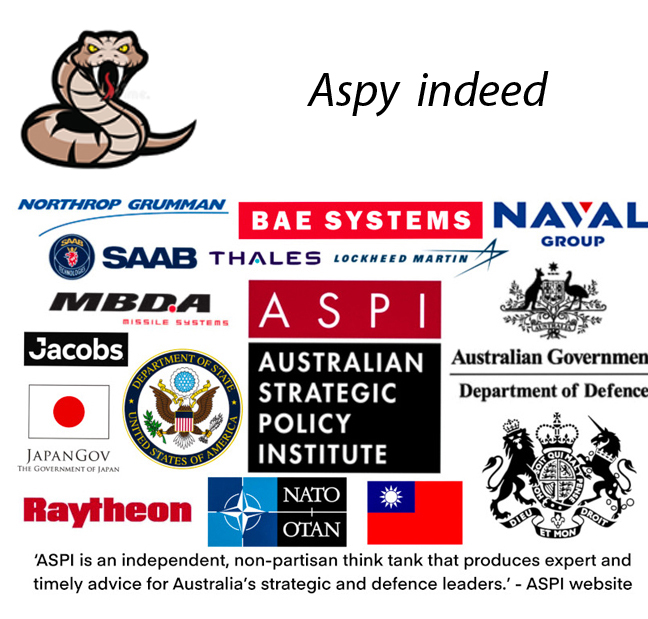
A senior defence strategy and capability analyst at the Australian Strategic Policy Institute, Malcolm Davis, said while space was critical for Aukus’s pillar two, it would also be crucial for pillar one, in terms of communicating with submarines…………………………. https://www.theguardian.com/australia-news/2023/mar/22/australian-military-looks-to-build-crucial-space-capabilities-that-will-support-aukus-nuclear-subs
Some Labor and Independent members of parliament not happy with AUKUS nuclear submarine deal
Above – Labor MP Josh Wilson not happy about the nuclear submarine deal
Labor’s old guard follow Keating into the trenches over $368b submarine deal The Age, 22 Mar 23
KEY POINTS
- Kim Carr has called AUKUS a “huge leap into the dark”, joining other high-profile Labor members in criticising the deal.
- Labor MP Josh Wilson told Parliament that Australia is yet to solve the problem of dealing with radioactive waste.
- Teal independents have raised concerns over nuclear proliferation and how AUKUS will be funded.
Former federal cabinet minister Kim Carr has joined Labor colleagues in raising deep concerns about the AUKUS pact after federal MPs questioned the deal in parliament and some party members sought to mobilise against the decades-long commitment.
Carr voiced doubts about the $368 billion cost of the agreement on nuclear-powered submarines as well as the strategic risk of a “forward defence” policy that he compared to the approach that drew Australia into the Vietnam War in the 1960s.
The comments intensify the row over the sweeping defence plan after former prime minister Paul Keating, former foreign minister Bob Carr and former foreign minister Gareth Evans challenged it with opinions ranging from ferocious criticism to cautious doubt.
Prime Minister Anthony Albanese backed the defence policy in the regular Labor caucus meeting in Parliament House on Tuesday after three MPs raised questions about its cost, the concerns from voters about Australian sovereignty and the need for 20,000 workers to complete the task.
But Kim Carr, who held portfolios such as industry and defence materiel during the Rudd and Gillard governments and left parliament at the last election, said AUKUS was a “huge leap into the dark” that depended heavily on the United States.
“The fundamental question is whether this is the best use of $368 billion of public money in defence of Australia,” he said.
“I don’t believe the question has been answered. And I am deeply concerned about a revival of a forward defence policy, given our performance in Vietnam, so there are several levels on which we should question this plan more closely.
“Given it’s 20 years since Iraq, you can hardly say our security agencies should not be questioned when they provide their assessments.”
The growing public debate highlights the unrest within the party membership and the test for Albanese in shoring up support from Labor voters who may shift support to the Greens after the smaller party came out strongly against AUKUS.
Bob Carr, who was premier of NSW for a decade before serving as foreign minister in the Gillard government, also expressed concern about the way the AUKUS agreement could take Australia into a conflict alongside the United States.
“I want upheld the notion that even under ANZUS, there should be no assumption of Australian engagement,” he said.
Last Friday, former Gillard government environment minister Peter Garrett voiced his own objections to the deal, saying in a social media post that “AUKUS stinks”……..
Western Australian Labor MP Josh Wilson aired his concerns on the floor of Parliament on Monday night by saying Australia was yet to solve the problem of low-level radioactive waste, let alone the waste from a future fleet with nuclear reactors
…………………………….. members of the crossbench expressed concerns about the implications.
“I’m concerned about the cost/benefit analysis of AUKUS and the risk of losing sovereignty over Australian defence resources,” said Zali Steggall, the member for Warringah.
Zoe Daniel, the member for Goldstein, said constituents had been in touch about the major shift in Australia’s strategic approach.
“On their behalf, I will be seeking to understand whether such an unequivocal and long-term alignment with the United States is in Australia’s best interest,” she said.
Kylea Tink, the member for North Sydney, said she was worried about nuclear proliferation and Sophie Scamps, the member for Mackellar, said she wanted more information about funding.
“The Albanese government needs to explain to the Australian people how it intends to pay for this program,” she said. “The vulnerable should not be sacrificed to pay for this additional budgetary spending.” https://www.theage.com.au/politics/federal/labor-s-old-guard-follow-keating-into-the-trenches-over-368b-submarine-deal-20230321-p5cu1h.html
PM flags nuclear prohibition treaty still on agenda despite AUKUS subs deal
Anthony Albanese has signalled Labor still plans to sign an international treaty on nuclear weapons amid concerns about the AUKUS deal.
Catie McLeod, news.com.au 23 Mar 23
Anthony Albanese has signalled Labor still plans to sign a treaty prohibiting nuclear weapons amid concerns the AUKUS submarine deal will breach Australia’s international obligations on the issue.
Under the trilateral security agreement with the United States and the UK, Australia will become the first non-nuclear weapon state to acquire nuclear-powered submarines by seeking an exemption from the International Atomic Energy Agency.
The government has said the submarines will only use nuclear propulsion and would not have nuclear weapons.
Despite this iron-clad assurance, some countries in the Indo-Pacific have raised concerns the submarine deal is a breach of Australia’s existing nuclear non-proliferation treaty obligations, and that it might stop it from ratifying an additional treaty prohibiting nuclear weapons.
Australia made a binding commitment to never acquire nuclear weapons when it ratified the international treaty on non-proliferation 50 years ago but it is yet to sign or ratify a newer treaty created in 2017 that binds member countries to outlawing nuclear weapons all together.
Labor first committed to signing and ratifying the Treaty on the Prohibition of Nuclear Weapons at its National Conference in 2018 and reaffirmed that commitment in 2022.
Speaking in parliament on Wednesday, the Prime Minister said Labor would stick with the commitment and said Australia’s clear position was that a world without nuclear weapons “would be a very good thing”.
“We don’t acquire them ourselves, we wish that they weren’t there,” Mr Albanese said after independent Goldstein MP Zoe Daniel asked him if Labor would sign the nuclear prohibition treaty.
“We will do is we will work systematically and methodically through the issues and in accordance with the commitments that were made in the national platform.”…………………. https://www.news.com.au/national/breaking-news/pm-flags-nuclear-prohibition-treaty-still-on-agenda-despite-aukus-subs-deal/news-story/f73813339997b2ca7efaaa8323813f0d
Productivity Commission casts doubt on the federal government’s decision to build nuclear-powered submarines
The Productivity Commission noted that for many years, the defence sector had received effective subsidy rates for domestic production of up to 300 per cent, compared to zero for most other parts of the economy.
It said that given the large sums of money involved in defence, more scrutiny from outside the sector was needed.
Australia should reconsider building its own defence equipment, review finds https://www.theage.com.au/politics/federal/australia-should-reconsider-building-its-own-defence-equipment-review-finds-20230319-p5ctbc.html By Shane Wright, March 19, 2023,
The Productivity Commission has cast doubt over the federal government’s decision to build nuclear-powered submarines in Australia, using its major report into the nation’s economy to argue for a complete re-appraisal of how the country meets its defence needs.
In the same week Prime Minister Anthony Albanese signed off on the AUKUS submarine project with the United States and Britain, at a cost of between $268 billion and $368 billion, the commission’s five-year review of productivity found that in most cases Australia was better off not developing its own defence production capability.
The commission’s report, Advancing Prosperity, made 71 recommendations across more than 1000 pages of analysis. It follows a long-term decline in Australia’s productivity growth rate, which over the past decade has slipped to its lowest level since the 1950s.
Part of the report focused on government infrastructure spending and procurement, particularly around defence, which it noted had for years suffered from “imperfect processes” and huge cost overruns.
It found there were problems in defence spending due to the complexity of much of the equipment, the need for a high-skilled workforce and the costs associated with integrating new technologies with old. This meant in almost all cases, Australia should avoid building its own defence equipment.
“Depending on the context, buying an already proven technology from overseas and not quickly, if ever, developing a domestic production capability is likely to be optimal in many contexts,” it found.
“A sophisticated domestic capability to use, store and maintain equipment would still be required regardless of where it was sourced from but would involve lower costs than domestic production and assembly.”
Under the AUKUS deal, Australia will obtain three Virginia-class submarines from the United States – to arrive in 2033, 2036 and 2039.
In the 2040s, Australia will build a new type of submarine, the SSN AUKUS, based on an updated version of the current British Astute-class submarine and featuring American parts.
The Productivity Commission noted that for many years, the defence sector had received effective subsidy rates for domestic production of up to 300 per cent, compared to zero for most other parts of the economy.
There was also less transparency around projects as governments cited national security grounds. But the commission said these reasons did not justify “the present level of opacity”.
On Sunday, Defence Minister Richard Marles refused to be drawn on the individual cost of the submarines to be supplied under the AUKUS agreement.
Since announcing the project, the government has been at pains to talk up its benefits to the Australian economy, particularly in South Australia and Western Australia.
Last Friday, Albanese said the submarines would create 20,000 jobs directly in Australia and “many tens of thousands” more through the broader economic impact of the project.
“What this will do is highly sophisticated manufacturing will lead to a renaissance of high-value manufacturing in Australia. That money, that economic activity stays right here,” he told ABC radio.
The Productivity Commission said the focus on local industry needs had added to the cost problems around many defence projects. It said that given the large sums of money involved in defence, more scrutiny from outside the sector was needed.
“Defence procurement is ripe for deep and disinterested scrutiny of its processes. There are strong grounds for re-thinking defence procurement, drawing on advice from those outside Defence,” it found.
“The productivity and efficiency benefits of better practices are large given the $270 billion of anticipated defence spending over the next decade.”
Apart from an outside examination of defence spending, the commission also argued all government spending needed closer inspection. It backed the public release of cost-benefit analyses of public projects.
The Grattan Institute’s transport and cities program director, Marion Terrill, said the growth in the number of “mega-projects” demanded more scrutiny.
She said two-thirds of the current major infrastructure projects under way across Australia are worth more than $5 billion, which meant the potential for cost blow-outs was increasing.
The $100 billion cost range for the submarine project meant it faced the same problems as a major infrastructure project.
“The larger the projects, the bigger the contracts, the greater the chance of a cost overrun and the size of that cost overrun being larger. We’ve got to the point where a $100 million project is little more than a rounding error,” she said.
Terrill said she backed the commission’s call for more transparency around public projects.
“We need to look at these projects in terms of taxpayers being shareholders, so it’s only fair that they understand why a decision has been made on their behalf but also the underlying assumptions around the costs and benefits.”
Marles on Sunday rejected suggestions that Australia had given the United States a commitment to assist in a war over Taiwan in return for the purchase of its Virginia-class submarines.
“The answer to that is, of course not. Of course not. And nor was one sought. I’ve listened to that conjecture from a number of commentators. It is plain wrong,” he said.
“What Australia would do or not in respect of any future conflict will be a matter to be considered at that time by the government of the day.”
1 This month
To see nuclear-related stories in greater depth and intensity
– go to https://nuclearinformation.wordpress.com/


 Antinuclear