How the military-industrial complex has captured Australia’s top strategic advisory body

AUSTRALIA CAPTURED – How the military-industrial complex has captured Australia’s top strategic advisory body, MICHELLE FAHY, DECLASSIFIED AUSTRALIA 9 DECEMBER 2021
The Australian Strategic Policy Institute has veered away from its founding vision of providing an array of independent diverse views, to now promote an aggressive militaristic solution to the heightened tensions in Australia’s region.
The Australian Strategic Policy Institute (ASPI) in Canberra is the government’s primary source of outside-government advice, research and analysis on military and strategic affairs. Since its establishment in mid-2001, it has veered away from its founding vision.
There is a jarring disconnect between the lofty goals of independence expressed in ASPI’s charter, and the infiltration of ASPI by tentacles of the military-industrial complex. This has been barely mentioned in Australia’s mainstream media.
A Declassified Australia investigation has uncovered a casebook example of ‘state-capture’, with the development of deep connections between ASPI, and the world’s largest and most powerful military weapons manufacturers.
Australia is a significant participant in the global arms trade at present. Its $270-billion decade-long spending spree upgrading weapons and war machines is large by international standards, and Australia is increasingly becoming an arms seller too. As Australia moves militarily ever closer to the US, even defence insiders say the defence industry is ‘awash with money’.
The wars in Iraq, Afghanistan, Syria and Yemen have made the world’s biggest weapons manufacturers richer, larger, and more influential. At the lesser-known end of the spectrum, the Yemen war is notable for its extensive human rights abuses and war crimes: it has created the world’s largest humanitarian crisis. Despite pleas from the UN, the arms still flow and the war continues. The weaponry for this war has been supplied by the world’s top arms manufacturers, including Lockheed Martin, BAE Systems, Boeing, and missile-maker Raytheon.
ASPI and the Weapons Lobby
The Australian subsidiaries of these and other global weapon-makers have been regular ASPI sponsors for years. Some of them have successfully used the back door to gain access to ASPI’s top table, its governing council. ASPI council members have included former senior military officers, defence ministers, and federal MPs who are also on arms and cyber company boards. It has also included former and current arms industry executives. The challenge to ASPI’s independence is large and real.
ASPI’s founding charter, since it was established in 2001 by then prime minister John Howard with bipartisan support from Labor leader Kim Beazley, declares it must ‘operate independently of Government and of the Defence Organisation’.
Further, it states that ‘the perception, as well as the reality, of that independence would need to be carefully maintained’. Thus, from the outset, the government was acknowledging how such an important think tank would be vulnerable to capture by vested interests, both ideological and commercial………..
Our investigation shows that the ASPI council has numerous members who represent or have close links to the military-industrial complex. Of the 11 non-executive directors on ASPI’s governing council, five sit on the boards or advisory boards of weapons or cybersecurity corporations, while numerous past council members have had similar connections.
The current council includes former Howard defence minister Robert Hill. He’s on the supervisory board of German weapon-maker Rheinmetall’s Australian subsidiary, which is supplying Defence’s $5 billion of Boxer combat reconnaissance vehicles, and will soon also produce and export ammunition for the US Joint Strike Fighter program. Hill is also chair of Viva Energy Group, a major supplier of fuel to the Australian Defence Force (ADF)…………………….
Declassified Australia put questions to ASPI and the current council members. Dr Nelson declined to comment. No other council member responded by deadline. ASPI replied saying it manages conflict of interest matters in line with other Australian proprietary limited companies, and that ‘Council members will recuse themselves from discussions which may give rise to the perception of a conflict of interest matter’.
ASPI has a history of council members with interests in the defence industry. Jim McDowell was chief executive of BAE Systems in Australia for a decade, and then ran BAE in Saudi Arabia, where the Saudi military has since used BAE arms in the catastrophic war in Yemen. Returning to Australia, he was engaged by Liberal defence industry minister Christopher Pyne, and Defence, on numerous sensitive defence projects while also on ASPI’s Council. BAE Systems is in the running to provide Australia’s planned nuclear-powered submarines under the AUKUS pact.
Former Labor senator Stephen Loosley’s Council membership, including seven years as chair, coincided with board roles at French arms multinational Thales Australia, manufacturer of the Austeyr, the service rifle for all the Australian military, as well as armoured vehicles, submarine sonars and munitions. The Thales group has been accused of selling weapons to the Indonesian military who are running a war in West Papua against the independence movement.
Former Labor defence minister Kim Beazley was an ASPI distinguished fellow for two years in 2016-2018. For the majority of that time he was on the board of Lockheed Martin Australia while writing regularly for ASPI, without ASPI disclosing his board position at Lockheed.
………..ASPI’s independence is drawn into question not just by its board appointees but also by some research fellows. One recent example is the former director of cyber, intelligence and security at BAE Systems Applied Intelligence, Rajiv Shah, who cowrote a report on collaboration within the intelligence community that was sponsored by BAE Systems. Shah is now an ASPI fellow and a consultant to government and industry. ASPI does not disclose either in the report nor in his website bio Shah’s previous employment with BAE Systems, one of the world’s top 10 arms companies. Dr Shah did not respond to questions.
Declassified Australia does not imply any illegality by any past or present ASPI council members, fellows, or staff. The issue is the deep involvement of people associated with global weapons manufacturers, and the potential for, and perception of, conflicts with ASPI’s charter of independence.
The Reshaping of ASPI
At its foundation, the ASPI Council was instructed by the government to ensure its independence. As set down by the defence minister, it is required not only to be ‘politically non-partisan’ but also, most crucially, to ‘reflect the priority given to both the perception and substance of the Institute’s independence’.
The Howard government had envisaged that ASPI would do this by maintaining a ‘very small’ permanent staff while relying mostly on short-term contracts, secondments and similar arrangements for its research work. It would not publish views in its own name but would provide a forum for the views of a wide variety of outside experts.
20 years on, ASPI has morphed into a very different organisation.
A decision by Labor prime minister Kevin Rudd to make Stephen Loosley the ASPI Council chair in 2009, while Loosley was on the Thales Australia board, tested perceptions of independence. Then, in 2012, the Gillard Labor government appointed the current executive director directly from the senior position of Deputy Secretary of Strategy in the Defence Department. In the late 90s, Peter Jennings had been chief of staff to Liberal defence minister Ian McLachlan when the Howard Government first mooted the idea of creating ASPI.
Under this new leadership, ASPI set about expanding. Staff numbers have quadrupled in nine years from 14 to 60, plus there are now 29 research fellows and nine interns.
ASPI receives its core funding via a grant from the Defence Department. In 2018, the Morrison government approved a $20 million grant to cover five years’ of ASPI operations. In May 2021, this grant was increased by $5 million to cover two years of operations of a new Washington DC office.
Since 2012, ASPI has vigorously pursued additional funding. Within two years, annual income from commissioned research jumped from $37,000 to $1.1 million, and sponsorships were up 235% to $746,000. ASPI’s own-sourced revenue has continued to grow dramatically. In 2011-12, ASPI received less than $500,000 above its base funding, by 2020-21 it had exploded to $6.7 million.
The single largest source of ASPI’s funding in 2020-21, beyond its core funding, was from the US Government’s Departments of Defense and State ($1.58m), followed by additional funding from Defence ($1.44m) and other federal government agencies ($1.18m). The NSW and Northern Territory governments provided $445,000. In the private sector, the largest source was social media, tech and cybersecurity companies ($737,362), with Facebook ($269,574), Amazon ($100,000) and Microsoft ($89,500) being the largest. From the arms industry, ASPI received $316,636, with more than two-thirds of that coming from two of Australia’s largest defence contractors, Thales ($130,000) and BAE Systems ($90,000).
In 2019-20, Twitter gave ASPI $147,319 for its cyber research. Significantly, Twitter last week announced a partnership with ASPI said to be dealing with misinformation from the Chinese communist party that was seeking to counter evidence of human rights abuses in Xinjiang. As a result of ASPI’s research, thousands of “state-linked accounts” were shut down by Twitter.
While the cash from the arms industry may not appear substantial, as we have seen, the arms industry wields its major influence via its representatives finding their way on to seats at the top table.
The substantial extra funding from the US government, Defence and other Australian government departments, as well as corporate interests, provides a real challenge to ASPI’s responsibility to remain independent. It raises serious questions about undue influence, including foreign influence, at ASPI.
ASPI responded to our questions about protecting the perception of its independence by saying it retains ‘complete editorial independence on the material we choose to research’. It said it would not accept funding from parties attempting to constrain its editorial independence.
But just what does the US government get in return for its $1.57 million funding of ASPI, beyond its research projects on human rights violations, disinformation, and cybersecurity in China?
And what might BAE Systems get for its $90,000 grant to ASPI, other than a new report on the need for a ‘collaborative and agile’ intelligence community?
And what about Thales Australia, in return for its $130,000 grant to ASPI, beyond just being lead sponsor of the 2020 ASPI Conference?
The answer for them all, is ‘influence’.
ASPI’s role in advising the Australian government on defence strategy and procurements and cybersecurity would better serve the Australian people if it was to return to its original charter of researching and publishing a diversity of views from a position of uncompromised independence.
MICHELLE FAHY is an independent writer and researcher, specialising in the examination of connections between the weapons industry and government, and has written in various independent publications. She is on twitter @FahyMichelle, and on Substack at undueinfluence.substack.com https://declassifiedaus.org/2021/12/09/australia-captured/?fbclid=IwAR0_MMo3hIrY7uDHK4d2l5M-nxdsGBFyA_6Xtim8jxjotqPkMXmFheeGNWM
To suck up to the American government, Australia’s government leaders agreed to buy nuclear submarines, with no Parliementary discussion.
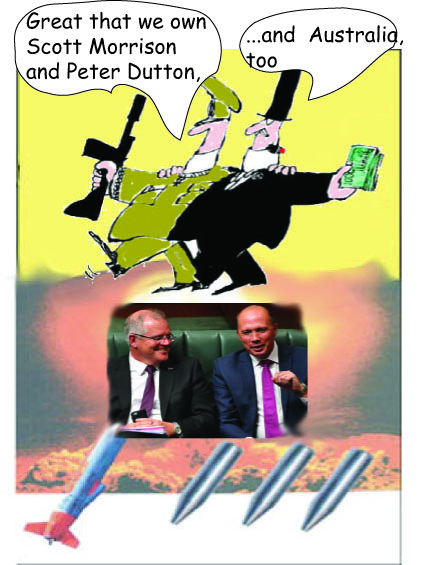
And as for the process, involving a sudden announcement to the Australian public, it is extraordinary that this momentous decision could be made without parliamentary or public scrutiny.
Australia bows down to America for nuclear submarines, Independent AustraliaBy Lee Duffield | 10 December 2021, As tensions between the U.S. and China grow, Australia’s nuclear submarine program has become less to do with our defence and more about placating the American Government, writes Dr Lee Duffield.
DEFENCE INDUSTRY MINISTER Melissa Price, on 9 November, declared the country’s nuclear-powered submarines would be built in South Australia.
How would this be done? Constructing the ships around imported reactors? It added into the brewing of questions and arguments since the sudden announcement of the nuclear plan and immediate cancellation of the French contract for conventional submarines on 16 September.
Trying to make sense of it all, several analysts, mostly through the Lowy Institute publication, The Interpreter, and at think-tanks to the Left and Right, have produced these main points:
- that American policy towards China is the main factor in this mix;
- that Australian sovereignty stands to be diminished, even if its security might be helped; and
- that the insult to France and its consequences, while not the main game, remains important — especially as it affects the standing of the Australian Government.
Sam Roggeveen, Director of the Lowy Institute’s International Security Program, contributed two articles, seeing the China-USA contest as the heart of it, with Australia now brought in more as a great power client, less as itself.
Roggeveen wrote:
‘The defence deal is a clear escalation and indication that Washington views Beijing as an adversary. It also has thrust Australia into a central role in America’s rivalry with China.’
U.S. reacts — Australia goes, too
The deal in question is the full package of the new tripartite defence arrangement, AUKUS (Australia, the United Kingdom, the United States), with Australia obtaining probably eight nuclear submarines at the centre of it.
As Roggeveen explains:
‘…the scale of this agreement and the close strategic and operational links it implies will create expectations from Washington. Australia cannot have this capability while assuming that it does not come with heightened expectations that Australia will take America’s side in any dispute with China.’
And as for the process, involving a sudden announcement to the Australian public, it is extraordinary that this momentous decision could be made without parliamentary or public scrutiny.
Allan Behm, Director of International and Security Affairs at the Australia Institute, gave a similar reading, seeing the decision to build long-range nuclear submarines for Australia as an American game, little to do with the defence of Australia:
The aim is to make possible an Australian contribution to U.S. battle plans against China which that country will view as profoundly threatening with implications also for war planning by Russia, North Korea and other nuclear-armed states.
Even leaving aside the fiscal profligacy and defence opportunity costs for Australia of the literal blank cheque issued by the Morrison Government, the nuclear submarine decision takes Australia into the heart of naval warfighting in East Asia and Southeast Asia.
“Step up to the bully”
Some steps to the right of Behm at the Australia Institute is Rowan Callick writing for the Centre for Independent Studies, a neoliberal and anti-communist lobby, in the current debate articulating much of the confrontationist thinking on how to deal with Beijing. …………
For the U.S., AUKUS is a win. It exemplifies the importance Washington attaches to deepening cooperation with key allies and strengthening their military capabilities to assist in deterring the security challenges posed by China in the region.
A very hard and costly undertaking
Great difficulty running a nuclear submarine program is foreshadowed for a country with no nuclear industry, where the navy for several years was unable to provide specialist crews for each of its Collins class submarines — rotating them ship-to-ship as vessels took turns in maintenance. There is also the long lead time proposed for getting the nuclear boats into service, starting with 18 months reserved for more discussion, for official thinking to get clarified on such questions.
Oriana Skylar Mastro and Zack Cooper have talked about many critics already raising ‘valid concerns’:
Critics of AUKUS… worry that 18 months is a long time to wait for clarity on the plan, and 18 years would be too long to wait for submarines. Nuclear-powered submarines will prove difficult and expensive for Australia to master and could create non-proliferation concerns. Washington, Canberra and London will have to mend ties with Paris as well as concerned friends in Southeast Asia, especially Jakarta. Others have argued that the deal ties Australia too closely to the United States or creates unnecessary tensions with China (although we would dispute these last two assertions)…………
In the vanguard of concerns about the French connection, Richard Ogier saw further risks to Australia’s options as a sovereign state, and considered that:
‘In Europe, and not only in France, the image of Australia has suffered a direct hit. Australia may be a staunch U.S. ally, but under certain circumstances, was prepared to go beyond the old ANZUS alliance. Australians may be warm and welcoming, is the message sent, but watch for the kick when your back is turned.’
A full version of this article has been published in subtropic.com.au. Dr Lee Duffield is a former ABC foreign correspondent, political journalist and academic. https://independentaustralia.net/politics/politics-display/australia-bows-down-to-america-for-nuclear-submarines,15832
Australian superannuation funds still have considerable investments in nuclear weapons companies: some are not disclosing this

John Buckley 9 Dec 21
- Most major super funds have some kind of exposore to nuclear weapons.
- Australian Super, the nation’s largest fund, was found to have $1.5 billion in nuclear weapons holdings.
- Some omit nuclear weapons from their “controversial” investment exclusions.
Most of Australia’s major super funds continue to hold investments in nuclear weapons companies, almost a year after the UN Treaty on nuclear weapon prohibition came into effect.
According to new analysis from the Australia Institute and nuclear weapons prevention non-profit, Quit Nukes, 17 of Australia’s major super funds currently have holdings in nuclear weapons companies.
The funds that do, the analysis found, make opaque attempts — if any at all — to disclose the investments to current and potential members, and in some cases go to great lengths to conceal them.
Australian Super, the nation’s largest super fund both by membership and funds under management, has close to $1.5 billion in nuclear weapons companies.
The fund’s investment policy says Australian Super does not exclude nuclear weapons (or other controversial weapons technology) from its investment pot.
For members with a higher conscience, Australian Super offers a “Socially Aware” membership, but even then, that only excludes landmines and cluster munitions.
Moving through the list, the case was the same in most other corners across the market. Aware Super, Australia’s second largest fund, says that it excludes controversial weapons, but that definition doesn’t cover nuclear weapons.
Aware invests in 12 nuclear weapons companies.
HESTA, meanwhile, only excludes investment in companies which earn more than 5% of their total revenue from nuclear weapons across the whole portfolio, but still has exposure to 14 nuclear weapons companies.
Over at Hostplus, nuclear weapons aren’t classified as controversial weapons either, and therefore aren’t excluded from the fund’s investment prospects.
But the fund says that it plans to recategorise nuclear weapons come January next year, at which point it’ll have to find a way to divest from eight nuclear weapons companies.
It is a popular strategy at most of the market’s major players, where controversial weapons are excluded from investment, but nuclear weapons aren’t considered controversial.
Among them are Rest Super, Telstra Super, and Mercer Super. At Cbus “controversial weapons” are explicitly excluded from fund investment opportunities, but there’s no mention of nuclear weapons. The fund has exposure to six nuclear weapons companies.
A survey undertaken by Quit Nukes found that just under 70% of Australians would expect nuclear weapons to be considered “controversial weapons”, while that same proportion of Australians, when asked, said they’d prefer their super not be invested in nuclear weapons.
Margaret Beavis, co-director at Quit Nukes, said Australia’s $3.4 trillion pension industry has phenomenal power, and their abstinence could go a long way in eliminating nuclear weapons, which are now illegal under international law.
“While there is big money invested in nuclear weapons companies, these investments are usually a tiny percentage of the whole funds under management,” Dr Beavis said.
“There is no evidence to suggest that divestment will negatively impact returns. Some funds are making change, including Hostplus, which recently decided to divest all nuclear weapons holdings by the end of January 2022,” she said.
Bill Browne, a senior researcher at The Australia Institute’s Democracy and Accountability Program, said it’s clear that Australians don’t want their money “invested in weapons of mass destruction”, and that super funds should heed the warning.
“Australians have the right to know exactly how their money is being invested, but most major super funds do not tell their members about their investments,” Browne said.
“Superannuation is one of the great Australian projects, guaranteeing retirement income for millions of workers. Most Australians would have no idea that their retirement money is being used to finance nuclear weapons,” he said.
“It is incumbent upon all funds to invest in the future of Australians — and that future does not include nuclear weapons.”
Some smaller, emerging funds have already pulled the rug on nuclear investments completely. The only six funds that that have either fully divested, or weren’t exposed to nuclear in weapons in the first place are: Active Super, Australian Ethical, Christian Super, Crescent Wealth, Future Super, and Verve Super.
Union leaders demand super funds dump nuclear-linked companies

Six super funds have already divested from the 26 companies on the list, including Active Super, Australian Ethical, Christian Super, Crescent Wealth, Future Super and Verve Super.
CareSuper previously had holdings in Safran and Thales but has divested from these companies, according to the report.
Union leaders demand super funds dump nuclear-linked companies, https://www.afr.com/policy/tax-and-super/union-leaders-demand-super-funds-dump-nuclear-linked-companies-20211208-p59frc , Michael Read Reporter, Dec 8, 2021 Hostplus has agreed to divest from companies linked to the nuclear weapons industry after coming under pressure from progressive think-tank the Australia Institute and Quit Nukes.
Other industry funds are being lobbied to follow suit, including AustralianSuper, which has $1.5 billion invested in 18 companies that critics say are linked to the nuclear weapons industry.
A new report by the Australia Institute and Quit Nukes says 17 of Australia’s largest super funds, including Aware Super and BT Funds Management, are investing in companies linked to the nuclear weapons industry.
The report argues that funds can divest from these companies without negatively affecting financial returns.
The report says Hostplus has agreed to divest by the end of the year, but The Australian Financial Review was unable to reach the fund to confirm.
“Just prior to the launch of this report, Hostplus confirmed with Quit Nukes that it has decided to include nuclear weapons in their definition of controversial weapons,” the report says.
It quotes Hostplus as saying: “Our Responsible Investment Policy and our Controversial Weapons Divestment Policy have both been updated and approved by the Board. Hostplus expects to be fully divested of their holdings in nuclear weapons companies by the end of January 2022.”
Wide range of investments
The Australia Institute classifies 26 companies as involved in the nuclear weapons industry. The companies are involved directly in the development, testing, production or maintenance of nuclear weapon-related technology, parts products or services.
The list includes defence industry giants such as Lockheed Martin and Raytheon and missile system producers Bharat Dynamics and Aerojet Rocketdyne.
Some of the companies on the list are conglomerates such as Airbus and Boeing whose corporate activities extend well beyond their involvement in the defence industry.
The report finds that the nation’s largest super fund, AustralianSuper, has $1.5 billion invested across 18 companies linked to the nuclear weapons industry. The investments include a $1.6 million stake in BWX Technologies, which is involved in uranium processing and other site-specific services for the United States’ nuclear arsenal.
AustralianSuper did not respond to a request for comment.
Aware Super holds a stake in 12 companies on the list, including US firm Textron, which produces re-entry vehicles for intercontinental ballistic missiles, and Safran, which is involved in missile production for the French nuclear arsenal.
A spokesman for Aware Super committed to reviewing its investment framework and said nuclear weapons companies were already excluded from its socially responsible investment option.
AustralianSuper did not respond to a request for comment.
Aware Super holds a stake in 12 companies on the list, including US firm Textron, which produces re-entry vehicles for intercontinental ballistic missiles, and Safran, which is involved in missile production for the French nuclear arsenal.
A spokesman for Aware Super committed to reviewing its investment framework and said nuclear weapons companies were already excluded from its socially responsible investment option.
“BT excludes securities where industries or activities undertaken breach our ESG (environmental, social and governance) exclusions framework, this includes nuclear weapons activities in contravention of the UN Treaty on the Non-Proliferation of Nuclear Weapons,” a spokeswoman said.
We have investment options available that exclude all nuclear weapons and we regularly review and refine our investment approach across a broad range of ESG issues … We haven’t seen the full report, so can’t comment on its findings,” she said.
Unions call for divestment
Union leaders are demanding that super funds divest from companies that critics say are linked to nuclear weapons production.
Electrical Trades Union national assistant secretary Michael Wright said it was “tough to claim industry funds are an ethical choice if they continue to invest in nuclear weapons”.
“I know a lot of our members are with funds called out in this report as investing in nuclear weapons. If these funds don’t divest soon our members may well look to place their retirement savings with funds that are more ethical,” Mr Wright said.
For union- and employer-backed industry funds, the equal representation board model means directors are sourced equally from the two groups.
Six super funds have already divested from the 26 companies on the list, including Active Super, Australian Ethical, Christian Super, Crescent Wealth, Future Super and Verve Super.
CareSuper previously had holdings in Safran and Thales but has divested from these companies, according to the report.
Australian Nursing and Midwifery Federation federal secretary Annie Butler said there was “an urgent need for superannuation funds to ensure their investments are safe and ethically sound – and not in industries which can ultimately cause so much devastation and misery to our populations”.
Australian Services Union national secretary Robert Potter said investments in nuclear weapons undermined the work done by the union’s members.
“We welcome the nuclear weapon ban treaty and we’re committed to steering workers capital to align with the objectives of our ASU national policy,” Mr Potter said.
The Australia Institute’s senior researcher, Bill Browne, said he hoped the report would act as a “wake-up call to all superannuation funds still investing in nuclear weapons companies”.
“Superannuation is one of the great Australian projects, guaranteeing retirement income for millions of workers,” Mr Browne said. “Most Australians would have no idea that their retirement money is being used to finance nuclear weapons.
“It is incumbent upon all funds to invest in the future of Australians – and that future does not include nuclear weapons.”
Australian government using a loophole to evade international non-proliferation treaties, to get nuclear submarines?
“interesting interpretation” that the government would try to qualify for an exemption from the International Atomic Energy Agency’s inspection regime by claiming military submarines, which will be fuelled with weapons grade uranium, are for peaceful purposes.”
Labor questions whether nuclear subs breach international law, AFR, Andrew Tillett, Political correspondent, 30 Nov 21, Labor MPs have raised concerns about Australia breaching its non-proliferation obligations under the Morrison government’s plan to acquire nuclear-powered submarines from Britain and the United States.
Parliament’s Treaties Committee has begun a snap inquiry into the first element under the AUKUS deal, an agreement between the three countries to allow the sharing of highly classified nuclear technology with Australian officials.
The nuclear agreement also covers training opportunities for Australian submariners and technicians with the British and American programs.
Under the AUKUS pact, the government will acquire up to eight nuclear-powered submarines, promising they will be built in Adelaide. The first is due to be delivered sometime before 2040.
The government is adamant the nuclear submarine deal will not be a precursor to acquiring nuclear weapons.
The inquiry is due to report by December 17 but at its first hearing on Monday, Labor MP Josh Wilson highlighted significant uncertainty over the government’s plan to use a loophole in the international nuclear safety regime, which had never been used before, to acquire the submarines.
Mr Wilson and fellow Labor MP Peter Khalil grilled officials from the Defence, Foreign Affairs and Attorney-General’s departments over how Australia could acquire nuclear-powered submarines while still complying with its obligations under the nuclear non-proliferation treaty.
Training ‘needs to start now’
Mr Wilson said it was an “interesting interpretation” that the government would try to qualify for an exemption from the International Atomic Energy Agency’s inspection regime by claiming military submarines, which will be fuelled with weapons grade uranium, are for peaceful purposes.
“If it was determined that was acceptable, we will have broken new ground in weakening the existing non-proliferation regime,” Mr Wilson observed……….. https://www.afr.com/politics/federal/questions-over-whether-nuclear-subs-breach-international-law-20211129-p59d0h
France’s Foreign Minister raises concerns about AUKUS, nuclear submarines, and risks of weapons proliferation.
the theme of ‘betrayal’ in terms of both being ‘cheated’ out of a deal and being deceived by NATO allies and, in Australia’s case, a historical ally.
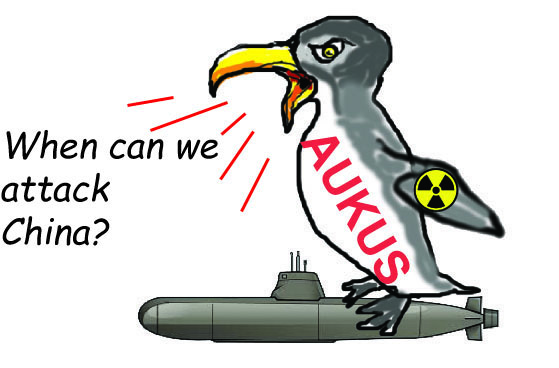
AUKUS was about ‘pressing a sense of confrontation with China’
if tomorrow Australia has some nuclear-powered submarines, why not, some other countries could ask for similar technology, it could be Indonesia, why not?’
Australia needs an entente cordiale with Indonesia over nuclear propulsion and non-proliferation, The Strategist, 29 Nov 2021, |David Engel However relaxed and comfortable Indonesian Defence Minister Prabowo Subianto might be about Australia’s plans to acquire nuclear-powered submarines (SSNs), the visit to Jakarta of French Foreign Minister Jean-Yves Le Drian has probably validated the very different view of Le Drian’s counterpart, Retno Marsudi.
……………………………………………. the most striking moment of the visit came during Le Drian’s address to Indonesia’s leading international affairs think tank, the Centre for Strategic and International Studies (CSIS). While his speech focused on issues such as multilateralism and the EU’s position on the Indo-Pacific, his response to a question on ‘minilateralism’—specifically, AUKUS and the Quad—took on a very different tone.
Ignoring the Quad, he levelled his remarks at AUKUS, stressing four points. The first two reiterated the theme of ‘betrayal’ in terms of both being ‘cheated’ out of a deal and being deceived by NATO allies and, in Australia’s case, a historical ally. He talked about American efforts to restore trust through various US commitments to France. He didn’t mention Australia in this context.
More significantly, his third point was that AUKUS was about ‘pressing a sense of confrontation with China’ (as the simultaneous translation put it). He said that, while France was not oblivious to China’s military threats and risks, he believed that the best way to respond to these threats was to ‘develop an alternative model rather than to first of all oppose’.
Perhaps his most significant point for Australian interests was his fourth, which went to the transfer of nuclear technology for submarine propulsion. He pointed out that until now no nuclear-weapon state had done this. But ‘if tomorrow Australia has some nuclear-powered submarines, why not, some other countries could ask for similar technology, it could be Indonesia, why not?’ He continued that, even though this technology was not covered by the Nuclear Non-Proliferation Treaty (NPT), the risk the arrangement posed of starting a trend was nonetheless of concern.
Irrespective of Le Drian’s intentions in answering the question in this manner—and it’s noteworthy that he didn’t cover AUKUS in his formal address—he would surely have known that his words would resonate powerfully with his audience, both at CSIS and more generally among Indonesia’s foreign policy establishment. While his depiction of Australia as duplicitous was evidently personal and heartfelt, it would also have struck a chord with those Indonesians who have characterised Canberra the same way over such issues as East Timor, Papua and spying allegations, irrespective of how justified that judgement might be.
Le Drian’s last point went directly to concerns about nuclear proliferation—issues that Indonesia highlighted in its official statement on AUKUS and the planned submarines. It corresponds closely ‘in spirit’ with subsequent official commentary to the effect that Indonesia was considering advocating a change to the NPT aimed at preventing non-nuclear-weapon states from acquiring SSNs………
whoever governs in Canberra now and into the future should at least make a priority of assuaging Jakarta’s worries on this subject, however overstated and unbalanced they are. While Indonesia’s prospects of changing the NPT and precluding Australia from having SSNs look remote at best—not least because several of its ASEAN colleagues do not share its views of Australia’s ambitions—the sooner the two countries can put this latest irritant to rest the better.
In the circumstances, the onus for doing so must primarily rest with Canberra………https://www.aspistrategist.org.au/australia-needs-an-entente-cordiale-with-indonesia-over-nuclear-propulsion-and-non-proliferation/
Australian Conservation Foundation comments to Parliamentary Committee on nuclear submarine agreement.

Australian Conservation Foundation comment on the Joint Standing Committee on Treaties review of the Agreement between the Government of Australia, the Government of the United Kingdom of Great Britain and Northern Ireland, and the Government of the United States of America for the Exchange of Naval Nuclear Propulsion Information (ENNPIA)
November 2021
- Unreasonable time frame
ACF maintains that the focus of the proposed Treaty action – the planned acquisition of nuclear powered submarines – has profound security, diplomatic, environmental and economic implications. The plan has been described by the RAN’s Head of Navy as one that “will shape the direction of our navy forevermore, and will no doubt change the shape of our nation”.
In this context the scarcity of time given to the consideration of this proposed action is neither justified nor acceptable.
To provide less than one working week for invited comment is not consistent with the credible and comprehensive consideration of the many and complex issues.
This truncated approach undermines community confidence and procedural credibility. There is a risk JSCOT be perceived not as a respected and effective review mechanism, but rather an eviscerated rubber stamp.
ACF seeks to formally record our concern and disappointment that the first piece of policy architecture being used to advance such a significant change has been approached in this fashion.
If part of the rationale for the planned action is to ensure “Australia is a responsible and reliable steward of this technology” this cavalier approach is a counter-productive one.
- Limited consultation
The consultation process for the proposed Treaty action mirrors the compressed timeline as it both unnecessarily restrictive and limited.
Only federal government agencies – DFAT, PMC and AGs – were consulted.
There has been no consultation with wider nuclear related agencies including the Australian Radiation Protection and Nuclear Safety Agency, the Australian Radioactive Waste Agency or any environmental experts.
State governments and state agencies were not consulted, despite these jurisdictions being the host sites for activities directly related to the Treaty action.
The comment that no public consultation was undertaken “as the ENNPIA relates to national security and operational capability matters” ignores the fact that there is a legitimate and high level of community interest and concern with the wider AUKUS proposal and further undermines community confidence in these politicised decision making processes.
In light of this, ACF would welcome clarification through the JSCOT review of the nature of the proposed “18 month consultation period” Who is going to be consulted? Will there be a public or wider stakeholder aspect to these consultations? Are they genuine consultations or top-down information updates?
ACF also notes that the NIA (in particular NIA point 5) contains assumptions on the benefits of nuclear submarines that underpin the wider AUKUS plan that have not been openly tested. The clear focus of this process is to advance a pathway to operationalise a decision that has already been made, rather than have an open examination of the issues to inform evidence-based decision making.
- Non-proliferation concerns
Should AUKUS be advanced, Australia would be the only non Nuclear Weapon State to have nuclear powered submarines. This unhelpful exercise in Australian exceptionalism and the proposed use of weapons grade highly enriched uranium (HEU) has clear proliferation sensitivities and has understandably been the focus of deep concern from nations in the region.
This has also attracted attention and concern from the International Atomic Energy Agency which has stated that “with Australia, with the United States and with the United Kingdom, we have to enter into a very complex, technical negotiation to see to it that as a result of this there is no weakening of the nuclear non-proliferation regime.”
The current approach to fast-track this Treaty action utterly fails to recognise or reflect the complexity and significance of the non-proliferation concerns related to the AUKUS plan.
The proposed use of a designated non-explosive military use, facilitated by direct military transfer, in order to place weapons grade HEU outside of IAEA safeguards is a disturbing development that could increase pressure on the already strained global non-proliferation framework. It raises the likelihood of other nations seeking similar exceptions and HEU safeguard exemptions.
ACF notes and welcomes that the “ENNPIA does not authorise and will not support the sharing or transfer of any information related to nuclear weapons”. ACF further notes that a comparable commitment that AUKUS does not involve nuclear weapons was made by the Prime Minister when the plan was announced in mid-September.
This pivotal commitment needs to be given a firmer basis than a political assurance. ACF has called on the PM and federal government to send an unequivocal signal that Australia will not countenance or consider nuclear weapons by moving to sign and ratify the UN Treaty on the Prohibition of Nuclear Weapons
- Nuclearisation by stealth
ACF has previously expressed concern that the AUKUS nuclear submarine plan could lead to increased pressure for a domestic nuclear industry: https://www.acf.org.au/dont-turn-nuclear-powered-subs-into-nuclear-power-subsidies and https://www.acf.org.au/nuclear-submarines-australia
ACF notes and welcomes that both the Prime Minister and Opposition Leader have explicitly ruled out a domestic nuclear power industry and stated that the AUKUS plan is not a forerunner to any such activity.
ACF notes that the NIA (12) limits the scope of the planned action to naval nuclear propulsion and states that the ENNPIA “does not support the transfer of any equipment or technology, nor does it support the sharing or transfer of any information on civil nuclear matters”. This is a welcome but insufficient specification.
Since the mid-September AUKUS announcement a range of voices, including within the federal government, have made calls for Australia to embrace domestic nuclear power. The Prime Minister needs to act decisively to give effect to his clear statements that AUKUS is not linked to and will not propel any domestic nuclear industry by explicitly referencing and re-affirming the two key legislative prohibitions on nuclear power in the EPBC and ARPANS Acts.
ACF notes with concern the potential for opaque expansion of the proposed Treaty action, including in Article 2 which states that parties will “provide support to facilitate such communication or exchange, to the extent and by such means as may be mutually agreed”.
This provides considerable latitude and given the AUKUS process to date has been characterised by surprise announcements, non-inclusion and fast-tracking there is no basis for community confidence that mutual agreement might see an expanded set of activities. Could UK or US nuclear submarines be hosted routinely or permanently in Australia as part of this critical skills and information exchange?
In a similar vein, the approach taken with this ENNIPA process reinforces community unease over the nature and speed of AUKUS related decision making and the risk that this approach will become the standard. In relation to further Treaty actions ACF notes that the “agreement can be changed subject to all party agreement and subject to Australia’s domestic treaty-making requirements”. Given the current truncated approach there is no assurance in this statement and no confidence that any future changes will be openly and robustly scrutinised.
- Recommendations:
- JSCOT not recommend advancing the current Treaty in the absence of sufficient time to credibly review key aspects of the proposed action, especially in relation to the “very complex, technical negotiation” needed to ensure there is no weakening of the nuclear non-proliferation regime.
- JSCOT recommends Australia sign the Treaty on the Prohibition of Nuclear Weapons (TPNW) both as a regional assurance mechanism and to give effect to PM Morrison’s clear statements that AUKUS is not related to any Australian ambition to acquire a nuclear weapons capability
- That greater detail on the proposed AUKUS submarine plan be presented to the Australian Parliament and people, including but not limited to issues around cost, rationale, the 18 month “consultation” process and emergency and waste management concerns.
- That the Prime Minister give effect to his repeated commitment that naval nuclear propulsion will not lead to increased moves for an Australian nuclear power industry by explicitly referencing and re-affirming the two key legislative prohibitions on domestic nuclear power in the EPBC and ARPANS Acts.
To discuss or clarify any aspect of this submission please contact Dave Sweeney, ACF nuclear policy analyst via dave.sweeney@acf.org.au or 0408 317 812
French nuclear submarines a better choice for Australia
We’re repeating all the same Collins mistakes, THE AUSTRALIAN 27 Nov 21, Why we should turn AUKUS into FAUKUS and buy our nuclear-powered submarines from France.By JON STANFORD
”…………………unfortunate decision is to effectively eliminate competition in selecting Australia’s SSNs. The likelihood is that our AUKUS partners will decide which of them – probably the British – will provide Australia with SSNs. Without a competitor – and the French Suffren is the only option – we will again be negotiating with a monopolist on a “take it or leave it” basis.
In addition, the prospect of acquiring a US or British SSN takes us back to the third problem with the Attack program – overambition. Both the British and US navies operate large submarines – around three times the size of Collins – that may be too much for the smaller RAN to digest.
Defence has stated that Australia should acquire a mature submarine design. This will be difficult to achieve within AUKUS. With production of its PWR2 reactor now terminated, there will be no further construction of the British Astute-class after delivery of the seventh boat. The next British SSNs will use the new PWR3 reactor, largely an American design, and the platform will need to be bigger in order to accommodate it.
Were we able to acquire an American submarine, this would also probably be a new design. The US is already planning for the first SSN(X) to replace the Virginia-class in the early 2030s.
In both the British and American options, therefore, all the risks of a new design, including late delivery, will be present.
Both these new platforms will be bigger than the submarines they replace and require even larger crews. The Virginia-class has a crew of 135, 80 more than Collins, while Astute’s complement is 98. Would we be able to populate these very large submarines? Even the British, with a much bigger population than Australia, have difficulty in recruiting and retaining crews for their submarines.
The latest French SSN, Suffren, has some advantages for the RAN. It is a relatively recent design with only the first of class in commission. Reputedly, it has superior stealth characteristics. It has a crew of 60, only five more than Collins. Given the progress already made on Attack, whose reference design was Suffren, Australia should be able to acquire a mature French SSN in a shorter timeframe than a new American or British design.
French SSNs also have the advantage of using low enriched uranium (LEU) rather than the weapons grade, highly enriched uranium (HEU) that fuels American and British boats………
The government’s story that Australian industry cannot refuel nuclear reactors is also pure fiction. ……. Our 20MW nuclear reactor is located in Lucas Heights, a leafy Sydney suburb in Sutherland Shire, adjacent to the Prime Minister’s electorate of Cook. The Australian Nuclear Science and Technology Organisation has been refuelling nuclear reactors there for more than 60 years
Unlike its predecessor, which was designed for HEU, the current OPAL reactor uses LEU fuel…….
It is difficult to see any benefit in scrapping our strategic partnership with France. While a Barry McKenzie-style of diplomacy may trigger political resonance for the government, it has needlessly damaged an important relationship and constrained our options for acquiring nuclear submarines……..
The US administration, blindsided by the unprecedented recall of the ambassador of its oldest ally, may already be thinking of extending an olive branch to France. Time for FAUKUS, anyone?
Jon Stanford is principal of the think tank Submarines for Australia and a former senior official in the Department of Prime Minister and Cabinet. https://www.theaustralian.com.au/inquirer/were-repeating-all-the-same-collins-mistakes/news-story/eaeff234940e33bec455dab9ead8ed3b
China calls on the Association of Southeast Asian Nations (ASEAN) to make Southeast Asia a nuclear-weapons-free zone
China pushes for nuclear-weapon-free Southeast Asia, KhmerTimes, Aandolu Agency ISTANBUL 22 Nov 1 – China on Monday said it is ready to work with the members of the Association of Southeast Asian Nations (ASEAN) towards a nuclear-weapon-free region besides ensuring stability in the disputed South China Sea.
“China supports ASEAN’s efforts to build a nuclear-weapon-free zone, and is prepared to sign the Protocol to the Treaty on the Southeast Asia Nuclear-Weapon-Free Zone as early as possible,” President Xi Jinping told the China-Asia summit marking 30 years of the relations between two sides.
Beijing’s demand for a nuclear-free Southeast Asia comes as the US and UK empower their ally Australia with nuclear-armed submarines under a deal called AUKUS signed in September………..
The bilateral trade between China and ASEAN has skyrocketed by 85 times to $684.6 billion in 2020 from less than $8 billion in 1991, making the two sides each other’s largest trading partners. https://www.khmertimeskh.com/50975461/china-pushes-for-nuclear-weapon-free-southeast-asia/
I MAY VOMIT
Australia, the United States and the United Kingdom officially signed the Exchange of Naval Nuclear Propulsion Information Agreement in Canberra, giving Australia access to nuclear-powered submarines technology.
Australian TV blatantly advertises weapons sales, in absurd claims about China invading Australia

Australian War Propaganda Goes Off the Rails https://consortiumnews.com/2021/11/17/australian-war-propaganda-goes-off-the-rails/ November 17, 2021 In a blatant advert for arms sales masquerading as news, 60 Minutes tries to tie Taiwan to the fantasy of China randomly invading a continent of white foreigners thousands of miles away, writes Caity Johnstone. By Caitlin Johnstone
CaitlinJohnstone.com
60 Minutes Australia has churned out yet another fear-mongering war propaganda piece on China, this one so ham-fisted in its call to beef up military spending that it goes so far as to run a brazen advertisement for an actual Australian weapons manufacturer disguised as news reporting.
This round of psychological conformity-making features Australian former major general Jim “The Butcher of Fallujah” Molan saying that in three to ten years a war will be fought against China over Taiwan and that Australians are going to have to fight in that war to prevent a future Chinese invasion of the land down under.
He argues Australia will need to greatly increase its military spending in order to accomplish this, because it can’t be certain the United States will protect it from Chinese aggression.
“Australia is monstrously vulnerable at the moment; we have this naive faith that American military power is infinite, and it’s not,” says Molan, who is a contributor to government/arms industry-funded think tanks Lowy Institute and Australian Strategic Policy Institute.
Decrying what he calls “panda huggers” (meaning people who aren’t China hawks), Molan claims that “the Chinese Communist Party’s aim is to be dominant in this region and perhaps dominant in the world.” Asked when war might break out, he claims “Given the power that they have in their military they could act any time from now on, and that’s what frightens me more than anything.”
“The next war is not going to be ten or twenty years away, it’s going to be in the next three to ten years,” Molan asserts.
“My estimate is that in a serious fight the Australian Defense Force only has enough missiles for days. This is not going to be resolved in days. And of course we’re not big enough. We should expand the defense force significantly… We should fund defense now based on our assessment of the national security strategy which is based on the war that we want to win.”
“In short do you think Australia needs to prepare for war tomorrow?” the interviewer asks Molan.
“Absolutely,” he replies.
Molan makes the ridiculous argument that if Australia does not to commit to defending Taiwan from the mainland then it won’t be long before they can expect a Chinese invasion at home, as though there’s any line that could be drawn between the resolution to a decades-old Chinese civil war and China deciding to invade a random continent full of white foreigners thousands of miles away.
Suppose we said okay Taiwan you’re on your own up there and the Chinese snapped it up, and the Chinese started looking around the world and they might snap up other liberal democracies like Australia,” Molan argues. “And we might then turn to America and say America well could you give us a bit of a hand here? And the Americans might say what we said to Taiwan. Where do you draw the line? This situation that is developing now is an existential threat to Australia as a liberal democracy.”
Incredibly, the 60 Minutes segment then plunges into several minutes of blatant advertising for Australian defense technology company Defendtex which manufactures weaponized drones designed to be used in clusters, saying such systems could handily be used to defeat China militarily in a cost-effective manner.
The segment also promotes bare-faced lies which have become commonplace in anti-China propaganda, repeating the false claim that Chinese fighter planes have been “breaching Taiwanese airspace” and repeating a mistranslation of comments by Xi Jinping which it used in a previous anti-China segment made to sound more aggressive than they actually were.
This segment follows a cartoonishly hysterical fear porn piece on China put out by the same program this past September which featured Australian Strategic Policy Institute ghouls insisting that Australians must be prepared to fight and die in defense of Taiwan and that a Chinese invasion of Australia is a very real threat. That 60 Minutes segment was preceded by an equally crazy one in May which branded New Zealand “New Xi-Land” for refusing to perfectly align with U.S. dictates on one small foreign policy issue.
To be perfectly clear, there is no evidence of any kind that China will ever have any interest in an unprovoked attack on Australia, much less an invasion, and attempts to tie that imaginary nonsense threat to Beijing’s interest in an island right off its coast which calls itself the Republic of China are absurd.
As we’ve discussed previously, anyone who’d support entering into a war against China over Taiwan is a crazy idiot. In the unfortunate event that tensions between Beijing and Taipei cannot be resolved peacefully in the future there is no justification whatsoever for the U.S. and its allies to enter into a world war between nuclear powers to determine who governs Taiwan.
The cost-to-benefit ratio in a conflict which would easily kill tens of millions and could lead to the deaths of billions if it goes nuclear makes such a war very, very, very far from being worth entering into, especially since there’s no actual evidence that Beijing has any interest in attacking nations it doesn’t see as Chinese territory.
There’s so much propaganda going toward generating China hysteria in westerners generally and Australians in particular, and it’s been depressingly successful toward that end.
Watching these mass-scale psyops take control of people’s minds one after another has been like watching a zombie outbreak in real time; people’s critical thinking faculties just fall out their ears and then all of a sudden they’re all about cranking up military spending and sending other people’s kids off to die defending U.S. interests in some island.
Please don’t become a zombie. Keep your brain. Stay conscious.
Australian Parliament should urgently review the potentially dangerous AUKUS deal
 | |||
Australian Federal Parliament Should Urgently Review the Potentially Dangerous AUKUS Deal https://worldbeyondwar.org/australian-federal-parliament-should-urgently-review-the-potentially-dangerous-aukus-deal/
By Australians for War Powers Reform, November 17, 2021
On September 15 2021, with no public consultation, Australia entered into a trilateral security arrangement with Britain and the United States, known as the AUKUS Partnership. This is expected to become a Treaty in 2022.
At short notice, Australia cancelled its contract with France to purchase and build 12 submarines on 16 September 2021 and replaced it with an arrangement to buy eight nuclear submarines from either Britain or the United States or both. The first of these submarines is unlikely to be available until 2040 at the earliest, with major uncertainties in relation to cost, delivery schedule and the ability of Australia to support such a capability.
Australians for War Powers Reform sees the public announcement of AUKUS as a smokescreen for other undertakings between Australia and the United States, the details of which are vague but which have major implications for Australia’s security and Independence.
Australia said the United States had requested increased use of Australian defence facilities. The US would like to base more bomber and escort aircraft in the north of Australia, presumably at Tindale. The US wants to increase the number of marines deployed in Darwin, which would see numbers rise to around 6,000. The US wants greater home porting of its vessels in Darwin and Fremantle, including nuclear-powered and armed submarines.
Pine Gap is in the process of significantly expanding its listening and war directing capabilities.
Acquiescing to these requests or demands considerably undermines Australian sovereignty.
The US is likely to want oversight, amounting to control, of northern air space and shipping lanes.
If the US deploys Cold War tactics against China, for that is what this military build-up is all about, it is likely to conduct aggressive flight missions up to the edge of Chinese air space with nuclear armed bombers, just as it did against the USSR. The US will patrol shipping lanes with greater frequency and intensity, knowing it has secure home bases only a short distance away, protected by surface-to-surface and surface-to-air missiles which are soon to be installed.
Any one of these flights or naval patrols could trigger a warlike response directed against Australian and US defence facilities and other assets of strategic value, such as oil, fresh water and infrastructure, or a cyber-attack on Australian communications and infrastructure.
Australia could be at war before most Australian politicians are aware of what is happening. In such an event, Parliament will have no say on going to war nor on the conduct of hostilities. Australia will be on a war footing as soon as these arrangements are in place.
AUKUS will be detrimental to national security. The ADF will lose its capacity to act independently.
Australians for War Power Reform believes these arrangements should not come into force, and that AUKUS should not become a Treaty.
We deplore the lack of consultation with neighbours, friends and allies, particularly relating to the storage and home porting of nuclear weapons and other US arms, ammunition and materiel.
We deplore the hostile profile adopted against our recent friend and major trading partner China.
We deplore the activities of the Australian Strategic Policy Institute (ASPI), funded by foreign arms manufacturers and the US State Department, in blind-siding the Australian people with its advocacy for such a deleterious outcome.
US Ex military man says nuclear submarines could arrive sooner, wants USA to get tough on China, re Taiwan
Nuclear subs can arrive much earlier than 2040, US ex-commander says Australia should be able to acquire nuclear submarines much earlier than a mooted 2040 delivery date, easing fears of a capability gap, according to a former top US military commander with responsibility for the Indo-Pacific. AFR, Andrew TillettPolitical correspondent In an interview with The Australian Financial Review, retired admiral Harry Harris said the AUKUS agreement the Morrison government struck with the United States and United Kingdom to access nuclear technology “changes the regional balance” amid growing alarm over China…………
Time for clarity on Taiwan
Mr Harris said the US needed to harden its position of “strategic ambiguity” over the defending Taiwan from a Chinese invasion to one of “strategic clarity” that makes it explicit how America would react to a Chinese attack.
Currently the US is not obliged by treaty to defend Taiwan, but US laws allow for arms sales to help Taiwan’s self-defence, leaving open the question of whether America would come to its aid. https://www.afr.com/politics/federal/nuclear-subs-can-arrive-much-earlier-than-2040-us-ex-commander-says-20211114-p598rm
Australian-UK-US nuclear submarine deal makes the connection clear between civilian and military nuclear activities
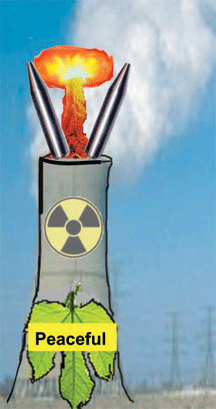
In failing fully to investigate this link between military nuclear and civil energy policy, the UK media have also missed more intimate connections. The senior Energy Ministry figure who negotiated the extraordinarily costly electricity contracts with France from the sole UK nuclear power plant currently under development went on to become the leading official in the Defence Ministry.
This same individual confirmed under questioning by Parliament that the nuclear submarine program is connected to civil nuclear policy. And it is this same person who is reported to have played a lead role in brokering the AUKUS deal.
In the United Kingdom, France, the United States, and Australia, policies in non-military, non-nuclear areas are often shaped by military nuclear interests. The AUKUS alliance is driven, in part, by a longstanding crisis in the nuclear submarine industry’s efforts to realize economies of scale.
In these countries, energy policy is steered towards risky, costly, delay-prone nuclear options rather than alternatives. In the process, policymakers impede progress on vital climate targets. Throughout, the public remains unaware. So, the gravest damage inflicted by hidden nuclear military interests is not their warping effects on non-military policy but on the health of democracy.
Australian-UK-US nuclear submarine deal exposes civilian-military links, https://thebulletin.org/2021/11/australian-uk-us-nuclear-submarine-deal-exposes-civilian-military-links/ Bulletin, By, Phil Johnstone | November 9, 2021 Andy Stirling Andy Stirling is Professor of Science and Technology Policy in the Science Policy Research Unit at Sussex University where he co-directs the ESRC. Phil Johnstone is a Senior Research Fellow at the Science Policy Research Unit at Sussex University. Phil has researched and published widely .
Under the AUKUS agreement, the United States and the United Kingdom plan to transfer nuclear submarine technologies to Australia. One international security scholar characterized the deal as “a terrible decision for the nonproliferation regime,” noting grave concerns for peace and security worldwide. Others have expressed concerns about “loopholes” surrounding nuclear submarine fissile materials, increased nuclear risks in the Pacific, and a potential acceleration of an arms race in the region. Still others doubt the purported efficacy of nuclear-propelled submarine designs.
Within national borders, nuclear activities often depend on expensive access to specific skills, supply chains, regulatory and design capabilities, educational and research institutions, and waste management and security infrastructures. These dependencies are especially strong in national struggles to build, maintain, and operate nuclear-propelled submarines. The AUKUS announcement overturned normally sacrosanct nuclear secrecy on these matters. It also raised bigger questions about energy policy, climate strategies, and democracy itself.
In democratic nuclear weapons states such as the United States, the United Kingdom, and France, shared civil-military nuclear industrial bases are largely—albeit indirectly—funded by electricity consumers. Colossal investments in new nuclear power are underwritten by anticipated revenues from future electricity sales. These investments flow through nuclear construction supply chains and outward to support military nuclear activities. In this way, crucial support is given to military infrastructures, outside of defense budgets and off the public books. But as civil nuclear power declines, this massive hidden funding flow may diminish, which presents problems for nuclear submarines whose costs are not only often prohibitive but escalating.
The AUKUS deal makes more sense when viewed in light of this crisis in the US, UK, and French national nuclear submarine industries. Spiralling civil nuclear construction delays, technological failures, bankruptcies, and fraud exercise little effect on government commitments to civil nuclear power, given pressure to underpin military capability. This is why these governments are failing to recognize the radical technology and market changes that render baseload power, according to industry, “outdated.” This is why policymakers so often neglect renewables and storage options that are outcompeting nuclear power. This is why some argue that nuclear power must persist as a “necessary part of the mix” in nuclear weapons states, despite diverse alternatives offering sufficient volumes of zero carbon power more quickly and cheaply than can nuclear.
Although well documented in the defense policy documents of existing and aspiring nuclear weapons states, these military drivers have been seriously neglected in discussions of energy and climate strategies. Recently however, some countries have begun to acknowledge the strong connections between civil and military nuclear capabilities.
In the United States, for instance, a report led by former energy secretary Ernest Moniz said in 2017 that “a strong domestic supply chain is needed to provide for nuclear Navy requirements. This supply chain has an inherent and very strong overlap with … commercial nuclear energy.” Since then, multiple high level reports have acknowledged that US military nuclear programs depend on a vibrant civil nuclear sector. “The connectivity of the civilian and military nuclear value chain—including shared equipment, services, and human capital—has created a mutually reinforcing feedback loop, wherein a robust civilian nuclear industry supports the nuclear elements of the national security establishment,” according to one study. Civil nuclear activities transfer an effective value of $26.1 billion dollars to the US military nuclear enterprise, according to this study.
In recent years, French press reports have hinted that dwindling civil nuclear power threatens national military nuclear capabilities. President Macron confirmed this when he said that “without civil nuclear power, there can be no military nuclear power.” Military drivers of civil nuclear activities are also acknowledged in more authoritarian nuclear states like Russia and China.
Australia possesses some of the most abundant and competitive renewable energy resources in the world. Yet the Australian nuclear lobby argues that acquiring military nuclear technology will benefit the claimed imperative to establish a civil nuclear industry. Prime Minister Scott Morrison asserted that he is not pushing for a civil nuclear power program, but other prominent voices disagree. Referring to submarine-derived small modular reactors, Australian politician and UK trade advisor Tony Abbott said that “if nuclear power is ok at sea, pretty soon it will be ok on land, too.” The Minerals Council for Australia claims that acquiring military nuclear technology is an “incredible opportunity” because it “connect[s] [Australia]… to the growing global nuclear power industry and its supply chains.”
Australian civil nuclear proponents welcome the aspirations of military nuclear proponents—and the reverse is also true. Australia’s military is concerned that a lack of a civil nuclear industry may pose difficulties for sustaining nuclear submarine competencies. Australian Navy Admiral Chris Barry pointed out that the absence of a civil nuclear industry left a “big gap” in the country’s ability to manage nuclear submarines. Some argue that a civil nuclear sector in Australia could provide the skills and expertise to enable military nuclear capability. Others are concerned that Australia will be the only country with nuclear submarines but no civilian nuclear industry. Military nuclear ambitions drive otherwise-inexplicable civil nuclear attachments.
In the United Kingdom, some worry about a post-imperial loss of a coveted “seat at the top table” of world affairs. Here again, nuclear submarine capabilities take center stage. Former prime minister Tony Blair worried that relinquishing nuclear capabilities would be “too big a downgrading of our status as a nation.” Meanwhile, detailed official energy policy analyses urged the government to set nuclear plans aside, given trends in renewables and related options. But shortly after a Defence Ministry report on submarine capabilities, Tony Blair swapped the open energy policy consultation for a quicker, covert process, after which the government proclaimed a “nuclear renaissance.”
The Royal Courts of Justice found reasoning for this policy insufficient, but Blair doubled down. “Nuclear power is back with a vengeance,” he said, invoking the name of the recently launched ballistic missile submarine, HMS Vengeance. He did not mention the military rationale. Since then, UK government white papers have failed to justify the country’s civil nuclear commitments—for instance by comparing nuclear costs with those of renewable alternatives. The commitment is taken for granted.
In the United Kingdom, the submarine industry’s openness about military pressures for civil nuclear power contrasts with energy policymakers’ silence. Now-declassified defense reports express grave worries that faltering civil nuclear programs undermine provision for essential military skills. Submarine-builder BAE Systems admits that funding for civil programs “masks” military costs. Naval reactor manufacturer Rolls Royce states that their expensive, government-funded efforts on ostensibly civilian small modular reactors can “relieve the burden” on Defence Ministry efforts to retain skills and capabilities for military programs. Numerous other government documents highlight synergies between civil and military nuclear skills. Yet when challenged, the UK Government denies that civil nuclear commitments influence military activities.
Boris Johnson emphasized that the AUKUS deal offers the United Kingdom “a new opportunity to strengthen Britain’s position as a science and technology superpower, and … could reduce the cost of the next generation of nuclear submarines for the Royal Navy.” Indeed, as discussed in this publication, the deal is “…likely to have particular significance for the UK’s nuclear program” because “the UK is struggling through a number of issues related to the revamping of its nuclear enterprise.” Despite government denials, Johnson’s statement confirms that the AUKUS deal is influenced by the same cost pressures and economies of scale associated with dogged maintenance of a shared civil-military industrial base.
In failing fully to investigate this link between military nuclear and civil energy policy, the UK media have also missed more intimate connections. The senior Energy Ministry figure who negotiated the extraordinarily costly electricity contracts with France from the sole UK nuclear power plant currently under development went on to become the leading official in the Defence Ministry. This same individual confirmed under questioning by Parliament that the nuclear submarine program is connected to civil nuclear policy. And it is this same person who is reported to have played a lead role in brokering the AUKUS deal.
In the United Kingdom, France, the United States, and Australia, policies in non-military, non-nuclear areas are often shaped by military nuclear interests. The AUKUS alliance is driven, in part, by a longstanding crisis in the nuclear submarine industry’s efforts to realize economies of scale. In these countries, energy policy is steered towards risky, costly, delay-prone nuclear options rather than alternatives. In the process, policymakers impede progress on vital climate targets. Throughout, the public remains unaware. So, the gravest damage inflicted by hidden nuclear military interests is not their warping effects on non-military policy but on the health of democracy.
Former Prime Minister Paul Keating scathing about Australia’s planned nuclear submarine deal
Mr Keating accused Mr Morrison of ‘wantonly leading Australia into a strategic dead end by its needless provocations against China’.
Australia’s eight nuclear subs by 2040 will be like ‘throwing toothpicks at a mountain’ when facing China, ex-PM declares in scathing pro-Beijing speech slamming Scott Morrison’s Covid origins probe. Daily Mail UK
- Australia cancelled a $90billion submarine contract with France in September
- Instead Scott Morrison has partnered with US and UK to obtain nuclear boats
- Former Prime Minister Paul Keating said they will be ‘very old’ when ready
- He also blasted Mr Morrison for offending China with call for Covid inquiry
By CHARLIE MOORE, POLITICAL REPORTER FOR DAILY MAIL AUSTRALIA 10 November 2021 In September, Mr Morrison cancelled a contract with France for 12 conventional submarines in favour of a new partnership with the US and UK known as AUKUS which will give Australia the technology to build nuclear boats for the first time.
But Mr Keating said they will take too long to arrive and pale in comparison to China’s navy which already has six nuclear-powered subs and more than 50 diesel-powered subs.
Mr Keating, who led Australia as a Labor Prime Minister between 1991 and 1996, said the eight US-style nuclear submarines would have no impact militarily.
‘These Virginia-class submarines were designed in the 1990s – by the time we have half a dozen of them it’ll be 2045 or 2050 – they’ll be 50 or 60 years old.
‘In other words, our new submarines will be old tech – it’ll be like buying an old 747.
‘And here we are, we’re going to wait 20 odd years to get the first one and 35 to 40 years to get the lot. For what will be then very old boats.’
Mr Keating said Australia was falling in line with the US strategy to use nuclear ‘hunter killer’ submarines to contain China.
‘The whole point of these hunter killer submarines is to round up the Chinese nuclear submarines and keep them in the shallow waters of the Chinese continental shelf before they get to the Mariana Trench and become invisible,’ he said.
‘To stop them having nuclear capability towards the United States.’
The 77-year-old insisted that China has no desire to expand its territory in the east and said Australia should be focussing on its own defence with conventional subs.
[Former Deputy Prime Minister] Kim Beazley and I built the Collins [class submarines]. I built the Anzac frigates, they were built for the defence of Australia. Their range was to stop any incoming vessels, military vessels against us,’ he said. ……….
Mr Keating accused Mr Morrison of ‘wantonly leading Australia into a strategic dead end by its needless provocations against China’.
Instead, he said Australia should show China respect for the way it has brought millions of people out of poverty with rapid economic growth over the past few decades.
‘I think what the Chinese want is the acknowledgement of validity of what they have done and what they have created,’ he said.
Mr Keating, who has frequently defended the Chinese Government, said Beijing does not represent a threat to Australia despite its military build up in the south and east china seas and its sweeping territorial claims in the region.
China does not represent a contiguous threat to Australia,’ he said, insisting it is not like the Soviet Union which wanted communism to spread across the world after the Second World War.
‘China is not about turning over the existing world order. It only wants to reform it, and it wants to reform it because of its only scale,’ he said.
‘It signed up to the World Trade Organisation, it signed up to the International Monetary Fund, it signed up to the World Bank, it signed up to the World Health Organisation.’……………… https://www.dailymail.co.uk/news/article-10184775/Paul-Keating-blasts-Australias-nuclear-submarines-pro-China-speech.html
1 This month

of the week – Australians for War Powers Reform (AWPR)
To see nuclear-related stories in greater depth and intensity
 Antinuclear