New Australia, Britain, and U.S. military alliance—AUKUS— a serious escalation of the new Cold War on China.

‘Anti-China’ Military Pact ‘Threatens Peace and Stability’ in Pacific, Groups Warn
“The announcement of the new Australia, Britain, and U.S. military alliance—AUKUS—represents a serious escalation of the new Cold War on China.” Common Dreams , KENNY STANCIL, September 16, 2021 Anti-war advocates are denouncing Wednesday’s formation of a trilateral military partnership through which the United States and the United Kingdom plan to help Australia build a fleet of nuclear-powered submarines—a long-term initiative broadly viewed as a challenge to China by Western powers determined to exert control over the Pacific region.
Although Australian Prime Minister Scott Morrison, U.K. Prime Minister Boris Johnson, and U.S. President Joe Biden did not mention Beijing during their joint video announcement of the so-called AUKUS alliance, “the move is widely seen as a response to China’s expanding economic power, military reach, and diplomatic influence,” the Washington Post reported. “China is believed to have six nuclear attack submarines, with plans to increase the fleet in the next decade.”
The Guardian noted that it could take more than a decade for AUKUS to develop submarines propelled by enriched uranium—which allow the attack vessels to operate more quietly and remain deployed for up to five months—”but once at sea, the aim is to put Australia’s currently diesel-powered navy on a technological par with China’s navy, the world largest.”
In addition to “cooperation on naval technology,” the newspaper reported, “the partnership will involve closer alignment of regional policies and actions, and greater integration of the militaries and the defense industries of the three allies,” which “also intend to work together on cyberwarfare and on artificial intelligence capabilities.”
In response to the development, the British chapter of the No Cold War coalition said Thursday in a statement that “the new anti-China military alliance forged between Australia, Britain, and the U.S.—AUKUS—is an aggresive move which threatens peace and stability in the Pacific region.”
According to the coalition of nearly two dozen peace groups, the creation of AUKUS “follows the recent sending of a British warship to the South China Sea in an aggressive and provocative gesture of support for the U.S.’s massive military build-up against China.”
“It should be noted,” the coalition continued, “that New Zealand is not participating in this aggressive military alliance and it’s no nuclear policy means that Australian nuclear-powered submarines will be banned from New Zealand’s ports and waters.”
“It is against the interests of the British people, the Chinese people, and all of humanity for Britain to join the U.S. and Australia in racheting up aggression against China,” No Cold War added. “The world needs global cooperation to tackle shared threats of the pandemic and climate change, not a new Cold War.”
Anti-war progressives from Australia and the U.S. have also condemned the new military alliance.
“It was only a few weeks ago that a generation-long war in Afghanistan came to an end,” Alison Broinowski of the Independent and Peaceful Australia Network, said in a statement shared prior to the official launch of AUKUS. “Instead of reflecting on the pointlessness and horror of U.S. militarism, Australia and the U.S. are already talking about their next military adventure.”
“How can Australia assert an independent and peaceful foreign policy with a military that is so integrated into the U.S.?” Broinowski asked.
During his remarks publicizing the pact, Biden claimed that “we need to be able to address both the current strategic environment in the region, and how it may evolve, because the future of each of our nations, and indeed the world, depends on a free and open Indo-Pacific enduring and flourishing in the decades ahead.”
China Is Not Our Enemy, a project of U.S.-based peace group CodePink, responded by asserting that “if Biden and the Pentagon really want to ‘ensure peace and stability’ in the region, they could simply stop dealing missiles, weapons, [and] nuclear tech to Australia, Japan, South Korea, and Taiwan that escalate conflict and threaten global safety.”
Officials in Beijing also criticized the agreement, with China’s Foreign Ministry spokesperson Zhao Lijian reportedly calling the U.S. and U.K.’s decision to export extremely sensitive nuclear technology to Australia an “extremely irresponsible” move that exposes “double standards.”
AUKUS “seriously undermines regional peace and stability, aggravates the arms race, and hurts international nonproliferation efforts,” Zhao added.
Describing AUKUS as a “disastrous” deal, CodePink co-founder Medea Benjamin tweeted Wednesday that Australia, the U.K., and the U.S. “are ratcheting up the tension that could easily lead to a nuclear war with China.”
Amid growing concerns that Washington’s increasingly hostile approach to China could escalate into a full-blown military conflict, nearly 50 advocacy organizations in July sent a letter to Biden and members of Congress in which they argued that “nothing less than the future of our planet depends on ending the new Cold War between the United States and China.” https://www.commondreams.org/news/2021/09/16/anti-china-military-pact-threatens-peace-and-stability-pacific-groups-warn
Of course Tony Abbott has to put his pro nuclear oar in.

Tony Abbott says Australia’s decision to secure nuclear submarines sends a message of ‘don’t mess with us’
Tony Abbott says Australia’s trilateral security partnership with the United Kingdom and the United States indicates “we are prepared to act to meet the common danger”. Bryant Hevesi Former Prime Minister Tony Abbott says Australia’s landmark deal to acquire at least eight nuclear-powered submarines through a new trilateral security partnership sends a message to other countries of “don’t mess with us”. ……
It’s a brave decision because it overturns decades of strategic caution and it’s an important decision because it indicates that we are going to stand shoulder-to-shoulder with the United States and United Kingdom………. https://www.skynews.com.au/australia-news/defence-and-foreign-affairs/tony-abbott-says-australias-decision-to-secure-nuclear-submarines-sends-a-message-of-dont-mess-with-us/news-story/620b73a358062f3808a3cf89faa790cd
Senator Rex Patrick calls for Inquiry before Australia moves to buy USA nuclear submarines

Senator calls for inquiry before move to nuclear sub fleet https://www.smh.com.au/national/australia-news-live-australia-us-and-uk-to-unveil-new-defence-pact-nsw-health-staff-yet-to-get-covid-vaccines-victorian-lockdown-could-ease-20210915-p58rw3.html By Daniella White
Senator Rex Patrick, a former navy submariner, has called for a senate inquiry before Australia moves to a nuclear fleet of submarines.
His comments come as Australia, the US and Britain prepare to unveil a landmark new security pact which may include sharing nuclear submarine technology.
Senator Patrick said it could be difficult to support nuclear-powered submarines in a country like Australia that does not have an established nuclear industry.
“But there’s no question that before this decision can be taken we need to have a Senate inquiry, there’s so many sort of complex issues,” he said on ABC Radio.
“If it’s a US submarine, they have highly enriched uranium in their reactors and that creates a proliferation issue in terms of Australia standing up saying, no one should have this sort of fuel available to them.
“Yet we might end up having to have that on our submarines.”
Senator Patrick said Australia would save far more money by walking away from its troubled $90 billion deal with France to build submarines, than if it proceeded with it.
“It’s almost unbelievably costly in the context of what other countries pay for submarines,” he said.
Nuclear by stealth? Concerns grow over nuclear submarine plan
President Joe Biden has today announced a partnership with Prime Minister Scott Morrison and UK Prime Minister Boris Johnson to expand military capabilities and collaboration in the Asia Pacific region. A key part of the deal is Australia’s acquisition of nuclear-powered submarines for the first time.

16 Sept 21, ICAN Australia views this proposal with alarm due to the increased nuclearisation of Australia’s military capability.
The submarines would be conventionally-armed, but powered by nuclear reactors and purchased from the US.
“Important questions remain over construction of the submarines and the potential imposition of military nuclear reactors on Adelaide or other cities, making construction sites and host ports certain nuclear targets,” said Gem Romuld, Director of the International Campaign to Abolish Nuclear Weapons, Australia. “Military nuclear reactors in Australia would present a clear nuclear weapons proliferation risk and become potential sites for nuclear accidents and radiological contamination long into the future.”
The new alliance and deal sends a message of hostility and preparations for war among nuclear-armed nations. Australia should resist becoming further embroiled with military escalation in our region.
The vast majority of Australians want Prime Minister Morrison to sign and ratify the UN Treaty on the Prohibition of Nuclear Weapons. While this wouldn’t bar Australia from acquiring nuclear-powered submarines, it would require Australia to ensure its alliance relationships do not involve cooperation on the use or threat of use of
nuclear weapons, a critical step forward for global security.
We reject any collaboration on nuclear weapons capabilities with nuclear-armed nations, in clear violation of international law. This proposal needs to be studied closely, with a transparent, open, evidenced based process. As the government seeks input around this proposal for nuclear powered submarines, we will be seeking a better understanding of the environmental, security, diplomatic, economic and regional implications.
“We note that the PM has clearly stated that this move does not signal future consideration of nuclear weapons. But he must match this with action – Australia must sign and ratify the TPNW now – to not do so leaves the door open for a future stealthy slide towards nuclear weapons.
The best way that the PM can assure Australians, the region and the world that he is serious about rejecting nuclear weapons is to pick up a pen today and sign the nuclear weapon ban treaty,” said Gem Romuld, Director of the International Campaign to Abolish Nuclear Weapons, Australia.
Morrison says sub deal won’t lead to nuclear power push in Australia. Don’t believe him — RenewEconomy

Morrison says he has no plans for nuclear power plants despite nuclear subs deal. But conservatives and the pro-nuclear lobby won’t stop trying. The post Morrison says sub deal won’t lead to nuclear power push in Australia. Don’t believe him appeared first on RenewEconomy.
Morrison says sub deal won’t lead to nuclear power push in Australia. Don’t believe him — RenewEconomy
Prime minister Scott Morrison insisted on Thursday morning that the landmark nuclear submarine deal struck with US president Joe Biden and UK prime minister Boris Johnson won’t translate into a push for nuclear power plants in Australia.
“Let me be clear: Australia is not seeking to establish nuclear weapons or establish a civil nuclear capability. And we will continue to meet all of our nuclear non-proliferation obligations,” Morrison said.
On the issue of nuclear power plants, don’t believe him. Morrison could hardly have said anything else. It’s one thing to announce a switch to nuclear powered submarines without any broad social discussion, but quite another to commit the country to nuclear power.
But the pro-nuclear lobby – both within and without the federal Coalition government – won’t be able to help themselves, even if the reality is that the sub construction won’t likely even start for the best part of a decade, such is the complexity of the technology.
The lobby will say it is bizarre that Australia could be the only country in the world planning to sustain a nuclear powered submarine fleet without a civil nuclear industry. And the argument is already being put that if Australia is happy to host nuclear power in a tin can under the sea, then why not in a land-based power plant.
Too late to pull out of Australia’s botched super-expensive submarines purchase?
‘Lost the plot’: How an obsession with local jobs blew out Australia’s $90 billion submarine program, By Anthony GallowaySEPTEMBER 14, 2021 Nick Minchin isn’t surprised Australia’s future submarines are arriving later than expected and $40 billion more expensive. He has seen it all before……..
I was staggered by that, no wonder we ran into financial difficulties with Defence’s estimates of maintaining and operating these things,” Minchin tells The Sydney Morning Herald and The Age…………
Now, history is repeating itself.
Australia’s 12 new attack-class submarines – Australia’s largest military acquisition in its history – were originally slated to cost between $40 billion and $50 billion. According to the latest projections they will now cost about $90 billion to build and $145 billion to maintain over their life cycle. Despite the fact former prime minister Tony Abbott promised the first of the submarines would be in the water by the mid-2020s, it is now not scheduled to become operational until the mid-2030s.
In the current debate on Australia’s submarine debacle, French-bashing has been all the rage. And with French builder Naval Group’s cost blowouts, schedule slippages and dubious commitments on meeting local content requirements – it’s been an easy sport. But it’s worth asking: would we have arrived at this point regardless of which bidder we chose? After all, Defence’s acquisition debacles are not confined to French-designed submarines…………….
And it’s not just submarines where there are inherent problems………..
………………. the Abbott government opted for a deeply flawed Competitive Evaluation Process which led to the current mess.”.
……….. On April 26, 2016, Turnbull announced France had won the hard-fought global race for the $50 billion contract and all the submarines would be built in Adelaide. According to Turnbull, the recommendation from Defence was “unequivocal” that the French proposal for a conventionally powered version of the latest French nuclear submarine design – the Shortfin Barracuda – was the best of the three options.
Is it too late to pull out?
Once Scott Morrison took over the prime ministership, the project was already going off course. By late 2019, Defence officials conceded that the cost of building and maintaining the submarines would total $225 billion over the life of the program, while concerns were mounting about Naval Group’s schedule slippages and its ability to meet its local content commitments, which were never written into the agreement.
…………. Morrison tasked Vice-Admiral Jonathan Mead and Commodore Tim Brown to look at alternative options for the submarine fleet, including long-range conventionally powered submarines that Swedish company Saab Kockums had offered the Dutch navy. The government also rejected Naval Group’s proposal outlining the next two-year phase of the program, telling the company it needed more information on how its cost and schedule projections would be met.
After taking over the defence portfolio, Peter Dutton told The Sydney Morning Herald and The Age he was having some “frank discussions” with his department. A month later, Dutton revealed he had ordered life-of-type extensions for all six Collins-class submarines, which involves completely rebuilding them so they can continue to operate beyond their planned retirement date of the mid-2020s. Dutton also tasked Defence to embrace more asymmetric warfare capabilities by acquiring long-range missiles and drones, which can be “produced in bulk, more quickly and cheaply, and where their loss would be more tolerable, without significantly impacting our force posture”.
After taking over the defence portfolio, Peter Dutton told The Sydney Morning Herald and The Age he was having some “frank discussions” with his department. A month later, Dutton revealed he had ordered life-of-type extensions for all six Collins-class submarines, which involves completely rebuilding them so they can continue to operate beyond their planned retirement date of the mid-2020s. Dutton also tasked Defence to embrace more asymmetric warfare capabilities by acquiring long-range missiles and drones, which can be “produced in bulk, more quickly and cheaply, and where their loss would be more tolerable, without significantly impacting our force posture”.
Within the next week, the government is expected to announce it has reached a deal with Naval Group on the next two-and-half years of the submarine program.
By then, it almost certainly will be too late to pull out. https://www.theage.com.au/politics/federal/lost-the-plot-how-an-obsession-with-local-jobs-blew-out-australia-s-90-billion-submarine-program-20210913-p58r34.html
The ANZUS treaty does not make Australia safer. Rather, it fuels a fear of perpetual military threat

Instead of viewing our region with empathy and generosity — or partnering with the US to prevent the world from becoming poorer, more dangerous or more disorderly — the Australian government seeks to arm itself.
In the process, it serves only to perpetuate a world in which conflict becomes ever more likely, and economic, racial and environmental inequality more entrenched.
The ANZUS treaty does not make Australia safer. Rather, it fuels a fear of perpetual military threat https://theconversation.com/the-anzus-treaty-does-not-make-australia-safer-rather-it-fuels-a-fear-of-perpetual-military-threat-165670?utm_medium=email&utm_campaign=Latest%20from%20The%20Conversation%20for%20September%201%202021%20-%202047620154&utm_content=Latest
Emma Shortis, Research Fellow, RMIT University, September 1, 2021 In June 2020, the Australian federal government announced a new, A$270 billion defence strategy. Part of this entailed spending $800 million on new AGM-158C long-range anti-ship missiles from the United States.
The new spend formed part of a long tradition of Australian defence procurement from the US. In 2017, the Australian National Audit Office estimated the Australian Defence Force (ADF) had spent an eye-watering $10 billion on American weapons and equipment in the previous four years alone.
This trend looks set to continue. This May, for example, the ADF announced the establishment of a $7 billion space division, which will inevitably deepen Australia’s security and economic ties with the US.
And as the Biden administration focuses more attention on “the Quad” — the quadrilateral security arrangement between the US, Australia, Japan and India — to counter Chinese influence in the Asia-Pacific region, Australia will most likely purchase even more American weapons and military equipment.
ANZUS is no security guarantee
These close security linkages reflect the broader consensus underpinning the Australia, New Zealand, United States Security Treaty (ANZUS), which marks its 70th birthday today.
This consensus – shared not just by US and Australian governments, but also by the broader foreign policy and media establishments in both countries – is that ANZUS makes Australia, and the world, safer.
The belief is the treaty — and the deep friendship between our two countries — gives Australia special access to advanced American military technology that we need (although not at a discount).
And, more importantly, that it keeps us under an American security umbrella. Australians can rely, in the recent words of one senior bureaucrat, on the “protection afforded” by ANZUS.
This assumption rests specifically on Article IV of the treaty, in which each party “declares that it would act to meet the common danger”. This language is widely assumed to constitute a security guarantee from the US. However, the reality is, it does not.
The belief is the treaty — and the deep friendship between our two countries — gives Australia special access to advanced American military technology that we need (although not at a discount).
And, more importantly, that it keeps us under an American security umbrella. Australians can rely, in the recent words of one senior bureaucrat, on the “protection afforded” by ANZUS.
This assumption rests specifically on Article IV of the treaty, in which each party “declares that it would act to meet the common danger”. This language is widely assumed to constitute a security guarantee from the US. However, the reality is, it does not.
Reinforcing a perception of perpetual military threat
Why is this? One reason is the treaty (and Australia’s relationship with the US more broadly) reinforces and perpetuates a belief that Australia faces a perpetual military threat.
It also reinforces the idea that military might is needed to meet that threat. The purchase of more American weapons, in the words of Prime Minister Scott Morrison, has the effect of “deterring an attack on Australia and helping to prevent war”.
Even putting the questionable basis of this assumption aside, this focus on military threat at the expense of all else has had significant consequences for both Australia and our region. Other genuine threats, such as climate change, are always treated as peripheral to the core of Australia’s relationship with the US.
It was perhaps telling that as Australian officials were negotiating the purchase of more American weaponry last year, they weren’t using our uniquely close relationship to secure priority access to something that would actually make Australians safer: American vaccines.
When Morrison announced the country’s new defence strategy, he justified both the spending and aggressive posturing on the basis a post-COVID world will be “poorer, more dangerous and more disorderly”.
As I argue in my new book, Our Exceptional Friend: Australia’s Fatal Alliance with the United States, ANZUS reinforces this way of seeing the world.
Instead of viewing our region with empathy and generosity — or partnering with the US to prevent the world from becoming poorer, more dangerous or more disorderly — the Australian government seeks to arm itself.
In the process, it serves only to perpetuate a world in which conflict becomes ever more likely, and economic, racial and environmental inequality more entrenched.
A shift in mentality is needed
ANZUS was born out of a shared experience of war in the 1950s, and particularly Australian perceptions of ongoing, existential threats from non-white neighbours. These perceptions, based on deep racism and fear, were wrong then, and they are wrong now.
Yet, the current US-Australia strategic relationship still requires an enemy – a “common danger”. As a result, the US and Australia will always find one, together.
The only way to change this is through a deep, honest reckoning with the origins of Australia’s security alliance with the US — and its consequences.
This doesn’t mean scrapping ANZUS. Even if that were possible, the structures that exist around it and the ideas that inform Australian foreign policy would endure.
It does mean, however, trying to find different ways for Australia to manoeuvre within those structures, stepping back from a fear-mongering, military threat mentality, and forging genuine relationships with our neighbours.
It means trying to forge a relationship with the United States that is not, in the words of a former US president, “sealed with … blood”.
Yet, even as the recent events in Afghanistan make the consequences of our unquestioning security alliance so glaringly obvious, there is no indication Australia will do anything other than double down on it.
The mindset that has led successive Australian governments to follow the US will not change, no matter what Washington does or who is in charge. The position of the current government is to strengthen the treaty, rather than try to dismantle it.
That’s dangerous for us and the world. Happy birthday, ANZUS.
Emma Shortis’s new book, Our Exceptional Friend: Australia’s Fatal Alliance with the United States, was published last month by Hardie Grant Books.
Macedon Ranges joins 36 local councils to call on Australian government to sign and ratify the UN Treaty on the Prohibition of Nuclear Weapons.
Council raises voice on nuclear weapons Midland Express 01/09/2020 Macedon Ranges has joined the call for the federal government to sign and ratify the UN Treaty on the Prohibition of Nuclear Weapons.
The council last week joined 36 local councils to pass a motion in support of the International Campaign to Abolish Nuclear Weapons Cities for Peace Appeal.
Spearheading the move, Cr Annette Death was adamant that local government needed to consider the consequences of nuclear warfare and voice concern.
…….. Macedon Ranges doctor and Medical Association for Prevention of War member, Jenny Grounds, briefed the council in August on the impact nuclear war would inflict on local communities………… McEwen MP Rob Mitchell signed the International Campaign to Abolish Nuclear Weapons pledge in 2018, and last week welcomed the council’s move.
“Labor in government will sign and ratify the ban treaty and has recommitted to act with urgency and determination to rid the world of biological, chemical and nuclear weapons,” he said. https://midlandexpress.com.au/latest-news/2021/09/01/macedon-ranges-shire-council-adds-voice-to-anti-nuclear-campaign/
Little chance for genuine community consultation on Napandee nuclear waste dump decision

MY COMMENTS
What is difficult about these legislative provisions is to know what they mean and why are they there
They are probably meaningless for it is only an invitation with no result to a very restricted group of persons.
I should have thought that if you had a right or interest in the nominated land then you would have been included in the formal nomination
The only persons with a right or interest may be Aboriginal peoples under customary or ancestral ownership
What’s the betting no one in Pitt’s group will have a proper answer or even knows what it means as it is extremely poor drafting
NATIONAL RADIOACTIVE WASTE MANAGEMENT ACT 2012 as amended in 2021
There appear to be only very limited rights for community consultation underthe National Radioactive Waste Management Act 2012 as recently amended despite statements to the contrary
The problem under subsections (5) and (6) of section 10 of this legislation – and replicated for a subsequent situation by subsections (2) and (3) of section 18 – is that there is reference to only persons with a right or interest in the land
Regrettably this is rather vague and on black letter law extremely narrow in its context – what is the right or interest in the land ? with whom and how is the consultation process started ?
These provisions do not encompass or provide for the general community consultations claimed by virtue of the ultimate amendments to the legislation
In fact the community consultation process under the new legislation is extensively restrictive and does no credit to the senators claiming to have achieved a basis for considerable and comprehensive consultations before a ministerial declaration is made under the legislation.
It is certainly not the strong community consultation lauded as having beenachieved by the recently agreed amendments
Added to the seemingly lack of knowledge or simply ignorance of the technicalities and dangerous nature of nuclear waste and its proper management becomes unintentionally a rather toxic combination playing right into the current responsible minister’s hands.
It is unrealistic to rely on the progressive development of the facility for community consultations as obviously the minister will want to rush throughThe the facility’s establishment without any impediments or delays
Section 10(5) of original 2012 legislation reads
Division 4—Procedural fairness in relation to Minister’s declarations and
approvals
10 Procedural fairness in relation to Minister’s declarations and approvals
Section 10
Australia’s participation in America’s wars. Was it worth it?
War Powers: immense profits for arms dealers, incalculable losses for Australians,michael West Media,
By Tasha May|August 17, 2021
“Freedom’s always worth it,” said Scott Morrison. “What a waste,” said the father who had lost his son in Afghanistan. Afghanistan, Iraq, Vietnam. Tasha May totes up the immense cost of futile wars and the immense profits.
As Australians watched the Taliban take Afghanistan’s capital Kabul Sunday, many were left wondering why Australia spent two decades there.
If we draw a line back to Australia’s participation in foreign wars since we followed America into Vietnam in 1962, Afghanistan presents yet another conflict with far greater losses than anything gained. It begs the question of why the pattern keeps repeating itself, with yet more soldier and civilian lives lost, billions more dollars spent, without any greater foresight exercised before entering these conflicts?
As Adam Bandt, leader of the Greens has said, “the wars in Vietnam, Afghanistan and Iraq were all wars Australia got involved in with the Prime Minister exercising the powers as though they were a monarch. They didn’t even consult cabinet. All those invasions were disasters”.
These were the words Bandt shared with Parliament as he introduced a bill for war powers reform, requiring parliament’s approval before Australians are sent into armed conflict abroad. Yet it’s a reform that’s been introduced before, first by the Democrats in 1985 and 1988 and 2003, and then by the Greens in 2003 and 2014 and which Coalition and Labor governments have opposed.
While this most serious of decisions has continued to rest with the Prime Minister and his executives, where have their decisions led Australia and what has been achieved?
Michael West Media has summarised below the toll the wars in Vietnam, Iraq and Afghanistan have taken on human lives, both solider and civilian, as well as heavy economic costs. Looking at the balance sheet, it’s clear only the defence contractors like Lockheed Martin, Raytheon, BAE and Northrup Grumman come out as winners.
The Losses
The economic cost to Australia are in the billions of dollars………. [ excellent graph]
But of course that price tag is nothing compared to the millions of lives that have been lost, lives of Australian defence personnel and civilians. [graph]
The number of defence personnel killed does not even include the 500 veteran suicides in Australia since the start of the Afghanistan war.
The Winners
In the last 20 years, arms manufacturer Lockheed Martin’s value on the New York Stock Exchange has risen from $US33 to today over $US360. They have proudly called their technology “Afghanistan’s Eyes in the Sky.”
In the same period arms manufacturer Northrup Grumman have risen from $US40 on the NYSE to today to today over $US365. The company has supported unmanned aircraft systems in Afghanistan. https://www.michaelwest.com.au/war-powers-immense-profits-for-arms-dealers-incalculable-losses-for-australians/—
Defence hides Australia’s weapon sales to Israel amid war crimes investigation into Palestine,
The Australian Centre for International Justice joined with the Palestinian Human Rights Organizations Council to write a submission to the Department of Foreign Affairs and Trade on the feasibility of a free trade agreement (FTA) with Israel. The organisations said Australia should not negotiate an FTA but should instead impose an arms embargo on Israel and suspend defence cooperation and defence industry partnerships.
This call was echoed in a petition signed by 22,000 Australians and tabled in federal parliament last week. The petition demanded targeted sanctions, an arms embargo, an end to defence cooperation and an end to all Australian support for Israeli settlements.
Defence hides Australia’s weapon sales to Israel amid war crimes investigation into Palestine, https://www.michaelwest.com.au/defence-hides-australias-weapon-sales-to-israel-amid-war-crimes-investigation-into-palestine/ By Michelle Fahy Revolving Doors|August 16, 2021
Defence has elevated “opportunities for Australian companies” over human rights and transparency in weapons sales, as an investigation by Michelle Fahy reveals 187 permits for military exports to Israel.
The Defence Department approved 187 permits for military exports to Israel in the six years to March 31, according to figures released under Freedom of Information (FOI).
The figures prompted questions about the ethics of Australia approving the export of weapons, military technology and other military goods to Israel, given its large number of documented violations of international human rights law in Palestine over decades.
In May, Israel conducted a devastating military campaign against the Gaza Strip and the West Bank. The bombardment lasted 11 days with the UN reporting more than 220 Palestinians killed, including 63 children, and thousands injured. At least 12 Israelis also died following indiscriminate rocket attacks by armed Palestinian groups.
There are Defence reports showing Australia has sent military exports to Israel from the early years of this century, but ties between the two countries have deepened in the past few years. Australia and Israel have recently expanded cooperation on national security, defence and cyber security. The two countries signed a defence industry cooperation agreement in October 2017. Eighteen months later, a new Australian Trade and Defence Office opened in West Jerusalem tasked with facilitating trade, investment and defence industry partnerships. Trade Minister Dan Tehan is also canvassing a free trade agreement with Israel.
“It is horrifying to learn that Australia is approving so many export permits to Israel – one of the most heavily militarised states in the world, which has been subjecting the Palestinian people to a brutal military occupation for over five decades,” said Rawan Arraf, Executive Director, Australian Centre for International Justice. “It’s highly likely then, that Australian goods are being used in aiding and abetting war crimes and crimes against humanity. We have a right to know what is being exported and to demand that it ends.”
Continue readingThe new push for a nuclear Australia

The government hasn’t wasted time in attempting to leverage nuclear energy’s supposed green credentials to shift public sentiment and open the door to overturning the moratorium.
A bomb in the basement’: The new push for a nuclear Australia, https://redflag.org.au/article/bomb-basement-new-push-nuclear-australia—Liz Ross, 20 July 2021
The Australian ruling class has long enthused about a nuclear-fuelled future. And as most of the rest of the world powers reduce their commitment to nuclear energy—Germany plans to shut down all of its nuclear plants by 2022, and only 16 percent of countries today have operational nuclear reactors—the Australian government wants to power up.
Australian governments have been nuclear supporters since the technology first emerged in the 1940s. The country had scientists involved in bomb research in the US during World War Two. During and after the war, in the wake of the horrors of Hiroshima and Nagasaki, it readily responded to UK and US requests for uranium, primarily for nuclear weaponry.
In his book Australia’s Bid for the Atomic Bomb, Wayne Reynolds spells out in detail the nuclear ambitions of wartime Labor Prime Minister John Curtin, his successor Ben Chifley and Liberal Party Prime Minister of the 1950s and ’60s Robert Menzies. He writes that many major projects of the postwar years, such as the Snowy Mountains scheme, were undertaken with a view to Australia becoming a nuclear state.
In 1952 the Australian Atomic Energy Commission was established to develop and train a cohort of researchers and workers to support a future nuclear industry. Defence and security planning also foresaw a central role for nuclear—the Australian air force, for example, purchased F-111 fighter jets precisely because of their nuclear weapons capability. The vision was not of an Australian state armed with nuclear weapons for defence, but one that could use such weapons to enhance its position as a regional imperialist power.
The main thing that has prevented the development of a nuclear industry in Australia is the anti-nuclear campaign and strong opposition from unions in the 1970s and ’80s. This campaign pushed state and federal governments to implement a moratorium on nuclear energy that has held ever since.
In recent years, however, there have been growing calls for the question to be revisited. Today’s nuclear proponents have a fresh angle for their propaganda campaign: a newly discovered concern about climate change. Though the Australian government refuses to commit to zero-carbon goals and pours billions into coal and gas, the need for improved sustainability is suddenly front and centre when it comes to arguments for nuclear power.
The government hasn’t wasted time in attempting to leverage nuclear energy’s supposed green credentials to shift public sentiment and open the door to overturning the moratorium. In August 2019 Energy Minister Angus Taylor set up a parliamentary inquiry—led by the Standing Committee on Energy and Environment—into “the prerequisites for nuclear energy in Australia”.
The result was a foregone conclusion because the Liberals hold four out of seven seats on the committee, although its two Labor members and the independent Zali Steggall wrote dissenting reports. “The Australian government”, the inquiry found, “should further consider the prospect of nuclear technology as part of its future energy mix”, and “consider lifting the current moratorium on nuclear energy … for new and emerging nuclear technologies”.
Recent reports suggest the government may be preparing to make good on these recommendations. “Morrison ministers lay groundwork for nuclear energy election plan”, read the headline of a 22 June article by Australian national editor Dennis Shanahan. According to Shanahan, “The option of taking a proposal for nuclear power in Australia to the next election has been considered in cabinet-level discussions as pressure grows within the Morrison government to prepare for a nuclear energy industry”.
“The top-level political and policy discussions including Liberal and Nationals ministers involved the argument that the moratorium on nuclear energy could be lifted in the decades ahead to cut greenhouse gas emissions and replace reliance on fossil fuels.”
Plans for a nuclear-fuelled Australia must be opposed. Nuclear is the “fool’s gold” solution to the climate crisis. As environmental scientist Mark Diesendorf says, “On top of the perennial challenges of global poverty and injustice, the two biggest threats facing human civilisation in the 21st century are climate change and nuclear war. It would be absurd to respond to one by increasing the risks of the other. Yet that is what nuclear power does”.
“The top-level political and policy discussions including Liberal and Nationals ministers involved the argument that the moratorium on nuclear energy could be lifted in the decades ahead to cut greenhouse gas emissions and replace reliance on fossil fuels.”
Plans for a nuclear-fuelled Australia must be opposed. Nuclear is the “fool’s gold” solution to the climate crisis. As environmental scientist Mark Diesendorf says, “On top of the perennial challenges of global poverty and injustice, the two biggest threats facing human civilisation in the 21st century are climate change and nuclear war. It would be absurd to respond to one by increasing the risks of the other. Yet that is what nuclear power does”.
The real motivation for the push for nuclear energy in Australia remains the same as it was in the 1950s and ’60s: the potential to develop nuclear weapons. The government, of course, isn’t prepared to say the quiet part out loud. Others, however, have no such qualms.
In an article published in the Financial Review in April, Patrick Porter—a professor of international security and strategy at the University of Birmingham—said what many in the Australian military and political establishment are no doubt thinking. In the context of growing instability in the region and the possibility of a war between the US and China, Australia should at least “create the option” to build its own nuclear arsenal, becoming “a latent nuclear state, with a so-called ‘bomb in the basement’: the ability to swiftly generate a deployable atomic arsenal if the world turns more threatening”.
A nuclear-armed Australia would be a disaster for workers here and around the world. It’s time to recapture the spirit of the anti-nuclear campaign of the 1970s and ’80s. And once again, if we’re to win we’ll need workers and unions at the forefront. Recent statements opposing the nuclear industry by the Electrical Trades Union and the Victorian branch of the CFMEU provide an example that other unions should follow.
How War Profiteers Manufacture Consent
How War Profiteers Manufacture Consent, Consortium News, August 13, 2021 Governments and war profiteers fund think tank reports that mass media then pass off as news, writes Caitlin Johnstone.By Caitlin Johnstone
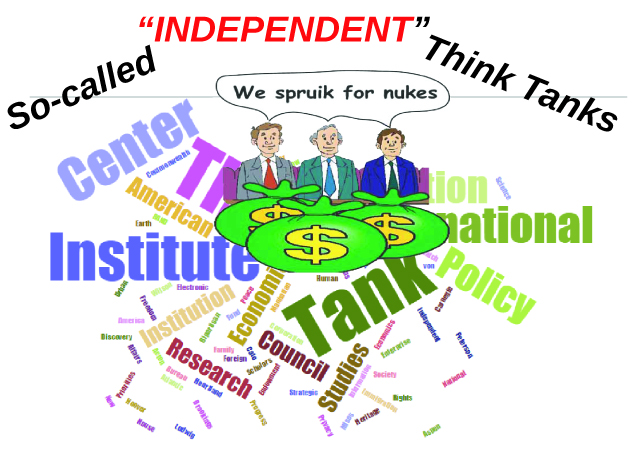
“Think tank” is a good and accurate label, not because a great deal of thought happens in them, but because they’re dedicated to controlling what people think, and because they are artificial enclosures for slimy creatures. Their job, generally speaking, is to concoct and market reasons why it would be good and smart to do something evil and stupid.
And it works. Because of the efforts of warmonger-funded think tanks like the Lowy Institute, Center for a New American Security, and the profoundly odious Australian Strategic Policy Institute (ASPI), more and more Australian brains are being turned into soup by ridiculous propaganda narratives about China posing a meaningful threat to them.
CaitlinJohnstone.com One of the weirdest things about the mass media propaganda that manipulates the way people think, act and vote to maintain the status quo is that mainstream news outlets routinely cite the employees of think tanks that are sponsored by war profiteers and government powers as expert sources for their reports. And they just get away with it.
To pick one of nearly infinite possible examples, here in Australia the Murdoch press are currently citing a report generated through the funding of governments and weapons manufacturers to whip up public hysteria about the ridiculous fantasy that China might attack us.
The most egregious of these is a write-up from Sky News with the headline, “Lowy Institute report: China possesses ability to ‘strike Australia’ with long-range missiles, bombers.“
On social media Sky News is sharing this story with the even more incendiary caption “China now has the military arsenal to pose the greatest threat to the Australian mainland since World War II, experts warn.”
The “experts” in question are the Lowy Institute, named after its billionaire founder, which is funded by multiple branches of the Australian government including ASIO and the Department of Defence, by major financial institutions and by weapons manufacturers like Boeing.
The author of the Lowy Institute report is Thomas Shugart, himself an employee of the notorious Center for a New American Security, a Biden administration-aligned warmongering think tank that receives funding from top war profiteers Boeing, General Dynamics, Lockheed Martin, Northrop Grumman and Raytheon, as well as the U.S. State Department and numerous other governments.
So, in summary, government agencies and war profiteers paid for a report which manufactures consent for their agendas among policymakers and the public, and mass media institutions passed this off as “news.”
And this is exactly what these think tanks exist to do: cook up narratives which benefit their immensely powerful and unfathomably psychopathic sponsors, and insert those narratives at key points of influence.
“Think tank” is a good and accurate label, not because a great deal of thought happens in them, but because they’re dedicated to controlling what people think, and because they are artificial enclosures for slimy creatures. Their job, generally speaking, is to concoct and market reasons why it would be good and smart to do something evil and stupid.
And it works. Because of the efforts of warmonger-funded think tanks like the Lowy Institute, Center for a New American Security, and the profoundly odious Australian Strategic Policy Institute (ASPI), more and more Australian brains are being turned into soup by ridiculous propaganda narratives about China posing a meaningful threat to them.
As The Conversation highlighted last month, a poll conducted by that same Lowy Institute claims that “only 16% of surveyed Australians [express] trust in China compared with 52% just three years ago,” that a “similar number of Australians think China will launch an armed attack on Australia (42%) as on Taiwan (49%),” and that “more Australians (13%) than Taiwanese (4%) think a Chinese invasion of Taiwan is likely sometime soon.”
Zombie Outbreak
You can understand why the Lowy Institute would want to show off numbers like that to potential sponsors, and I wouldn’t be surprised if they are entirely accurate; I’ve started conversations with complete strangers here in Victoria recently and seen them start babbling about how awful China is within a few minutes, completely out of the blue. It’s like watching a zombie outbreak in real time.
And this is of course entirely by design. Because of its useful geostrategic location in relation to China, Australia has been turned into a functional U.S. military/intelligence asset so crucial that multiple coups have been instituted here to ensure we remain aligned with the Pentagon against Beijing. You can’t have the locals meddling with the gears of your war machine with pesky little nuisances like the democratic process, so you’ve got to keep them aggressively propagandized.
This is why our consciousness is continually pummeled with think tank-manufactured narratives about China. An attention-grabbing headline about the big scary Chinese boogeyman will almost always be authored by a sleazy think tank denizen or be based on the work of one.
A few weeks ago 60 Minutes Australia ran an unbelievably hysterical segment branding New Zealand “New Xi-Land” because its government didn’t perfectly align with Washington on one particular aspect of its Cold War agenda, and it featured an interview with an Australian Strategic Policy Institute spinmeister as well as the actual ASPI office.
The Australian Strategic Policy Institute is cited by mass media outlets around the world and is funded by, you guessed it, governments and war profiteers. According to APAC News’ Marcus Reubenstein, ASPI is funded by all the usual weapons manufacturers, by the U.S. State Department and other governments.
“ASPI has received funding from the governments of Britain, Japan and Taiwan as well as NATO,” Reubenstein writes. “Among its corporate supporters are global weapons makers Thales, BAE Systems, Raytheon, SAAB, Northrop Grumman, MDBA Missile Systems and Naval Group. Yet their contribution of over $330,000 last year is dwarfed by that of a handful of government departments and agencies.”
Media citation of warmonger-funded think tanks is common throughout the Western world. Government-sponsored imperialist spin factories like Bellingcat are routinely cited by the mainstream media, and those citations are leant credibility by the fawning puff pieces which those media institutions regularly churn out about the propaganda firm.
The fact that disguising statements by propagandists who are sponsored by governments and war profiteers is journalistic malpractice should be obvious to everyone in the world, and if media and education systems were doing their jobs instead of indoctrinating society into accepting the status quo, it would be. But propaganda only works if you don’t realize you’re being propagandized, and keeping people from realizing this is itself a part of the propaganda…
Make a fortune killing people and selling their bodies and you’d be remembered as the century’s worst monster. Make the same fortune selling the weapons used to kill the same number of people in wars you propagandized into existence and you’re a respected job creator.
Absolutely appalling. https://consortiumnews.com/2021/08/13/how-war-profiteers-manufacture-consent/
People of the Pacific condemn Talisman Sabre Military Exercises
9 Aug 21, Groups from the Pacific region condemn the recent military exercises in Australia as damaging to the environment, health and peace in the region.
After two weeks of high intensity combined forces training, the U.S. forward-deployed America Expeditionary Strike Group is moving again as Australia’s largest warfighting exercise, joint exercise Talisman Sabre 2021 (TS21), winds down.
On July 24, at the height of Talisman Sabre, representatives from Pacific nations including Australia, New Zealand, Guahan (Guam), Hawaii (USA), Japan, Rep of Korea, West Papua and the Philippines called for an end to Talisman Sabre – and all exercises in the Pacific.
Their statements of concern and commitment to collaboration for peace in the Pacific can be heard here.
TS21 saw 17,000 U.S., Australian and allied troops engaging in combined land, sea and air manoeuvres inland and along the Queensland coast.
This year’s exercise marked many firsts, among them:
● The first year the ADF did not engage in Public Environment Report
● South Korea participating in Talisman Sabre for the first time, sending a destroyer. Japan, U.K., Canada, New Zealand also participated, with France, Germany, India and Indonesia present as observers.
● U.S. forward deployed Expeditionary Strike Group. America, part of the 7th Fleet, joining the exercise.
● The first use of U.S. Patriot missiles in Talisman Sabre – reportedly the first use in the Southern Hemisphere.
● First involvement of U.S.F-35B fighter jets and to integrate non-US aircraft into HIMARS system.
● First to use regional township of Hughenden and to activate RAAF Base RAAF Base Scherger in Queensland’s far north, Cape York near Weipa.
Robin Taubenfeld spokesperson for Friends of the Earth Australia and Pacific Peace Network member group said: “The Pacific Peace Network condemns Talisman Sabre. At this time of global health and climate crisis, there is no justification for ongoing investment in war or increased military activity. We call for the Pacific to be honoured for its name; rather than as a stage for sabre rattling, it should be a region of peace. ”
“2021 was a year for many notable firsts for Talisman Sabre. Though smaller in size, the exercise targeted a greater number of defence and non-defence areas and used more lethal firepower than previous exercises. If this is the down-sized version of Talisman Sabre, we are alarmed at what post-pandemic iterations of the exercise might bring.”
“2021 was the first year the ADF did not engage in the Public Environment Report (PER) process around the exercise, despite its spread into regional locations and numerous non-defence areas.”
The ramping up of firepower, the spreading of activity to Queensland’s northernmost region and the increased number of participating nations sends a clear message of U.S. allied strength to China.”
“With tensions mounting in the South China Sea, allied governments may spruik the benefits of interoperability with the U.S.”
“Many of their constituents and people around the Pacific, however, have grave concerns about the increasing presence of U.S. troops and the social and environmental cost of ongoing militarism in the region and want to see these exercises cancelled.”
For more information or interviews:
Robin Taubenfeld 0411118737 robin.taubenfeld@foe.org.au
Annette Brownlie 0431597256 Ipan.australia@gmail.com
On Hiroshima Day, the City of Newcastle reaffirms its commitment as a Nuclear Free Zone, supporting United Nations Treaty on the Prohibition of Nuclear Weapons
Hiroshima Day flag-raising reaffirms City’s commitment to Nuclear Free Zone, Mirage News, 8 Aug 21, City of Newcastle reaffirmed its long-held commitment to declaring the city a Nuclear Free Zone, raising the Hunter Peace Group and International Campaign to Abolish Nuclear Weapons (ICAN) flags in Civic Park in recognition of Hiroshima Day.
Observed each year on 6 August, 2021 marks the 76th anniversary of the devastating bombing of Hiroshima and Nagasaki by US forces.
In support of ongoing efforts to raise awareness about the campaign toabolish nuclear weapons, the flags were flown alongside the Australian and Aboriginal flags to mark the historic anniversary.
It followed a Lord Mayoral Minute supported by City of Newcastle councillors in June, acknowledging the City’s long-standing history with local, national and international peace movements, dating back to 29 June 1982 when the City first declared Newcastle a Nuclear Free Zone under Lord Mayor Joy Cummings AM, and resolving to establish with Hunter Peace Group a dedicated Newcastle Peace Park at Tighes Hill Reserve, adjacent to Islington Park.
Peace parks exist in many cities across the country, including Adelaide, Hobart and Canberra, and more locally at Cessnock and Tanilba Bay.
Lord Mayor Nuatali Nelmes said the City of Newcastle was proud to support these efforts as a progressive city.
“The City of Newcastle has a long and proud history of activism against nuclear weapons, particularly as a city with a large working port,” Cr Nelmes said.
“Former Newcastle Lord Mayor Joy Cummings was a passionate advocate for the peace movement, inspiring strong community support and joining with Hunter Peace Group, trade unionists and activists to hold demonstrations on the importance of nuclear disarmament and protecting Newcastle as a Nuclear Free City and port.
I am honoured to uphold that mission today on behalf of the City, in which there is no place for nuclear weapons in modern society.”
Hunter Peace Group Secretary Lynda Forbes said the group was pleased to continue this important work with the City of Newcastle.
While ever there is nuclear testing being conducted across the globe, Hunter Peace Group believes it is important to continue to commemorate the anniversaries of the bombing of Hiroshima and Nagasaki, to draw public attention to the threat that nuclear weapons pose to communities throughout the world,” Ms Forbes said.
“Despite City of Newcastle supporting the United Nations’ Treaty on the Prohibition of Nuclear Weapons in 2019, and advocating to the Federal Government in 2020, Australia is yet to sign and ratify the treaty, which came into force in January this year.
………..https://www.miragenews.com/hiroshima-day-flag-raising-reaffirms-citys-609135/
1 This month

of the week – Australians for War Powers Reform (AWPR)
To see nuclear-related stories in greater depth and intensity
 Antinuclear