Australia’s nuclear submarines are looking more and more like a mirage.

NUCLEAR SUBMARINES LOOK MORE AND MORE LIKE A MIRAGE, AU Manufacturing, Analysis by Peter Roberts, 18 October 21,
Admiral Mead first implied (by wanting to take a question on notice) that he had no idea of schedule, then that the boats were to be in the water by the end of next decade.
Mead then implied he had no idea of whether advice on cost was given to the government, then that advice had been ‘provided by the department to government over many months’, and then that ‘our projected cost forward is that it will be significant and it will be more than Attack’.
The upshot is that Australia entered into a process that will lead to the expenditure of more than $90 billion with only the vaguest idea of how much they would cost or when they could be delivered.
The more time passes since the Prime Minister’s sudden cancelling of our order for French submarines in favour of US or British nuclear ones, the more obvious it is that Australia will never actually acquire them.
Not only that, the more time passes the more obvious it is that even if we did buy nuclear boats, they are unlikely to be built in Adelaide. Or if Adelaide, somehow, had some involvement there would be bugger all genuine Australian industrial content in the things.
This became clearer on Friday in the Senate economic references committee when South Australian Senator Rex Patrick – himself a former submariner – closely questioned the Royal Australian Navy Commander Admiral Jonathan Mead about the N-submarine decision.
As Patrick put it later: ‘Our Collins class subs will still be needed in 2050.
“By that time the last Collins boat, HMAS Rankin, will be unmaintainable and a steel coffin in combat.”
The lack of clarity from the Navy is mirrored by other evidence given – our nuclear science agency and regulator gave very few details on what their role will be in monitoring and regulating any new nuclear propelled submarines, according to Senator Kim Carr.
But it is the likely lack of science and industry involvement in this massive expenditure which is really worrying.
Defence media has been full of speculative stories about whether any submarines would be built in Adelaide, whether Australia might lease submarines from the US, and whether these might be second-hand submarines.
Who would crew and maintain these vessels, who would provide for basic safety given that N-reactors are supposedly going to be fitted to submarines in Adelaide, and whether they would be under Australia’s sovereign control remains a mystery since we will know nothing about the nuclear propulsion systems on board.
Australia acquiring N-submarines under these circumstances is about as useful as giving Borneo head-hunters a F-35 fighter jet………………. https://www.aumanufacturing.com.au/nuclear-submarines-look-more-and-more-like-a-mirage
Uncertain delivery date for nuclear submarines. Australia’s existing fleet still in use in 2050?
Nuclear submarines’ uncertain delivery date means ageing Collins class could be in use until , could be more than 50 years old by the time the Aukus deal delivers Australia’s nuclear fleet. Guardian, Daniel Hurst and Tory Shepherd
Fri 15 Oct 2021
Australia’s navy chief has left the door open to keeping some of the existing Collins-class submarines in the water until 2050, amid uncertainty about the exact schedule for acquiring new nuclear-propelled submarines.
The government is already planning to extend the life of the six Collins class submarines by 10 years, with the extensive refitting work set to cost between $3.5bn and $6bn.
But the navy chief, V-Adm Michael Noonan, indicated on Friday that a “potential” option was to refit them a second time to further extend their life.
Given the first Collins-class submarines were commissioned in the late 1990s, that option could see them used until they are about 50 years old…….
The South Australian senator Rex Patrick accused the government of being “extremely reckless” with national security amid the latest revelations…….
At a shipbuilding committee hearing on Friday – the first since the $90bn French deal was dumped – senators explored concerns about Australia facing a “capability gap” while it waited for the new submarines to be ready……….
Labor – which has backed the Aukus plan – said the evidence raised many questions for the government, including whether the Collins class submarines would be able to withstand multiple upgrades of this type.
Labor’s defence spokesperson, Brendan O’Connor, asked: “If enhanced submarine capability is critical to our national security, why would we still have 50-year-old Collins Class vessels in 2050?”……..
The Australian government has set up a taskforce, with 89 members and growing, whose job over the next year and a half is to work with the US and the UK on “identifying the optimal pathway to deliver at least eight nuclear-powered submarines for Australia”……..
It remains unclear precisely how much the Australian government will have to pay to settle contracts with France’s Naval Group and another defence contractor, Lockheed Martin………….. https://www.theguardian.com/world/2021/oct/15/nuclear-submarines-uncertain-delivery-date-means-ageing-collins-class-could-be-in-use-until-2050
AUKUS nuclear submarines deal must be abandoned
AUKUS nuclear submarines deal must be abandoned, Pearls and Irritations, By Brian TooheyOct 13, 2021
Australia doesn’t need nuclear powered submarines, especially given the Australia’s long-standing support for the world’s nuclear non-proliferation goals.
The White House failed to think beyond its Anglo-Saxon allies in London and Canberra when agreeing to sell Australia eight nuclear submarines.
The US’s north Asian allies Korea and Japan are much closer to China and more at risk, however slight. The Japan Times responded with a cool headed article spelling out the folly of the decision. It said the US, “has put at risk long-standing but fragile global pacts to prevent the proliferation of dangerous nuclear technologies”.
It also reported that US Navy ships “use about 100 nuclear bombs worth of Highly Enriched Uranium (HEU) each year”.
Although the US or the UK is supposed to build Australia eight nuclear-powered attack submarines under as new agreement called AUKUS, there is no realistic way this can occur without trashing Australia’s long-standing support for the world’s nuclear non-proliferation goals.
One of the key problems is the US Navy insists it is essential to use uranium enriched to 93 per cent to obtain the main fissile isotope of U-235, the same level as in nuclear weapons. It also insists it couldn’t switch to low levels of enrichment without greatly increasing the costs and size of the submarines as well as the construction time.
This means the US Navy will reject Malcolm Turnbull’s suggestion to get the French to supply non-weapons grade fuel. The British can’t help as they get their HEU fuel from the US. The enrichment to 93 per cent compares to around 40 per cent for Russian and Indian submarines. The French only enrich to 7.5 per cent, China to about 5 per cent and civilian power reactors to around 3.5 per cent. Anything less that 20 per cent is defined as low level enrichment.
The White House’s attitude has changed since the 1980s when the US blocked Canada’s attempts to buy nuclear submarines from the UK or France.
Nevertheless, some members of the US Congress and senior officials want the navy to shift to low enrichment to eliminate proliferation problems.
A nuclear problem
In a letter to The New York Times, former US undersecretary of state for arms control and international security Rose Gottemoeller said the proposal to share HEU-fuelled submarines with Australia “has blown apart 60 years of US policy” designed to minimise the use of HEU uranium.
“Such uranium makes nuclear bombs, and we never wanted it in the hands of non-nuclear-weapon states, no matter how squeaky clean,” she said.
Of the seven nuclear weapons states, five have nuclear submarines. Australia will be the first non-nuclear weapons state to get nuclear submarines. The understandable concern is that other allies will want similar treatment, expanding the risk that weapons grade uranium will be stolen or diverted.
In some interpretations, a loophole exempts naval nuclear reactors from the International Atomic Energy Agency’s anti-proliferation requirements.
But there are numerous other agreements that Australia might have to comply with if it stores HEU in its submarines.
In addition, the AUKUS agreement includes Australian access to other technologies, including Tomahawk long-range cruise missiles for the navy’s Hobart-class destroyers. Because the Tomahawk can be armed with nuclear or conventional explosives, this could make it difficult to comply with the Missile Technology and Control Regime which Australia has strongly backed.
Another hurdle stems from the Howard government’s passage of a parliamentary act in 1999 outlawing just about all nuclear activities, apart from mining and exporting uranium. If circumstances prevent the US from maintaining all the nuclear aspects of Australia’s future submarines, this might spark calls for the rapid construction of nuclear facilities here. But the necessary amendments to the 1999 act could be blocked in the Senate.
Prime Minister Scott Morrison can’t credibly commit Australia to never engaging in nuclear proliferation. In the 1960s, Liberal prime minister John Gorton took preliminary steps to develop Australia’s own nuclear weapons, explaining to the US secretary of state Dean Rusk that he did not trust the US to defend Australia if it had to use nuclear weapons. A prime minister sharing Gorton’s assessment could emerge at any time.
Perhaps the White House will overrule the navy after a protracted battle to ensure the new submarines use low enrichment uranium posing no proliferation problem.
Nuclear submarines are not essential
However, the deal would still make no sense for Australia.
Government sources are widely quoted as saying the cost of the new submarines will be well over $100 billion, yet the first one won’t be operational until after 2040 and the last until after 2060. By then, the submarines would be obsolete death traps, susceptible to detection and destruction by several existing and new technologies.
The time scale reinforces the entire air of unreality about acquiring these submarines, only a couple of which may be operationally available at any one time.
Some commentators suggest Australia must buy the submarines to help the US counter a Chinese threat to Taiwan.
But no one knows what will happen to China or the US in a radically uncertain future. By 2060, China may be the dominant country in Asia, it may have returned to its earlier policy of living in Confucian harmony with its neighbours………………..
 |
Radioactive risks of nuclear submarines

The radioactive waste from reactors poses a difficult and expensive problem to manage health and environmental hazards for geological time periods. The governments involved in this proposal have been silent about disposal of the high and intermediate level waste that would be generated. Despite many flawed and failed attempts at interim storage, Australia has no current plan for disposal of the much smaller amount of its existing intermediate level radioactive waste.
Proposed US/UK nuclear-powered submarines for Australia jeopardise health while escalating an arms race no one can win
Joint statement by International Physicians for the Prevention of Nuclear War and its affiliates in Australia, UK and USA: Medical Association for Prevention of War (Australia); Medact (UK); Physicians for Social Responsibility (USA) 10 Oct 21, ”……. Radioactive risk
Nuclear reactors on ships and submarines have been involved in numerous accidents. The risks of accident or attack causing release of radioactive material combined with the targeting by adversaries of such vessels including while they are in port, are why many cities around the world sensibly oppose visits of such vessels to their harbours. Such incidents could cause chaos and panic, the need to evacuate large areas of cities for years, and expose tens or hundreds of thousands of people to harmful radioactive fallout.
Australia’s lack of nuclear scientific, engineering, management and regulatory capacity and experience will inevitably mean that more is likely to go wrong building and operating nuclear submarines. If something does go wrong with one of its nuclear submarines, the likelihood of it being quickly and effectively managed is reduced and the risks of radioactive release in a port city or into the marine or coastal environment is increased.
A total of 8 nuclear-powered submarines have sunk because of accidents at sea between 1963 and 2003 – two because of fires, two by weapon explosions, two by flooding, and one each from storm damage and unknown reasons. These contribute substantially to the already widespread radioactive pollution resulting from naval reactors. The most recently reported fatal accident was a fire in a Russian nuclear submarine in 2019, which killed 14 people.
The radioactive waste from reactors poses a difficult and expensive problem to manage health and environmental hazards for geological time periods. The governments involved in this proposal have been silent about disposal of the high and intermediate level waste that would be generated. Despite many flawed and failed attempts at interim storage, Australia has no current plan for disposal of the much smaller amount of its existing intermediate level radioactive waste. …. https://beyondnuclearinternational.org/2021/10/10/nuclear-submarine-deal-needlessly-raises-tensions/
Nuclear submarines – A step towards nuclear power and nuclear weapons?
Nuclear submarine deal needlessly raises tensions, Proposed US/UK nuclear-powered submarines for Australia jeopardise health while escalating an arms race no one can win
Joint statement by International Physicians for the Prevention of Nuclear War and its affiliates in Australia, UK and USA: Medical Association for Prevention of War (Australia); Medact (UK); Physicians for Social Responsibility (USA), Beyond Nuclear, 10 Oct 21,
”……..A step towards nuclear power and nuclear weapons?
Already, in the wake of the announced plans, there are mounting calls in Australia, including from some government MPs, for Australia to embrace nuclear power as well. Throughout the 1950s and 1960, Australia made active plans and preparations to acquire nuclear weapons. Calls that Australia needs to be prepared to acquire its own nuclear weapons, from former senior government officials and those employed by think tanks close to the government, have never gone away.
Twenty nuclear weapons could be built from the amount of HEU fuelling the nuclear reactor of each planned submarine.
The way forward
More than a leader’s word is needed to ensure that the planned submarines will not be used as the thin end of a wedge towards an expanded civil nuclear industry, such as nuclear power generation, and that the planned submarines will not be armed with US, UK or Australian nuclear weapons.
Rather than escalating a nuclear-propelled new cold war, both the UK and US should make their people and the world truly safer by pursuing a verifiable and binding agreement with other nuclear armed states to eliminate their nuclear arsenals. They should welcome and work towards joining the 2017 UN Treaty on the Prohibition of Nuclear Weapons (TPNW), which provides the only internationally agreed, treaty-codified framework for the elimination of nuclear weapons. Naval nuclear propulsion, especially with HEU, should be phased out.
There are abundant compelling reasons for all states to join the TPNW — indeed that is the best test of whether they are serious about nuclear disarmament, or not. Contrary to its support for the treaties prohibiting all other major types of inhumane and indiscriminate weapons and weapons of mass destruction — biological and chemical weapons, landmines and cluster munitions — Australia opposes the TPNW.
The best way for Australia to provide surety that any nuclear-powered submarines would not be a stepping stone towards acquiring nuclear weapons, nor have any role in the possible use of nuclear weapons, is to join the TPNW. If it continues to refuse to do so, such concerns will remain well justified.
If Australia does proceed to acquire nuclear submarines, it should insist on LEU fuel, implement stringent safeguards, the submarines should be configured so that they cannot carry nuclear weapons, and nothing about their construction or operation should impede Australia joining the TPNW.
For the full joint IPPNW statement with signatures, go here. https://beyondnuclearinternational.org/2021/10/10/nuclear-submarine-deal-needlessly-raises-tensions/
Nuclear submarine deal needlessly raises tensions — Highly Enriched Fuel a particular danger

World needs to work together, not provoke further conflict
Nuclear submarine deal needlessly raises tensions — Beyond Nuclear International 10 Oct 21, s
Proposed US/UK nuclear-powered submarines for Australia jeopardise health while escalating an arms race no one can win
Joint statement by International Physicians for the Prevention of Nuclear War and its affiliates in Australia, UK and USA: Medical Association for Prevention of War (Australia); Medact (UK); Physicians for Social Responsibility (USA)
Physicians in the countries involved in the proposal announced on 16 September for Australia to acquire nuclear-powered submarines with UK and US assistance are concerned this plan will jeopardise global health and security. Under this proposal, Australia would become the seventh country to use nuclear propulsion for its military vessels, and the first state to do so which does not possess nuclear weapons, or nuclear power reactors. These submarines are to be armed with sophisticated long-range missiles including US Tomahawk cruise missiles. These submarines would increase tensions and militarisation across Asia and the Pacific region, fuel an arms race and risk deepening a new cold war involving China.
The wrong decision at the wrong time
Humanity is in the midst of a major pandemic, and facing twin existential threats of dire urgency — global heating and the growing danger of nuclear war. People everywhere desperately require our leaders to work together to address these major challenges, which can only be solved cooperatively.
Beginning on November 1, the UN Climate Change Conference will be held in Glasgow, when leaders have a choice to condemn humanity to cascading climate catastrophe, or step up and take the decisive and ambitious actions needed to drastically reduce greenhouse gas emissions and keep warming within 1.5 degrees. COVID vaccines are still out of reach for most of the world’s poor people. If ever there was a time to build goodwill and focus on cooperation to complex global problems rather than escalate military confrontation, that time is now.
Our leaders should be focussing their energies not on escalating a new cold war arms race with China, but on building peaceful cooperation to address urgent shared threats with the government of the world’s most populous and largest greenhouse gas emitting nation.
Instead, this plan will raise tensions, make cooperation more difficult, drive proliferation of ever more destructive weapons, divert vast resources needed to improve health and well-being and stabilise our climate, and increase the risks of a slide to armed conflict between the world’s most heavily armed states, risking nuclear escalation in which there can be no winners.
Spreading nuclear bomb fuel
Commendable international efforts over decades to reduce production, use and stockpiles of highly-enriched uranium (HEU) worldwide have been supported by Australia, UK and US, including through the Nuclear Security Summits led by President Obama. In its role as G7 president, the UK has committed to ‘reinvigorate the aim of minimising production and use of Highly Enriched Uranium (HEU)’.
UK and US nuclear-powered submarines use HEU as fuel, which is directly usable in nuclear weapons, including those of the simplest design easiest for terrorists to build. Indeed their current naval reactor fuel is enriched to 93% and was originally produced for use in nuclear warheads. They have resisted and delayed efforts to convert their naval reactors to much less proliferation-prone low-enriched uranium fuel, as France and China have done, and any conversion to LEU is not likely before the late 2030s at the earliest.
So it seems very likely that any Australian nuclear submarines built with US or UK naval reactors over the next 20 years will also use HEU. Precisely because of the proliferation dangers of naval reactor fuel, the US has previously gone to considerable lengths to thwart the spread of naval reactors, such as in the 1980s blocking Canada from buying nuclear attack submarines from France and the UK.
A loophole exists in the international safeguards required under the nuclear Non- proliferation Treaty (NPT): states without nuclear weapons can remove fissile materials (which can be used to build nuclear weapons) from safeguards for a temporary period for use in military applications short of nuclear weapons. No nation has yet done this in relation to naval nuclear reactors.
The quantities of HEU involved are large. As Sebastien Philippe from Princeton University has estimated, a fleet of between 6 and 12 nuclear submarines as proposed, operated for about 30 years, will require between 3 and 6 tons of HEU. The International Atomic Energy Agency (IAEA) stipulates that 25 kg of HEU would enable a nuclear weapon, even though US nuclear weapons are known to contain an average of only 12 kg of HEU.
So HEU fuel for the proposed Australian submarines would involve 120 to 240 times the amount of HEU as the IAEA stipulates is sufficient to build a nuclear weapon, and it could be out of international safeguards for decades. Philippe has aptly characterised this as “a terrible decision for the non-proliferation regime”. It discredits all three nations’ claims to support a treaty curbing fissile materials, and would make such a treaty harder to verify.
The Australian government proclaims its support for strong nuclear safeguards, while falsely claiming that the safeguards obligations in the UN Treaty on the Prohibition of Nuclear Weapons (TPNW) are weaker than those under the NPT 3 (they are, in fact, stronger). Its plan to drive large amounts of HEU in reactors roaming the oceans for decades through a loophole in its safeguards does not indicate good faith on safeguards and non-proliferation.
This proposal needs careful independent scrutiny and strong new safeguards provisions to ensure Australia fulfills its obligations under both the NPT and the South Pacific Nuclear Free Zone Treaty. The latter goes further than the NPT in prohibiting the stationing of any nuclear explosive device in the territory of a state party.
The UK announcement in March of a planned 40% increase in its nuclear arsenal is in breach of its NPT obligations, as the UN Secretary-General has stated. The UK and US are modernising their nuclear arsenals, both in breach of their now 51-year-old legally binding NPT commitment to disarm.
Australia acquiring nuclear-powered submarines could well encourage other states, such as South Korea, Japan and Iran to pursue a similar path. Proliferation of submarines or other vessels with lifespans of several decades that are fuelled by weapons-grade HEU will encourage uranium enrichment, wider use and storage of HEU, and will set back and make more difficult control and elimination of fissile materials…….. https://beyondnuclearinternational.org/2021/10/10/nuclear-submarine-deal-needlessly-raises-tensions/
It’s unfortunate that the AUKUS nuclear submarine deal looks like weakening global nuclear non proliferation.
Limiting the nuclear-proliferation blowback from the AUKUS submarine deal, The Strategist, 21 Sep 2021|Anastasia Kapetas If the If the architects of the AUKUS pact and its headline initiative to supply Australia with nuclear-powered submarines imagined it would be seen as proliferation neutral, the reality might not be so straightforward. The announcement was extremely sketchy on many critical details, particularly from a non-proliferation perspective.
Of course, how nuclear non-proliferation issues are addressed isn’t the sole test of this deal, but it will be part of managing its future trajectory. It’s notable that the State Department doesn’t seem to have been in the loop on negotiations. It has carriage of US non-proliferation commitments, so some of the proliferation consequences may not have been front of mind.
Prime Minister Scott Morrison has said the deal will comply with Australia’s international non-proliferation commitments. That’s true, as there’s a massive loophole in Article III of the United Nations Treaty on the Non-Proliferation of Nuclear Weapons that exempts naval reactors from nuclear safeguards. However, the non-proliferation community has long seen the loophole as a major threat to one of the treaty’s key aims—to limit the production and use of highly enriched uranium (HEU), which can be used to make nuclear weapons………
There could also be implications for negotiations on the proposed fissile material cut-off treaty, historically supported by Australia, which aims to strictly limit the amount of fissile material that nucelar-weapon states can manufacture. Negotiations are locked in a stalemate, largely thanks to Pakistan. Nonetheless, the treaty’s goals have broad international support and the manufacture of more weapons-grade uranium to power Australia’s submarines will likely also set those goals back.
There seems to be an emerging consensus in the global arms-control community that the AUKUS submarine deal could have a hugely negative effect on non-proliferation norms and practices. Depending on how Washington responds, this could have an impact on how the program unfolds.
Hans Kristensen, director of the Nuclear Information Project at the Federation of American Scientists, says that the deal ‘will further intensify the arms race in the region and dynamics that fuel military competition’. Pointing to the sparse strategic rationale offered so far, he adds, ‘Other than fielding more and better weapons, does anyone have a plan?’
Similar views have rippled across non-proliferation and arms-control circles, driven by fears that the deal will set a precedent ushering in a dangerous era of loosened nuclear restraints.
Daryl Kimball, director of the Arms Control Association, points out that if Australia gets a HEU submarine like the US Virginia class, it will be the first non-nuclear-weapon state to have such a capability.
What will Washington say to other allies, such as Israel, that might want the same technology? ………..
The US and Australia both recognise the importance of strengthening global rules and the institutions that allow existential nuclear-proliferation issues to be mediated. Conventional nuclear and military deterrence might make state adversaries think twice before using nuclear weapons, but it’s of little use in stopping acquisition and the attendant risks of catastrophic miscalculation. https://www.aspistrategist.org.au/limiting-the-nuclear-proliferation-blowback-from-the-aukus-submarine-deal/?fbclid=IwAR2TrXJx7UbCJUDBUCMzhGJ0i_RFC188XE1Xotq9b-hP
Growing pressure for Australia to scrap the plan for nuclear submarines fuelled by Highly Enriched Uranium (HEU)

Experts warn Joe Biden supplying nuclear submarines to Australia threatens US security
Malcolm Turnbull says reactor not a ‘plug and play’ power pack as former US officials raise national security concerns, Guardian Tory Shepherd, Fri 8 Oct 2021 Malcolm Turnbull says reactor not a ‘plug and play’ power pack as former US officials raise national security concerns.
There is growing pressure on the new Aukus partners to scrap plans to use weapons-grade uranium on submarines.
A group of former US officials and experts has written to the US president, Joe Biden, warning the deal could threaten US national security by encouraging hostile nations to obtain highly enriched uranium (HEU).
At the same time, the former Australian prime minister Malcolm Turnbull says if Australia does buy the submarine reactors without a domestic nuclear industry – and therefore the nuclear expertise – it will be “more plug and pray” than “plug and play”.
The former Nato deputy secretary general Rose Gottemoeller has called on Australia to make a new deal with France to use their uranium, which is not weapons grade. That would heal the rift with France and ease nuclear proliferation fears, she said.
In the letter to Biden, the seven signatories called on him to commit to using low-enriched uranium (LEU), which is what the French use in their submarine program.
“The Aukus deal to supply Australia with nuclear-powered attack submarines fuelled with weapons-grade uranium could have serious negative impacts on the global nuclear non-proliferation regime and thereby on US national security,” wrote the group, which includes former White House officials.
At the heart of their concern is that if Australia, as a non-nuclear country, gets HEU then other countries would use that example to justify their own acquisition of the material.
Iranian officials intimated to the UN that, like Australia, they might want HEU for naval purposes.
France described Australia’s decision to ditch the $90bn submarine project in favour of the Aukus deal as a “stab in the back”, while Australia has argued that switching to nuclear-propelled submarines is strategically necessary.
There will now be an 18-month process to work out the details of the deal, which has come under heavy criticism.
Turnbull told Guardian Australia that the government should have stuck with the French deal, bought an initial three diesel-electric boats, then switched to their LEU technology.
That would be the “honest and straightforward” course, and would speed up the process because crews would already train in a very similar boat.
“(And) we wouldn’t have double-crossed France and destroyed people’s trust in Australia,” he added.
He said one of the reasons Australia had chosen France over Germany and Japan was the possibility of transitioning to nuclear……………
Morrison has said Australia won’t need a nuclear industry because the reactor will be made overseas then put into the Australian-built boat.
Can the Australian government ignore this powerful letter exposing the foolish decision to ”go nuclear” with submarines and AUKUS?
Ed. note. Here I summarise the points in this well-researched letter: Diplomatic Repercussions – Geopolitical Tensions and Australian National Security(Why the decision makes Australias national security worse not better) – We now have No Submarine Program at All. – But Is Nuclear the Best Stealth? – Can we Build them at Osborne? -Time to re-evaluate our Submarine Program? –The worst option is to do as we have now done. – Conclusion – This decision should be re-visited
Conclusion
The submarine decision, especially within the context of the new ‘AUKUS’ grouping, but even taken on its own:
—Worsens rather than improves Australias own national security, making us (more of) a nuclear target than we have ever been, and extending the targeting potentially from joint facilities to Australian cities and naval bases.
—Worsens rather than improves regional security, adding impetus to regional arms racing, and increasing the likelihood that other Governments may decide they would like to have submarines fueled by HEU
—Leaves Australia currently with no replacement program for the Collins Class submarines
—Makes no sense even within its own restricted terms of reference because it does not offer a submarine with the best stealth
—Requires a submarine that may not be possible to construct even in part at Osborne.
Letter Sent 5 October to Cabinet Security Cttee, Senate, Reps, DFAT, re Nuclear Subs, AUKUS,
PEOPLE FOR NUCLEAR DISARMAMENT
HUMAN SURVIVAL PROJECT – NUCLEAR SUBMARINES, AUKUS
Dear Prime Minister Scott Morrison, other decision-makers on the Australian nuclear submarines project, Cabinet National Security Committee, AUKUS:
Summary:
The decision to establish a new diplomatic/military grouping, AUKUS, deepens confrontational tendencies in the Indo-Pacific region and is hence destabilizing, and worsens rather than improves Australia’s national security. It helps to ‘paint nuclear targets on Australia’s backside’.
The decision to equip Australia with nuclear submarines fueled with highly enriched uranium is both destabilizing and proliferative even if technically within the letters of the NPT. The decision to go with HEU fueled subs in particular opens a proliferation ‘pandoras box’.
The new Australia, UK, and US nuclear submarine announcement: a terrible decision for the nonproliferation regime
The decision to ‘go nuclear’ with submarines has been justified on the supposed technical superiority of nuclear over conventional subs. However a look in detail at the real – world technical and operational characteristics of advanced conventional and nuclear subs shows clear technical superiorities on the part of advanced conventional submarines exactly where we are being told nuclear subs are superior – in the area of quietness and non-detectability. The technical case for nuclear over conventional submarines is not established.
No analysis, and no thought, has been given as to what are Australia’s real security needs, and into whether submarines of any description fit into it.
The decision leaves Australia with currently NO replacement program for the Collins Class subs.
The Submarine Decision and AUKUS
The decision to cancel an existing, well – established, contract with the French Naval Group for a diesel version of the Suffren class attack submarine has not met with universal acclaim, particularly from the French.
At the same time, the closely related decision to establish a new military/diplomatic grouping to be known as ‘AUKUS’ (Australia-UK-US) has also raised questions as to its geo-strategic impact, and contributed further to the deterioration of our relations with China, and possibly with Russia, with potentially catastrophic implications for Australias national security and the safety of all Australians.
It has quite reasonably been suggested that the establishment of ‘AUKUS” cements Australia into an ‘Anglo-sphere’ that is intrinsically limited in scope (how for example, does it relate to the ‘quad’ of India, Australia, Japan, US?), that excludes other nations that have strong Indo-Pacific interests and are allies (including France itself, now snubbed and smarting), and above all, that deepens confrontational attitudes in the region, especially with China.
It is by no means clear that the decision to substitute nuclear powered submarines is even the best decision on technical grounds, or that nuclear powered submarines are necessarily superior in the respects that might be important to Australia and particularly in extreme stealth – to conventionally powered submarines, either the existing Collins class, the erstwhile projected French submarine, or to an evolutionary successor to Collins.
Continue readingWill all submarines, even nuclear ones, be obsolete and ‘visible’ by 2040?
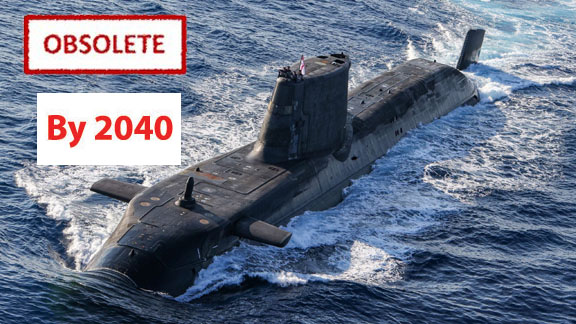
Will all submarines, even nuclear ones, be obsolete and ‘visible’ by 2040?
Technologies could render the ocean transparent by the time Australia’s new submarines are ready, some experts say, Guardian, Tory Shepherd, 5 Oct 21, Australia’s proposed nuclear-powered submarines could be obsolete by the time they hit the water in the 2040s due to new technologies making underwater vessels “visible”, some experts argue.
One of the controversies over the federal government’s decision to ditch the $90bn deal to build conventional submarines in favour of nuclear boats is the timeline for getting them battle-ready.
The navy will have to stretch out the lifespan of the existing Collins-class fleet and possibly hire submarines to fill the gap before the new ones are on the horizon.
But even before the deal to buy 12 submarines from France’s Naval Group was made, military analysts warned that submarines of all types would be rendered obsolete by new technology including submersible drones and new weapons systems.
There are also warnings that different technologies will render the ocean “transparent”, so even the stealthiest submarines could be spotted by an enemy force.
The Australian National University’s National Security College report Transparent Oceans? found that transparency is “likely or “very likely” by the 2050s, a decade after Australia’s new fleet of nuclear-powered subs is due to enter service.
A multidisciplinary team looked at new sensor technology, underwater communications and the possibility of tripwires at choke points. They also examined new ways to detect chemical, biological, acoustic and infra-red signatures, finding that even with improvements in stealth submarines will become visible.
The report found “future technologies will make the oceans broadly transparent and counter-detection technologies will not have the same salience in the decades ahead as they have had previously”.
China has already developed submarine-spotting lasers.
CSIRO is working with a Chinese marine science institute that has separately developed satellite technology that can find submarines at depths of up to 500 metres.
That collaboration is due to end next year. The Australian has reported that Asio warned it could help the Chinese navy to hunt down Australian submarines but CSIRO said making that connection was “alarmist and irresponsible reporting”.
The defence analyst Albert Palazzo, writing for the Lowy Institute, said China’s technology will be advanced enough that “any Australian submarine that attempts to do something in these waters, such as launch a tomahawk missile, will reveal its position and shortly thereafter be destroyed”.
Others say submarines are just a base platform for a range of new and evolving technologies…………….
According to the taskforce set up under Aukus, the new submarines will have “superior characteristics of stealth, speed, manoeuvrability, survivability, and almost limitless endurance”, with better weapons, the ability to deploy drones and “a lower risk of detection”. https://www.theguardian.com/australia-news/2021/oct/05/will-all-submarines-even-nuclear-ones-be-obsolete-and-visible-by-2040
Taiwan endorses AUKUS pact, asks Australia for help in war with China
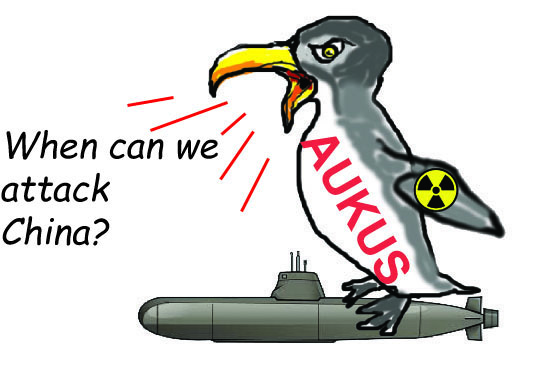
Taiwanese Foreign Minister warns his country is preparing for war with China, asks Australia for help, ABC, by defence correspondent Andrew Greene and Stan Grant 4 Oct 21, Taiwan’s Foreign Minister warns his nation is preparing for war with China and urges Australia to increase intelligence sharing and security cooperation as Beijing intensifies a campaign of military intimidation.
Key points:
- Taiwan’s Foreign Minister Joseph Wu warns of looming war with China and urges closer cooperation with Australia
- Dozens of Chinese military aircraft have flown into Taiwanese airspace in recent days
- Mr Wu has also thanked Australia for supporting Taiwan’s bid to join a new trade pact
Dozens of aircraft from the People’s Liberation Army (PLA) have flown sorties into Taiwan’s Air Defence Identification Zone (ADIZ) since Friday, prompting the self-ruled island to scramble its own military jets.
Speaking to the ABC’s China Tonight program, Taiwan’s Foreign Minister Joseph Wu declared that if the PLA were to launch an actual strike, his democratic state would be ready to repel it……………
Australia does not formally recognise Taiwan diplomatically, but the federal government regularly calls for a “peaceful resolution” of differences between China and the small independent nation through dialogue and without the threat or use of force or coercion.
A communique issued after last month’s AUSMIN meetings between Australia and the United States declared that “both sides stated their intent to strengthen ties with Taiwan, which is a leading democracy and a critical partner for both countries”.
Taiwan endorses new AUKUS pact, won’t seek its own nuclear submarines
Taiwan has also welcomed the recent establishment of the AUKUS strategic partnership between Australia, the United Kingdom, and the United States, as well as the growing activity between the Quad allies, the US, India, Australia and Japan.
……………….The Taiwanese Foreign Minister said that unlike Australia, his nation would not be trying to acquire nuclear-powered submarines, because it has a “different war strategy”.
Defence analyst Professor Clinton Fernandes from the University of New South Wales warns it would be difficult for the US and allies to prevent any invasion attempt by China……….. https://www.abc.net.au/news/2021-10-04/taiwan-preparing-for-war-with-china/100511294
Unknowns about Australia’s proposed nuclear submarines, especially weapons proliferation risks
U.S., UK Pledge Nuclear Submarines for Australia, October 2021 Arms Control Association,
By Julia Masterson, Australia could become the first non-nuclear-weapon state to field a nuclear-powered submarine as part of a new trilateral security partnership with the United States and United Kingdom known as AUKUS. The initiative was unveiled at a joint virtual press conference held Sept. 15.
…………… The United States has shared nuclear submarine propulsion technology only with the UK, a product of a series of Cold War agreements aimed to counter Soviet influence in Europe.
The UK Royal Navy operates three nuclear-powered submarine systems: the Vanguard-class ballistic missile submarine and the Astute- and Trafalgar-class attack submarines. Johnson said the AUKUS partnership will provide “a new opportunity to reinforce Britain’s place at the leading edge of science and technology, strengthening our national expertise.”
Morrison said that Australia will work with Washington and London over the next 18 months “to seek to determine the best way forward to achieve” a conventionally armed nuclear-powered submarine fleet. He also said that the submarines will be constructed “in Australia in close cooperation” with the UK and the United States. The submarines will reportedly be finished in time to be fielded in the 2040s. Early reports suggest Australia may lease U.S. or UK nuclear-powered submarines in the meantime, but the details remain unclear.
At a press conference in Canberra on Sept. 16, Morrison noted that “[n]ext-generation nuclear-powered submarines will use reactors that do not need refueling during the life of the boat. A civil nuclear power capability here in Australia is not required to pursue this new capability.”
A senior Biden administration official appeared to confirm on Sept. 20 that the vessels will be powered with HEU, as UK and U.S. submarines are, when they commented on Australia’s fitness for “stewardship of the HEU.” It remains unclear who would supply Australia with the fissile material necessary to fuel the submarines or whether the nuclear-powered submarines might be provided through a leasing arrangement.
Another unknown is whether the submarine design will be based on existing U.S. or UK attack submarines or an entirely new design. One of the reasons that Australia may lease U.S. or UK vessels in the near term is to “provide opportunities for us to train our sailors, [to] provide the skills and knowledge in terms of how we operate,” Australian Defense Minister Peter Dutton told reporters Sept. 19, suggesting the new submarines may share a similar design.
The AUKUS initiative is not limited to the new submarine project. It will also facilitate the sharing of information in a number of technological areas, including artificial intelligence, underwater systems, and quantum, cyber-, and long-range strike capabilities. Morrison said Australia will also enhance its long-range strike capabilities through the purchase of Tomahawk cruise missiles and extended range Joint Air-to-Surface Standoff Missiles.
………. Australian, UK, and U.S. officials have endeavored to assure the international community that the initiative does not pose a heightened proliferation risk………
Most nonproliferation experts, however, say the concern is not necessarily with Australia’s intentions but the precedent that the nuclear-powered submarine-sharing scheme would set. Although Australia’s new submarines would be conventionally armed, they clearly would be deployed for military use and will reportedly utilize HEU, which can also be used for nuclear weapons………
In a Sept. 21 letter to the editor published in The New York Times, Rose Gottemoeller, former U.S. undersecretary of state for arms control and international security, criticized the proposal to share HEU-fueled submarines with Australia. The proposal, she wrote, “has blown apart 60 years of U.S. policy” designed to minimize HEU use. “Such uranium makes nuclear bombs, and we never wanted it in the hands of nonnuclear-weapon states, no matter how squeaky clean,” she said.
As recently as May 2021, the UK and United States declared that they wanted to “reinvigorate” efforts to minimize the use of HEU, according to the official statement laying out the goals for the G7 Global Partnership Against the Spread of Weapons of Mass Destruction. (See ACT, June 2021.) Reducing the production and use of HEU “enjoys broad support but requires more solid political support,” the statement said.
Senior Biden administration officials have called the decision concerning Australia “a one-off,” implying that similar arrangements would not be made with other U.S. allies.
Despite support for the new initiative among the three capitals, the AUKUS partnership risks undermining U.S. and UK relations with allies, particularly France……………
Paris also cancelled a French-UK defense minister’s summit scheduled for the week of Sept. 20.https://www.armscontrol.org/act/2021-10/news/us-uk-pledge-nuclear-submarines-australia
Vatican not happy with Australia getting nuclear submarines (that’s except for George Pell, who backs them)
Vatican drops its oar into Aussie bid for nuclear submarines, THE AUSTRALIAN, TESS LIVINGSTONE 3 Oct 21, The Vatican has raised concerns about AUKUS, Australia’s defence collaboration with the US and Britain, especially the agreement to help the Australian Navy acquire a fleet of eight nuclear-powered submarines.
Secretary of State Pietro Parolin, the main architect of the Vatican’s secretive agreement with the Chinese Communist Party government, spoke to journalists on September 23, during a meeting of the European’s People’s Party in Rome. He is second behind Pope Francis in the church hierarchy.
“The Holy See is against rearmament,’’ Cardinal Parolin said. “All the efforts that have been made and are being made by the Vatican are to eliminate nuclear weapons because they are not the way to maintain peace and security in the world. They create even more dangers for peace and even more conflict.’’
……… Cardinal George Pell, who has returned to Rome from Australia and was questioned last week about Cardinal Parolin’s views, backed the deal and the AUKUS partnership. “I agree, as do the vast majority of my fellow citizens and the political forces of government and opposition,’’ he told Italian newspaper Avvenire…….. https://www.theaustralian.com.au/world/vatican-drops-its-oar-into-aussie-bid-for-nuclear-submarines/news-story/8e5f5aede5b66ae8ca611655f42856b8
Russia warns that AUKUS is a ” a great challenge to the international nuclear non-proliferation regime.”
AUKUS deal leaves Russia ‘concerned’ that Australia will have nuclear-powered submarines, ABC 1 Oct 21, Russia says it is concerned that the AUKUS defence agreement between Australia, Britain and the United States will allow Australia to enter the select group of nations that operate nuclear-powered submarines.
Key points:
- Deputy Foreign Minister Sergei Ryabkov said the pact is a challenge to global nuclear non-proliferation
- The EU has delayed free trade talks with Australia for a month but denies it is in retaliation for ripping up a submarine deal with France
- The AUKUS announcement has angered China which has previously questioned Australia’s willingness to improve relations
Currently the United States, Russia, Britain, France and China operate such submarines.
The three-way pact, under which Australia will obtain nuclear submarine technology from the United States, has angered France and concerned China since it was announced………..
We are also concerned about the … partnership that will allow Australia, after 18 months of consultations and several years of attempts, to obtain nuclear-powered submarines in sufficient numbers to become one of the top five countries for this type of armaments,” Mr Ryabkov was quoted as saying by Russia’s TASS news agency.
“This is a great challenge to the international nuclear non-proliferation regime.”
China’s Foreign Minister Wang Yi said earlier in the week that the security pact brings a hidden danger to regional peace, stability and international order.
Foreign ministry spokesman Hua Chunying also questioned whether Australia really cared about improving relations with China.
The defence pact has worried some of Australia’s closer neighbours…………. https://www.abc.net.au/news/2021-10-02/russia-concerned-about-aukus-and-nuclear-submarines/100509258
Australia the sucker for cash-strapped U.S, and U.K submarine companies General Dynamics and BAE Systems

UK Prime Minister Boris Johnson is close to BAE, the UK defence contractor whose nuclear subs program is struggling. The submarine program in the US too is foundering, so the game plan by our AUKUS partners is to rope in the dopey Aussies for a hundred billion dollars-plus to finance their distressed submarine sectors.
Both US submarine builder General Dynamics and its British counterpart BAE are looking for a new income stream from Downunder.
$66 Billion Reasons: did Scott Morrison get the French submarines right? By Michael West| September 30, 2021 ….. Michael West investigates the awkward AUKUS alliance and whether Scott Morrison made the right call on French submarines.As if ……….being dead last in the developed world on climate action , Scott Morrison and his Coalition have now burnished their reputation for incompetence on the global stage.
In one fell swoop, the sudden AUKUS declaration, they have achieved a stunning betrayal of the French, further peeved our biggest trading partner China, upset half of Europe, shown the bird to New Zealand and our neighbours in the Asian region, and waved an open cheque-book at the US and the UK military industrial complex.
Yet, in their ardour to crawl back to the Mother Country and bat their debutante eyes at Washington, they appear to have got something right: axing the French submarines. Are our self-described band of “Superior Economic Managers” accidental heroes, or did they mean to get it right?
If they double down and splash $100b plus on nuclear submarines, they will have got it doubly wrong.
Defence correspondent Michelle Fahy has documented here the $90b shocker which is Australia’s deal with French shipbuilder Naval Group. Naval itself has an ugly history of corruption and there are serious questions about how the deal came about in the first place, indeed serious questions about the billions in public money smoked every year in Defence procurement.
Murder, corruption, bombings – the company at centre of Australia’s submarine deal
The arms company at the centre of a deadly criminal saga and numerous global corruption scandals, Naval Group, was selected by the Australian government to build our new fleet of submarines – a deal heralded as ‘one of the world’s most lucrative defence contracts’. How did this happen? In this special investigation Michelle Fahy discovers significant gaps in anti-bribery and corruption measures.
Yet there is upside. Scott Morrison and co have junked a deal which would have delivered a fleet of expensive, obsolete submarines 20 years too late for the war which the government’s champions in the media keep telling us we might have to fight against China. Even though a war with China is nothing more than a grotesque proposition, scaremongering by the weapons lobby and media to distract from corruption and mismanagement at home. Media war porn.
The same might be said of the F-35 Strike Fighter debacle and the BAE frigates scandal. Every large defence procurement is marred by billions of dollars in waste. But here’s the thing with the subs; there is a solid body of work which suggests submarines are already obsolete, nuclear or not. They can be tracked; they are a titanic waste of money.
The National Security College (Federal Government and ANU) published a working paper in May 2020 saying nuclear powered ballistic missile submarines will be detectable at sea.
Meanwhile, the French are complaining we owe them $US66 billion for reneging on the deal with Naval. That’s an ambit claim, to be sure. It might cost the government $5b-$10b all up, some already sunk, the rest to stave off an embarrassing court action; but the result so far is: one, no obsolete subs deal with the French, and two, only a mooted nuclear subs deal with the Brits and Americans which may never happen. Hopefully.
UK Prime Minister Boris Johnson is close to BAE, the UK defence contractor whose nuclear subs program is struggling. The submarine program in the US too is foundering, so the game plan by our AUKUS partners is to rope in the dopey Aussies for a hundred billion dollars-plus to finance their distressed submarine sectors.
The doctrine of the gullible Aussie is getting airplay in the US press. According to war contractor expert Charles Tiefer in Forbes:
“Under the cloud of smoke around the Australian submarine deal, are the unspoken aspects of the enrichment of American military contractors. There is no public mention of which American contractors will build the expensive parts of the expensive Australian submarines.”
Both US submarine builder General Dynamics and its British counterpart BAE are looking for a new income stream from Downunder.
Should the Coalition stay true to its track record of dithering though, it may soon become evident that submarines in general are a leviathan waste of money and public money ought to be expended on something less wasteful.
Scott Morrison might, unwittingly, have got it right. He might not have to spend much on submarines at all. The question then becomes, what has he got us into?
Back to the future
As three former prime ministers in Paul Keating, Malcolm Turnbull and Kevin Rudd have already pointed out, AUKUS puts Australians in greater danger, renders Australia a vassal to foreign power and antagonises our neighbours in the region.
Depending on how you count them, there are probably already four US bases in operation now:
- Pine Gap near Alice Springs, Northern Territory,
- Naval Communication Station Harold E. Holt, north of the town of Exmouth, Western Australia,
- Robertson Barracks in Darwin, Northern Territory,
- Australian Defence Satellite Communications Station near Geraldton, WA.
However, the US military already has access to all major Australian Defence Force (ADF) training areas, northern Australian RAAF airfields, port facilities in Darwin and Fremantle, and probably future access too to an expanded Stirling naval base in Pe
Under AUKUS, this may just be the beginning. It was largely ignored during the AUKUS media blitz and the dramatic cuckolding of the French but Peter Dutton had this to say at his press conference on September 16,
Unveiling plans for new facilities on Australian soil for US naval, air, and ground forces would entail “combined logistics, sustainment, and capability for maintenance to support our enhanced activities, including … for our submarines and surface combatants”. That is on top of “rotational deployments of all types of US military aircraft to Australia”.
If the plan is to shred Australia’s sovereignty and make us a target for China, he is succeeding with aplomb. We are about to be swamped by US military.
Forward to the past
It is poetic too, that at this very time we are striking even stronger and even more unnecessary ties with Westminster and Washington. Boris Johnson’s government is beset by the chaos which is Brexit, such chaos now that it has spawned a global energy emergency. While the EU has the wobbles on its trade deal with Australia, Boris is in the market for a friend.
It is poetic too, that at this very time we are striking even stronger and even more unnecessary ties with Westminster and Washington. Boris Johnson’s government is beset by the chaos which is Brexit, such chaos now that it has spawned a global energy emergency. While the EU has the wobbles on its trade deal with Australia, Boris is in the market for a friend………… https://www.michaelwest.com.au/aukus-french-submarines-scott-morrison/
1 This month
17 October, Free Public Talk on Nuclear Issues in South Australia
David Noonan will speak on public interest concerns over the new Roxby Downs Indenture Act 2026 on BHP copper-uranium mining and ore processing in SA, and on how AUKUS may face SA with a High-Level nuclear waste agenda.
Dr Jim Green will discuss international developments in the field of nuclear power including ‘small modular reactors’ and Generation 4 ‘advanced’ nuclear reactor concepts.


Help Aunty Sue Protect Her Land and Sacred Sites From Destructive Rocket Testing.
.

Australians deserve the truth
about
AUKUS – https://aukuspublicinquiry.com/

PETITION – To: Prime Minister Anthony Albanese and the Australian Labor Government

of the week – Australians for War Powers Reform (AWPR)
To see nuclear-related stories in greater depth and intensity

