On the brink of a new nuclear arms race.

Ed. note. An intelligent article (for THE AUSTRALIAN, that is) with insights into the current nuclear arms race, and into why Australia should not aim to get nuclear weapons.
Still, the rest of the article goes on to praise the American war machine, and to advise Australians to stick with it. That is the sucking up to America thinking that we have come to know and love, from Murdoch’s THE AUSTRALIAN
Worrying signs we’re on the brink of a new nuclear arms race, THE AUSTRALIAN By ALAN DUPONT From Inquire rAugust 7, 2021
There are worrying signs the world is on the brink of a new nuclear arms race. A regional conflict between nuclear-armed states could escalate quickly into a destructive global crisis with catastrophic consequences.
Fear that a conflict between the US and China over Taiwan could go nuclear is shaping the government’s risk assessments, strengthening the case to upgrade our missile defences for critical defence installations and operationally deployed units of the Australian Defence Force………..
Although China’s arsenal is still dwarfed by those of the US and Russia, its nuclear breakout could double the number of its nuclear warheads. The expansion is part of a disturbing global trend that reverses the late Cold War momentum towards nuclear arms reductions. There are continuing tensions over North Korea’s nuclear weapons program. Tehran is inching its way towards becoming the 10th nuclear weapons state despite the Biden administration’s efforts to resurrect a nuclear deal abandoned by Donald Trump. And Russian military planners seem to believe it is possible to win a limited nuclear war in what has been dubbed an “escalate to de-escalate strategy”……….
The Cold War was fought in the shadow of nuclear Armageddon.
The 1962 Cuban missile crisis came perilously close to initiating an existential war that would have devastated the planet and killed more than 100 million Americans and Russians.
These estimates don’t include deaths from the long-term effects of radiation and the nuclear winter that would follow, blanketing the sun and causing massive crop losses and damage to the Earth’s ecosystem. A 1982 study calculated that if Europe, China and Japan were included, there would be 400 million to 500 million fatalities.
After the close call in Cuba, a new doctrine emerged. Mutual assured destruction recognised that since the US and Soviet Union each had a comparable number of warheads neither could win a nuclear war. Any attempt to strike pre-emptively would be tantamount to suicide since the country attacked would have enough missiles left to annihilate the other.
MAD was satirised brilliantly by Stanley Kubrick in the memorable black comedy starring Peter Sellers as the US President’s eccentrically unhinged scientific adviser, Dr Strangelove………
The main concern after the Cold War break-up of the Soviet Union was that “loose nukes” might fall into the hands of terrorists untroubled by moral constraints and undeterred by the superior military power of nation-states. While still a problem, a bigger concern is the emerging second cold war between the US and its authoritarian challengers, Russia and China, which is eroding the trust essential for verifiable arms control agreements.
Most forms of bilateral arms control between the US and Russia have collapsed since the arms control agreements signed by Reagan and Gorbachev in the late 1980s. Beijing has resisted pressure to join new arms control talks, fearful of being locked into the position of a second-rate nuclear power since it has only a fraction of the nuclear weapons possessed by the US and Russia.
Other important drivers of the new nuclear arms race are Beijing’s determination to become a fully fledged nuclear power, Washington’s decision to modernise its nuclear forces and the development of smaller, stealthier and low-yield nuclear weapons.
The outcome of this race is less predictable and even more dangerous than before because there are more players, fewer constraints and greater potential for the proliferation of destabilising nuclear weapons technologies. Today’s nukes can be carried by an expanding list of delivery systems – from suitcases and artillery guns to cruise missiles and super-fast hypersonic missiles…….
Technological advances – notably the miniaturisation of nuclear warheads and advances in guidance systems, sensors and satellites – have increased the speed, accuracy and manoeuvrability of the latest missile classes.
They also have reduced warning times dramatically, encouraging hair-trigger “launch on warning” responses that make nuclear war more probable……………….
Trump ruffled feathers in Beijing and Moscow by proposing to spend $US1 trillion across the next 30 years upgrading all three elements of America’s nuclear triad (land, air and sea). His 2018 Nuclear Force Posture Review declared new warheads were necessary to maintain the viability of the US nuclear deterrent and to provide more flexibility for a range of plausible contingencies. These new warheads – low-yield variants of the missiles on its nuclear submarines and sea-launched cruise missiles – were heavily criticised as destabilising by Moscow and Beijing, as well as non-government organisations advocating for reductions in nuclear arms.
Despite branding Trump’s warhead initiative as a “bad idea” on the campaign trail and assuring NGOs the current arsenal “is sufficient”, Joe Biden has left intact Trump’s key initiatives and asked congress for a similar level of funding. This has drawn the ire of critics including progressives in his own party, who accuse Biden of expanding nearly all Trump’s programs and have vowed to fight his budget request.
Beijing’s historic nuclear shift must be seen against the background of a fragmenting international order. Confronted with the mega-challenges of the mutating Covid-19 pandemic and a warming planet, the last thing the world needs is a new nuclear arms race and a China determined to close a perceived [ perceived? it’s real] nuclear gap with the US. But that’s where we are headed……………
…….under pressure to develop our own nuclear weapons. But going down this path would be folly. Apart from stirring domestic controversy, a decision to develop nuclear weapons would be prohibitively expensive, alarm our neighbours and fly in the face of our commitment to the nuclear non-proliferation treaty. A handful of Australian nukes could never replace the protection afforded by the US nuclear guarantee………… https://www.theaustralian.com.au/inquirer/how-were-relearning-to-worry-about-the-bomb/news-story/422df1145c1965471987fb043bdf7769
Victoria’s Bayside Council call on Australian government to support the UN nuclear weapons ban treaty
Bayside Council supports nuclear prohibition,, https://www.miragenews.com/bayside-council-supports-nuclear-prohibition-601949/ 26 July 21, Bayside City Council has become the 11th Council in Victoria to join the call for the Australian Government to sign and ratify the United Nations (UN) Treaty on the Prohibition of Nuclear Weapons.
In a unanimous decision at the July 2021 Council Meeting, Bayside Councillors declared their support and are now calling on the Australian Government to sign the Treaty without delay.
Nuclear weapons pose a threat to communities throughout the world, and we believe all people, including our residents, have the right to live in a world free from this threat,” Mayor Cr Laurence Evans said.
“Any use of nuclear weapons, whether deliberate or accidental, would have catastrophic, far-reaching and long lasting consequences for people and the environment.”
Australia has not signed or ratified the Treaty, despite committing to pursue nuclear disarmament under the 1970 nuclear Non-Proliferation Treaty.
“It’s time for Australia to sign and get on the right side of history,” Cr Evans said.
Part of the Council resolution includes writing to the Foreign Affairs Minister, and the local Federal member of parliament, advising of Council’s support to the Treaty.
t was also resolved that Council will take steps to ensure that funds administered by Bayside City Council are not invested in companies that produce nuclear weapons.
Bayside City Council is the 11th Victoria Council to join the International Campaign to Abolish Nuclear Weapons (ICAN) Cities Appeal- a global call from cities and towns in support of the UN Treaty on the Prohibition of Nuclear Weapons.
(ICAN) is a coalition of non-governmental organisations in 100 countries promoting the implementation of the United Nations Treaty on the Prohibition of Nuclear Weapons. Founded in Melbourne in 2007, ICAN was awarded the 2017 Nobel Peace Prize
US and Allies’ military machine – out of Afghanistan (where it’s needed) and into the Pacific – against its new enemy – The Great Barrier Reef

War games on despite pandemic, threat to Great Barrier Reef https://www.greenleft.org.au/content/war-games-despite-pandemic-threat-great-barrier-reef, Kerry SmithJuly 16, 2021 Lurking off the coast of China’s eastern seaboard now are three United States aircraft carrier battle groups (each with about 30 support vessels).
They will be joined by a British aircraft carrier group and Australian and Canadian warships as part of biennial military exercises, which start on July 18 and last until the end of the month.
Talisman Sabre 2021 (TS21) will involve a US expeditionary strike group from the USS America, the amphibious assault ship based at Sasebo Naval Base in Japan, and 17,000 Australian, US and foreign troops in combined land, sea and air war exercises.
According to Stars and Stripes, for the first time, there will be live-fire training: the US Army will fire a Patriot missile defense system from Shoalwater Bay in Queensland at a pair of drone targets on July 16.
This is within the Great Barrier Reef Marine Park and other environmentally and culturally significant areas.
The war games will also take place in Darwin in the Northern Territory and Evans Head, New South Wales.
All are thousands of kilometres away from their home base, and provocatively close to the new declared enemy — China.
Forces from Canada, Japan, New Zealand and the Republic of Korea will take part and Australia-based personnel from India, Indonesia, France and Germany will observe.
Meanwhile, the ABC’s “defence correspondent” hyperventilated on July 14 that a solitary Chinese military ship, outside Australian territorial waters, poses a threat to national security.
The Independent and Peaceful Australia Network (IPAN) is concerned about both the war games and its impact on environmentally and culturally significant sites.
“TS21 will involve amphibious assaults, movement of heavy vehicles, use of live ammunition as well as the use of U.S. nuclear-powered and nuclear-weapon capable vessels,” IPAN spokesperson Annette Brownlie said.
“These activities are incompatible with the protection of the environment and, in particular, the Great Barrier Reef.
“During Talisman Sabre 2013, the US jettisoned four unarmed bombs on the Great Barrier Reef when they had difficulty dropping them on their intended target, Townshend Island,” Brownlie said.
The objective of Talisman Sabre is to further integrate the Australian military with the US — now ranked among the world’s worst polluters.
IPAN said the ADF did not engage in a Public Environment Report process for TS21 and has yet to release an environmental assessment for the areas in which TS21 will take place.
However, the Department of Defence did produce an environmental awareness video for visiting troops that promotes the military use of the Great Barrier Reef. The video reminds troops to consider the reef and not to litter.
“Talisman Sabre is a threat to the reef and to the environment. Putting out a video is a completely inadequate response,” Brownlie said.
This comes as federal environment minister Sussan Ley is lobbying to keep the Great Barrier Reef off the United Nations Educational, Scientific and Cultural Organization World Heritage Committee’s “in danger” list.
Despite a global pandemic, about 1800 foreign military personnel have arrived in Darwin to participate.
Australia’s weapons lobby drumming up fear of nuclear attack by China, against all logic

Those in Australia beating the “drums of war” point to Taiwan as the flashpoint for the next major global conflict. To what end does a first strike on Australia achieve China’s goals in relation to Taiwan?
War with China: zero logic yet the weapons lobby has 42% of Australians believing it Michael West Media, by Marcus Reubenstein | Jul 16, 2021 Incredibly, a survey finds 42% of Australians believe China will attack Australia, this despite exports to China surging 36% over in the last six months, and despite there being no logical rationale for war with China, or an attack by China. Marcus Reubenstein analyses the ludicrous position of Australia’s China hawks and the mainstream media pushing their agendas.
“Cry ‘Havoc!’ and let slip the dogs of war.”
William Shakespeare, Julius Caesar Act 3, Scene 1
China is a rapidly growing economic power, seeking to exert considerable influence in its region and beyond. And like every great power it is a bully which tries to entice, cajole or intimidate other nations into adopting its view of the world.
How is this such a difficult concept for Australians to embrace?
Since Federation we’ve tied our fortunes to two great powers, the declining British Empire then the rising, and rising even more, US global hegemony……….
Who is threatening whom?
A new report from the Australia Institute begins with the following words:

“In April this year, Australians were warned by no less an expert than the former Minister for Defence, Christopher Pyne, that they may need to engage in a ‘kinetic’ war with China in the next five to ten years.”
Perhaps, in the realm of China policy, ‘no lesser expert’ better describes his authority on the subject.
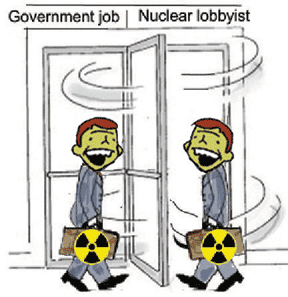
The same Pyne, famously discussed his role as a defence industry consultant with EY whilst he was a sitting member of the Federal Cabinet, a matter which prompted a Senate investigation.
He still works for EY, sits on the board of defence contractor XTEC, is Chair of the Advisory Board of another defence contractor NIOA, and in June last year Arawa Capital announced him as Chair of its Advisory Board and Investment Committee for a fund investing in weapons systems.
In heralding that appointment Arawa specifically referred to the, still unsubstantiated, Scott Morrison announcement of a malicious cyber attack by an unnamed “state-based” actor. Arawa trumpeted Pyne has “unrivalled knowledge of the cyber, intelligence and national security landscape.”
With Pyne on board, Arawa said it “anticipates closing out the initial $50mil capital raising swiftly.” It transpired there was a swift “closing out”, ASIC records show six months later Arawa Capital Pty Ltd was deregistered as a company.
According to research from Michael West Media’s “Revolving Doors” series, Pyne’s numerous board memberships and consultancies put him in direct, or indirect, contact with more than a dozen weapons makers and contractors.
Clearly, talking up a war with China is of no financial benefit to these companies.
Why would China attack Australia?
Should Australia go to war with China in defence of Taiwan? is the title of the Australia Institute report and 42% of its six hundred respondents think China is poised to attack Australia.
How and why?
Those in Australia beating the “drums of war” point to Taiwan as the flashpoint for the next major global conflict. To what end does a first strike on Australia achieve China’s goals in relation to Taiwan?
If Australia has something China wants, it is many times cheaper and easier to buy it than to send your army half way around the world to steal it.
China’s current leadership is presiding over a great deal more diplomatic disasters than triumphs but, if nothing else, the Chinese are pragmatic.
Australia’s rabid China hawks will no doubt dismiss such assessments, saying China doesn’t need to deploy military assets it would simply launch a nuclear strike on a target—which they ignore is home to 1.2 million ethnically Chinese people.
My counter argument?
The policy wonks in Washington, who made you their lapdogs, didn’t throw you a bone because they thought you were smart, they threw you the bone because they knew you were dumb enough to catch it!
This survey’s inconvenient truth
The same number of respondents were polled in Taiwan and only a few more (49 percent) expressed fears of an attack from the mainland. Bear in mind the Taiwanese are of the same Han ethnicity as the majority of Chinese, who moved over from the mainland in the 1680s; the PRC has never given up its claim to what was once part of China; and the island sits just 161 kilometres off the coast of China.
That four in ten Australians should think Beijing—a mere 9,000 kilometres from Canberra—is gearing up for invasion is staggering.
Report author Allan Behm noted, “Given Australia and Taiwan’s historical and geographical differences, it is astounding that Australians could be more fearful than Taiwan in anticipating an attack from China.”
This anticipation is undoubtedly fuelled by Australia’s China hawks, all with close ties to US-funded research groups and patronage from US weapons makers.
However, they should not be too smug in thinking their “drums of war” are resonating.
73 percent of Australians regard the United States as an aggressive nation, while only six in ten Australians believe the US would come to our aid in the event of war with China.
Given Australia has followed the United States into 100 percent of its wars, that Australians would only rate America a 60 percent chance of leaping to our defence is a sobering statistic.
Totally at odds with Prime Minister Morrison and Foreign Minister Maris Payne’s unquestioned support of the US antagonism towards China, 75 percent of Australians think it is in our interests that China and the US “work together towards world peace”. Of concern to the spin merchants inside the government an even higher number of coalition supporters, 79 percent, think peace with China is a good idea.
Despite the US, and Morrison’s, rhetoric of Taiwan being a like-minded democracy of shared values, 76 percent of Taiwanese rate America as an aggressor. Should the US come to Taiwan’s aid in a war with China, only 18 percent of Taiwanese people think they would win.
How reliable are drummers?
By any sensible strategic logic, the dogs of war should remain in their box. Let the drums of war continue to drum up business for the China threat industry and their death-merchant patrons. …..
Military exercises put the Great Barrier Reef in danger
 | |||
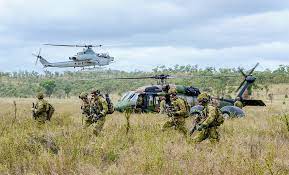
15 July 2021, The Independent and Peaceful Australia Network is greatly concerned about the impact of current warfare exercises on environmentally and culturally significant sites, such as the Great Barrier Reef.
Talisman Sabre 2021 (TS21) is currently taking place in Australia and will see 17,000 Australian, U.S. and foreign troops engaging in combined land, sea and air manoeuvres.
Exercises as part of TS21 will take place along the Queensland and New South Wales coastline, within the Great Barrier Reef Marine Park as well as other environmentally and culturally significant areas.
TS21 will involve amphibious assaults, movement of heavy vehicles, use of live ammunition as well as the use of U.S. nuclear-powered and nuclear-weapon capable vessels. These activities are incompatible with the protection of the environment and in particular the Great Barrier Reef.
This year, the ADF did not engage in a Public Environment Report process for TS21 and has not publicly released an environmental assessment for the areas in which TS21 will take place.
However, the Department of Defence did produce an environmental awareness video for visiting troops that promotes the military use of the Great Barrier Reef. The video reminds troops to consider the reef and not to litter.
Annette Brownlie, Chairperson of the Independent and Peaceful Australia Network: “Talisman Sabre is a threat to the reef and to the environment. Just putting out a video is a completely inadequate response to the active environmental management required to protect the vulnerable reef. Particularly as environment minister, Sussan Ley, is on an international lobbying campaign to keep the Great Barrier Reef off the UNESCO World Heritage Committee ‘in danger’ list.”
“The objective of Talisman Sabre is to integrate the Australian military further into the U.S. military, which is ranked among the world’s worst polluters and is the world’s greatest organisational consumer of oil.”
“Let us not forget that during Talisman Sabre in 2013, the U.S. jettisoned four unarmed bombs on the Great Barrier Reef when they had difficulty dropping them on their intended target, Townshend Island.”
Annette Brownlie, Chairperson of the Independent and Peaceful Australia Network: “Talisman Sabre is a threat to the reef and to the environment. Just putting out a video is a completely inadequate response to the active environmental management required to protect the vulnerable reef. Particularly as environment minister, Sussan Ley, is on an international lobbying campaign to keep the Great Barrier Reef off the UNESCO World Heritage Committee ‘in danger’ list.”
“The objective of Talisman Sabre is to integrate the Australian military further into the U.S. military, which is ranked among the world’s worst polluters and is the world’s greatest organisational consumer of oil.”
“Let us not forget that during Talisman Sabre in 2013, the U.S. jettisoned four unarmed bombs on the Great Barrier Reef when they had difficulty dropping them on their intended target, Townshend Island.” IPAN Media Liaison: 0428 973 324 or ipan.australia@gmail.com
Maralinga nuclear bomb tests – British and Australian governments’ callous cruelty to First Nations people.

Australia’s Chernobyl: The British carried out nuclear tests on Indigenous land. It will never heal. https://www.mamamia.com.au/maralinga-nuclear-testing/ CHELSEA MCLAUGHLIN, JULY 5, 2021 For tens of thousands of years, the Aṉangu people lived on the warm, red earth of their country.
The land provided them with food, water and shelter as they travelled around an area we now know as outback Far North South Australia.
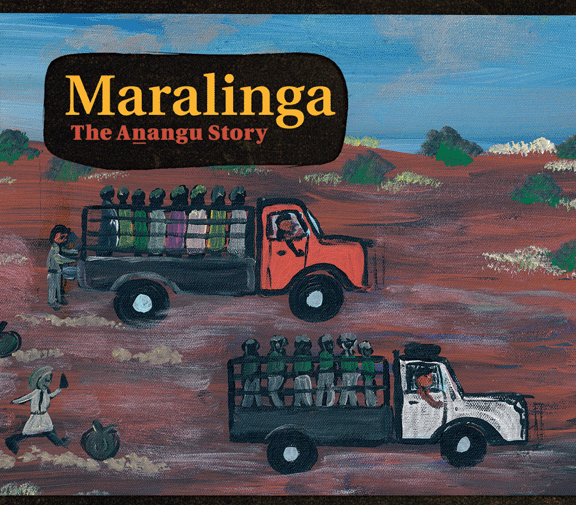
But after colonisation, they were moved off their land: forcibly removed, sent into missions across the region and displaced by train lines linking Australia’s east and west that impacted their water supply.
Much of the information around the tests was highly classified, and some information remains so.
For tens of thousands of years, the Aṉangu people lived on the warm, red earth of their country.
The land provided them with food, water and shelter as they travelled around an area we now know as outback Far North South Australia.
But after colonisation, they were moved off their land: forcibly removed, sent into missions across the region and displaced by train lines linking Australia’s east and west that impacted their water supply.
Much of the information around the tests was highly classified, and some information remains so.
Thirty per cent of the British and Australian servicemen who were exposed during these tests died of cancer, though a Royal Commission in 1984 was not able to reach a conclusion linking their health issues directly to the blasts.
Similarly, many locals died prematurely, went blind and suffered from illness that may have been linked to radiation.
British nuclear scientists, wanting to determine the long-term effects of the tests on Australia and its citizens, ordered the testing of dead Australian infants and children for radiation contamination.
Between 1957 and 1978 in hospitals around Australia, bones were secretly removed from 21,830 bodies. They were reduced to ash and sent away to be analysed for the presence of Strontium 90, a radioactive isotope produced by nuclear fission.
Unsurprisingly, none of the First Nations people of the region were told about the tests and many of the bones were taken without permission.
Associate professor Liz Tynan, the author of Atomic Thunder: The Maralinga Story, told Mamamia‘s The Quicky First Nations people were still in the area during the periods of testing, and this led to disastrous consequences.
Tynan said the Milpuddie family – Charlie, Edie, two kids and their dogs – were found by British service personnel in 1957, camped on the crater left by the bomb Marcoo soon after it had been detonated.
They were rounded up and most of the family, not Edie, but most of them, were given showers. Edie didn’t wish to have a shower,” Tynan explained.
“They were tested for radioactivity and the geiger counters did detect radioactivity, particularly on the young boy Henry. Anyway, there were rather insensitively treated I suppose, given showers, had clothes put on them and then take off down south to a mission.”
Their dogs were shot in front of them. Edie was pregnant at the time, and she later lost her child.
“It was a tragic story and indicative of the callous approach to Indigenous people that was displayed by both the British government and their officials that were conducting the tests, and by the Australian government as well,” Tynan said.
Following the testing, many Aṉangu people returned to the area, but the lands that had previously sustained and protected them were now poison.
We still don’t know the truth impact of the bombs at Maralinga, as well as nearby Emu Fields and the Montebello Islands off the coast of Western Australia.
“The South Australian Department of Health commissioned a fairly extensive study, [but] that study was hampered by the fact there was no base-line data from which to understand the general health of the population before the tests,” Tynan said.
The study did show an increase in various cancers, but most of the findings were inconclusive due to a lack of information. Indigenous Australians were not counted in the census at the time and there was very little known about the health of the populations.
In 1964, a limited cleanup of the Maralinga site, named ‘Operation Hercules’, took place.
A year after a 1966 survey into the level of contamination at the site, a second clean-up titled ‘Operation Brumby’ filled 21 pits with contaminated equipment and covered them with 650 tonnes of concrete.
Tynan said it was later found the survey data was drastically wrong, and the contamination was 10 times worse than thought.
It wasn’t until decades later, with the help whistleblowers and scientists, that the government began to realise the true, horrifying extent of the damage done to the land at Maralinga.
Under an agreement between the governments of the United Kingdom and Australia in 1995, another clean-up took place. And while this was more thorough than the previous, it still came with issues.
Whistleblower Alan Parkinson, who wrote the 2007 book Maralinga: Australia’s Nuclear Waste Cover-up, exposed the unsatisfactory methods.
The plan had been to treat several thousand tonnes of debris contaminated with plutonium by a process called situ vitrification. Against the advice of Parkinson, the government extended the contract of the project manager, even though that company had no knowledge of the complex process of vitrification.
Parkinson was let go from the project.
The government and the project manager then embarked on a hybrid scheme in which some pits would be exhumed and others treated by vitrification. After successfully treating 12 pits, the 13th exploded and severely damaged the equipment. The government then cancelled the vitrification and simply exhumed the remaining pits, placed the debris in a shallow pit and covered it with clean soil.
Parkinson told The Quicky another, complete clean-up of Maralinga could take place, but it was unlikely because of the cost and the courage it would take to admit the previous attempts were insufficient.
Around the same time as the 90s clean up was the Australian government push for a nuclear waste dump to be located nearby.
Fearing even further poisoning of their country, First Nations woman Eileen Wani Wingfield co-founded the Coober Pedy Women’s Council to campaign against the proposal.
The plan was eventually abandoned, but has popped up again in many forms over the decades. Currently, the Coalition is amending a bill that could see a site set up near Kimba.
Glen Wingfield, Eileen’s son, has spent his life working and learning from his parents’ tireless campaign for protection of their country.
The theme of NAIDOC Week 2021 is Heal Country! but as Wingfield told The Quicky, much of the Aṉangu lands in and around Maralinga are beyond healing.
“A lot of the Aboriginal communities that live in and around that area, they just will not and do not go back near that country. I think that’s a word, healing, that we can’t use in the same sentence with that area.”
Tynan agreed, saying there are parts of the area that will be uninhabitable for a quarter of a million years.
“There are parts of the site that you can’t go to, that are still very dangerous,” she said.
“The real problem at Maralinga was the plutonium which was detonated in a series of trials… The particular type of plutonium they used, plutonium 239, has a half-life of 21,400 years which takes hundreds of thousands of years for that radioactivity to diminish.”
Wingfield said the broken connection between these people and their lands is “just downright disgraceful and horrible”.
“No amount of conversation will ever cover what’s been done for people in and around. The lasting effects of health issues on people have been passed through people who were there to generational abnormalities… I think when you talk compensation and stuff, I don’t think we’ll ever get close.”
Need for a USA”no first use” of nuclear weapons policy – the concern of regional U.S. allies

In our lead article this week, Van Jackson makes a compelling case for the United States to establish a no-first use policy on nuclear weapons. This would entail a pledge from Washington that its nuclear arsenal would not be used as a means of warfare except in the event that it was first subject to a nuclear attack by an adversary. While there is already some momentum behind such a policy amongst Democrats, Biden has taken no concrete steps towards implementing it and it has yet to be legislated by Congress.
No-first use nuclear policy. https://www.eastasiaforum.org/2021/07/05/no-first-use-nuclear-policy/ Author: Editorial Board, ANU, 5 July 21,
Since the election of Joe Biden in 2020, much of the world has breathed a collective sigh of relief as we have witnessed what appears to be a return to ‘pre-Trump normalcy’ in the United States. One of the greatest foreign policy challenges that faces the Biden administration, however, is recovering US credibility in Asia, which was severely undermined by his predecessor Donald Trump.
From the standpoint of US allies in the region, a concerning aspect of Trump’s rise to the presidency was his loose talk about nuclear weapons and apparent openness to utilising them against adversaries. While most allies have long emphasised the immense benefits of the US security guarantee and its attendant nuclear umbrella, Trump’s rise to power rendered alliance relationships potential liabilities.
These concerns among allies in the region were significantly elevated in 2017, when Trump began to entertain the prospect of launching a pre-emptive — albeit non-nuclear — strike against North Korea. He supposedly even went so far as to order an evacuation of US servicemen and their families from Seoul — an injunction that was ultimately not carried out by US officials in South Korea. His apparent willingness to engage in conflict with a nuclear-armed North Korea was reinforced rhetorically as he threatened ‘fire and fury’ against Kim Jong-un’s regime.
These developments had US allies (and non-allies alike) in the region beleaguered by the prospect of nuclear war in the region. Their concerns were reinforced by Trump’s predilection to appoint family members — with little to no foreign policy expertise — as official advisors. The notion that a US-initiated conflict with North Korea, entailing probable commitment by American allies, might be informed in part by the likes of Ivanka Trump and Jared Kushner was a severe indictment of alliance management.
The election of Joe Biden allayed some of the concerns of US allies. But the fact that Trump received over 70 million votes in the election and may run again for president in 2024 means that his tenure cannot be easily viewed as an unfortunate aberration.
What can Biden do during his presidency to restore confidence among American allies in the region, and restore US credibility in the aftermath of the Trump administration?
In our lead article this week, Van Jackson makes a compelling case for the United States to establish a no-first use policy on nuclear weapons. This would entail a pledge from Washington that its nuclear arsenal would not be used as a means of warfare except in the event that it was first subject to a nuclear attack by an adversary. While there is already some momentum behind such a policy amongst Democrats, Biden has taken no concrete steps towards implementing it and it has yet to be legislated by Congress.
Jackson outlines three common arguments that are cited against a non-first use nuclear policy: China, Russia and North Korea would never believe in the veracity of no-first use declarations; it would encourage uncertainty among adversaries as to whether the United States could use nuclear weapons against them; and there would also be concerns among American allies about the implications of a no-first use policy for US extended nuclear deterrence and Washington’s ability to deter threats on their behalf.
Yet Jackson argues that, ‘ … the world is no longer unipolar. The old bargain — Washington does arms-racing so allies don’t — makes no sense in a world where US politics is depressingly awry. Allied nuclear proliferation poses its own risks, but it may be a better alternative to US nuclear preponderance and presidential first-use launch authority’.
As the region becomes increasingly volatile, a policy of US restraint on the use of nuclear weapons has acquired new urgency. The advent of the Biden administration has done little to alleviate US–China tensions; Biden’s China policy so far appears to be a continuation of that of the Trump administration. Meanwhile, prospects of a cross-Strait crisis continue to rise and progress on the denuclearisation of North Korea remains elusive. These political tensions have been aggravated by economic destabilisation in the region that has been fuelled by the COVID-19 crisis.
These developments have spawned new concerns about conflict and the role of US alliances in the region. Some analysts believe that such conflict would have potential to evolve into nuclear war. Given that the US-led alliance network is premised on the maintenance of regional peace and security, it behoves Washington to clarify that it will not employ first use of nuclear weapons.
This is important for the Biden government. It is also important for the future US administrations that could see the likes of Trump with a finger back on the nuclear button.
The EAF Editorial Board is located in the Crawford School of Public Policy, College of Asia and the Pacific, The Australian National University.
Australian Local Gov Association support Mount Isa nuclear weapons ban motion
Australian Local Gov Assoc pass Mount Isa nuclear weapons motion https://www.northweststar.com.au/story/7316487/australian-local-gov-assoc-pass-mount-isa-nuclear-weapons-motion/
Derek Barry ocal Government Association has supported Mount Isa City Council’s letter to the federal government looking for a nuclear weapons ban……..(subscribers only)
Australian Robert Floyd to head the Comprehensive Nuclear-Test-Ban Treaty Organisation.
‘Never in my wildest dreams’: The Australian set to head UN body policing nuclear weapons has grand plans, SMH, By Anthony Galloway, May 30, 2021 When Australian Robert Floyd began his career as a biological scientist, he had no aspirations of heading a United Nations body charged with policing the world for any signs of nuclear tests. He did not foresee a life of negotiating with the world’s major powers to ban all testing of nuclear weapons.
But that is exactly what is in store for him after last week being elected as the first Australian executive secretary of the Comprehensive Nuclear-Test-Ban Treaty Organisation.
………… He will take up his position in Vienna in August, after 10 years as the Director-General of the Australian Safeguards and Non-Proliferation Office, which implements Australia’s treaty obligations on weapons of mass destruction……..
The CTBTO is the organisation charged with policing the Comprehensive Nuclear-Test-Ban Treaty, which was adopted by the United Nations General Assembly in 1996 and seeks to ban all nuclear tests.
But the treaty is not legally binding because eight countries have held off on ratifying it: the US, China, North Korea, India, Pakistan, Iran, Israel and Egypt.
Floyd concedes it is unlikely that he will convince all eight countries to ratify the treaty, but he is going to try to get some of them across the line before his four-year term is up.
…….. The CTBTO has an arsenal of more than 300 monitoring stations that can pick up seismic vibrations or radioactive particles in the air, ocean or atmosphere. Floyd says this allows it to detect a nuclear explosion “anywhere, anytime”.
“That network produces data that no country can have by themselves. So everyone sees value in the treaty,” he says.
………. Unlike other nuclear treaties, the CTBT is not about nuclear getting states to rid themselves of nuclear weapons; it is focused on convincing them not to test them. ………..https://www.smh.com.au/politics/federal/never-in-my-wildest-dreams-the-australian-set-to-head-un-body-policing-nuclear-weapons-has-grand-plans-20210527-p57vlf.html
Australia, the USA’s only ”best friend” in the Indo Pacific, to deploy more USA military equipment, heightening the threat against China.

Zhang Junshe, a senior research fellow at the PLA Naval Military Studies Research Institute, told the Global Times on Friday that Australia is likely to allow the US to deploy more military equipment on its soil, making it the only US friend on its Indo-Pacific strategy.
By doing this, Australia will make itself a target for future military conflicts between the US and other countries, Zhang said, adding that a responsible government which really cares about the interests of its people would never allow it.
China urged to increase sea-based nuclear deterrent amid US intensified strategic threat https://www.globaltimes.cn/page/202105/1224773.shtml By Zhang Hui May 28, 2021 Facing a serious strategic threat from the US, China was urged to increase the number of nuclear weapons, especially its sea-based nuclear deterrent of intercontinental submarine-launched ballistic missiles, to deter potential military action by US warmongers, Chinese military experts said on Friday, after reports that the US’ new defense budget will modernize its nuclear arsenal to deter China.
Having a nuclear arsenal appropriate to China’s position will help safeguard national security, sovereignty and development interests and establish a more stable and peaceful world order, which will be beneficial for the world, they said.The US defense budget, set to be sent to Congress on Friday, is expected to include investments in troop readiness, space, and the Pacific Deterrence Initiative aimed at countering China’s military existence in the region, and nuclear weapons technology, Reuters reported on Thursday.
However, Chinese military experts believe that US attempts of increasing military deployment in the Indo-Pacific region will not increase returns for the US as most countries in the region will not allow the flames of war initiated by the US to burn themselves.
The US would buy ships and jets and develop and test hypersonic weapons and other “next-generation” weapons systems to build capabilities to counter Russia and China. The total national security budget will be $753 billion, a 1.7 percent increase over the 2021 figure, Reuters said.
China has kept its defense spending at around 1.3 percent of GDP in recent years, which is far below the average global level of 2.6 percent, data shows. The US, by far the world’s top military spender, has spent about four times that of China in recent years.
Chinese analysts said China has never taken aim at US military spending, nor does China want to engage in any form of arms race with the US.
But the US has applied greater military pressure on China, sending warships and warplanes at an increasing frequency to the South China Sea and Taiwan Straits.
The US is also preparing what US media called its “biggest navy exercise in a generation with 25,000 personnel across 17 time zones,” as it’s preparing for a “possible conflict” with China and Russia.
The US attempted to deepen the militarization of space with its new budget plan, including its investment on future weapons. Considering that the US deems China its top imaginary enemy, China needs to increase the quantity and quality of nuclear weapons, especially submarine-launched ballistic missiles, to effectively safeguard its national security, sovereignty and development interests, Song Zhongping, a Chinese military expert and TV commentator, told the Global Times on Friday.
Some military experts said China should increase the number of its most advanced intercontinental ballistic missiles (ICBM), the DF-41, which has the longest operational range among all Chinese ICBMs.
Facing a serious strategic threat from the US, China was urged to increase the number of nuclear weapons, especially its sea-based nuclear deterrent of intercontinental submarine-launched ballistic missiles, to deter potential military action by US warmongers, Chinese military experts said on Friday, after reports that the US’ new defense budget will modernize its nuclear arsenal to deter China.
Having a nuclear arsenal appropriate to China’s position will help safeguard national security, sovereignty and development interests and establish a more stable and peaceful world order, which will be beneficial for the world, they said.
Song said that strengthening sea-based strategic nuclear deterrence is also an important direction for China’s future development, as these weapons are better at stealth and secondary nuclear strikes.
China could use its most advanced submarine-launched ballistic missile (SLBM) to effectively counter the US threat, Song said.
China just commissioned three PLA Navy warships, namely the Changzheng 18, the Dalian and the Hainan, at a naval port in Sanya, South China’s Hainan Province in April. Observers identified the Changzheng 18 as a likely Type 09IV nuclear-powered strategic ballistic missile submarine.
Burning themselves
The US Pacific Deterrence Initiative, created to counter China, focuses on competition in the Indo-Pacific and aims to boost US preparedness in the region by funding radars, satellites and missile systems, according to Reuters.
Wei Dongxu, a Beijing-based military expert, told the Global Times on Friday that the initiative enables the US to use a variety of spy satellites to conduct reconnaissance and intelligence gathering to provide extensive and accurate intelligence support for US military operations, including joint military operations with its allies, and the US will also use allies, such as US overseas military bases, to deploy more radar systems to guide its weapons.
On the day its budget was sent to Congress, US Secretary of Defense Lloyd Austin was expected to meet with India’s Minister of External Affairs, Subrahmanyam Jaishankar, as part of India’s first cabinet-level visit to Washington, the Pentagon said.
“The secretary’s meeting with the external affairs minister will continue discussions that the two held in New Delhi in March and will continue the robust bilateral defense and security relationship between our two countries,” the Pentagon said.
Chinese military experts said it’s likely that India would buy more American weapons, have more military drills with the US or deepen its cooperation with the US in military intelligence sharing, and the US will use these in exchange for India’s cooperation for its Indo-Pacific strategy.
But India will have second thoughts on US military deployment on its soil, Song said, noting that weapons and radar deployment involves a country’s sovereignty, and India, which has been claiming to pursue an independent foreign policy, will unlikely give the US a satisfactory answer.
Even if India would like to deepen its military cooperation with the US, certain cooperation such as opening military bases to the US is not an option for India, Song said.
India may not be a very ideal partner, and most of US allies in Asia, including Japan and South Korea, also fear that the flames of war would eventually burn themselves.
In South Korea, protests against US military presence have become louder in the past years, and South Korea will not allow the US to turn Northeast Asia into a battlefield and drag itself into war, nor will it sacrifice its relations with China, observers said.
Zhang Junshe, a senior research fellow at the PLA Naval Military Studies Research Institute, told the Global Times on Friday that Australia is likely to allow the US to deploy more military equipment on its soil, making it the only US friend on its Indo-Pacific strategy.
By doing this, Australia will make itself a target for future military conflicts between the US and other countries, Zhang said, adding that a responsible government which really cares about the interests of its people would never allow it.
New research highlights need for international standards to safeguard against plutonium ”hot” particles.
New study delves into issues relating to soils around Maralinga region, https://www.portlincolntimes.com.au/story/7262167/study-shows-radioactive-particles-from-nuclear-testing-persist-at-maralinga, Luca Cetta,
A new study has highlighted the first international standards needed to safeguard against contamination from nuclear testing, and a Kokatha Elder says the impact of nuclear testing at Maralinga cannot be forgotten.
More than 100 kilograms of highly toxic uranium and plutonium was dispersed in the form of tiny ‘hot’ radioactive particles after nuclear tests were conducted by the British in remote areas of South Australia, including Maralinga.
Scientists have new evidence these radioactive particles persist in soils to this day, more than 60 years after the detonations.
The British detonated nine nuclear bombs and conducted nuclear tests in South Australia between 1953 and 1963.
There had previously been limited understanding in how plutonium was released from the particles into the environment for uptake by wildlife around Maralinga.
The new study, published in Nature’s Scientific Reports, led by Monash University researchers, warns the hot particles are more complex and varied than previously thought.
Currently, there are no international best practice standards for the environmental impact or risk assessment of plutonium and uranium-rich hot particles released during nuclear testing.
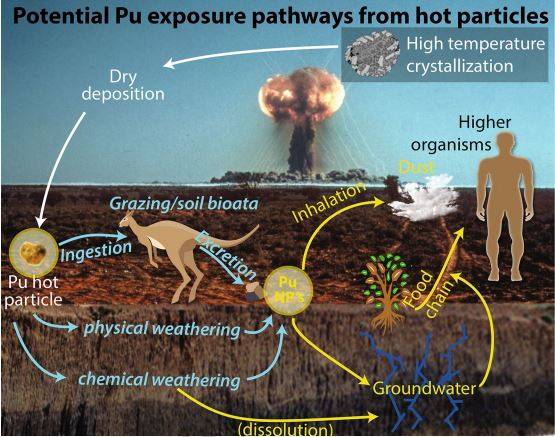
This study provides the first mechanism for future modelling to predict the environmental life cycle of plutonium from hot particles, including how they are slowly broken down in the environment over a long period, and potentially exposed to animals and humans through inhalation, soil or ground water.
“The resulting radioactive contamination and cover-up continues to haunt us,” lead study author from Monash University’s School of Earth, Atmosphere and Environment Dr Megan Cook said.
“The results of our study profoundly changes our understanding of the nature of hot particles at Maralinga – despite the fact that those were some of the best studied particles anywhere in the world.”
Sue Haseldine, who grew up in the Koonibba district in the 1950s and 1960s, has long campaigned against nuclear testing and weapons.
She has been part of the International Campaign to Abolish Nuclear Weapons (ICAN), an organisation awarded the Nobel Peace Prize in 2017, and has spoken about her experience growing up in the shadow of nuclear testing at Maralinga.
Ms Haseldine said the people in the area had long-suspected there were health issues deriving from those tests.
“Experts would tell you that radiation will not last for 60 years, nor 60,000, but for a long, long time, and it is still causing troubles today,” she said.
“The old ladies told me these cancers and illnesses were not around before the bomb and over the years I have seen the rates go up.
“There are a lot more younger people with heart problems – it is known that radiation problems can cause heart diseases – and it is coming down through the generations.”
Ms Haseldine said the testing and fallout from Maralinga was not spoken about enough and that was why her campaigning with ICAN was so important.
“It is important to let people know what the government’s legacy is to us through their testing and we have to keep the past alive to protect the future, so they don’t do it to future generations,” she said.
“I grew up in the Koonibba district, but the radiation didn’t just stay in the Maralinga area.”
Study co-author professor Joël Brugger said the study invited a revisit of the implications of earlier results for the fate of plutonium at Maralinga.
“Understanding the fate of hot particles in the arid environment setting of the Australian outback is critical for securing Australia in case of nuclear incidents in the region, and returning all the native land affected by the British tests to the traditional Anangu owners of the Maralinga Tjarutja lands.”
The research team used synchrotron radiation at the Diamond Light Source near Oxford in the United Kingdom to decipher the physical and chemical make-up of the particles.
At Monash, they dissected some of the hot particles using a nano-sized ion beam, and further characterised the complex make-up of these particles down to the nano-size.
“It’s a major breakthrough,” study co-author associate professor Vanessa Wong said.
“Our observations of the hot particles from Maralinga provide a clear explanation for the complex and variable behaviour of different hot particles with respect to the chemical and physical weathering that has hindered predictive modelling to this day.
“This study provides a mechanistic foundation for predicting the future evolution of hot particles from high-temperature nuclear events and the likely exposure pathways.”
The researchers demonstrated the complexity of the hot particles arose from the cooling of polymetallic melts from thousands of degrees Celsius in the explosion cloud during their formation.
“We found that the particles contained low-valence plutonium-uranium-carbon compounds that are typically highly reactive – which is unexpected for particles that survived for over 30 years in the environment,” corresponding author Dr Barbara Etschmann said.
Plutonium ”hot particles” are not as stable as we assumed. Research on contaminated landscape around Maralinga in outback South Australia

We sliced open radioactive particles from soil in South Australia and found they may be leaking plutonium https://theconversation.com/we-sliced-open-radioactive-particles-from-soil-in-south-australia-and-found-they-may-be-leaking-plutonium-161277
Barbara Etschmann, Research officer, Monash University
Joel Brugger, Professor of Synchrotron Geosciences, Monash University
Vanessa Wong, Associate Professor, Monash University
May 21, 2021 Almost 60 years after British nuclear tests ended, radioactive particles containing plutonium and uranium still contaminate the landscape around Maralinga in outback South Australia.
These “hot particles” are not as stable as we once assumed. Our research shows they are likely releasing tiny chunks of plutonium and uranium which can be easily transported in dust and water, inhaled by humans and wildlife and taken up by plants.
A British nuclear playground
After the US atomic bombings of Hiroshima and Nagasaki in 1945, other nations raced to build their own nuclear weapons. Britain was looking for locations to conduct its tests. When it approached the Australian government in the early 1950s, Australia was only too eager to agree.
Between 1952 and 1963, Britain detonated 12 nuclear bombs in Australia. There were three in the Montebello Islands off Western Australia, but most were in outback South Australia: two at Emu Field and seven at Maralinga.
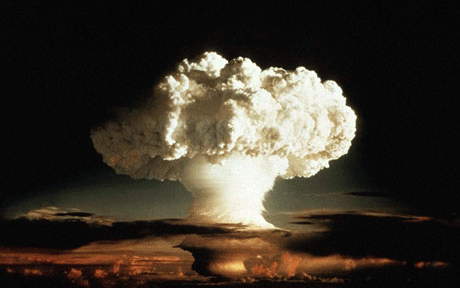
Besides the full-scale nuclear detonations, there were hundreds of “subcritical” trials designed to test the performance and safety of nuclear weapons and their components. These trials usually involved blowing up nuclear devices with conventional explosives, or setting them on fire.
The subcritical tests released radioactive materials. The Vixen B trials alone (at the Taranaki test site at Maralinga) spread 22.2 kilograms of plutonium and more than 40 kilograms of uranium across the arid landscape. For comparison, the nuclear bomb dropped on Nagasaki contained 6.4 kilograms of plutonium, while the one dropped on Hiroshima held 64 kilograms of uranium.
These tests resulted in long-lasting radioactive contamination of the environment. The full extent of the contamination was only realised in 1984, before the land was returned to its traditional owners, the Maralinga Tjarutja people.
Hot potatoes
Despite numerous cleanup efforts, residual plutonium and uranium remains at Maralinga. Most is present in the form of “hot particles”. These are tiny radioactive grains (much smaller than a millimetre) dispersed in the soil.
Plutonium is a radioactive element mostly made by humans, and the weapons-grade plutonium used in the British nuclear tests has a half life of 24,100 years. This means even 24,100 years after the Vixen B trials that ended in 1963, there will still be almost two Nagasaki bombs worth of plutonium spread around the Taranaki test site.
Plutonium emits alpha radiation that can damage DNA if it enters a body through eating, drinking or breathing.
In their original state, the plutonium and uranium particles are rather inactive. However, over time, when exposed to atmosphere, water, or microbes, they may weather and release plutonium and uranium in dust or rainstorms.
Until recently, we knew little about the internal makeup of these hot particles. This makes it very hard to accurately assess the environmental and health risks they pose.
Monash PhD student Megan Cook (the lead author on our new paper) took on this challenge. Her research aimed to identify how plutonium was deposited as it was carried by atmospheric currents following the nuclear tests (some of it travelled as far as Queensland!), the characteristics of the plutonium hot particles when they landed, and potential movement within the soil.
Nanotechnology to the rescue
Previous studies used the super intense X-rays generated by synchrotron light sources to map the distribution and oxidation state of plutonium inside the hot particles at the micrometre scale.
To get more detail, we used X-rays from the Diamond synchrotron near Oxford in the UK, a huge machine more than half a kilometre in circumference that produces light ten billion times brighter than the Sun in a particle accelerator.
Studying how the particles absorbed X-rays revealed they contained plutonium and uranium in several different states of oxidation – which affects how reactive and toxic they are. However, when we looked at the shadows the particles cast in X-ray light (or “X-ray diffraction”), we couldn’t interpret the results without knowing more about the different chemicals inside the particles.
To find out more, we used a machine at Monash University that can slice open tiny samples with a nanometre-wide beam of high-energy ions, then analyse the elements inside and make images of the interior. This is a bit like using a lightsaber to cut a rock, only at the tiniest of scales. This revealed in exquisite detail the complex array of materials and textures inside the particles.
Much of the plutonium and uranium is distributed in tiny particles sized between a few micrometres and a few nanometres, or dissolved in iron-aluminium alloys. We also discovered a plutonium-uranium-carbon compound that would be destroyed quickly in the presence of air, but which was held stable by the metallic alloy.
This complex physical and chemical structure of the particles suggests the particles formed by the cooling of droplets of molten metal from the explosion cloud.
In the end, it took a multidisciplinary team across three continents — including soil scientists, mineralogists, physicists, mineral engineers, synchrotron scientists, microscopists, and radiochemists — to reveal the nature of the Maralinga hot particles.
From fire to dust
Our results suggest natural chemical and physical processes in the outback environment may cause the slow release of plutonium from the hot particles over the long term. This release of plutonium is likely to be contributing to ongoing uptake of plutonium by wildlife at Maralinga.
Even under the semi-arid conditions of Maralinga, the hot particles slowly break down, liberating their deadly cargo. The lessons from the Maralinga particles are not limited to outback Australia. They are also useful in understanding particles generated from dirty bombs or released during subcritical nuclear incidents.
There have been a few documented instances of such incidents. These include the B-52 accidents that resulted in the conventional detonation of thermonuclear weapons near Palomares in Spain in 1966, and Thule in Greenland in 1968, and the explosion of an armed nuclear missile and subsequent fire at the McGuire Air Force Base in the USA in 1960.
Thousands of active nuclear weapons are still held by nations around the world today. The Maralinga legacy shows the world can ill afford incidents involving nuclear particles.
New research on the complexity of particles from plutonium resulting from British atomic bomb tests at Maralinga
| Pu particles from nuclear testing more complex than previously thought https://www.eurekalert.org/pub_releases/2021-05/mu-ppf051821.php Plutonium particles from British nuclear testing in outback Australia more complex than previously thought, scientists warnMONASH UNIVERSITYResearch News 21 May 21 More than 100 kg of highly toxic uranium (U) and plutonium (Pu) was dispersed in the form of tiny ‘hot’ radioactive particles after the British detonated nine atomic bombs in remote areas of South Australia, including Maralinga.Scientists say that these radioactive particles persist in soils to this day, more than 60 years after the detonations. Previously, we had limited understanding of how Pu was released from these “hot” particles into the environment for uptake by wildlife around Maralinga. |
But now, a new study published today in Scientific Reports and led by Monash University researchers warns that the particles are actually more complex and varied than previously thought. This means that the processes which slowly release Pu into the environment are also much more complex and varied.
“The British detonated nine nuclear bombs and conducted hundreds of nuclear tests in outback South Australia between 1953 and 1963,” said lead study author Megan Cook, a PhD student from the Monash University School of Earth, Atmosphere and Environment. “The resulting radioactive contamination and cover-up continues to haunt us.”
“The results of our study profoundly changes our understanding of the nature of hot particles at Maralinga – despite the fact that those were some of the best studied particles anywhere in the world,” said study co-author Associate Professor Vanessa Wong.
The research team used synchrotron radiation at the Diamond Light Source near Oxford, UK to decipher the physical and chemical make-up of the particles.
At Monash University they dissected some of the hot particles using a nano-sized ion beam, and further characterised the complex make-up of these particles down to the nano-size in exquisite details.
The researchers demonstrated that the complexity of the hot particles arose from the cooling of polymetallic melts from thousands of degrees Celsius in the explosion cloud during their formation.
“We found that the particles contained low-valence plutonium-uranium-carbon compounds that are typically highly reactive, yet, had been stabilised in the hot-particle matrix for nearly 60 years,” said corresponding author Dr Barbara Etschmann.
Between 1950 and 1988 alone there were more than 230 recorded nuclear weapon accidents, including at least 10 with documented release of radioactive particles into the environment. The risks of such incidents are only increasing as international treaties such as the Intermediate-Range Nuclear Forces Treaty were cancelled.
“Understanding the fate of hot particles in the unique setting of the Australian outback is critical for securing Australia in case of nuclear incidents in the region, and returning all the native land affected by the British tests to the traditional Anangu owners of the Maralinga Tjarutja lands,” said study co-author Professor Joël Brugger.
Australia risks bringing on a nuclear war with China. Urgent need to change foreign policy.
Nuclear’: Grim prediction for what war with China would look like, Yahoo News. Brooke Rolfe· News ReporterSat, 8 May 2021
Australia’s escalating rift with China could see the hypothetical prospect of war swiftly become a reality if the government doesn’t urgently rethink its approach, according to Hugh White, a leading expert on Australia’s strategic defence………..
Now our government has begun, with disconcerting nonchalance, to talk of war,” he wrote in The Saturday Paper.
“And yet our government seems to have no idea how serious, and dangerous, our situation has become, and has no viable plan to fix it. This must count as one of the biggest failures of statecraft in Australia’s history.”………..
“It would be a war the US and its allies would have no clear chance of winning. Indeed, it is not even clear what winning a war with a country such as China means. And it would very likely become a nuclear war,” he wrote.
Recent reports from the government saying Australia’s troops should be ready for a military conflict suggest Prime Minister Scott Morrison and Defence Minister Peter Dutton are prepared to go to war with China, Prof White noted.
He urged against any notion of heated conflict and implored the Federal Government to rethink its relationship with China from the ground up.
China’s inevitable rise needs to be accepted, combined with “a new order in Asia” which includes the rise of India and Indonesia.
“Australia must conceive a new relationship with China, one that takes account of this reality and works to balance and protect the full range of our interests … this would require hard work, deep thought and subtle execution. It would mean a revolution in our foreign policy.”…….
He urged against any notion of heated conflict and implored the Federal Government to rethink its relationship with China from the ground up.
China’s inevitable rise needs to be accepted, combined with “a new order in Asia” which includes the rise of India and Indonesia.
“Australia must conceive a new relationship with China, one that takes account of this reality and works to balance and protect the full range of our interests … this would require hard work, deep thought and subtle execution. It would mean a revolution in our foreign policy.” https://au.news.yahoo.com/nuclear-grim-prediction-for-what-war-with-china-would-look-like-051637841.html
Nobel prize winner Beatrice Fihn urges Australia to join the Nuclear Weapons Ban Treaty, as public support for it grows

Australian government urged to heed public support for treaty banning nuclear weapons. Nobel prize-winning anti-nuclear campaigner Beatrice Fihn says ‘change is not only possible, it’s inevitable’ https://www.theguardian.com/australia-news/2021/may/06/australian-government-urged-to-heed-public-support-for-treaty-banning-nuclear-weaponsDaniel Hurst Foreign affairs and defence correspondent@danielhurstbne Thu 6 May 2021
The Australian government is being urged to rethink its opposition to a new international treaty banning nuclear weapons, with a leading campaigner warning of the “indiscriminate destructiveness” of such arms.
Beatrice Fihn, the head of the Nobel prize-winning International Campaign to Abolish Nuclear Weapons (Ican), will use a speech in Tasmania on Thursday to implore the government to heed strong public support for joining the treaty.
“Change is not only possible; it’s inevitable,” Fihn will say when she presents the annual Red Cross Oration at the University of Tasmania.
The Australian government has not joined the Treaty on the Prohibition of Nuclear Weapons, a relatively new agreement that requires parties not to develop, test, produce, acquire, possess, stockpile, use or threaten to use nuclear weapons.
So far, the treaty has been signed by 86 countries, of which 54 have formally ratified it – but it has been snubbed by the nuclear weapons states including the US, Russia and China.
“Australia does not support the Treaty on the Prohibition of Nuclear Weapons,” a spokesperson for the Department of Foreign Affairs and Trade said on Wednesday.
The Australian government argues the new treaty “would not eliminate a single nuclear weapon” because none of the nuclear weapons states have signed it and because it “ignores the realities of the global security environment”.
The government also says the treaty would be inconsistent with its US alliance obligations. However, campaigners point out that several US allies, such as New Zealand, Thailand and the Philippines, have already ratified the treaty.
Fihn, who is based in Geneva and will be addressing the University of Tasmania via video link, will call on the government to act on the “strong and growing support that exists in Australia for this crucial new piece of international law”.
According to prepared remarks provided to Guardian Australia in advance, she will describe the treaty as an “incredible step forward towards a world without nuclear weapons”.
Fihn will say the countries that have joined the treaty are “leading the way forward to a world without nuclear weapons”.
“Meanwhile, in countries that have not yet joined the treaty, including Australia, people are speaking up against nuclear weapons and calling on their countries to join,” she will say.
“Cities around the world, including Berlin, Paris and Washington DC are adopting resolutions calling on their governments to join. In fact, the very first city to sign our Cities Appeal was Melbourne, followed soon after by Sydney – and we’re delighted that the City of Hobart is also on board.”
Polling commissioned by Greenpeace in 2017 found 72.7% of 1,669 Australians surveyed said they supported a ban on nuclear weapons as a step towards the elimination of all nuclear weapons.
“From Australia to Canada, Germany, Japan and the United Kingdom, polls show that the majority of people want their government to join,” Fihn will say.
“Thousands of parliamentarians have pledged to work to bring their respective countries on board. In Australia, 88 of the current members of parliament have taken Ican’s pledge.”
The Ican pledge commits parliamentarians “to work for the signature and ratification of this landmark treaty by our respective countries”.
The federal MPs and senators who have signed up are mostly Labor politicians, including the opposition leader, Anthony Albanese, who has been campaigning against nuclear weapons since early in his political career.
The list also includes the Greens leader, Adam Bandt, and crossbenchers. The Liberal National party MP for Flynn in central Queensland, Ken O’Dowd, has also signed up.
In Thursday’s speech, Fihn will also emphasise the need to “amplify the voices of First Nations peoples in Australia and the Pacific who continue to suffer the horrendous impacts of nuclear tests carried out on their lands and in their waters by the United Kingdom, the United States and France”.
More than 75 years after the US bombing of the Japanese cities of Nagasaki and Hiroshima in 1945, she says, nuclear-armed states are spending billions of dollars each year to build new weapons and to keep the 13,000 existing weapons.
But Fihn says nuclear-armed states “do not prepare for what comes next, after the bombs are dropped”, citing reports that about 80% of hospitals were destroyed in Hiroshima. Out of 300 doctors in the city, 270 died or were injured; out of 1,780 nurses, 1,654 were killed or injured.
“They do not prepare for the hundreds of thousands of burn victims, for the blasted hospitals, for the injured and dying medical professionals left to heal an entire city,” Fihn says.
“The trauma of overwhelmed hospitals and overburdened doctors and nurses around the world who are struggling to meet the needs of patients during the Covid-19 pandemic shows just how impossible it would be for medical infrastructure to respond to even one nuclear weapon detonation.” The Australian government and other non-signatories are being encouraged to send officials to attend, as observers, the first meeting of parties in Vienna early next year.
Guardian Australia understands Australia will consider attendance closer to the event.
1 This month

of the week – Australians for War Powers Reform (AWPR)
To see nuclear-related stories in greater depth and intensity
 Antinuclear