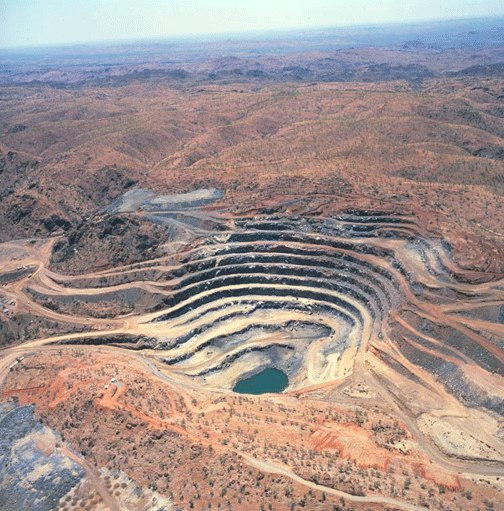
URANIUM. From 1944 the purpose of Australia’s uranium industry was to supply nuclear weapons. Up until 1962 Australia supplied 7,730 tonnes of uranium to the USA and UK for their nuclear weapons programs.
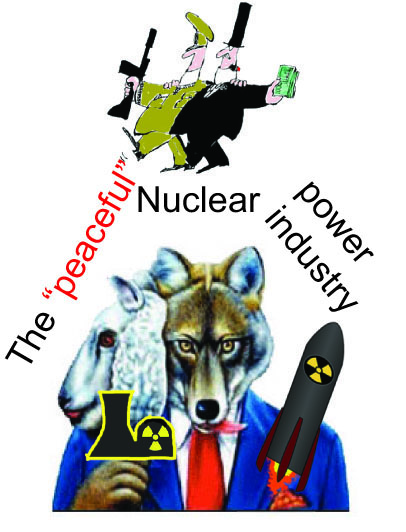
More recently, Australia’s uranium is supposed to go only to “peaceful” nuclear power. So – it can go to India, for example, where there’s dubious supervision anyway, and where it frees up other uranium supplies for India’s burgeoning nuclear weapons.
NUCLEAR BOMBS. The Menzies government allowed Britain to explode its nuclear bombs in South Australia, and also at Monte Bello Island, in the 1950s and 60s. So the nuclear weapons industry has had its dirty foot well into Australia.
NUCLEAR REACTOR. Lucas Heights nuclear reactor was always intended as a step towards nuclear weapons, AND IT STILL IS. In the early 1950s, politicians, scientists and Defence Department enthusiasm for Australia to get a nuclear weapon led to the building, in 1957, of a nuclear reactor at Lucas Heights. A plan to build a nuclear reactor at Jervis Bay was pitched to the public as a commercial venture, but was always intended to provide enriched uranium for Australia’s own nuclear weapons.
Others favoured getting nuclear bombs supplied by Britain. The pro nuclear lobby always had nuclear weapons in mind, and campaigned for them strongly through the 1960s, to 1972, when Prime Minister Whitlam ended these ambitions. The campaign continued, more quietly.
ANSTO. In 1987 the Australian Atomic Energy Commission was abolished, and the Australian Nuclear Science and Technology Organisation (ANSTO) was set up. ANSTO is very secretive about its operations, but does pursue the advanced technology that would make nuclear weapons development possible. Today’s nuclear weapons advocates talk incessantly about “medical research”, and foster the myth of the “peaceful atom”.
As the nuclear weapons establishment in UK and USA now make clear – “peaceful” nuclear power is essential for nuclear weapons – as an industry supplying resources and trained operatives for the weapons industry.
The push for Australia to house nuclear wastes, and the whole nuclear fuel chain is an intrinsic part of the global nuclear weapons industry.
It’s a nearly impossible task to discover exactly what Australia is selling and to whom because the federal government refuses to say, but nuggets of information make it clear that Canberra is aggressively selling weapons and defence equipment to countries involved in conflicts where human rights abuses are being perpetrated.
In his seminal 2011 book on the global arms trade The Shadow World, journalist Andrew Feinstein exposes the fallacies of a nation’s expanding defence sector. “The arms industry’s economic contribution is undermined by the frequency with which its main players around the world, Lockheed Martin, BAE, Boeing, Northrop Grumman … are implicated in grand corruption, inefficiency and wastage of public resources,” he wrote.
Feinstein concludes that the arms trade “often makes us poorer, not richer, less not more safe, and governed not in our own interests but for the benefit of a small, self-serving elite, seemingly above the law, protected by the secrecy of national security and accountable to no one”.
Murky business: Australia’s defence industry is growing, but at what cost? SMH, Antony Loewenstein , 4 Nov 17
This year’s Avalon Air Show in Geelong was the first chance for the public to see the long-delayed Joint Strike Fighter in action. At a cost of at least $100 million per aircraft, Canberra is slated to spend $17 billion on 72 F-35s in the coming years.
Manufacturer Lockheed Martin, the world’s biggest defence contractor, has faced countless problems with the plane including cost blowouts (spending more than $US1 trillion and counting), a Pentagon report in January finding 276 deficiencies (with 20 new issues discovered per month) and consistent troubles with overheating and cybersecurity. An Australian contractor on the aircraft was recently hacked, with sensitive material stolen.
None of this dampened the mood at Avalon. Prime Minister Malcolm Turnbull, along with Defence Minister Marise Payne, Defence Industry Minister Christopher Pyne and Lockheed Martin CEO Marillyn Hewson, praised the plane and Australia’s growing defence sector. Continue reading →
Australia conducts naval drills to stop and search North Korean weapons ships, SMH, David Wroe, 6 Nov 17, Australia is stepping up its role in tightening the net around North Korea, carrying out naval drills with the United States and South Korea to practise intercepting ships suspected of carrying illicit weapons to and from the rogue regime.
Two Anzac Class frigates began the two-day joint exercises on Monday in seas to the South of the Korean peninsula alongside powerful guided-missile destroyers from the other two countries as well as four smaller warships, maritime patrol planes and helicopters.
The crews are rehearsing how to stop and search a suspect ship of any country but the drills are clearly aimed at North Korea, which is not allowed to trade in arms because of several sets of United Nations sanctions.
Defence Minister Marise Payne said the drills would enforce UN Security Council Resolution 2375, concerning “the interdiction of vessels carrying suspicious cargo”……..
The training mission came as the Pentagon outlayed the grim choices facing the US and its allies in stopping North Korea, saying that a full ground invasion of the country was “the only way” to be certain it could destroy all of Pyongyang’s nuclear weapons…….
The United States wanted to dramatically increase ship interdictions in the most recent round of UN sanctions aimed at reining in Pyongyang’s nuclear weapons program. That would have allowed the US and others to use force on the high seas to stop ships suspected of carrying any type of goods whose trade is prohibited by sanctions.
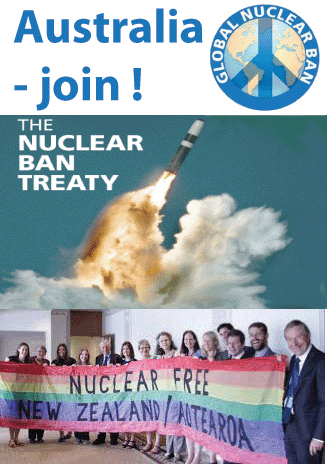
Ninety organisations have joined ICAN to call for Australia to sign and ratify the Treaty on the Prohibition of Nuclear Weapons.
In an open letter addressed to Malcolm Turnbull the groups warn of the “existential threat” that nuclear weapons pose. “There are no safe hands for nuclear weapons. We face a clear choice: continue to let these weapons spread and risk their inevitable use, or eliminate them”.
The letter is signed by a range of health, union, student, Indigenous, humanitarian, environment and faith organisations from across Australia. It highlights the urgency of disarmament amidst current heightened risks of nuclear conflict.
“There is no argument – moral, ethical or rational – for the retention of weapons with the capability to end life on Earth. No person or group of people should wield that kind of power,” Stuart McMillan, President of the Uniting Church in Australia.
“The Treaty on the Prohibition of Nuclear Weapons provides the necessary vehicle for nations to walk away from these unacceptable, and now illegal, weapons. Australia has signed the treaties banning chemical and biological weapons, landmines and cluster munitions. It’s time to take genuine action against these weapons by signing and ratifying the ban treaty,” said Tilman Ruff from ICAN.
The signatories to the letter include World Vision Australia, Oxfam Australia, Save the Children Australia, ChildFund Australia, the Australian Council of Trade Unions and the Uniting Church in Australia.
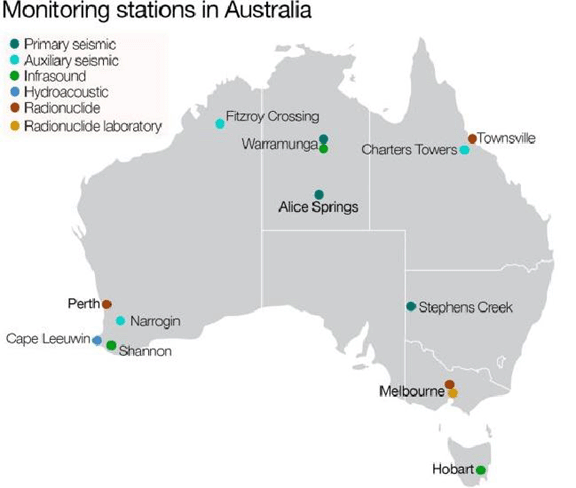
The Warramunga Seismic and Infrasound Research Station is 35km to the southeast of the township of Tennant Creek and monitors any signs of nuclear activity across the globe.
It has recorded all of North Korea’s nuclear tests.
Warramunga’s work doesn’t just include nuclear blasts. It also monitors earthquakes and storms.
ANU’s Dr Michelle Salmon said Warramunga was manned by a small team from the Australian National University’s Research School of Earth Sciences and was one of 321 monitoring stations around the world.
“The station is considered one of the best in the world for recording nuclear blasts because of its quiet site and because it is manned 24/7,” she explained.
We have people living there and this means we can deal with problems that occur immediately.
“Our station is part of a big word wide community that is trying to monitor and make sure that we know what’s going on around the world.
“You can’t explode a large nuclear weapon around the world and not let someone know about it.
“We know where and we know when a blast happens. We really know how big they are getting.”
THERE are 321 monitoring stations around the world all designed with one common goal. The International Monitoring System (IMS) uses four technologies to monitor nuclear activity in countries including North Korea.
Unsurprisingly some of these stations are located within our own borders and play a powerful role in monitoring rogue nations.
In a piece for The Conversation, Trevor Findlay, Senior Research Fellow Department of Social and Political Sciences at the University of Melbourne reveals the key role Australia plays.
Dr Findlay writes Australia hosts six seismic, two infrasound, and one hydroacoustic station, including a large seismic array and infrasound station at Warramunga in the Northern Territory.
DETECT AND RELAY
The Vienna-based Comprehensive Test Ban Treaty Organization (CTBTO) uses the IMS to detect nuclear tests around the world.
This means if Kim Jong-un decides to conduct another nuclear test there are several monitoring stations in Australia which could potentially pick up this abnormal activity.
According to Dr Findlay its monitoring system, which began construction in 1996, is “sensitive enough to detect underground nuclear tests below 1 kiloton”.
The CTBTO picked up the September 3 blast detecting a seismic magnitude of 6.1 and a blast yield of 160 kilotons.
Data such as this is picked up is transmitted to Vienna via satellite where it is analysed and distributed to member states.
The CTBTO’s International Monitoring System is basically designed to verify compliance with the 1996 Comprehensive Nuclear Test Ban treaty.
POWERFUL TOOL
According to Associate Professor at Australian National University’s Strategic and Defence Studies Centre Dr Stephan Fruhling, the monitoring system is hugely beneficial.
“The technologies used by the monitoring system (seismic, infrasound, and radionucleides) were all used developed the Cold War to monitor other countries’ nuclear tests, and/or are also the same as used in geophysical monitoring,” he said.
However, it has a much more vital function.
“The main innovation of the CTBTO system is that it makes all raw data freely available, which means that all member states have now access to a global detection system that is meant to give confidence that the treaty is effective, whereas before only the superpowers had such capabilities,” Dr Fruhling said.
He also said the system is operating “even though the CTBTO itself isn’t actually legally in force, and probably never will be.”
Dr Fruhling said the system was very effective and expects it to become even more so over time as sensors and computing improve and the last few stations come online.
He said the system wasn’t perfect.
“There are some limits to the system in terms of very low-yield tests, especially where reduced enrichment fuels are used that do not produce a full yield but still a useful neutron flux to validate a weapons design,” he said.
“However, this is something that is of more use to the advanced nuclear powers who have a lot of experience and access to past testing data, than it is to a new proliferant like North Korea.
AUSTRALIA’S ROLE
Nuclear disarmament campaigner John Hallam said the system and Australia’s role in it was actually quite remarkable.
Mr Hallam said the system has managed to not merely detect, but diagnose every North Korea test right from their first which was just a fraction of a kiloton.
“Australia plays quite a key role, mainly with the big seismic and infrasound array at Warramunga and the Hydroacoustic station at Cape Leeuwin,” he said.
“The CTBTO manages to do amazing work not only in detection of nuclear blasts, but also in detecting earthquake and volcanic activity and a secondary role as a tsunami early warning network.”
However Mr Hallam said the current policies of the US threaten all of that as the CTBTO has been in effect “boycotted” by the Government, despite being the first to actually sign it.
CTBTO’s executive Secretary Lassina Zerbo is geophysicist who used to be the Director of the International Data Centre which processes and analyses all the data coming from the more than 300 stations around the globe.
CTBTO’s work, including the establishment and maintenance of the IMS, is mandated by the Comprehensive Nuclear-Test-Ban Treaty which was negotiated under the auspices of the United Nations Conference on Disarmament in the 1990s and endorsed by the General Assembly. It opened for signature in 1996.
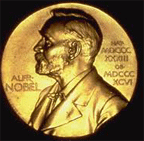
Nobel Peace Prize winners ICAN urge Australia to sign nuclear weapons treaty, SBS News 7 Oct 17 An Australian-born group that was awarded this year’s Nobel Peace Prize says Australia needs to join global efforts to abolish nuclear weapons.A Victorian-born international group that was awarded this year’s Nobel Peace Prize says it’s a shame the Australian government has not signed the treaty banning nuclear weapons that led to its award……
The organisation worked on negotiations for the Treaty on the United Nations Prohibition of Nuclear Weapons, which was adopted by 122 countries in July.
However, the treaty was shunned by nuclear powers the US, Britain, Russia and China. Australia also did not sign the treaty.
“It is a matter of deep regret that the Australian government has thus far refused to join the treaty, and boycotted the conference to negotiate it,” the group said in a statement on Saturday.
ICAN says Australia led a small group of nations who tried to derail efforts in 2016 to secure a UN mandate to launch treaty negotiations.
“Our government’s belief that nuclear weapons, for a select few, are a legitimate and essential source of security is not only misguided, but also dangerous, for it incites proliferation and undermines disarmament,” the group said.
ICAN hopes the federal government will change its stance on nuclear weapons given Australia’s commitment to other treaties prohibiting chemical and biological weapons, anti-personnel landmines and cluster munition.
ICAN now has 468 partner organisations in 101 countries. It was pivotal to the UN adopting the Treaty on the Prohibition of Nuclear Weapons (TPNW) on July 7 this year
A Nobel Peace Prize born in Australia http://www.smh.com.au/comment/a-nobel-peace-prize-born-in-australia-20171007-gyw93r.html, Margaret Beavis Australians can be very proud. The winner of the 2017 Nobel Peace Prize, the International Campaign to Abolish Nuclear Weapons (ICAN), started in Melbourne. It began when the Medical Association for the Prevention of War (MAPW) recognised that nuclear weapons, the very worst of the weapons of mass destruction, were still “legitimate”. This contrasted with chemical weapons, biological weapons, cluster munitions, land mines – even dumdum bullets, which all have been made illegal by UN treaty, with impressive results. Continue reading →
“We’re calling on all countries to sign the new UN treaty prohibiting nuclear weapons, which offers a powerful alternative to a world in which threats of mass destruction are allowed to prevail.
“We will work in coming months to persuade more nations to sign this landmark treaty.
“One of our priorities will be to bring the Australian government on board.
By Jessica Haynes The International Campaign to Abolish Nuclear Weapons (ICAN) has taken out one of the world’s most prestigious awards, the 2017 Nobel Prize for Peace.
So how did a campaign from Melbourne make its way to the international stage?
Key points:
Group honoured for “ground-breaking efforts” to achieve nuclear ban treaty
ICAN also awarded for drawing “attention to the catastrophic humanitarian consequences” of nuclear weapons
215 individuals and 103 organisations were nominated for the prize
So what is ICAN?
ICAN describes itself as a coalition of non-governmental organisations in 100 countries promoting adherence to and implementation of the United Nations nuclear weapon ban treaty.
It has advocated at the United Nations and in parliaments around the world, bringing the stories of those impacted by nuclear testing and survivors of the Hiroshima and Nagasaki bombings to a world stage.
How did it form?
ICAN set up its first office in Melbourne, with disarmament campaigner Felicity Hill as the coordinator.
It officially launched in Vienna, Austria in April 2007 during the Non-Proliferation Treaty preparatory committee meeting.
ICAN campaign director Tim Wright said it was inspired by the International Campaign to Ban Landmines, which had played a major role in the negotiation of the Anti-Personnel Mine Ban Convention, also known as the Ottawa treaty. Continue reading →
During a time when the risk of nuclear conflict is imminent, the prestigious Nobel peace prize has been awarded to a Melbourne-born advocacy group that pushed to establish the first treaty to ban nuclear weapons.
The Nobel Committee honoured the now Geneva-based group, the International Campaign to Abolish Nuclear Weapons, “for its work to draw attention to the catastrophic humanitarian consequences of any use of nuclear weapons and for its ground-breaking efforts to achieve a treaty-based prohibition of such weapons.”
The group worked to advance the negotiations that led to the Treaty on the Prohibition of Nuclear Weapons, which was passed earlier this year at the United Nations.
In July, 122 nations voted to pass the treaty, but nuclear-armed states including the United States, Russia, China, Britain and France stayed out of the talks.
Leonid Petrov, a leading North Korean expert, said Australia could play a much better and more viable option in the crisis.
Dr Petrov, a visiting fellow at the College of Asia and the Pacific at the Australian National University, said it was obvious someone who served as US deputy assistant secretary of defence for nuclear and missile defence policy would recommend buying a US-made piece of equipment.
However, Dr Petrov said there was a cheaper option on the table.
“Australia can save a lot of money (and lives) by using its diplomatic channels and mediate a comprehensive peace deal, which North Korea is begging for since 1974,” he said.
North Korea missile crisis: Could Australia be targeted by Kim Jong-un? A PENTAGON adviser has warned Australia could be on the receiving end of Kim’s fury as experts say anything could happen.news.com.au Debra Killalea@DebKillalea 2 Oct 17
IT WAS a stunning warning that made Australia sit up and take notice.
Former Pentagon official Dr Brad Roberts said Australia needed to develop greater missile defences in the event of a North Korea missile strike.
Dr Roberts, who served as US deputy assistant secretary of defence for nuclear and missile defence policy between 2009 and 2013, also warned Australia had no say in Kim Jong-un’s decisions.
“Unfortunately, Australia doesn’t really get to choose whether or not North Korea threatens it — it’s the choice that the North Korean leader,” he told the ABC.
“His objective is to make us fearful so that our leaders will not stand up to his threats and coercion.”
But just how much of a target is Australia, and are we likely to feel the wrath of Kim?
CAN A NORTH KOREAN MISSILE HIT AUSTRALIA?
Experts warn anything is possible and hope this scenario remains an unlikely possibility. Continue reading →
Doesn’t this tie in nicely with the push by American nuclear weapons firms like Lockheed Martin to sell military and space technology to Australia?
Australia must prepare for nuclear war with North Korea, former Pentagon official warns, Yahoo News, Australia has no choice but to prepare for a missile attack from North Korea, a former Pentagon nuclear weapons official warns.
Brad Roberts served as US deputy assistant secretary of defence for nuclear and missile defence policy is warning a weapon fired from North Korea could strike the country.
“Unfortunately, Australia doesn’t really get to choose whether or not North Korea threatens it — it’s the choice that the North Korean leader [Kim Jong-un] makes,” he told the ABC.
“His objective is to make us fearful so that our leaders will not stand up to his threats and coercion.” The former Obama administration defence official also said that warships should be fitted with proper while pointing out that Australia’s radar defences were rather sparse.
Australia joins boycott of UN treaty outlawing nuclear weapons
Foreign Minister Julie Bishop joined representatives from the US, Britain, France and others who were absent from the event at the annual United Nations gathering of world leaders overnight.
A total of 51 countries lined up to sign the new treaty.
The treaty was adopted by 122 countries at the United Nations in July following negotiations led by Austria, Brazil, Mexico, South Africa and New Zealand.
None of the nine countries that possess nuclear weapons — the United States, Russia, Britain, China, France, India, Pakistan, North Korea and Israel — took part in the negotiations.
“There remain some fifteen thousand nuclear weapons in existence. We cannot allow these doomsday weapons to endanger our world and our children’s future,” UN Secretary-General Antonio Guterres said as he opened the treaty for signing.
NATO condemned the treaty, saying that it may in fact be counter-productive by creating divisions.
As leaders formally signed on the sidelines of the annual UN General Assembly, Secretary-General Antonio Guterres hailed as historic the first multilateral disarmament treaty in more than two decades.
But Guterres acknowledged that much work was needed to rid the world of its stockpile of 15,000 atomic warheads.
“Today we rightfully celebrate a milestone. Now we must continue along the hard road towards the elimination of nuclear arsenals,” said Guterres.
The treaty will enter into force when 50 countries have signed and ratified it, a process that could take months or years.
“At a time when the world needs to remain united in the face of growing threats, in particular the grave threat posed by North Korea’s nuclear program, the treaty fails to take into account these urgent security challenges,” the 29-nation Western alliance said.
It added: “Seeking to ban nuclear weapons through a treaty that will not engage any state actually possessing nuclear weapons will not be effective, will not reduce nuclear arsenals, and will neither enhance any country’s security, nor international peace and stability.
Rejecting need for nuclear weapons
Foreign Minister Sebastian Kurz of Austria, one of the few Western European nations that is not in NATO, rejected the idea that nuclear weapons were indispensable for security.
“If you look at the world’s current challenges, this narrative is not only false, it is dangerous,” he told AFP.
“The new treaty on the prohibition on nuclear weapons provides a real alternative for security: a world without any nuclear weapons, where everyone is safer, where no one needs to possess these weapons,” he said.
Brazilian President Michel Temer was the first to sign the treaty. Others included South African President Jacob Zuma and representatives from Indonesia, Ireland and Malaysia as well as the Palestinian Authority and the Vatican.
Nuclear annihilation was the common childhood nightmare for those growing up in the late 20th century. When the Cold War ended, the issue dropped off the public radar, to be replaced by other existential concerns such as global warning.
In the meantime, states with nuclear weapons got on with modernising their arsenals away from the glare of community awareness, and other states forged ahead with their own nuclear programs because, as noted by Australia’s former UN Ambassador Richard Butler, “as long as any state holds nuclear weapons, others will seek to acquire them”.
Now, two man-children possessed of odd hairdos, nuclear arsenals and twitchy fingers have brought the issue back to where it should have been all along. Uppermost in our minds.
Nuclear weapons are uniquely destructive to human health and the environment, because of the nature and extent of the devastation they cause and the ongoing radioactive fallout. Some nuclear weapons today are more than 3000 times more powerful than the atomic bombs that wiped out Hiroshima and Nagasaki 72 years ago. A single nuclear warhead, if detonated on a large city, could kill millions of people, with the effects lasting for decades.
While other destructive weapons — land mines, cluster munitions, biological and chemical weapons — are already banned, the most powerful of all, nuclear weapons, remain the only weapons of mass destruction not yet explicitly prohibitedunder international law.
This year, more than 135 other countries came together at the United Nations to negotiate a nuclear weapons ban treaty. You’d think Australia’s participation in the negotiations would have been a no-brainer for the federal government, what with the Australian public being overwhelmingly supportive, with Australia’s proud record of advocacy of nuclear disarmament, and with the Labor Opposition expressing its strong support.
This so-called ‘nuclear deterrence’ policy requires rational behaviour by all those who control nuclear weapons. Do we really have confidence that North Korean leader Kim Jong-Un and U.S. President Donald Trump will always behave rationally in not launching an attack on other nuclear states or their allies?
The nuclear deterrence policy also assumes that nuclear weapons make the world safer, not more dangerous. Patently, the reverse is true. The production, testing and possession, let alone the use, of nuclear weapons pose inherent risks.
There have already been a number of close calls (think Cuban Missile Crisis) and accidents, including last June, when a test missile involving the British Trident nuclear deterrence program malfunctioned and veered towards the U.S. coast before self-destructing. Luckily the missile was not armed with a nuclear warhead on that occasion but the British and U.S. governments did not reveal the incident when it happened, which incidentally, was just before the UK Parliament voted on renewing the Trident nuclear program.
Channeling Kath and Kim’s ‘I’ve got one thing to say to you’, the former UN Secretary-General was heard to say: “There are no right hands for wrong weapons.”
John Carlson, former head of Australia’s nuclear safeguards office for more than two decades, has pointed out in articles for the Lowy Institute that, as a party to the non-proliferation treaty, Australia is legally required to pursue negotiations in good faith on effective measures relating to nuclear disarmament.
It is difficult to see how Australia’s boycott of the nuclear ban treaty negotiations could be compatible with that obligation. Carlson also noted that:
“The world still has 15,000 nuclear weapons and the risk of nuclear war is increasing. A ban treaty is needed to re-energise disarmament efforts. The treaty will help to stigmatise nuclear weapons and change mindsets about retaining them”.
Notwithstanding Australia’s immoral (and likely illegal) boycott of the negotiations, the treaty text was finalised on July 7, and opened yesterday, September 20, for signature.
The treaty prohibits nations from developing, testing, producing, manufacturing, transferring, possessing, stockpiling, using or threatening to use nuclear weapons, or allowing nuclear weapons to be stationed on their territory. It also prohibits them from assisting, encouraging or inducing anyone to engage in any of these activities. Nations are obliged to provide assistance to all victims of the use and testing of nuclear weapons and to take measures for the remediation of contaminated environments. The preamble acknowledges the harm suffered as a result of nuclear weapons, including the disproportionate impact on women and girls, and on indigenous peoples around the world.
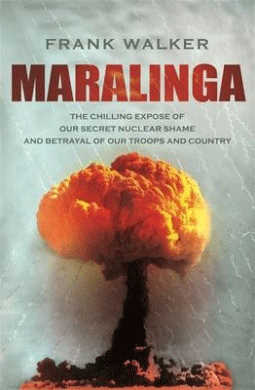
Many Australian indigenous and service personnel victims of British colonial nuclear testing at Maralinga, Emu Field and the Montebello islands in the 1950s and ’60s would no doubt attest to the importance of the treaty, which will come into force upon the ratification of 50 nations.
Just as it is time for Australia to have its own head of state, it is time for Australia to finally let go of our long-time strategic dependence on a great power, and to pursue fully independent foreign and defence policies.
Our ties with the U.S. will always be close — as Paul Keating said recently, “we couldn’t shake the Americans, even if we wanted to”. But surely, the time has come, particularly following the election of Donald Trump, to distance ourselves from counter-productive defence policies that are based on false assumptions, and take our place among the majority of nations as a constructive contributor to global peace.
I urge the Turnbull Coalition government to sign and ratify the UN nuclear ban treaty. If the present government fails to act, I urge the great Australian Labor Party of luminaries like Tom Uren, to convert its present support for nuclear ban treaty negotiations in Opposition into future support for the treaty in government, with a firm commitment at next year’s ALP national conference to ratify the nuclear ban treaty early in its first term.
Tomorrow The World Is Going To Try And Ban Nuclear Weapons. Australia Wants To Keep Them. New Matilda, By Rewena Maheshon A global push to save the world from a nuclear armageddon has the backing of more than 120 nations. Australia isn’t one of them. Rewena Mahesh explains.
On July 7, a global treaty was adopted at the UN General Assembly to prohibit nuclear weapons. This treaty now sets precedence for a powerful norm that will change the course of history by helping promote disarmament and preventing further proliferation.
This treaty closes a large international law gap, by prohibiting states from developing, testing, producing, manufacturing, transferring, possessing, stockpiling, using, or threatening to use nuclear weapons once ratified by 50 states.
That will happen tomorrow, on the 20th of September.
Despite an overwhelming 122 countries endorsing the treaty, strongly and actively supported by hundreds of civic society organizations including the World Medical Association, Medical Association for Prevention of War, the World Federation of Public Health Associations, nine member countries that possess nuclear weapons and most NATO allies boycotted the agreement.
Shamefully, one of those countries absent from negotiations and which played a role in boycotting the treaty is Australia. We fall under the nuclear protection of the USA.
While Australia, possesses no nuclear weapons, it is a major producer and supplier of uranium used in the production of nuclear arsenals for the US and British military and most recently Russia, China and India.
Australia has had a long history with nuclear testing, hosting the British in the 1950s and 60s to conduct 12 major nuclear tests which dispersed radiation across much of the continent. In particular site workers and Aboriginal communities nearby have been suffering the consequences of radiation, seen in high rates of cancer with very little compensation, and a lack of capacity to use traditional land due to contamination.
As a result of Australia hosting the US military and intelligence facilities, such as Pine Gap near Alice Springs, we are offered protection in the face of a nuclear threat, under the extended nuclear deterrence, and thus consider nuclear weapons to be legitimate, useful and necessary despite their devastating and catastrophic effects……..
Given the current volatile environment with unpredictable leaders, the only guarantee we have against the spread and use of nuclear weapons is to eliminate them completely.
Indiscriminate weapons such as landmines, biological and chemical weapons, and cluster munitions which have all been permanently banned are increasingly accepted as illegitimate, and are losing their political status.
It is thus difficult to acquire resources for the production and modernisation of a prohibited weapon by companies or governments. It is then hoped that by eliminating nuclear weapons, this forms the new norm globally and they too will lose their legitimacy and political status in due course.
Nuclear weapons are also an ineffective means of combating almost all issues globally and nationally, such as cyber warfare, climate change, poverty, antimicrobial resistance etc.
The International Campaign to Abolish Nuclear Weapons (ICAN) showed that 84 per cent of Australians surveyed wanted the government to support the efforts of a treaty to ban nuclear weapons. Australia still has the opportunity to be on the right side of history by signing the treaty tomorrow.
Australia needs to be at the forefront of global efforts to eliminate nuclear weapons and not be misled by the notion of extended nuclear deterrence under the protection of the US.
Australia needs to look across the Tasman to its neighbour New Zealand, which for decades has remained an ally of the US, but has had an independent foreign policy.
David Noonan will speak on public interest concerns over the new Roxby Downs Indenture Act 2026 on BHP copper-uranium mining and ore processing in SA, and on how AUKUS may face SA with a High-Level nuclear waste agenda.
Dr Jim Green will discuss international developments in the field of nuclear power including ‘small modular reactors’ and Generation 4 ‘advanced’ nuclear reactor concepts.