Off the Books: how the Army privatised SAS elite to dark ops outfit Omni
Michael West Media, by Stuart McCarthy | May 4, 2024
Former SAS officers referred to national corruption watchdog over $230 million in government contracts to private security and intelligence “front company” Omni Executive. A Stuart McCarthy investigation.
According to the company’s website, Omni was established in 2012 and focuses on “delivering innovative national security, intelligence and critical infrastructure solutions to further our national interests.”
Since 2015, Omni has been awarded more than $230 million in security and intelligence related contracts by the departments of Defence, Foreign Affairs and Trade, Home Affairs, Prime Minister and Cabinet, the Australian Signals Directorate, the Australian Federal Police and the Australian Criminal Intelligence Commission.
Omni contracts hidden……………………………………………………………….. more https://michaelwest.com.au/army-privatised-sas-elite-to-dark-ops-outfit-omni/
Is There Life Beyond Nuclear Armageddon?

Bruce Dorminey, Senior Contributor, Forbes, 30 Apr 24
Earth is a very rare jewel of a planet. A completely serendipitous chance encounter with a Mars-sized impactor some 4.5 billion years ago created our anomalously large moon which to this day gives our planet its stable axial tilt. All of which enabled our planet to evolve its current life-rich biosphere.
Yet only in the last 300,000 years or so have we been around long enough to watch Earth’s civilizations come and go. And only within the last hundred years have we created weapons of mass destruction so powerful that if used in anger, they could wipe out billions of years of biological evolution.
Given recent geopolitics, however, in fifty years’ time I wouldn’t bet on there being anybody here to ponder such philosophical musings.
Thus, could life survive a full-scale nuclear war?
A nuclear Armageddon might be broadly similar to the K/Pg impact (the “dinosaur killer”) some 66 million years ago, Ariel Anbar, a geochemist and President’s Professor at Arizona State University in Tempe, told me via email. But in terms of the energy released the impact was thousands of times larger than even an all-out nuclear war would release, he says. Nuclear war also brings with it radiation that can drive mutations, which is a special kind of “nasty” but both scenarios are more than enough to bring down human civilization, says Anbar.
Most if not all of humanity would simply disappear.
My suspicion is that something like 99.9% of all humans would die, and our civilization would never rebound, Bruce Lieberman, a paleontologist and evolutionary biologist at the University of Kansas in Lawrence, told me via email. Either we wouldn’t survive, or it would be so bad for those few that lived that they would be better off if they didn’t survive, says Lieberman.
But Would Our Biosphere Survive?
Earth’s biosphere would survive even though it would take a big hit, says Anbar. Leaving aside the consequences of radioactive fallout, a nuclear war would be less severe than the K/Pg impact some 66 million years ago, he says. The consequences of nuclear fallout from a global exchange are hard to gauge since there’s a lot we do not know, says Anbar. But plenty of animals would likely survive so evolution is not likely to be “reset” back to microbes, he says.
How would nuclear Armageddon compare to natural planet killers that have befallen planet Earth, such as giant asteroids, comets as well as nearby gamma ray bursts or supernova explosions?
Life eventually rebounded after each of these mass extinctions, though it took at least 10-20 million years for diversity to reach former levels and for ecosystems to return to their pre-extinction levels of complexity, says Lieberman.
Even so, Lieberman says a global nuclear holocaust would cause a tremendous initial loss in biodiversity, perhaps on the order of 70% to 95% of all animal and plant species on land and 25% to 50% in the oceans.
The lesson here is that our planet’s fate can turn on a dime…………………………………………………………………………. more https://www.forbes.com/sites/brucedorminey/2024/04/30/is-there-life-beyond-nuclear-armageddon/?sh=30cdf0a04eb0
Nukes in space: Why a very very stupid idea just became more likely

Fears of a Cold War nightmare are resurfacing.
Tom Howarth, May 4, 2024, https://www.sciencefocus.com/space/nukes-in-space
Could a nuke be used in space? Last month, Russia seemingly took a step toward making the idea a reality. In defiance of a US and Japan-sponsored UN resolution, the country vetoed plans to prevent the development and deployment of off-world nuclear weapons.
Fortunately, the country didn’t actually threaten to launch such a device into space, an act that would violate the 1967 Outer Space Treaty. However, the UN representative for Russia did call the new resolution a “cynical ploy” and claimed “we are being tricked”.
But what would actually happen if Russia – or any other country – detonated a nuke above Earth? The worrying answer: such an explosion could be as devastating as one on ground level.
What happens if you detonate a nuclear warhead in space?
There are some pretty stark differences between setting off a nuke at ground level and up in orbit.
“When nuclear weapons go off on the ground, a lot of energy is initially released as X-rays,” Dr Michael Mulvihill, vice chancellor research fellow at Teesside University, tells BBC Science Focus.
“Those X-rays superheat the atmosphere, causing it to explode into a fireball – that’s what produces the shockwave and characteristic mushroom cloud that sucks up dirt and produces fallout.”
But in space there is no atmosphere. So no mushroom clouds or shockwaves are formed when you set off a nuke in space. That doesn’t mean the effects are any less terrifying, however.
“In space, a nuclear explosion releases a huge amount of energy as X-rays, gamma rays, intense flows of neutrons and subatomic charged particles. It also produces what’s known as an electromagnetic pulse, or EMP,” Mulvihill says.
An EMP is effectively a burst of electromagnetic energy; when one interacts with the upper atmosphere, it strips electrons from it, blinding radar systems, knocking out communications and wiping out power systems.
After the initial explosion, a belt of radiation wraps around the Earth that persists for months, possibly even years – no one knows for sure. The radiation can damage satellites and, as Mulvihill points out, would pose a serious risk to anyone in space at the time – such as astronauts on the ISS.
“The EMP would knock out power systems on the ISS, effectively destroying the life support systems and everything that circulates the atmosphere within the space station. And I imagine the astronauts would be exposed to high levels of radiation too,” Mulvihill explains.
“It would be highly hostile to life in orbit.”
Space is becoming more and more crowded with satellites – approximately 10,000 satellites are in low earth orbit right now, and tens of thousands more are planned for launch in the coming years. This significantly raises the stakes of unleashing nuclear energy in space, as we become more reliant on the systems we put into orbit.
From ground level, however, other than blowing power grids and disrupting communications, the effects could also be somewhat beautiful.
As charged particles from the explosion interact with the Earth’s magnetic field and the atmosphere, they would cause brilliant auroras, stretching across huge distances that could last for days. So there’s that, at least.
Have nuclear explosions reached space before?
Unsurprisingly, during the Cold War, global superpowers (namely, the US and Russia) tested nukes in just about every scenario imaginable. On land, underwater, in a mountain – you name it, they tried blowing it up.
It comes as no surprise then, that detonating nuclear weapons in space has been done before. In total, the US conducted five space nuclear tests in space; the most famous of which, according to Mulvihill, occurred on 9 July 1962 near(ish) to the Pacific island paradise of Hawaii.
Starfish Prime was launched 400km (250 miles) above Johnston Island and had an explosive power of 1.4 megatons – about 100 times more powerful than the Hiroshima bomb.
The EMP was much larger than expected, compromising the classified nature of the test as streetlights and phone lines were knocked out in Hawaii 1,450 km (900 miles) away from the detonation point.
The ensuing red auroras stretched across the Pacific Ocean and lasted for hours.
“At the time there were around 22 satellites in space, of which around a third were knocked out,” Mulvihill says. The casualties included the world’s first TV communication satellite, Telstar 1, which had been a beacon of US technological development until Starfish Prime caused it to prematurely fail after just seven months in orbit.
In the following years, everyone came to their senses a bit and decided that testing nuclear warheads in space constituted a bad idea. Thus, the Outer Space Treaty (OST) was born.
Signed in 1967 by the US, UK and Soviet Union, the OST now has over 100 signatories and designates space as free for all to use for peaceful purposes only. The world breathed a sigh of relief and got on with using space for nice things like astronomy, space stations and WiFi for the next 60 years. So, what’s changed?
How worried should we be?
Rumours of a change in the orbital security situation began swirling when earlier this year the US House Intelligence Committee chairman Mike Turner issued a vague warning about a “serious national security threat” posed by Russia.
Following this, news outlets began reporting that the threat pertained to a possible “nuclear weapon in space”.
“It’s certainly concerning, but don’t lose sleep over it,” Mulvihill says. “Russia is still a signatory of the OST, so any sort of weapon in space would be absolutely illegal.”
He also points out that as Starfish Prime demonstrated, nuclear weapons in space are indiscriminate, meaning any detonation would do just as much damage to Russia and its allies as anyone else.
“It wouldn’t just knock out Starlink [the SpaceX system of satellites that provides internet to 75 countries]. It would knock out Chinese satellites and everyone else’s too.”
Another possibility, Mulvihill thinks, is that countries could develop nuclear-powered ‘jammers’. In other words, not a bomb (phew), but something that uses nuclear power to generate a signal that could disrupt, rather than destroy, other satellites.
Ultimately, though, this could all be little more than geopolitical posturing. “Deterrence is all about messaging and trying to persuade somebody that you would do it without ever actually getting there. I think that’s probably the psychology that’s going on with this,” Mulvihill concludes.
Inside story: Will Iran’s supreme leader revise his ‘nuclear fatwa’?
https://amwaj.media/article/inside-story-will-iran-s-supreme-leader-revise-his-nuclear-fatwa 5 May 24
The direct confrontation between Iran and Israel has sparked speculation about a potential shift in the Islamic Republic’s nuclear policies under the leadership of Ayatollah Ali Khamenei.
Following Iran’s Apr. 14 military action against Israel in response to the Apr. 1 bombing of the Iranian consulate in Damascus, a senior commander of the Islamic Revolutionary Guard Corps (IRGC) explicitly suggested the possibility of a revision to Tehran’s objection to atomic weapons. The suggestion may only be a part of the war of words between Iran and Israel. However, the fact that such discourse is rapidly becoming mainstream in Iran raises questions of what may lie ahead—including whether a shift may take place under Khamenei, who has long opposed atomic weapons on a religious basis.
Rapidly changing discourse
Amid media speculations of a major Israeli attack in response to Iran’s Apr. 14 drone and missile strike on sites inside Israel, Gen. Ahmad Haqtalab—the commander of the Protection and Security Corps of Nuclear Centers—on Apr. 18 stated, “If the Zionist regime wants to use the threat of attacking our country’s nuclear centers as a tool to pressure Iran, it is possible to review the nuclear doctrine and policies of the Islamic Republic of Iran and deviate from the previous considerations.”
The warning was rare, and even as tensions eased between Tehran and Tel Aviv, Iranian officials continued to underscore the significance of the matter. Four days after Haqtalab’s intervention, former IRGC commander and current MP Javad Karimi Qoddousi tweeted, “If permission is issued, there will be [only a] week before the first [nuclear] test.” Qoddousi separately posited that the same amount of time was needed to test missiles with an increased range of 12,000 km (7,456 miles).
However, Iranian Foreign Ministry spokesman Nasser Kanani promptly interjected, dismissing the notion of any alteration to the country’s nuclear doctrine. Meanwhile, government-run Iran daily slammed Qoddousi, characterizing his statements as “untrue” and possibly being exploited by “enemies” to pursue further sanctions and fear mongering against Iran. Several other outlets, including conservative-run media, notably echoed such criticisms.
Yet, despite the blowback, Qoddousi went ahead and posted a video on Apr. 25 in which he said that Iran needs only half a day to produce the 90%-enriched uranium necessary to build nuclear bombs.
Khamenei and the ‘nuclear fatwa’
In Shiite Islam, a fatwa is a religious edict issued by a high-ranking Islamic jurist on the basis of interpretation of Islamic law. To followers of the jurist in question, fatwas are binding and the primary point of reference for everything from major life decisions to day-to-day matters. Fatwas can also be a part of state policies.
Ayatollah Khamenei has on multiple occasions over the past two decades reiterated his objection to the development, stockpiling, and usage of nuclear weapons as haram or religiously impermissible. Among believers, violating what is deemed haram would have serious consequences both in this life and the hereafter. In 2010, the supreme leader reiterated his objection to weapons of mass destruction in a message to an international conference on nuclear disarmament, stating they “pose a serious threat to humanity” and that “everyone must make efforts to secure humanity against this great calamity.”
Critics of what became known as the nuclear fatwa have over the years raised a variety of objections, from the modality of Khamenei’s religious edict to the manner in which it has been presented. Some even question whether the ruling really exists. What is indisputable, however, is that the religious edict has previously averted conflict by aiding diplomacy.
For instance, in connection with the 2013-15 nuclear negotiations that led to the signing of the Joint Comprehensive Plan of Action (JCPOA) between Iran and world powers—which saw Tehran agree to restrictions on its atomic program in exchange for sanctions relief—there were suggestions that the Islamic Republic should codify the fatwa.
Amid the nuclear negotiations with Iran, then-US secretary of state John Kerry in 2014 stated, “We take [Khamenei’s fatwa] very seriously….a fatwa issued by a cleric is an extremely powerful statement about intent. Our need is to codify it.” In another interview the same year, Kerry asserted that “the requirement here is to translate the fatwa into a legally binding, globally recognized, international understanding…that goes beyond an article of faith within a religious belief.”
Only days after the signing of the JCPOA in 2015, Khamenei said, “The Americans say they stopped Iran from acquiring a nuclear weapon. They know it is not true. We had a fatwa, declaring nuclear weapons to be religiously forbidden under Islamic law. It had nothing to do with the nuclear talks.”
Will Khamenei change his fatwa?
Khamenei is not the first Iranian Islamic jurist to issue a fateful religious edict on a highly politicized matter. Back in 1891, Mirza Mohammad Shirazi (1815-95), a leading Shiite religious authority at the time, issued a hokm or verdict against the usage of tobacco in what became known as the Tobacco Protest. The move came in protest against a concession granted by the Qajar monarch Naser Al-Din (1848-98) to the British Empire, granting control over the growth, sale, and export of tobacco to an Englishman. The hokm issued by Shirazi ultimately led to the repeal of the concession.
Neither a fatwa nor a hokm is set in stone and can be revised. The main distinction between the two types of rulings is that a hokm tends to have more conditions and requirements attached to it. Moreover, while a fatwa must be followed by the followers of the Islamic jurist who issued it, a hokm must be followed by all believers—including Shiites who are not followers of the jurist in question.
Explaining the intricacies of a hokm, a cleric and professor of Islamic law (fiqh) at the Qom Seminary told Amwaj.media, “There are primary hokm and secondary hokm. The former is like the necessity of the daily prayer that is mentioned in the Quran and the hadiths [traditions], or the prohibition on consuming alcohol. The secondary hokm is based on expediency and necessity that leads to the first ruling being changed. For example, if alcohol helps someone stay alive, then it is not haram [religiously impermissible] for him or her [to make use of it].” He added, “A fatwa can be changed too.”
TODAY. Small modular reactors – yes -the nuclear lobby will keep hyping them – no matter what!

Well, we all do know why. The small nuclear reactor (SMR)power industry – moribund though it is, is essential for the nuclear weapons industry – for a number of reasons, but importantly – to put a sweet gloss on that murderous industry.
Never mind that USA’s NuScale’s SMRs were a resounding flop – NuScale is still being touted, along with all the other little nuclear unicorns manouvreing to get tax-payer funding.
The facts remain, and apparently just need to be hammered again and again:
SMRs are not cheap, not safe, do not reduce wastes, are not reliable for off-grid power, are not more efficient fuel users than are large reactors.
The latest hyped -up push for SMRs is in Canada – with the boast that they will benefit indigenous communities . Successful bribery of indigenous people would give a huge boost to the global nuclear lobby, – as indigenous people have historically been the most distrustful of uranium mining and of the whole nuclear fuel chain.

The gimmicks this time are floating nuclear power plants – barges carrying Westinghouse’s eVinci microreactors. These would take over from the current deisal power plants serving remote communities. There are already some solar, wind and battery projects – frowned upon by the nuclear lobby, of course.
These projects are being strongly promoted, but poorly explained to indigenous communities, would bring radiological hazards along Canada’s Northern shoreline
And what really are the chances that these little nuclear power sources would be effective anyway? Recent reports by the International Atomic Energy Agency (IAEA) reveal that while 83 small nuclear reactors are “in development”, but there are only 2 in operation.
In both cases, the development of the reactors was a very lengthy and expensive process.
The Chinese SMR HTR-PM- “Between January and December 2022, the reactors operated for only 27 hours out of a possible maximum of 8,760 hours. In the subsequent three months, they seem to have operated at a load factor of around 10 percent.”
For the Russian SMR – “The operating records of the two KLT-40S reactors have been quite poor. According to the IAEA’s PRIS [Power Reactor Information System] database, the two reactors had load factors of just 26.4 and 30.5 percent respectively in 2022, and lifetime load factors of just 34 and 22.4 percent.”
Will Canada’s remote indigenous communitites buy the duplicitous nuclear lobby’s propaganda on SMRs ? And then, subsequently, will the rest of us buy it, despite the facts. I guess that the corporate media will help, – if lies are repeated often enough, people come to believe them.
Can floating nuclear power plants help solve Northern Canada’s energy woes?

tangible details on how nuclear technology might be deployed for the benefit of Indigenous peoples were almost entirely absent.
being saddled with a floating radiological hazard on its shoreline could be a worst-case scenario for a Northern community – around the world, there’s a long history of derelict vessels abandoned and left for others to deal with.
Diesel is the only way to keep the lights on in many remote Arctic towns. A new project wants to offer a greener [?] option – but first it has to assuage safety and cost concerns and compete with other renewables
The Globe and Mail MATTHEW MCCLEARN 3 May 24
The nuclear industry is seeking to establish a beachhead in Canada’s North – literally – with a proposed floating nuclear power plant to serve remote Indigenous communities.
Westinghouse, a U.S.-based reactor vendor, has partnered with Prodigy Clean Energy, a Montreal-based company, to develop a transportable nuclear power plant. Essentially a barge housing one or more of Westinghouse’s eVinci microreactors, it would be built in a shipyard and moved thousands of kilometres by a heavy-lift carrier to its destination in the Far North. There it could be moored within a protected harbour, or installed on land near the shore.
Prodigy, which spent the past eight years developing the barge, markets it as a solution for delivering small modular reactors (SMRs) for coastal applications. To serve markets with larger energy appetites, Prodigy has partnered with another American vendor, NuScale, whose reactor produces far more electricity than the eVinci.
While both the eVinci and barge are still works in progress, the partners vow to have their first transportable nuclear plant operating by the end of this decade. “We are talking here about really starting a new industry,” said chief executive Mathias Trojer. “Prodigy solves the SMR deployment problem.”
Prodigy markets its product as an alternative to diesel-fired power plants, which power nearly all Northern remote communities. Diesel is unpopular because of its high emissions and the considerable logistical challenges and costs associated with shipping it to far-flung places.
Prodigy’s message dovetails with broader marketing efforts by the federal government and the nuclear industry to promote SMRs: The word “Indigenous” appeared in the government’s 80-page “SMR road map” more than 100 times, mostly in relation to how communities should be engaged with well in advance of specific project proposals. Yet tangible details on how nuclear technology might be deployed for the benefit of Indigenous peoples were almost entirely absent.
With Prodigy’s transportable plant, a more coherent vision is beginning to emerge. In March, Prodigy announced it had reached an agreement with Des Nëdhé Group, a development corporation of the English River First Nation in northern Saskatchewan. Des Nëdhé’s task will be to engage with First Nations, Inuit and Métis across Canada on potential installations.
“You have Indigenous people that want to be part of this process, that want to include other Indigenous people and treat them like value-added partners,” said Sean Willy, Des Nëdhé’s president and CEO. “Having Indigenous people talk to Indigenous people seems to work a lot better than bringing in a bunch of outside consultants and highly technical people. That’s why we’re part of this project.”
Floating reactors are marketed for other purposes, too. At a conference the International Atomic Energy Agency held late last year that focused on them, possibilities discussed included supplying power to offshore oil and gas platforms, island nations, desalination plants and ports.
But as the partners race to commercialize their transportable nuclear plant, a few Northern communities are already using renewables such as wind and solar to reduce diesel consumption. Will floating nuclear power plants be ready in time and at an affordable price?
Diesel dissatisfaction
Gjoa Haven, Sachs Harbour, Puvirnituq, Arviat: They’re four of the roughly 200 remote communities across Canada lacking a connection to North America’s continental electricity grid and natural gas pipelines. For many decades, diesel-fired plants were the only option.
Their ubiquity stems in part from low upfront capital costs, and they’re relatively straightforward to maintain. They can respond rapidly to shifting demand – a quality that is particularly important for small communities. They have proved dependable in harsh environments.
Diesel “can be installed almost anywhere,” said Michael Ross, a professor at Yukon University who studies Northern energy needs. “It’s been around for many, many years, and we know how it works.”
And yet it’s woefully unpopular. According to one estimate, Northern communities consume an average of 680 million litres of diesel every year. Severe conditions in the North leave a short delivery window each summer; shipments may arrive only once or twice a year. (Nunavut alone consumes approximately 15 million litres of diesel annually.) To ensure those supplies last, communities often maintain large excess reserves, which are expensive. Operating costs are high. A 2015 Senate committee report found that many of the North’s diesel plants were built in the 1950s and 60s and had already surpassed their expected service lives, driving costs higher still.
These and other factors drive up Northerners’ power bills to levels that would incite outrage elsewhere. Yet were it not for heavy government subsidies, they’d pay between 10 and 30 times today’s rates, according to the Pembina Institute, a clean energy think-tank. It estimates direct subsidies at between $300-million and $400-million annually.
Environmental effects are also considerable. Diesel-fired plants emit sulphur dioxide, nitrogen oxides and particulate matter, impairing local air quality, along with greenhouse gases. Leaks and accidental spills occur frequently. Even so, as recently as a few years ago, the consensus was that there were no alternatives. ………………………………………………….
The 2021 mandate letter for Minister of Natural Resources Jonathan Wilkinson ordered him to work with Indigenous partners to help replace diesel-fuelled power with renewables by 2030. Though nuclear technology is not renewable and was not mentioned, Mr. Wilkinson is an ardent supporter, and his government has funded SMR vendors. The federal government has already contributed $27.2-million to support the eVinci’s development.
Barging in
The underlying technology for floating nuclear power plants has a long history. The first nuclear-powered submarine entered service in the 1950s. Since then, reactors have powered American, British and Russian submarines as well as aircraft carriers and icebreakers……………………………………………….
In Siberia, the four-reactor Bilibino nuclear plant was constructed during the 1970s and supplied electricity to the port of Pevek, hundreds of kilometres away. Its output was recently replaced by the Akademik Lomonosov, which is sometimes described not only as the world’s lone floating nuclear power plant, but also the only true functioning SMRs. (According to reports, more floating SMRs are being constructed to supply electricity to mines near Pevek, and there are proposals to deploy Chinese-built floating nukes in the South China Sea.)
The Akademik Lomonosov’s history, though, is not entirely encouraging. According to Mycle Schneider, a nuclear energy analyst and consultant who produces annual reports on the state of the industry, the original plan was to build the plant in less than four years and commission it in 2010; it was delivered a full decade late, and far over budget…………………………………………………..
Even ballpark pricing for a five-megawatt transportable plant is unavailable. Cost is no small consideration here: Nuclear has traditionally been regarded as among the most expensive options for generating power. And according to the Pembina Institute, Indigenous communities and businesses have difficulty accessing capital.
Qulliq Energy, Nunavut’s sole electricity provider, generates nearly all the electricity for its approximately 15,000 customers using 25 diesel plants. It has demonstrated a willingness to consider nuclear power, but admits it can’t afford to pay for any alternatives. A 2020 report said the utility “will not be able to incorporate alternative energy sources into its generation supply mix unless significant funding becomes available.” It looked to the federal government to pay.
Qulliq’s media relations department did not respond to inquiries. Michael MacDonald, a spokesperson for the federal Natural Resources Department, said his department hadn’t provided funding to Qulliq for SMRs or for any other nuclear project. It did provide Qulliq with funding for a solar project in Kugluktuk
Mr. Trojer insisted a floating eVinci’s power would be “very significantly more affordable” than diesel. M.V. Ramana, a professor at the University of British Columbia who specializes in nuclear issues and has studied the economic attractiveness of SMRs in remote applications, disagrees. He estimates costs for SMRs could be as much as 10 times higher than diesel.
“If you really are interested in lowering their costs, I think one would first try out a lot more renewable options, and seek to reduce the demand for diesel before you even think about nuclear,” he said.
Racing against alternatives
The earliest Northern communities to reduce their dependence on diesel have done precisely that – they’ve pursued renewables.
The White River First Nation’s Beaver Creek Solar Project, in Yukon, featured 1.9 megawatts of solar panels and 3.5 megawatt hours of battery storage capacity, and is expected to reduce diesel consumption by more than half. The Sree Vyàa solar project, in Old Crow, Yukon, aimed to reduce that community’s diesel consumption by 190,000 litres.
“Wind and solar seem to be the most sought-after solutions, in partnership with batteries,” said Prof. Ross, who has work on 11 Northern renewable energy projects……………………………………
SMRs are often marketed as producers of “clean” energy, but this overlooks their radioactive wastes. In Southern Canada, the longstanding practice has been to store spent fuel in special facilities at nuclear power plants. But being saddled with a floating radiological hazard on its shoreline could be a worst-case scenario for a Northern community – around the world, there’s a long history of derelict vessels abandoned and left for others to deal with.
…………………………………………………………………………………………….. The Nuclear Waste Management Organization is responsible for long-term storage of spent fuel, and proposes to construct an underground disposal site known as a Deep Geological Repository to permanently store it. It says the repository would be able “to accommodate changes in technology,” but is currently focused on reactors already in the licensing process.
“We are aware of and actively monitoring additional technologies, including the eVinci, however these are still at a preliminary stage,” it said in a statement……………………………………………….
Other issues must be ironed out as well. All of Canada’s existing nuclear plants are large industrial facilities – the largest have thousands of employees and multiple parking lots. It’s not clear yet how many people would be required to operate a transportable nuclear plant equipped with an eVinci. Enticing highly skilled workers to tiny remote communities – and retaining them – could be a challenge.
Canada’s existing nuclear plants are patrolled by security teams. How many individuals with automatic weapons would be needed to patrol a transportable plant? This also has yet to be determined.
Citing waste concerns, the Assembly of First Nations, a national advocacy group, adopted a resolution in 2018 opposing construction and operation of SMRs anywhere in Canada. In March, Biigtigong Nishnaabeg First Nation (Ontario), Kabaowek First Nation (Quebec) and the Passamaquoddy Recognition Group (New Brunswick) were among hundreds of civil society groups who signed a declaration in Brussels against the backdrop of an international nuclear summit.
“Time is precious,” the declaration read, “and too many governments are wasting it with nuclear energy fairy tales.”
……………………………………………….. Whether Ottawa’s ready or not, Prodigy is pushing forward. Mr. Trojer said his company has ensured all elements of the transportable nuclear power plant can be licensed under existing rules and regulations. And Prodigy has closely co-ordinated with delivery dates promised by partners like Westinghouse. It’s now speaking with Canadian shipyards in hopes of finding one to build the transportable nuclear power plant.
The 2030 target, he vowed, will be met. “Prodigy absolutely will meet this timeline.” https://www.theglobeandmail.com/business/article-can-floating-nuclear-power-plants-help-solve-northern-canadas-energy

Australia and the F-35 supply chain: in lockstep with Lockheed
The Australian government has continued arms exports to Israel while assuring Australians it has not sent weapons to Israel for five years
MICHELLE FAHY. MAY 03, 2024, https://undueinfluence.substack.com/p/lockstep-with-lockheed-australia?utm_source=post-email-title&publication_id=297295&post_id=143751160&utm_campaign=email-post-title&isFreemail=true&r=1ise1&triedRedirect=true&utm_medium=email
Australia is one of six western countries that are complicit in the ‘genocidal erasure’ of the Palestinian people by continuing to supply Israel with arms, according to Dr Ghassan Abu-Sittah, a British-Palestinian surgeon and newly elected rector of Glasgow University.
Israel’s relentless bombing campaign has systematically destroyed all of Gaza’s 11 universities plus more than 400 schools, and killed 6,000 students, 230 teachers, 100 professors and deans, and two university presidents.
The elimination of entire educational institutions (both infrastructure and human resources) is ‘scholasticide’ and is a critical component of the genocidal erasure, says Dr Abu-Sittah.
He named the United States, Germany, the United Kingdom, Australia, Canada and France as comprising an ‘axis of genocide’ because they have been supporting the genocide in Gaza with arms, and had also maintained political support for Israel.
Dr Abu-Sittah worked in Gaza for 43 days in the immediate aftermath of the October 7 attacks. His experience was cited in South Africa’s genocide case at the International Court of Justice (ICJ).
In his submission to the ICJ, Dr Abu-Sittah wrote: ‘There was a girl with just her whole body covered in shrapnel. She was nine. I ended up having to change and clean these wounds with no anaesthetic and no analgesic. I managed to find some intravenous paracetamol to give her…her Dad was crying, I was crying, and the poor child was screaming…’
Australia defies the UN
The Albanese government has consistently denied it is supplying weapons to Israel, even as the United Nations pointed a finger directly at Australia, alongside the US, Germany, France, the UK, and Canada, asking these countries to immediately halt all weapons transfers to Israel, including weapons parts, and to halt export licences and military aid.
The Defence Department has refused to answer questions about whether it has halted the arms export permits for Israel that were in place before October 7, the day of Hamas’s deadly attack in Israel.
Defence approved new export permits to Israel after October 7
Defence approved three new export permits to Israel in October 2023, and none in November, December or January (to 29/1), according to figures Defence released following a Freedom of Information (FOI) request I lodged on 29 January.
In a Senate estimates hearing on February 14, the Defence Department revealed it had approved two new export permits to Israel since the Hamas attacks of October 7. Asked for clarification about the timing, Defence’s deputy secretary of Strategy, Policy, and Industry, Mr Hugh Jeffrey, said, ‘Two export permits have been granted since the time of the last estimates’. The previous estimates hearing had been on 25 October 2023.
The Senate Estimates and FOI evidence together show that Defence approved one export permit to Israel prior to October 7 and two in the period October 25–31.
Mr Jeffrey refused to say what items the two new permits covered. Instead he said they ‘would have been agreed on the basis that they did not prejudice Australian national interests under the criterion of the legislation’.
Possible implications
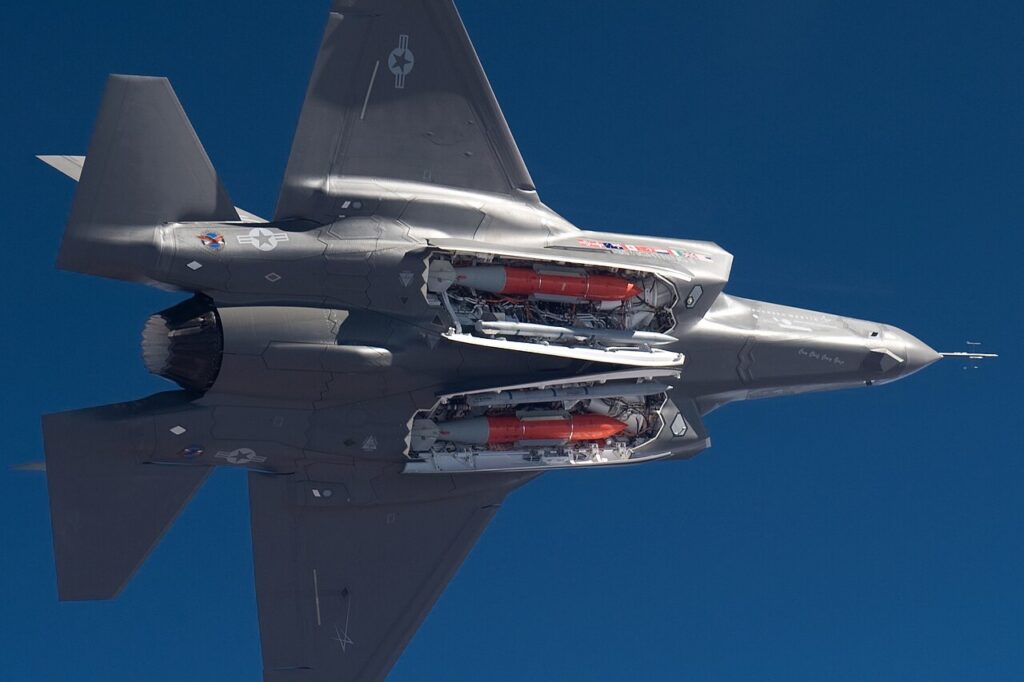
Israel has been using its F-35 fighter jets in its bombardment of Gaza. Australia is one of a number of countries that manufacture and export parts and components into Lockheed Martin’s F-35 fighter jet global supply chain. Given this, there are several reasons why the above information may be significant:
- The head of the F-35 joint program office, Lieutenant General Michael Schmidt, a US Air Force officer, said a year ago that the F-35 program was established with a ‘just in time’ supply chain, where parts arrive just before they’re needed and very little inventory is stockpiled. [Emphasis added.] Lt-Gen Schmidt described that situation as ‘too risky’.
In mid-December, a US Congressional hearing on the F-35 program revealed that the F-35 joint program office had been moving ‘at a breakneck speed to support…Israel…by increasing spare part supply rates’. [Emphasis added.]- More than 70 Australian companies are involved in the global supply chain for the F-35. Several of the companies are the sole global source of the parts they produce. Without them, new F-35 jets cannot be built and those parts in existing jets cannot be replaced. The US recently authorised the transfer to Israel of 25 more F-35s.
The F-35 global supply chain is vulnerable to disruption, which is why Australia could be under pressure to continue meeting supply contracts.
In his testimony to the December 12 Congressional hearing, Lieutenant General Schmidt also made clear the role of the F-35 joint program office in closely supporting Israel:
I had the opportunity to talk with [Israel’s] Chief of Staff just yesterday… [Israel is] very satisfied with [the] performance [the] sustainment enterprise is giving them. We could learn a lot from them in terms of the quickness with which they’re turning airplanes, [plus] all of the things we’re learning ourselves with moving parts around the world in support of a conflict. [Emphasis added.]
Defence Department and Australian industry partnering with F-35 program office
Defence issued a media release on October 30, around the same time it approved the two additional export permits to Israel.
The release announced that Melbourne company Rosebank Engineering had established an important regional F-35 capability that would also contribute to the global F-35 program. The release said Australian industry is playing an increasingly important role in the production and sustainment of the global F-35 fleet and that Rosebank and the Defence Department had partnered with the US F-35 joint program office and Lockheed Martin to establish the new facility.
Lockheed Martin removes information from its website
US multinational Lockheed Martin is the world’s largest arms manufacturer and the prime contractor for the F-35 fighter jet. As the horror of Israel’s war on Gaza has unfolded over the past seven months, there have been court cases and protests targeting the F-35 and its global supply chain.
In this context, Lockheed Martin recently edited the Australian page of its F-35 website to remove the ‘Industrial Partnerships’ section. The text had acknowledged that Australian parts were used in every F-35 fighter jet.
The deleted section can be viewed at the Wayback Machine web archive. This was the opening paragraph:[screenshot on original]
Lockheed Martin has also deleted other information from its website. A feature post about Marand Precision Engineering, another Melbourne-based company supplying the F-35 program, has been removed. The page had described how Marand engineered, manufactured, and now sustains ‘one of the most technically advanced mechanical systems’ ever created in Australia. The system, an engine removal and installation mobility trailer for the F-35, comprises 12,000 individual parts. The page said, ‘Marand has worked in close concert with Lockheed Martin on the F-35 program for many years’ and revealed that in 2022 the company had established a maintenance facility for its F-35 trailer in the US, ‘to better meet Lockheed Martin’s sustainment needs’. The deleted page can be viewed at the Wayback Machine web archive.
Sydney-based Quickstep Holdings is another long-term Australian supplier to the F-35 program. In December 2020, it announced it had produced its 10,000th component for the F-35 program. Quickstep estimated it had completed just 20% of its commitment to the program. The company revealed it manufactures more than 50 individual components and assemblies for the F-35, representing about $440,000 worth of content in each F-35.
Last year, Lockheed Martin also acknowledged that Queensland’s Ferra Engineering had been providing products for the F-35 since 2004 and that it remained a vital partner supporting delivery of the aircraft.
Despite the Albanese government’s persistent and misleading claim that no weapons have been supplied to Israel for the past five years, all of the above companies have supplied parts and components into the F-35’s supply chain during this period.
Threshold for genocide met, says UN Special Rapporteur
On March 26, Francesca Albanese, the UN Special Rapporteur on the Human Rights Situation in the West Bank and Gaza, said, ‘Following nearly six months of unrelenting Israeli assault on occupied Gaza, it is my solemn duty to report on the worst of what humanity is capable of, and to present my findings.’
Ms Albanese said there were ‘reasonable grounds to believe that the threshold indicating the commission of the crime of genocide… has been met’.
On April 5, the UN Human Rights Council adopted a resolution that included a call for an arms embargo on Israel.
Some 28 countries voted in favour of the resolution and 13 abstained. Israel’s two largest suppliers of weaponry, the US and Germany, along with four other countries, voted against it. (The Council has 47 members elected for staggered three-year terms on a regional group basis. Australia is not currently a member.)
Horror radioactive leak warning as Russian floods barrel towards uranium mine
Local authorities have flagged the Dobrovolnoye uranium mine as being in the flood zone, Russian investigative site Agentstvo reported on Sunday.
By CHRIS SAMUEL, Mon, Apr 22, 2024 , https://www.express.co.uk/news/world/1891008/russia-flood-radioactive-leak-threat-uranium-mines
Russian environmentalists have issued a dire warning over the threat of a radioactive leak threat as floodwaters near a uranium mine in the country’s Kurgan region.
The Russian Urals region and northern Kazakhstan have been hit by the worst flooding in decades, with authorities evacuating tens of thousands of residents from Kurgan and Orenburg, amid rescue operations to save stranded residents and animals.
Experts are now sounding the alarm over the potential for drinking water to be contaminated by radioactive material.
Local authorities have flagged the Dobrovolnoye uranium mine, in the village of Ukrainskoye in Kurgan’s Zverinogolovsky district, as being in the flood zone, Russian investigative site Agentstvo reported on Sunday.
The mine is estimated to hold around 7,077 tons of uranium, with a grade level of between 0.01 percent to 0.05 percent uranium, Global energy news outlet NS Energy Business reported.
Environmental experts fear the Tobol River, which flows close by, could become contaminated with uranium as water levels soar.
Sergei Eremin, head of the regional environmental organization Foundation for Public Control Over the State of the Environment and the Well-Being of the Population, said footage captured by a resident indicates that an old well “that had been leaking [uranium] for 35 years” may already have been submerged, as per Newsweek.
The devasting washout came after an abrupt rise in temperatures this spring, combined with high snow reserves, increased humidity and frozen soil, resulting in the worst flooding in 80 years, Natalia Frolova, a professor in the geography department at Moscow State University, told Bloomberg.
Andrei Ozharovsky, an expert in the Radioactive Waste Safety program of the Russian Social-Ecological Union, told Agentstvo that a uranium leak from the Dobrovolnoye mine will result in an elevated concentration of uranium salts in the Tobol River, which could contaminate drinking water.
Small modular reactors aren’t the energy answer for Canada’s remote communities and mines
The energy costs associated with small modular reactors exceed those of diesel-based electricity. Policy-makers should focus on renewables.
by Sarah Froese, Nadja Kunz, M. V. Ramana August 26, 2020 https://policyoptions.irpp.org/magazines/august-2020/small-modular-reactors-arent-the-energy-answer-for-remote-communities-and-mines/
A new type of theoretical nuclear power plant design called small modular reactors (SMRs) has been in the news of late. Earlier this year, at the 2020 Canadian Nuclear Association conference, Minister of Natural Resources Seamus O’Regan announced that the federal government will release an SMR Action Plan this fall. Ontario, New Brunswick and Saskatchewan have announced their backing and possibly some financial support for the development of these reactors.
Promoters suggest that remote communities and off-grid mining operations are promising markets for SMRs in Canada. These communities and mines pay a lot for electricity because they are reliant on diesel generators, and transporting and storing diesel to these locations can be very expensive. Thus, supporters hope, SMRs might be a way to lower electricity costs and carbon dioxide emissions.
We examined this proposition in detail in a recently published paper and concluded that this argument has two problems. First, the electricity that SMRs produce is far more expensive than diesel-based electricity. Second, even ignoring this problem, the total demand for electricity at these proposed markets is insufficient to justify investing in a factory to manufacture the SMRs.
SMRs have been proposed as a way to deal with many problems associated with large nuclear power plants, in particular the high costs of construction, running to tens of billions of dollars. SMR designs have much in common with large nuclear reactors, including, most basically, their reliance on nuclear fission reactions to produce electricity. But they also differ from large nuclear reactors in two ways. First, they have electricity outputs of less than 300 megawatts (MW) and sometimes as low as a few MW, considerably lower than the outputs of 700 to 1500 MW typical of large nuclear reactors. Second, SMR designs use modular means of manufacturing, so that they need only be assembled, rather than fully constructed, at the plant site. While large reactors that have been constructed in recent years have also adopted modular construction, SMR designers hope to rely more substantially on these techniques.
A standard metric used to evaluate the economics of different energy choices is called the levelized cost of energy (LCOE). We calculated that the LCOE for SMRs could be over ten times greater than the LCOE for diesel-based electricity. The cheapest options are hybrid generation systems, with wind or solar meeting a part of the electricity demand and diesel contributing the rest.
Why this high cost? The primary problem is that the small outputs from SMRs run counter to the logic of economies of scale. Larger reactors are more cost-efficient because they produce more electricity for each unit of material (such as concrete and steel) they use and for the number of operators they employ. SMR proponents argue that they can make up for this through the savings from mass manufacture at factories and the learning that comes with manufacturing many reactors. The problem is that building a factory requires a sizable market, sometimes referred to as an order book. Without a large number of orders, the investment needed to build the factory will not be justified.
We estimated the potential market for SMRs at remote mines and communities in Canada. We drew primarily upon two databases produced by Natural Resources Canada regarding mining areas and remote communities. As of 2018, there were 24 remote mining projects that could be candidates for SMR deployment within the next decade. Currently, these projects use diesel generators with a total installed capacity of 617 MW. For remote communities, we calculated a fossil fuel (primarily diesel) generation capacity of 506 MW. But many of these communities had demands that were too low for even the smallest-output SMR under review at the Canadian Nuclear Safety Commission.
Even if all these potential buyers want to adopt SMRs for electricity supply, without regard to the economic or noneconomic factors weighing against the construction of nuclear reactors, the combined demand would likely be much less than 1000 MW. The minimum demand required to justify the cost of producing SMRs would be three to seven times higher.
Furthermore, we concluded that the economics of SMRs don’t compete when compared with other alternatives. The cost of electricity from SMRs was found to be much higher than the cost of wind or solar, or even of the diesel supply currently used in the majority of these mines and communities.
Of course, our estimates for the LCOEs of different sources are dependent on various assumptions. We tried varying these assumptions within reasonable limits and found that the main result — that electricity from SMRs is far more expensive than the corresponding costs of generating electricity using diesel, wind, solar or some combination thereof — remains valid. All else being equal, the assumed capital cost of constructing a SMR would have to decline by over 95 percent to be competitive with a wind-diesel hybrid system. The limited experience with SMRs that are being built around the world suggests that construction costs will be higher, not lower, than advocates promise.
Meanwhile, renewables and storage technologies have seen substantial cost declines over the past decades. Recent estimates place wind, solar and hybrid systems at costs competitive with diesel power. Successful demonstrations suggest that renewable hybrid applications are becoming increasingly feasible for heavy industry, and the implementation of numerous numerous projects in northern communities suggests a high level of social acceptance. Many northern and, in particular, Indigenous communities have an interest in self-determined decision-making and maintaining a good relationship with the land. In June 2019, for example, the Anishinabek Chiefs-in-Assembly, representing 40 First Nations across Ontario, unanimously expressed opposition to SMRs. Grand Council Chief Glen Hare announced that the Anishinabek Nation is “vehemently opposed to any effort to situate SMRs within our territory.”
Instead of focusing on SMRs, policy-makers should bolster support for other renewable generation technologies as key mechanisms to reduce carbon emissions and align with community values.
Gaza Journalists Killed by Israel Honored on World Press Freedom Day
“To claim these deaths are accidental is not only incredulous, it is insulting to the memory of professionals who lived their lives in service of truth and accuracy,” said one expert.
Common dreams JESSICA CORBETT, May 03, 2024
As the international community marked World Press Freedom Day on Friday, journalists and advocates across the globe mourned and celebrated those killed in Israel’s ongoing assault on the Gaza Strip.
The U.S.-based Committee to Protect Journalists (CPJ) has publicly identified at least 97 media workers killed since Israel launched its retaliatory war on October 7: 92 Palestinian, three Lebanese, and two Israeli reporters.
Since the Israel-Gaza war began, journalists have been paying the highest price—their lives—to defend our right to the truth. Each time a journalist dies or is injured, we lose a fragment of that truth,” said CPJ program director Carlos Martínez de la Serna in a Friday statement. “Journalists are civilians who are protected by international humanitarian law in times of conflict. Those responsible for their deaths face dual trials: one under international law and another before history’s unforgiving gaze.”
Reporters Sans Frontières (RSF)—or Reporters Without Borders—puts the journalist death toll in Gaza above 100. Middle East Monitorreports at least 144 members of the press are among the 34,622 Palestinians that Israeli forces have killed in less than seven months in what the International Court of Justice has called a plausibly genocidal campaign.
RSF on Friday released its annual Press Freedom Index. In its section on the Middle East, the group states:
Palestine (157th), the most dangerous country for reporters, is paying a high price. The Israel Defense Forces (IDF) have so far killed more than 100 journalists in Gaza, including at least 22 in the course of their work. Since the start of the war, Israel (101st) has been trying to suppress the reporting coming out of the besieged enclave while disinformation infiltrates its own media ecosystem……………………………………………………..
The Paris-based group nominated Palestinian journalists covering Gaza for an annual award from the United Nations Educational, Scientific, and Cultural Organization (UNESCO)—an honor they received during a ceremony on Thursday.
“Each year, the UNESCO/Guillermo Cano Prize pays tribute to the courage of journalists facing difficult and dangerous circumstances,” said Audrey Azoulay, the U.N. organization’s director-general. “Once again this year, the prize reminds us of the importance of collective action to ensure that journalists around the world can continue to carry out their essential work to inform and investigate.”…………………………………….
While Israel has repeatedly claimed—as it did to CNN on Friday—that “the IDF has never, and will never, deliberately target journalists,” members of the press and others have cast doubt on such comments.
“For far too long Israel has been able to operate with impunity in the occupied Palestinian territory, and this has included occasionally killing reporters, like the Palestinian-American journalist Shireen Abu Akleh, in 2022,” Simon Adams, president of the Center for Victims of Torture, told the Inter Press Service.
Given the number of journalists killed in Gaza since October, he said, “to claim these deaths are accidental is not only incredulous, it is insulting to the memory of professionals who lived their lives in service of truth and accuracy.”…………………………… more https://www.commondreams.org/news/gaza-journalists
Start thinking now about alternatives to AUKUS Pillar 1

The Strategist 30 Apr 2024|, Harlan Ullman
The program to equip the Royal Australian Navy with nuclear submarines is in trouble. The takeaway: Australia must begin thinking now about what to do to avoid program failure.
Why has this situation arisen? First, the prospective program costs are enormous and have been badly underestimated. Second, industrial capacity is inadequate for the tasks of building and supporting a nuclear fleet. Third, the program lacks a powerful leader and an effective management plan to drive it forward.
And, strategically, the planned force of eight nuclear attack submarines (SSNs) armed with only conventional weapons would have minimal deterrent value on Chinese perceptions.
Building the submarines is Pillar 1 of AUKUS, the security partnership of Australia, Britain and the United States. Pillar 2 consists of other technology exchanges among them. It is in Pillar 2 that AUKUS may prove itself.
The United States is to supply three Virginia-class SSNs to Australia—two from the US fleet, which will have to be topped up with newly built vessels, and one straight from a shipyard. Australia has the option to seek to acquire a fourth and fifth Virginia. Britain is to design, in coordination with its partners, a new class, SSN-AUKUS, for the Royal Navy and Royal Australian Navy. The Australians are due to build units of that class to reach a total fleet of eight SSNs by the mid-2050s .
But here is the first constraint. How long does it take to build a new Virginia-class submarine? According to the Congressional Budget Office, the answer is nine years, due to supply chain limitations. Huntington-Ingalls Industries (HII) in Newport News, Virginia, cannot now build enough SSNs for the US Navy. How will it find capacity to build even more to cover acquisitions by Australia?
As well as competing for nuclear talent with General Dynamics, which is constructing the Navy’s top-priority Columbia-class nuclear ballistic-missile submarines (SSBNs), HII is building nuclear aircraft carriers. Delays to delivery of the carrier USS Enterprise illustrate the lack of skilled workers for all the required nuclear construction. And the question of huge cost overruns in the Australian SSN program may not have been fully considered.
The first Columbia class boat will cost about $20 billion. Follow-ons are estimated at lower costs. However, the entire nuclear infrastructure is inordinately expensive. Australia must start from scratch. And, as Britain will rediscover, a new SSN class is almost certain to experience large cost overruns.
Maintenance, repairs, logistics, training and recruiting to maintain a nuclear navy are not cheap. While Australia will benefit from using US and British facilities, that will not significantly offset the costs. Plans to deal with these and other challenges are not fully mature.
The question of who is in overall charge is difficult to answer. There is no czar like Admiral Hyman Rickover, who ruled the US nuclear submarine program for decades with absolute authority. Nor is there a Vice Admiral William (‘Red’) Raborn, who did the same for the US Polaris SSBN program.
It is unclear that these obstacles have been fully digested in an overall plan for completing AUKUS Pillar 1. One practical outcome could be—and emphasis is on ‘could be’—the US selling one or two more older Virginias to Australia as an option.
Those who are more optimistic should think about Skybolt.
In the early 1960s, the US was contracted to build an air-launched ballistic missile as the centerpiece of Britain’s strategic nuclear deterrent. But the concept proved too difficult to engineer, and Skybolt was cancelled, leaving Britain scrambling to find a new way of sustaining its deterrent. Will AUKUS suffer the same fate?…………………………
Ironically, in retrospect, a better choice may have been building diesel submarines with long-range strike missiles and air-independent propulsion for extended underwater loitering. But that is no longer re-negotiable.
The crucial question is this: what impact will eight nuclear submarines, if they can be built and delivered, have on China? Unless nuclear weapons are to be carried, the effect will not be significant. And huge impediments threaten development and construction of the nuclear boats.
What is needed now is a plan to save as much of Pillar 1 of AUKUS as possible and to save Pillar 2 at all costs. This is a grim situation that must be confronted now. Otherwise, the spectre of another Skybolt disaster looms large. https://www.aspistrategist.org.au/start-thinking-now-about-alternatives-to-aukus-pillar-1/
Bowen says Coalition’s nuclear push would put grid reliability at risk due to delays in coal plant closures

ReNeweconomy, Giles Parkinson, Apr 26, 2024
Federal climate and energy minister Chris Bowen has again lambasted the Coalition’s pursuit of nuclear power and its intention to stop renewables, saying it would put reliability of the grid at risk because it would delay the closure of ageing and increasingly decrepit coal fired power stations.
The federal Coalition has yet to release details of its nuclear power plan, but has made no secret of its intention to halt the rollout of large scale wind, solar and storage, and has even threatened to tear up contracts with the commonwealth should it be returned to government.
The Coalition has also made it clear that it has no intention of meeting its commitment to the Paris climate targets, where the bulk of emissions reductions need to occur in the next decade.
That can’t happen if the transition to renewable energy is stopped and coal fired power plants kept on the grid to wait for nuclear some time in the 2040s. The Coalition appears only focused on the 2050 target for “net zero”.
“They know it’s a fantasy,” Bowen said in an interview with Renew Economy’s Energy Insiders podcast of the delays in the release of the Coalition energy policy. “Of course they do. But they are thinking of ways to avoid action and nuclear is the one they’ve settled on.
“Internally, in the Liberal Party, the National Party, I’m advised it is a miss. There’s a lot of anger that they’ve been foisted with this policy. You are seeing it delayed constantly because they are trying to make it stack up, and they can’t.”
Bowen says the push for nuclear is simply an excuse to keep coal fired power station operating longer, and delay renewables.
“That’s what it’s about. But there are two problems with that,” Bowen say
“There’s emissions. But perhaps even more acutely, there’s reliability. It’s a risk to our energy system, because coal fired power is the most unreliable form the power, because of the ageing nature of our coal fired power stations.
“They’ve done good work. They’ve been engineering masterpieces. But they’re very bloody old now. And they break down a lot, sometimes spectacularly, like Callide, and other times, not as spectacular, but still unexpected, and still with a big impact.
“And if we’re relying more and more on that ageing infrastructure, it’s going to be a big risk to reliability. That’s, again, another argument at the next election. And it’s an argument we’re ready for.”
Bowen also attacked the threats by National leader David Littleproud last week to tear up wind and solar contracts that could be signed under the Commonwealth, which has just announced the biggest ever auction of renewables in the country, six gigawatts of new capacity in a process that begins next month.
“I don’t think they will, and I don’t think they can,” Bowen said.
It’s entirely irresponsible – governments, parties to government, Labor and Liberal at the federal level, have consistently said, ‘we will honour contracts’.
“There’s been contracts that the previous government entered into, which I didn’t love and wouldn’t assign if I was the minister at the time, but we honour them. I don’t know what he’s talking about there, to be honest. It’s not a sensible contribution.”
Bowen says the CIS will help re-boot Australia’s transition to green energy, and meet the federal government’s 82 per cent renewable energy target by 2030, which he insists remains both ambitious and achievable. “No question in my mind,” he says.
The 6 GW CIS auction will begin in May, and will include a minimum 2.2 GW that is reserved for NSW, and 300 MW for South Australia, which is already leading the country, and the world, with a 75 per cent share of wind and solar in its in the past 12 months.
Bowen says the early indications – from the initial smaller tenders in NSW and in Victoria and South Australia – are that the CIS will succeed in getting projects moving.
“The early auction results have been outstanding, just outstanding in New South Wales. And the indications are, in terms of the size of the bids we’ve had come in for South Australia and Victoria, they are very high quality, which really indicates to me the pipeline is very strong, the interest is huge.
“The CIS is what was needed to unlock that risk matrix, to really make sure that Australia’s right at the top of the list for renewable investment decisions that are being made by multinational companies.”……………………………………………………………………………………….more https://reneweconomy.com.au/bowen-says-coalitions-nuclear-push-would-put-grid-reliability-at-risk-due-to-delays-in-coal-plant-closures/
Critical worker shortage menaces nuclear-powered submarine workforce

INDUSTRY, 29 APRIL 2024, By: Liam Garman
The document, sourced through a freedom of information request from former independent senator for South Australia Rex Patrick, examined the civilian nuclear workforce required to maintain a nuclear reactor plant.
According to the document, Australia will require over 75,000 additional electricians, construction managers, metal machinists and welders in its “feeder workforce”, a term for Australia’s pool of workers that are eligible to pursue a career in the submarine workforce.
In particular, by financial year 2030–2031, Australia will require:
- An additional 33,553 electricians;
- An additional 19,364 construction managers;
- An additional 11,753 metal machinists;
- An additional 12,280 welders.
The figures were assessed by calculating the difference between the projected demand and supply of skilled workers.
The document warns that the total shortfall will be even larger than the initial figures, confirming that the totals do not include additional demand produced by the nuclear-powered submarine industry.
The report raises an alarm for policymakers, noting that Australia has neither a skilled nuclear-powered workforce to leverage for the construction and maintenance of nuclear-powered submarines, nor does it have a big enough pool of eligible candidates.
“There is no current Australian talent pool with the required mix of qualifications, skills, experience, and behaviours to fulfil the civilian nuclear workforce roles,” the document read……………………………………………………………
Defence may also face additional constraints with the decision to build the SSN-AUKUS at Osborne in South Australia and maintain the capability in Henderson in Western Australia.
The research found the greatest feeder workforce is located in NSW, followed by Victoria and Queensland, while the state with the fewest skills is South Australia. https://www.defenceconnect.com.au/industry/13993-critical-worker-shortage-menaces-nuclear-powered-submarine-workforce
1 This month


Help Aunty Sue Protect Her Land and Sacred Sites From Destructive Rocket Testing.
.

Australians deserve the truth
about
AUKUS – https://aukuspublicinquiry.com/

PETITION – To: Prime Minister Anthony Albanese and the Australian Labor Government

of the week – Australians for War Powers Reform (AWPR)
To see nuclear-related stories in greater depth and intensity

