Everything’s Getting Way More Dangerous And Way More Stupid

CAITLIN JOHNSTONE, MAY 27, 2023
Moon of Alabama has an article out on how an uncomfortable number of relatively restraint-oriented foreign policy officials have been exiting the Biden administration, while a China hawk has just been appointed the next chairman of the Joint Chiefs of Staff.
Antiwar has an article out about how New York congressman Jerry Nadler told an Epoch Times reporter that he “wouldn’t care” if Ukraine used US-made F-16s to strike Russian territory, and doesn’t find the possibility that they might do so concerning.
This comes days after we learned that the Biden administration has signed off on Ukraine getting F-16s while also greenlighting an offensive on Crimea using US-made weapons, a nightmare scenario which greatly escalates the risks of nuclear war.
There are no adults behind the wheel of the vehicle that’s driving us toward World War Three. We’re on a bus that’s being driven straight toward a cliff, and it’s being driven by infants. If we survive this it will not be because of the experienced leadership of western governments, but completely in spite of it.
It’s getting more and more dangerous, and it’s getting more and more stupid. The other day the Ukrainian government tweeted a video in which the faces of characters from the Harry Potter film series are superimposed over Ukrainian soldiers, a perfect compliment to an earlier tweet by NATO about the Ukrainian military saying “We are Harry Potter and William Wallace, the Na’vi and Han Solo. We’re escaping from Shawshank and blowing up the Death Star. We are fighting with the Harkonnens and challenging Thanos.” This truly is the phoniest, most PR-intensive proxy war of all time.
And that’s nothing compared to how stupid the 2024 US presidential race is getting, already in May of 2023. In a recent interview on Fox News, Republican presidential hopeful Ron DeSantis was asked by Trey Gowdy how he would respond to the war in Ukraine on day one of his presidency and he started babbling about wokeness and gender ideology………………………….. more https://caitlinjohnstone.substack.com/p/everythings-getting-way-more-dangerous?utm_source=post-email-title&publication_id=82124&post_id=124081677&isFreemail=true&utm_medium=email
Japan Nuclear Watchdog Asks Fukushima Plant Operator to Assess Reactor Risk

Photo May 22– damaged pedestal supporting reactor core, Unit 1
By Mari Yamaguchi | May 26, 2023
TOKYO (AP) – A nuclear watchdog has asked the operator of Japan’s wrecked Fukushima nuclear power plant to assess possible risks resulting from damage that was found in a key supporting structure inside one of the three melted reactors.
A robotic probe sent inside the Fukushima Daiichi plant’s Unit 1 primary containment chamber found that its pedestal – the main supporting structure directly under its core – was extensively damaged. Most of its thick concrete exterior was missing, exposing the internal steel reinforcement.
About 880 tons of highly radioactive melted nuclear fuel remain inside the plant’s three damaged reactors. Robotic probes have provided some information, but the status of the melted debris is still largely unknown.
Based on data collected from earlier probes and simulations, experts have said most of the melted fuel inside Unit 1, believed to be the worst hit, fell to the bottom of the primary containment chamber, but some might have fallen through to the concrete foundation – a situation that makes the already daunting task of decommissioning extremely difficult.
At a meeting Wednesday of the Nuclear Regulation Authority, its commissioners agreed to order operator Tokyo Electric Power Company Holdings to urgently assess the risks from the pedestal damage, including the possible leak of radioactive substances from cracks and holes caused by the meltdown. The authority also requested that TEPCO assess potential risks if, in the event of another disaster, the pedestal fails to support the reactor.
”We need to think about responses in case of an accident,” commissioner Shinsuke Yamanaka told reporters. “TEPCO has a responsibility to make the risk assessment as soon as possible.”…………………………………………………….
The damage is believed to be from the initial earthquake in 2011, but might have happened more recently. The images of the exposed steel reinforcement have triggered concerns among local residents about the reactor’s safety.
A plan to release treated, but still slightly radioactive, water from the Fukushima Daiichi plant into the sea has also triggered concerns and protests from the local fishing community and neighboring countries, including South Korea.
A South Korean delegation of government experts visited the plant for two days this week to see the facilities related to the planned water release. The team members were to meet with Japanese officials on Thursday in Tokyo, where they said they plan to follow the review of the International Atomic Energy Agency, which has been assisting Japan to improve transparency and credibility…………………. https://www.claimsjournal.com/news/international/2023/05/26/317199.htm—
Clean energy transition sparks nuclear reaction

Along with its many known problems, as an inflexible, costly baseload power source, nuclear is becoming as outdated as fossil fuels.
By David Suzuki with contributions from Senior Editor and Writer Ian Hanington, https://davidsuzuki.org/story/clean-energy-transition-sparks-nuclear-reaction/ 26 May 23
As the impacts of climate disruption become more frequent and intense, we need a range of solutions. One that’s getting a lot of attention is nuclear power.
Industry is pushing hard for it, especially “small modular reactors,” and the federal government has offered support and tax incentives. After 30 years without building any new reactors, Ontario is also jumping onto the nuclear bandwagon again. How should we react?
Along with its many known problems, as an inflexible, costly baseload power source, nuclear is becoming as outdated as fossil fuels. Small modular reactors will create even more waste and cost more — and slow the necessary transition to renewable energy.
Many disadvantages of nuclear are well known. It can contribute to weapons proliferation. Radioactive waste remains highly toxic for a long time and must be carefully and permanently stored or disposed of. And while serious accidents are rare, they can be devastating and difficult to deal with, as the Chernobyl and Fukushima disasters demonstrated.
Along with its many known problems, as an inflexible, costly baseload power source, nuclear is becoming as outdated as fossil fuels.
Uranium to fuel nuclear also raises problems, including high rates of lung cancer in miners and emissions from mining, transport and refining. Add that to the water vapour and heat it releases, and nuclear power produces “on average 23 times the emissions per unit electricity generated” as onshore wind, according to Stanford University professor Mark Jacobson.
But the biggest issues are that nuclear power is expensive — at least five times more than wind and solar — and takes a long time to plan and build. Small modular reactors are likely to be even more expensive, especially considering they’ll produce far less electricity than larger plants. And because the various models are still at the prototype stage, they won’t be available soon.
Because we’ve stalled for so long in getting off coal, oil and gas for electricity generation, we need solutions that can be scaled up quickly and affordably.
The last nuclear plant built in Ontario, Darlington, ended up costing $14.4 billion, almost four times the initial estimate. It took from 1981 to 1993 to construct (and years before that to plan) and is now being refurbished at an estimated cost of close to $13 billion. In 1998, Ontario Hydro faced the equivalent of bankruptcy, in part because of Darlington.
Ontario’s experience isn’t unique. A Boston University study of more than 400 large-scale electricity projects around the world over the past 80 years found “on average, nuclear plants cost more than double their original budgets and took 64 per cent longer to build than projected,” the Toronto Star reports. “Wind and solar, by contrast, had average cost overruns of 7.7 per cent and 1.3 per cent, respectively.”
China has been building more nuclear power plants than any other country — 50 over the past 20 years. But in half that time, it has added 13 times more wind and solar capacity.
As renewable energy, energy efficiency and storage technologies continue to rapidly improve and come down in price, costs for nuclear are rising. As we recently noted, the Intergovernmental Panel on Climate Change’s Sixth Assessment report shows that nuclear power delivers only 10 per cent of the results of wind and solar at far higher costs. In the time it takes to plan and build nuclear, including SMRs, and for much less money, we could be putting far more wind, solar and geothermal online, and developing and increasing storage capacity, grid flexibility and energy efficiency.
The amount it will cost to build out sufficient nuclear power — some of which must come in the form of taxpayer subsidies — could be better put to more quickly improving energy efficiency and developing renewable energy such as wind, solar and geothermal.
Putting money and resources into nuclear appears to be an attempt to stall renewable electricity uptake and grid modernization. Small modular reactors are likely to cost even more than large plants for the electricity they generate. And, because more will be required, they pose increased safety issues.
David Suzuki Foundation research shows how Canada could get 100 per cent reliable, affordable, emissions-free electricity by 2035 — without resorting to expensive and potentially dangerous (and, in the case of SMRs, untested) technologies like nuclear.
New nuclear is a costly, time-consuming hurdle on the path to reliable, flexible, available, cost-effective renewable energy. The future is in renewables.
Stella Assange at Sydney rally: “It’s not just Julian who has lost his freedom, but all of us”
The whistleblower noted the comments of Australian Labor Party Prime Minister Anthony Albanese, who has made extremely tepid statements expressing “concern” over Assange’s plight. Albanese has said that “enough is enough” in relation to the Assange case. He claims to have made private representations to the US and British governments on behalf of Assange, but has stopped far short of any public demand for the Australian journalist’s freedom.
Albanese has recently hinted at the prospect of a plea deal in the Assange case. Kenny forcefully rejected this course. “Is there a Hicks solution? Why should there be? He has not committed any crime. He should not be forced to plead to anything. We need our prime minister to stand up, not just say ‘enough is enough.’”
Oscar Grenfell@Oscar_Grenfell, 24 May 2023
Some 800 people attended a protest in Sydney yesterday morning demanding the immediate freedom of imprisoned WikiLeaks publisher Julian Assange. People came from across New South Wales and from around the country to attend the rally, which was one of the largest demanding Assange’s freedom yet, despite being held on a weekday.
Speaking at the demonstration, Stella Assange, Julian’s wife, declared that the protesters were “at the forefront of a global movement for justice. A global movement that converges on one man, but the meaning of which goes far beyond Julian’s freedom. It’s not just Julian who has lost his freedom, but all of us. Because in order to keep Julian in prison, they have had to corrupt their own rules and their own principles.”
Stella, visiting Australia for the first time, noted that her tour had initially been planned to coincide with a scheduled visit of US President Joe Biden. He had been set down to attend a summit of the warmongering and anti-China Quadrilateral Strategic Dialogue this week in Sydney.
Biden cancelled, however Stella proceeded with the visit. She explained the crucial importance of the fight within Australia to securing her husband’s freedom. Assange is detained in Britain and faces extradition to the US, where he would be tried on Espionage Act charges carrying 175 years imprisonment for exposing American war crimes.
Assange is an Australian citizen. Stella explained: “Julian’s case is a case of global importance. But you guys are at the centre of it because Julian is an Australian, he’s a country boy, and he’s from this country. That means that the key to securing Julian’s release lies with you.”
Assange’s supporters in Australia were part of a “global movement” involving millions of people all over the world, she said. There is a growing recognition, internationally, that “he’s in prison because he exposed the crimes of others. No decent human being will ever tolerate that. The only people whose interest remains Julian’s imprisonment, are the ones who are guilty and implicated in those crimes.”
Within Australia, there had been a “sea change.” Only a few years ago, there had been “radio silence” on Assange’s case. But increasingly it was being discussed in the media, as well as by official politicians. This, Stella stressed, was a consequence of the demands made by ordinary people and a protracted grassroots campaign.
This fight had to be deepened, she said. “You guys need to shout louder, fight harder, put the pressure on each of your representatives, make Julian’s situation visible everywhere, every day, on your cars, on your shirts. Every day you tell all your friends, you talk about it with your family… Make sure Julian remains top priority until he steps out of that prison. I think we’re near, we can achieve this together.”
Stella noted that it was her first time in Australia, but it would not be her last. “I will come back here, home with Julian, and our kids who are Australian citizens will come home too.”
John Shipton, Assange’s father, placed the persecution of Assange within a broader context. Brown University, in the United States, had recently published a report showing that there had been 4.5 million deaths in the Middle East following the 2003 invasion of Iraq. An earlier document, from the same institution, estimated that the predatory US-led wars in the region had displaced 38 million people.
Speaking of those US interventions Shipton condemned a “hegemon standing in a river of blood.” He emphasised the striving of ordinary people for “justice” and “humanity,” which would ultimately be victorious. Assange’s case and the fight for his freedom were integral to this broader struggle.
Gabriel Shipton, Assange’s brother, said: “If anything is to be taken from Julian’s persecution, it is that it has mobilised people all around the world… The fight gives meaning to Julian’s work. It has brought us all together here to fight for something that is so important to our Western democracies and that’s a free press. How can we make decisions about what our governments do in our name if we don’t know? It’s not possible.”
David McBride addressed the protest. A former Australian army lawyer, he faces life behind bars for blowing the whistle on Australian war crimes in Afghanistan. They included verified murders of civilians and prisoners and other violations of international law. For these offenses, McBride, the man who exposed them, is the first to face court proceedings.
“There’s a good chance that even though I reported murders and cover-ups, that I’m going to go to jail for the rest of my life… It’s not something I hang my head about. It’s something I’m proud of… We need to stand up, the future of the planet depends on it.”
The whistleblower noted the comments of Australian Labor Party Prime Minister Anthony Albanese, who has made extremely tepid statements expressing “concern” over Assange’s plight. Albanese has said that “enough is enough” in relation to the Assange case. He claims to have made private representations to the US and British governments on behalf of Assange, but has stopped far short of any public demand for the Australian journalist’s freedom.
McBride responded: “I say this to Anthony Albanese. Enough of you saying ‘enough is enough.’ It means nothing. Imagine if I had witnessed war crimes in Afghanistan, witnessed murder and cover-up… and all I said to them is ‘enough is enough.’ It’s not enough.” McBride called for Albanese to “step up to the plate” and secure Assange’s unconditional freedom.
Stephen Kenny, Assange’s Australian lawyer, issued the same demand. Kenny represented Australian citizen David Hicks, who was rendered to the American military prison in Guantánamo Bay as part of the “war on terror.” Hicks was eventually freed and returned to Australia, as the result of a powerful campaign led by his father Terry Hicks. David Hicks had been compelled to sign a plea deal, despite having committed no crime.
Kenny noted the parallels. “Like David Hicks, Julian Assange has not committed any crime at all. So why is he in jail?” The editors of other major publications, who were involved in WikiLeaks’ 2010 and 2011 releases, for which Assange is being prosecuted, remain at liberty. This, Kenny explained, made clear that the case against Assange was political and required a political solution.
He outlined some of the abuses of the British judiciary. This included placing Assange in a glass box at the back of his courtroom during the first extradition proceedings, denying him the right to participate in his own case. Assange’s lawyers, moreover, had filed their latest appeal in November. The British judges merely need to determine whether he has an arguable case, a process which Kenny said should take several days or at most a week. But six months on and this task has not been completed.
Albanese has recently hinted at the prospect of a plea deal in the Assange case. Kenny forcefully rejected this course. “Is there a Hicks solution? Why should there be? He has not committed any crime. He should not be forced to plead to anything. We need our prime minister to stand up, not just say ‘enough is enough.’”
The rally raised several political issues. Many of the speakers, importantly, emphasised the decisive role of mobilising ordinary people in the fight to free Assange.
Inevitably, the statements of Albanese and other Labor representatives have generated some hope within the Assange camp. But there is no indication, whatsoever, that Albanese is fighting for Assange’s freedom, behind closed doors or anywhere else. This week he refused to even meet with Stella Assange. Albanese was part of the Gillard Labor government, which in 2010 and 2011, played a central role in the initial stages of the persecution of Assange…….. https://www.wsws.org/en/articles/2023/05/25/rgzp-m25.html?fbclid=IwAR1yfKnxx-_FuaTf0qdcSzFjaiYawdDU8YzVOUBFX5GT0RrBI6gj61xvWCE
Hundreds rally against state government’s proposed increases to penalties for protesting
About 500 people have marched through the Adelaide CBD rallying against proposed changes to the state’s protest laws.
The state government proposed changes to laws that would strengthen penalties for obstructing public places in response to Extinction Rebellion protests last week.
A climate change protester was charged with obstructing a public place after she abseiled down Morphett Street bridge with a rope and was suspended over North Terrace, causing traffic delays.
Another four protesters were charged with offences, including property damage, after allegedly throwing paint at the Santos building.
The proposed changes to the Summary Offences Act — backed by the state opposition — would mean anyone who “intentionally or recklessly engages in conduct that obstructs the free passage of a public place” would face possible three months jail or a $50,000 fine.
Currently, there is no option for jail time and the maximum fine is $750.
“One of the amendments that I’m moving will be to add in a sunset clause to this bill so that it expires in 12 months time.
“We are also adding in a clause requiring a review after a 12-month period and I’ll also be introducing a reasonableness test so that people who are caught under this bill will have a possible defence.”
About 80 community groups, including Amnesty International Australia, have signed a letter calling on the government to withdraw the bill.
The organisations listed their support in a full-page advertisement taken out in Friday’s edition of The Advertiser titled Protect Our Right to Protest — Before It’s Too Late, which was authorised by the South Australian Council of Social Service.
‘Almost wartime measure’
The Law Society of South Australia and the South Australian Bar Association have also jointly written a strongly worded letter to the Attorney-General outlining a long list of concerns about the proposed new laws.
………………………………………. The legal bodies raised concerns about the legal wording of the proposed reforms which would significantly shift the onus of proof for the offence of obstructing a public place.
“The effect is that a person only has to turn their mind to the possibility that an obstruction will occur, even though the consequence is entirely unintended, to be found guilty of the offence,” the letter states………………………….. more https://www.abc.net.au/news/2023-05-26/hundreds-protest-against-anti-protest-laws/102396520
TODAY. It’s the CLIMATE, stupid!
The Southern Overturning Circulation is slowing down, because of the rapidly melting ice around Antarctica. What does this mean?
It means a speed-up of climate effects (double the speed of the effects of slowing down of the better-known Atlantic Meridional Overturning Circulation (AMOC) from the Arctic ). Rapid sea-level rise, changed rain patterns in tropical areas, drastic loss of nutrients essential for marine life – effects will occur within the next few decades.
Why is this not the top news story around the world? The whole process might not now be stopped – but what is so important is that it could be slowed, if homo-not-very-sapiens stopped pouring carbon into the atmosphere.
Why are we swallowing the propaganda about STEM education – with its focus on Technology and Engineering? That focus should be on Temperature and Ecology – not on how to do big industrial stuff, but on how to maintain our planet home, – and whether or not we should be doing big industrial stuff, (including costly, wasteful narcissistic adventuring to Mars.)
I have been focussing on the nuclear industry, But in reality, nuclear is irrelevant to our big threat – Global Heating.
The one important relevance is in regard to Truth and Lies. The propaganda now prevailing from the nuclear lobby is the biggest example of lying. If the world can be persuaded to believe that nuclear spin-rubbish – then any lie can prevail. And that includes the omissions, half-truths, and lies that tell us that climate change doesn’t matter.
Nuclear Turns Fashionable

Should nuclear power really circumnavigate the planet with mini-power plants?
BY ROBERT HUNZIKER, CounterPunch 26 May 23
Small Modular Reactors (SMR) are the new nuclear craze, especially with the U.S. Congress, as America’s representatives see SMRs as a big answer to energy needs and reduction of greenhouse gases, advertised as a green deal for clean energy that skirts the heavy costs of paying the Middle East billions upon billions. However, the devil in the details is dangerously overlooked.

Notable nuclear accidents: NRX (1952) Kyshtym (1957) Windscale (1957) SL-1 (1961) Wood River Junction (1964) K-27 (1968) Three Mile Island (1979) Constituyentes (1983) Mohammedia (1984) K-431 (1985) Chernobyl (1986) Tokai (1997, 1999) Fukushima (2011) … but wait, hundreds, possibly thousands, of Small Modular Reactors (nuclear SMRs) are about to pop up around the world. What could possibly go wrong?
“Multiple and unexpected failures are built into society’s complex and tightly coupled nuclear reactor systems. Such accidents are unavoidable and cannot be designed around.” (Charles Perrow, Normal Accidents (Princeton University Press, 1999)
“On dozens of occasions because of human error or technical miscue or active threat, the world has come dangerously close to the brink of nuclear conflagration… it is a terrifying history of which most people remain ignorant.” (Julian Cribb, How to Fix a Broken Planet, Cambridge University Press, 2023.)
Should nuclear power really circumnavigate the planet with mini-power plants?
For Germany, which closed its last three nuclear plants in April 2023, the country’s Federal Office for the Safety of Nuclear Waste Management conducted a study: “SMRs have been the subject of repeated discussion in recent times. They promise cheap energy, safety, and little waste. BASE commissioned an expert report (in German) to evaluate these concepts and the risks associated with them. The report provides a scientific assessment of possible areas of application and the associated safety issues. It concludes that the construction of SMRs is only economically viable for a very large number of units and poses significant risks if widely deployed.”
Yet, “resistance to nuclear power is starting to ebb around the world with support from a surprising group: environmentalists… This change of heart spans the globe, and is being prompted by climate change, unreliable electrical grids and fears about national security in the wake of Russia’s invasion of Ukraine.” (Source: Why Even Environmentalists are Supporting Nuclear Power Today, NPR, August 30, 2022
U.S. senators recently introduced a nuclear energy bill called the Advance Act with bipartisan support, hopefully enhancing and advancing America’s world leadership role in nuclear energy by deploying SMRs by the bucketful, idealized as a “cleaner smarter safer solution” to today’s bulky nuclear power plants. Advance Act will cut red tape and make it easier and much faster for SMRs to gain a foothold in the marketplace……………………..
The excitement over nuclear is palpable, as politicians’ hands tremble with excitement, introducing what’s billed as the perfect green clean way to solve energy needs. There are cheerleaders galore. The U.S. Congress for one is a very influential cheerleading group, but it’s more pervasive than that. Big players like Japan and China are going all-in for nuclear. Japan Adopts Plan to Maximize Nuclear Energy, in Major Shift, AP News, December 22, 2022.

Wait a moment… isn’t Japan currently being criticized in several quarters of the world for dumping Fukushima toxic radioactive water into the ocean? After all, the U.S. National Association of Marine Laboratories, with over 100 member laboratories, issued a position paper strongly opposing the toxic dumping because of a lack of adequate and accurate scientific data in support of Japan’s assertions of safety.
Regardless, last week the G7 nations gave its blessing for Japan to dump Fukushima’s toxic water into the Pacific Ocean. Hmm.
Interestingly, PM Shinzo Abe (1954-2022) shortly after Fukushima’s meltdown 10 years ago, assured the International Olympic Committee in consideration of holding the games in Tokyo, that “everything was under control.” Notwithstanding numerous assurances by Japanese authorities of no harm, no foul, over the years, several independent journalists in Japan have reported numerous deaths because of the Fukushima meltdown and its aftermath but never acknowledged by the government. Assurances are not always assurances!
Therefore, it’s only fair that the darker side of nuclear cheerleading — yea yea yea no nuclear no nuclear — deserves some notoriety. For starters, the results of a recent study by Stanford University’s Center for International Security and Cooperation published in the prestigious Proceedings of the National Academy of Sciences, May 31, 2022, entitled Nuclear Waste from Small Modular Reactors.
Stanford News also published the study: Sandford-led Research Finds Small Modular Reactors Will Exacerbate Challenges of Highly Radioactive Nuclear Waste. The study concludes that SMRs will generate more radioactive waste than conventional nuclear power plants. Stanford and the University of British Columbia jointly conducted the study, e.g., SMRs will be manufactured in factories and industry analysts claim SMRs will be cheaper and produce fewer radioactive byproducts than the big bulky conventional reactors; however, the study discovered the upsetting fact that, pound-for-pound when compared to the big bulky conventional nuclear plants, SMRs will increase nuclear waste… considerably!
………………………………………………………………………………………. Meanwhile, SMRs are about to enter a world of nuclear power that has sharp critics. For example, crib notes of a detailed analysis of nuclear by Greenpeace, which has considerable nuclear expertise on staff, provides an offset to the ringing applause around the world for SMRs: 6 Reasons Why Nuclear Energy is not the Way to a Green and Peaceful World d/d March 18, 2022.
Greenpeace is not at all hesitant about exposing the “myths being perpetuated by the nuclear industry.”

For starters the scale of proposed nuclear energy installations does not come close to meeting the needs to go to net zero emissions in a timely fashion, according to projections by the World Nuclear Association, greenhouse gas emissions would only drop by 4% by 2050, assuming 37 new large nuclear reactors brought onto the grid per year from now to 2050. Yet only 57 new reactors are schedule for construction over the next 15 years. A number for SMRs is unknown currently.

Nuclear power plants are extremely dangerous as easy targets for terrorists, cyberattacks or acts of war. Moreover, they are unique hazards for accidents by nature like Fukushima and/or by human error like Chernobyl, and some accidents never go away.
“For the first time in history, a major war is being waged in a country with multiple nuclear reactors and thousands of tons of highly radioactive spent fuel. The war in southern Ukraine around Zaporizhzhia puts them all at heightened risk of a severe accident…. Nuclear power plants are some of the most complex and sensitive industrial installations, which require a very complex set of resources in ready state at all times to keep them operational,” Ibid.
Nuclear power plants are a water-hungry technology that must, must, must have a lot of water to cool the radioactive hot stuff. Nuclear power facilities are vulnerable to water stress, warming rivers, and rising temperatures. Facilities in the US and France have often been shut down during heatwaves or have scaled down activity, especially France’s shakiness in 2022. Global warming is nuclear power’s biggest enemy.

And, then there’s this: “Electricite de France SA’s fleet of 56 atomic power plants has long been the backbone of Europe’s energy system, but in 2022 it was more of a millstone……………………………………………..
For a prize-winning compelling read about the most toxic place in America and a terrifying look at the radioactive nuclear materials produced at Hanford for four decades: Atomic Days, The Untold Story of the Most Toxic Place in America (Haymarket Books, 2022)
Regardless of the strongest assurances, nuclear accidents happen. They just happen!
Robert Hunziker lives in Los Angeles and can be reached at rlhunziker@gmail.com. https://www.counterpunch.org/2023/05/26/nuclear-turns-fashionable/
Ukraine: Why Negotiations Are the Only Rational Option in the Face of Climate Chaos and Nuclear Dangers

By Fabian Scheidler / Original to ScheerPost 26 May 23
The Pentagon Leaks have shown that, from the U.S. military’s perspective, the confrontation between Russia and Ukraine has reached a stalemate. Neither side can win in the foreseeable future, according to the assessment. Senior military leaders, such as General Mark Milley, chairman of the Joint Chiefs of Staff, had said so publicly before. This makes negotiations, as difficult as they may be, the only rational option. For a continuation of the war under these conditions would lead to endless bloodshed, to a new Verdun, without achieving the restoration of Ukrainian territory. At the same time, nuclear escalation would become increasingly likely.
Any ethically sound position in such a conflict must weigh the risks and sacrifices to be made for a goal against what can realistically be achieved. Yet even the question of how many people in Ukraine should die in order to shift the future course of the border by how many kilometers is considered cynical and lacking in solidarity by many who loudly pose as friends of Ukraine. But isn’t it, on the contrary, cynical not to ask this very question in the current situation? After all, those who die are Ukrainians and Russian soldiers, not those who muse in Berlin or Washington about war aims and noble principles. And those affected in Ukraine themselves currently have no opportunity to express their views on the matter by voting. …………………………………………………………………..
Geopolitical and ecological tipping points
The question, which kind of ethics we choose, goes far beyond the consequences of war in the narrower sense and relates to the entire global situation. The world faces a whole series of dangerous tipping points, both geopolitical and ecological. For one thing, a lasting new bloc confrontation greatly increases the risk of nuclear war. Even a “limited” nuclear exchange would lead globally to a nuclear winter and wipe out a large part of humanity. For this reason alone, diplomacy based on an ethics of responsibility is the only rational option.
Second, the new cold and hot war destroys the chances of preventing climate and biosphere collapse in several ways. If we cross some of the imminent tipping points in the climate system, the Earth threatens to enter an entirely new state that climate scientists call Hothouse Earth. Entire regions of the Earth, including parts of South Asia, the Middle East and Africa, would become uninhabitable. To prevent this, most of the fossil fuels in the Earth’s crust must remain in the ground. For this, in turn, intensified international cooperation – including with China and Russia – is indispensable.
As far-fetched as this may seem at the moment, the West must make Russia offers on how it can transform itself from an exporter of fossil fuels into a producer of renewable energies – because the largest country on earth has enormous potential for this. If Russia remains a pariah from the Western perspective, a nation with whom one does not talk, such a perspective is unthinkable.
The new bloc confrontation also threatens to channel the resources urgently needed for a socio-ecological transformation into the most destructive and climate-damaging of all sectors: the military. ……………………………..
According to the calculations of U.S. economist Robert Pollin, an effective Global Green New Deal that could still prevent devastating climate chaos would cost about $4.5 trillion annually – about 5 percent of global GDP. This sum would be affordable, but only if global military spending were curbed at the same time…………………………………………..
The question of sovereignty
The urgent need for negotiation initiatives is often brushed aside with two arguments. One, it is said, is that one cannot negotiate with a monster like Putin. But the history of the March 2022 negotiations, which had led to significant rapprochements between the two sides, proves otherwise. Secondly, it is repeatedly pointed out, especially by the U.S. government, that it is not up to us to propose compromises, that it is exclusively up to the Ukrainians. Of course, it is up to Ukraine and especially its citizens – who, however, have not even been consulted about any of this for years – to make decisions about war, peace and negotiations. But it is completely out of touch with reality to pretend that this war is taking place in a geopolitical vacuum………………………………………
……………….It is also interesting that the argument against interference comes from the U.S., of all countries, which has massively interfered in Ukraine’s affairs for a long time……………
………………………… more https://scheerpost.com/2023/05/25/ukraine-why-negotiations-are-the-only-rational-option-in-the-face-of-climate-chaos-and-nuclear-dangers/
Nuclear umbrella to protect Taiwan could be globally catastrophic
May 25, 2023
Analysts say a new plan to protect Taiwan could be globally catastrophic, as Taiwan’s Foreign Minister suggested he’s in talks with the United States to have the country covered by the US “nuclear umbrella”.
That would mean the US could use nuclear weapons if Taiwan was attacked. https://www.skynews.com.au/world-news/global-affairs/nuclear-umbrella-to-protect-taiwan-could-be-globally-catastrophic/video/21b5ceffa74672b99ce3c61552d89e78
Australian Prime Minister Albanese refuses to meet with Assange’s wife
Oscar Grenfell@Oscar_Grenfell, 22 May 2023, WSWS,
Asked by independent MP Andrew Wilkie why he would not meet with Mrs Assange, Albanese brushed aside the question, declaring: “Who I meet with is determined by the priorities that my office has.”
Over the past month, Albanese has met with a multitude of business tycoons. He attended the wedding of right-wing radio shock jock Kyle Sandilands, alongside a convicted drug dealer and reputed crime boss. Most recently, Albanese fawned over US President Joe Biden in Tokyo on the weekend. Biden is overseeing the attempt to extradite Assange from Britain, and imprison him for 175 years for exposing American war crimes.
Albanese proclaimed in parliament, he was not interested in meeting Assange’s wife, which he said would be akin to a “demonstration” and “grandstanding.” Albanese sought to dress up the refusal by reiterating vague comments that “enough is enough” in relation to the Assange case, and he cannot see that anything is served by the WikiLeaks founder’s continued incarceration.
While Albanese claims he has made this position clear to the US administration, there is no evidence of that, including in extensive correspondence obtained under freedom of information requests between various American and Australian government bodies. Labor continues to give carte blanche to the very administration seeking Assange’s destruction.
The obvious question is: if Albanese won’t even meet with Assange’s wife, a basic act of respect and courtesy that he has extended to thousands of others over the course of his year in office, why would anyone think the prime minister is waging a fight for the imprisoned Australian journalist’s freedom behind closed doors?
As part of her visit to Australia, Stella Assange yesterday addressed the National Press Club in Canberra.
The speech was a powerful plea for Assange’s freedom, an exposure of the draconian conditions under which he is detained in Britain’s maximum-security Belmarsh Prison and a clear outline of the fundamental issues of democratic rights at stake in the attempted prosecution of her husband.
Stella noted a groundswell of support for Assange. She stated: “I would like to thank the overwhelming dedication of the Australian people, who have brought about a sea change in awareness and solidarity for Julian’s plight. This unity in support for my husband is a source of enormous encouragement for our family. It nurtures Julian’s ability to continue on.”
She added: “The reality is that to regain his freedom, Julian needs the support of his home country. This is a political case, and it needs a political solution.”
In discussing her presence in Australia, and also what she speaks about with her husband, Stella stressed Assange’s connection to Australia. He had been raised in the country, and had shared his extensive memories, from surfing in Byron Bay, to beekeeping in Melbourne’s Dandenong Ranges and riding a horse in the New South Wales Northern Rivers.
“That’s how I imagine Julian when he is free,” she said………………………..
Stella outlined the draconian security procedures required for her and her two children to visit their father. They had to pass innumerable checkpoints, searches and scans for their visits. The children had only ever seen their father in the inhospitable prison visiting room. For the elder of the two, now six years old, “Prisons feature in his dreams and his nightmares.”
Turning to the case, Stella stated: “A 175 year sentence is a living death sentence. A prospect so desperate that the English court found that it would drive him to take his own life, rather than live forever in hell. We must do everything we can to ensure that Julian never, ever, sets foot in a US prison. Extradition in this case is a matter of life and death.”
She explained: “For most people, Julian is a symbol. A symbol of staggering injustice, because he is in prison on trumped up charges for exposing the crimes of others. A symbol because he faces a bewildering 175 year sentence for publishing the truth. A symbol of a sophisticated form of state violence dressed up in complexity and indirection that not even Franz Kafka could have imagined.
“For the press and the public, Julian’s case is the most brutal attack on press freedom that the Western world has seen in the last 70 years. A foreign government is using the political offences in its statute books to indict a foreign national abroad, because of what he or she published in a different country.
“Accurate, damning publications exposing their war crimes. If sovereignty is to mean anything, if jurisdiction is a proper legal and political reality, the case against Julian cannot be understood as anything other than an absurdity.”
Despite the dire threat to press freedom, the address was largely subjected to a media boycott. Only a handful of nationally-recognised journalists attended. Several prominent publications sent junior staff, fresh out of university, armed only with arrogance and obnoxious questions based on the slanders that have been used to attack Assange.
The shameful display underscored the fact that broad sections of the official media function as nothing more than state propagandists. While they are cheering on each new step in Australia’s integration into the US preparations for war with China, this corrupted layer is hostile to a genuine journalist who exposed war crimes………………………………………. https://www.wsws.org/en/articles/2023/05/23/gavm-m23.html?fbclid=IwAR180uIICBGtiZ8Fb3gyk6bwi2YScNh7OxnAQDK0979TWB0XNzNFuUBpSso
60 Minutes Australia Keeps Churning Out War-With-China Propaganda

Australians are particularly vulnerable to propaganda because Australia has the most concentrated media ownership in the western world, dominated by a powerful duopoly of Nine Entertainment (who airs 60 Minutes) and the Murdoch-owned News Corp. This vulnerability is being fully exploited as the time comes for the western empire to beat the war drums against China.
CAITLIN JOHNSTONE, MAY 25, 2023 https://caitlinjohnstone.substack.com/p/60-minutes-australia-keeps-churning?utm_source=post-email-title&publication_id=82124&post_id=123620142&isFreemail=true&utm_medium=email
60 Minutes Australia has been playing a leading role in saturating Australian airwaves with consent-manufacturing messaging in support of militarising to participate in a US war against China. A segment they ran a year ago is titled “Prepare for Armageddon: China’s warning to the world,” and features an image of Xi Jinping overlaid with war planes and explosions and captioned “POKING THE PANDA”. Another from a year ago is titled “War with China: Are we closer than we think?” Another from ten months ago is titled “China’s new target in the battle to control the Pacific.” Another from six months ago is titled “Inside the battle for Taiwan and China’s looming war threat.” Another from two months ago is titled “Is the Navy ready? How the U.S. is preparing amid a naval buildup in China.”
All of these segments have millions of views on YouTube alone. Now this past weekend 60 Minutes Australia has aired back-to-back segments titled “The real Top Gun: US military in heated stand-off with China” and “Five countries secretly sharing intelligence say China is the No.1 threat,” both of which are as jaw-droppingly propagandistic as anything I’ve ever seen.
“It might sound like twisted logic, but military forces everywhere argue that the greater the firepower they possess, the greater the chance of maintaining peace,” opens 60 Minutes Australia’s Amelia Adams. “In other words, massive weaponry is the best deterrent to war. Right now the theory is being tested like never before, and much of it is happening in Australia’s backyard, the Indo-Pacific region. The United States wants the world, and more particularly China, to know of its increasing presence there, and to do that it’s putting on a spectacular show.”
What follows is 19 minutes of overproduced footage displaying this “massive weaponry” while Adams oohs and ahhs and gives slobberingly sycophantic interviews to US military officials.
“There’s something utterly mesmerising about the F-35 jet,” Adams moans. “The sound, the heat, and the power put this supersonic stealth fighter in a league of its own.”
“Colonel these are some very impressive machines you’re in charge of!” she gushes to an officer on an aircraft carrier.
“Yes ma’am,” the colonel replies.
Jesus lady, do your orgasming off camera.
Contrast this glowing ecstatic revelry with Adams’ open hostility later in the segment toward a Chinese think tanker named Henry Wang, claiming that he was trying to “rewrite history” for dismissing panic about a Chinese military buildup by pointing out (100 percent correctly) that China is spending a lower percentage of its GDP on its military than western nations.
“Every command, every maneuver, is being fine-tuned on this vast blue stage, where China has proven to be a bad actor, playing a long game of intimidating Pacific nations,” Adams proclaims over helicopter footage of US war ships. “But the US and its allies aren’t having it, bolstering their defenses — and it’s an impressive display.”
I defy you to find me footage more brazenly propagandistic than this, from any point in history. This is supposed to be a news show, run by people who purport to be journalists, yet they’re engaging in propaganda that looks like it came from a Sacha Baron Cohen spoof of a third world dictatorship.
As I never tire of pointing out, the claim that the US has been militarily encircling its number one geopolitical rival defensively is the single dumbest thing the empire asks us to believe these days. The US is surrounding China with war machinery in ways that it would consider an outrageously aggressive provocation if the same thing were done in its neck of the woods, which means the US is plainly the aggressor in this standoff, and China is plainly reacting defensively to those aggressions.
While the first segment unquestioningly regurgitates Pentagon narratives and gives supportive interviews to military officials, the second segment unquestioningly regurgitates talking points from the western intelligence cartel and gives supportive interviews to Five Eyes spooks.
“Showing off deadly weaponry in massive war games is a tactic China and the United States both use to try to avoid full-on combat,” says 60 Minutes Australia’s Nick McKenzie in introduction. “But the truth is the two countries, as well as other nations including Australia, are already battling it out in an invisible war. There are no frontline soldiers but there are significant skirmishes. Until now these conflicts have been kept quiet, but key members of a secretive alliance of top cops from Australia, the United States, the United Kingdom, Canada and New Zealand are about to change that.”
“Their group is called the Five Eyes, and tonight they want you to know what they see,” says McKenzie, which is the same as saying “We’re telling you what the Five Eyes intelligence agencies told us to tell you.”
McKenzie literally just assembles a bunch of Five Eyes officials to tell Australians that China is bad and dangerous, and then disguises the western intelligence cartel advancing its own information interests as a real news story.
“There is one threat that alarms our partners more than any other,” McKenzie says over dramatic music, asking “Which state actor is the key threat to democracy in Australia and amongst the Five Eyes partners?” and presenting a montage of western intelligence operatives answering (you guessed it) China.
“The Americans describe a growing menace on our doorstep flowing from China’s increasing influence in the region,” McKenzie says, before asking an American official, “Do you see the Chinese state preying on Pacific island nations?”
“I believe so, yes,” the official responds.
Western journalism, ladies and gents.
Australians are particularly vulnerable to propaganda because Australia has the most concentrated media ownership in the western world, dominated by a powerful duopoly of Nine Entertainment (who airs 60 Minutes) and the Murdoch-owned News Corp. This vulnerability is being fully exploited as the time comes for the western empire to beat the war drums against China.
We keep being hammered by this narrative that “massive weaponry is the best deterrent to war,” when all facts in evidence say the exact opposite is true. It was the military encroachment against Russia and the conversion of Ukraine into a NATO military asset which provoked Putin to invade Ukraine, and all the militarization against China that we are seeing is only inflaming tensions and making war more likely.
And, I mean, of course it is; even a casual glance at the Cuban Missile Crisis reveals that powerful nations don’t take kindly to having menacing forces placed near their borders. So much of the propaganda indoctrination we’re subjected to in the 2020s revolves around convincing people to believe that Russia and China should react completely differently than the way the US would react if foreign proxy forces were being amassed along its borders.
So yes, Amelia Adams, claiming that aggression and militarism is the best path toward peace is absolutely “twisted logic”. It is as twisted as it gets. Because it is false. This is obvious to anyone who hasn’t yet been successfully indoctrinated into this omnicidal belief system.
We need to do everything we can to fight against this indoctrination now, because if we wait until the war actually starts it will likely be too late to resist.
America’s Wars and the US Debt Crisis
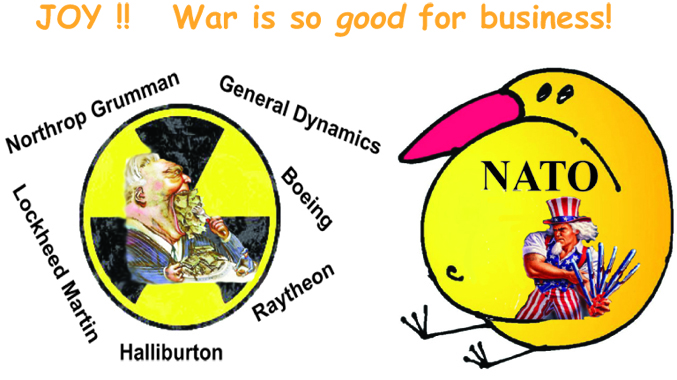
To surmount the debt crisis, America needs to stop feeding the Military-Industrial Complex, the most powerful lobby in Washington.
JEFFREY D. SACHS, May 20, 2023, Common Dreams https://www.commondreams.org/opinion/military-spending-debt-crisis
In the year 2000, the U.S. government debt was $3.5 trillion, equal to 35% of the Gross Domestic Product (GDP). By 2022, the debt was $24 trillion, equal to 95% of GDP. The U.S. debt is soaring, hence America’s current debt crisis. Yet both Republicans and Democrats are missing the solution: stopping America’s wars of choice and slashing military outlays.
Suppose the government’s debt had remained at a modest 35% of GDP, as in 2000. Today’s debt would be $9 trillion, as opposed to $24 trillion. Why did the U.S. government incur the excess $15 trillion in debt?
The single biggest answer is the U.S. government’s addiction to war and military spending. According to the Watson Institute at Brown University, the cost of U.S. wars from fiscal year 2001 to fiscal year 2022 amounted to a whopping $8 trillion, more than half of the extra $15 trillion in debt. The other $7 trillion arose roughly equally from budget deficits caused by the 2008 financial crisis and the Covid-19 pandemic
Facing down the military-industrial lobby is the vital first step to putting America’s fiscal house in order
To surmount the debt crisis, America needs to stop feeding the Military-Industrial Complex (MIC), the most powerful lobby in Washington. As President Dwight D. Eisenhower famously warned on January 17, 1961, “In the councils of government, we must guard against the acquisition of unwarranted influence, whether sought or unsought, by the military-industrial complex. The potential for the disastrous rise of misplaced power exists and will persist.” Since 2000, the MIC led the U.S. into disastrous wars of choice in Afghanistan, Iraq, Syria, Libya, and now Ukraine.
The Military-Industrial Complex long ago adopted a winning political strategy by ensuring that the military budget reaches into every Congressional district. The Congressional Research Service recently reminded Congress that, “Defense spending touches every Member of Congress’s district through pay and benefits for military servicemembers and retirees, economic and environmental impact of installations, and procurement of weapons systems and parts from local industry, among other activities.” Only a brave member of Congress would vote against the military-industry lobby, yet bravery is certainly no hallmark of Congress.
America’s annual military spending is now around $900 billion, roughly 40% of the world’s total, and greater than the next 10 countries combined. U.S. military spending in 2022 was triple that of China. According to Congressional Budget Office, the military outlays for 2024-2033 will be a staggering $10.3 trillion on current baseline. A quarter or more of that could be avoided by ending America’s wars of choice, closing down many of America’s 800 or so military bases around the world, and negotiating new arms control agreements with China and Russia.
Yet instead of peace through diplomacy, and fiscal responsibility, the MIC regularly scares the American people with a comic-book style depictions of villains whom the U.S. must stop at all costs. The post-2000 list has included Afghanistan’s Taliban, Iraq’s Saddam Hussein, Syria’s Bashar al-Assad, Libya’s Moammar Qaddafi, Russia’s Vladimir Putin, and recently, China’s Xi Jinping. War, we are repeatedly told, is necessary for America’s survival.
A peace-oriented foreign policy would be opposed strenuously by the military-industrial lobby but not by the public. Significant public pluralities already want less, not more, U.S. involvement in other countries’ affairs, and less, not more, US troop deployments overseas. Regarding Ukraine, Americans overwhelmingly want a “minor role” (52%) rather than a “major role” (26%) in the conflict between Russia and Ukraine. This is why neither Biden nor any recent president has dared to ask Congress for any tax increase to pay for America’s wars. The public’s response would be a resounding “No!”
While America’s wars of choice have been awful for America, they have been far greater disasters for countries that America purports to be saving. As Henry Kissinger famously quipped, “To be an enemy of the United States can be dangerous, but to be a friend is fatal.” Afghanistan was America’s cause from 2001 to 2021, until the U.S. left it broken, bankrupt, and hungry. Ukraine is now in America’s embrace, with the same likely results: ongoing war, death, and destruction.
The military budget could be cut prudently and deeply if the U.S. replaced its wars of choice and arms races with real diplomacy and arms agreements. If presidents and members of congress had only heeded the warnings of top American diplomats such as William Burns, the U.S. Ambassador to Russia in 2008, and now CIA Director, the U.S. would have protected Ukraine’s security through diplomacy, agreeing with Russia that the U.S. would not expand NATO into Ukraine if Russia also kept its military out of Ukraine. Yet relentless NATO expansion is a favorite cause of the MIC; new NATO members are major customers of U.S. armaments.
The U.S. has also unilaterally abandoned key arms control agreements. In 2002, the U.S. unilaterally walked out of the Anti-Ballistic Missile Treaty. And rather than promote nuclear disarmament—as the U.S. and other nuclear powers are required to do under Article VI the Nuclear Non-Proliferation Treaty—the Military-Industrial Complex has sold Congress on plans to spend more than $600 billion by 2030 to “modernize” the U.S. nuclear arsenal.
Now the MIC is talking up the prospect of war with China over Taiwan. The drumbeats of war with China are stoking the military budget, yet war with China is easily avoidable if the U.S. adheres to the One-China policy that properly underpins U.S.-China relations. Such a war should be unthinkable. More than bankrupting the U.S., it could end the world.
Military spending is not the only budget challenge. Aging and rising healthcare costs add to the fiscal woes. According to the Congressional Budget Office, debt will reach 185 percent of GDP by 2052 if current policies remain unchanged. Healthcare costs should be capped while taxes on the rich should be raised. Yet facing down the military-industrial lobby is the vital first step to putting America’s fiscal house in order, needed to save the U.S., and possibly the world, from America’s perverse lobby-driven politics.
Seymour Hersh: The Ukraine Refugee Question
Ukraine’s neighbors push for Zelensky to pursue peace as millions of displaced people flow into Europe. By Seymour Hersh / Substack https://scheerpost.com/2023/05/19/seymour-hersh-the-ukraine-refugee-question/
Last Saturday the Washington Post published an exposé of classified American intelligence documents showing that Ukrainian President Volodymyr Zelensky, working behind the back of the Biden White House, pushed hard earlier this year for an expanded series of missile attacks inside Russia. The documents were part of a large cache of classified materials posted online by an Air Force enlisted man now in custody. A senior official of the Biden administration, asked by the Post for comment on the newly revealed intelligence, said that Zelensky has never violated his pledge never to use American weapons to strike inside Russia. In the view of the White House, Zelensky can do no wrong.
Zelensky’s desire to take the war to Russia may not be clear to the president and senior foreign policy aides in the White House, but it is to those in the American intelligence community who have found it difficult to get their intelligence and their assessments a hearing in the Oval Office. Meanwhile, the slaughter in the city of Bakhmut continues. It is similar in idiocy, if not in numbers, to the slaughter in Verdun and the Somme during World War I. The men in charge of today’s war—in Moscow, Kiev, and Washington—have shown no interest even in temporary ceasefire talks that could serve as a prelude to something permanent. The talk now is only about the possibilities of a late spring or summer offensive by either party.
But something else is cooking, as some in the American intelligence community know and have reported in secret, at the instigation of government officials at various levels in Poland, Hungary, Lithuania, Estonia, Czechoslovakia, and Latvia. These countries are all allies of Ukraine and declared enemies of Vladimir Putin.
This group is led by Poland, whose leadership no longer fears the Russian army because its performance in Ukraine has left the glow of its success at Stalingrad during the Second World War in tatters. It has been quietly urging Zelensky to find a way to end the war—even by resigning himself, if necessary—and to allow the process of rebuilding his nation to get under way. Zelensky is not budging, according to intercepts and other data known inside the Central Intelligence Agency, but he is beginning to lose the private support of his neighbors.
One of the driving forces for the quiet European talks with Zelensky has been the more than five million Ukrainians fleeing from the war who have crossed the country’s borders and have registered with its neighbors under an EU agreement for temporary protection that includes residency rights, access to the labor market, housing, social welfare assistance, and medical care. An assessment published by the UN High Commissioner for Refugees reports that the estimate excludes roughly 3 million Ukrainian refugees who escaped from the war zone without a visa into any of the 27 European nations that have abolished border control between each other under the Schengen agreement. Ukraine, though not in the EU, now enjoys all the benefits of the Schengen pact. A few nations, exhausted by the 15-month war, have reintroduced some forms of border control, but the regional refugee crisis will not be resolved until there is a formal peace agreement.
The UNHRC reports that free travel from Ukraine into the Baltic states and EU states in Western Europe “makes it particularly difficult to determine exactly how many Ukrainians have reached the EU in the last few months, and where they are now.” The report says the “vast majority” of the Ukrainian refugees are women and children, and one third of them are under the age of eighteen. Seventy-three per cent of the refugees of working age are women, many with children.
A February analysis of the European refugee issue by the Council on Foreign Relations found that “tens of billions of dollars” in humanitarian aid were poured into Ukraine’s neighbors during the war’s first year. “As the conflict enters its second year with no end in sight,” the report says, “experts worry that host countries are growing fatigued.”
Weeks ago I learned that the American intelligence community was aware that some officials in Western Europe and the Baltic states want the war between Ukraine and Russia to end. These officials have concluded that it is time for Zelensky to “come around” and seek a settlement. A knowledgeable American official told me that some in the leadership in Hungary and Poland were among those working together to get Ukraine involved in serious talks with Moscow. “Hungary is a big player in this and so are Poland and Germany, and they are working to get Zelensky to come around,” the American official said. The European leaders have made it clear that “Zelensky can keep what he’s got”—a villa in Italy and interests in offshore bank accounts—“if he works up a peace deal even if he’s got to be paid off, if it’s the only way to get a deal.”
So far, the official said, Zelensky has rejected such advice and ignored offers of large sums of money to ease his retreat to an estate he owns in Italy. There is no support in the Biden Administration for any settlement that involves Zelensky’s departure, and the leadership in France and England “are too beholden” to Biden to contemplate such a scenario. There is a reality that some elements in the American intelligence community can’t ignore, the official said, even if the White House is ignoring it: “Ukraine is running out of money and it is known that the next four or months are critical. And Eastern Europeans are talking about a deal.” The issue for them, the official told me, “is how to get the United States to stop supporting Zelensky,” The White House support goes beyond the needs of the war: “We are paying all of the retirement funds—the 401k’s—for Ukraine.”
And Zelensky wants more, the official said. “Zelensky is telling us that if you want to win the war you’ve got to give me more money and more stuff. He tells us, ‘I’ve got to pay off the generals.’ He’s telling us”—if he is forced out of office—“he’s going to the highest bidder. He’d rather go to Italy than stay and possibly get killed by his own people.”
“All of this talk is being reported and is now flying around inside the American intelligence community, but, as usual,” the official said, “it’s not clear to the intelligence community what the president and his foreign policy aides in the White House know of the reality” of the European discussion about finding a way to end the war. “We are still training Ukrainians how to fly our F-16s that will be shot down by Russia as soon as they get into the war zone. The mainstream press is dedicated to Biden and the war and Biden is still talking about the Great Satan in Moscow while the Russian economy is doing great. Putin can stay where he is”—in power—“despite his failure to wipe Ukraine off the map as an independent state. And he thought he would win the war with just one airborne division”—a sardonic reference to Russia’s failed effort in the first days of the war to seize a vital airport by parachuting in an attack force.
“Europe’s problem,” the official said, in terms of getting a quick settlement to the war, “is that the White House wants Zelensky to survive while there are others”—in Russia and in some European capitals—“who say Zelensky has got to go, no matter what,”
It’s not clear that this understanding has gotten to the Oval Office. I have been told that some of the better intelligence about the war does not reach the president, through no fault of those who prepare the often contrary assessments. Biden is said to rely on briefings and other materials prepared by Avril Haines, director of National Intelligence, since the Biden Administration came into office. She has spent much of her career working for Secretary of State Anthony Blinken, whose ties to Biden and agreement with him on matters pertaining to Russia and China go back decades.
The one saving grace for some in the community, I have been told, has been CIA Director William Burns. Burns was ambassador to Russia and deputy secretary of State and is seen as someone “who has come around” in opposition to some of the White House’s foreign policy follies. “He doesn’t want to be a rat on a sinking ship,” the official told me.
On the other hand, I have been told, it’s not clear to those in the CIA who prepare the President’s Daily Brief that Joe Biden is a regular reader of their intelligence summary. The document is usually three pages. Decades ago I was told—by someone who begged me not to write about it at the time—that Ronald Reagan rarely read the PDB until Colin Powell, then in the White House, began reading it to a video recorder. The tape would then be played for the president. It’s unclear who, if anyone, might take the initiative as Biden’s Colin Powell.
NOTE TO SCHEERPOST READERS: We are happy to be able to run some of Sy Hersh’s pieces from his new Substack venture. Please, if you can, sign up at seymourhersh.substack.com so you can support Sy Hersh’s work and the ability to bring it here on ScheerPost. Thank you!
Government introduces Bill to exempt nuclear submarines from crucial environmental protection acts.
Government seeks to make nuclear submarines more hazardous
Independent Australia, By Bevan Ramsden | 23 May 2023,
New legislation seeks to exempt nuclear power plants onboard submarines from crucial environmental protection acts, writes Bevan Ramsden.
THE GOVERNMENT has a bill before Parliament which, if passed, would exempt nuclear power plants on nuclear-propelled submarines from the requirement of two other acts: the Australian Radiation Protection and Nuclear Safety Act 1998 and the Environment Protection and Biodiversity Conservation Act 1999.
The bill is called the Defence Legislation Amendment (Naval Nuclear Propulsion) Bill 2023. The amendments involve inserting an additional paragraph in parts of each act to exempt ‘a naval nuclear propulsion plant related to use in a conventionally-armed, nuclear-powered submarine’ from the requirements in the parts of either of those acts which refer to nuclear power plants.
This must be of considerable concern to the Australian community as it is totally illogical to make a distinction between the nuclear plant providing the power to propel “conventionally-armed, nuclear-powered submarines” and that of a land-based nuclear power plant in relation to controls and protections as it is indeed still a nuclear power plant.
The nuclear power plant on board a submarine needs the same or more requirements for control and protection as a nuclear power plant on land. Indeed, the uranium to be used in these proposed SSN submarines is enriched to the level that is used in nuclear weapons.
It also presents more danger than conventionally uranium-fired nuclear power plants to the naval staff operating inside a nuclear-propelled submarine as they live and work in very close proximity to the nuclear power plant powering the submarine. When in port, residents in the vicinity of the port are potentially exposed to the toxic impact of possible radiation leaks from the submarine’s nuclear power plant.
To pass these amendments exempting nuclear power plants on board a nuclear-propelled submarine from the requirements of these two acts would be a betrayal by Parliament of its responsibilities to the naval staff operating the submarines and to the wider Australian public, especially those in proximity to the ports which service nuclear-powered submarines.
The Federal Parliament has never had the opportunity to vote on Australia joining the trilateral AUKUS security treaty through which the nuclear-powered submarine technology is to be transferred to Australia.
Nor has it had the opportunity to vote on the decision for Australia to buy/acquire nuclear-propelled submarines.
Here is one, possibly the only, opportunity for Parliament to vote on an aspect of the nuclear-propelled submarine procurement and step in and take some responsibility in maintaining the controls and protection of the nuclear power plant on board a submarine by not exempting it from the requirements of these two acts.
The Senate has referred this bill to the Senate Foreign Affairs, Defence and Trade Legislation Committee for review and report by 9 June 2023. Submissions can be made to it by 26 May. As many submissions as possible should be made to this committee urging that it recommend opposition to these amendments……………………………………..more https://independentaustralia.net/politics/politics-display/government-seeks-to-make-nuclear-submarines-more-hazardous,17538
New Zealand won’t give up its nuclear-free stance, says Prime Minister Chris Hipkins
Mark Quinlivan, 23 May 23, https://www.newshub.co.nz/home/politics/2023/05/new-zealand-won-t-give-up-its-nuclear-free-stance-says-prime-minister-chris-hipkins.html
“New Zealand’s nuclear-free position is long-standing and it’s not going to change.”
Chris Hipkins is refusing to budge on New Zealand’s nuclear-free status and says there are still no plans for Aotearoa to join a non-nuclear arm of a US-led defence alliance.
The Prime Minister appeared on AM on Tuesday, having just returned from a trip to Papua New Guinea to meet with US Secretary of State Antony Blinken and Pacific leaders.
“I was pretty clear [with Blinken]; New Zealand’s nuclear-free position is long-standing and it’s not going to change,” he told host Ryan Bridge.
Hipkins noted that position would prevent New Zealand from “ever” being directly involved in a defence alliance between Australia, the UK and the US – known as AUKUS.
“The US is still committed to a security relationship with New Zealand regardless of our nuclear-free status – I think that’s a good thing.”
Hipkins would not be drawn on even considering the possibility of allowing US nuclear submarines into New Zealand waters.
“We don’t allow those in New Zealand waters and that’s not going to change,” he said. “Many other Pacific nations have similar concerns.”
Bridge asked Hipkins what New Zealand’s specific concerns were.
The Prime Minister said New Zealand was “concerned about nuclear energy… because of the environmental impact of it, and the potential for environmental disaster”.
As for New Zealand joining a second, nuclear-free tier of AUKUS, Hipkins reiterated it remained unclear how that would work.
It comes after Defence Minister Andrew Little earlier this year confirmed Washington had raised the possibility of New Zealand becoming a non-nuclear partner of the alliance.
1 This month.


PETITION – To: Prime Minister Anthony Albanese and the Australian Labor Government
Chernobyl: The Lost Tapes – A good documentary on Chernobyl on SBS available On Demand for the next 3 weeks– https://www.sbs.com.au/ondemand/tv-program/chernobyl-the-lost-tapes/235274195556
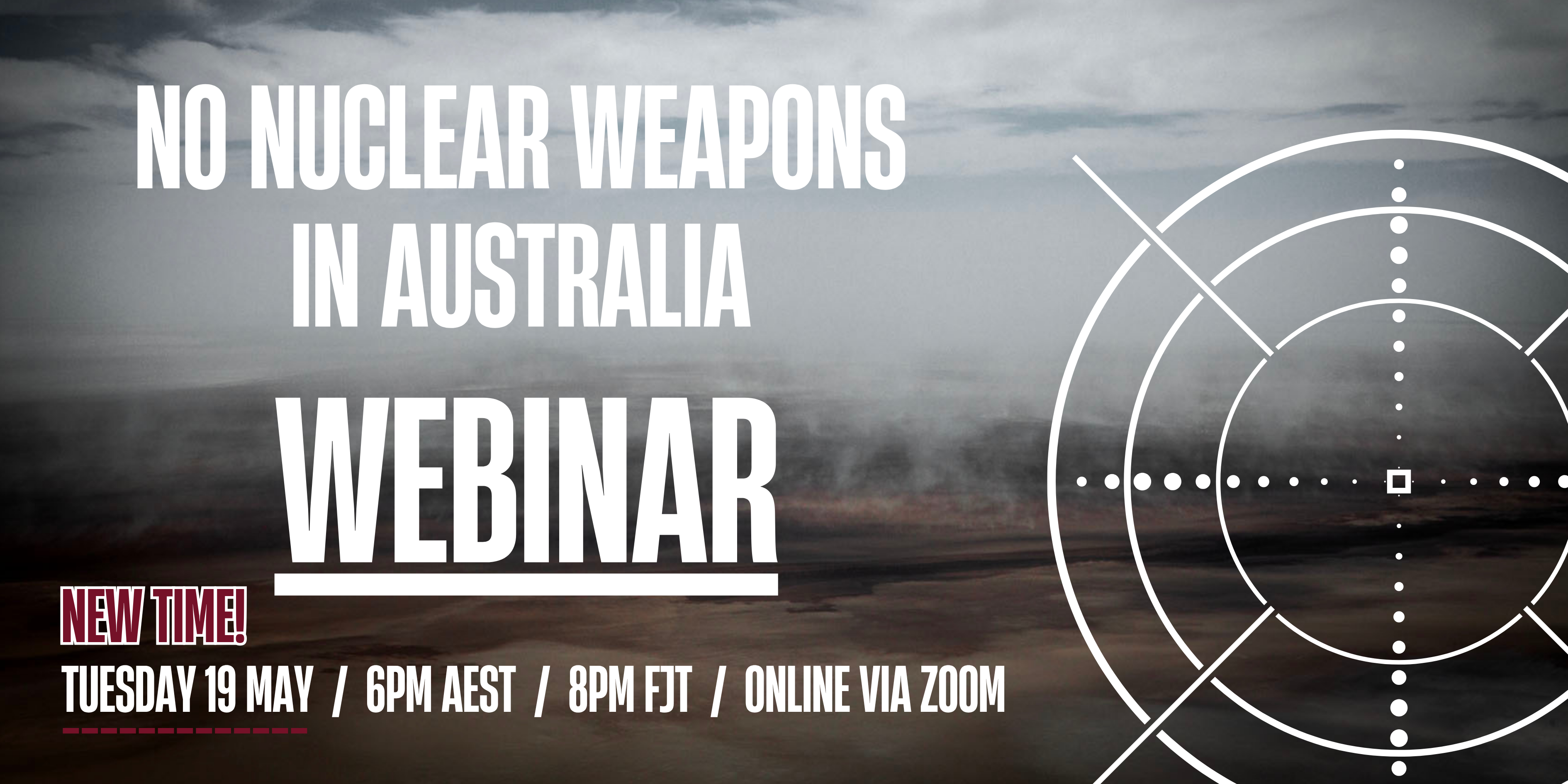
19 May – Webinar- Webinar: No Nuclear Weapons in Australia
Start: 2026-05-19 18:00:00 UTC Canberra, Melbourne, Sydney (GMT+10:00)
End: 2026-05-19 19:30:00 UTC Canberra, Melbourne, Sydney (GMT+10:00)
20 May – Webinar – The dangerous world of AUKUS, US, military occupation and suppression of dissent

National Webinar, 20th May, 2026, 6.30pm AEST. Confronting laws restricting/suppressing protest speech and action
Speakers: Former Sen. Rex Patrick, Lawyer Nick Hanna ,Arthur Rorris ,Jorgen Doyle, Sen David Shoebbridge,
Facilitator Kelley Tranter.

of the week – Australians for War Powers Reform (AWPR)
To see nuclear-related stories in greater depth and intensity
 Antinuclear