“The only reason there’s a nuclear renaissance is because the federal government is throwing tens of billions of dollars at nuclear,” …….. “Investors aren’t interested.”
Opening of Georgia Power’s Vogtle unit 3 comes 7 years late and billions of dollars over budget.
The US nuclear energy industry has reached a watershed moment. Plant Vogtle unit 3 began delivering commercial electricity to the Georgia power grid, becoming the first nuclear reactor the country has built from scratch in more than three decades.
Unit 3 and a twin reactor to open in the coming months may also be the last. Years of delays and billions of dollars of cost overruns have made the megaproject as much a cautionary tale as a new chapter for atomic investment.
The 1,100-megawatt Vogtle unit 3 was initially supposed to enter service in 2016, however. Its start of operations was delayed once more in June after the company discovered a degraded seal in its main generator.
“It turns out nuclear construction is hard,” said Bob Sherrier, a staff attorney at the Southern Environmental Law Center, which challenged the project in court.
“Along the way the company kept ratcheting up the cost estimates, pushing back the deadlines a bit at a time. Every time it was raised just enough where it was still within the bounds of justification that it made sense to proceed. But they were wildly off in their estimates every single time.”
“The resurgence of America’s nuclear industry starts here in Georgia, where you’ve just got approval, for the first time in three decades, to build new nuclear reactors,” then-US energy secretary Steven Chu said as Vogtle was authorised in 2012.
The Georgia project was supposed to be the first among dozens of new reactors built across the country. But the renaissance floundered amid safety concerns after the 2011 Fukushima disaster in Japan coupled with plunging prices for natural gas, a competing generation fuel. In the end only four reactors moved ahead and two, Vogtle units 3 and 4, have been built. Unit 4 is scheduled to come online by early 2024.
Soaring costs at Vogtle, along with new reactors at the VC Summer nuclear project in South Carolina, forced engineering contractor Westinghouse into bankruptcy in 2017. While South Carolina utilities pulled the plug on their project, Georgia ploughed ahead.
The $14bn original cost of Vogtle units 3 and 4 has now ballooned to more than $30bn. The cost for Georgia Power, with a 45 per cent share of the project, will be about $15bn.
How the company’s costs are shared with its customers will be decided by the commission once unit 4 is operating: the law allows only costs deemed “prudent” to be passed on to ratepayers.
McDonald said the company should not expect an easy ride. “They are guilty until they prove themselves innocent,” he said.
Georgia Power, a division of New York-listed Southern Company, did not respond to multiple requests for an interview.
……………………………………… there are no other traditional large-scale light water reactors under way in the US. Critics say that investors have been turned off.
“The only reason there’s a nuclear renaissance is because the federal government is throwing tens of billions of dollars at nuclear,” said David Schlissel at the Institute for Energy Economics and Financial Analysis. “Investors aren’t interested.”
For Georgians, the more immediate concern is what the project means for utility bills. Georgia Watch, a consumer group, estimates ratepayers have already paid $900 extra since construction began to cover financing costs. Bills are set to rise by another $3.78, or 3 per cent, on average when unit 3 comes online.
But the ultimate impact will not be felt until unit 4 comes online and the PSC decides how much of the burden will be left for ratepayers to shoulder. Georgia Watch estimates the final increase will add anywhere between 10-13 per cent to bills……………… https://www.ft.com/content/5d8e0c6c-59c9-4b40-806f-604889dd5fb6
2 Government, Industry Explore Nuclear, Solar Space Engines
COLORADO SPRINGS, Colorado — More commercial and military activity is taking place in space, and the Defense Department and industry are investing in emerging propulsion technologies to move systems in orbit faster, farther and more efficiently.
……………………………………..In 2021, the Defense Advanced Research Projects Agency selected Lockheed Martin as one of three prime contractors — along with General Atomics and Blue Origin — for Phase 1 of its Demonstration Rocket for Agile Cislunar Operations, or DRACO, program to showcase the potential of a nuclear thermal propulsion system in space, a DARPA release said.
This January, NASA announced it had partnered with DARPA on the DRACO program, describing a nuclear thermal rocket engine as “an enabling capability for NASA crewed missions to Mars.” The goal is to demonstrate the system in orbit in fiscal year 2027, with the Space Force providing the launch vehicle for the DRACO mission, a DARPA statement said.
The program is about to enter Phase 2, which “will primarily involve building and testing on the non-nuclear components of the engine” such as valves, pumps, the nozzle and “a representative core without the nuclear materials in it,” DARPA’s program manager for DRACO Tabitha Dodson said during a panel discussion at the Space Foundation’s Space Symposium in April. Dodson said then a Phase 2 decision is “quite close.” However, at press time in mid-July, no contracts have been awarded.
…………………………………“There are no facilities on Earth that we could use for our DRACO reactor’s power test … so we’ve always baselined doing our power test for the reactor in space,” Dodson said. Once in space, DARPA will “very gradually” ramp up the system to “full power thrust,” she said………………………………………………………………………………………………………………………………………… Despite DARPA’s commitment to safety, nuclear propulsion systems face an uphill battle getting deployed on spacecraft at scale, said Joel Sercel, founder and CEO of TransAstra, a space technology company.
………………………………………………………………………………..In May, the Space Force awarded TransAstra a Phase One Small Business Innovation Research contract to explore new applications for the company’s propellant-agnostic Omnivore thruster.
The Omnivore thruster uses solar reflectors to focus sunlight onto a solar absorber, which then superheats the system’s propellant to generate thrust “typically six times faster and eight times cheaper than electric systems,” a company release said.
Additionally, TransAstra calculated an Omnivore thruster “using liquid hydrogen propellant … will perform similarly to nuclear rockets, but without nuclear materials, costs or risk.”
Sercel said Omnivore has “80 percent of the performance of nuclear at 1 percent of the cost.” The system is essentially nuclear powered, “but the nuclear reactor in question is the fusion reactor at the center of the solar system called the Sun,” he added.
“The nice thing about nuclear reactors is that you have a small, compact reactor versus large deployable solar reflectors, but the basic performance of solar thermal rockets and nuclear rockets is about the same,” he said. And with Omnivore “you don’t have all these safety concerns and radioactive material and reactor control issues and so on. So, we think it’s a much more practical approach.”
Omnivore could have multiple mission applications for the Defense Department, Sercel said. Using liquid hydrogen propellant, the thruster “can deliver hundreds of kilograms” of spacecraft to geosynchronous orbit “on small launch vehicles, and the Space Force seems to be very excited about this,” he said. The system could also deliver spacecraft weighing more than 100 kilograms to cislunar space, he said.
Additionally, TransAstra has an Omnivore variant that uses water as the propellant, the solar absorber superheating the water vapor and releasing the gas through a nozzle to generate thrust.
The water-based variant can be placed on the company’s Worker Bee small orbital transfer vehicles, about 25 of which can fit on a single Falcon 9 rocket, Sercel said.
the average age of an operating U.S. reactor is now around 40. None are insured, despite assurances dating to the 1957 Price-Anderson Act that the reactor fleet would get private liability coverage by 1972.
the dangers escalate as the plants age. Meaningful estimates of the cost of a catastrophic accident are hard to come by, but after Chernobyl and Fukushima, the costs have soared into the trillions.
Nuclear power not only costs twice as much as wind and solar, it’s responsible for superheating our air and waterways.
Every day, as they burn with nuclear fission at some 571 degrees Fahrenheit, some 430 nuke reactors roast our Earth. They irradiate and superheat our air, rivers, lakes and oceans.
They also spew radioactive carbon, and emit more greenhouse gasses in the mining, milling, enrichment and fabrication processes that produce their fuel. Still more is emitted as they attempt to store their wastes.
Six big reactors and their fuel pools now threaten an apocalypse in Ukraine. Pleas for United Nations intervention are increasingly desperate.
But “nuclear renaissance” proponents say we need even more reactors to “combat climate change.”
However, these mythical new reactors have real costs — and for at least the next six years, they can produce nothing of positive commercial or ecological significance.
The primary reason there’s likely to be no new reactors in the U.S. until at least 2030 (if ever) is economic — the cost of construction is gargantuan.
Let’s consider eight recent major construction failures in Europe and the U.S.
Atomic plants were first constructed during the Manhattan Project that built the atomic bomb. Heralded as the “too cheap to meter” harbinger of an atomic age, the first commercial reactor came online at Shippingport, Pennsylvania, in 1958.
At VC Summer Nuclear Station in South Carolina, after a decade of site work marred by faulty construction, substandard materials, bad planning, labor strife, and more, two reactors were abandoned outright in 2017, wasting $10 billion while bankrupting Westinghouse.
In Hinkley, United Kingdom, two more reactors are also years late and could surpass $42 billion.
In Flamanville, France, a single reactor project begun in 2007 is still unfinished, years past its original promised completion date, and four times over its original cost estimate — with the price tag now beyond $14 billion.
Finland’s Olkiluoto has opened after 18 years of construction at around $12 billion in costs so far — three times the original promise.
All these reactor projects failed due to overly optimistic industry promises designed to attract investors, followed by poor execution, bad design, substandard components, labor strife, and more. Despite the industry hype, none of these eight reactors can ever compete with renewables, whose prices now range as low as a third to a quarter of nuclear — and are dropping.
With incalculable billions and a decade or more needed to build old-style big nuclear reactors, financial experts have long predicted that the necessary capital won’t be anywhere on the horizon.
Instead, the industry has been gouging state and local governments to keep the old reactors running, a desperate and dangerous toss of the dice.
Six billion dollars was pledged to nuclear energy plants in Biden’s infrastructure bill alone. A billion in federal dollars has been promised to keep California’s Diablo Canyon running, along with another billion from the state.
But the average age of an operating U.S. reactor is now around 40. None are insured, despite assurances dating to the 1957 Price-Anderson Act that the reactor fleet would get private liability coverage by 1972. Despite their immense inherent danger, only nominal company participation in a perfunctory insurance fund has been required for a license. Blanket coverage against a cataclysmic accident has not been a legal requirement to build or operate these reactors.
After six decades, reactor owners are still exempted from the costs of a catastrophic accident, and no nongovernmental insurance corporation has stepped in at an appropriate scale.
Yet the dangers escalate as the plants age. Meaningful estimates of the cost of a catastrophic accident are hard to come by, but after Chernobyl and Fukushima, the costs have soared into the trillions.
The oldest operating U.S. plant, at Nine Mile Point on Lake Huron, opened in 1969. Repeated near-disasters at Davis-Besse in Ohio include a hole eaten through a critical core component by boric acid that was missed because the owners refused to do required inspections. Monticello and Prairie Island in Minnesota threaten the entire Mississippi Valley. Critical intake pipes at South Texas recently froze, as its builders never anticipated the cold weather that hit it unexpectedly in 2021.
French and U.S. rivers are often too hot to cool reactor cores, forcing them to cut output or shut altogether.
Palo Verde in Arizona evaporates some 27,000 gallons of water per minute in a roasting desert. San Onofre in California was shut in 2012 because of leaking generators and now stores its high-level waste 100 feet from the ocean. Perry (Ohio) and North Anna (Virginia) have both been damaged by earthquakes.
Former Nuclear Regulatory Commission (NRC) site inspector Michael Peck has warned that Diablo Canyon in California should be closed because of the danger posed by seismic activity. Just 45 miles from the San Andreas Fault, Diablo was on its way to an orderly shut-down when Gov. Gavin Newsom strong-armed the state legislature and Public Utilities Commission to keep the embrittled, under-maintained reactors open despite their ability to blanket the state in terminal radioactivity. The NRC ignored Peck’s warning and he’s now gone from the Commission.
Diablo’s owner, Pacific Gas & Electric, has a blemished record when it comes to public safety — it has admitted to more than 80 counts of felony manslaughter due to the 2018 wildfires in California.
In Ukraine, of six reactors at Zaporizhzhia, five are in cold shut-down while one lingers on to power the place. But six shaky fuel pools contain apocalyptic quantities of radiation. Power supplies are in doubt, vital cooling water is threatened by a sabotaged dam, military attacks are possible, and site workers maintain the plant in a state of terror.
Like Zaporizhzhya, any operating reactor or fuel pool would be devastating targets for military or non-state terrorist attacks. The 9/11 masterminds reportedly toyed with hitting the Indian Point power plant north of New York City, irradiating the northeast. Any of the 90-plus decayed uninsured U.S. nukes are potential Chernobyls or Fukushimas. Deep concerns have been expressed by United Nations inspectors and many others. A public petition now asks that UN peacekeepers take over the Zaporizhzhya site.
So, taken in sum, “nuclear power” to date is defined by catastrophic fiscal failure and public risk. No new plants are under construction and efforts to keep the current fleet operating are fraught with uninsured danger.
In straight-up financial terms, the peaceful atom’s “too cheap to meter” promises can never compete in real terms with renewables, which won’t melt, explode, release mass quantities of radiation or create atomic wastes.
Projections for thorium, fusion, and other futuristic reactors also remain technically and fiscally vaporous. The fusion facility at ITTR in France has already burned through $65 billion.
And a reactor burning at 100 million degrees is as likely to cool the planet as Edward Teller’s fusion superbombs.
Which leaves us with the much-hyped small modular reactors (SMRs), now wallowing in deep delay and soaring prices. SMRs are theoretical nukes designed to be far smaller than today’s 1,000+ megawatt reactors, to be mass produced and buried throughout the country. Only one SMR developer, NuScale, has gotten significant preliminary licensing approval. Cost and delivery projections from Bill Gates’s TerraPower, X-Energy, and other prospective manufacturers are theoretical, with little concrete data to back up when they might be deployed and at what prices.
Projected prices at NuScale have soared from $58/megawatt-hour in 2017 to $89 now, nearly double the range of wind and solar. By 2030, SMR prices are likely to be triple or more. A recent piece by former NRC Chair Allison MacFarlane eviscerated the technology’s potential with a devastating analysis, referring to it primarily as a means of attracting government hand-outs and “stupid money.”
But with no big U.S. reactors being built while SMRs drown in red ink and tape, the industry still burns and irradiates the planet with about 430 aging reactors worldwide and 92 ancient ones here in the U.S. And the odds of an apocalypse at one or more of those old reactors grow with each day they age.
The pitfalls include unsolved problems of reactor waste, deteriorating infrastructure, a fast-retiring workforce, a diminishing ability of the industry to deliver on its promises, a minimum five-year gap before any small reactors could come into significant commercial production, the forever threats of war and terrorism, the killing power of radiation, and much more.
Meanwhile, renewables have long since blown past both nukes and coal in jobs, price, safety, efficiency, reliability, speed to build, and more.
As nuclear investments dry up, offshore wind, rooftop solar, “agri-voltaic” farmland and advanced efficiency are booming.
A pending transition from lithium to sodium may soon transform the battery industry. For reasons of cost, ecological impacts and resistance to mines on Indigenous lands, lithium-based batteries face serious challenges.
But with cheaper, more widely available sodium at their core, battery technologies are poised for a near-term Great Leap. Should that happen soon, the current storage challenges of the green power revolution could all but disappear.
Thus, we face the ultimate test: Can our species replace these failed, lethal nukes with safe and just forms of green power — or will we let this latest atomic con fry us all?
In a major report, the Science, Innovation and Technology Committee calls on the Government to develop and publish a Nuclear Strategic Plan to turn high level aspirations into concrete steps to deliver new nuclear. The Committee says that the Government is right to look to nuclear power to meet our future electricity needs and that this requires a substantial programme of nuclear new build.
But the Report warns that the Government target of 24 GW of nuclear generating capacity by 2050 and the aspiration to deploy a new nuclear reactor every year are more of a ‘wish list’ than the comprehensive detailed and specific strategy that is required to ensure such capacity is built.
The Government’s stated aim of 24 GW of nuclear capacity is ambitious: it is almost double the highest installed nuclear capacity the UK has ever achieved. It could involve new gigawatt-scale nuclear power, small modular reactors (SMRs) and advanced modular reactors (AMRs), and further development of nuclear fusion. It would require substantial progress on technologies, financing, skills, regulation, decommissioning and waste management.
Science, Innovation, Technology Committee 31st July 2023
Behind the scenes intrigues by defence chiefs and intel services through their media releases are a quite inadequate substitute for these democratic consultations.
Hopes of US co-operation in releasing Julian Assange who is languishing in Belmarsh Prison in London while awaiting extradition to the USA to face charges for breaches of the US Espionage Act were dashed at the recent AUSMIN Meeting.
Decades ago – in 1951 – the ANZUS Pact promised ongoing consultations about strategic policies within the US Global Alliance. Now, from the elite surroundings of Queensland’s Government House in Brisbane, media statements from AUSMIN have taken everyone back to school days. Our elected leaders are now the principals in a frightening new age in which preparation for war is a key element in foreign and strategic policies (Joint Statement from AUSMIN 29 July 2023):
Minister for Foreign Affairs Penny Wong and Deputy Prime Minister and Minister for Defence Richard Marles hosted the U.S. Secretary of State Antony J. Blinken and Secretary of Defense Lloyd J. Austin III on 29 July in Brisbane to advance the Australia-U.S. Alliance and their cooperation in the Indo-Pacific and globally. Building on the high tempo of engagement between leaders and ministers, including the meeting between Prime Minister Albanese and President Biden in May 2023, the Ministers and Secretaries (the principals) determined that the Alliance has never been stronger. Based on a bond of shared values, it remains a partnership of strategic interest – premised on a common determination to preserve stability, prosperity, and peace.
For our visiting US Principals, it seems that peace will be delivered by exporting cluster bombs to extend the war in Europe.
National sovereignty is always imperiled by unnecessary secrecy like the Treaty of London (1915) which moved Italy from neutrality to becoming a participant in the Great War (1914-18) at the instigation of the British Government.
ARTICLE 2. On her part, Italy undertakes to use her entire resources for the purpose of waging war jointly with France, Great Britain, and Russia against all their enemies…………………………….
ARTICLE 16. The present arrangement shall be held secret.
It would have been better for Italy if a brave Julian Assange from the era told the Italian people about the secret strategic deals with Britain in 1915. Italy’s involvement in the Great War brought family tragedies, mass immigration, financial ruin and the rise of fascism in its wake.
The current militarization of the global economy by potential friend and foe alike will ultimately be ended by accidental conflict or economic recession from burnt out commitments and distortion of investment flows globally. Going too far by Australian leaders risks schism in the Labor Movement as in the Great War or tensions within the Labor Party during the Cold War in the 1950s and more recently when New Zealand withdrew from the ANZUS Pact over visits by naval vessels that were either nuclear powered or carrying nuclear weapons or both in the 1980s.
If there is a chink in the armour of public support for Australia’s defence commitments to the US Global Alliance, it lies in medium and long-term concerns about the costs of the AUKUS defence commitments which are apparent in theLowy Institute’s 2023 Polling.
It would have been better for Italy if a brave Julian Assange from the era told the Italian people about the secret strategic deals with Britain in 1915. Italy’s involvement in the Great War brought family tragedies, mass immigration, financial ruin and the rise of fascism in its wake.
The current militarization of the global economy by potential friend and foe alike will ultimately be ended by accidental conflict or economic recession from burnt out commitments and distortion of investment flows globally. Going too far by Australian leaders risks schism in the Labor Movement as in the Great War or tensions within the Labor Party during the Cold War in the 1950s and more recently when New Zealand withdrew from the ANZUS Pact over visits by naval vessels that were either nuclear powered or carrying nuclear weapons or both in the 1980s.
If there is a chink in the armour of public support for Australia’s defence commitments to the US Global Alliance, it lies in medium and long-term concerns about the costs of the AUKUS defence commitments which are apparent in theLowy Institute’s 2023 Polling.
The financial costs of the submarine deal is the real chink in favourable Australian public opinion towards more participation in the US Global Alliance.
Despite the outpouring of patriotic rhetoric at the launching event in Mobile, Alabama, Austal Limited Australia had not finalized its Australian taxation commitments from an annual revenue of $579.4 million in 2020-21 by 2 November 2022. The tax owing under review by the ATO was a paltry $28 million due to legalized tax minimization by the company’s accountants. Austal’s explanation of these processes is well covered in the 2022 Annual Report from Austal Australia which can easily be perused by interested readers.
Orders for AUKUS vessels and commitments to the QUAD Defence Arrangements will provide windfall revenue for the military and industrial complexes of Britain and the USA for a generation ahead until 2050. In the traditions of the original ANZUS Defence Alliance of 1951, our bipartisan strategic commitments were always consistent with adherence to the UN Charter and to open discussion of defence arrangements.
Behind the scenes intrigues by defence chiefs and intel services through their media releases are a quite inadequate substitute for these democratic consultations.
Hopes of US co-operation in releasing Julian Assange who is languishing in Belmarsh Prison in London while awaiting extradition to the USA to face charges for breaches of the US Espionage Act were dashed at the recent AUSMIN Meeting. Defence analyst Chelsea Manning who actually released the Pentagon documents to Julian Assange for publication had his charges commuted by President Obama in 2017.
These documents are largely in the public domain through sites like ChatGPT which can retrieve the gist of most items released but without adequate referencing by the AI robots at Opensystems in San Francisco. Readers can avail themselves of the resources of ChatGPTin the absence of full and frank media releases from Australian government strategic agencies.
Environmental risks of nuclear-powered ship visits to Australian ports also add to the policy dilemmas facing Australians.
It was the Morrison Government which welcomed the ageing French nuclear powered submarine to HMAS Sterling near Perth in late 2020 en route to naval manoeuvres near Guam and likely stealth operations in the South China Sea to test China’s maritime intelligence. Such manoeuvres in troubled waters are hazardous operations. This epic seven-month voyage to the Indo-Pacific Basin was well covered inthis YouTube video.
The New York Times(31 March 1994) and other global media outlets of the nuclear accident involving the nuclear-powered submarine off Toulon. ChatGPT has a blind spot about the reporting of this incident from media monitoring:
Ten sailors died today in an accident aboard a French nuclear-propelled submarine that was taking part in naval exercises in the Mediterranean off Toulon, the Defense Ministry announced.
A ministry spokesman said that the Émeraude, a 2,400-ton Rubis-class attack submarine, did not carry nuclear missiles and that its 48-megawatt nuclear reactor was not damaged in the accident, which occurred when a burst pipe released high pressure steam into a turbine compartment.
“The steam is certainly not radioactive,” Rear Adm. Philippe Roy said at a news conference in the southern port city of Toulon this evening.
Hours after the accident, the navy recalled three other nuclear-propelled submarines — two from the Mediterranean and one from the Atlantic — pending an investigation. “We are recalling them because we are asking questions about what happened,” Admiral Roy said.
Since I covered this topic the WA State Police Minister’s Office has kindly provided details of protocols operating for the containment of accidents involving nuclear powered ship visits which possibly carry nuclear weapons under Don’t Ask Won’t Tell Protocols operating within the US Global Alliance……………………………………………………………………………….
Specialist staff within DFAT will of course have access to some classified documents generated by the US Department of Defense and its related intel networks. To guard against the emergence of any new generation of Australians wishing to follow in the traditions of Chelsea Manning of Oklahoma, it is my understanding from personal communications from just one staff member on my reporting rounds for AIM Network that personal phones and communication systems are all monitored by local intel services and probably by overseas agencies as well.
Whilst ChatGPT is tightening up on the topics on which it is able to release information, it can still provide a wealth of anecdotal information to assist in the reporting of hearsay on strategic and intelligence matters. Reporters can work on this anecdotal information by perusing reliable documents in the public domain such as annual reports of companies within the global military industrial complexes.
Like the manufacturers of lethal weapons during the Great War, not all corporate data can be withheld from potential investors and curious members of the general public. Corporations here and overseas will make windfall profits from defence contracts. ChatGPT could offer these details of key defence companies operating in Australia:
Thales Australia: Thales is a major defense contractor with operations in various sectors, including aerospace, defense, security, and transportation. They have a significant presence in Australia and are involved in projects such as armoured vehicles, naval systems, and communications.
Austal: Austal is an Australian shipbuilding company known for designing and manufacturing high-speed aluminum vessels for defense and commercial purposes.
BAE Systems Australia: BAE Systems is a global defense company with a significant presence in Australia, involved in areas such as maritime, aerospace, and land systems.
Rheinmetall Defence Australia: Rheinmetall is a German defense company with operations in Australia, focusing on armored vehicles and defense technology.
ASC (Australian Submarine Corporation): ASC is a government-owned company that specializes in submarine maintenance, sustainment, and upgrades.
US Companies operating in Australia who are likely to gain from international strategic tensions include:
Lockheed Martin Australia: Lockheed Martin is a prominent U.S. defense contractor, and its Australian subsidiary, Lockheed Martin Australia, operates in the country. They are involved in various defense projects, including aerospace, cybersecurity, and naval systems.
Boeing Defence Australia (BDA): Boeing, a major U.S. defense and aerospace company, has a subsidiary known as Boeing Defence Australia. BDA is actively engaged in providing defense products, services, and solutions in Australia, including aviation and intelligence systems.
Northrop Grumman Australia: Northrop Grumman, another U.S. defense company, has a presence in Australia through its subsidiary Northrop Grumman Australia. They focus on delivering advanced defense and security technologies and systems.
General Dynamics Land Systems – Australia (GDLS-A): General Dynamics is a U.S. defense contractor, and its Australian subsidiary GDLS-A is involved in the design, engineering, and support of military land systems.
Raytheon Australia: Raytheon, a major U.S. defense and technology company, has a presence in Australia through its subsidiary Raytheon Australia. They are active in areas such as defense systems, cybersecurity, and intelligence.
Inquisitive readers can easily check which prominent Australian family is a big shareholder in Austal Limited which manufactured the USS Canberra in Mobile, Alabama prior to its commissioning in Sydney on 22 July 2023. With so many millions to spare, this family is a prominent investor in the Ukrainian Development Fund with just a small holding of US $500 million.
More than a century ago during the Great War (1914-18) peace initiatives were by-passed because both sides of the conflict in Europe hope for strategic advantages from continuing the fighting. These peace initiatives involved the Vatican under Pope Benedict XV and ultimately diplomatic engagement between the warring parties in 1916-17.
More than a century later, Pope Francis has authorized his peace envoy in Cardinal Matteo Zuppi of Bologna to visit Washington, Kiev, Moscow and Beijing to sound out the possibilities for an end to the current conflicts with colleagues from the Vatican secretariat of state. As in the Great War, initial efforts are on behalf of the civilian victims of warfare. These efforts became mainstream in the Great War as noted by Philip Zelikow in his book for the US Woodrow Wilson Institute.
he Road Less Travelled: The Secret Battle to End the Great War, 1916-1917
For more than five months, from August 1916 to the end of January 1917, leaders from the United States, Britain, and Germany held secret peace negotiations in an attempt to end the Great War. They did so far out of public sight – one reason why their effort, which came astonishingly close to ending the war and saving millions of lives, is little understood today. In The Road Less Travelled.
As Australia is not a current non-permanent member of the UN Security Council, our immediate efforts for some token welfare support for the victims of war can be made through the efforts of NZ’s UN Ambassador Carolyn Schwalger (NZ Department of Foreign Affairs and Trade). NZ is still officially outside the US Global Alliance but is kept well in the loop by the Australian Government.
Supporting governments which are involved in the use of cluster bombs to counter Russian aggression against Ukraine is dramatically at odds with the values of the broader Labor Movement and this opposition should be taken up by delegates from the progressive wings of the Labor Party within the National Conference. Supporters of lobbyists from the commercial military industrial complexes across the US Global Alliance have no affinity with Labor Values and should be exposed by committed delegates who believe in peace and disarmament.
The central question now is whether the US build-up is transforming Australia into a base for offensive US operations into Asia.
James Curran, Finsncial Review, International Editor, Jul 30, 2023
The AUSMIN talks over the weekend continued a trend since the late 1990s of tying Australia more tightly into both American grand strategy and war planning in Asia.
Three Ukrainian drones have attacked Moscow in the early hours on Sunday, Russian authorities said, injuring one person and prompting a temporary closure of traffic in and out of one of four airports around the Russian capital.
Key points:
The Russian Defence Ministry referred to the incident as an “attempted terrorist attack by the Kyiv regime”
Moscow Mayor Sergei Sobyanin said the attack “insignificantly damaged” the outsides of two buildings in the Moscow city district
A spokesperson for the Ukrainian air force said the Russian people were seeing the consequences of Russia’s war in Ukraine
Ukrainian President Volodymyr Zelenskyy warned on Sunday that “war” was coming to Russia after the attack.
“Gradually, the war is returning to the territory of Russia — to its symbolic centres and military bases, and this is an inevitable, natural and absolutely fair process,” Mr Zelenskyy said on a visit to the western city of Ivano-Frankivsk.
It was the fourth such attempt at a strike on the capital region this month and the third in a week, fuelling concerns about Moscow’s vulnerability to attacks as Russia’s war in Ukraine drags into its 18th month.
The Russian Defence Ministry referred to the incident as an “attempted terrorist attack by the Kyiv regime” and said three drones targeted the city.
One was shot down in the surrounding Moscow region by air defence systems and two others were jammed. Those two crashed into the Moscow business district…………………………………………………………………
Without directly acknowledging that Ukraine was behind the attack on Moscow, a spokesperson for the Ukrainian air force said that the Russian people were seeing the consequences of Russia’s war in Ukraine………………………………….
Mr Ihnat also referenced a drone attack on Russian-occupied Crimea overnight.
Moscow announced on Sunday that it had shot down 16 Ukrainian drones and neutralised eight more with an electronic jamming system. There were no casualties, officials said.
In Ukraine, the air force reported that it had destroyed four Russian drones above the country’s Kherson and Dnipropetrovsk regions.
The mainstream media has once more tried to generate alarm about the presence of two relatively innocuous Chinese electronic spy ships in international waters during the latest biennial Talisman Sabre military exercise spread across the Australian mainland and offshore oceans. It involves 30,000 troops from 13 countries. Although the Indian prime minister Narendra Modi had publicly assured his Australian counterpart Anthony Albanese that his country would attend, India did not turn up.
The unnamed enemy is China. A London based journalist reported from Townsville that the latest exercise was occurring against a “changing security landscape in which China grows evermore belligerent”. Apparently, he didn’t see any need to give evidence for this dubious claim. The defence minister, Richard Marles said Talisman Sabre provided an opportunity to practice “high-end” warfare. Just how participants such as PNG, Tonga and Fiji can do this is not clear. In a war, their role would be to let the US operate from their territory.
During the last exercise, the ABC’s national television news each night ran a video of the spy ships across the top of the screen. It hasn’t gone that far this time, but has given extensive coverage to the spy ships without explaining what harm they might be doing.
The participants don’t seem alarmed. During the last exercise, an ABC journalist asked an American soldier on an amphibious ship if he was worried about the presence of Chinese spy ships. He replied, “No, we do it to them and they do it to us”. An Australian military spokesman said this time that it had taken the appropriate precautions to ensure the spy ships don’t cause any harm. A core reason is that all signals traffic is encrypted. The reality is that the US and its allies conduct electronic intelligence gathering on a much greater scale than China can. The Pine Gap satellite ground station in central Australia, for example, generates billions of pieces of intelligence every day. This did not stop the ABC defence correspondent Andrew Green commenting on the activities of one Chinese spy ship, “If knowledge is power, China has just become more powerful”.
The RAAF’s P8A Poseidon electronic spy planes pose an aggressive threat to China by dropping sonar buoys in the South China Sea where its submarines are based on Hainan island close to the mainland. The small buoys contain an underwater microphone to pick up the sounds from submarines and relay the data to the spy planes conducting surveillance for potential military use.
Australia’s behaviour in the South China Sea is the same as if Chinese planes dropped sonar buoys outside the Fremantle base for Australian and US submarines. But the Chinese planes don’t do this. …………………………………………………………………………………
Certainly, Australian media would consider it provocative if China developed a long-range air capability and dropped sonar buoys off the submarine base at Fremantle. Albanese portrays the co-operation between the US and Australia to conduct potentially aggressive military activities in the South China Sea as part of the struggle between autocracies and democracy. Unfortunately, the draconian nature of some of Australia’s national security laws, deprive Australia of the right to call itself a liberal democracy.
Similar problems arise with Albanese’s iron grip on the Labor party’s federal conference in Brisbane on August 17-19. Although he describes Labor as a democratic party, he has effectively banned any parliamentarians attending the conference from supporting motions in favour of scrapping the AUKUS pact or the acquisition of nuclear submarines. Albanese has also banned any parliamentarian from supporting the existing conference policy of making it a priority to recognise of Palestine as a state. https://johnmenadue.com/australian-medias-alarm-over-chinese-spy-ship-highlights-stark-double-standard/
Even a relatively small slice of the Pentagon and Department of Energy nuclear budgets could create many more jobs if invested in green energy, sustainable infrastructure, education, or public health – anywhere from 9% to 250% more jobs, depending on the amount spent…..
Tom Dispatch, JULY 30, 2023
Yes, the atomic bombs dropped on Hiroshima on August 6 and Nagasaki on August 9, 1945, would kill staggering numbers of people and be an eerily (if all too grimly) appropriate ending to the war that started with the Japanese sneak attack on Pearl Harbor on December 7, 1941, and, by August 1945, had resulted in the saturation bombing of 64 Japanese cities.
The scientist who led the team responsible for creating the bombs that destroyed those two cities (and for the initial nuclear test in New Mexico that, as we only recently learned, spread fallout over 46 states, Canada, and Mexico), the 41-year-old J. Robert Oppenheimer, would later borrow a line from the Bhagavad Gita, the Hindu scriptures, to describe his mood at the time: “Now, I am become death, the destroyer of worlds.” And eerily enough, the use of the weapon that would prove to be the second way humanity found to destroy our planet — the first, climate change, was already in effect but not yet known — would find all too few in the U.S. government hesitant to use it at that time. As historian John Dower would put it in his memorable book Cultures of War,
“The policy makers, scientists, and military officers who had committed themselves to becoming death… never seriously considered not using their devastating new weapon. They did not talk about turning mothers into cinders or irradiating even the unborn. They brushed aside discussion of alternative targets, despite the urging of many lower-echelon scientists that they consider this. They gave little if any serious consideration to whether there should be ample pause after using the first nuclear weapon to give Japan’s frazzled leaders time to respond before a second bomb was dropped.”
They just did it, twice, and the world changed radically. Almost 80 years later, at a moment when a global leader is once again evidently considering the possible use of what are now called “tactical nuclear weapons” (but can be several times more powerful than the bombs that destroyed Hiroshima and Nagasaki), Oppenheimer is having his moment in the sun (or is it a blaze of atomic light?) in a film that, to the surprise of many, has hit the big time in an almost nuclear fashion. And as TomDispatch regular and Pentagon expert William Hartung reminds us while considering that three-hour odyssey of a film, what “Oppie” began then has by now become a full-scale nuclear-industrial complex on a planet where ultimate destruction, it often seems, always lurks just around the corner. Tom
The Profiteers of Armageddon
Oppenheimer and the Birth of the Nuclear-Industrial Complex
“…………………………………………………………………………………………………………………… A feature film on the genesis of nuclear weapons may not strike you as an obvious candidate for box-office blockbuster status. As Nolan’s teenage son said when his father told him he was thinking about making such a film, “Well, nobody really worries about nuclear weapons anymore. Are people going to be interested in that?” Nolan responded that, given what’s at stake, he worries about complacency and even denial when it comes to the global risks posed by the nuclear arsenals on this planet. “You’re normalizing killing tens of thousands of people. You’re creating moral equivalences, false equivalences with other types of conflict… [and so] accepting, normalizing… the danger.”
These days, unfortunately, you’re talking about anything but just tens of thousands of people dying in a nuclear face-off. A 2022 report by Ira Helfand and International Physicians for the Prevention of Nuclear War estimated that a “limited” nuclear war between India and Pakistan that used roughly 3% of the world’s 12,000-plus nuclear warheads would kill “hundreds of millions, perhaps even billions” of us. A full-scale nuclear war between the United States and Russia, the study suggests, could kill up to five (yes, five!) billion people within two years, essentially ending life as we know it on this planet in a “nuclear winter.”
Obviously, all too many of us don’t grasp the stakes involved in a nuclear conflict, thanks in part to “psychic numbing,” a concept regularly invoked by Robert Jay Lifton, author of Hiroshima in America: A History of Denial (co-authored with Greg Mitchell), among many other books. Lifton describes psychic numbing as “a diminished capacity or inclination to feel” prompted by “the completely unprecedented dimension of this revolution in technological destructiveness.”
Given the Nolan film’s focus on Oppenheimer’s story, some crucial issues related to the world’s nuclear dilemma are either dealt with only briefly or omitted altogether.
The staggering devastation caused by the bombings of Hiroshima and Nagasaki is suggested only indirectly without any striking visual evidence of the devastating human consequences of the use of those two weapons. Also largely ignored are the critical voices who then argued that there was no need to drop a bomb, no less two of them, on a Japan most of whose cities had already been devastated by U.S. fire-bombing to end the war…………………..
The film also fails to address the health impacts of the research, testing, and production of such weaponry, which to this day is still causing disease and death, even without another nuclear weapon ever being used in war. Victims of nuclear weapons development include people who were impacted by the fallout from U.S. nuclear testing in the Western United States and the Marshall Islands in the Western Pacific, uranium miners on Navajo lands, and many others. Speaking of the first nuclear test in Los Alamos, New Mexico, Tina Cordova of the Tularosa Basin Downwinders Consortium, which represents that state’s residents who suffered widespread cancers and high rates of infant mortality caused by radiation from that explosion, said “It’s an inconvenient truth… People just don’t want to reflect on the fact that American citizens were bombed at Trinity.”
Another crucially important issue has received almost no attention. Neither the film nor the discussion sparked by it has explored one of the most important reasons for the continued existence of nuclear weapons — the profits it yields the participants in America’s massive nuclear-industrial complex.
Once Oppenheimer and other concerned scientists and policymakers failed to convince the Truman administration to simply close Los Alamos and place nuclear weapons and the materials needed to develop them under international control — the only way, as they saw it, to head off a nuclear arms race with the Soviet Union — the drive to expand the nuclear weapons complex was on. Research and production of nuclear warheads and nuclear-armed bombers, missiles, and submarines quickly became a big business, whose beneficiaries have worked doggedly to limit any efforts at the reduction or elimination of nuclear arms.
The Manhattan Project and the Birth of the Nuclear-Industrial Complex
……………………………………………………. According to nuclear expert Stephen Schwartz, author ofAtomic Audit, the seminal work on the financing of U.S. nuclear weapons programs, through the end of 1945 the Manhattan Project cost nearly $38 billion in today’s dollars, while helping spawn an enterprise that has since cost taxpayers an almost unimaginable $12 trillionfor nuclear weapons and related programs. And the costs never end. The Nobel prize-winning International Campaign to Abolish Nuclear Weapons (ICAN) reports that the U.S. spent $43.7 billion on nuclear weapons last year alone, and a new Congressional Budget Office report suggests that another $756 billion will go into those deadly armaments in the next decade.
Private contractors now run the nuclear warhead complex and build nuclear delivery vehicles. They range from Raytheon, General Dynamics, and Lockheed Martin to lesser-known firms like BWX Technologies and Jacobs Engineering, all of which split billions of dollars in contracts from the Pentagon (for the production of nuclear delivery vehicles) and the Department of Energy (for nuclear warheads). To keep the gravy train running — ideally, in perpetuity — those contractors also spend millions lobbying decision-makers. Even universities have gotten into the act. Both the University of California and Texas A&M are part of the consortium that runs the Los Alamos nuclear weapons laboratory.
The American warhead complex is a vast enterprise with major facilities in California, Missouri, Nevada, New Mexico, South Carolina, Tennessee, and Texas. And nuclear-armed submarines, bombers, and missiles are produced or based in California, Connecticut, Georgia, Louisiana, North Dakota, Montana, Virginia, Washington state, and Wyoming. Add in nuclear subcontractors and most states host at least some nuclear-weapons-related activities.
And such beneficiaries of the nuclear weapons industry are far from silent when it comes to debating the future of nuclear spending and policy-making.
Profiteers of Armageddon: The Nuclear Weapons Lobby
The institutions and companies that build nuclear bombs, missiles, aircraft, and submarines, along with their allies in Congress, have played a disproportionate role in shaping U.S. nuclear policy and spending. They have typically opposed the U.S. ratification of a Comprehensive Nuclear Test Ban treaty; put strict limits on the ability of Congress to reduce either funding for or the deployment of intercontinental ballistic missiles (ICBMs); and pushed for weaponry like a proposed nuclear-armed, sea-launched cruise missile that even the Pentagon hasn’t requested, while funding think tanks that promote an ever more robust nuclear weapons force.
A case in point is the Senate ICBM Coalition (dubbed part of the “Dr. Strangelove Caucus” by Arms Control Association Director Daryl Kimball and other critics of nuclear arms). The ICBM Coalition consists of senators from states with major ICBM bases or ICBM research, maintenance, and production sites: Montana, North Dakota, Utah, and Wyoming. The sole Democrat in the group, Jon Tester (D-MT), is the chair of the powerful appropriations subcommittee of the Senate Appropriations Committee, where he can keep an eye on ICBM spending and advocate for it as needed.
The Senate ICBM Coalition is responsible for numerous measures aimed at protecting both the funding and deployment of such deadly missiles. ……………………….. That Coalition’s efforts are supplemented by persistent lobbying from a series of local coalitions of business and political leaders in those ICBM states. Most of them work closely with Northrop Grumman, the prime contractor for the new ICBM, dubbed the Sentinel and expected to cost at least $264 billion to develop, build, and maintain over its life span that is expected to exceed 60 years.
Of course, Northrop Grumman and its 12 major ICBM subcontractors have been busy pushing the Sentinel as well. They spend tens of millions of dollars on campaign contributions and lobbying annually, while employing former members of the government’s nuclear establishment to make their case to Congress and the executive branch. And those are hardly the only organizations or networks devoted to sustaining the nuclear arms race. You would have to include the Air Force Association and the obscurely named Submarine Industrial Base Council, among others.
The biggest point of leverage the nuclear weapons industry and the arms sector more broadly have over Congress is jobs. How strange then that the arms industry has generated diminishing job returns since the end of the Cold War. According to the National Defense Industrial Association, direct employment in the weapons industry has dropped from 3.2 million in the mid-1980s to about 1.1 million today.
Even a relatively small slice of the Pentagon and Department of Energy nuclear budgets could create many more jobs if invested in green energy, sustainable infrastructure, education, or public health – anywhere from 9% to 250% more jobs, depending on the amount spent. Given that the climate crisis is already well underway, such a shift would not only make this country more prosperous but the world safer by slowing the pace of climate-driven catastrophes and offering at least some protection against its worst manifestations.
A New Nuclear Reckoning?
Count on one thing: by itself, a movie focused on the origin of nuclear weapons, no matter how powerful, won’t force a new reckoning with the costs and consequences of America’s continued addiction to them. But a wide variety of peace, arms-control, health, and public-policy-focused groups are already building on the attention garnered by the film to engage in a public education campaign aimed at reviving a movement to control and eventually eliminate the nuclear danger.
Past experience — from the Campaign for Nuclear Disarmament that helped persuade Christopher Nolan to make Oppenheimer to the “Ban the Bomb” and Nuclear Freeze campaigns that stopped above-ground nuclear testing and helped turn President Ronald Reagan around on the nuclear issue — suggests that, given concerted public pressure, progress can be made on reining in the nuclear threat. The public education effort surrounding the Oppenheimer film is being taken up by groups like The Bulletin of the Atomic Scientists, the Federation of American Scientists, and the Council for a Livable World that were founded, at least in part, by Manhattan Project scientists who devoted their lives to trying to roll back the nuclear arms race; professional groups like the Union of Concerned Scientists and Physicians for Social Responsibility; anti-war groups like Peace Action and Win Without War; the Nobel Peace prize-winning International Campaign to Abolish Nuclear Weapons; nuclear policy groups like Global Zero and the Arms Control Association; advocates for Marshall Islanders, “downwinders,” and other victims of the nuclear complex; and faith-based groups like the Friends Committee on National Legislation. The Native American–led organization Tewa Women United has even created a website, “Oppenheimer — and the Other Side of the Story,” that focuses on “the Indigenous and land-based peoples who were displaced from our homelands, the poisoning and contamination of sacred lands and waters that continues to this day, and the ongoing devastating impact of nuclear colonization on our lives and livelihoods.”
On the global level, the 2021 entry into force of a nuclear ban treaty — officially known as the Treaty on the Prohibition of Nuclear Weapons — is a sign of hope, even if the nuclear weapons states have yet to join. The very existence of such a treaty does at least help delegitimize nuclear weaponry. It has even prompted dozens of major financial institutions to stop investing in the nuclear weapons industry, under pressure from campaigns like Don’t Bank on the Bomb.
In truth, the situation couldn’t be simpler: we need to abolish nuclear weapons before they abolish us. Hopefully, Oppenheimer will help prepare the ground for progress in that all too essential undertaking, beginning with a frank discussion of what’s now at stake. https://tomdispatch.com/the-profiteers-of-armageddon/
J Robert Oppenheimer advocated for the regulation of nuclear energy after the bombings of Hiroshima and Nagasaki, and attempted to communicate with Jawaharlal Nehru about this in 1951.
Director Christopher Nolan’s Oppenheimer has once again put the spotlight on one of history’s most controversial figures, and by Nolan’s own estimation, ‘the most important person who ever lived’. Oppenheimer was in charge of the Manhattan Project in the 1940s, a American endeavor which resulted in the creation of the world’s first atomic bombs.
Oppenheimer often spoke about the guilt that he feltafter two bombs were dropped on the Japanese cities of Hiroshima and Nagasaki, and dedicated the rest of his days to advocating for the regulation of nuclear power. He refused to participate in the creation of the hydrogen bomb, and urged his government to tread very carefully. These themes are prominently explored in Nolan’s film, which ends with a guilt-ridden Oppenheimer having a vision of the world’s destruction.
And according to writer Nayantara Sahgal, Oppenheimer attempted to communicate with then prime minister Jawaharlal Nehru about the US government’s efforts to build a weapon ‘far more deadly than the atomic bomb’, and begged Nehru to not trade all-important thorium with the Americans in exchange for the wheat that India needed at the time. In her book Nehru: Civilizing A Savage World, Sahgal, who is Nehru’s niece, reproduced a letter that received in 1951 from her mother and his sister, Vijaya Lakshmi Pandit, who was serving at the time as India’s envoy in Moscow, Washington and London.
In the letter, she told him about a conversation she had with Oppenheimer, who’d rung her up from Princeton, and told her that he had ‘something very urgent to communicate’ and was sending an emissary, Amiya Chakravarti, who brought the ‘chilling message that the United States was developing a weapon far more deadly than the atom bomb.’ For this purpose, the US needed access to India’s ‘inexhaustible supply’ of thorium, and was prepared to offer wheat in exchange. Oppenheimer begged of India not to sell any thorium to the US voluntarily or through pressure, but Nehru wouldn’t have done it either way, as he ‘abhorred nuclear weapons and strove passionately to seek their total elimination’, as Sahgal wrote.
‘Hugely significant’: Australia to manufacture and export missiles to US’ (SMH)
‘Australia to manufacture and export missiles to US and others’ (9 News)
‘US to help Australia develop guided missiles by 2025’ (Aljazeera)
Above are just a few of the rapturous headlines in the print media. Then the joyous Australian TV and radio media – orgasmic delight at Australia’s new subservience to USA militarism.
BUT – by today – 204 comments on thed Sydney Morning Herald’s delighted article by Matthew Knott. July 28, 2023. Yes quite a few comments rejoicing in the prospect of the missiles industry . BUT the overwhelming majority of commentators were disgusted. Below are some of the comments.
Australia will be the front line in a US war with China
And make Australia a target for attacks un-necessarily ? Australia should NOT be drawn into any activity that is war-like in nature. We are a peaceful country that should not be militarily engaged in other nations issues. Sure we can have a voice BUT NOT ACT MILITARILY .. If the Americans want to stick their nose in other nation’s affairs, so be it .. Don’t drag us in militarily !!!
We voted Labor and they are throwing any semblance of autonomy we had away.Terrible idea !We can’t make Under Pants, Socks, Kettles, Washing Machines, Dustpans.
The Syrian war and Ukraine wars have generated 10 million refugees who have fled into the rest of Europe. The South China Sea has 200 million people living within 10 km of the coastline. Australians were easily convinced to turn back the boats and create a cruel offshore detention program all for the expediency of the LNP’s re election. The obsession with contributing to the US led arms race and the insistence of provoking a war over Taiwan will inevitably lead to our shiny new missiles and military arsenal being used as an expediency to turn back the thousands of boats
Just how (and why) are we finding the capacity to make death ? More military lunacy.
We can’t make Under Pants, Socks, Kettles, Washing Machines, Dustpans.
Just how (and why) are we finding the capacity to make death ?
We can’t make Under Pants, Socks, Kettles, Washing Machines, Dustpans.
Just how (and why) are we finding the capacity to make death ?As Fraser said, we should have got out of Anzus at the end of the Cold War. Seems now we’re more captured by the US’s foreign policy agenda than ever before.
For Labor it’s clearly about the domestic optics. They want to be seen as the tough guy on military and defence matters, so long that being the Coalition’s political play.
Because of Morrison, and no Choice. We ended up with ALBO the United States Cheerleader.
Albo will NOT provide leadership and he will not provide intellectual input in the following areas; •‘Made a public call for building an autonomous Australia in a persistent attempt to shake off Australia’s shackles and prove that it is not the vassal of The United States. •that Australia should be one pole of multipolarity with its own independent position to serve its own interests, and cannot be a vassal of other forces, •When dealing with its relations with the US, it is hoped that Australia can truly safeguard its own core interests and get rid of the shackles the US has placed on it in the fields of economy, trade, ideology and even security, Finally he has no idea on how to make Australia a world class manufacturing hub as declared in his election policy speech.
I’d much rather see Australia manufacturing things like solar panels and wind turbines and exporting them to the rest of the world to help tackle the growing threat of global climate change. Instead we focus on weapons and the machinery of war. Strange priorities from a Labor government…..disappointing really!
Big cheers for this ‘Hugely significant’!!! We finally became like North Korea, soon we will be able to replace New Year celebrations with real deadly missiles.
With the added bonus for politicians: whenever they make a mess they just fire missiles to distract the electorates … and at the same time it would be ‘Hugely Great’. The Rednecks and war mongers will be cheering all the way … it’s win win… well done Albo
We are being conned. Can we go back to making cars. At least they were useful. Missiles are for war. Unless we agree to annilate all Mankind we are walking down the wrong path. In a car you can go somewhere.
And so the violence industry marches on. By setting such an example is it little wonder there is so much killing & maiming in the world today?
So now new funding just extending the Morrison/Dutton Missile manufacturing policy announced in 2021?
Will it be like the F18 program all over again – assembling kits from the US? How much will the taxpayer subsidise the program?
So we’ve been sold out to the military industrial complex and will become fully integrated into the US War machine as the US makes its last ditch attempt to maintain its global hegemony and it control over the pacific region. We are being marched into WWIII by the crazy neo cons in the USA and we are too blind to see it, chanting USA, USA, USA as we are led like lambs to the slaughter.
Unbelievable.
How are we a ‘peaceful country’ – name a war we HAVEN’T been involved in! We’re sycophants, hiding under the US’s skirt.
After being a gigantic quarry for so many years, our new major export industry will be providing weapons of war.
This is shameful. Surely we have the intelligence and foresight to do better than this.
Unbelievable.
After being a gigantic quarry for so many years, our new major export industry will be providing weapons of war.
This is shameful. Surely we have the intelligence and foresight to do better than this.
This is a step up from days of Lithgow Small-Arms .303s and these days, our Bushmasters. We’ll just be making them here to another nation’s specs & IP, all for the promise of jobs.
Blinken & Bush: “We have no greater friend, no greater partner, no greater ally than Australia. A charm offensive that Albanese must take heed.
We import foods & goods from our neighbours for survival only for them to be killed by our missiles. How gross!
While the US and Australia are incessantly focusing on arms and the military in the Pacific, China’s hospital ship, the Peace Ark is in Tonga and will depart Nuku’alofa on 4 August 2023. It will also visit Kiribati, Vanuatu, Solomons Islands and Timor-Leste during its mission. The ‘Peace Ark’, on her third goodwill visit to Tonga on a humanitarian medical mission from 28 July to 4 August 2023. So which country is doing more for the people in the Pacific?
American owned, designed, parts supplied. We are just like a 3rd world country assembling stuff, all profits going offshore with no tax paid. What a waste………… And paying for the privilege
And another target added to the growing number of American bases.
..and what about all the bs about becoming self-sustaining after the pandemic when we saw how reliant we are on imports? Or this is suddenly irrelevant? They need a Royal Commission into the capabilities of Australia when another and worse pandemic hits. Oh, I can write the summary now “We will be stuffed – starvation, no drugs, no products”. But yes, focus on warheads. Made with Australian metal I hope? Stick some kangaroo prints on it so when it is dug out of children we can be proud.
Yes, “assembled ‘Down Under’ from imported components subject to our strict specifications so you can rest assured that when you get hit by a genuine ‘Aussie’ missile it’s gonna hurt”…………….. Exactly! How gullible we are to trust the Americans? It’s unbelievable!
Now imagine if an LNP government announced we were making killing things for Uncle Sam. You’d never hear the end of it. Oh the hypocrisy.
Nice not, when we have industry again it is all about weapons and destruction.
What have we become? So we are not making products that will make our life easier and more comfortable? We are not making tools and machines to facilitate our normal daily activities? We are no building metro lines to reduce commute times? We are not making electric vehicles to reduce carbon emissions? Yet we are going to making missiles for wars that will kill human beings. What a weird sense of priority we’ve got ???
Lloyd Austin moved from the board of Raytheon to Secretary of Defence. Is it any wonder we are now getting sucked into arms manufacturing a cycle of endless wars, which is a bona fide policy of the US. We need to be much more discerning than “all the way with Uncle Sam” this is a very poor sign of our priorities, and the “jobs and growth” mantra has been taken from the liberal playbook to justify this stupid and dangerous choice.
So the plan is to continue a longstanding trend to make us even more financially and militarily dependent on foreigners right?
“Sydneysiders are aghast at the level of gun violence breaking out. On to happier news, Australia is going to create its very own missile manufacturing plants”.RESPECT8
We’re being used again, it won’t be to our advantage everything the US does is for theirs. We are their lapdog. The anti-China brigade in Canberra is pushing hard to get Labor to think China wants to go to war & so we have to be closely allied with the US.
NO it is the USA that always wants to go to war – look how many we’ve followed them into and look at China, only min-wars or skirmishes on their borders, never ever far afield.
I think this idea stinks.
ALP – American Lapdog Party
What is hugely significant is Albo’s lost his marbles.
No way. To restore our manufacturing capacity, I’d rather prefer we start making electric vehicles and solar panels, not missiles.
We’re becoming completely dependant upon the American military machine. AUKUS are about all our government seems to care about anymore. Meanwhile… over 1 million young people are living in poverty and koalas are going extinct. It’s all about priorities and it’s 100% obvious what and who our leaders are working for and it ain’t the people or the country. With friends like Labor, who needs Liberals?
Who cares what Simon Birmingham thinks, or says.
He represents a government that made defence decisions that were more photo-op than substance; cancelled the SEA1000 project that put us squarely into the ship-building “Valley of Death” that the COALition hyperventilated over; failed abysmally in both defence and foreign policy, all the while telling us what absolute standouts they were in government.
It was the COALition that left us with this mess called AUKUS.
I can’t see us receiving nuclear-powered submarines, despite the efforts to push through with AUKUS. At some point, the taxpayers of Australia will simply say “enough!” The options being offered are far too expensive.
“US defence contracting giants Lockheed Martin and Raytheon have been selected by the government as preferred partners for its guided weapons and explosive ordnance enterprise“. The Hawkei is made by Prime contractors including Thales Australia (French) Boeing (US) Plasan (Israel). The Virginia submarines are designed and built by US General Dynamics Electric Boat (EB) and Huntington Ingalls Industries. Virtually all military equipment purchased or being built in Australia by foreign, usually US companies. Australia is feeding overseas military complexes, not developing anything new.
A gigantic error from the government here. The only priorities here are for shareholders of Raytheon and Lockheed Martin. The US are always looking for the next endless war. History repeating itself over and over. We will be used as pawns between the US and China.
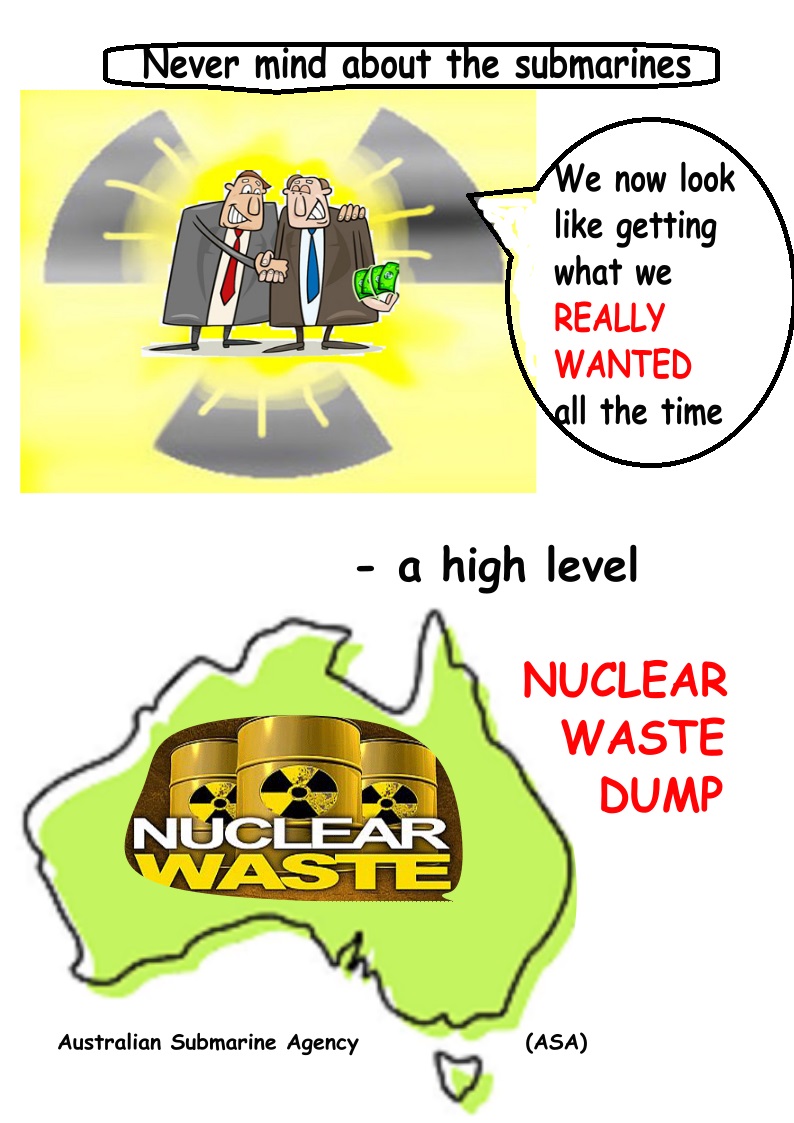
The spectre of an international nuclear waste dump in Australia hangs over AUKUS and what this secretive agreement commits Australia to. Does it oblige us simply to dispose of spent nuclear reactors from our submarines if and when we get them? Or is there a hidden agenda whereby we also take the expired nuclear reactors from US and British submarines? If so, could it lead to Australia becoming a dump for high-level waste from civil nuclear reactors around the world?
Crikey.com is the latest to set speculative hares running. On 26 July it published an article by David Hardaker claiming the Albanese government had struck a secret deal under AUKUS to build a high-grade nuclear waste facility in Australia. Crikey claimed the deal has echoes that resound from 26 years ago.
Indeed it does. In December 1998, a proposal was made by Jim Voss, an American nuclear evangelist, who through his company Pangea proposed constructing an international nuclear waste repository on Billa Kalina, a pastoral lease near Roxby Downs in South Australia. Roxby Downs is a town built to service the giant BHP uranium, gold, copper and silver mine at Olympic Dam. Water for the town and the mine comes from Australia’s Great Artesian Basin.
As I wrote in Fact or Fission – the truth about Australia’s nuclear ambitions (Scribe 2003 and 2022), Voss’s proposal was leaked to the public by Friends of the Earth. Pangea was flying a kite on behalf of Anglo-American and possibly other nuclear interests. It made the unassailable observation that there is a real risk of nuclear weapons proliferation through the theft of plutonium or highly enriched uranium from nuclear power programs. Voss proposed a nuclear waste dump in Western Australia to take about a quarter of the high-level waste from the 445 commercial power reactors in 30 countries around the globe.
This, he claimed, would achieve several things – support international efforts to reduce nuclear weapons proliferation, further the objectives of nuclear disarmament, strengthen Australia’s relations with the United States, protect the global environment, and support the International Atomic Energy Agency (IAEA) and the United Nations. How all this would happen he didn’t say.
Such a repository has also been a gleam in the eyes of the Australian nuclear lobby and several politicians for many years. In 2006, John Howard’s Nuclear Review sought to expand Australia’s nuclear footprint by making nuclear power ‘a practical option’ in Australia’s electricity production. He also envisioned an international nuclear waste dump somewhere in the Outback. In 2014, former Prime Minister Bob Hawke, supported by then South Australian Premier Adam Giles, proposed to put a high-level nuclear waste depository at Muckaty Station north of Tennant Creek in South Australia. Hawke said the money earned would be of immense value to indigenous communities.
Prime Minister Tony Abbott had similar aspirations. So did Malcolm Turnbull, who in 2015 suggested that Australia should not just export uranium oxide (U3O8), but enrich it, process it into fuel rods, retain Australian ownership by leasing the rods abroad, and take them back as spent fuel for permanent disposal in Australia. That way, he said, Australia retained ownership of the uranium, preventing it from being diverted into clandestine weapons programs.
None of these proposals resulted in practical action. Except for qualified acceptance of the export of Australian yellowcake under safeguards to approved civil nuclear energy companies, the Australian public maintained an aversion to all things nuclear. The earlier careless disposal of nuclear tailings at Radium Hill, the contemptuous and ineffective clean-up of highly toxic plutonium in the aftermath of Britain’s nuclear tests at Emu Field and Maralinga in the 1950s, and French nuclear tests in the Pacific in the 1990s, all consolidated Australians’ aversion.
Following negative public reactions to his proposal, Voss quietly closed his Pangea office In January 2002 and retreated to Europe. But several years later, he was given renewed hope.
In 2016, the South Australian Nuclear Fuel Cycle Royal Commission under former South Australian governor Kevin Scarce concluded that although nuclear energy in Australia would not be economically viable for the immediate future, research should continue regarding the feasibility of an international spent fuel repository.
Voss returned to Australia in 2022, and took over the optimistically-named Ultra Safe Nuclear Corporation in Melbourne. Safe disposal of nuclear waste remained on his agenda. According to Crikey, Voss reckons very deep boreholes of around three to five kilometres could safely incarcerate spent fuel from the reactors of Australia’s nuclear-powered submarines for thousands of years.
Could such a storage facility attract US or British attention? Could their governments pressure Australia to take their own submarine spent fuel reactors as well as those of Australia?
They have strong motives to do so. Around 90 British spent fuel submarine reactors are said to be lying around Devonport Docks in Plymouth and the Rosyth dock in Fife, safeguarded only at huge expense. The US Navy has many more in open trenches at the Hanford Nuclear Reservation in Washington State. There are plans to process and store their transuranic elements somewhere permanently, but the Yukka Mountain Deep Geological repository in Nevada was de-funded in 2010, and has been subject to complex political manoeuvring ever since.
Given Albanese’s and Marles’ supine acceptance of US conditions to keep the reactors from our own submarines after their service lives, they could also easily be leant on to take US and UK used submarine reactors as well.
Could this in turn lead to Voss’s grand vision of Australia becoming a spent fuel repository for the international nuclear industry? Since we cannot even decide on the location of a repository for low-level nuclear waste from hospitals and materials testing laboratories, let alone places for intermediate and high-level waste, such an expansion seems a pipe dream. But we must not under-estimate the persistence of the Australian nuclear industry or its backers in Federal and State parliaments and in the Murdoch press.
FORTUNE, BY STEPHANIE COOKE, July 29, 2023 Since the turn of the millennium, at least $50 billion has been spent on a frantic effort to create a new Golden Age for nuclear energy in the U.S. Billions more are being lavished on an even more desperate effort to launch small reactors as supposedly safer, cheaper alternatives to yesteryear’s elephant-sized versions. Most of the money comes from ratepayers and taxpayers, accompanied by an avalanche of public relations that rivals the 1950s “Atoms for Peace” campaign with its claims of “too cheap to meter” electricity.
So far, the effort has produced little in tangible assets: roughly one gigawatt of capacity from the Watts Bar-2 reactor completed after decades of on-and-off-again construction and the promise of 2 GW from the long-delayed Plant Vogtle in Georgia. So far, not a single molecule of CO2 emissions has been avoided by a new reactor, and the primary beneficiaries are not the people who paid but publicly-owned utilities, reactor design companies, and PR and law firms. They are part of a chorus of advocacy groups and government agencies, led by the Department of Energy (DOE), advancing the idea that low-carbon nuclear is essential to any long-term climate change solution.
The story is selling well but the push for more and more money—in direct subsidies, ratepayer financing, and government grants or loans–has a dark side. To cite just a few examples, former state officials and utility executives in Illinois and Ohio face lengthy prison terms for bribery schemes linked to subsidies for unprofitable nuclear plants. In South Carolina, two former Scana executives received prison sentences after pleading guilty to criminal charges in 2020 and 2021 over a nuclear project that ultimately collapsed. Two Westinghouse executives also charged are facing a similar fate, with one still awaiting trial in October.
When it comes to costs and schedules, the lack of honesty surrounding nuclear projects is often breathtaking. In Georgia, where two Westinghouse reactors at Vogtle have been under construction since 2009, only one is completed and is now struggling to achieve commercial operation after multiple unplanned reactor and turbine trips, according to recent Georgia Public Service Commission staff testimony. That testimony also included allegations that utility executives have been providing “materially inaccurate” cost estimates over the project’s life. Vogtle’s estimated total $33 billion cost, as outlined in the testimony, versus $13.3 billion originally estimated makes it the most expensive power plant ever built in the United States. Most of the tab is being footed by ratepayers, with the US taxpayer, via DOE, providing $12 billion in loans.
And still, the messaging that nuclear is a must for reducing emissions goes on at a fever pitch. But the message is distorted: The industry cannot deliver what is needed. The U.S. lost its industrial base, including heavy forging capacity, decades ago–and the costs of a major nuclear buildout could now be in the trillions.
Moreover, the billions currently being spent on nuclear are crowding out viable, less costly solutions for decarbonizing the power sector (not only renewables such as wind and power but also high-voltage direct current transmission lines to deliver them to where they’re needed), thus slowing the transition. A surfeit of renewables projects is seeking grid access, enough to meet 90% of the Biden administration’s goal of a carbon-free power sector by 2035, according to a Berkeley Lab report, but the country’s Balkanized electricity market system, monopolistic utilities, and lack of adequate transmission capacity will likely prevent most of it from succeeding.
The transmission capacity needed for renewables will require anywhere from $30 billion to $90 billion to meet demand by 2030, with the figures rising to $200 billion to $600 billion between 2030 and 2050, according to a study by the Brattle Group. Squandering such sums on nuclear should be out of the question.
Our current fleet of 92 reactors generates about a fifth of the nation’s electricity, but most of the plants are slated for permanent closure by 2050, assuming they operate well beyond their 40-year design life. The DOE admits that such “life extensions” put operators in uncharted waters because there is no actual experience to support 60- or 80-year reactor lifetimes.
The problem of where to put used nuclear fuel (radioactive waste) remains after funding was withdrawn for an estimated $100 billion underground repository project at Yucca Mountain in Nevada. Proposed privately-owned interim storage sites in New Mexico and Texas, though licensed by the U.S. Nuclear Regulatory Commission, face intense local and state opposition as well as political obstacles at the federal level.
Industry officials privately acknowledge these challenges. Even so, nuclear is receiving the most favorable media coverage since the 1950s, and the latest annual Gallup poll on nuclear, released in April, showed the highest level of support in a decade for nuclear power among the American public–at 55%. Nuclear opponents in Congress are now silent on the issue or even hinting at changed views, and bipartisan support in Congress has over the past couple of years resulted in billions in tax incentives and other forms of support for both existing and planned nuclear plants.
But public opinion is fickle–and no guarantee for the future. Since Gallup began polling on nuclear in 1994, support peaked at 62% in 2010, a year before the triple meltdowns at Fukushima. After that, it went steadily down, to a low of 44% in 2016. Nor is popular opinion an indicator of whether nuclear’s formidable technical, financial, environmental, and geopolitical challenges can be overcome.
The primary aims of today’s promoters are to prevent aging, uneconomic reactors from closing, and to secure funding for small modular reactors (SMRs) and “advanced” reactors (and associated fuels).
The push for smaller reactors appears to have been an act of desperation by a nuclear-centric energy agency–the DOE (which also oversees the country’s nuclear weapons programs)—after its failed attempt to create a nuclear “renaissance” in the early 2000s. Although that project generated interest (utilities filed plans for 28 large-scale reactors), only the two at Vogtle were ever built………………………………………………………………………………………
does it really sound like a coincidence that we’re seeing all these news stories about UFOs and aliens at the same time we’re seeing news stories about a race between the US and China and Russia to dominate space militarily?
If Wednesday’s House Oversight subcommittee hearing on UFOs had happened ten years ago instead of today, it would have shaken the world. Imagine someone from 2013 hearing congressional testimonies about “routine” military pilot encounters with giant flying tic tacs, floating orbs, 300-foot red squares, and cubes in clear spheres zipping around in ways that surpass all known earthly technology by leaps and bounds, or about secret government possession of otherworldly aircraft they’re trying to reverse engineer and the dead bodies of their non-human pilots, or about the possibility that these creatures are not merely extraterrestrial but extra-dimensional. Their jaws would have hit the floor.
Now in 2023 we’ve been getting incrementally drip-fed bits and pieces of these stories for six years, so the scene on Capitol Hill on Wednesday didn’t have the impact it would’ve had in 2013. It’s making headlines and getting attention, but not as much as Sinead O’Connor’s death or people’s thoughts on Barbie and Oppenheimer. The response from the general public could be described as a collective nervous laugh and a shrug.
……………………………………………………. the new UFO narrative wasn’t just cooked up at the last minute to distract from current headlines, it’s been unfolding for six years, and people aren’t even paying that much attention to it. The empire doesn’t tend to orchestrate spectacular events as a “distraction” anyway; the adjustment of public attention tends to take the much more mundane form of agenda setting in the media, where some stories receive more attention than others based on what’s convenient for the oligarchs who own the press.
……………………………………. for me what really stinks about all this UFO stuff is the timing. Here we are in the early stages of a new cold war which features a race to militarize space, and we’re hearing congressional testimony about mysterious vehicles posing a threat to US airspace which have the ability to go up and down between earth and space very quickly. That smells off.
I mean, does it really sound like a coincidence that we’re seeing all these news stories about UFOs and aliens at the same time we’re seeing news stories about a race between the US and China and Russia to dominate space militarily?
A Foreign Policy article from last year blares the headline “China and Russia Are Catching Up to U.S. in Space Capabilities, Pentagon Warns” with the subheading “The militarization of space is picking up pace.” These warnings are echoed in articles by Defense One and Time. An article on the United Nations website from last year carries the title “‘We Have Not Passed the Point of No Return’, Disarmament Committee Told, Weighing Chance Outer Space Could Become Next Battlefield.” A 2021 report from the war machine-funded Center for Strategic and International Studies titled “Defense Against the Dark Arts in Space: Protecting Space Systems from Counterspace Weapons” warns of the urgent need to build more space weapons to counter US enemies. A Global Times article from last year carries the title “Chinese experts urge avoidance of space weaponization amid commercial space capability deployment in Ukraine.”
………………………………….it just seems mighty suspicious to me how we’re being slowly paced into this UFO narrative (or UAP narrative for those hip to the current jargon) right when there’s a mad rush to get weapons into space. I can’t actually think of any other point in history when the timing of something like this would have looked more suspicious.
So for me the most disturbing parts of the UFO hearing were the parts that could wind up facilitating the agenda to militarize space, like when this phenomenon was framed as a “national security” threat or when it was mentioned that they can transition from earth to space very rapidly.
When asked by congressman Glenn Grothman “do you believe UAPs pose a threat to our national security?”, former Navy commander David Fravor answered with an unequivocal yes. A few minutes later Fravor described these vehicles as being able to “come down from space, hang out for three hours and go back up.”
When asked by congressman Andy Ogles whether UFOs could be “collecting reconnaissance information” on the US military, all three witnesses — Grusch, Fravor, and former Navy pilot Ryan Graves — answered in the affirmative. Asked by Ogles if UFOs could be “probing our capabilities,” all three again said yes. Asked if UFOs could be “testing for vulnerabilities” in US military capabilities, all three again said yes. Asked if UFOs pose an existential threat to the national security of the United States, all three said they potentially do. Asked if there was any indication that UFOs are interested in US nuclear technology, all three said yes.
Ogles concluded his questioning by saying, “There clearly is a threat to the national security of the United States of America. As members of Congress, we have a responsibility to maintain oversight and be aware of these activities so that, if appropriate, we take action.”
When asked by congressman Eric Burlison if “there has been activity by alien or non-human technology, and/or beings, that has caused harm to humans,” Grusch said he couldn’t get into specifics in a public setting (a common theme throughout the hearing), but said that “what I personally witnessed, myself and my wife, was very disturbing.”
Grusch would complicate this cryptic statement a few minutes later by saying that he’s never seen a UFO. How this statement doesn’t contradict his previous statement about having witnessed harmful behavior from non-human technology and/or beings was not made clear.
So you’ve got US policymakers being told that there are vehicles using technology not of this world routinely violating US airspace and posing an existential threat to US national security, and that these craft can go from earth to space and back at will, and that they need to help make sure their nation can address this threat.
What conclusions do you come to when presented with that kind of information? If you’re a lawmaker in charge of facilitating the operation of a highly militaristic empire, you’re probably not going to conclude that it’s time to hold hands and sing Kumbaya. You’re probably eventually going to start thinking in terms of military technology.
One of the most important unanswered questions in all this UFO hullabaloo is, why now? Why are we seeing all this movement on “disclosure” after generations of zero movement? If these things are in fact real and the government has in fact been keeping them secret, why would the adamant policy of dismissal and locked doors suddenly be reversed, allowing “whistleblowers” to come forward and give testimony before congress? If they had motive to keep it a secret this entire time, why would that motive no longer be there?
…………………………………So why now? Why the drastic and sudden shift from UFOs and aliens being laughable tinfoil hat nonsense to the subject of serious congressional inquiries and widespread mainstream media coverage?
Well, the timing of the race to militarize space might provide an answer to the “why now?” question. Is it a coincidence that this new UFO narrative began its rollout in 2017, around the same time as the rollout of the Space Force? Are we being manipulated at mass scale about aliens and UFOs to help grease the wheels for the movement of war machinery into space? How likely is it that by pure coincidence this extraplanetary narrative timed out the way it did just as the US empire makes a last-ditch grab at unipolar planetary domination?
I don’t know. I do know that if I’m assigning degrees of probability, “Extraterrestrial or extradimensional beings are here and take a special interest in us and sometimes crash their vehicles and our government recovered them but kept them a secret but suddenly decided not to be so secretive about them anymore” ranks significantly lower than “Our rulers are lying and manipulating to advance their own interests again.”
I am 100 percent wide open to the possibility of extraterrestrials and otherworldly vehicles zipping around our atmosphere. What I am not open to is the claim that the most depraved institutions on earth have suddenly opened their mind to telling us the truth about these things, either out of the goodness of their hearts or because they were “pressured” by UFO disclosure activists.
‘Era of global boiling has arrived,’ says UN chief as July set to be hottest month on record. The era of global warming has ended and “the era of global boiling has arrived”, the UN secretary general, António Guterres, has said after scientists confirmed July was on track to be the world’s hottest month on record.
David Noonan will speak on public interest concerns over the new Roxby Downs Indenture Act 2026 on BHP copper-uranium mining and ore processing in SA, and on how AUKUS may face SA with a High-Level nuclear waste agenda.
Dr Jim Green will discuss international developments in the field of nuclear power including ‘small modular reactors’ and Generation 4 ‘advanced’ nuclear reactor concepts.