Inglorious inertia: The Albanese Government and Julian Assange
Australian Independent Media, April 1, 2023, Dr Binoy Kampmark
The sham that is the Assange affair, a scandal of monumental proportions connived in by the AUKUS powers, shows no signs of abating. Prior to Prime Minister Anthony Albanese assuming office in Australia, he insisted that the matter dealing with the WikiLeaks publisher would be finally resolved. It had, he asserted, been going on for too long.
Since then, it is very clear, as with all matters regarding US policy, that Australia will, if not agree outright with Washington, adopt a constipated, non-committal position. “Quiet diplomacy” is the official line taken by Albanese and Australian Foreign Minister Penny Wong, a mealy-mouthed formulation deserving of contempt. As Greens Senator David Shoebridge remarks, “‘quiet diplomacy’ to bring Julian Assange home by the Albanese Government is a policy of nothing. Not one meeting, phone call or letter sent.”
Kellie Tranter, a tireless advocate for Assange, has done sterling work uncovering the nature of that position through Freedom of Information requests over the years. “They tell the story – not the whole story – of institutionalised prejudgment, ‘perceived’ rather than ‘actual’ risks, and complicity through silence.”
The story is a resoundingly ugly one. It features, for instance, stubbornness on the part of US authorities to even disclose the existence of a process seeking Assange’s extradition from the UK, to the lack of interest on the part of the Australian government to pursue direct diplomatic and political interventions
Former Australian Foreign Minister Julie Bishop exemplified that position in signing off on a Ministerial Submission in February 2016 recommending that the Assange case not be resolved; those in Canberra were “unable to intervene in the due process of another’s country’s court proceedings or legal matters, and we have full confidence in UK and Swedish judicial systems.” Given the nakedly political nature of the blatant persecution of the WikiLeaks founder, this was a confidence both misplaced and disingenuous.
The same position was adopted by the Australian government to the United Nations Working Group on Arbitrary Detention (WGAD), which found that same month that Assange had been subject to “different forms of deprivation of liberty: initial detention in Wandsworth prison which was followed by house arrest and his confinement at the Ecuadorean embassy.” The Working Group further argued that Assange’s “safety and physical integrity” be guaranteed, that “his right to freedom of movement” be respected, and that he enjoy the full slew of “rights guaranteed by the international norms on detention.”………………………….
At the time, such press outlets as The Guardian covered themselves in gangrenous glory in insisting that Assange was not being detained arbitrarily and was merely ducking the authorities in favour of a “publicity stunt”………………………………
The new Australian High Commissioner to the United Kingdom, Stephen Smith, has kept up that undistinguished, even disgraceful tradition: he has offered unconvincing, lukewarm support for one of Belmarsh Prison’s most notable detainees. ……………………………………
As with his predecessors, Smith is making his own sordid contribution to assuring that the WikiLeaks founder perishes in prison, a victim of ghastly process.
As for what he would be doing to impress the UK to reverse the decision of former Home Secretary Priti Patel to extradite the publisher to the US, Smith was painfully predictable. “It’s not a matter of us lobbying for a particular outcome. It’s a matter of me as the High Commissioner representing to the UK government as I do, that the view of the Australian government is twofold. It is: these matters have transpired for too long and need to be brought to a conclusion, and secondly, we want to, and there is no difficulty so far as UK authorities are concerned, we want to discharge our consular obligations.”……………………… https://theaimn.com/inglorious-inertia-the-albanese-government-and-julian-assange/
;
USA CONGRESSIONAL EFFORT TO END ASSANGE PROSECUTION IS UNDERWAY

Rep. Rashida Tlaib is collecting signatures on a letter calling on Attorney General Merrick Garland to end the extradition drive against WikiLeaks’ Julian Assange.
The Intercept Ryan Grim March 31 2023
REP. RASHIDA TLAIB, D-Mich., is circulating a letter among her House colleagues that calls on the Department of Justice to drop charges against Julian Assange and end its effort to extradite him from his detention in Belmarsh prison in the United Kingdom.
The letter, a copy of which was obtained by The Intercept, is still in the signature-gathering phase and has yet to be sent to Attorney General Merrick Garland.
The Justice Department has charged Assange, the publisher of WikiLeaks, for publishing classified information. The Obama administration had previously decided not to prosecute Assange, concerned with what was dubbed internally as the “New York Times problem.” The Times had partnered with Assange when it came to publishing classified information and itself routinely publishes classified information. Publishing classified information is a violation of the Espionage Act, though it has never been challenged in the Supreme Court, and constitutional experts broadly consider that element of the law to be unconstitutional.
“The Espionage Act, as it’s written, has always been applicable to such a broad range of discussion of important matters, many of which have been wrongly kept secret for a long time, that it should be regarded as unconstitutional,” explained Daniel Ellsberg, the famed civil liberties advocate who leaked the Pentagon Papers.
The Obama administration could not find a way to charge Assange without also implicating standard journalistic practices. The Trump administration, unburdened by such concerns around press freedom, pushed ahead with the indictment and extradition request. The Biden administration, driven by the zealous prosecutor Gordon Kromberg, has aggressively pursued Trump’s prosecution. Assange won a reprieve from extradition in a lower British court but lost at the High Court. He is appealing there as well as to the European Court of Human Rights. Assange’s brother, Gabriel Shipton, who has been campaigning globally for his release, said that Assange’s mental and physical health have deteriorated in the face of the conditions he faces at Belmarsh.
Tlaib, in working to build support, urged her colleagues to put their differences with Assange the individual aside and defend the principle of the free press, enshrined in the Constitution. “I know many of us have very strong feelings about Mr. Assange, but what we think of him and his actions is really besides the point here,” she wrote to her colleagues in early March. “The fact of the matter is that the [way] in which Mr. Assange is being prosecuted under the notoriously undemocratic Espionage Act seriously undermines freedom of the press and the First Amendment.”
Tlaib noted that the Times, The Guardian, El País, Le Monde, and Der Spiegel had put out a joint statement condemning the charges, and alluded to the same problem that gave the Obama administration pause. “The prosecution of Mr. Assange, if successful, not only sets a legal precedent whereby journalists or publishers can be prosecuted, but a political one as well,” she wrote. “In the future, the New York Times or Washington Post could be prosecuted when they publish important stories based on classified information. Or, just as dangerous, they may refrain from publishing such stories for fear of prosecution.”
So far, the letter has collected signatures from Democratic Reps. Jamaal Bowman, Ilhan Omar, and Cori Bush. Rep. Ro Khanna said he had yet to see the letter but added that he has previously said Assange should not be prosecuted because the charges are over-broad and a threat to press freedom. Rep. Pramila Jayapal is not listed as a signee but told a Seattle audience recently she believes the charges should be dropped. A spokesperson for Rep. Alexandria Ocasio-Cortez said that she intends to sign before the letter closes.
Chip Gibbons, policy director for Defending Rights & Dissent, said that the relative silence from Congress on the Assange prosecution has undermined U.S. claims to be defending democracy abroad. “In spite of the rhetoric about opposing authoritarianism and defending democracy and press freedom, we really haven’t seen a comparable outcry from Congress — until now,” said Gibbons, whose organization has launched a petition calling on the Justice Department to drop charges. “Rep. Tlaib’s letter isn’t just a breath of fresh air, it’s extremely important for members of Congress to be raising their voices on this, especially those from the same party of the current administration, at this critical juncture in a case that will determine the future of press freedom in the United States.”
A significant number of Democrats continue to hold a hostile view of Assange……………..
The full letter is below [on the original article at] https://theintercept.com/2023/03/30/julian-assange-congress-rashida-tlaib/
Submission to Senate – a trenchant critique of Australia’s pro nuclear fringe
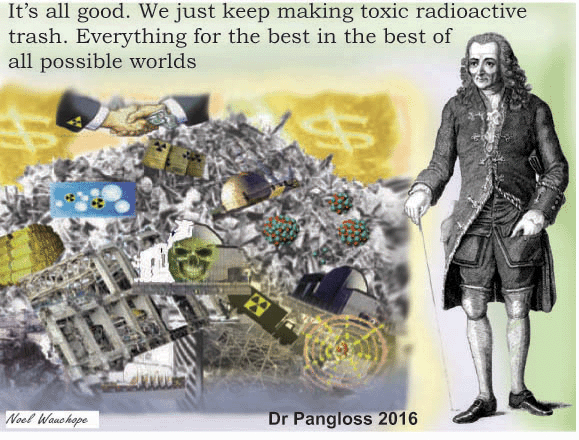
Environment and Other Legislation Amendment (Removing Nuclear Energy Prohibitions) Bill 2022 Submission No. 125 (Name Withheld)
Here we find ourselves with yet ANOTHER inquiry into nuclear power in Australia.
This time the timing couldn’t be better – with all the issues created by nuclear power on full display in Europe.From the extreme example of nuclear power plants being used as a weapon of terror by invading forces (Zaporizhzhia) leading to the unforgettable front page headline on The Weekend Australian of March 5-6, 2022, “Nukes fear: ‘End of Europe'”.
To the more mundane but economically crippling complete failure of the French nuclear power industry during a major European energy crisis caused by the Russian invasion of Ukraine – resulting in the introduction of a new French law requiring all car parking spaces with a capacity of over 80 cars to install solar panels resulting in the potential capacity addition of 11GW. With around half of the French nuclear fleet out of commission, wholesale prices have soared to over Euros 1000/MWh.
However, even these issues won’t soften the enthusiasm of the nuclear fringe – so we have to go through this inquiry process once again. Thank God the country doesn’t have bigger issues to deal with……… https://www.aph.gov.au/Parliamentary_Business/Committees/Senate/Environment_and_Communications/Nuclearprohibitions/Submissio
Australian government always knew that Australia would end up with AUKUS nuclear wastes – they just didn’t let on to the public.

“…………………………………… our ALP federal gov says they will within 12 months make an announcement of a process to dispose of High Level nuclear waste (a feat no other country has achieved) from AUKUS nuclear powered submarines on existing or future defence lands,
this will involve a site study across ‘remote’ areas and likely be by imposition, with compulsory land acquisition and override of State / Territory laws and may be without recognising a right of affected traditional owners to Say No…
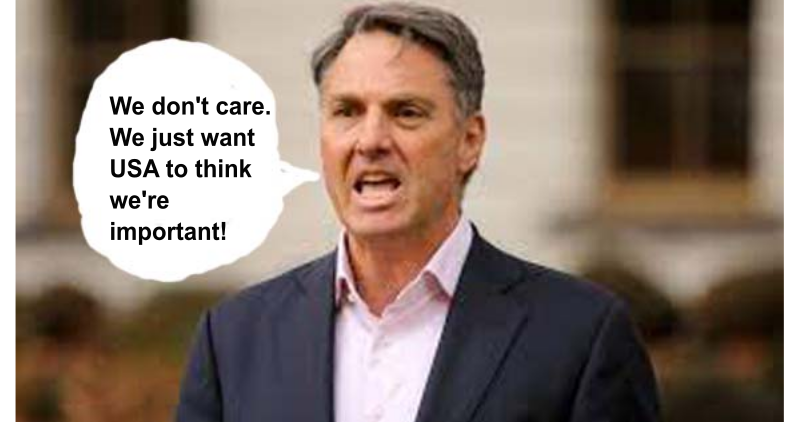
Deputy Leader Hon Richard Marles MP has said ‘keeping the waste was always a pre-condition to AUKUS nuclear subs’ – the ALP gov just didn’t let on to the public till after they’d sought to lock in an ‘pathway’ https://cosmosmagazine.com/…/explainer-radioactive…/…
Letter to the Australian Nuclear Science and Technology Organisation (ANSTO), dispelling its deceptions about nuclear medicine and nuclear wastes.
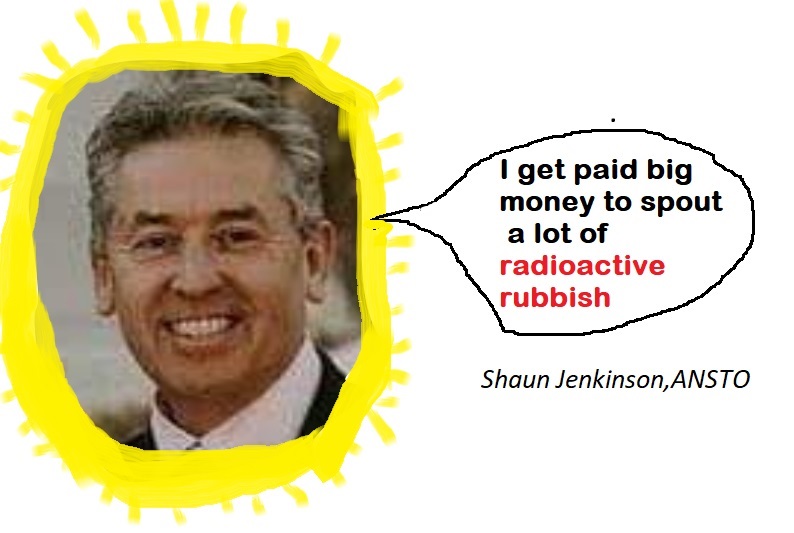
To Mr Shaun Jenkinson , Chief Executive Officer , Australian Nuclear Science and Technology Organisation, 31 Mar 23
Dear Shaun Jenkinson
While I should be congratulating the Australian Nuclear Science and Technology Organisation (ANSTO) on the occasion of its seventieth anniversary I cannot agree with its euphemistic contention that Australia punches above its weight in the international nuclear arena
You know well enough that this is far from the truth in the eyes of many leading experts internationally in all aspects of nuclear science and technology and which is particularly confirmed by various circumstances involving ANSTO in the past few years
This situation relates to the very existence and necessity of ANSTO and no degree of membership of various global committees by its staff can justify the claim that Australia holds its own (presumably through ANSTO) on the international stage among the leading nuclear nations of the world BECAUSE IT SIMPLY DOES NOT
The prime examples of this are the completely misleading contentions by ANSTO as to its its leadership in the production of nuclear medicine and its continued operational problems at Lucas Heights
While you have claimed that the production of nuclear medicine by ANSTO represents 80% of its undertaking the fact is that it relates to reactor generated medicine from which the medical profession worldwide is turning away due to its inherent and dangerous nature
In fact the better medical opinion internationally is that reactor generated nuclear medicine will ultimately be completely replaced by other means of diagnostic and curative treatment based on which a large part of the purpose of ANSTO would be lost
This fact could be readily verified if you and the federal government on your advice allowed a proper independent and internationally based review of the production of nuclear medicine by ANSTO which of course as a comprehensive business case would completely destroy a large part of its commercial undertaking
As far as the operations at Lucas Heights are concerned it is incredible how many times the nuclear reactor breaks down and has to cease its activity and also the number of leakages and mishandling of nuclear material all of which ANSTO hides from public scrutiny but is well-known overseas
However perhaps the most damaging fact to the reputation of ANSTO has been its inapt handling of the proposed but completely unsuitable nuclear waste management facility at Kimba in South Australia which through international peer group pressure will never see the light of day
Although it appears that it has now passed on its functions for Kimba to another entity yet to be legislated ANSTO had previously and seemingly wilfully ignored all of the major and necessary prescriptions of the International Atomic Energy Agency (IAEA) relating to the development of a nuclear installation including principally the lack of a proper safety case from the outset of its intentions
This is viewed internationally as a major breach of human rights and is a devastating blow to the self-proclaimed qualifications of ANSTO internationally
That is why no degree of membership in many instance of not highly relevant international committees for Australia can overcome these major failings by ANSTO
You are no doubt still sticking voodoo pins into me over my exposure of ANSTO by the Senate estimates committee hearing in October 2020 relating to the mistruths – in fact open lies – about the dismissal of its previous chief executive and the underhanded payments to China for the development of small nuclear power generating reactors for local use to which no proper answers have yet been provided
It gave me no pleasure to have to expose these situations and as I have previously told you that in a normal commercial context they would have been tantamount to corporate criminality
Instead of its unrealistic claims of international standing and self appraisement ANSTO would gain far more respect if it addressed these circumstances and heeded external advice and guidance
While the federal government would find it most unpalatable if it were to reduce ANSTO to its true operational and useful existence based on properly justified scientific and commercial reasons rather than involvement in somewhat meaningless committees which have little national relevance this may be necessary for Australia to gain the international respect it so badly seeks
Sincerely
Peter Remta
Canadian First Nations do not want small nuclear reactors on their lands

Decolonizing energy and the nuclear narrative of small modular reactors https://policyoptions.irpp.org/magazines/february-2022/decolonizing-energy-and-the-nuclear-narrative-of-small-modular-reactors/
Kebaowek First Nation is calling for an alternative to a planned SMR project, one that won’t undermine proper consultation and leave a toxic legacy.
by Lance Haymond, Tasha Carruthers, Kerrie Blaise, February 7, 2022 In early 2021, the Canadian Nuclear Safety Commission began reviewing the application from a company called Global First Power to build a nuclear reactor at the Chalk River Laboratories site about 200 kilometres northwest of Ottawa.
This project, known as a micro modular reactor project, is an example of the nuclear industry’s latest offering – a small modular reactor (SMR).SMRs are based on the same fundamental physical processes as regular (large) nuclear reactors; they just produce less electricity per plant. They also produce the same dangerous byproducts: plutonium and radioactive fission products (materials that are created by the splitting of uranium nuclei). These are all dangerous to human health and have to be kept away from contact with people and communities for hundreds of thousands of years. No country has so far demonstrated a safe way to deal with these.
Despite these unsolved challenges, the nuclear industry promotes SMRs and nuclear energy as a carbon-free alternative to diesel for powering remote northern communities. The Canadian government has exempted small modular reactors from full federal environmental assessment under the Impact Assessment Act. Many civil society groups have condemned this decision because it allows SMRs to escape the public scrutiny of environmental, health and social impacts.
The proposed new SMR in Chalk River, like the existing facilities, would be located on Algonquin Anishinabeg Nation territory and the lands of Kebaowek First Nation – a First Nation that has never been consulted about the use of its unceded territory and that has been severely affected by past nuclear accidents at the site.
At this critical juncture of climate action and Indigenous reconciliation, Kebaowek First Nation is calling for the SMR project at Chalk River to be cancelled and the focus shifted to solutions that do not undermine the ability of First Nations communities to be properly consulted and that do not leave behind a toxic legacy.
While these reactors are dubbed “small,” it would be a mistake to assume their environmental impact is also “small.” The very first serious nuclear accident in the world involved a small reactor: In 1952, uranium fuel rods in the NRX reactor at Chalk River melted down and the accident led to the release of radioactive materials into the atmosphere and the soil. In 1958, the same reactor suffered another accident when a uranium rod caught fire; some workers exposed to radiation continue to battle for compensation.
What makes these accidents worse – and calls into question the justification for new nuclear development at Chalk River – is that this colonized land is the territory of the Algonquin Anishinabeg Nation territory (which consists of 11 First Nations whose territory stretches along the entire Ottawa River watershed straddling Quebec and Ontario). Kebaowek First Nation, part of the Algonquin Nation, was among those First Nations never consulted about the original nuclear facilities on their unceded territory, and is still struggling to be heard by the federal government and nuclear regulator. Its land has never been relinquished through treaty; its leaders and people were never consulted when Chalk River was chosen as the site for Canada’s first nuclear reactors; and no thought was given to how the nuclear complex might affect the Kitchi Sibi (the Ottawa River).
History is being repeated at Chalk River today as the government pushes ahead with the micro modular reactor project without consent from Kebaowek. Assessments of the project have been scoped so narrowly that they neglect the historical development and continued existence of nuclear facilities on Kebaowek’s traditional territory. The justification for an SMR at this location without full and thorough consideration of historically hosted nuclear plants – for which there was no consultation nor accommodation – is a tenuous starting point and one that threatens the protection of Indigenous rights.
The narrative of nuclear energy in Canada is one of selective storytelling and one that hides the reality of the Indigenous communities that remain deeply affected, first by land being taken away for nuclear reactor construction, and later by the radioactive pollution at the site. All too fitting is the term radioactive colonialism coined by scholars Ward Churchill and Winona LaDuke, to describe the disproportionate impact on Indigenous people and their land as a result of uranium mining and other nuclear developments. In country after country, the uranium that fuels nuclear plants has predominantly been mined from the traditional lands of Indigenous Peoples at the expense of the health of Indigenous Peoples and their self-determination.
Kebaowek First Nation has been vocal in its objection to the continuation of the nuclear industry on its lands without its free prior and informed consent, as is its right under the United Nations Declaration on the Rights of Indigenous Peoples (UNDRIP). Despite requests for the suspension of the SMR project, pending adequate provisions for Indigenous co-operation and the Crown’s legal duty to initiate meaningful consultation, Kebaowek has yet to see its efforts reflected in government decisions and Crown-led processes.
Nuclear is a colonial energy form, but it is also bio-ignorant capitalism – a term coined by scholars Renata Avila and Andrés Arauz to describe the ways in which the current economic order ignores the planetary climate emergency, human and ecological tragedies, and the large-scale impact on nature. The narrative of nuclear as a “clean energy source” is a prime example of this bio-ignorance. Decision-makers have become fixated on carbon emissions as a metric for “clean and green,” ignoring the radioactive impacts and the risks of accidents with the technology.
It is more than 70 years since Chalk River became the site for the splitting of the nucleus. The continuation of nuclear energy production on unceded Indigenous territory without meaningful dialogue is a telling example of continued colonial practices, wherein companies extract value from Indigenous land while polluting it; offer little to no compensation to impacted communities; and abide by timelines driven by the project’s proponents, not the community affected. We need to move away from this colonial model of decision-making and decolonize our energy systems.
The challenge of climate change is urgent, but responses to the crisis must not perpetuate extractivist solutions, typical of colonial thinking, wherein the long-term impacts – from the production of toxic waste to radioactive releases – lead to highly unequal impacts.
The authors thank Justin Roy, councilor and economic development officer at Kebaowek First Nation, and M.V. Ramana, professor at the School of Public Policy and Global Affairs at the University of British Columbia, for contributing to this article.
An obnoxious clause in Canada’s draft Act for Implementing the United Nations Declaration on the Rights of Indigenous Peoples (UNDRIP).

First -let’s see what the Assembly of First Nations of Canada (AFN) say about Small Modular Nuclear Reactors
The AFN resolution from 2018 against SMRs, available HERE says:
THEREFORE BE IT RESOLVED that the Chiefs-in-Assembly:
1. Demand that free, prior and informed consent is required to ensure that no storage or disposal of hazardous
materials shall take place in First Nations lands and territories.
2. Demand that the Nuclear Industry abandon its plans to operate Small Modular Nuclear Reactors in Ontario and
elsewhere in Canada.
3. Demand that the Government of Canada cease funding and support of the Small Modular Nuclear Reactors
program.
4. Direct that the National Chief and appropriate staff work to ensure that the Nuclear Industry and the Canadian Government abandon this program.
Now see what the Government includes in this draft Act
In the Environment section of Canada’s draft Act for Implementing the United Nations Declaration on the Rights of Indigenous Peoples (UNDRIP)- the specific SMRs text is found, in Chapter 1, Shared priorities. https://www.justice.gc.ca/eng/declaration/ap-pa/ah/p3.html
The Government of Canada will take the following actions……………
44. Increase capacity for Indigenous peoples to meaningfully engage, make informed decisions, and participate financially in clean energy alternatives like Small Modular Reactors (SMRs). SMRs in Canada are developing along three parallel streams including near-term on-grid, next generation and micro/off-grid, and there is potential for multiple benefits including use in remote Indigenous communities for abating emissions of heavy industry and increasing energy security. (Natural Resources Canada)
Australia Isn’t A Nation, It’s A US Military Base With Kangaroos, and happy to have Julian Assange imprisoned


Caitlin Johnstone 1 Apr 23 https://caitlinjohnstone.substack.com/p/australia-isnt-a-nation-its-a-us?utm_source=post-email-title&publication_id=82124&post_id=111947244&isFreemail=true&utm_medium=email
One of the many, many signs that Australia is nothing more than a US military and intelligence asset is the way its government has consistently refused to intervene to protect Australian citizen Julian Assange from political persecution at the hands of the US empire.
In a new article titled “Penny Wong moves to dampen expectation of breakthrough in Julian Assange case,” The Guardian quotes Australia’s foreign minister as saying, “We are doing what we can, between government and government, but there are limits to what that diplomacy can achieve.” Wong said this when asked if Prime Minister Anthony Albanese discussed the world’s most famous press freedom case with the US president and British prime minister when he met with them together two weeks ago.
Wong refused to say whether her government’s leader had raised the issue with his supposed US and UK counterparts, repeating instead the same line she’s been bleating since Labor took over: that the Assange case “has dragged on long enough and should be brought to a close.” Which if you listen carefully isn’t actually a statement in favor of releasing the WikiLeaks founder or blocking extradition — it’s just saying the case should be concluded hastily, one way or another.
These statements came in response to questions from Greens Senator David Shoebridge, who took a jab at the Labor government’s “quiet diplomacy” approach to the Assange case.
“The idea that quiet diplomacy must be so silent that the government can’t tell the public or the parliament if the PM even spoke to the president is bizarre,” Shoebridge said.
Wong told Shoebridge that Australia is powerless to intervene to protect the acclaimed Australian journalist, saying, “We are not able as an Australian government to intervene in another country’s legal or court processes.”
While it is true that Australia can’t force the US to end the political imprisonment and persecution of Assange for exposing US war crimes, it obviously can conduct diplomacy with its supposed ally in order to protect an Australian citizen. Even nations with whom Australia has no form of alliance are vocally confronted by Canberra when they imprison Australian citizens, like the statement Wong released yesterday regarding China’s detention of Chinese-Australian journalist Cheng Lei in which the foreign minister explicitly and unequivocally calls for “Ms Cheng to be reunited with her family.”
Just yesterday alone Wong tweeted to demand justice for Cheng and for American journalist Evan Gershkovich, who has been arrested in Russia on espionage charges.
“It is one year since Australian citizen Cheng Lei faced a closed trial in Beijing on national security charges,” tweeted Wong. “She is yet to learn the outcome. Our thoughts are with Ms Cheng and her loved ones. Australia will continue to advocate for her to be reunited with her children.”
“Australia is deeply concerned by Russia’s detention of Wall Street Journal Moscow correspondent Evan Gershkovich. We call on Russia to ensure access to consular and legal assistance,” Wong tweeted a few hours later.
Now guess how many times Penny Wong has tweeted the word “Assange”?
Answer: zero.
What is the basis for this discrepancy? Why has Australia’s foreign minister been publicly demanding that China release Cheng Lei and return her to her children, without making the same demands of the US for Julian Assange? Assange has children too, and he has been imprisoned for four times longer than Cheng — more than ten times longer if you count the period of his arbitrary detention in the Ecuadorian embassy in London before his arrest. Why are we seeing more action from the Australian government to defend an Australian journalist in China than to defend an Australian journalist fighting extradition to a nation we’re supposedly allied with which upholds itself as the leader of the rules-based international order?
The answer is that Australia is not a real country. It’s an American colony. It’s a giant US military base with kangaroos.
That’s why the Albanese government’s “quiet diplomacy” to free Assange is so quiet that it can’t actually be said to exist.
Regular readers may recall that the last time we discussed an interaction between Senators Wong and Shoebridge was when the former condescendingly dismissed the latter’s efforts to find out if the Australian government is allowing the US military to bring nuclear weapons into the country. Wong angrily told Shoebridge that the US has a standing “neither confirm nor deny” position with regard to where it keeps its nuclear weapons, and that the Australian government understands and respects that position.
We’re so far under Washington’s thumb that we’re not even allowed to know if there are American nukes in our country, and our own government can’t even advocate in defense of its own citizen when he’s being persecuted for the crime of good journalism.
Add that to the fact that Australia has been pressed into an AUKUS pact which makes us much less safe and a hostile relationship with China which hurts our own economic and security interests, the stationing of a US nuclear intelligence site which makes us a nuclear target, and the US staging literal coups of our government whenever its elected leaders threaten US strategic interests, and it becomes clear that our so-called “country” is functionally just a US aircraft carrier that happens to be the size of a continent.
Which would be bad enough if these bastards weren’t pushing us to play a front-and-center role in World War Three. We’ve got to start fighting against our enslavement to the US empire and against the Pentagon puppets in our own government like our lives depend on it, because they very clearly do.
AUKUS Exists To Manage The Risks Created By Its Existence
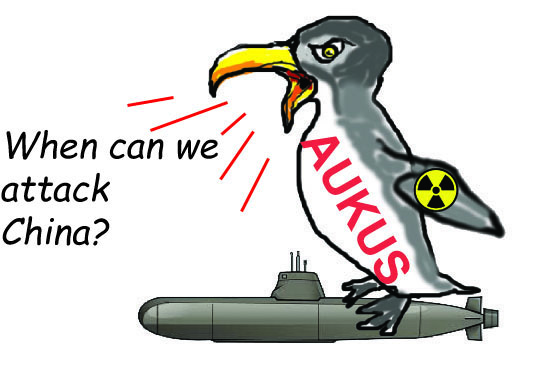
Australia would be at risk of being attacked by China because the US wants to use Australia to attack China.
The only way China attacks Australia is if Australia’s role as a US military asset makes us a target when the US attacks China
“NATO exists to manage the risks created by its existence,” Professor Richard Sakwa once wrote in an attempt to articulate the absurdity of the military alliance’s provocative nature on the world stage. At some point Australians must wake up to the fact that this is equally true of AUKUS: we’re told the military alliance exists for our protection, but its very existence makes us less safe.
As former prime minister Paul Keating recently observed in the Australian Financial Review, this government’s justification for the AUKUS alliance and the obscenely expensive nuclear submarine deal that goes with it has been all over the map, first claiming that it’s to protect our own shores from a Chinese attack, then pivoting to claiming it’s to protect sea lanes from being blocked off by China after Keating dismantled the first claim at the National Press Club two weeks ago.
One thing Canberra has struggled to do is to explain exactly why China would launch an unprovoked attack on Australia or its shipping routes; the former couldn’t yield any benefit that would outweigh the immense cost even if it succeeded, and the latter is absurd because open trade routes are what makes China an economic superpower in the first place.
Luckily for us, the Pentagon pets cited in the Australian media’s recent propaganda blitz to promote war with China explained precisely what the argument is on Canberra’s behalf. They say Australia would be at risk of being attacked by China because the US wants to use Australia to attack China.
…………………………………………………… In their haste to make the case for more militarism and brinkmanship, these war propagandists admit what’s long been obvious to anyone paying attention: that the only thing putting Australia in danger from China is its alliances and agreements with the United States. The difference between them and normal human beings is that they see no problem with this.
Other empire lackeys have been making similar admissions. In a recent article by Foreign Policy, Lowy Institute think tanker Sam Roggeveen is quoted as saying the AUKUS nuclear submarine deal will make it “almost impossible” for Australia to avoid getting entangled in a war between the US and China:………………
The only way China attacks Australia is if Australia’s role as a US military asset makes us a target when the US attacks China
…………………………………………………AUKUS has nothing to do with “defence”. You don’t need long-range submarines to defend Australia’s easily-defended shores, you need long-range submarines to attack China. Australia’s “defence posture” is an attack posture.
………………
AUKUS is not a defence partnership because it’s got nothing to do with defence, and it’s also not a defence partnership because it is not a “partnership”. It’s the US empire driving Australia to its doom, to nobody’s benefit but the US empire.
AUKUS exists to manage the risks created by its existence, and the same is true of ANZUS and all the other ways our nation has become knit into the workings of the US war machine. If we’re being told that our entanglements with the US war machine will make it almost impossible for us to avoid entering into a horrific war that will destroy our country, then the obvious conclusion is that we must disentangle ourselves from it immediately.
The problem is not that Australia’s corrupt media are saying our nation will have to follow the US into war with China, the problem is that they’re almost certainly correct.
The Australian media aren’t criminal in telling us the US is going to drag us into a war of unimaginable horror; that’s just telling the truth. No, the Australian media are criminal for telling us that we just need to accept that and get comfortable with the idea.
No. Absolutely not. This war cannot happen. Must not happen. We cannot go to war with a nuclear-armed country that also happens to be propping up our economy as our number one trading partner. We need to shred whatever alliances need to be shredded, enrage whatever powers we need to enrage, kick the US troops out of this country, get ourselves out of the Commonwealth while we’re at it, bring Assange home where he belongs, and become a real nation. https://caitlinjohnstone.substack.com/p/aukus-exists-to-manage-the-risks?utm_source=post-email-title&publication_id=82124&post_id=111711350&isFreemail=true&utm_medium=email
Small Modular Nuclear Reactors may not be the holy grail for energy security, net zero

So, if SMRs are the current political flavour of the month, how have we reached this position when there is still no formal approval of the technology from regulators, let alone practical evidence of how it can operate in the real world?
It’s possible to achieve both energy security and the UK’s climate goals without blowing the budget on next-gen nuclear technologies, according to Andrew Warren.
Andrew Warren, Chairman of the British Energy Efficiency Federation. https://electricalreview.co.uk/2023/03/29/smrs-may-not-be-the-holy-grail-for-energy-security-net-zero/
Electrical Review covered in-depth the array of announcements that were made during the Spring Budget, but there was arguably one announcement above all that was most pertinent to the net zero drive. That was when Chancellor Jeremy Hunt reconfirmed – for the fifth time – that the Government intends to create a new Great British Nuclear agency.

It is a name that of itself may bring comfort to all those living on the nuclear-free island of Ireland.
So what will this agency do? Well, the Chancellor explained that, when launched, it will run a competition this year for the UK’s first Small Modular Reactor (SMR). The plan is for it to eventually award £1 billion in co-funding to a winner to build out an SMR plan.
This competition has some distinct echoes. Back in March 2016, the Government launched a competition to identify the best value SMR design for the UK. To the best of my knowledge, nobody has ever claimed that prize, of £250 million.
This re-announcement prompted me to consider the background to this Budget announcement.
It comes at a time in which private sector funding for larger nuclear power stations is proving to be extremely difficult. There is a lengthy list of large pension funds that have publicly refused to get involved with providing capital for the hapless Sizewell C pressurised water reactor project in Suffolk. Meanwhile, European Commission President Ursula von der Leyen is rumoured to be promoting the inclusion of SMRs within the European green investment taxonomy, whilst simultaneously excluding pressurised water reactors which make up most of the existing nuclear fleet.
So, if SMRs are the current political flavour of the month, how have we reached this position when there is still no formal approval of the technology from regulators, let alone practical evidence of how it can operate in the real world?

In January, the UK Government announced that six SMR vendors had applied for their designs to be formally assessed with a view to commercialisation in Britain. The companies have joined a much publicised Rolls-Royce-led consortium and will be subjected to an assessment process carried out by the UK’s Office of Nuclear Regulation (ONR), which will look in exhaustive detail at reactor designs proposed for construction.
Designs that successfully complete the Generic Design Assessment (GDA) – which is expected to take between four and five years – will then be ready to be built anywhere in the country, subject to meeting site-specific requirements.
Why do we need new reactor designs?
Recent results of orders placed for larger nukes are uniformly poor, with reactors invariably late and over budget. Some of the worst cases, notorious projects in Olkiluoto, Finland and Flamanville, France, have seen construction periods of 18 years and costs of three to four times above the expected level.

So, SMRs are being increasingly seen as the new saviours for the nuclear industry. This category embodies a range of technologies, uses and sizes, but relies heavily on features that were the selling points for larger designs. They are smaller than current stations which produce 1,200MW to 1,700MW of electricity. Instead, sizes range from 3MW to about 500MW. The Rolls-Royce design is a 470MW pressurised water reactor, which is bigger than one of the reactors at Fukushima in Japan that suffered serious damage in the 2011 tsunami.
These advanced designs are not new – sodium-cooled fast reactors and high temperature reactors were built as prototypes in the 1950s and 1960s – but successive attempts to build demonstration plants have been short-lived failures. It is hard to see why these technologies should now succeed given their poor record.
A particular usage envisaged for some of the technologies is production of hydrogen. However, as Professor Stephen Thomas of Greenwich University recently pointed out to me, to produce hydrogen efficiently, reactors would need to provide heat at 900°C. This, he said, is “a temperature not yet achieved in any power reactor, not feasible for a pressurised water reactor or boiling water reactor and one that will require new exotic and expensive materials.”

Developers of SMRs like to give the impression that their designs are ready to build, the technology proven, the economic case established and all that is holding them back is Government inactivity. However, taking a reactor design from conception to commercial availability is a lengthy and expensive process taking more than a decade and certainly costing more than £1 billion.
How can the economics of SMRs be tested?
The main claim for SMRs over their predecessors is that being smaller, they can be made in factories as modules using cheaper production line techniques, rather than one-off component fabrication methods being used at Hinkley Point C. The idea is that the module would be delivered to the site on a truck essentially as a ‘flatpack’. This would avoid much of the on-site work which is notoriously difficult to manage and a major cause of the delays and cost overruns that every European large reactor project suffers from.
However, any savings made from factory-built modules will have to compensate for the scale economies lost. A 1,600MW reactor is likely to be much cheaper than 10 reactors of 160MW.
And it will be expensive to test the claim that production line techniques will compensate for lost scale economies. The first reactor constructed will need to be built using production lines if the economics are to be tested. But once the production lines are switched on, they must be fed. Rolls-Royce assumes its production lines will produce two reactors per year and that costs will not reach the target level until about the fifth order. So, if we assume the first reactor takes five years to build, there will be another nine reactors in various stages of construction before a single unit of electricity has been generated from the first, and the viability of the design tested.
This could mean that perhaps about 15 SMRs will need to be under construction before the so-called ‘nth of a kind’ settled-down cost is demonstrated. But once the initial go ahead is given, there will be pressure on the Government to continue to place orders before the design is technically and economically proven, so the production lines do not sit idle.
Will SMRs be a major contributor to meeting the UK’s climate change targets?

The selling point for nuclear power is that it is a relatively low-carbon source of power that can replace fossil fuel electricity generation in the UK and elsewhere. However, by the time SMRs might be deployable in significant numbers, realistically after 2035, it will be too late for them to contribute to reducing greenhouse gas emissions. Electricity is acknowledged to be the easiest sector to decarbonise. If the whole economy is to reach net zero emissions by 2050, then this sector will have to reach that point long before then, probably by 2035. So SMRs appear to be too little, too late.

There is also a fear that SMRs will create more waste than conventional reactors, according to a study recently published in Proceedings of the American National Academy of Sciences. The research notes that SMRs would create far more radioactive waste, per unit of electricity they generate, than conventional reactors by a factor of up to 30. Some of these smaller reactors, with molten salt and sodium-cooled designs, are expected to create waste that needs to go through additional conditioning to make it safe to store in a repository.
And yet, despite the past failures of nuclear power and increasing public scepticism, there remains an appetite within the British Government to give the nuclear industry one more chance.
It remains to be seen whether the Government follows its instinct to continue supporting the sector or whether the amount of public money at risk makes such a decision politically impossible, given the massive underwriting these projects require by consumers and taxpayers.
Nuclear’s specious claims
The claims being made for SMRs will be familiar to long-time observers of the nuclear industry: costs will be dramatically reduced; construction times will be shortened; safety will be improved; there are no significant technical issues to solve; nuclear is an essential element to our energy mix.
In the past such claims have proved hopelessly over-optimistic and there is no reason to believe results would turn out differently this time. Indeed, the nuclear industry may well see itself in this ‘last-chance saloon’.
The risk is not so much that large numbers of SMRs will be built; it is my belief that they won’t be. The risk is that, as in all the previous failed nuclear revivals, the fruitless pursuit of SMRs will divert resources away from options that are cheaper, at least as effective, much less risky, and better able to contribute to energy security and environmental goals. Given the climate emergency we face, surely it is time to finally turn our backs on this failing technology.
Andrew Warren is a former special advisor to the House of Commons environment committee. Special thanks to Greenwich University’s Professor Stephen Thomas for his advice for this piece.
Timothy Clifford – Submission – Australia has the opportunity to become a clean energy superpower – nuclear is unviable and a distraction.
Submission No. 122 To: Committee Secretary, Senate Standing Committees on Environment and
Communications
Submission: The Environment and Other Legislation Amendment (Removing
Nuclear Energy Prohibitions) Bill 2022
I am writing as I was extremely concerned to learn that several politicians are
pushing for the removal of the Nuclear Energy Prohibitions Bill. I am strongly
opposed to this as nuclear energy is not a viable solution both in a financial and
technological sense and presents a huge risk for current and future Australians.
Everyday Australians are currently feeling the pressure of energy price
increases due to our ageing infrastructure, a result of political inaction for over
a year. Renewables are here, they’re cheaper than all other forms of energy
and have virtually no environmental impact when compared to fossil fuels or
nuclear. Considering nuclear energy will only slow the transition to renewables
and lead to further increases in energy bills for Australian families.
It’s true that sunshine and wind can’t be dug up, which is likely why some
politicians and their millionaire mining donors are so against them.
The proponents of nuclear talk about futuristic, modular reactors. These are
nowhere near being commercially available and it’s unclear if they ever will be.
Even if we assume they will be at some point, the issues around nuclear waste
and security threats remain and these will only increase as climate change
grows more extreme
Our own climate science and policy experts, Climate Council, have already
ruled out nuclear energy as a viable solution – “Nuclear power stations are
highly controversial, can’t be built under existing law in any Australian state or territory, are a more expensive source of power than renewable energy, and present significant challenges in terms of the storage and
transport of nuclear waste, and use of water.”
Let’s listen to the experts, not a
group of self-interested politicians and lobbyists.
I strongly urge members of the senate to decouple Australia’s energy resources
from dangerous, polluting, finite resources and focus our efforts on natural, clean, infinite renewables. We have the potential to be a clean energy superpower, strengthening our economy, security and environment for
Australians now, and in centuries to come. https://www.aph.gov.au/Parliamentary_Business/Committees/Senate/Environment_and_Communications/Nuclearprohibitions/Submission
Australian Labor prepares return to disastrous Forward Defence doctrine
Pearls and Irritations, By Brian Toohey, Mar 31, 2023
Nearly everything the Labor government says about nuclear subs is ludicrous and highly damaging.
Despite Defence Minister Marles apparently saying Australia will not participate in a war over Taiwan, Hugh White (ex- Dep Head Defence) says the US would never sell nuclear submarines to Australia without guarantees they will always be used in a US war. The reason is that these subs are taken from off its own line of battle. They are not additional submarines from the production line. Once again, Australian sovereignty does not exist in the sense of being able to use US weapons how we want to do after buying them.
Marles now says the nuclear subs are not for war, but to protect Australian merchant shipping. A leading economist Percy Allan points out there are 26,000 cargo ship movements to and from Australia each year. Nuclear subs have terrible maintenance problems and if we buy the expected three second hand Virginia Class attack subs from America, only one might be operationally available at any time and probably none.
One sub, let alone none, can’t protect 26,000 cargo shipping movements, but mainstream journalists swallow this nonsense.
Before his sudden conversion to pacifism, Marles wanted to deploy the nuclear subs off the Chinese coast to fire long-range cruise missiles into the mainland. This represents a return to the Forward Defence doctrine that failed in Singapore in 1942, and later in Vietnam. Arthur Calwell gave a magnificent anti-war speech in 1965. He was fully vindicated when the Vietnamese won a war against a horrendously destructive invasion that was a war crime. Now, Albanese effectively supports war.
With Labor now returning to the disastrous Forward Defence doctrine, it’s worth remembering the Coalition defence minister in 1969 Allen Fairhall scrapped this doctrine and cut military spending by 5%, while there were still 7,000 Australian troops in Vietnam. The Coalition then switched to the direct defence of Australia. Whitlam, Fraser, Hawke and Keating all embraced the defence of Australia, not forward defence. Keating also adopted a long sighted policy of seeking our security in Asia, not from it.
Later, in the 2003 invasion of Iraq, Howard reverted to do America’s bidding in another war crime of aggression.
Australia’s best defence is it’s surrounded by water and a long way from China or India. There is no evidence either is a threat. If this changes for the worse, the Defence of Australia doctrine will come into its own.
Marles and Albanese will recklessly position nuclear subs off China. But that’s where China’s forces are concentrated. Because Marles and Albanese would be playing to China’s strengths, they would then be responsible for a disastrous military blunder when the subs are sunk.
It would be much better to play to our strengths, by defending the approaches to Australia by buying highly advanced, medium sized, submarines that are superior to nuclear subs.

Marles estimates his subs will cost up to $368 billion (realistically over $400b). As explained later, that includes the crazy decision to pay the UK to co-design 8 new submarines for Australia. This dwarfs the next highest defence acquisition —$17 billion for F-35 fighter jets.
The US Government Accountability Office and the Congressional Research Service have an outstanding record for exposing appalling waste and incompetence in US submarine shipyards. One Virginia sub was tied up at a jetty for five years before it could be fixed. The US has a military budget of $US880, yet Albanese is donating $3 billion to help improve the shipyards.
Marles did not take the responsible ministerial step and commission a cost-effectiveness study of the options before splurging $400 billion. Australia could get ten superior conventional submarines for a total $10-$15 billion from Japan, South Korea or Germany that could deter any hostile ships approaching Australia from a couple of thousand kilometres away. Submerged drones and mines could also help at a low cost.
Japan’s new Taigei subs use highly advanced batteries that run silently for several weeks without needing to surface to charge the batteries. South Korean and German submarines are about to get much improved batteries. These new subs can run silently on hydrogen fuel cells as well as batteries.
Nuclear subs are easier to detect. When they go at high-speed, they make a detectable wake. Being much bigger, they have a stronger magnetic impression than suitable conventional boats.
Like other subs, nuclear ones have to come to the surface to stick up periscopes and radar and electronic warfare equipment. They produce an easily detected infrared signal due to the reactor constantly boiling water for steam engines to propel the subs. (Nuclear power does not propel the sub. Puffing Billy does.)
Another huge problem with nuclear subs is the government has rightly said it will take all the highly enriched uranium waste at end of the sub’s life, then safely store it. This requires the waste to be vitrified overseas and returned in thick drums for burying deep in stable dry underground rock formations for hundreds of years and heavily guarded. Each reactor weighs 100 tons and contains 200 kg of highly radioactive uranium. When used in nuclear power stations, uranium is enriched to about 5%, the same as for French and Chinese nuclear submarines and 20% for Russian. It’s 93% for ours, greatly exacerbating the disposal problem.
I recently asked Australia’s principal nuclear safety organisation, the Australian Radiation Protection and Nuclear Safety Agency about how such waste could be safely stored. It refused to answer. Perhaps it was intimidated by Defence.
Marles exacerbated the problem by saying the waste uranium would be stored “on” defence land. It can’t be stored safely on top of the land. It must be stored deep underground. He’s not dealing with low-grade hospital nuclear waste.
Neither the US or the UK has a high-level underground nuclear waste repository. They could easily pressure Australia into securing their waste from their nuclear subs reactors here.
It seems likely the burial site will be on land in central Australia that is important to Australia’s indigenous population. Whatever happens, it is essential there is no repeat of the way the indigenous people were wilfully exposed to radiation during and after the British nuclear tests in the 1950s and 60s in Australia’s south and central desert areas…………………………………………………………….. more https://johnmenadue.com/labor-prepares-return-to-disastrous-forward-defence-doctrine/
Fight For Country – the story of the Jabiluka Blockade (Pip Starr) – anniversary 1 April 23
Today is the 25th Anniversary in stopping the Jabiluka Uranium Mine in Kakadu Northern Territory and this movie is about their fight called Fight for Country
Fight For Country tells the story of one of Australia’s largest ever land rights and environmental campaigns, the fight to stop the building of a second uranium mine within Kakadu National Park.
Made with the cooperation of the Mirrar aboriginal clan, the owners of the land on which Jabiluka was proposed to be built on. Includes a 12 minute animation of the nuclear fuel cycle with archival footage from Chernobyl, Chelyabinsk, Sellafield and others.
Features some very funky animations made by Fishfeet Designs. Writer/director/camera/editor: Pip Starr Producer/Technical Direction/ Audio : Bill Runting Animations – Dermot Egan, Fishfeet Designs. Digitized from FOE (Melbourne) Anti-Nuclear Archives.
Helen Bradbury – Submission – nuclear power not only useless against climate change, but also becomes a serious risk in extreme weather events.

Environment and Other Legislation Amendment (Removing Nuclear Energy Prohibitions) Bill 2022 Submission No. 103
Australians do not need or want Nuclear Power in this country.
Australia needs FAST transition to renewable energy & going down the nuclear energy path is expensive, slow & delays our country’s path to a better energy solution to assist in delaying climate change. The delays in regulating & building nuclear power will seriously delay actions that can mitigate climate change issues.
With floods & fires recently all over Australia (& extreme weather events World wise)we need alternative power solutions Immediately!
Nuclear Power is 5 times more expensive to establish than renewable energy infrastructure
It is a serious risk during 1 in 100/ climate change weather events( floods/fires etc).
We don’t need nuclear power. Australians need renewable energy infrastructure to be encouraged & built.
Saul Griffith “The Big Switch” author has worked in the US but now lives back in Australia & is the man to speak to. ( listen to his Radio National interview) we need renewables.
Nuclear power is risky, very slow to provide an energy solution and very expensive to build, operate and the … https://www.aph.gov.au/Parliamentary_Business/Committees/Senate/Environment_and_Communications/Nuclearprohibitions/Submission
1 This month


Help Aunty Sue Protect Her Land and Sacred Sites From Destructive Rocket Testing.
.

Australians deserve the truth
about
AUKUS – https://aukuspublicinquiry.com/

PETITION – To: Prime Minister Anthony Albanese and the Australian Labor Government

of the week – Australians for War Powers Reform (AWPR)
To see nuclear-related stories in greater depth and intensity

