Darwin, Australia in the forefront for USA’s Pacific war against China

preparing for possible island battles in the Western Pacific by acquiring additional bases in the area.
The first such installation to be established is the Marine Rotational Force (MRF) in Darwin, Australia. Located by the Timor Sea in Australia’s Northern Territory, the MRF facility is closer to the southern Philippines and the South China Sea than to, say, Sydney or Melbourne. As a result of an agreement signed by President Obama during a visit to Australia in 2011, the U.S. presence has grown from just 200 Marines in the first rotation to approximately 2,500 today. While in Australia, these troops engage in a six-month stint of training and exercises, usually in conjunction with Australian military personnel. In the event of a war with China, the Darwin facility could also be used to support combat operations throughout the South China Sea area.
Restructuring the Force
With China now identified by the U.S. Department of Defense as the most dangerous, or “pacing” threat to U.S. national security, all of the military services have been instructed to prepare for a U.S.-China conflict. Accordingly, both the U.S. Army and the Marine Corps are restructuring their Asia-oriented forces — those committed to the Pentagon’s Indo-Pacific Command (INDOPACOM) — to be capable of conducting multiple offensive and defensive operations throughout the Western Pacific. This has generally entailed lightening their arms and equipment to allow for easy deployment and acquiring more forward operating bases in the region. Both also seek new mobile missile systems (often called “precision fires”) for attacks on enemy ships and land installations.
Pentagon Prepares for Island Combat in the Pacific as US-China Tensions Rise The U.S. has been securing new basing facilities and conducting large-scale combat exercises in the Western Pacific. By Michael T. Klare , TRUTHOUT, February 28, 2023
“………………………………………………… the notion of another major amphibious campaign in the Pacific has largely evaporated. Recently, however, the U.S. Army and Marine Corps have begun preparing for precisely such a contest as China has emerged as the principal adversary to U.S. hegemony and neighboring Pacific islands have acquired fresh strategic significance.
Any major U.S. conflict with China, it is widely believed, will largely entail air and naval operations in China’s maritime areas, notably the East and South China Seas and the waters surrounding Taiwan. Such a clash, strategists assume, will involve intense air and sea battles for control of these areas. But, as in World War II, the fighting will also envelop any islands housing the air and naval bases of either side, such as China’s installations on islands in the South China Sea and U.S. bases in Japan, Okinawa and the Philippines. Aside from air and missile attacks on these island facilities, either or both sides may seek to occupy them through amphibious assault, resulting in the sort of brutal combat seen in those same areas during World War II.
These islands are all part of (or enclosed within) what Chinese strategists call the “the first island chain” — the long string of archipelagos stretching from Japan in the north to the Ryukyus and Taiwan in the middle and the Philippines and Borneo in the south, together acting as a sort of barrier to Chinese naval projection into the greater Pacific. (Strategists also speak of a second, outer island chain, consisting of the Mariana Islands and the western Caroline Islands.)
The United States has long maintained a major military presence on islands up and down the first chain, both to project U.S. power into the region and to sustain U.S. combat operations in the event of a war. These include the major concentration of Air Force and Navy forces in Japan, the large Marine Corps contingent on Okinawa and bare-bones facilities in the Philippines. Along with any U.S. ships in the area, these bases would be among the primary targets for Chinese air and missile attacks at the onset of a U.S.-China conflict, followed, conceivably, by amphibious assaults aimed at occupying or demolishing them — which would no doubt provoke an aggressive U.S. response.
Located between the Chinese coastline and the first island chain are several contested island groups — the Spratly Islands in the South China Sea and the Senkaku Islands in the East China Sea — that could also become sites of U.S.-Chinese fighting in the event of a future conflict. The Spratlys are claimed in their entirety by China and in part by Brunei, Malaysia, the Philippines and Vietnam; the Senkakus (called the Diaoyu by the Chinese) are claimed by both China and Japan.
Both island groups have witnessed clashes between Chinese vessels and those of the other claimants in recent years, and the U.S. has vowed to assist its allies in defending their territorial claims against future Chinese harassment. Should China attempt to test this pledge in some significant fashion — say, by seizing islands now occupied by Filipino personnel — U.S. forces might engage in an amphibious operation to repel such an attack. A Chinese attempt to occupy the Senkakus — now administered by Japan — could produce a similar result, especially given President Biden’s recent assertion that the U.S. mutual defense treaty with Japan extends to the Senkakus.
To further complicate the picture, China has established military installations on some of the islands and atolls it claims in the South China Sea, in some cases using sand dredged from the seafloor to expand their size to allow the construction of airstrips. These installations, outfitted with an array of anti-air and anti-ship missiles, pose a potential threat to U.S. and allied warships operating in the area and so would constitute a prime target for amphibious assault in the event of a major U.S.-China conflict.
Restructuring the Force
With China now identified by the U.S. Department of Defense as the most dangerous, or “pacing” threat to U.S. national security, all of the military services have been instructed to prepare for a U.S.-China conflict. Accordingly, both the U.S. Army and the Marine Corps are restructuring their Asia-oriented forces — those committed to the Pentagon’s Indo-Pacific Command (INDOPACOM) — to be capable of conducting multiple offensive and defensive operations throughout the Western Pacific. This has generally entailed lightening their arms and equipment to allow for easy deployment and acquiring more forward operating bases in the region. Both also seek new mobile missile systems (often called “precision fires”) for attacks on enemy ships and land installations…………………………………………………………………………………………………………………………………………………………
Training for Pacific Island Wars
To put all these plans into practice, both military branches have been conducting large-scale combat exercises in the Western Pacific and securing new basing facilities there.
Especially indicative of the Marines’ new thinking is a series of exercises called “Resolute Dragon,” held in conjunction with the Japan Self-Defense Forces (JSDF) over the past two years. Although ostensibly focused on defending Japan’s main islands, the exercises appear to embody a larger strategic sweep, involving joint amphibious operations throughout the region.
During Resolute Dragon 2021, held December 4-17 of that year, some 2,650 Marines and 1,400 soldiers from the JSDF engaged in simulated maritime assault operations. …………………………………
Resolute Dragon 2022, held last October, retained many features of the 2021 version but included an additional twist: while 1,600 U.S. Marines were training alongside JSDF soldiers in Japan, another 1,900 were partnered with Philippines Marine Corps personnel in a parallel exercise,…………….. also involved participation by the JSDF Amphibious Rapid Deployment Brigade and Republic of Korea Marines, suggesting the multinational and region-spanning nature of U.S. planning for future amphibious operations.
………………………………………………. Guam was again the site of a simulated airborne assault one year later,
…………………………………. Acquiring Forward Operating Bases
In addition to these training and restructuring efforts, the Army and Marine Corps are preparing for possible island battles in the Western Pacific by acquiring additional bases in the area.
The first such installation to be established is the Marine Rotational Force (MRF) in Darwin, Australia. Located by the Timor Sea in Australia’s Northern Territory, the MRF facility is closer to the southern Philippines and the South China Sea than to, say, Sydney or Melbourne. As a result of an agreement signed by President Obama during a visit to Australia in 2011, the U.S. presence has grown from just 200 Marines in the first rotation to approximately 2,500 today. While in Australia, these troops engage in a six-month stint of training and exercises, usually in conjunction with Australian military personnel. In the event of a war with China, the Darwin facility could also be used to support combat operations throughout the South China Sea area.
Just recently, on February 2, Secretary of Defense Lloyd Austin signed an agreement with Philippine President Ferdinand Marcos Jr. affording the U.S. military access to four more bases in his country, in addition to four other facilities the Pentagon has been allowed to use under a previous accord.
The acquisition of these bases, along with all the other developments described above, demonstrate just how far the Army and Marine Corps have proceeded in their efforts to prepare for major combat operations in the Western Pacific. Clearly, senior Pentagon officials believe that a war with China is becoming increasingly likely, and that, when and if such a conflagration erupts, it will entail heavy fighting over key islands in that region.
………………………………… With diplomacy making little progress in resolving U.S.-China tensions, both sides are continuing to arm and train their forces for combat over the critical island bases of the Western Pacific. And while these contests may not resemble those of World War II in every respect, the simulated battles enacted in exercises like Forager and Resolute Dragon suggest they will be equally ferocious and bloody. https://truthout.org/articles/pentagon-prepares-for-island-combat-in-the-pacific-as-us-china-tensions-rise/?eType=EmailBlastContent&eId=b8136138-3739-4340-98df-2fe56169438b
UK, US or a hybrid? Intense speculation as Australia’s $170bn nuclear submarine choice looms
Tory Shepherd Guardian, 6 Mar 23,
UK and Australian ministers have been hinting at a trilateral design for the eight boats, but all options are still on the table in Australia’s biggest defence purchase.
Australia is set to within a couple of weeks learn some basic details about a program that could cost more than $170bn and will run for decades.
The opposition leader, Peter Dutton, this week warned against opting for a new UK design. For now though, the Aukus submarine program is a “black box”, says Tom Corben, a foreign policy and defence research fellow at the University of Sydney’s United States Studies Centre.
“We’re just speculating until we get the announcement,” he says, adding that the secret has been very well kept, considering the prime minister, Anthony Albanese, is set to go to the US to announce it in March……………………………..
The US is currently building 19 Virginia class submarines (known as SSNs, the US classification code for nuclear-powered attack submarines – as opposed to SSBNs, which are nuclear-powered ballistic missile submarines).
These are more than 140m long and require a crew of 132. They displace (or weigh) more than 10,000 tonnes and carry Tomahawk cruise missiles.
From the mid 2030s, the Virginia class will be replaced with the next-generation SSN(X). That “X” means the design hasn’t been finalised yet. The US navy has described it as an “apex predator” that will be faster, stealthier, and bristling with more weapons.
The UK’s Astute class also carry Tomahawk cruise missiles, which allow the submarine to hit targets 1,000kms away and send back images of the battlefield. It also has Spearfish torpedos designed to destroy enemy submarines.
It has a crew of about 100, is almost 100m long and has displacement of 16,000 tonnes.
The UK, too, is thinking about the next generation. The SSN(R), which is still being designed, will replace the Astutes………………..
These are not submarines that can be plucked “off the shelf” from some global supermarket. The newer ones, still in the design phase, are years away from even starting trials. The older ones are desperately needed by their own navies. https://www.theguardian.com/australia-news/2023/mar/05/uk-us-or-a-hybrid-intense-speculation-as-australias-170bn-nuclear-submarine-choice-looms
AUKUS nuclear sub announcement surfaces as PM heads to India
Andrew Tillett 6 Mar 23
Prime Minister Anthony Albanese over the next week will seek to boost trade and security ties with emerging partner India before unveiling how the navy will acquire nuclear-powered submarines from Australia’s oldest allies, the United States and Britain.
British media is reporting Mr Albanese, US President Joe Biden and British Prime Minister Rishi Sunak will meet in San Diego next week for a “trilateral summit” to announce how they will share top-secret nuclear technology under AUKUS. The Financial Times and US military website Breaking Defense said the announcement could be made on March 13.
Mr Albanese’s office declined to confirm the report about his travel plans. San Diego is home to America’s major west coast naval bases, including Los Angeles-class nuclear-powered submarines.
The AUKUS announcement will outline the design of the submarine for Australia – with suggestions it will be the next generation British submarine but with a US combat system and weapons – the cost, timelines and measures to avoid a capability gap with the Collins-class subs before the new boats are delivered.
It will also outline the mammoth task to grow the workforce, including training nuclear submariners to crew the boats and the trades and professionals needed to build them, as well as establish a regulatory and safety regime………………………… https://www.afr.com/politics/federal/aukus-nuclear-sub-announcement-surfaces-as-pm-heads-to-india-20230307-p5cpzm
Traditional owners fight to stop SA nuclear waste dump
Peth Now, Tim Dornin, AAP, March 6, 2023
Issues with the decision-making process and questions over consultation have been raised by traditional owners in their court bid to block the federal government’s plans for a nuclear waste dump on South Australia’s Eyre Peninsula.
The case for a judicial review brought by the Barngarla people opened on Monday, with the Federal Court in Adelaide told of how the decision to locate the dump at Napandee, near Kimba, played out.
After beginning the process to select the site through its administrative powers, the then coalition government changed tack and decided to legislate, partly to avoid delays through legal challenges.
However, when the legislation failed in the Senate, the government restarted the administrative process.
Counsel for the Barngarla told Justice Natalie Charlesworth that raised questions over whether former resources minister Keith Pitt, who ultimately named the Napandee location and who strongly supported the legislative approach, could properly carry out his administrative role.
“That, of itself, would excite a reasonable apprehension that the minister might be unable or unwilling to approach the matter with an open mind,” he said.
“Because, effectively, the decision had already been made.”
The court was also told that the Barngarla disagreed with the former government’s view that the dump had wide community support in Kimba and would also argue the decision on the dump was unreasonable given the lack of proper consultation with the Indigenous owners.
Given minister Pitt’s correspondence with the Barngarla people and his other statements, the impression that might arise was that consultation would largely amount to “matters around the edges”.
“In terms of identifying culture and the like in the implementation of the site, which had already been selected and to which the minister was committed,” counsel said.
With the case listed for several days, the federal government is expected to argue that much of the material to be relied on by the applicants is subject to parliamentary privilege.
Before Monday’s hearing began, members of the Barngarla community and their supporters gathered outside the court, vowing to continue the fight no matter the result of the court proceedings.
“If it goes against the government, they are going to appeal it. If it goes against us, we are going to appeal it,” Elder Harold Dare said.
“We are going to appeal it as long and as hard as we can.
“It’s not just about the Barngarla, it’s about all of Australia and ultimately the world.
“We’re fighting for the protection of a sacred Aboriginal women’s site. It’s about the respect we are showing to our women’s sites.”
“We’re fighting for the protection of a sacred Aboriginal women’s site. It’s about the respect we are showing to our women’s sites.”
The Barngarla launched their action in 2021 after being denied the right to participate in a community ballot to gauge local support for the Napandee site because many did not live in the Kimba council area.
The community ballot returned about 61 per cent in favour of the dump.
But when the Barngala conducted their own ballot among their community members, 83 voted no and none voted yes……. more https://www.perthnow.com.au/news/crime/traditional-owners-fight-to-stop-sa-nuclear-waste-dump-c-9947910
Der Spiegel asks: “Is the CIA hunting Assange’s supporters?”

This campaign is inextricably tied to war. Assange is being persecuted for exposing war crimes, under conditions where the US and its allies are preparing even greater horrors through their proxy war against Russia in Ukraine and their confrontation with China.
WSWS, Oscar Grenfell, SEP candidate for NSW Legislative Council, 27 February 2023
In a feature article published last Thursday, the well-known German weekly magazine Der Spiegel pointedly asked whether the US Central Intelligence Agency (CIA) was “hunting” associates and supporters of Julian Assange.
The persecuted WikiLeaks publisher remains in Britain’s maximum-security Belmarsh Prison while the UK authorities seek to facilitate his extradition to the US. There, Assange faces 175 years’ imprisonment for exposing the war crimes committed by American imperialism and its allies in Iraq, Afghanistan and elsewhere.
Over recent years, a wealth of material has been published laying bare the scope of the US campaign against Assange and its gross illegality. In October 2021, Yahoo! News issued an article, based on the statements of 30 former and current US officials. It asserted that the CIA and the Trump administration had plotted to kidnap or assassinate Assange while he was an internationally-recognised political refugee in Ecuador’s London embassy.
There are well-documented allegations that UC Global, the security company contracted by the Ecuadorian authorities to provide security to the embassy, was secretly collaborating with the US authorities. UC Global whistleblowers have attested to this, and the unlawful surveillance material, including videos of Assange’s privileged discussions with his lawyers, has been publicly released.
The Der Spiegel article provides additional information. It paints a picture of a global dragnet established by the US government and its agencies to target not only Assange, but also his collaborators. Much of the material is anecdotal, but the standing of those providing it, together with the context of established US state operations against WikiLeaks, makes for a persuasive case.
Summarising the material it collected, Der Spiegel writes: “At one point, a lawyer in London lost her laptop; at another, a journalist researching Assange’s case had medical data stolen. The office of Assange’s Spanish defence lawyers was broken into in a bizarre way. In Ecuador, a Swedish software developer has been held in the country for nearly four years on flimsy grounds. Elsewhere, Assange supporters who prefer to remain anonymous reported similar spooky incidents.
“That they are connected cannot be proven. Nor has it been possible to determine the authors beyond doubt in any case so far. It could be a matter of coincidences. ‘But who is to believe that?’ asks Assange’s lawyer Aitor Martínez, who is certain that it is a concerted campaign by U.S. authorities, whose often dubious methods WikiLeaks has exposed quite a few times. ‘It’s a vendetta against Julian Assange,’ says the Spaniard. And the focus is not only on companions and family members of Assange, but also on lawyers and journalists, who by law should be particularly protected from wiretapping.”
everal case studies are provided.
One concerns Andy Müller-Maguhn, a German collaborator of Assange and a computer expert. In addition to having met frequently with Assange in the Ecuadorian embassy, Müller-Maguhn plays a pivotal role in WikiLeaks’ operations by managing funds for the organisation donated through the German Wau Holland Foundation.
The Der Spiegel report recounts that Müller-Maguhn discovered in March 2018 a high-powered spying device in a Southeast Asian apartment where he sometimes resides. The small surveillance implant had been expertly soldered into one of Müller-Maguhn’s secure mobile phones. Der Spiegel commented: “It is equipped with U.S. made chips and cannot be detected with a normal frequency locator.”
Other incidents followed, with Müller-Maguhn describing the situation as the “edge of surreality.” In one instance, “in June 2019, he was waiting for his wife in Milan when he spotted an ‘unkempt guy’ across the street pointing a telephoto lens at him through a plastic bag. ‘When he sees me looking at him,’ he takes off.”
In another incident…………………………….
The German citizen has filed a legal case against the spying in the German federal courts. His account is lent substantial credence by the fact that the US government has openly admitted to targeting him.
The US Federal Bureau of Investigations named Müller-Maguhn as a potential WikiLeaks courier in the 2016 Mueller report…………………………..
Lawyer targeted
Aitor Martínez, one of Assange’s Spanish lawyers, also appears to have been targeted. Der Spiegel pointedly notes: “For him, too, the series of oddities apparently began in the spring of 2017, when CIA chief Pompeo declared WikiLeaks an enemy intelligence agency.”
Pompeo made that declaration in response to WikiLeaks’ publication of Vault 7, a trove of CIA documents proving that the agency was running a global hacking operation aimed at gaining access to smartphones, televisions and even electric vehicles. The agency was also developing technologies to falsely ascribe its own illegal actions to other nations, such as Russia and Iran. The clear implication of Pompeo’s assertion was that WikiLeaks would be treated as an enemy state or a terrorist organisation.
…………………………………………..
In the most serious attack, masked men broke into Martínez’s Spanish legal office on the night of December 16, 2017. They appeared to be looking for something, which the lawyer suspects was a computer server that they did not find.
The timing suggests coordination with UC Global, along with the US authorities………………………………………………………………….
…………….the Justice Department, which is now overseeing Assange’s attempted extradition, was potentially tag-teaming with spying agencies in criminal operations such as attempted burglaries.
Significantly, Martinez stated that his apartment was broken into last year, but nothing was stolen. That would suggest that this gangster campaign against Assange’s associates continues, despite his imprisonment and the extradition proceedings.
Another individual whose story is recounted by Der Spiegel is Ola Bini, a Swedish computer expert. He was arrested in Ecuador, where he was working, almost simultaneously with the Ecuadorian government’s expulsion of Assange from its London embassy on April 11, 2019. Bini, who says he has never worked for WikiLeaks, but did meet with Assange at the embassy, was accused of hacking into Ecuadorian government communications and attempting to destabilise its government.
Bini has been subjected to a years-long legal ordeal. While an Ecuadorian court acquitted him in January, prosecutors have filed an appeal, so he cannot leave the country.
Der Spiegel recounted some of his experiences with surveillance:………………………………………..
Reports since 2019 have indicated that the Ecuadorian campaign against Bini has been coordinated with US officials.
The spying and dirty tricks perpetrated against WikiLeaks’ associates, including lawyers, underscores the fact that the persecution of Assange is the spearhead of a broader assault on democratic rights, with global implications.
This campaign is inextricably tied to war. Assange is being persecuted for exposing war crimes, under conditions where the US and its allies are preparing even greater horrors through their proxy war against Russia in Ukraine and their confrontation with China. As in the 20th century, war is incompatible with fundamental civil liberties, which governments erode in a bid to suppress widespread opposition to militarism among workers and young people.
The lawless campaign against WikiLeaks is yet another exposure of the fraud of Washington’s claims to be defending “democracy” and “human rights” in Ukraine or anywhere else. What emerges is an imperialist regime that will use all methods, including criminal, to stamp out opposition to its illegal wars and interventions.
The full Der Spiegel article can be read in German here. Investigative journalist Tareq Haddad has provided an English translation here. https://www.wsws.org/en/articles/2023/02/27/wydb-f27.html?pk_campaign=assange-newsletter&pk_kwd=wsws—
The ninth anniversary of the Ukraine war

At the end of 2021, President Putin made very clear that the three red lines for Russia were: (1) NATO enlargement to Ukraine as unacceptable; (2) Russia would maintain control of Crimea; and (3) the war in the Donbass needed to be settled by implementation of Minsk-2. The Biden White House refused to negotiate on the issue of NATO enlargement.
By Jeffrey Sachs, Mar 3, 2023 https://johnmenadue.com/the-ninth-anniversary-of-the-ukraine-war/
We are not at the 1-year anniversary of the war, as the Western governments and media claim. This is the 9-year anniversary of the war. And that makes a big difference.
The war began with the violent overthrow of Ukraine President Viktor Yanukovych in February 2014, a coup that was overtly and covertly backed by the United States government (see also here). From 2008 onward, the United States pushed NATO enlargement to Ukraine and Georgia. The 2014 coup of Yanukovych was in the service of NATO expansion.
We must keep this relentless drive towards NATO expansion in context. The US and Germany explicitly and repeatedly promised Soviet President Mikhail Gorbachev that NATO would not enlarge “one inch eastward” after Gorbachev disbanded the Soviet military alliance known as the Warsaw Pact. The entire premise of NATO enlargement was a violation of agreements reached with Soviet Union, and therefore with the continuation state of Russia.
The neocons have pushed NATO enlargement because they seek to surround Russia in the Black Sea region, akin to the aims of Britain and France in the Crimean War (1853-56). US strategist Zbigniew Brzezinski described Ukraine as the “geographical pivot” of Eurasia. If the US could surround Russia in the Black Sea region, and incorporate Ukraine into the US military alliance, Russia’s ability to project power in the Eastern Mediterranean, the Middle East, and globally would disappear, or so goes the theory.
Of course, Russia saw this not only as a general threat, but as a specific threat of putting advanced armaments right up to Russia’s border. This was especially ominous after the US unilaterally abandoned the Anti-Ballistic Missile Treaty in 2002, which according to Russia posed a direct threat to Russian national security.
During his presidency (2010-2014), Yanukovych sought military neutrality, precisely to avoid a civil war or proxy war in Ukraine. This was a very wise and prudent choice for Ukraine, but it stood in the way of the U.S. neoconservative obsession with NATO enlargement.
When protests broke out against Yanukovych at the end of 2013 upon the delay of the signing of an accession roadmap with the EU, the United States took the opportunity to escalate the protests into a coup, which culminated in Yanukovych’s overthrow in February 2014.
The US meddled relentlessly and covertly in the protests, urging them onward even as right-wing Ukrainian nationalist paramilitaries entered the scene. US NGO spent vast sums to finance the protests and the eventual overthrow. This NGO financing has never come to light.

Three people intimately involved in the US effort to overthrow Yanukovych were Victoria Nuland, then the Assistant Secretary of State, now Under-Secretary of State; Nuland was famously caught on the phone with the US Ambassador to Ukraine, Geoffrey Pyatt, planning the next government in Ukraine, and without allowing any second thoughts by the Europeans (“F*ck the EU,” in Nuland’s crude phrase caught on tape).

Jake Sullivan, then the security advisor to VP Joe Biden, and now the US National Security Advisor to President Biden;

and VP Biden, now President.
The intercepted conversation reveals the depth of the Biden-Nuland-Sullivan planning. Nuland says, “So on that piece Geoff, when I wrote the note Sullivan’s come back to me VFR [direct to me], saying you need Biden and I said probably tomorrow for an atta-boy and to get the deets [details] to stick. So, Biden’s willing.”
US Film director Oliver Stone helps us to understand the US involvement in the coup in his 2016 documentary movie, Ukraine on Fire. I urge all people to watch it, and to learn what a US-regime change operation looks like. I also urge all people to read the powerful academic studies by Prof. Ivan Katchanovski of the University of Ottawa (for example, here and here), who has laboriously reviewed all of the evidence of the Maidan and found that most of the violence and killing originated not from Yanukovych’s security detail, as alleged, but from the coup leaders themselves, who fired into the crowds, killing both policemen and demonstrators.
These truths remain obscured by US secrecy and European obsequiousness to US power. A US-orchestrated coup occurred in the heart of Europe, and no European leader dared to speak the truth. Brutal consequences have followed, but still no European leader honestly tells the facts.
The coup was the start of the war nine years ago. An extra-constitutional, right-wing, anti-Russian and ultra-nationalist government came to power in Kiev. After the coup, Russia quickly retook Crimea following a quick referendum, and war broke out in the Donbass as Russians in the Ukraine army switched sides to opposed the post-coup government in Kiev.
NATO almost immediately began to pour in billions of dollars of weaponry to Ukraine. And the war escalated. The Minsk-1 and Minsk-2 peace agreements, in which France and Germany were to be co-guarantors, did not function, first, because the nationalist Ukrainian government in Kiev refused to implement them, and second, because Germany and France did not press for their implementation, as recently admitted by former Chancellor Angela Merkel.
At the end of 2021, President Putin made very clear that the three red lines for Russia were: (1) NATO enlargement to Ukraine as unacceptable; (2) Russia would maintain control of Crimea; and (3) the war in the Donbass needed to be settled by implementation of Minsk-2. The Biden White House refused to negotiate on the issue of NATO enlargement.
The Russian invasion tragically and wrongly took place in February 2022, eight years after the Yanukovych coup. The United States has poured in tens of billions of dollars of armaments and budget support since then, doubling down on the US attempt to expand its military alliance into Ukraine and Georgia. The deaths and destruction in this escalating battlefield are horrific.
In March 2022, Ukraine said that it would negotiate on the basis of neutrality. The war indeed seemed close to an end. Positive statements were made by both Ukrainian and Russian officials, as well as the Turkish mediators. We now know from former Israeli Prime Minister Naftali Bennett that the United States blocked those negotiations, instead favouring an escalation of war to “weaken Russia.”
In September 2022, the Nord Stream pipelines were blown up. The overwhelming evidence at this date is that the United States led that destruction of the Nord Stream pipelines. Seymour Hersh’s account is highly credible and has not been refuted on a single major point (though it has been heatedly denied by the US Government). It points to the Biden-Nuland-Sullivan team as leading the Nord Stream destruction.
We are on a path of dire escalation and lies or silence in much of the mainstream US and European media. The entire narrative that this is the first anniversary of war is a falsehood that hides the reasons of this war and the way to end it. This is a war that began because of the reckless US neoconservative push for NATO enlargement, followed by the US neoconservative participation in the 2014 regime-change operation. Since then, there has been massive escalation of armaments, death, and destruction.
This is a war that needs to stop before it engulfs all of us in nuclear Armageddon. I praise the peace movement for its valiant efforts, especially in the face of brazen lies and propaganda by the US Government and craven silence by the European governments, which act as wholly subservient to the US neoconservatives.
We must speak truth. Both sides have lied and cheated and committed violence. Both sides need to back off. NATO must stop the attempt to enlarge to Ukraine and to Georgia. Russia must withdraw from Ukraine. We must listen to the red lines of both sides so that the world will survive.
Jeffrey D. Sachs, Professor of Sustainable Development and Professor of Health Policy and Management at Columbia University, is Director of Columbia’s Center for Sustainable Development and the UN Sustainable Development Solutions Network. He has served as Special Adviser to three UN Secretaries-General. His books include The End of Poverty, Common Wealth, The Age of Sustainable Development, Building the New American Economy, and most recently, A New Foreign Policy: Beyond American Exceptionalism.
A coming wider war with Crimea in US sights
How is it that this evil woman, Nuland, is allowed to drive the US towards nuclear war with Russia?
There are two key signals of a possible US-NATO change in strategy that are perceptible if we understand that NATO, at least so far, does what the US says it needs to do.
New deliveries of special types of long-range ammunition to Kiev are the first signal. The second is the publicized switch by
Under Secretary of State for Political Affairs Victoria Nuland to favoring a refocus on retaking Crimea in a new Ukrainian offensive.
US-NATO response to fall of Bakhmut is likely an assault on Crimea, which in turn will spark Russian attacks on Eastern Europe
by Stephen Bryen March 4, 2023 https://asiatimes.com/2023/03/a-coming-wider-war-with-crimea-in-us-sights/
Ukrainian forces are pulling out of Bakhmut and the battle for the small Donetsk city is nearly finished. So what happens next?
There appear to be two stages to the Bakhmut pullout. The first started perhaps a month ago, though that isn’t certain. The troops pulled out comprised foreign fighters and Yellow Armband troops.
The Russians say they have not seen any foreign fighters for about a month. Most of these were said to be from Georgia and Abkhazia. (Abkhazia is the area in Georgia carved out by the Russians and declared an independent entity.)
The Yellow Armband troops are professional and well-trained Ukrainian “heavy” military units. They have mostly been used on the flanks protecting the city of Bakhmut, trying to stop the Russian encirclement.
Within the city are so-called Green Armband troops. They are not well trained and are mostly recent conscripts. Mainly they carry small arms, which they fire from buildings and other covered positions. Many of them are underage or, alternatively, overage.
According to Yevgeny Prighozin, head of the Wagner Group paramilitary organization, the Green Armbands are starting to leave the city, having already pulled out from most of the eastern parts. Reports say they are either using a country road or walking across farm fields.
As it now stands, the end of the battle is at most a few days away, although the Ukrainians have launched a counteroffensive to the west and south of a town called Ivanivske. The operation may be meant to hold off a wider encirclement of Ukrainian forces that the Russians appear to have launched.
The Yellow Armband Ukrainian forces trying to relieve Ivanivske are deploying a number of infantry fighting vehicles, but so far few if any tanks. Whether Ukraine’s army can actually hold off a wider Russian operation remains to be seen.
But the Ukrainians are low on soldiers and ammunition, so it isn’t clear they can sustain a hard hit if that’s what the Russians intend to launch.
Up next: Crimea
The US and NATO likely see the handwriting on the wall if the Ukrainians continue to try and hold territory in the Donbas region.
While the US thinks that Russia failed to succeed in its original objectives in the Donbas and in forcing a governmental change in Kiev, the long-term picture looks troublesome as the Russians have not only improved their tactics but also appear willing to pay the price and grind down Ukraine’s army.
Likewise, it is by now clear that it will take more than a few years in the US and Europe to rebuild ammunition and equipment stocks, while the Russians seem to have put their defense manufacturing on a full-time, day-and-night basis to bring supplies to the front.
There are two key signals of a possible US-NATO change in strategy that are perceptible if we understand that NATO, at least so far, does what the US says it needs to do.
New deliveries of special types of long-range ammunition to Kiev are the first signal. The second is the publicized switch by Under Secretary of State for Political Affairs Victoria Nuland to favoring a refocus on retaking Crimea in a new Ukrainian offensive.
“[W]e will support Ukraine for as long as it takes. Ukraine is fighting for the return of all of its land within its international borders. We are supporting them, including in preparing a next hard push to regain their territory…Crimea must be—at a minimum, at a minimum—demilitarized.”US Under Secretary of State for Political Affairs Victoria Nuland
Nuland’s view is not supported fully by the State Department or the Pentagon, largely because of concern Russia may choose to attack Western supply lines in retaliation, leading to a broader war in Eastern Europe, starting with Poland and Romania.
Both Poland and Romania, one should recall, are historical Russian stomping grounds. Joseph Stalin decided to support the Ribbentrop-Molotov pact in August 1939 because the Soviet leader saw it as giving him part of Poland and Romania’s oil fields.
There is a famous story that circulated during the Cold War about a Polish soldier facing an invasion by Russian tanks on one axis and German tanks on the other. Standing there with one antitank weapon, what should he choose? Deciding to fire on the Russian tanks, the Polish soldier supposedly says, “Business before pleasure.”
Fast forward to the present, US Secretary of State Antony Blinken is known to worry about a wider conflict but may well have lost out to Nuland, a major proponent of the Ukraine war who wants at a minimum regime change in Moscow.
The evidence that Nuland has won the argument starts with the fact Biden has announced a new long-range weapons program for Ukraine and is also sending mobile bridging equipment that could help the Ukrainian army attack Russian forces in a Crimea offensive.
Such an operation itself would start with long-range glide bombs – joint direct attack munitions (JADAM), HIMARS with long-range, ground-launched, small-diameter bombs (GLDSB) and artillery strikes. It would then develop into a land offensive against Crimea.
The operational problem is that this scenario would require fighter planes that can fly to high altitudes of around 30,000 feet before launching JDAMS, kits that fit on “iron” bombs to give them GPS guidance. But a bomb glides to its target, so to achieve standoff range high-flying aircraft are required.
This would require Ukraine to use its MIG-29s, but it has few of the fighters left. Thus the latest arms deliveries may include, in some form or another, Western aircraft probably flown by NATO pilots.
This would amount to a direct declaration of war, as both Blinken (who is against it) and Nuland (who is for it) understand. To launch such an offensive, for example as soon as this May, there’s no alternative to using Western aircraft.
There is bipartisan Congressional support for F-16s for Ukraine, although that support is for Ukrainians to fly them, which is unlikely in the next three months.
The Nuland threat to Crimea appears more and more to be a foregone conclusion: a US policy with existential implications for Europe and perhaps also for America.
The issue was decided by the new arms shipments (two separate announcements as late as March 3 US time). While no published decision has been made and Biden has been silent, the equipment being sent could only be intended for Nuland’s offensive on Crimea.
If there were a public announcement of a decision supporting Nuland, Blinken would likely have a heart attack – but the US is sending long-range bombs and artillery as well as bridging equipment essential to attack Crimea. If such an attack is not envisioned, the Ukrainians don’t need this kit.
Meanwhile, there seems to be very little coherent US opposition to the unfolding scenario of what could quickly become a general war in Europe.
Stephen Bryen is a senior fellow at the Center for Security Policy and the Yorktown Institute. Follow him on Twitter at @stevebryen
The West hasn’t gone after Russia’s nuclear energy. Here’s why
CNN, Story by Clare Sebastian 7 Mar 23
Much of Russia’s energy exports have been hit by Western sanctions since the country launched its full-scale invasion of Ukraine, with a notable exception — nuclear power.
Russia’s state-owned nuclear energy monopoly Rosatom, which exports and enriches uranium as well as builds nuclear power stations around the world, has been in control of Europe’s largest nuclear plant in Ukraine’s Zaporizhzhia region since Russian forces seized it a year ago.
Kyiv has accused Russian forces of turning the complex into a military base and using it as cover to launch attacks, knowing that Ukraine can’t return fire without risking hitting one of the plant’s reactors……
Petro Kotin, interim president of Ukraine’s atomic energy company, Energoatom, is worried about the militarization of the plant, but also a significant reduction in the number of qualified staff on site. The Russian press service for the plant told CNN that new employees are being recruited, “which ensures [its] safe operation.”…………….
Despite what Kotin described as the rising risk of a mistake or breach of safety protocols at the Zaporizhzhia plant, and repeated calls by Kyiv for sanctions on Rosatom, the Russian company remains largely unscathed, although the United Kingdom sanctioned its top management and several subsidiaries last month, and Finland terminated a power plant deal last May.
Experts say Rosatom remains protected by the vital role it plays in global nuclear power, and the fact it can’t easily be replaced.
The problem is a “Russian doll’s worth of interlocking dependencies,” says Paul Dorfman, chair of Nuclear Consulting Group and a long-time advisor to the UK government and the nuclear industry.
To start with, Rosatom is a key exporter of nuclear fuel. In 2021, the United States relied on the Russian nuclear monopoly for 14% of the uranium that powered its nuclear reactors. European utilities bought almost a fifth of their nuclear fuel from Rosatom. According to Dorfman, the European Union has made little progress since weaning itself off Russia’s nuclear industry.
Rosatom also provides enrichment services, accounting for 28% of what the United States required in 2021.
It has built numerous nuclear plants around the world and in some cases financed their construction. At the end of 2021, almost one in five of the world’s nuclear power plants were in Russia or Russian-built, and Rosatom is building 15 more outside of Russia, according to Columbia University’s Center on Global Energy Policy.
Kacper Szulecki, a research professor at the Norwegian Institute of International affairs, says the cost of building a nuclear power plant is so high that it can only be financed by governments, and in some cases even they can’t afford it. In those cases, Rosatom has often stepped in, offering credit lines guaranteed by the Russian government and in some cases long-term contracts to provide fuel for or even run the plant.
Szulecki, who co-authored a recent paper on Russia’s nuclear industry, says the most extreme of these kinds of deals is the build-own-operate model. It was first used by Rosatom with Turkey’s Akkuyu power plant, which the corporation is building, fully financing and has committed to operating for its entire lifetime.
The Akkuyu nuclear power plant as its construction continues in November 2022 – Serkan Avci/Anadolu Agency/Getty Images
Such dependency can trump other considerations. For example, Hungary has been the European Union’s most vocal opponent of sanctions on Rosatom. It is also one of only several EU countries that rely on nuclear energy for more than 40% of their electricity and it has a long-term financing deal with Rosatom to build a nuclear power plant.
Experts say finding new suppliers to replace Rosatom in the global nuclear industry would take years.
That may be why, far from deterring future customers, Rosatom’s occupation of the Zaporizhzhia plant has coincided with growth in the company’s foreign revenue. Its Director General Aleksey Likhachev told Russian newspaper Izvestiya in December that overseas revenue was on track to rise by about 15% in 2022 compared with 2021.
For his part, Kotin at Energoatom believes Rosatom is maintaining the equipment at the plant so poorly that the Russian occupation may cause irreversible damage.
If it continues for another year, “then I’m sure we won’t be able to restart this plant,” he said…………. https://www.msn.com/en-ca/news/world/the-west-hasn-t-gone-after-russia-s-nuclear-energy-here-s-why/ar-AA18hEL7?ocid=msedgntp&cvid=5ec87a4e668849fcb11470dd5d1a6c35&ei=14
Is nuclear power in a global death spiral?

Jim Green 3 March 2023 https://reneweconomy.com.au/is-nuclear-power-in-a-global-death-spiral/?fbclid=IwAR0wIw8QIyQA0qxkgFa0Sa_WVmAYGlnKG3_4zdJOqoj4UvbmM
Last year was the same for nuclear power as almost every other for the past 30 years: a small number of reactor start-ups and a small number of closures. There were seven reactor start-ups worldwide in 2022 and five permanent reactor closures, a net gain of 4.2 gigawatts (GW) of electricity generating capacity.
The fleet of mostly young reactors 30 years ago is now a fleet of mostly ageing reactors. Due to the ageing of the reactor fleet, the International Atomic Energy Agency (IAEA) anticipates the closure of 10 reactors (10 GW) per year from 2018 to 2050.
Over the past decade (2013-22), there were on average 6.5 reactor construction starts annually — that’s a recipe for slow decline.
That said, there were 20 construction starts over the past two years, suggesting the possibility of a further period of stagnation.
Slight growth is also a possibility, if and only if China’s nuclear program accelerates. The 2022 World Nuclear Industry Status Report notes that from 2002-2021, there were 50 reactor start-ups in China and no closures while in the rest of the world there was a net loss of 57 reactors.
China’s nuclear program is modest — an average of 2.5 reactor start-ups per year from 2002-2021. But the pace has picked up with 11 construction starts over the past two years. China’s nuclear program has picked up pace and then lost steam twice over the past 15 years, so only time will tell if the latest acceleration persists.
In addition to sparing the nuclear industry from a global death spiral, China has shown the world how to grow the nuclear industry: with inadequate nuclear safety and security standards, inadequate regulation, media repression, whistleblower repression, the worst insurance and liability arrangements in the world, and rampant corruption.
Even in the most optimistic scenario for the nuclear industry, its share of global electricity generation will continue to fall. Nuclear power’s contribution to global electricity generation has fallen 46 percent from a peak of 17.5 percent in 1996 to 9.4 percent now.
The Golden Rule of nuclear economics
The growth of nuclear power in China contrasts with the stunning failure of reactor construction projects in the US, the UK and France.
In the US, the only reactor construction project is the Vogtle project in Georgia (two AP1000 reactors). The latest cost estimate of US$34 billion (A$50.6 billion) is more than double the estimate when construction began (US$14-15.5 billion). Costs continue to increase and the project only survives because of multi-billion-dollar taxpayer bailouts.
The V.C. Summer project in South Carolina (two AP1000 reactors) was abandoned in 2017 after the expenditure of around US$9 billion (A$13.4 billion).
In 2006, Westinghouse said it could build an AP1000 reactor for as little as US$1.4 billion (A$2.0 billion) — 12 times lower than the current estimate for Vogtle.
In the late 2000s, the estimated construction cost for one EPR reactor in the UK was £2 billion (A$3.6 billion). The current cost estimate for two EPR reactors under construction at Hinkley Point — the only reactor construction project in the UK — is £32.7 billion (A$58.6 billion). Thus the current cost estimate is over eight times greater than the initial estimate of £2 billion per reactor.
The only current reactor construction project in France is one EPR reactor under construction at Flamanville. The current cost estimate of €19.1 billion (A$30.1 billion) is nearly six times greater than the original estimate of €3.3 billion (A$5.2 billion). (Lower figures cited by EDF and others typically exclude finance costs.)
So the cost of reactors in the US, the UK and France stands at A$25 billion, A$29 billion and A$30 billion per reactor, respectively.
The ballooning cost estimates have increased 12-fold, 8-fold and 6-fold. Thus we can posit the Golden Rule of Nuclear Economics: add a zero to industry estimates and your estimate will be far closer to the mark than theirs.
‘Turbocharged’ renewables growth
Nuclear power’s stagnation contrasts sharply with the growth of renewables. Renewable expansion of about 320 GW last year was 76 times greater than nuclear growth of 4.2 GW. The same pattern was evident in 2021: nuclear capacity fell by 0.4 GW while renewable capacity growth amounted to 314 GW including 257 GW of non-hydro renewables.
Renewables (including hydro) accounted for 29.1 percent of worldwide electricity generation in 2022 according to the Electricity Market Report 2023 report by the International Energy Agency (IEA — not to be confused with the IAEA), more than three times nuclear’s share of 9.4 percent.
Nuclear has been overtaken by non-hydro renewables and has fallen below 10 percent for the first time in decades.
The growth of renewables is being turbocharged as countries seek to strengthen energy security, the IEA said in December when releasing its Renewables 2022 report.
The IEA projects that in 2025, renewable electricity generation will account for 34.6 percent of total global generation and renewables will have overtaken coal and gas.
The IEA projects that in 2027, renewable electricity generation will have grown to 38 percent of total global generation with declining shares from 2022-27 for all other sources: coal, gas, nuclear and oil. Wind and solar PV are projected to more than double to account for almost 20 percent of global power generation in 2027.
The IEA projects that China will install almost half of new global renewable power capacity from 2022–2027, with growth accelerating despite the phaseout of wind and solar PV subsidies. In China in 2021, wind (656 terrawatt-hours — TWh), solar (327 TWh) and hydro (1300 TWh) combined generated six times more electricity than nuclear (383 TWh).
The IEA projects that China, the US and India will all double their renewable generating capacity from 2022-27, accounting for two-thirds of global growth. Renewable generating capacity in Australia is expected increase by 85 percent.
IEA Executive Director Fatih Birol said in December 2022 that renewables were already expanding quickly, but the global energy crisis has kicked them into “an extraordinary new phase of even faster growth as countries seek to capitalise on their energy security benefits.
“The world is set to add as much renewable power in the next 5 years as it did in the previous 20 years,” Birol said.
“This is a clear example of how the current energy crisis can be a historic turning point towards a cleaner and more secure energy system. Renewables’ continued acceleration is critical to help keep the door open to limiting global warming to 1.5 °C.”
Nuclear risks in Ukraine
Meanwhile, there is an ongoing risk of a nuclear catastrophe in Ukraine. The IAEA (not to be confused with the IEA) has released a report noting that several of Ukraine’s five nuclear power plants and other facilities have come under direct shelling over the past year.
The IAEA report states:
“Every single one of the IAEA’s crucial seven indispensable pillars for ensuring nuclear safety and security in an armed conflict has been compromised, including the physical integrity of nuclear facilities; the operation of safety and security systems; the working conditions of staff; supply chains, communication channels, radiation monitoring and emergency arrangements; and the crucial off-site power supply.”
Loss of off-site power, and thus reliance on diesel generators to power reactor cooling, dramatically increases the risk of nuclear fuel meltdown and significantly increases the risk of a nuclear disaster.
The IAEA report further states:
“Shelling, air attacks, reduced staffing levels, difficult working conditions, frequent losses of off-site power, disruption to the supply chain and the unavailability of spare parts, as well as deviations from planned activities and normal operations, have impacted each nuclear facility and many activities involving radioactive sources in Ukraine.
“The reliability of the national power infrastructure necessary for the safe and secure operation of the nuclear facilities has also been affected and, for the first time since the start of the armed conflict, all [nuclear power plant] sites, including the [Chernobyl] site, simultaneously suffered a loss of off-site power on 23 November 2022.”
In addition to the horrors that a nuclear catastrophe would inflict on Ukrainians, it would surely result in a global death spiral for nuclear power
Dr Jim Green is the national nuclear campaigner with Friends of the Earth Australia and lead author of a detailed submission to a current Senate inquiry into nuclear power.
Wind and solar output hits new records as heat waves sweep across country — RenewEconomy

The spate of heatwaves across Australia has coincided with some wind and solar output records. So how much storage will we really need? The post Wind and solar output hits new records as heat waves sweep across country appeared first on RenewEconomy.
Wind and solar output hits new records as heat waves sweep across country — RenewEconomy
Spanish wind giant commits to 4GW of new renewables a year, including in Asia Pacific — RenewEconomy

Spain-based wind energy giant wants to invest billions in the development of gigawatts of new utility-scale solar and wind – including in Australia. The post Spanish wind giant commits to 4GW of new renewables a year, including in Asia Pacific appeared first on RenewEconomy.
Spanish wind giant commits to 4GW of new renewables a year, including in Asia Pacific — RenewEconomy
Rolls-Royce Small Modular Reactor project running out of cash

3 March 2023 https://www.neimagazine.com/news/newsrolls-royce-smr-faces-financial-problems-10648145
UK-based Rolls-Royce SMR says its £500m ($600m) small modular reactor (SMR) programme will run out of cash by the end of 2024, Reuters has reported. Alastair Evans, Government & Corporate Affairs Director at Rolls-Royce SMR noted: “We aren’t asking the government to make an order (for the nuclear units) today but we need to start negotiations on a deployment plan by the middle of this year. We are facing a cliff edge, by December 2024 the money will have run out.” This would put at risk UK government plans to use SMRs to boost energy security and achieve climate targets.
The 470 MWe Rolls-Royce SMR design is based on a small pressurised water reactor. The design was accepted for Generic Design Assessment review in March 2022 and Rolls-Royce SMR expects to receive UK regulatory approval by mid-2024. A Rolls-Royce-led UK SMR consortium aims to build 16 SMRs. The consortium – which includes Assystem, Atkins, BAM Nuttall, Jacobs, Laing O’Rourke, National Nuclear Laboratory, the Nuclear Advanced Manufacturing Research Centre and TWI – expects to complete its first unit in the early 2030s and build up to 10 by 2035.
Rolls-Royce’s SMR development business received a commitment of £210m from the UK government in 2021 but talks on how the projects would be funded are yet to start. Rolls-Royce’s new CEO Tufan Erginbilgic said recently that there was a sense of urgency in its engagement with government. “We built a capable team (and) without any project, sustaining that team will be a big challenge,” he told reporters after the group published full-year results. He noted that it was vital to move quickly, given that rival companies were developing similar technology.
“It is important that we engage therefore with the UK government urgently, and for a project that we can deploy as soon as possible,” he said. Rolls Royce and shareholders in the SMR business – advisory firm BNF Resources Ltd, US Energy company Constellation and Qatar Investment Authority have invested a total of around £280m.
This and the government money have been used to build the business, which employs some 600 staff across Derby, Warrington and Manchester. The funds have enabled it to start the regulatory process to approve the reactor design and identify sites for plants and factories. In November 2022, Rolls-Royce identified four sites with the potential to deploy multiple SMR units: Trawsfynydd (requiring agreement with Nuclear Decommissioning Authority (NDA) – and the Welsh Government); Sellafield (NDA land availability to be confirmed); Wylfa-South (requiring agreement with Horizon Nuclear Power); and Oldbury-North (also requiring agreement with Horizon Nuclear Power).
Rolls-Royce hopes to build the reactors in UK factories. In July 2022, the company announced six potential locations for the factory, shortlisted from more than 100 submissions from local enterprise partnerships and development agencies. They were: Sunderland in Tyne and Wear, Richmond in North Yorkshire, Deeside in Wales, Ferrybridge in Yorkshire, Stallingborough in Lincolnshire and Carlisle in Cumbria. David White, newly appointed Chief Operating Officer of Rolls-Royce SMR, said another two locations – Shotton in Deeside (Wales) and Teesworks in Redcar (North East) – had been added to the list.
The absurdities of AUKUS

I refuse to accept this spending without registering my protest, and I reject the ease with which we are expected to embrace this military madness.
Those who are pushing for war with China often know nothing about the country, while the academics and diplomats who are China specialists have been ignored.
Pearls and Irritations, By Marianne HansonMar 31, 2023
On 14 March, when the AUKUS nuclear powered-submarine details were revealed, I spent most of the day in the Emergency Department of a hospital in Brisbane, with a family member needing urgent medical care.
It took over 12 hours for my relative to get a bed in the ED and then several hours more before a doctor could see him. He was not given his regular medication – a potentially disastrous omission – because the nursing staff simply had no time to do so. They were rushed off their feet, with another 72 patients in Emergency to tend to at the same time.
These health professionals were obviously working under extremely difficult conditions with insufficient beds and a wholly inadequate number of staff.
Not once did their attitude shift from friendliness and genuine care to one of disregard or contempt for their patients.
The live broadcast in the ED room’s television of our Prime Minister smiling with Joe Biden and Rishi Sunak, proudly announcing the spending of 368 billion dollars to acquire eight nuclear-powered submarines was, by contrast, rather sickening. It seemed a betrayal of those who voted Labor less than a year ago who wanted a new direction in foreign policy and especially an end to Australia’s involvement in America’s disastrous wars.
Like me, they hoped that a focus on the things that really threaten Australia – environmental catastrophe, the lack of public housing and a record number of homeless people, declining health and education provisions – would take precedence over the smug militarism which the Morrison government had embraced.
The submarines announcement, with its accompanying regalia and carefully staged photos seemed to me to be giving the finger to the Australian public. Unlike staff in the Emergency ward who stoically and cheerfully continued to help the people who needed their care, here was a scenario on an American beach showing these three men almost as Hollywood stars. I could not see any sense of genuine care for the ordinary people ‘doing it tough’ back home, and certainly no acknowledged consideration of how that obscenely high financial commitment could benefit everyday Australians. (By the way, that figure is more than twice the cost originally estimated for the submarines.)
I refuse to accept this spending without registering my protest, and I reject the ease with which we are expected to embrace this military madness. I am also disturbed by those who believe that the only response to a growing China is the acquisition of hugely expensive attack submarines designed to sail up to the Chinese coast and launch missiles onto its mainland.
Set aside for one moment my belief that the threat of China attacking Australia has been wilfully manufactured and inflated by vested interests in Australia. Set aside the hysterical response by the West to what is normal behaviour for a rising power determined to secure its influence in its near-abroad, and which wants to reunite with a territory that the US, Australia and most of the world already recognises as a one of its provinces. Set aside the point that while China’s human rights record might be shocking, so too is India’s, a state with which we are happy to align ourselves.
Those who are pushing for war with China often know nothing about the country, while the academics and diplomats who are China specialists have been ignored. But the thing I find most troubling is the limited imagination on how we should respond to, and work with, a rising power in our region, and the use of ridiculous tropes on why the only option is to plan for war.
For example, on the ABC’s Q and A program on 27 March …………………………………………………………………
What about diplomacy? What about the usual tools of statecraft, such as ongoing negotiations and deepening trade ties? (which still allows us to criticise human rights abuses; ………………
Working with our regional partners and organisations to deepen engagement and build mutual security assurances?
None of these gets a look-in in the rubbish that passes for meaningful debate on AUKUS…………………. more https://johnmenadue.com/the-absurdities-of-aukus/
MONDAY, MARCH 6, *SNAP ACTION* Support Barngarla fighting the Nuke Waste Dump
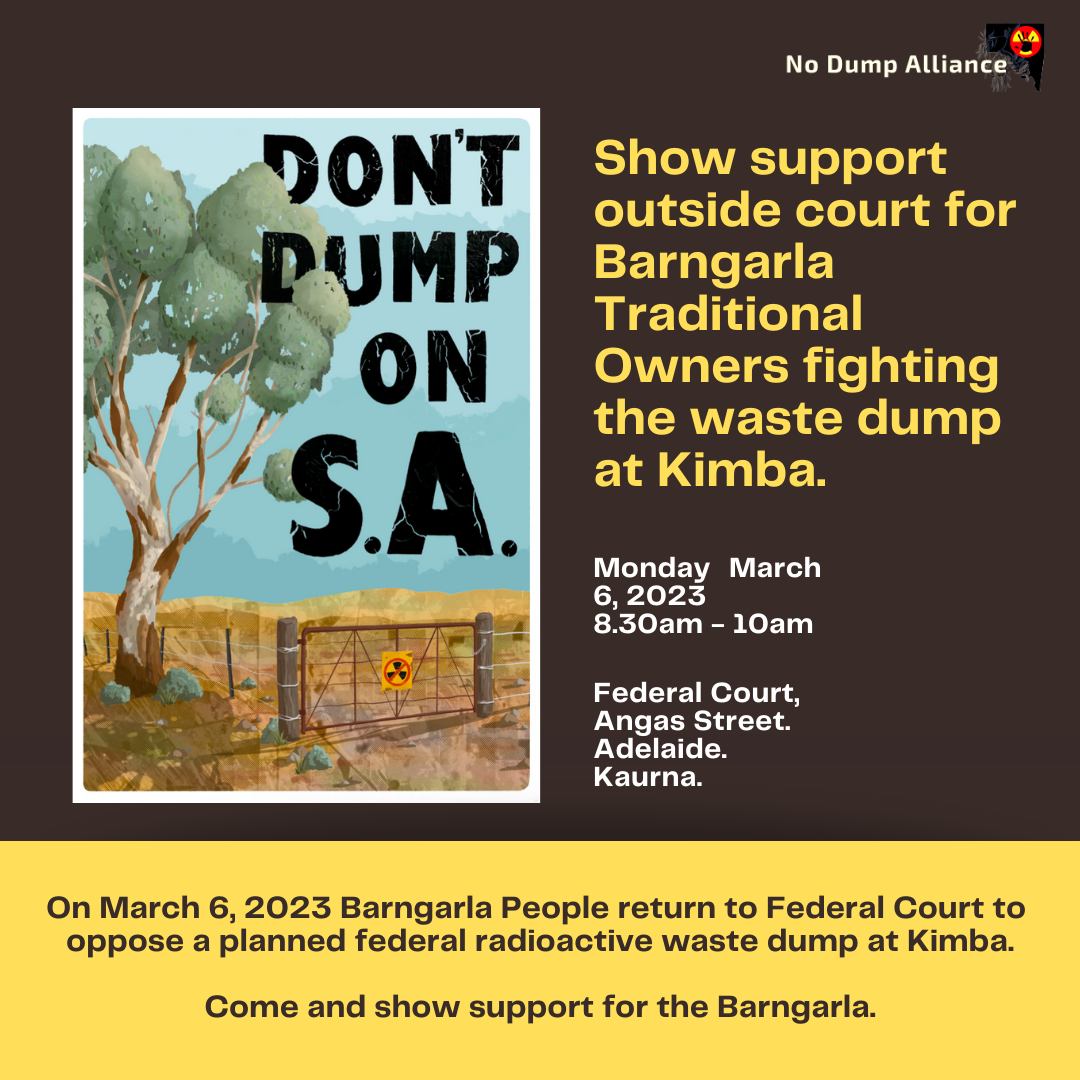
https://www.facebook.com/events/654942649972536?ref=newsfeed
Richard Marles and the betrayal of Australian sovereignty
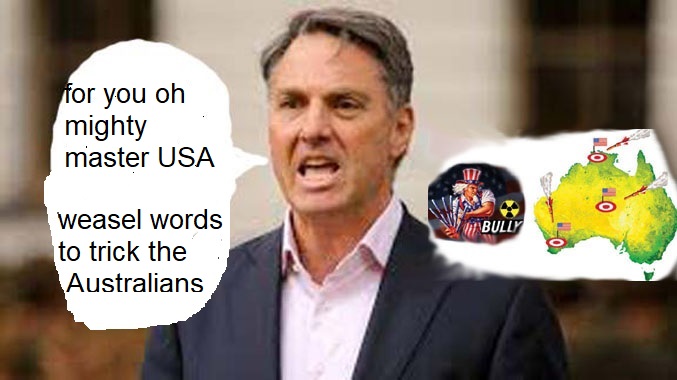
Therefore, in plain language, Australia has no control over access, use, or further disposition of US weapons or equipment stationed on Australian soil. This is a death sentence for our sovereignty, because it means America can attack a third country from these shores without the agreement or even knowledge of the Australian government, yet we will have become a target and will perforce suffer the retaliatory consequences, possibly even nuclear.
https://johnmenadue.com/richard-marles-and-the-betrayal-of-australian-sovereignty/ By Guest author Michael Callanan 28 Feb 23
It’s clear that Australian sovereignty is being seriously, perhaps fatally, imperilled by the policies of successive Australian governments populated by Austral-Americans.
Defence Minister Richard Marles’ address to parliament on February 9, entitled ‘Securing Our Sovereignty’, deserves a close reading.
It was delivered at a time when, in the minister’s own words, “it has never been more important to guard, reinforce and enhance our sovereignty”.
However, it’s clear that this vaunted sovereignty is being seriously, perhaps fatally, imperilled by the policies of successive Australian governments.
DM Marles defines sovereignty as “…the capacity of a people, through their government, to determine their own circumstances and to act of their own accord, free from any coercive influence”.
More specifically, he states that any “defence capability…which is not at the absolute discretion of the country which operates it does nothing to enhance sovereignty.”
True enough, but this is where the situation becomes rather confused. Recent treaties and agreements which have enhanced the “interoperability” of Australian and US forces, as well as allowing the “rotation” of military forces and materiel through Australian territory, have explicitly ceded both Australian control over those forces and materiel, and rendered opaque what might ultimately comprise these elements.
The 2014 Force Posture Agreement Article VII explicitly states that, “The prepositioned materiel of United States Forces, and Agreed Facilities and Areas designated for storage of such prepositioned materiel shall be for the exclusive use of United States Forces, and full title to all such equipment, supplies, and materiel remains with the United States. United States Forces shall have exclusive control over the access to, use of, and disposition of such prepositioned materiel.”
Therefore, in plain language, Australia has no control over access, use, or further disposition of US weapons or equipment stationed on Australian soil. This is a death sentence for our sovereignty, because it means America can attack a third country from these shores without the agreement or even knowledge of the Australian government, yet we will have become a target and will perforce suffer the retaliatory consequences, possibly even nuclear.
Marles states that a “defence capability…which is not at the absolute discretion of the country which operates it does nothing to enhance sovereignty”, implying he is referring to Australia. But this is a sleight of hand, because the significant defence capabilities in question will not be operated by Australia in any case, thanks to the FPA, and therefore can’t enhance our sovereignty, by his own fraught definition.
He reinforces this tendentious reasoning by implying that Australia is in the situation of having a “…high-end capability – the use of which is at the complete discretion of [our] country, [and which] contributes greatly to the capacity of [our] people to determine their circumstances and therefore contributes greatly to national sovereignty.
The problem of course is that we have nothing like “complete discretion” in the use of US weapons and forces positioned on our soil. In fact we have no control, and it seems quite probable that no Australian knows whether or not, at any given moment, nuclear weapons are “prepositioned” in this country. Naturally, any enemy would assume the worst and act accordingly.
Yet Marles is implying that we have somehow enhanced our own sovereignty by allowing foreign military forces and weapons into our country, over which we will have no control, as agreed in the FPA treaty.
Thus the above considerations make laughable Marles’ conclusion that “our partnerships build our national capability and security…and are anchored in Australian sovereignty”, and that “our cooperation with…our US ally, is managed through robust policy frameworks and principles that maintain and protect our sovereignty”. Sadly, however, the continuous repetition of a falsehood doesn’t make it any truer.
A further related fantasy in this regard is Marles’ assertion that “a fundamental principle underpinning these activities is the longstanding bipartisan policy of having no foreign bases on Australian sovereign territory.”
What else is a foreign base other than an area of land on which a foreign power positions forces and materiel over which it exercises sole and unfettered control, including the further disposition of that materiel?
Marles’ collusion in the fiction that “partner activities occur on a rotational basis, within Australian facilities or as a part of jointly operated facilities” is patently untrue, and demonstrably so, by reference to the FPA provisions.
His further claim that “our US alliance fundamentally strengthens, rather than diminishes, our sovereignty” is explicitly denied by the treaty law that is the FPA, and is a brazen misrepresentation of the truth.
Finally, some attention must be devoted to unmasking yet another pervasive and corrosive fiction, that of “our long-standing and bipartisan policy of ‘full knowledge and concurrence’”.
According to the Defence Minister, “‘full knowledge’ means Australia has a full and detailed understanding of any capability or activity with a presence on Australian territory, or making use of Australian assets”.
Clearly, as a matter of logic, this contradicts the Australian government’s compliance with the US policy of ‘refusal to confirm or deny’ the existence of nuclear weapons being carried by warships or planes arriving in Australia. One can’t “know” if one is kept in the dark. As such, “full knowledge” is a bald-faced deception.
According to Marles, “‘Concurrence’ means that Australia approves of the presence of a capability or function in Australia, in support of mutually-agreed goals”. Again, quite clearly, if ‘knowledge’ is absent then ‘concurrence’ is irrelevant. One can’t approve of something if one is unaware of its existence.
Defence Minister Marles is apparently a nice chap, intelligent and well educated, who’s clearly very enthusiastic about the possibility of enhancing our sovereignty by becoming further enmeshed in desperate US planning for a coming war with China.
As such, it’s hard to know how to account for the quite glaring contradictions between his public reassurances and the provisions specified in the treaties and agreements with the USA to which we are bound.
Shuttling between the possibilities of his being either seriously deluded or wilfully deceptive, one is at a profound loss to explain the manifest inconsistencies between Marles’ unreasonably optimistic faith in our once-great-and-powerful friend and the black-and-white reality of the ink on those pages which have signed away our sovereignty, and quite possibly a relatively peaceful and prosperous future.
1 This month


Help Aunty Sue Protect Her Land and Sacred Sites From Destructive Rocket Testing.
.

Australians deserve the truth
about
AUKUS – https://aukuspublicinquiry.com/

PETITION – To: Prime Minister Anthony Albanese and the Australian Labor Government

of the week – Australians for War Powers Reform (AWPR)
To see nuclear-related stories in greater depth and intensity

