Russian Uranium NOT Sanctioned – Why?
Russian Uranium NOT Sanctioned – Why? Russia still ships uranium-filled
nuclear fuel rods to reactors around the world – no limits. If US has
sanctions against Russian oil, gas & coal, why do we not sanction their
uranium?
Why is the nuclear industry exempt? And who decided? Linda Pentz
Gunter founded Beyond Nuclear in 2007 and serves as its international
specialist, as well as its media and development director. Prior to her
work in anti-nuclear advocacy, she was a journalist for 20 years in print
and broadcast, working for USA Network, Reuters, The Times (UK) and other
US and international outlets. She brings a clarity and precision to all her
reporting, with specific insights into international angles on nuclear
issues. To find out more on one under-represented nuclear aspect of the
Russian war on Ukraine, I spoke with Linda Pentz Gunter on Thursday, April
2
1, 2022 Nuclear Hotseat 21st April 2022
A new propaganda film to jolly up the pro nuclear enthusiasts
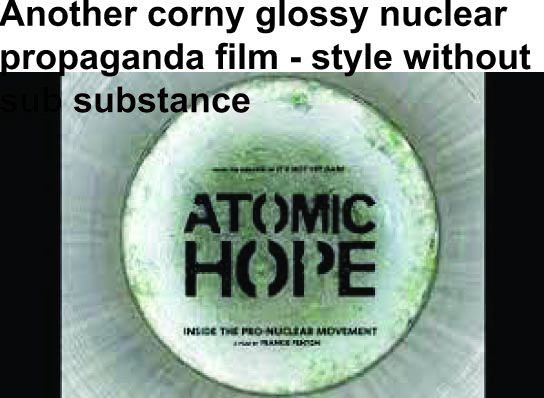
‘Atomic Hope: Inside the Pro-Nuclear Movement’ Review: Uncritical Doc Empowers a Controversial Energy Solution
While intriguing, this Irish documentary’s boosterism doesn’t really provide a thorough argument for embracing the nuke.
Variety, by Dennis Harvey 4 May 22, ……………………….. in recent years, some voices have argued that nuclear power is in fact humanity’s best option to meet its energy requirements amid escalating environmental and resource crises.
It’s an intriguing if unpopular viewpoint that merits clear explanation and debate, things that “Atomic Hope” ultimately does not provide.
Irish filmmaker Frankie Fenton’s second feature, following the much more intimately focused “It’s Not Yet Dark,” chooses to focus primarily on pro-nuke advocates and their uphill public campaigns — as opposed to the pro-nuke arguments themselves, which are never rigorously addressed. Nor are opponents heard from at all. The result is a slick globe-trotting documentary that holds attention, yet doesn’t really leave the viewer more enlightened on the subject at hand than they were before.
………………………… Among those enthusiastic about nuclear being the safest, cleanest and most productive energy option going forward are leaders from disparate advocacy orgs Thorium Energy Alliance, Generation Atomic and Mothers for Nuclear.
…………….. A major figure in “Atomic Hope” is author and recurrent California political candidate Michael Shellenberger. He’s presented as a plucky, good-humored rebel for his more combative stances as an “ecomodernist,” notably raining on the parade of those championing “renewables,” i.e. wind and solar power. The film entirely sidesteps the controversy of his views among many environmental scientists and academics who’ve termed them misleading or inflammatory.
Indeed, even as it sprawls from San Francisco to Manila, “Atomic Hope” somehow eludes the harder questions that might have both challenged and ballasted the stances of proponents onscreen. We don’t doubt the genuineness of their concern or activism, but the full evidence isn’t here to win us over. While it finds some colorful personalities and situations to capture (notably some desperate ploys for public attention), the film errs in assuming activists themselves merit central focus when their cause itself remains so poorly understood.
At heart it’s a documentary for the converted, at a time when most viewers will still require converting. ………………….https://variety.com/2022/film/reviews/atomic-hope-inside-the-pro-nuclear-movement-review-1235257555/
Pope says NATO may have led to Russia’s invasion of Ukraine
Francis says transatlantic military alliance was ‘barking’ at Russia’s door. BY HANNAH ROBERTS Politico
May 3, 2022
ROME — Pope Francis said that NATO “barking” at Russia’s door may have led to Vladimir Putin’s invasion of Ukraine — and said he has offered to meet the Russian president in Moscow.
In an interview with the Italian newspaper Corriere della Sera, Francis reflected on Russia’s lethal aggression toward its neighbor and said while he might not go as far as saying NATO’s presence in nearby countries “provoked” Moscow, it “perhaps facilitated” the invasion.
Francis also condemned the “brutality” of the war and compared it to Rwanda’s civil war in the 1990s, which resulted in a genocide of the Tutsi minority.
The Holy See has been asking since mid-March for a meeting between Francis and Putin in Moscow, the pope said. “Of course we needed the leader of the Kremlin to allocate a window of time. We haven’t yet had any response, and we are still trying, even if I fear that Putin can’t and doesn’t want to have this meeting at this time.”
In the interview, Francis ruled out going to Kyiv for now: “First I have to go to Moscow, first I have to meet Putin.”……………. https://www.politico.eu/article/pope-francis-nato-cause-ukraine-invasion-russia/
Pope Francis reiterates complete opposition to the possession and use of nuclear weapons
 | |||
Pope Francis: ‘Use and possession of nuclear weapons inconceivable’
In talks on Wednesday with Japanese Prime Minister Fumio Kishida, Pope Francis says the use and possession of nuclear weapons is inconceivable.
Vatican News, By Linda Bordoni 4 May 22, In a meeting with the Japanese Prime Minister on Wednesday morning before the General Audience, Pope Francis reiterated his position of total opposition to the use and possession of nuclear armaments.
According to Holy See Press Office Director, Matteo Bruni, during their conversation that lasted about 25 minutes, Prime Minister Fumio Kishida and the Pope talked about nuclear weapons and about how their use and possession is inconceivable.
Long-standing opposition to nuclear arms
It is not the first time that Pope Francis has expressed this view…………………….. https://www.vaticannews.va/en/pope/news/2022-05/pope-japan-prime-minister-nuclear-weapons-inconceivable.html
Climate change could introduce humans to thousands of new viruses
Climate change could introduce humans to thousands of new viruses
To prevent future pandemics, we need to connect the dots between the spread of disease and the destruction of the planet.
Climate sceptic thinktank received funding from fossil fuel interests
Climate sceptic thinktank received funding from fossil fuel interests
Global Warming Policy Foundation has led the backlash against UK government’s net zero policy
May 4 Energy News — geoharvey

Science and Technology: ¶ “How Spiral Welding Is Revolutionizing Wind Turbine Manufacturing” • Colorado-based Keystone Tower Systems is changing how wind turbines can be manufactured, transported, and installed. They have been using a spiral-welding technique, borrowed from the steel-pipeline industry, to build some of the largest turbine towers on the market. [CleanTechnica] Audi plant in […]
May 4 Energy News — geoharvey
Ukraine’s nuclear power plants caught in the Crossfire of War With Russia
Russia’s invasion of Ukraine has triggered fears of another nuclear power disaster in the region, 36 years after the world’s largest nuclear accident. The Revelator, May 2, 2022 – by Jordan Gass-Poore’
It took less than a minute after an unexpected power surge for one of the nuclear reactors at Chornobyl (Chernobyl in the Russian spelling) to explode on April 26, 1986, ripping the roof off and spewing dangerous chemicals into the air.
The event, and emergency cleanup that followed, left 30 workers dead, thousands exposed to cancer-causing nuclear material, and a legacy of radiation. Now, 36 years later and with war raging, Ukraine is desperate to prevent another nuclear disaster.
Nuclear reactors generate more than half of the country’s power. Ukraine is the first country with such a large and established nuclear energy program to experience war, according to the International Atomic Energy Agency.
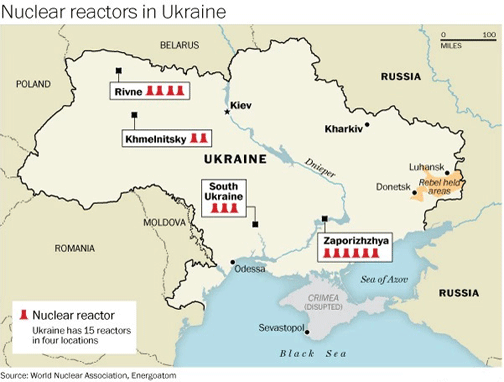
The country’s 15 nuclear reactors, housed in four power plants, have layers of safeguards to prevent core meltdowns like the one that happened in 1986, when Chornobyl was part of the Soviet Union. But wartime is far from normal conditions, and experts warn that Russian military action poses numerous threats to these facilities.
Andrey Ozharovsky, a Russian engineer turned anti-nuclear activist, said Ukraine’s nuclear infrastructure is “quite vulnerable” to the chaos surrounding military attacks.
Chornobyl, Again
Those attacks have already begun.
The Chornobyl Nuclear Power Plant and the 20-mile exclusion zone around it, set up to limit further spread of radioactive material following the 1986 disaster, were captured by Russian forces on Feb. 24. It was in their control until they withdrew from the site on March 31.
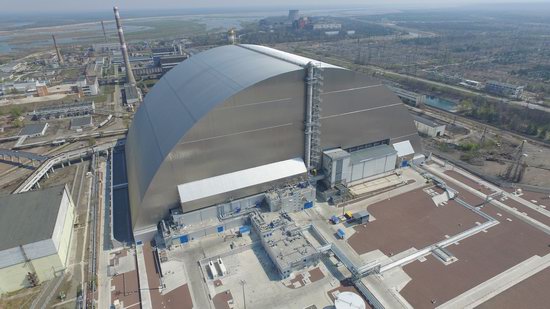
Although Chornobyl is not an active nuclear power plant, the massive cap covering the reactor that exploded decades ago still needs to be maintained to prevent further radiation leakage.
Sensors put in place by the Ukrainian Ecocentre in case of an accident reported a spike in radiation levels shortly after the capture, likely due to Russian military vehicles stirring up radiation in the environment.
The IAEA said the rise wasn’t enough to pose a public health hazard.
Ozharovsky, who was one of the first to raise an alarm about the recent spike at Chornobyl, said he’s concerned that radioactive dust from the site could spread across the continent.
“The most dangerous thing is that they can bring radioactive particles in their hair, in their clothes and their boots,” he says………………………
Nuclear Plant Captured
Chornobyl isn’t the only concern. Ukraine’s active nuclear-power facilities are also at risk.
On March 4, Russian forces captured Europe’s largest active nuclear-power plant, Zaporizhzhia, located in southeastern Ukraine. During intense fighting one of the site’s buildings caught fire, but didn’t harm the plant’s six reactors, and no radiation was released.
Ukrainian technicians continue to monitor Zaporizhzhia, but the country’s regulators have claimed that Rosatom, Russia’s state nuclear power company, has engineers at the plant who are giving orders to staff. Further, Ukraine reports that plant management actions require approval from the Russian commander, according to the IAEA.
“Who is now in charge of the Zaporizhzhia Nuclear Power Plant?” asks Ozharovsky. “The Russian army is around, but armies aren’t nuclear engineers.”
Rosatom released a statement on March 12 and denied that they’re managing the operation of Zaporizhzhia. They characterized their staff’s presence at the plant as “consultative assistance” that takes place “on a regular basis.”
Grossi expressed “deep concern” about the situation in a statement last month.
Further Threats
Since then, there’s been more reason for alarm.
On April 16, three missiles flew over the South Ukrainian nuclear power plant, Yuzhnoukrainsk, according to Energoatom, Ukraine’s state-run nuclear power company.
Then on April 26 Energoatom reported that two cruise missiles flew over the Zaporizhzhia Nuclear Power Plant.
The flight of missiles at low altitudes directly above the Zaporizhzhia Nuclear Power Plant site, where 7 nuclear facilities with a huge amount of nuclear material are located, poses huge risks,” says Petro Kotin, Energoatom’s acting president, in a statement released on the company’s Telegram channel. “After all, missiles can hit one or more nuclear facilities, and this threatens a nuclear and radiation catastrophe around the world.”
The day before, Energoatom reported that Russia fired missiles over the cooling pond of the Khmelnytskyi Nuclear Power Plant in northwest Ukraine
Kosharna wrote in an email that if a missile would’ve hit one of the plants the consequences wwould have been “catastrophic” for the world.
Typically nuclear plants use back-up generators to maintain power with a grid disruption and keep the cooling systems functioning normally. In wartime fuel shortages are common, and this risks the stability of the generators. Ukraine’s current shortage is only getting worse, according to the Gas Transmission Operator of Ukraine, a gas pipeline operator
If the grid goes down and the generators are out of fuel and the cooling systems fail, there’s a last resort to prevent radiation from spreading. Containment structures around the reactors are designed to block any release of radiation, but they’re also vulnerable to missile attacks.
Reactor failure isn’t the only significant risk to the operation.
Staff operating facilities under extreme stress also poses a problem, Ozharovsky says, because any mistake they make on the job could be calamitous..

There are also other onsite dangers. Spent nuclear fuel storage pools that are a part of the waste-disposal system contain radioactive material. If they’re damaged the liquid could be released from containment, causing a massive spread of radiation. Japanese scientists considered this to be the “worst-case scenario” of the Fukushima Daiichi Nuclear Power Plant, which had a series of meltdowns after a tsunami struck the plant in 2011.
Ozharovsky said he doesn’t believe the Russian military would deliberately sabotage one of Ukraine’s nuclear power plants because it would threaten their interests. But he added that even the possibility that the nuclear power plants could be harmed accidentally should trigger worldwide alarm.
“For me it’s scary,” he says. “All the other nuclear power plants, like Khmelnytskyi, like Rivne, like South Ukraine (Yuzhnoukrainsk); they can be damaged during this war. And the international community needs to take care of that.”
Any attack on a nuclear plant is a breach of international humanitarian law. The Geneva Convention’s Article 56 considers attacking a nuclear power plant a war crime.
“I hope that many other countries who still have nuclear energy on their territory will rethink physical safety, military safety,” Ozharovsky says. “That’s a challenge no one country can solve.” https://therevelator.org/ukraine-war-nuclear-power/?utm_source=rss&utm_medium=rss&utm_campaign=ukraine-war-nuclear-power

Junior energy minister Tim Wilson may lose his Liberal blue ribbon seat — RenewEconomy

Polling suggests junior energy minister Tim Wilson could lose his seat to an independent backing stronger climate action. The post Junior energy minister Tim Wilson may lose his Liberal blue ribbon seat appeared first on RenewEconomy.
Junior energy minister Tim Wilson may lose his Liberal blue ribbon seat — RenewEconomy
Meet Kylea Tink: North Sydney independent who wants to break climate gridlock — RenewEconomy

Independent North Sydney challenger talks Australia’s failed climate leadership and the opportunity to seize a climate-focused economic future. The post Meet Kylea Tink: North Sydney independent who wants to break climate gridlock appeared first on RenewEconomy.
Meet Kylea Tink: North Sydney independent who wants to break climate gridlock — RenewEconomy
Canberra’s urban trees receive global recognition
Canberra’s urban trees receive global recognition
Canberra has been declared an international tree city of the world, joining 138 cities recognised around the world for their leadership in managing urban trees.
South Africa: Five years after the illegal nuclear deal was nuked, we are still struggling with a broken energy system
Daily Maverick By Francesca de Gasparis and Makoma Lekalakala, 02 May 2022,
The South African government’s current approach to energy production is our biggest barrier to a just transition and it seems as though we are deliberately choosing fossil fuels and nuclear, while implementing renewables at a snail’s pace.
The month of April was not only significant to South Africa as Freedom Month, but was also the month in which Earthlife Africa Johannesburg and the Southern African Faith Communities’ Environment Institute (Safcei) commemorated the court victory that exposed the severity of the corruption within the state and halted government’s “illegal and unconstitutional” R1-trillion nuclear energy deal with Russia……….
Apart from revealing the depths of the rot within government and how far members of the state were willing to go to dupe the public, this was also the start of an intense battle which continues to rage between public interests versus those of government and corporate to protect citizens’ right to be consulted on huge capital spends, especially in energy procurement that may affect them……………..
A publication released at COP26 in December 2021, Neither Climate Nor Jobs: Nuclear Myths About the Just Transition, argues that nuclear will be detrimental to our “collective capacity to transform our energy systems in a way that leaves no one behind”.
While nuclear power operations do not have as large a carbon footprint as coal, gas and oil, there are numerous other issues with this outdated and largely failed technology that must be considered, that make nuclear power utterly unsuitable for South Africa’s energy needs in our current reality. Comparatively, the carbon footprint of nuclear power is estimated to be at least two to four times more than that of renewables.
There are a number of reasons that nuclear energy is NOT a solution to the climate emergency and why it should not be part of the just transition. First, South Africa needs development that is pro-poor, and basic services need to be provided that are affordable to all. This means that the country’s energy plans should work to reduce the gaps in inequality, with the people – not industry nor the economy nor profits – at the centre of its plans.
Sadly, the government’s current approach to energy production is our country’s biggest barrier to a just transition and it seems as though we are deliberately choosing fossil fuels and nuclear, while implementing renewables at a snail’s pace.
Investing in nuclear energy requires huge capital investment – which could have an impact on public spending on social services – while the centralised and costly nature of its production will do little to reduce the widespread energy poverty in the country. When considering the urgent need for poverty-alleviating approaches to development and energy production, the fact that renewables create more jobs (with a wider variety and in more flexible locations) and can be installed in a matter of months, provides more compelling arguments against nuclear.
Furthermore, as climate change takes root and weather conditions become more extreme, a just transition will require a flexible and decentralised electricity supply for greater stability. Without even considering nuclear power stations’ poor installation and cost performance globally, we need only look at South Africa’s only existing nuclear power station at Koeberg to know that nuclear has not proven to be particularly reliable over the past 18 months.
Ongoing issues at the nuclear power station are a significant part of the reason that citizens have been plunged into darkness once again. We must recognise Koeberg’s deteriorating performance while noting the ongoing governance issues at Eskom and the Department of Mineral Resources and Energy.
Another reason that nuclear energy is not fit for purpose for our current and future energy needs is the outdated argument of the necessity of baseload energy, which completely ignores the strides made in modern technology. This type of centralised power often takes very long to come online and will do little to alleviate the energy poverty in the country. Even in the best-case scenario, it would be at least another decade before we are likely to get any electricity from a new power plant.
Just the fact that we need to keep temperatures below 1.5°C by 2030 means that even if we did go the nuclear route, we would be far too late to mitigate carbon emissions in any meaningful way. Yet, our government insists on wasting time pursuing nuclear, while utility-scale renewable energy projects could be ready in less than half the time.
South Africa is at a crossroads. Are we really willing to continue making the mistakes of the past?……….
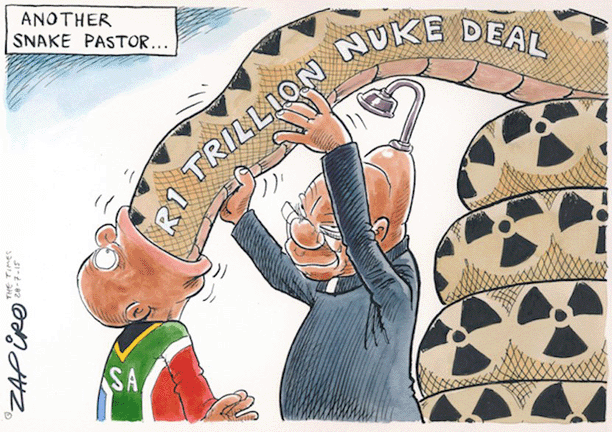
It is important, at this point, to remind South Africans that it was as a result of a national effort by many civil society organisations, academics and concerned citizens that we were able to stop then-President Jacob Zuma’s illegal nuclear deal five years ago, sparing us from the effects of the bankruptcy that would have ensued.
At a time when the divisions in our society were becoming decidedly evident, it was wonderful to be part of such a unifying campaign with people from all walks of life. From eco-justice NGOs to community-based organisations, right down to the ordinary person on the street, most South Africans knew we had to stand together or risk losing our country…….. https://www.dailymaverick.co.za/article/2022-05-02-five-years-after-the-illegal-nuclear-deal-was-nuked-we-are-still-struggling-with-a-broken-energy-system/
Brush-tailed bettongs doing well after reintroduction to SA mainland
Brush-tailed bettongs doing well after reintroduction to SA mainland
Nationally endangered brush-tailed bettongs have been successfully returned to South Australia’s Yorke Peninsula after being locally extinct for more than 100 years.
UK Greens the party on the rise – a ‘tectonic shift’ among voters.

Local elections 2022: Greens winning hearts in northeast as party eyes ‘tectonic shift’ among voters. Campaigners welcomed on doorstep in Labour stronghold South Shields as internal polls predict party will make large gains across the country.
The Greens are, by any measure, a party on the rise – both in the northeast and across the country. In a series of remarkable election results last year, they won 155 English and Welsh council seats, helping take their total to a record high of 467. They now lead two authorities, in Brighton and Hove, and Lancaster, are in a ruling coalition in another 13, including Oxfordshire, York and Sheffield, and make up the official opposition in eight more including Bristol, Norwich and Solihull.
Now, it is all but certain this growth will continue on 5 May: a realistic good night would see them smash the 500-seat barrier, party bosses suggest. In particular, they are hoping to move beyond their traditional metropolitan powerbases and establish a greater presence in the north’s old industrial heartlands. The increasing acceptance that the planet is, er, dying on its arse – that’s the climate crisis – has attracted plenty of voters in an area that will pretty quickly find itself under water if global temperatures continue rising.
But, perhaps of greater significance, is a tangible anger here at a sense of being taken for
granted by the dominant Labour Party for too long. “They’re sitting tenants,” one resident fumed. “They reckon they’ve a job for life and that’s how they treat it.”
Independent UK, 1st May 2022
Nuclear power is a HUGE water guzzler – so why are we guzzling the lie that nuclear is good for climate?
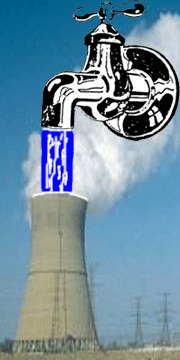
The video above is 2 years old – but so what? Nothing seems to have changed – this particular facility is especially water-dependent. But they all are. The current article below – is, unfortunately, behind a paywall. But it’s a rare mention in the media of this hugely significan factor in nuclear power problems.
Take France, for example. Right now, nearly half of their nuclear reactors are shut down anyway. But – come the summer – they’ll be shutting down again – due to water stress.
Huge nuclear plant in Arizona desert seeking new sources of water – it uses 23 b gallons of water per year The Arizona Republic 2 May 22, https://www.azcentral.com/restricted/?return=https%3A%2F%2Fwww.azcentral.com%2Fstory%2Fmoney%2Fbusiness%2Fenergy%2F2022%2F05%2F01%2Farizonas-nuclear-palo-verde-generating-station-wants-new-water-source%2F7306649001%2F
1 This month.


PETITION – To: Prime Minister Anthony Albanese and the Australian Labor Government
Chernobyl: The Lost Tapes – A good documentary on Chernobyl on SBS available On Demand for the next 3 weeks– https://www.sbs.com.au/ondemand/tv-program/chernobyl-the-lost-tapes/235274195556
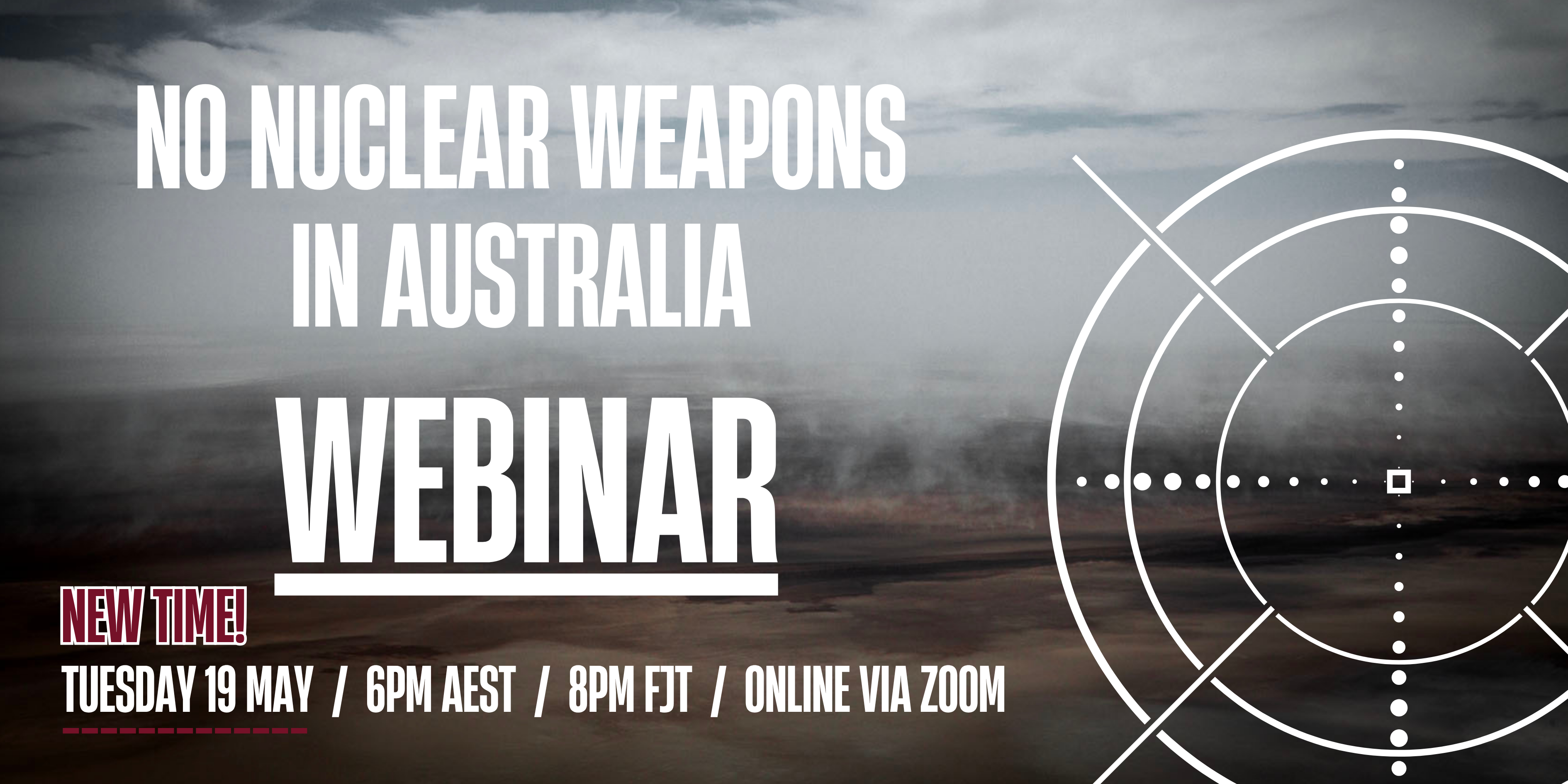
19 May – Webinar- Webinar: No Nuclear Weapons in Australia
Start: 2026-05-19 18:00:00 UTC Canberra, Melbourne, Sydney (GMT+10:00)
End: 2026-05-19 19:30:00 UTC Canberra, Melbourne, Sydney (GMT+10:00)
20 May – Webinar – The dangerous world of AUKUS, US, military occupation and suppression of dissent

National Webinar, 20th May, 2026, 6.30pm AEST. Confronting laws restricting/suppressing protest speech and action
Speakers: Former Sen. Rex Patrick, Lawyer Nick Hanna ,Arthur Rorris ,Jorgen Doyle, Sen David Shoebbridge,
Facilitator Kelley Tranter.

of the week – Australians for War Powers Reform (AWPR)
To see nuclear-related stories in greater depth and intensity
 Antinuclear