Australian companies’ uranium shares plummet

ASX uranium shares plummet amid Ukraine power station attack. Motley Fool, A fire at Europe’s largest nuclear power station has uranium investors on edge… Mitchell Lawler 6 Mar 22, ASX-listed uranium shares are tumbling on Friday following reports of a fire at Ukraine’s largest nuclear power station ……..
The S&P/ASX 200 Index (ASX: XJO) is suffering a red session on Friday amid an intensification of the situation in Ukraine. However, ASX uranium shares are showing up as some of the hardest-hit companies of all on the Australian share market.
At present, many uranium producers and explorers are trading 10% to 20% lower. This follows reports that one of Ukraine’s nuclear power stations — the largest in Europe — is on fire as a consequence of Russian attacks.
………. with years of unattractive prices for the commodity, investments in creating new a new supply had been dampened.
However, with expectations of nuclear energy becoming a piece in the green transition puzzle, investors were willing to take a punt on ASX uranium shares.
That was until the latest development in the Ukraine-Russia conflict.
Companies copping the brunt of bad news
Currently, ASX uranium shares are being sold off hard. Here’s how some of these companies are tracking:
- Boss Energy Ltd (ASX: BOE) down 13.7%
- Paladin Energy Ltd (ASX: PDN) down 12.2%
- Deep Yellow Limited (ASX: DYL) down 14.9%
- Peninsula Energy Ltd (ASX: PEN) down 14%
Peter Dutton’s war machine cult
Independent Australia, By Binoy Kampmark | 19 January 2022, The Federal Government has spent billions on defence equipment, ignoring issues such as the climate crisis and pandemic, writes Dr Binoy Kampmark.
THE OPERATING DOCTRINE of many a defence ministry is premised on fatuity. There is the industry prerogative and need for employment. There are the hectoring think tanks writing in oracular tones of warning that the next “strategic” change is peeking around the corner.
Purchases of weapons are then made to fight devils foreign and invisible, with the occasional lethal deployment against the local citizenry who misbehave. This often leads to purchases that should put the decision maker in therapy.
Australia’s war-wishing Defence Minister Peter Dutton may be in urgent need of such treatment, but he is unlikely to take up the suggestion, preferring to pursue an arms program of delusional proportions. His mental soundness was not helped by last year’s establishment of AUKUS and the signals of enthusiastic militarism from Washington.
Having cut ties with the French defence establishment over what was a trouble-plagued submarine contract, Dutton has been an important figure in ensuring that Australia will continue its naval problems with a future nuclear-powered submarine.
Submarines are seaborne phallic reassurances for the naval arm of defence. Stubbornly expensive and always stressing celebrated potential over proven reality, they stimulate the defence establishment. The land-based forces, however, will also have their toys and stimulants, their own slice of make believe. And Dutton is promising them a few, including tanks.
This month, the Minister announced that Australia will be spending $3.5 billion on 120 tanks and an assortment of other armoured vehicles, including 29 assault breacher vehicles and 17 joint assault bridge vehicles. All will be purchased from the U.S. military machine. This will also include 75 M1A2 main battle tanks, which will replace the 59 Abrams M1A1s purchased in 2007 and kept in blissful quarantine, untouched by actual combat.
Reading from the script of presumed military relevance, Dutton declared that:
“Teamed with the Infantry Fighting Vehicle, Combat Engineering Vehicles and self-propelled howitzers, the new Abrams will give our soldiers the best possibility of success and protection from harm.”
………….. To dispel any notion that this purchase simply confirmed Australian deference and obedience to U.S. military power, the Defence Minister also claimed that the new Abrams:
“…will incorporate the latest developments in Australian sovereign defence capabilities, including command, control, communications, computers and intelligence systems, and benefit from the intended manufacture of tank ammunition in Australia.”
In other words, once Australia finishes with these cherished, dear imports, adjusted as they are bound to be for the ADF, they are more likely to be extortionately priced museum pieces rather than operable weapons of flexible deployment…………
The last time Australia deployed tanks in combat was during the Vietnam War, that other grand failure of military adventurism. They were never used in Australia’s engagements in Iraq and Afghanistan, despite being lauded as being a necessary vehicle in beating down insurgency movements…………………….
Critics of the purchase have included otherwise hawkish pundits such as Greg Sheridan of The Australian, who spent some of last year shaking his head at the proposed acquisition after it was announced by the U.S. Defence Security Cooperation Agency. The decision, he opined unleashing his talons, was one of ‘sheer idiocy’, an ‘anachronistic frivolity’. Tanks and other heavy, tracked vehicles would ‘never be of the slightest military use to us’……………………..
The tank fraternity, a gathering of near cultic loyalty, are swooning in triumph. As Peter J Dean, director of the Defence and Security Institute at the University of Western Australia remarked last year, their membership has never proven shy. Cults tend to show that utility is secondary to the importance of st https://independentaustralia.net/politics/politics-display/peter-duttons-war-machine-cult,15952
Friendlyjordies allegations against Dutton met with silence.
Friendlyjordies allegations against Dutton met with silence, Independent Australia,
By Victoria Fielding | 7 March 2022 An exposé on Peter Dutton by independent journalist Friendlyjordies has been ignored by the mainstream media, writes Dr Victoria Fielding.
On Friday last week, independent investigative journalist, Jordan Shanks (Friendlyjordies), released an explosive video about one of the most powerful Ministers in the Morrison Government. Since then, the story has sunk without a trace. What is going on?
Is this the mainstream news media refusing to admit Friendlyjordies has beaten them to a scandal, or is Defence Minister Peter Dutton being protected from scrutiny by his mates in the media?
As of writing, over 300,000 people have watched the Friendlyjordies piece. The investigation intricately maps out some very specific allegations about the business dealings of Dutton’s friends, including sources alleging sex scandals, drugs and dodgy dealings in lucrative government contracts.
One of the people involved in the web of intrigue exposed by Shanks is Ryan Shaw, who up until Wednesday was the Liberal National Party’s candidate for the marginal seat of Lilley. Shaw, an Army veteran, has been campaigning in the seat for months, including with Prime Minister Scott Morrison.
The seat is held by Labor MP Anika Wells by the wafer-thin margin of 0.64 per cent. Not just any candidate gets placed in a must-win marginal seat. Shaw’s withdrawal, citing family and mental health issues, is a big loss to the L-NP considering they are left without a candidate weeks out from the Election and after the much-wasted investment of time and resources.
Although it is impossible to know exactly why Shaw withdrew, it is more than a little coincidental that the decision was made at the exact same time as Shanks and his team were questioning Shaw about his involvement with people in the incredibly suspect chain of events detailed in the video.
I’ve spent a lot of time around politics and I know a candidate doesn’t withdraw their cand
I’ve spent a lot of time around politics and I know a candidate doesn’t withdraw their candidacy over any small thing. The Friendlyjordies allegations, if they could be batted away, no doubt would have been to save Shaw’s position. Yet they weren’t.
But it isn’t just Shaw who had questions to answer over his association with people directly implicated by allegations in the explosive story. Peter Dutton is also associated with key players.
Not only does Dutton hold the powerful position of Minister for Defence, but he is also a contender for leader of the Liberal Party, should Morrison choose to step down after the Election. This scandal therefore has all the ingredients you would think the mainstream media would need to make it top priority for journalist follow up.
Senior Minister in the Morrison Government — check. A high profile candidate stepping down seemingly for no reason weeks out from the Election — check. Allegations of government contracts being used to enrich Liberal Party donors — check. Allegations of drug-fueled parties and drug-taking — check…………..
On Sunday, by chance, Peter Dutton was interviewed at length by David Speers on ABC’s Insiders program. It is true that there is much on the Defence Minister’s agenda, what with the war in Ukraine and the Queensland and NSW floods, but there was plenty of time for at least one question about the Shanks allegations in the video. The Minister is not meant to define the agenda of the interview; the whole point of such questioning is to hold the Minister to account. This opportunity was missed.
So, what makes this story so untouchable by mainstream journalists?…………………
Whatever role Dutton has played in this scandal, he should be answerable to the public. And if the news media refuses to even mention the story, let alone pressure Dutton to explain his involvement, then it is a very sad day indeed for democracy. https://independentaustralia.net/politics/politics-display/friendlyjordies-allegations-against-dutton-met-with-silence,16122
Why the listless reaction from governments, the hush on climate change?
Why the listless reaction from governments, the hush on climate change?
The Morrison government has gone missing again at a time of national devastation and crisis, despite its disaster relief fund brimming with $4.8bn.
Scientists warn seawalls can make rising waters worse in the long run
Scientists warn seawalls can make rising waters worse in the long run
Green buffers like mangroves are generally better for protecting coastal communities than concrete defences, although they are not always an option
IPCC throws down the gauntlet on Australian institutional deficiencies
IPCC throws down the gauntlet on Australian institutional deficiencies
Bruce Thom
Exposure and vulnerability of various natural and human systems to climate change are discussed at length in the latest IPPC report (6th Assessment Report on impacts, vulnerability, and adaptation).
The US and NATO’s Sacrifice Of Ukraine

The US and NATO’s Sacrifice Of Ukraine https://www.pressenza.com/2022/03/the-us-and-natos-sacrifice-of-ukraine/ 04.03.22 Mark Lesseraux
THE INCEPTION POINT OF A NEW ERA
We are fast approaching the 33rd anniversary of Mikhail Gorbachev’s decision to untie the Soviet knot that held back the countries of Eastern Europe from moving in an independent, democratic direction. A decision that led to the collapse of the Berlin Wall in November 1989, and, subsequently, to the overturning of the Communist regime in Eastern Europe.
It was a turning point, a hopeful moment, that marked both the beginning of the end of the Cold War conflict and the inception point of a new era of cooperative possibilities between East and West.
THE U.S. AND EUROPE PROMISE TO END NATO EXPANSION
With the breakup of the Soviet Union it became clear to pretty much everyone involved in the diplomatic and political instigation of these major changes, that NATO had become obsolete. Washington and Europe met with Mikhail Gorbachev to create a new security pact that aimed to bring Russia into the cooperative fold. The Reagan administration, along with their West German allies, promised Gorbachev that once German unification was underway NATO would, for certain, cease expanding itself in an eastward direction.
This promise to end the expansion of NATO, which France and Great Britain also agreed to, seemed to signal the onset of a new era of global cooperation. It was agreed then and there by all parties present that a de-escalation of military spending and weapons production was in order now that the Cold War was winding down.
THE PROMISE IS BROKEN
In the years that followed, the war industry completely went back on the aforementioned promises. In fact, a massive eastward expansion of NATO was set in motion along with an unprecedented increase in military spending, weapons production and global weapons sales. NATO added Poland, Hungary, the Czech Republic, Bulgaria, Estonia, Latvia, Lithuania, Romania, Slovakia, Slovenia, Albania, Croatia, Montenegro, and North Macedonia to its fold.
These countries were all forced to restructure and reconfigure their militaries to become compatible with NATO’s military alignment policies. Most of the aforementioned countries achieved this realignment via large loans, creating debt and dependence on corporate lenders.
NO NEW ERA OF COOPERATION
Over the course of the last two-plus decades NATO has become a multi-billion-dollar cash cow for huge corporations that depend on the Cold War for profit. There has been no new era of cooperation with Russia, as promised by all who were involved in setting the new age of supposed partnership in motion. On the contrary, NATO has ignored Russia’s constant warnings and requests to stop its campaign of expansion. Instead NATO, led by the US, has pushed itself right up to Russia’s border, all the while generating a steady stream of new Cold War propaganda, demonizing Russia while proceeding to encircle its territory.
THE SACRIFICE OF UKRAINE
Seven years ago the Obama administration prudently refused to sell arms to Kiev. This act of cautiousness was subsequently cast aside by the Trump and Biden administrations. Over the past several years weapons from the U.S. and Great Britain have been pouring into Ukraine.
By flooding Ukraine with weapons (which is what the US did in the 2008 conflict between Russia and Georgia) over the past few years and refusing Russia’s constant requests that NATO drop its plan to annex Ukraine, an extremely volatile and deeply dangerous situation was created for Ukraine. A situation that has basically amounted to the sacrifice of the people of Ukraine.
NO JUSTIFICATION
There is no justification for the savage actions that Vladimir Putin has undertaken in Ukraine over the past week and a half. Putin is responsible for the bloodshed that he has generated. What this article is pointing to has nothing to do with absolving Putin for the violence in Ukraine. What this article is pointing to is the fact that the US and NATO have been myopic and reckless. What this article is illustrating is that what is going on now in Ukraine is, in part, the result of a thirty-three year history of broken promises and careless, greed propelled decisions made by the US and NATO.
MANY SAW THIS COMING
Over the past three decades, dozens of diplomats and historians have warned that a situation like the one we are seeing now in Ukraine was inevitable if NATO expansion continued. I’m going to end this article here with a quote from George Kennan who was considered by many to be the most respected voice on the matter of US-Soviet relations:
I think it is the beginning of a new cold war. I think the Russians will gradually react quite adversely and it will affect their policies. I think it is a tragic mistake. There was no reason for this whatsoever. No one was threatening anybody else. This expansion would make the founding fathers of this country turn over in their graves. We have signed up to protect a whole series of countries, even though we have neither the resources nor the intention to do so in any serious way. [NATO expansion] was simply a lighthearted action by a Senate that has no real interest in foreign affairs. What bothers me is how superficial and ill-informed the whole Senate debate was. I was particularly bothered by the references to Russia as a country dying to attack Western Europe.
Don’t people understand? Our differences in the Cold War were with the Soviet Communist regime. And now we are turning our backs on the very people who mounted the greatest bloodless revolution in history to remove that Soviet regime. And Russia’s democracy is as far advanced, if not farther, as any of these countries we’ve just signed up to defend from Russia. Of course, there is going to be a bad reaction from Russia, and then [the NATO expanders] will say that we always told you that is how the Russians are — but this is just wrong.”
– George Kennen 1998 Mark Lesseraux
Mark Lesseraux is a singer/songwriter/socio-political columnist from Brooklyn, New York, USA. He is a Humanist, a proponent and practitioner of Active Nonviolence and a student of Nonduality.
The Risks of Russian Attacks near Ukraine Nuclear Power Plants

The Risks of Russian Attacks near Ukraine Nuclear Power Plants, Commercial plants have built-in safety systems, but aren’t designed with warfare in mind. Scientific American By Andrea Thompson on March 4, 2022 People around the world watched via livestreamed security camera as Russian forces attacked and took over Ukraine’s Zaporizhzhia nuclear power plant—the largest in Europe—on Friday morning local time. Amid the shelling and gunfire, a fire broke out at a training facility in the complex and was later extinguished, according to news reports. The incident raised alarm among world leaders and nuclear experts about the potential for purposeful or accidental reactor damage that could cause radiation leaks or, in a worst-case scenario, reactor core meltdowns.
Rafael Grossi, director general of the International Atomic Energy Agency (IAEA), told the United Nations Security Council that the plant’s operations were normal after the attack and has said that no radioactive material was released. But he and other nuclear experts have warned that there is a danger of accidents there and at other nuclear plants in Ukraine as the conflict continues.
Scientific American spoke with Edwin Lyman, director of nuclear power safety at the Union of Concerned Scientists, to explain the concerns about such facilities during wartime and to talk about some of the safety measures that are in place.
The six reactors at Zaporizhzhia are called VVER-1000s, and they are cooled and moderated by light [ordinary] water. So in that respect, they’re similar to U.S. pressurized water reactors. They are somewhat more advanced models than the earlier versions of [this type of reactor], so they do have some features that are more in line with modern safety philosophy—but not entirely. …………
These [Zaporizhzhia reactors] were designed in the Soviet Union, and they date as far back as the early 1980s. So they are past their expiration date, but the Ukrainians extended their licenses………..
The big danger in any nuclear reactor is that somehow cooling of the fuel is disrupted, because without enough cooling, the fuel will heat up to the point where it can destroy itself…… In addition, these plants store their spent nuclear fuel on-site—and some of that fuel is stored in cooling water, which also has to be replenished with pumps………
In addition to a pipe break, you can have a loss of power, which is what affected Fukushima. These plants normally draw electricity from the grid to operate their systems, and if that’s interrupted, they have to rely on backup power with emergency diesel generators. …….
……f you want to potentially seriously damage the plant, you don’t have to go after the containment building, which is the hardest part. There are other systems that are not as well protected. But even those containment buildings are not necessarily able to withstand certain types of military attack. Even if they are not breached, they can spall, and you can have concrete falling down onto the reactor vessel. Or just strong vibrations might also cause damage……….
The cost of hardening commercial nuclear power plants so that they might survive a military onslaught is probably prohibitive……..
In the worst case, if you have an unmitigated loss of cooling capability, the nuclear fuel can overheat and melt and burn through the steel reactor vessel that holds it and drop to the floor of the container. And in that case, the containment is the only remaining barrier between the radioactive material in the reactor and the environment. It’s designed to withstand certain types of events but not others.
……
if multiple reactors are affected at the same time, if the spent fuel is damaged, if the containment is mechanically breached, then all bets are off……
… having well-rested operators is critical because the tasks they have to perform are complex, and they need to be alert. You have to ensure that fatigue is being monitored. If there’s a plant staff, and they’re not getting any relief, and they can’t go home, and they’re working under duress, it’s a dangerous combination. There will have to be measures for that……….. https://www.scientificamerican.com/article/the-risks-of-russian-attacks-near-ukraine-nuclear-power-plants1/
—
The Fukushima taboo — Beyond Nuclear International

Japan’s nuclear version of “Don’t Ask, Don’t Tell”
The Fukushima taboo — Beyond Nuclear International
The Fukushima disaster ruined their lives — Beyond Nuclear International

Then it took them away
The Fukushima disaster ruined their lives — Beyond Nuclear International
How the West failed Ukraine….and how Putin has doomed Russia to collapse — daryanenergyblog

I came across this article in the Guardian that I think sums up how the west got itself into this mess. Why does the west always seem to lose to Putin? Timidity Greed & Sloth. The west has not effectively stood up to Putin any time he’s made some sort of move. Be it in […]
How the West failed Ukraine….and how Putin has doomed Russia to collapse — daryanenergyblog
Nuclear politics – fear and militarism – theme for March 2022

War in Ukraine
Joy to the weapons -makers of Western and Russian corporations.
Joy to the macho men of the Pentagon and the Russian Armed Forces
Joy to the political leaders who want their communities to forget about health, climate, and what is being done with their tax money
Joy to the nuclear industry, commercial-and military (they’re the same thing!)
The world waits to see what will be the outcome of hostilities in Uk.raine. No, Putin should not have attacked Ukraine. But also – No – the West, led of course by the world’s policeman, USA, did nothing to meet the very real concerns of Russia – understandable fears of being almost encricled by hostile NATO military installations – Ukraine being the most imprtant state on their doorstep.
Also the 8 years of war in Donestk and Luhansk – the genuine concerns of ethnically Russian people, and the presence of a Nazi -membered battalian attacking them – these factors were ignored by Biden and his Western disciples.
No answer to Putin’s list of requests, no concessions made, no compromises.
The result – terrible for Ukraine, pretty terrible for Russia and the rest of the world.
Australian Security Policy Institute – funded by weapons corporations, and federal govt – drumming up the frenzy for war with China
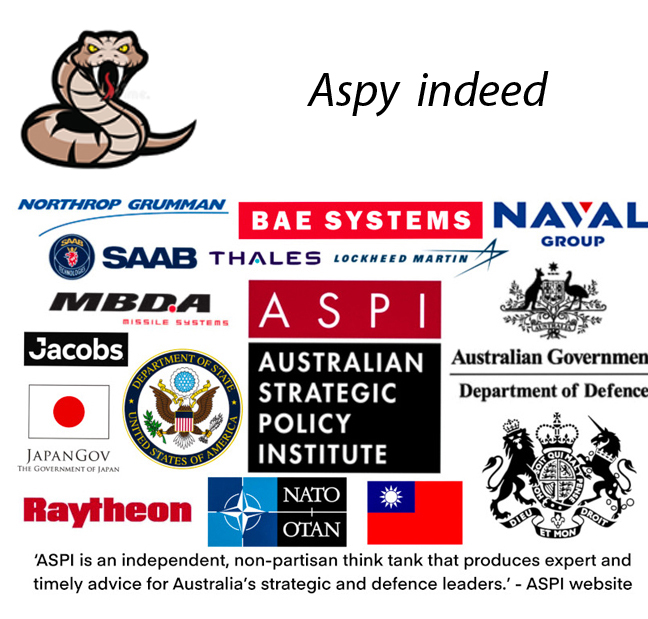
Guns still point to China: Ukraine a backdrop for national security panic merchants https://www.michaelwest.com.au/guns-still-point-to-china-ukraine-a-backdrop-for-national-security-panic-merchants/, Michael West Media, By Marcus Reubenstein, March 4, 2022
After a two-decade wait, Australia’s ”defence and strategic policy think tank” ASPI finally has a new war, one that will be a financial boon for its murky weapons maker backers. Backed also by Scott Morrison and Peter Dutton, this “independent” think tank is a key player in drumming up a pre-election China threat, writes Marcus Reubenstein.
The Australian Strategic Policy Institute (ASPI) is busy not so much with a conflict on the other side of the globe but finding a way to spin the misery of the people of Ukraine into anti-China propaganda. It’s just the kind of propaganda Scott Morrison wants, and the prime minister clearly thinks he needs, in the run up to a likely May federal election.
For years ASPI has suckled at the teat of the weapons industry; but far and away the most generous of ASPI’s benefactors is the Morrison government.
That makes sense because ASPI is not an independent research group. It is an Australian Commonwealth company, which reports directly to Defence Minister Peter Dutton and the appointment of its executive director must be ratified by cabinet.
When Morrison replaced Malcolm Turnbull as prime minister in 2018, ASPI was receiving around $1.6 million in annual government contracts over and above its core Defence Department funding of $3.5 million.
Faced with the real prospect of losing the 2019 election, Morrison and then defence minister Christopher Pyne changed the funding agreement to lock in $4 million of Defence funding for each year over five years.
What both ASPI and the government failed to mention was the Morrison government was about to embark on a gargantuan funding top-up strategy through the awarding of numerous government contracts.
Department of Finance figures show ASPI was awarded $9,497,783.88 in Commonwealth contracts in the 2020-2021 financial y
The 500 per cent increase in Commonwealth contracts awarded to a group parroting, and amplifying, the key national security message of the Morrison government suggests ASPI has been politically shifted from strategists to propagandists.
Prior to a detailed examination of ASPI’s funding sources published by Michael West Media in 2020, there had been zero disclosure as to the level of funding ASPI received from its benefactors.
These amounts are not insubstantial; in total ASPI has generated more than $100 million in revenue.
With a light shining on its finances ASPI now discloses the payments it gets from its funders. Outside Australia, that is principally a handful of foreign governments, weapons makers, and tech companies with a vested interest in crippling China’s rise as a global technology provider.
Buried on page 152 of the latest ASPI annual report is the claim that it received $2,620,978.73 in funding from government contracts. This does not reconcile with the Department of Finance’s figure of almost $9.5 million.
According to the Department of Finance, ASPI racked up 25 Commonwealth contracts while ASPI claims the figure is 21 contracts. ASPI’s accounts are audited by the Australian National Audit Office and there is no suggestion of impropriety in its reporting of income.
Three substantial contracts, two from Defence and one from the Department of Foreign Affairs, were multi-year agreements totalling $8,969,783.80. For reporting purposes, it appears there’s no requirement for disclosure of these specific payments in that reporting period.
One oddity is a contract of $1.5 million (CN3757203) awarded to ASPI in March 2021. Outside Defence, it is far and away the biggest single Commonwealth contract ever awarded to ASPI, yet there is not a single mention of it in the 2020-2021 annual report.
Transparency has never been ASPI’s strong suit.
Putin, payments and propaganda
No sooner had Prime Minister Scott Morrison announced Australian taxpayers were doling out $70 million to NATO for weapons to be sent to Ukraine, the Australian Strategic Policy Institute (ASPI) jumped in with its comprehensive analysis.
n line with its constant drone of “independence” from Canberra policy thought, ASPI challenged the wisdom of Defence Department policy. However, the main tenet of its criticism was that the Australian government has not bought enough missiles.
And who makes the shoulder-launched anti-tank Javelin missiles, en “kangaroo” route to Kyiv? Long-time ASPI sponsors Lockheed Martin and Raytheon.
The latter for years was the world’s biggest manufacturer of child-killing cluster munitions. Though they stopped making them in 2016, Raytheon cluster bombs have been stockpiled and reportedly are still being launched on civilian targets in the forgotten war in Yemen.
Raytheon is no longer an ASPI sponsor but there was zero disclosure in the ASPI missile piece that it took money from Raytheon between 2013 and 2019. Annual reports reveal Lockheed Martin – which makes the dud F-35 Strike Fighters which have soaked up billions in Defence spending – has been pouring money into ASPI’s coffers for the past 18 years.
ASPI presumably justified its non-disclosure of these sponsors because it had not identified they manufactured the Javelin missile in the report.
In late January, independent US website In These Times reported the CEO’s of Raytheon and Lockheed Martin both “boasted” on conference calls with Wall Street analyst that conflict between Russia and Ukraine was a “boom for business.”
One analyst reported Raytheon CEO Greg Hayes had said, in reply to a question about arming US allies: “Obviously we have some defensive weapons systems that we could supply which could be helpful, like the patriot missile system”. While commenting on rising geopolitical tensions, including both Ukraine and China, he said: “I fully expect we’re going to see some [financial] benefit from it.”
Spike in spruiking
When ASPI criticises Australia’s armed forces for the purchase of one type of weapons system it usually suggests an alternative — often the alternative just happens to be made by an ASPI sponsor.
In this case, ASPI’s Marcus Hellyer argued Australia’s shoulder-launched Javelin missile largesse had missed the mark. According to Hellyer, Australia has the wrong missile; instead we should be armed with Israeli-built Spike missiles, which were ordered two years ago by the ADF. There’s no sign of them yet.
And who makes the Spike? Another ASPI sponsor, Rafael. ASPI did disclose this at the end its article, in rather meek terms, that Rafael had hosted a workshop for the think tank in the previous year.
One thing ASPI has consistently never publicly discussed is the money its weapons industry sponsors get from the Australian government. In its 2018-19 annual report, ASPI boasted that it facilitates access to highly placed government officials for its sponsors. Between ASPI’s establishment and 2020, its sponsors collected more than $80 billion in Defence Department contracts.
ASPI’s China syndrome
ASPI’s analysts have been all over this latest conflict running two familiar lines: Western nations need more weapons and China is the real threat.
On February 24, ASPI executive director Peter Jennings, who is a columnist at Murdoch’s The Australian, wrote an opinion piece in which he asserts “China wins from this conflict.” Clearly there are geopolitical ramifications for China that will concern Australia, but to effectively put China front and centre in an eastern European conflict is straight out of the ASPI playbook.
In that same article Jennings argued that the failure of the Afghan military forces against the Taliban boiled down to one crucial factor — a lack of military hardware.
Imagine the price tag on hardware needed to fight a war with China that some of our politicians and security establishment as apparently salivating for.
The Kimba nuclear waste dump was NEVER about the supply of nuclear medicine.
Kazzi Jai Fight to Stop a nuclear waste dump in the Flinders Ranges 4 Mar 22, https://www.facebook.com/groups/941313402573199

“Time is running out, but we’re not going away. Our community is committed to our part in providing surety of supply for nuclear medicine provision for the benefit of every Australian, who, on average, will use nuclear medicine at least once in their lifetime.
The irony that neither federal nor state governments can provide our town and our community with base-level GP and emergency medical access is, quite frankly, unforgiveable and unacceptable to our community…..”* Mayor Dean Johnson opening remarks…
Wow!! So the “promises” are disappearing now Mayor Johnson??
Here’s a heads up – The Nuclear Waste Dump was NEVER about surety of supple of nuclear medicine!!!
Matt Canavan said so…ANSTO said so….DIIS said so – NEVER ABOUT SURETY OF NUCLEAR MEDICINE!
*Transcript excerpt from “General practitioner and related primary health services to outer metropolitan, rural and regional Australians” – Senate Inquiry Whyalla Session March 1st 2022
Now Is the Time for a Global Movement Demanding Nuclear De-escalation

Now Is the Time for a Global Movement Demanding Nuclear De-escalation, https://truthout.org/articles/now-is-the-time-for-a-global-movement-demanding-nuclear-de-escalation/?eType=EmailBlastContent&eId=552e5725-9297-4a7c-a214-53c8c51615a3 Norman Solomon, Truthout March 3, 2022
President Joe Biden spoke 6,500 words during his State of the Union speech Tuesday night, but not one of them acknowledged the dangers of nuclear war that have spiked upward during the last decade and even more steeply in recent days. The militarism that Martin Luther King Jr. warned us about has been spiraling toward its ultimate destination in the nuclear era — a global holocaust that would likely extinguish almost all human life on Earth.
In the midst of this reality, leaders of the world’s two nuclear superpowers continue to fail — and betray — humanity.
In the stark light of March 2022, Albert Einstein’s outlook 75 years ago about the release of atomic energy has never been more prescient or more urgent: “This basic power of the universe cannot be fitted into the outmoded concept of narrow nationalisms. For there is no secret and there is no defense, there is no possibility of control except through the aroused understanding and insistence of the peoples of the world.”
The phrase “narrow nationalisms” aptly describes the nuclear-weapons policies of the United States and Russia. They have been engaged in a dance of death with foreseeable human consequences on a scale that none of us can truly fathom.
Einstein expressed a belief that “an informed citizenry will act for life and not death.” But the dire nuclear trends have been enabled by citizenry uninformed and inactive.
Twenty years ago, the George W. Bush administration withdrew from the Anti-Ballistic Missile (ABM) Treaty. Despite his promising rhetoric, President Barack Obama plunged ahead to begin a $1.7 trillion program for further developing the U.S. nuclear arsenal under the euphemism of “modernization.” President Donald Trump pulled the United States out of the Intermediate-Range Nuclear Forces (INF) Treaty, which had removed an entire category of missiles from Europe since the late 1980s — largely as a result of the international movement against nuclear weapons.
By killing the ABM and INF agreements, the U.S. government pushed the world further away from nuclear arms control, let alone disarmament. And by insisting on expansion of the North Atlantic Treaty Organization (NATO) to Russia’s borders — and in recent months continuing to insist that Ukrainian membership in NATO should stay on the table — the United States ignored Russia’s longstanding and reasonable concerns about NATO expansion.
Placement of ABM systems in Poland and Romania, touted as defensive, gave NATO the capacity to retrofit those systems with offensive cruise missiles. Overall, NATO’s claims of being a “defensive” alliance have been undercut by three decades of broken promises, as well as intensive war operations in Serbia, Afghanistan and Libya.
Russia has its own military-industrial complex and nationalistic fervor. The duplicity and provocations by the United States and its NATO allies do not in the slightest justify the invasion of Ukraine that Russia launched a week ago. Russia is now on a murderous killing spree no less abhorrent than what occurred from the U.S. invasions of Afghanistan and Iraq.
Right now, an overarching truth remains to be faced and acted upon: The nuclear superpowers have dragged humanity to a precipice of omnicide. The invasion of Ukraine is the latest move in that direction.
Last week, the extreme recklessness of Russian President Vladimir Putin’s not-so-veiled threat to use nuclear weapons was an indication of just how dangerous the Ukraine conflict has gotten — for everyone, everywhere. Passivity will get us nowhere. In the U.S., supporting antiwar protests and demanding real diplomacy while organizing for peace are essential.
“However soon the war ends, its effects on the European security order and the world will be and already are profound,” San Francisco State University scholar Andrei Tsygankov wrote days ago. “In addition to human suffering and devastation, the European continent is entering a new era of social and political divisions comparable to those of the Cold War. The possibility of further escalation is now closer than ever. Instead of building an inclusive and just international order, Russia and most European nations will now rely mainly on nuclear weapons and military preparations for their security.”
Any “conventional” war that puts Russia and the United States in even indirect conflict has the very real potential of being a tripwire that could set off an exchange of nuclear missiles. Heightened tensions lead to fatigue, paranoia and greater likelihood of mistaking a false alarm for the real thing. This is especially dangerous because of land-based Intercontinental Ballistic Missiles (ICBMs), which are uniquely vulnerable to attack and therefore are on hair-trigger, “launch on warning” alert.
“First and foremost,” former Defense Secretary William Perry wrote in 2016, “the United States can safely phase out its land-based intercontinental ballistic missile force, a key facet of Cold War nuclear policy. Retiring the ICBMs would save considerable costs, but it isn’t only budgets that would benefit. These missiles are some of the most dangerous weapons in the world. They could even trigger an accidental nuclear war.” As Daniel Ellsberg and I wrote in The Nation last fall, “Contrary to uninformed assumptions, discarding all ICBMs could be accomplished unilaterally by the United States with no downside. Even if Russia chose not to follow suit, dismantling the potentially cataclysmic land-based missiles would make the world safer for everyone on the planet.”
But we’re not hearing anything from Congress or the White House about taking steps to reduce the chances of nuclear war. Instead, we’re hearing jacked-up rhetoric about confronting Russia. It’s all too clear that responsible leadership will not come from official Washington; it must come from grassroots activism with determined organizing and political pressure.
“I refuse to accept the cynical notion that nation after nation must spiral down a militaristic stairway into the hell of thermonuclear destruction,” Dr. King said as he accepted the Nobel Peace Prize in 1964. “I believe that even amid today’s mortar bursts and whining bullets, there is still hope for a brighter tomorrow.”
Realistic hope seems to be in very short supply right now. But at this dire moment, all that we love demands our determination to organize.
1 This month.


PETITION – To: Prime Minister Anthony Albanese and the Australian Labor Government
Chernobyl: The Lost Tapes – A good documentary on Chernobyl on SBS available On Demand for the next 3 weeks– https://www.sbs.com.au/ondemand/tv-program/chernobyl-the-lost-tapes/235274195556
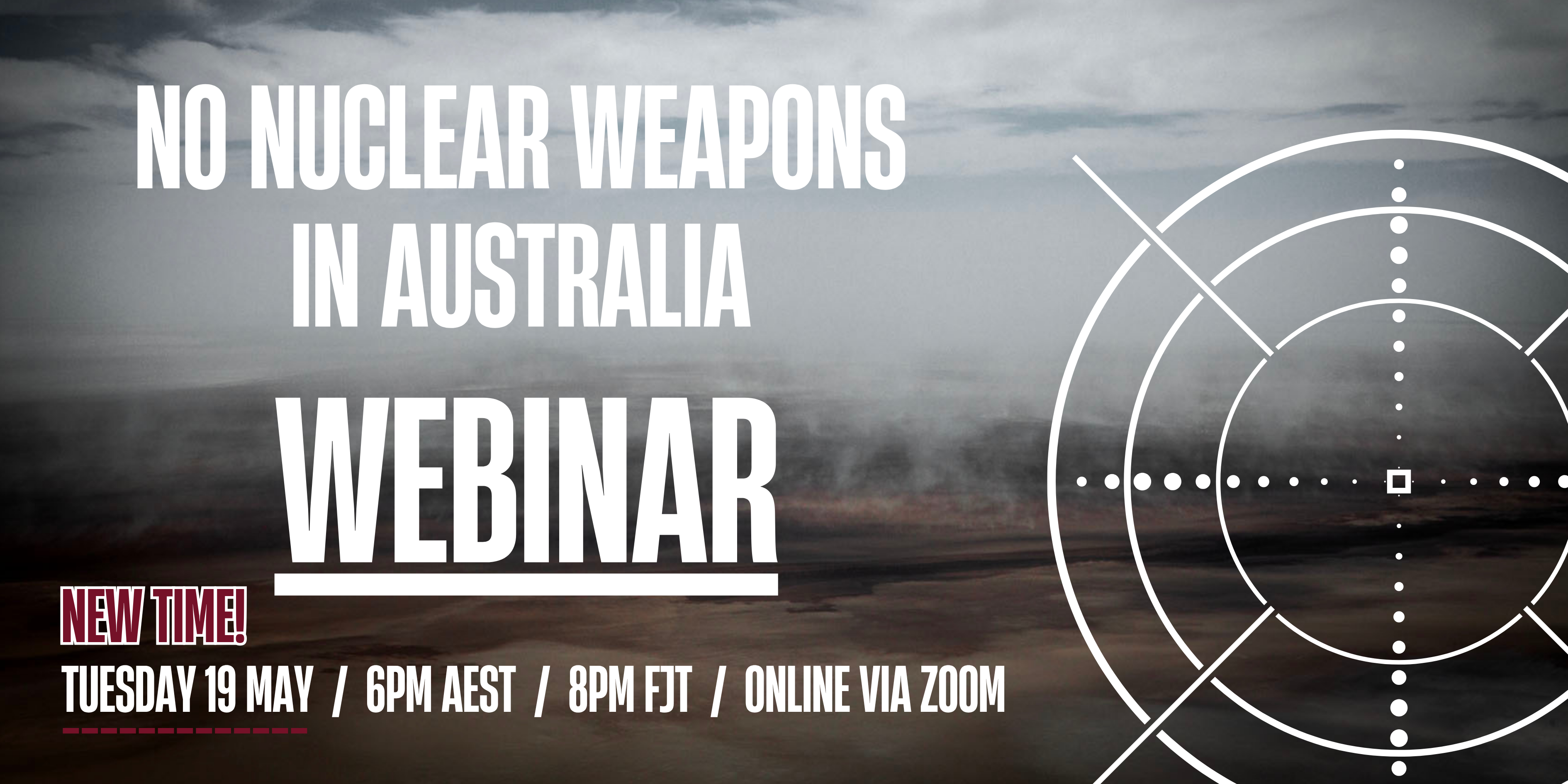
19 May – Webinar- Webinar: No Nuclear Weapons in Australia
Start: 2026-05-19 18:00:00 UTC Canberra, Melbourne, Sydney (GMT+10:00)
End: 2026-05-19 19:30:00 UTC Canberra, Melbourne, Sydney (GMT+10:00)
20 May – Webinar – The dangerous world of AUKUS, US, military occupation and suppression of dissent

National Webinar, 20th May, 2026, 6.30pm AEST. Confronting laws restricting/suppressing protest speech and action
Speakers: Former Sen. Rex Patrick, Lawyer Nick Hanna ,Arthur Rorris ,Jorgen Doyle, Sen David Shoebbridge,
Facilitator Kelley Tranter.

of the week – Australians for War Powers Reform (AWPR)
To see nuclear-related stories in greater depth and intensity
 Antinuclear