Robots used to remove Fukushima’s highly radioactive used nuclear fuel, but they’re still problematic.
Plutonium problems won’t go away, By Chris Edwards, Engineering and Technology, February 15, 2022 ”’………………………………………At a conference organised by the International Federation of Robotics Research on the 10th anniversary of the accident, Toyota Research chief scientist Gill Pratt said the first robots “got there in the overhead luggage of commercial flights”. For all of them it was a baptism of fire.
Narrow staircases and rubble turned into insurmountable obstacles for some. Those that made it further failed after suffering too much radiation damage to key sensors and memories. Finally, some developed by the Chiba Institute of Technology were able to explore the upper floors of Reactor 2. The researchers designed their Quince to work for up to five hours in the presence of a cobalt-60 source that would generate an average dose of 40 grays per hour.
Direct radiation damage was not the only problem for the Fukushima robots. Reactors are protected by thick concrete walls. Wireless signals fade in and out and fibre-optic cabling becomes an impediment in the cluttered space of a damaged building.
To be close enough to the machines, operators had to wear bulky protective clothing that made teleoperation much harder than it would be in other environments. Several robots went into the building only to fail and get stuck, turning into obstacles for other machines.
The risk of these kinds of failure played into the nuclear industry’s long-term resistance to using robots for repair and decommissioning. Plant operators continued to favour mechanical manipulators operated by humans, separated by both protective clothing and thick lead-heavy glass.
Since Fukushima, attitudes to robots in the nuclear industry have changed, but remote control remains the main strategy. Pratt says humans remain generally better at control and are far better at dealing with the unstructured environments within many older and sometimes damaged installations.
The long-term aim of those working on these systems is to provide robots with greater degrees of autonomy over time. For example, surveillance drones will be flown with operator supervision but the machines are acquiring more intelligence to let them avoid obstacles so they need only respond to simpler, high-level commands. This can overcome one of the problems created by intermittent communications. One instance of this approach was shown when UK-based Createc Robotics recently deployed a drone at Chernobyl and Fukushima, choosing in the latter case to survey the partly collapsed turbine hall for a test of its semi-autonomous mapping techniques.
To get more robots into play in the UK, the NDA has focused its procurement more heavily on universities and smaller specialist companies, some of which are adapting technologies from the oil and gas industry.
The NDA expects it will take many years to develop effective robot decommissioning and handling technologies. It has put together a broad roadmap that currently extends to 2040. Radiation susceptibility remains an issue. Visual sensors are highly susceptible to damage by ionising radiation. However, a mixture of smarter control systems and redundancy should make it possible to at least move robots to a safe point for repair should they start to show signs of failure.
Another design strategy being pursued both in the UK and Japan is to build robots as though they are a moving, smart Swiss-army knife: armed with a variety of detachable limbs and subsystems so they can adapt to conditions and possibly even perform some on-the-fly repairs to themselves.
Slowly, the technology is appearing that can handle and at least put the waste out of harm’s way for a long time, though you might wonder why the process has taken decades to get to this stage of development. ……………. (Goes on to laser developments, again, far from a sure thing.) https://eandt.theiet.org/content/articles/2022/02/plutonium-problems-won-t-go-away/
February 16 Energy News — geoharvey

NRDC Analysis On Build Back Better: ¶ “Maine To Get 3,600 New Jobs From Build Back Better Act” • If the US Senate passes the Build Back Better Act, it would bring a result of 3,600 to 5,100 new direct jobs being created in Maine, according to Natural Resources Defense Council analysis. Clean energy investment, […]
February 16 Energy News — geoharvey
Today’s Crisis Over Ukraine ACURA ViewPoint
Today’s Crisis Over Ukraine ACURA ViewPoint Jack F. Matlock, Jr.: American Committee for the Us- Russia Accord
February 14, 2022 Today we face an avoidable crisis that was predictable, actually predicted, willfully precipitated, but easily resolved by the application of common sense.
We are being told each day that war may be imminent in Ukraine………………………….
I cannot dismiss the suspicion that we are witnessing an elaborate charade, grossly magnified by prominent elements of the American media, to serve a domestic political end. ……………………..
Was the crisis avoidable?…………………………………….. In fact, the decision to expand NATO piecemeal was a reversal of American policies that produced the end of the Cold War…………………………
Willfully precipitated? Adding countries in Eastern Europe to NATO continued during the George W. Bush administration (2001-2009) but that was not the only thing that stimulated Russian objection. At the same time, the United States began withdrawing from the arms control treaties that had tempered, for a time, an irrational and dangerous arms race and were the foundation agreements for ending the Cold War.
—Easily resolved by the application of common sense?
The short answer is because it can be. What President Putin is demanding, an end to NATO expansion and creation of a security structure in Europe that insures Russia’s security along with that of others is eminently reasonable. He is not demanding the exit of any NATO member and he is threatening none. By any pragmatic, common sense standard it is in the interest of the United States to promote peace, not conflict. To try to detach Ukraine from Russian influence—the avowed aim of those who agitated for the “color revolutions”—was a fool’s errand, and a dangerous one. Have we so soon forgotten the lesson of the Cuban Missile Crisis?1
Now, to say that approving Putin’s demands is in the objective interest of the United States does not mean that it will be easy to do. The leaders of both the Democratic and Republican parties have developed such a Russophobic stance (a story requiring a separate study) that it will take great political skill to navigate the treacherous political waters and achieve a rational outcome.
President Biden has made it clear that the United States will not intervene with its own troops if Russia invades Ukraine. So why move them into Eastern Europe? Just to show hawks in Congress that he is standing firm? For what? Nobody is threatening Poland or Bulgaria except waves of refugees fleeing Syria, Afghanistan and the desiccated areas of the African savannah. So what is the 82nd Airborne supposed to do?……….
Jack F. Matlock served as US ambassador to the USSR (1987-1991). A member of the board of director of ACURA, he writes from Singer Island, Florida. https://usrussiaaccord.org/acura-viewpoint-jack-f-matlock-jr-todays-crisis-over-ukraine/
Ambassador suggested that Ukraine might drop its bid for NATO membership – but he was quickly corrected.
Ukrainian ambassador forced to walk back claims nation could drop NATO bid, By Vladimir Isachenkov and Stephen Coates, The Age February 14, 2022 Ukraine could drop its bid to join NATO to avoid war with Russia, the BBC quoted the country’s ambassador to Britain as saying, in what would amount to a major concession to Moscow in response to the build-up of Russian troops on its borders.
However, the ambassador walked back his remarks in a later interview as President Volodymyr Zelensky’s spokesman insisted that aspirations to join NATO and the European Union remain the absolute priority to the country.
Ambassador Vadym Prystaiko told the BBC on Monday morning (UK time) that Ukraine was willing to be “flexible” over its goal to join the Atlantic military alliance, a move Russian President Vladimir Putin has said would be a trigger for war.
We might – especially being threatened like that, blackmailed by that, and pushed to it,” Prystaiko, Ukraine’s foreign minister until 2020, was quoted as saying when asked if Kyiv could change its position on NATO membership.
Shortly after his remarks made headlines around the world, Prystaiko returned to the BBC to state that the former Soviet republic would not be reconsidering its attempt to join the military alliance, after a spokesman for the Ukrainian President said the ambassador needed to clarify what he meant…………..
Ukraine is not a NATO member but has a promise dating from 2008 that it will eventually be given the opportunity to join, a step that would bring the US-led alliance to Russia’s border.
Putin has been arguing that Ukraine’s growing ties with the alliance could make it a launch pad for NATO missiles targeted at Russia. He has said Russia needs to lay down “red lines” to prevent that………
Moscow denies it is planning an attack, calling the military manoeuvres exercises, but it has issued written demands that NATO forgo any further expansion eastwards including Ukraine. NATO members have rejected the demand……….https://www.theage.com.au/world/europe/ukraine-could-drop-nato-bid-to-avoid-war-uk-ambassador-20220214-p59we9.html
Julian Assange appeals to the Supreme Court,
Julian Assange appeals to the Supreme Court, https://www.bindmans.com/insight/updates/julian-assange-appeals-to-the-supreme-court, Kate Goold, 03 FEBRUARY 2022.
In December 2021, the High Court ruled that Julian Assange could be extradited to the USA, reversing a previous decision of Westminster Magistrates’ Court that extradition would be unjust or oppressive due to Mr Assange’s mental condition.
The ruling of the High Court was based on a package of diplomatic assurances provided by the US government about how and where Mr Assange would be detained if extradited and/or convicted. The assurances had been provided after the Magistrates’ Court found that Mr Assange was at a high risk of suicide if imprisoned in the very harsh regime that can be imposed on prisoners, who are considered a threat to national security, by the US. These fresh assurances were said by the USA to be sufficient to meet that concern, and the High Court agreed.
Among the assurances were undertakings that Mr Assange would not, at this time, be subject to Special Administrative Measures (SAMs), restricting his correspondence, visits and use of the telephone, nor detained at USP Florence ADMAX (ADX), a maximum-security prison in Colorado.
Crucially, however, these assurances were subject to the caveat that the US retained the power to impose such conditions if Mr Assange were to commit any future act that meets the tests for the imposition of SAMs or designation to ADX.
Application to the Supreme Court
As anticipated, Mr Assange sought permission to appeal the High Court judgment to the Supreme Court on the basis that there is a point of law of general public importance involved in the decision. He argued that the Supreme Court’s guidance was required on three questions of law regarding the assurances.
Firstly, he submitted that the Supreme Court ought to consider the question of whether a court can consider assurances that are introduced for the first time on appeal.
The second and third questions related to the caveat in the assurances concerning future acts. Mr Assange questioned whether it could be lawful to allow for potential exposure to conditions under SAMs or in ADX if the imposition of those prison regimes was judged by the US authorities to be justified by his own conduct. In Mr Assange’s case, this was said to be particularly important because conduct could involve speech, and also because it was accepted that he suffers from a severe mental condition.
On 24 January 2022, only the first question was certified by the High Court as an issue of general public importance:
In what circumstances can an appellate court receive assurances from a requesting state which were not before the court of first instance in extradition proceedings.
In the view of the High Court, this point of law is settled, but the High Court has certified a point of law of general public importance with regards to the provision of assurances at a later stage in proceedings, as the Supreme Court has not yet considered this specific question. The High Court concluded that the Supreme Court should have an opportunity to do so, since assurances are at the heart of many extradition proceedings and are increasingly relied on.
In extradition proceedings, assurances are not currently classed as ‘evidence’, but as ‘issues’, and therefore do not necessarily attract the same scrutiny. This also means they can be introduced after all evidence has been heard and tested.
The Supreme Court itself will now decide whether or not it should hear the appeal on this point.
Extradition practitioners largely welcome Supreme Court guidance on this point as late assurances designed to alleviate the court’s concerns about human rights violations following extradition have become a highly contentious issue, especially when provided by States with a poor record in human rights themselves.
It is of note that the High Court refused to certify the point of law with regards to future acts and did not appear to be overly concerned regarding the conditional nature of the diplomatic assurances provided. Mr Assange’s lawyers argued that the principle of absolute protection against inhuman or degrading treatment, contrary to Article 3, should also apply in cases where an individual’s mental condition is such that even if they are moved to a severe regime due to their behaviour (including speech), extradition should still be barred as oppressive (s91 Extradition Act) because the severity of the regime will cause such a deterioration in their mental health. The assurances provided do not rule out this possibility. This would have been an interesting issue for the Supreme Court to have considered, but that opportunity is no longer available.
Wider issues
Meanwhile, Mr Assange is likely to appeal to the High Court those grounds where he was unsuccessful before the District Judge at Westminster, as he was unable to cross appeal while the US appealed the District Judge decision. These grounds will largely focus on political motivation, freedom of speech and fair trial issues. If leave to appeal on the certified point is refused by the Supreme Court, Mr Assange still therefore has an opportunity to appeal to the High Court and his fight continues.
Robot ventures inside radioactive ruins of Fukushima power plant
Robot ventures inside radioactive ruins of Fukushima power plant, 9 News,
By Raffaella Ciccarelli • Producer 14 Feb 22, Melted nuclear fuel has been filmed in the bowels of Unit 1 of Japan’s Fukushima Power Plant as a remote controlled submarine navigated the radioactive ruins of the plant.
The remote-controlled device took to waters surrounding the plant on February 9 as part of ongoing clean-up efforts by plant operator Tokyo Electric Power Company Holdings (TEPCO).
It comes more than a decade after the plant’s catastrophic meltdown in 2011……………………
In 2016 Japan Times reported the area inside the reactors were contaminated by 530 sieverts of radiation per hour.
Exposure to 10 sieverts is fatal to a human, with death occurring within weeks.
Clean-up efforts are ongoing and TEPCO has a decommissioning target of 2051.
It’s been estimated it will take 30 more years and $106 billion to remove intact nuclear fuel at the bottom of the plants. https://www.9news.com.au/world/fukushima-japan-robot-ventures-inside-radioactive-ruins-of-unit-1/8d333107-b6c6-4909-b2ac-da21e873169d
Three years on, Morrison’s electricity underwriting scheme still has nothing to show — RenewEconomy

In 2019, Angus Taylor shortlisted a dozen power projects to improve grid reliability and cut electricity costs – three years later, not one has been built. The post Three years on, Morrison’s electricity underwriting scheme still has nothing to show appeared first on RenewEconomy.
Three years on, Morrison’s electricity underwriting scheme still has nothing to show — RenewEconomy
Crossbenchers urge switch to electric transport to boost Australia’s energy security — RenewEconomy

Federal independents call for Australia to tackle fuel security challenges through switch to locally-made EVs, and renewably powered manufacturing. The post Crossbenchers urge switch to electric transport to boost Australia’s energy security appeared first on RenewEconomy.
Crossbenchers urge switch to electric transport to boost Australia’s energy security — RenewEconomy
WA switches on rooftop solar switch-off rules, sparks call for faster grid reform — RenewEconomy

WA becomes Australia’s second state where AEMO can remotely switch off residential rooftop solar systems to keep the grid stable. But did it have to be this way? The post WA switches on rooftop solar switch-off rules, sparks call for faster grid reform appeared first on RenewEconomy.
WA switches on rooftop solar switch-off rules, sparks call for faster grid reform — RenewEconomy
“Highly exaggerated:” Experts debunk Coalition coal and gas jobs claims — RenewEconomy

Grattan Institute fact-checks Morrison government claims that Queensland coal and gas ban would risk 53,000 jobs and $A85 billion in investment. The post “Highly exaggerated:” Experts debunk Coalition coal and gas jobs claims appeared first on RenewEconomy.
“Highly exaggerated:” Experts debunk Coalition coal and gas jobs claims — RenewEconomy
February 14 Energy News — geoharvey

NRDC Analysis On Build Back Better: ¶ “West Virginia To See Thousands Of New Jobs From Build Back Better Act” • The Senate’s passage of the policies in the Build Back Better Act, which the House has passed, would enable West Virginia to invest in climate solutions that could lead to over 70,000 direct jobs, […]
February 14 Energy News — geoharvey
Australia and more – nuclear news this week

Some bits of good news: The green bucket list When you’re immersed in environmental science and environmental politics, it’s sometimes hard to step back and measure progress. Here are a few gains and victories to charge your batteries .

Nuclear. Ukraine dominated the news. The map above might help to explain why Russia really doesn’t need another NATO base on its doorstep.
Coronavirus: COVID-19: What you need to know about the coronavirus pandemic on 14 February
Climate. Adapting to climate change ‘happening worldwide’, essential. Fixing the Climate: Hopes and Hazards.
AUSTRALIA
Nuclear. Practical considerations may hamper Australia’s path to nuclear submarines. South Australian Labor supported Greens. motion opposing SA as nuclear waste dump, but Liberals SA Best and Advance SA blocked it. INVITATION TO WEBINAR – AUKUS WILL COST THE EARTH – 24 February
Climate. Climate projections paint a grim future for WA if emissions not cut Former UK prime minister urges Australia to lift its game on climate change. People are prepared to vote for stronger climate policies
Labor rules out ‘fringe’ deal in rebuff to Greens on climate Greens to seek moratorium on new fossil fuel projects in any post-election negotiations. Independent regional journalism, brought to you by fossil fuels.
Australian demand for solar goes through the roof, smashing records The revolution will be electrified – 7am podcast
Tasmania may get cold, but sunburn is still very much a threat .
INTERNATIONAL
Ukraine Special – 11 February 22
Conflict resolution – the positive way out of the Ukraine crisis. USA does not have to march into war with Russia over Ukraine. It can choose to keep to the Minsk-Normandy process. Amid Ukraine Tension, US Deploys Nuclear-Ready B-52 Bombers to UK.
Comfortably numb . CounterVortex Episode 110: Nuclear power? No thanks! .
JAPAN. Kenichi Hasegawa, former dairy farmer who continued to tell the truth about the nuclear accident in Fukushima, passes away. PCB waste treatment plan in Fukushima: “Insufficient explanation” and opposition from many people. Robot photos appear to show melted fuel at Fukushima reactor. Zero Contaminated Water” and “Dismantling of Reactor Buildings” Missing from the Plan: The Final Form of Decommissioning the TEPCO’s Fukushima Daiichi Nuclear Power Plant.
RUSSIA. The goal of Russia is to destroy NATO by exposing its impotence. Russian Congress of Intellectuals: An Open Letter to the Russian Leadership.
UKRAINE. In Ukraine, USA to finance American companies to sell nuclear technology there, and to other States. USA’s plan – far right Ukrainian militia to attack Russia-speaking Donbass Region – drawing Russian support – USA then to claim Russia aggression.
The Ultimate End of NATO

By 2008 NATO had become a bloated edifice largely unrecognizable from the organization that had been created at its founding, in 1949. Its appetite for expansion knew no bounds, with membership offers being dangled before two former Soviet Republics, Georgia and Ukraine, and military engagements being initiated in North Africa and the Persian Gulf.
Once NATO began expanding, both in terms of membership composition and scope and scale of its non-European military commitments, it was obvious to any observer exercising a modicum of intellectual curiosity that NATO existed for the sole benefit of the United States.
Exposing NATO
By militarizing the Ukraine crisis, Russia has exposed the absolute military impotence of NATO. First and foremost, after dangling the bait of NATO membership before Ukraine for the past fourteen years, NATO was compelled to confess that it would not be able to come to the defense of Ukraine in case of any Russian military invasion because Article 5 only allowed collective defense to be invoked for NATO members, which Ukraine is not.
Germany, Biden was saying, is little more than a colony of the United States.
The Ultimate End of NATO, Russia’s goal is not to destroy Ukraine—this could be accomplished at any time. Rather, the goal of Russia is to destroy NATO by exposing its impotence, writes Scott Ritter. Consortium News 11 Feb 22,
” …………………………………………. A Messy History.
Students of history might be experiencing what Yogi Berra once famously called “Déjà vu all over again” when examining the frenetic activities undertaken by the North Atlantic Treaty Organization (NATO) today, as it responds to what it alleges is a provocative Russian military buildup along the Russian-Ukrainian border.
The Trans-Atlantic alliance is a strange amalgam of political, economic, and military belief systems cloaking a mass of 30 nations who manage the day-to-day activities of their organization through a consensus-based, collective decision-making process that is as unwieldy as it is inefficient.
Originally formed as a collective of 12 nations united by the desire, as the first secretary-general of NATO, Lord Ismay, once quipped, “to keep the Russians out, the Americans in, and the Germans down”, the Trans-Atlantic alliance was, first and foremost, a club comprised of nations which had two things in common—a shared belief in the primacy of democratic governance, and a desire to be protected under the umbrella of American military power.
Early on the alliance witnessed a period of expansion, as it grew to 16 nations following the admittance of Turkey, Greece, Spain, and Portugal. These 16 nations served as the foundation of NATO throughout the Cold War, united in their determination to stand up to any potential Soviet aggression targeting the territory of western Europe.
NATO was always, from a political standpoint, a mess. Strong pro-communist movements in France and Italy led to the unseemly situation where the intelligence services of an allied nation, the United States, were engaged in manipulating the domestic political affairs of two ostensible allies to keep the communists out of power.
West Germany carried out its own unilateral Ostpolitik, seeking better relations with Soviet-occupied East Germany, much to the consternation of the United States. France, offended by what it (rightly) believed to be the dominance of the United States in the military command structure of the alliance, withdrew its military from NATO command authority. And Turkey and Greece were engaged in their own regional Cold War which, in 1974, went hot over the island of Cyprus.
The glue that held the alliance together was the collective defense provisions of Article 5 of the NATO Charter, which provides that if a NATO Ally is the victim of an armed attack, each and every other member of the Alliance will consider this act of violence as an armed attack against all members and will take the actions it deems necessary to assist the Ally attacked.
For much of the Cold War, the NATO alliance was configured militarily so that there was little doubt as to what actions would be taken, with a standing NATO army deployed in West Germany in constant combat readiness, prepared to repel any attack by the Soviet Army and its Warsaw Pact allies. Likewise, NATO maintained significant air and naval forces deployed in the Mediterranean Sea ready to confront any Soviet aggression there. These forces were anchored by a massive standing U.S. military presence comprising hundreds of thousands of troops, tens of thousands of armored vehicles, thousands of combat aircraft, and hundreds of naval vessels.
This full-time presence of concentrated combat-ready military power, prepared as it was to fight at the drop of a hat, gave the Article 5 obligation far more gravitas than it perhaps deserved. The reality of Article 5 is such that, upon its invocation, Allies can provide any form of assistance they deem necessary to respond to a situation based upon the circumstances.
While this assistance is taken forward in concert with other Allies, it is not necessarily military in nature and depends on the material resources of each country. In short, Article 5 leaves to the judgement of each individual member country to determine how and what it would contribute in the case of its invocation.
With the end of the Cold War in 1990-91 came the dismantlement of this full-time combat-ready military force. The unified nature of the NATO military component that existed in the 1980’s ceased to exist barely ten years later, with each member state carrying out its own demobilization and restructuring based upon domestic political requirements, and not the requirements of the alliance.
NATO Goes on Offense
During this time NATO also watched its long-held mantra of being a purely defensive alliance fall to the side as it engaged in offensive military operations on the soil of the former Republic of Yugoslavia, and non-member, and a offensive bombing campaign against Serbia, despite Serbia not having attacked any NATO member.
This deconstruction of NATO’s military capabilities and status as an exclusively defensive organization took place hand in glove with a decision by NATO to expand its membership to include the former members of the Warsaw Pact, beginning with the accession of Poland, Hungary, and the Czech Republic in 1999. The enlargement of NATO was seen as achieving two objectives—from the NATO perspective, it brought most of Europe together into a single collective of allied parties who, because of their membership, would contribute to the overall stability of Europe.
But there was another perspective at play, that being that of the U.S.. While NATO responded to the U.S. invoking of Article 5 after the 9/11 attacks, providing airborne surveillance aircraft for North American patrols and naval forces in the Mediterranean Sea, several core members, led by Germany and France, balked at becoming involved in the post-9/11 military misadventures of the U.S. in Afghanistan and Iraq.
This prompted then-Secretary of Defense Donald Rumsfeld to make a quip denigrating “Old Europe” at the expense of “New Europe.” The continued expansion of NATO eastwards, absorbing all of the former nations of the Warsaw Pact along with three former Soviet Republics in the Baltics not only pushed NATO’s geopolitical center of gravity further east, but also put NATO on a collision course with Russia, whose opinion most NATO members had conditioned themselves to ignore.
NATO went on to provide military and police training support to Iraq in 2004, following that nation’s defeat at the hands of a military coalition which included the U.S., U.K., and Poland providing combat troops, and Spain, Portugal, and the Netherlands providing political support.
Likewise, NATO contributed significant military forces to reconstruction efforts in Afghanistan. These troops operated under Article 4 authorities after the U.S. brought the Afghan situation post-9/11 to the attention of the general membership, which voted to authorize member states to deploy to Afghanistan in support of U.S. reconstruction and nation-building operations.
In 2011, NATO engaged in offensive military operations in Libya, part of a larger political campaign to remove the Libyan leader, Muammar Qaddafi, from power.
A US Adjunct
By 2008 NATO had become a bloated edifice largely unrecognizable from the organization that had been created at its founding, in 1949. Its appetite for expansion knew no bounds, with membership offers being dangled before two former Soviet Republics, Georgia and Ukraine, and military engagements being initiated in North Africa and the Persian Gulf.
While the bloated organizational structure of NATO looked impressive on paper, there were two realities that no amount of puffing and posturing could obviate. First and foremost was the absolute dearth of real military power on the part of the non-U.S. NATO components.
To support and sustain their respective military commitments to Afghanistan, the major NATO nations involved—Canada, the Netherlands, the United Kingdom, France, and Italy—were forced to cannibalize their overall military capability to surge their respective military components forward. Even then, none of these nations could accomplish their Afghan mission without the logistical support provided by the United States.
This over-reliance upon U.S. military capacity only underscored the inconvenient reality that NATO had become little more than an adjunct of U.S. foreign and national security policy. The U.S. had always played an oversized role in NATO. If this was singularly focused on preserving European security, the non-U.S. members of NATO could deceive themselves into believing that they were co-equal partners in a defensive-oriented Trans-Atlantic arrangement.
Once NATO began expanding, both in terms of membership composition and scope and scale of its non-European military commitments, it was obvious to any observer exercising a modicum of intellectual curiosity that NATO existed for the sole benefit of the United States.
Nothing drove this point home more than the humiliation NATO suffered at the hands of the U.S. when it came to the abandonment of the Afghan reconstruction mission. The decision to withdraw from Afghanistan was made unilaterally by the United States, without consultation. NATO, faced with a fait accompli, had no choice but to do as ordered, and leave Afghanistan with its tail between its legs.
The ultimate humiliation was yet to come. Nothing takes place in a vacuum, and the expansion of NATO, combined with its offensive re-orientation, drew the ire of Russia, which took extreme umbrage over the encroachment of a military alliance no longer bound by the constraints of collective self-defense, but rather imbued with a post-Cold War posture built around the notion of containing and constraining a Russia which was recovering from its post-Soviet collapse malaise and, under the leadership of Vladimir Putin, was actively restoring it position as a regional and global power.
NATO Fissures
Russia had, since 2001, been sounding a claxon call about NATO expansion and the threat it posed to Russian security interests. These calls were ignored by NATO and its U.S. masters, largely because they believed Russia to be too weak both militarily and economically.
While NATO chased post-9/11 ghosts in the Middle East and Afghanistan at the behest of its American overseer, Russia worked to reform its economy and military. In 2008 Russia defeated Georgia in a short but violent war precipitated by a Georgian military assault on the breakaway territory of South Ossetia. In 2014, Russia responded to the U.S.-orchestrated Maidan coup that ousted the democratically-elected president of Ukraine, Victor Yanukovich, by annexing Crimea and throwing its support behind pro-Russian separatists in the Donbass region of Ukraine.
The important thing to note about the current crisis in Ukraine is that while the underlying issues are solely the byproduct of NATO overreach, the timing of the crisis is based upon a Russian timetable defined by purely Russian goals and objectives. The goal of Russia is not to destroy Ukraine—this could be accomplished at any time. Rather, the goal of Russia is to destroy NATO.
This will not be accomplished through the direct use of military force, but rather the indirect threat of military action which forces NATO to react in a way which exposes the impotence of an organization which long ago lost its raison d-etre, collective defense, and instead flounders under the weight of a mission—the containment of Russia—it cannot achieve, and which its membership is not united in pursuing.
Here are a few statements of fact—the Russian military would defeat any force NATO can assemble in a stand-up conventional fight. The entire notion of collective self-defense is predicated on the ability to deter any potential adversary from considering military action against a NATO member because the outcome—the total defeat of the attacking party—was never in dispute.
While a truly defensive alliance would have the moral authority to call out the build-up of Russian military power around Ukraine as un-duly provocative, NATO has long since lost the ability to apply that label to itself with any degree of seriousness. From the standpoint of Russia, when the same “defensive” alliance which bombed its ally Belgrade and worked to overthrow the leader of Libya puts its sights on acquiring Ukraine and Georgia as members, such actions can only be viewed as aggressive, offensively oriented-measures that function as part of a broader anti-Russian campaign.
Exposing NATO
By militarizing the Ukraine crisis, Russia has exposed the absolute military impotence of NATO. First and foremost, after dangling the bait of NATO membership before Ukraine for the past fourteen years, NATO was compelled to confess that it would not be able to come to the defense of Ukraine in case of any Russian military invasion because Article 5 only allowed collective defense to be invoked for NATO members, which Ukraine is not.
Moreover, the “massive” economic sanctions that NATO has promised to unleash in lieu of a military response have turned out to be as impotent as NATO’s military power. Despite what the political leadership of NATO and the United States may say to the contrary, there is no unity of purpose when it comes to imposing sanctions on Russia in the event of a military incursion into Ukraine.
In short, any sanction package that targets Russian energy and/or access to banking institutions will hurt Europe far more than Russia. While the United States continues to push for Europe, and in particular Germany, to wean itself off Russian energy supplies, the fact is there is no viable alternative to Russian energy and, moreover, Europe is increasingly recognizing that the U.S. position has less to do with European security and more to do with a play by the U.S. to grab the European market for itself.
Under normal conditions, the U.S. cannot compete with Russia in terms of price and volume when it comes to natural gas deliveries. If, through sanctions, the U.S. can cut off Europe from Russia, then the U.S. will be able to impose its own energy products on Europe at prices that otherwise would be uncompetitive.
NATO’s Realization
The individual members of NATO are beginning to awaken to the reality that their organization is little more than an impotent tool of American global hegemony. Hungary has cut its own gas deal with Russia, in defiance of U.S. directives to pull back. Croatia and Bulgaria have made it clear that they will not be deploying troops in support of NATO posturing on Ukraine.
Turkey has stated that it views the Ukraine crisis as little more than a thinly disguised effort by NATO and the U.S. to weaken Turkey by forcing it to fight Russia in the Black Sea. But perhaps the most telling moments came when the two European powerhouses of NATO, Germany, and France, were compelled to come face to face with the reality of their subservient role vis-à-vis the U.S..
When French President Emmanual Macron flew to Russia to try and negotiate a settlement to the Ukraine crisis, he was confronted with the reality that Russia won’t negotiate with France without the U.S. first expressing support for the positions being put forward by the French President. The U.S. matters; France does not.
Likewise, the German chancellor was forced to stand mutely during his visit to the White House while U.S. President Joe Biden “promised” that he would unilaterally shut down the NordStream 2 pipeline project, even though the U.S. had no role to play in the construction and administration of the pipeline. Germany, Biden was saying, is little more than a colony of the United States.
The final nail in the NATO coffin came on Feb. 4, when the Russian president met with Chinese President Xi Jinping at the opening of the Winter Olympics in Beijing. The two leaders issued a 5,000-plus word joint statement in which China threw its weight behind Russia’s objection to NATO expansion into Ukraine.
The Sino-Russian joint statement was a de facto declaration that neither Russia nor China would allow the U.S.-led “rules based international order” being promulgated by the Biden administration to go forward unchallenged. Instead, the two nations announced that they will be pursuing a “law based international order” which draws on the United Nations Charter for its authority, in contrast to unilateral rules which only serve the interests of the U.S. and small blocs of allied nations.
A Different World
The world has fundamentally changed. NATO literally has no relevance. Its last gesture of defiance lays in the deployment of forces into eastern Europe to bolster the defensive capabilities of that region in accordance with Article 5. The forces deployed—a few thousand American paratroopers, and a smattering of other contingents from other NATO nations—not only cannot defeat a Russian adversary, but doesn’t even provide a modicum of deterrence value should Russia be inclined to shift its sights away from Ukraine toward Poland and the Baltics.
What NATO doesn’t realize is that Russia has no intention of invading either Ukraine or eastern Europe. All Russia has done is demonstrate the empty shell that NATO has become by underscoring just how empty the Article 5 promise of collective defense truly is.
In this regard, one should view NATO’s current round of muscle flexing as the modern-day equivalent of Picket’s Charge, the high-water mark of the Trans-Atlantic alliance. In the weeks and moths to come, NATO will be faced with the reality that Russia is not invading anyone, and that the muscle flexing it is currently engaged in is not only not needed, but worse, unsustainable.
The fractures exposed in NATO’s membership when it comes to Ukraine will only grow larger over time. It may take years for NATO to go away, but let no one be fooled by what is happening—NATO is finished as an alliance.
Scott Ritter is a former U.S. Marine Corps intelligence officer who served in the former Soviet Union implementing arms control treaties, in the Persian Gulf during Operation Desert Storm, and in Iraq overseeing the disarmament of WMD. https://consortiumnews.com/2022/02/11/the-ultimate-end-of-nato/
Clean South Australia – No Waste

https://www.ourfuturesa.org.au/clean_state_no_waste?fbclid=IwAR2kqw02naA6-CEmchvXavaipyb3nhJRoeZDIsci8A6y-O-xVxMUDa3LS-QSA has been a national leader in waste management and the circular economy, including our highly successful and popular container deposit scheme, and bans on plastic bags and single-use plastics.
However, per capita, our waste levels remain amongst the highest in the world. We need to step up our ambition.
Concerningly, we also face a Federal Government plan to impose a nuclear waste dump on our state, despite the fierce opposition of the Barngarla Traditional Owners.
We are asking the parties to commit to:
 | Actively opposing the Federal Government’s attempt to impose a temporary intermediate level nuclear waste facility in SA. |
| Publicly advocating for intermediate level waste (which needs to be kept safe from humans for 10,000 years) to continue to be stored in situ at Lucas Heights until a comprehensive, permanent (deep geological) solution is in place for the disposal of Australia’s long lived radioactive waste. |
| Expanding the successful and popular Container Deposit Legislation scheme to all glass (including wine and spirit) bottles, and plastic milk bottles. |
| Diverting 90% of municipal solid waste (MSW) from landfill by 2023, including state-wide comprehensive organics and food waste recycling. |
| Pushing nationally for an urgent phase-out of plastic waste in packaging through extended producer responsibility and a ban on the sale of products containing micro-plastics/micro-beads. |
INVITATION TO WEBINAR – AUKUS WILL COST THE EARTH – 24 February
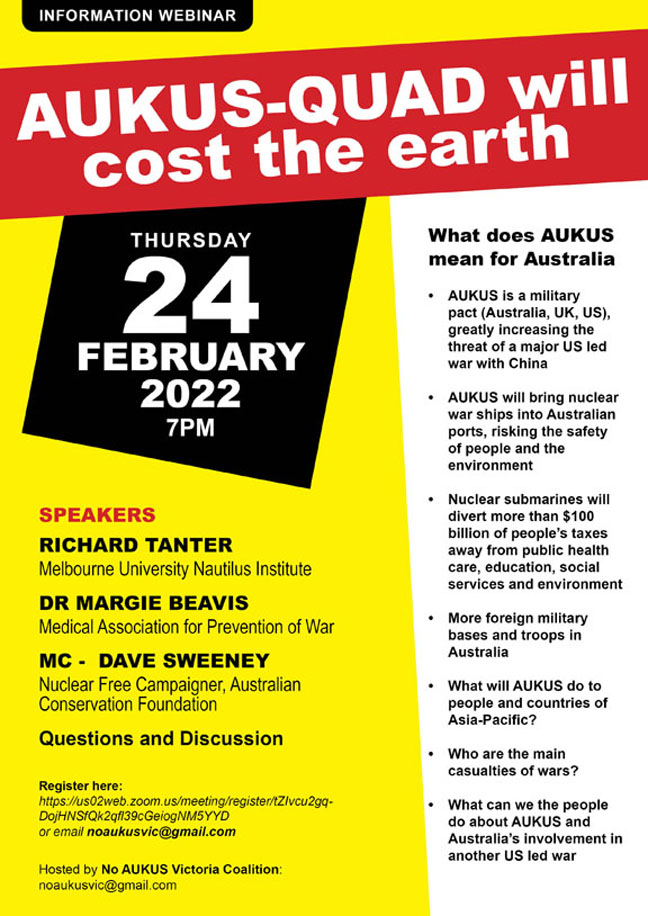
Register for the Webinar/Zoom here: Meeting Registration – Zoom Information and contact: noaukusvic@gmail.com
1 This month.


PETITION – To: Prime Minister Anthony Albanese and the Australian Labor Government
Chernobyl: The Lost Tapes – A good documentary on Chernobyl on SBS available On Demand for the next 3 weeks– https://www.sbs.com.au/ondemand/tv-program/chernobyl-the-lost-tapes/235274195556

19 May – Webinar- Webinar: No Nuclear Weapons in Australia
Start: 2026-05-19 18:00:00 UTC Canberra, Melbourne, Sydney (GMT+10:00)
End: 2026-05-19 19:30:00 UTC Canberra, Melbourne, Sydney (GMT+10:00)
20 May – Webinar – The dangerous world of AUKUS, US, military occupation and suppression of dissent

National Webinar, 20th May, 2026, 6.30pm AEST. Confronting laws restricting/suppressing protest speech and action
Speakers: Former Sen. Rex Patrick, Lawyer Nick Hanna ,Arthur Rorris ,Jorgen Doyle, Sen David Shoebbridge,
Facilitator Kelley Tranter.

of the week – Australians for War Powers Reform (AWPR)
To see nuclear-related stories in greater depth and intensity
 Antinuclear