Australian Labor Party does not trust Angus Taylor’s ”moronic” approach to energy and economics
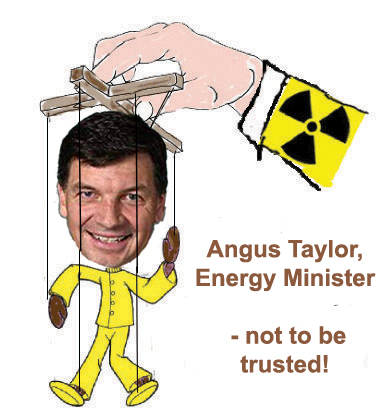
“Nothing better demonstrates the Liberals’ deeply moronic approach to energy and economics,” Josh Wilson, federal MP for Fremantle, tweeted on Friday.
“Nuclear power is not only ferociously expensive, but also slow, inflexible and toxic to the environment and human health.”
Top union leader backs Angus Taylor’s nuclear deal with UK, Jacob Greber AFR, Senior correspondent 30 July 21 One of Australia’s leading union leaders has lent support to Energy Minister Angus Taylor’s decision to enable Australian scientists to work with the UK on next-generation nuclear power development even as two Labor MPs slammed the idea of such power plants as “deeply moronic” and “toxic” to the environment and human health.
Daniel Walton, head of the Australian Workers Union called for “open and pragmatic energy solutions” to reduce carbon footprints at reliable and affordable rates.
If nuclear energy “ticks those three boxes, we should give it serious consideration,” Mr Walton told AFR Weekend. “If it doesn’t tick those boxes, we should move to the next solution.”
Mr Taylor signed a letter of intent this week with his British counterpart, Kwasi Kwarteng, for both countries to collaborate on low-emissions technology, including “advanced nuclear designs and enabling technologies”.
It is understood the co-operation will involve “leveraging” the expertise of the Australian Nuclear Science and Technology Organisation in waste processing and advanced materials to help advance development of small modular reactors, which are about the size of a standard shipping container……….
Reports of the UK-Australia nuclear tie-up triggered an immediate backlash from two West Australian Labor MPs.
“Nothing better demonstrates the Liberals’ deeply moronic approach to energy and economics,” Josh Wilson, federal MP for Fremantle, tweeted on Friday. “Nuclear power is not only ferociously expensive, but also slow, inflexible and toxic to the environment and human health.”
………….Mr Taylor said many Australians, particularly younger Generation Y and X voters, are looking at nuclear plants as a way of getting reliable power.
“All of it comes down to the genuine economic argument. If it’s uncompetitive against existing fossil fuels, then it won’t stack up,” he said. “But we’ll never know that if we never explore nuclear development. https://www.afr.com/policy/energy-and-climate/top-union-leader-backs-angus-taylor-s-nuclear-deal-with-uk-20210730-p58eiz
Tokyo’s Games Are Harming the Nuclear Weapons Ban
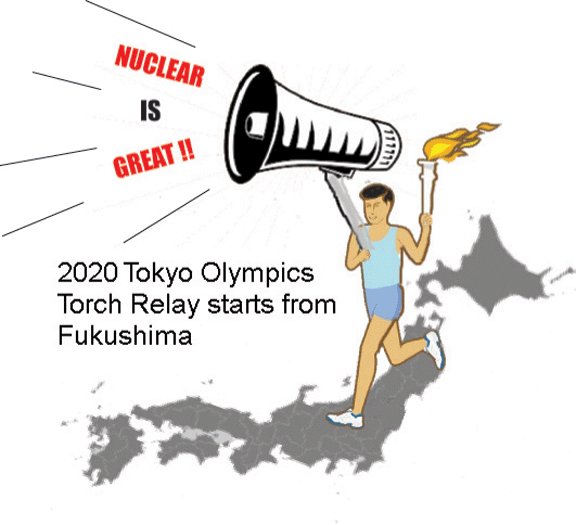
a two-week Olympic media blitz that normalizes nuclear disasters and shrugs at rising nuclear dangers, which illustrates why –
we need a new drive for mass nuclear literacy. With arms control in retreat, an informed citizenry could be our last, best line of defense.
Tokyo’s Games Are Harming the Nuclear Weapons Ban Movement https://www.thenation.com/article/society/tokyo-olympics-nuclear-weapons/
By paying lip service to the Fukushima disaster and the nuclear bombs dropped on Japan, these games are downplaying the growing danger of nuclear catastrophe.
By Alyn Ware
The Olympics are supposed to be a tangible symbol of global cooperation and peaceful competition. But the games carry a lot of baggage—not only from the pandemic but also from the Fukushima disaster and Japan’s nuclear politics.
As Covid cases spread in the Olympic Village and in Tokyo, protesters continue to demand the Olympics be canceled, and they continue to be ignored. But the tone-deafness of these Olympics goes back further—to the Fukushima nuclear disaster. In 2019, then–Prime Minister Shinzo Abe dubbed the Tokyo Olympics the “Recovery Games,” meant “to showcase the affected regions of the tsunami” and the nuclear meltdown of 2011, which continues to pose threats today.
That’s why some Olympic events are being held in Fukushima’s Azuma Stadium, and why Olympic torch runners have been routed through Fukushima prefecture, hitting what the official Olympic website calls “places of interest” near the Fukushima Daiichi nuclear plant. It started at J-Village, a former logistics hub for crews working to remediate the stricken reactors, now a sports complex, where Greenpeace detected a radiation hot spot in late 2019. It passed through Ōkuma and Futaba, where the plant is located, and other nearby towns long abandoned after the disaster.
This is intended to project an image of recovery and normalcy to the world. But it’s government propaganda, deaf to citizens’ concerns, and blind to ongoing threats. Fukushima Daiichi continues to leak radioactivity. New radiation hot spots and other impacts are being discovered all the time.
This sort of Olympic spin tactic has been used before. In the 1964 Tokyo Olympics, the government sought to portray Japan as a modern industrial nation with its own nuclear research program. Yoshinori Sakai, born in Hiroshima on the day the atomic bomb was dropped, lit the Olympic flame. A scant year and half after the Cuban missile crisis, this gesture soft-pedaled the dangers of nuclear technology, nuclear weapons, and the burgeoning arms race.
Today, the tone-deafness continues. This month, on the anniversary of the Trinity nuclear tests that enabled the atomic bombings of Japan, IOC President Thomas Bach went to Hiroshima to lay a wreath at a memorial, prompting an angry response. “President Bach using the image of ‘a peaceful world without nuclear weapons’ only to justify holding of the Olympics by force under the pandemic is a blasphemy to atomic bombing survivors,” a coalition of civic groups wrote. “An act like this does nothing but do harm to the global nuclear weapons ban movement.”
Billions watching the games are imbibing the idea that, protests notwithstanding, Covid, Fukushima, the atomic bombings, and rising nuclear dangers today pose no impediment to normalcy. This should be countered with factual context and truth-telling.
Nuclear Games, a new documentary available online, attempts this by contrasting the Olympic ideals of peace and humanity with our history of nuclear violence and inhumanity (full disclosure: My organization Basel Peace Office is one of several NGOs helping with the project). It uses manga and interactive content to counter Olympic spin and teach mass audiences, including young people, Nuclear History 101: the Cuban missile crisis, Chernobyl, the victims of uranium mining and nuclear testing, the North Korean nuclear program.
We urgently need remedial education on nuclear issues. Most millennials believe nuclear war will occur within the next decade, yet they also rank nuclear weapons as the least important of 12 global issues. They’re both justifiably anxious and badly misinformed.
Achieving basic nuclear literacy is indispensable now. Nuclear dangers are more acute than in 1964, the risk of nuclear war is growing, and the arms control regime is failing. This year, the Bulletin of the Atomic Scientists moved its Doomsday Clock ahead to 100 seconds before midnight—closer to the zero hour than during the Cuban missile crisis.
Nuclear weapons states are turning away from arms control and embarking on a second Cold War–style arms race. As China builds missile silos and Russia builds new types of nuclear weapons, the United Kingdom and Pakistan are expanding their nuclear arsenals, the United States is spending billions to “modernize” its arsenal, and other nuclear powers are following suit.
To be sure, there is pushback. Some 1,200 policy-makers, celebrities, academics, and civil society leaders issued a joint letter to presidents Biden and Putin flagging growing nuclear dangers and urging them to adopt a no-first-use policy to defuse nuclear tensions and facilitate disarmament. US Senators Ed Markey and Jeff Merkley and their colleagues on the Nuclear Arms Control Working group recently called on Biden to guide the Nuclear Posture Review towards a pledge of no first use and the elimination of new types of nuclear weapons.
But such things can hardly compete with a two-week Olympic media blitz that normalizes nuclear disasters and shrugs at rising nuclear dangers, which illustrates why we need a new drive for mass nuclear literacy. With arms control in retreat, an informed citizenry could be our last, best line of defense.
Australia’s carbon emissions down 20% due to wide take-up of renewable energy

Telegraph UK, 29th July 2021, For Australia’s part, our experience with technology-orientated pathways
gives us confidence that with the right investments and partnerships, a prosperous net-zero world is well within our reach.
On the ground, our real-world rollout of renewables has made clear to Australian firms and families the immense benefits of investing in clean technology. Because of their embrace of our new energy future, Australia’s emissions are down over 20 per cent on 2005 levels and green technology continues to be taken
up at record levels right across our nation.
https://www.telegraph.co.uk/news/2021/07/29/technology-key-free-prosperous-net-zero-world/
Japanese civil society calling for the suspension of the Olympic Games — limitless life
\ Dear Friend, The daily covid-19 infections in Japan today surpassed 10 thousand for the first time. Tokyo recorded 3865,the largest number. The explosion of the Delta type of Corona-related infections is now a reality. Civil society has started pleading for the immediate suspension of the on-going Olympic Games. The responsible organizers, the Japanese Government, the […]
Japanese civil society calling for the suspension of the Olympic Games — limitless life
Taylor tries again to redirect renewables funds into hand picked technologies — RenewEconomy

Angus Taylor re-issues ARENA regulations in new attempt to open up the renewable energy agency to the government’s preferred technologies. The post Taylor tries again to redirect renewables funds into hand picked technologies appeared first on RenewEconomy.
Taylor tries again to redirect renewables funds into hand picked technologies — RenewEconomy
Australia’s market operator plans path to zero emissions grid by 2035 — RenewEconomy

AEMO presents five scenarios for the energy transition, but only one delivers on climate targets and requires zero emissions grid by 2035. The post Australia’s market operator plans path to zero emissions grid by 2035 appeared first on RenewEconomy.
Australia’s market operator plans path to zero emissions grid by 2035 — RenewEconomy
Rio Tinto powers ahead on solar farm to supply Pilbara iron ore mine — RenewEconomy

Rio Tinto awards contract to build the mining giant’s first fully-owned solar farm at the Gudai Darri mine in WA Pilbara region. The post Rio Tinto powers ahead on solar farm to supply Pilbara iron ore mine appeared first on RenewEconomy.
Rio Tinto powers ahead on solar farm to supply Pilbara iron ore mine — RenewEconomy
A-bomb survivor activist, 89, calls Japan’s failure to back nuclear ban ‘disgraceful’
A-bomb survivor activist, 89, calls Japan’s failure to back nuclear ban ‘disgraceful’ https://mainichi.jp/english/articles/20210729/p2a/00m/0na/034000c
July 30, 2021 (Mainichi Japan) TOKYO — The world took a major step toward a nuclear-free world when the Treaty on the Prohibition of Nuclear Weapons completely banning the use and storage of atomic arms went into effect in January.
Nuclear powers and countries like Japan which are under the U.S. nuclear umbrella have not signed the treaty, only going as far as joining the Treaty on the Non-Proliferation of Nuclear Weapons (NPT), but the influence of the ban treaty on the NPT is enormous.
However, the COVID-19 pandemic has meant that top-level meetings concerning both treaties have not been held as planned, grinding international discussion of them to a halt. The pandemic has also thrown cold water on citizens’ anti-atomic weapons activism, forcing events to be minimized or canceled outright.
With the 76th anniversaries of America’s atomic bombings of Hiroshima and Nagasaki fast approaching, what do hibakusha — people exposed to the effects of the bomb — still alive today think of these dilemmas?
“This is the only country in the world to have been attacked with nuclear bombs in wartime, and yet it can’t ratify the Treaty on the Prohibition of Nuclear Weapons. I think it’s so pitiful, so disgraceful,” said Terumi Tanaka, the 89-year-old co-chair of the Japan Confederation of A- and H-Bomb Sufferers Organizations. Anger laced his calm tones, obvious even over the online video conference.
In response to the nuclear arms ban treaty going into effect, Tanaka began a petition drive to urge the Japanese government to join the treaty. But half a year has passed now with him unable to go out in the streets due to the pandemic………..
Countries with nuclear weapons won’t attend the conference of the signatories, and only countries without the arms will need to seek ways to ban them. “How do we get nuclear-armed countries involved? I think a time is coming where a great effort will have to be put in (to activism),” he said.
Getting nuclear powers and those under the nuclear umbrella like Japan to take part is no simple task. But while the coronavirus has prevented certain forms of activism, and spread with apparent ease across borders, Tanaka sees a silver lining in the situation, saying, “It’s presented the opportunity to realize that the conflicts countries have between each other are meaningless.”
With this year marking the 65th anniversary of the Japan Confederation of A- and H-Bomb Sufferers Organizations’ founding, Tanaka had in mind that it would mark a sense of closure. Its general meeting is held every June, but due to the state of emergency declared in Tokyo, it has been turned into an on-paper event this year.
“It was very disappointing. We’d needed to do a full review of our activism so far,” Tanaka said regretfully. The average age of hibakusha now is over 83. The generation of people with clear, unshakeable memories of that time like Tanaka, who was 13 when the bomb was dropped on Nagasaki, are gradually but steadily leaving this world.
“We experienced that sound with our bodies. The people who will make up the core of the activism going forward were very young children when they were exposed to the bomb, so they have few memories of the time involving their five senses. But, they might at some point remember what was for them a strange experience. In that sense, those people can be said to have experienced it first hand, too,” he said.
In March, Tanaka ended the international campaign he has pursued for five years to see an earlier implementation of the ban treaty. At the end of May, he resigned as chair of the Saitama Prefecture hibakusha association. After days spent passionately involved in anti-nuclear activism, Tanaka is thinking of using the time he has now to write about the life he spent giving himself to his work.
“Nuclear weapons are so cruel it seems they don’t even qualify for the name ‘weapon’. This testimony must, even when all the hibakusha are gone, be passed down for as long as the human race exists,” Tanaka said.
(Japanese original by Kayo Mukuda, Tokyo City News Department)
Algeria: deep resentment of French colonialism and the effects of nuclear bombing -still very real today.
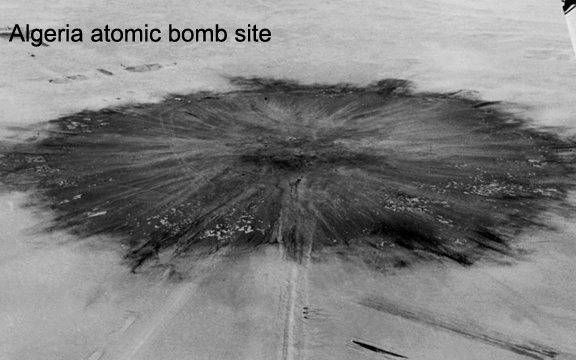
In Algeria, France’s 1960s nuclear tests still taint ties, https://www.france24.com/en/africa/20210729-in-algeria-france-s-1960s-nuclear-tests-still-taint-ties More than 60 years since France started its nuclear tests in Algeria, their legacy continues to poison relations between the North African nation and its former colonial ruler.The issue has come to the fore again after President Emmanuel Macron said in French Polynesia on Tuesday that Paris owed “a debt” to the South Pacific territory over atomic tests there between 1966 and 1996.
The damage the mega-blasts did to people and nature in the former colonies remains a source of deep resentment, seen as proof of discriminatory colonial attitudes and disregard for local lives.
Diseases related to radioactivity are passed on as an inheritance, generation after generation,” said Abderahmane Toumi, head of the Algerian victims’ support group El Gheith El Kadem.
“As long as the region is polluted, the danger will persist,” he said, citing severe health impacts from birth defects and cancers to miscarriages and sterility.
France carried out its first successful atomic bomb test deep in the Algerian Sahara in 1960, making it the world’s fourth nuclear power after the United States, the Soviet Union and Britain.
Today, as Algeria and France struggle to deal with their painful shared history, the identification and decontamination of radioactive sites remains one of the main disputes.
In his landmark report on French colonial rule and the 1954-62 Algerian War, historian Benjamin Stora recommended continued joint work that looks into “the locations of nuclear tests in Algeria and their consequences”.
France in the 1960s had a policy of burying all radioactive waste from the Algerian bomb tests in the desert sands, and for decades declined to reveal their locations.
‘Radioactive fallout’
Algeria’s former veterans affairs minister Tayeb Zitouni recently accused France of refusing to release topographical maps that would identify “burial sites of polluting, radioactive or chemical waste not discovered to date”.”The French side has not technically conducted any initiative to clean up the sites, and France has not undertaken any humanitarian act to compensate the victims,” said Zitouni. According to the Ministry of the Armed Forces in Paris, Algeria and France now “deal with the whole subject at the highest level of state”.
“France has provided the Algerian authorities with the maps it has,” said the ministry.
Between 1960 and 1966, France conducted 17 atmospheric or underground nuclear tests near the town of Reggane, 1,200 kilometres (750 miles) from the capital Algiers, and in mountain tunnels at a site then called In Ekker.
Eleven of them were conducted after the 1962 Evian Accords, which granted Algeria independence but included an article allowing France to use the sites until 1967.
A radioactive cloud from a 1962 test sickened at least 30,000 Algerians, the country’s official APS news agency estimated in 2012.
French documents declassified in 2013 revealed significant radioactive fallout from West Africa to southern Europe. Algeria last month set up a national agency for the rehabilitation of former French nuclear test sites.
In April, Algeria’s army chief of staff, General Said Chengriha, asked his then French counterpart, General Francois Lecointre, for his support, including access to all the maps.
We respect our dead’Receiving the maps is “a right that the Algerian state strongly demands, without forgetting the question of compensation for the Algerian victims of the tests,” stressed a senior army officer, General Bouzid Boufrioua, writing in the defence ministry magazine El Djeich.”France must assume its historical responsibilities,” he argued.President Abdelmadjid Tebboune, however, ruled out any demands for compensation, telling Le Point weekly that “we respect our dead so much that financial compensation would be a belittlement. We are not a begging people.”France passed a law in 2010 which provided for a compensation procedure for “people suffering from illnesses resulting from exposure to radiation from nuclear tests carried out in the Algerian Sahara and in Polynesia between 1960 and 1998”.
But out of 50 Algerians who have since launched claims, only one, a soldier from Algiers who was stationed at one of the sites, “has been able to obtain compensation”, says the International Campaign to Abolish Nuclear Weapons (ICAN).
No resident of the remote desert region has been compensated, it said.
In a study released a year ago, “Radioactivity Under the Sand”, ICAN France urged Paris to hand Algeria a complete list of the burial sites and to facilitate their clean-up.
The 2017 Treaty on the Prohibition of Nuclear Weapons obliges states to provide adequate assistance to individuals affected by the use or testing of nuclear weapons.
It was signed by 122 UN member states, but by none of the nuclear powers. France argued the treaty was”incompatible with a realistic and progressive approach to nuclear disarmament”.
ICAN France in its study argued that “people have been waiting for more than 50 years. There is a need to go faster.
“We are still facing an important health and environmental problem that must be addressed as soon as possible.”
Japanese civil society calling for the suspension of the Olympic Games — limitless life
\ Dear Friend, The daily covid-19 infections in Japan today surpassed 10 thousand for the first time. Tokyo recorded 3865,the largest number. The explosion of the Delta type of Corona-related infections is now a reality. Civil society has started pleading for the immediate suspension of the on-going Olympic Games. The responsible organizers, the Japanese Government, the […]
Japanese civil society calling for the suspension of the Olympic Games — limitless life
July 30 Energy News — geoharvey

Opinion: ¶ “Tesla’s Superior Engineering Cuts Costs, Giving Company New Option To Stoke Demand” • Tesla’s second-quarter earnings call confirms it is on track to continue to expand production like never seen before in the automotive market. Tesla will need to reduce pricing and pull other levers to sell the massive volume of cars it […]
July 30 Energy News — geoharvey
Submission: Sisters of St Joseph South Australia Reconciliation Circle on “ANSTO Intermediate Level Solid Waste Storage Facility Lucas Heights, NSW”

We have noted in the federal budget the allocation of $59.8 million to ANSTO. The PWC Inquiry should consider that proposed indefinite storage of ANSTO nuclear fuel waste and ILW in SA is untenable and compromises safety and security in SA. We respectfully remind the Committee that ANSTO’s premise to transfer ILW into indefinite storage in regional SA is contrary to International Best Practice (IBP) and does not comply with ARPANSA Committee advice.
Submission No. 5: Parliamentary Standing Committee on Public Works. Michele Madigan, Josephite SA Reconciliation Circle 27th July 2021 Inquiry: “ANSTO Intermediate Level Solid Waste Storage Facility Lucas Heights,NSW” Public Submission by the Josephite SA Reconciliation Circle. The Sisters of St Joseph South Australia (SA) Reconciliation Circle and their AssociateMembers welcome the opportunity to make a Public Submission to the Inquiry: “ANSTO Intermediate Level Solid Waste Storage Facility Lucas Heights, NSW”
In summary: Our members see as key the need for the Public Works Committee to actively encourage ANSTO to modify their storage facility for Intermediate Level Waste to keep the nation’s highest level of radioactive waste – intermediate long lived waste – on site until the final deep geological storage site is ready to receive it.
Our members include those who have been involved since 1998 with the vexed question of the federal government’s determination to store the nation’s highest level radioactive waste – intermediate long lived radioactive waste- in above ground temporary storage, with no planned final site.
Since 2015, these and other more recent members have been concerned and have taken action about the federal government’s latest plan to transport such waste to either the Flinders Ranges SA or the Kimba region SA. In this we have had good cause to stand with boththe Traditional Owners: the Adnyamathanha in the Flinders Ranges and the Barngarla in the
Kimba region.
Of course as South Australians we are also speaking for ourselves and many other South Australians concerned with various worrying aspects of the present federal government’s plans, including the inherent safety issues of such dangerous waste for communities along thetransport routes (yet to be determined or at least yet to be publicly released.)
We have noted in the federal budget the allocation of $59.8 million to ANSTO. The PWC Inquiry should consider that proposed indefinite storage of ANSTO nuclear fuel waste and ILW in SA is untenable and compromises safety and security in SA. We respectfully remind the Committee that ANSTO’s premise to transfer ILW into indefinite storage in regional SA is contrary to International Best Practice (IBP) and does not comply with ARPANSA Committee advice.
It is well known that the Dr Carl-Magnus Larsson former head of the regulator body ARPANSA has stated publicly on June 20th 2020 that ‘there is ample room at ANSTO for decades to come.’
Duty of Care As members of government the Public Works Committee will be well acquainted with the principle of ‘duty of care.’ Department officials seemingly have chosen an arbitrary number of 100 years for the proposed transported highly dangerous material to be left above ground with no definite contingencies to safeguard such.
Burden on Future Generations: Our members put it to the Committee that the present plans are simply ‘kicking the can down the road’ leaving a task for future generations that our present federal government is simply not willing to take on itself. And further that once transported and ‘stored’ there is no guarantee at all that the highly toxic material will not simply remain where it is.
Time frame. Clearly there are few Australians alive today who were born in 1921. One hundred years is beyond the knowledge of most of us. The fact that the ILW and other Lucas Heights material are by ANTSO’S own admission, toxic for an unimaginable 10,000 years, means that it is extremely irresponsible policy to be complicit or even advocating for such material to leave the direct care of ANSTO’s expertise and high security to be simply stored above ground on farming land, half way across the country from the nation’s nuclear experts.
ANSTO’S highly dangerous nuclear fuel wastes as well as their Intermediate Level Nuclear Waste need radiation shielding, safe expert handling and high security – and of course isolation from adults, children, animals and the environment lands and ground waters. This will not happen in the proposed above ground facility – even for 100 years.
Recommendation: We put to members of the Public Works Committee: that the present allocation of funding to ANSTO for safe and secure storage include the capacity to modify their storage facility to enable on site continuous storage of ANSTO’s own nuclear fuel waste and long lived intermediate level radioactive waste until such time as a permanent best practice underground final suitable storage site is found and
completed.
We thank you for receiving and noting oursubmission. https://www.aph.gov.au/Parliamentary_Business/Committees/Joint/Public_Works/ANSTOLucasHeights/Submissions
No need for Kimba interim nuclear waste storage, as Australian Government budgets for increased storage capacity at Lucas Heights.
the present nuclear waste storage site at Lucas Heights is in no danger of running out of room. ARPANSA (Australian Radiation Protection and Nuclear Safety Agency) is the nation’s nuclear regulator. In 2020 in parliamentary testimony, Dr Carl-Magnus Larsson clearly stated, ‘Waste can be safely stored at Lucas Heights for decades to come.’ In fact, the recent federal Budget provided $60 million for further decades of extended storage capacity for Intermediate Long-lived Waste at ANSTO Lucas Heights, building onto the operation of existing stores to 2026. There is no emergency.
As nuclear waste storage Bill passes, the fight continues, https://www.eurekastreet.com.au/article/as-nuclear-waste-storage-bill-passes–the-fight-continues?utm_medium=email&utm_campaign=Eureka%20Street%20Daily%20-%20Tuesday%2027%20July%202021&utm_content=Eureka%20Street%20Daily%20-%20Tuesday%2027%20July%202021+CID_ef6ae62e9543e5b0c91147f8dd3a4683&utm_source=Jescom%20Newsletters&utm_term=READ%20MORE Michele Madigan 26 July 2021
For several decades, successive federal governments have tried but failed to establish a national nuclear waste repository, primarily to take waste from the nuclear research reactor site operated by the Australian Nuclear Science and Technology Organisation (ANSTO) at Lucas Heights, 30 km south of Sydney. Currently, a site near Kimba on South Australia’s Eyre Peninsula is being targeted.
Federal Resources Minister Keith Pitt has always had the power to make a ministerial declaration of a particular site for the new national radioactive waste storage facility. But instead of making a selection, for over twelve months he chose to take his NRWMF (National Radioactive Waste Management Facility) Amendment Bill legislation to Parliament. Under his proposed legislation, any group that opposed the site he selected — including the Barngarla Traditional Owners — would not have the power of judicial review.
Last month, the Senate came to a decision approving an amended Bill that would allow Traditional Owners judicial review if the location was disputed. Minister Pitt was forced to admit defeat.
Over the course of the Bill’s passage, the Coalition had the numbers in the House of course, with the legislation passing in 2020 only after informed and strong opposing speeches by Labor, the Greens and Independents. The Senate, however, was a different matter. Labor, the Greens and the majority of the other five Crossbenchers continued for months standing firmly against legislation that denied judicial review to opposition groups.
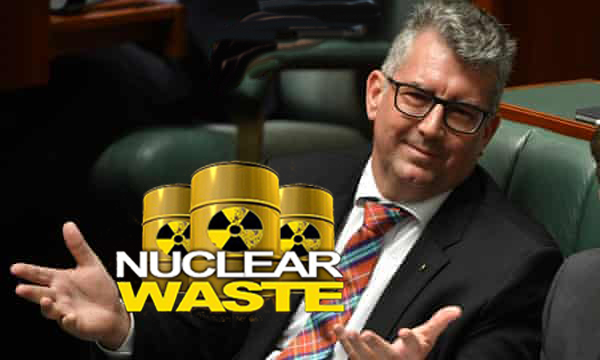
Minister Pitt, having listed the legislation a number of times, was then forced every time to withdraw his Bill. In regular media statements, Pitt harangued opposing Senators, especially Labor, with increasingly extravagant claims for the necessity of the dump for the future of nuclear medicine.
Government arguments to the contrary, the present nuclear waste storage site at Lucas Heights is in no danger of running out of room. ARPANSA (Australian Radiation Protection and Nuclear Safety Agency) is the nation’s nuclear regulator. In 2020 in parliamentary testimony, Dr Carl-Magnus Larsson clearly stated, ‘Waste can be safely stored at Lucas Heights for decades to come.’ In fact, the recent federal Budget provided $60 million for further decades of extended storage capacity for Intermediate Long-lived Waste at ANSTO Lucas Heights, building onto the operation of existing stores to 2026. There is no emergency.
During last month’s Senate debate many salient points were made by the Greens and other Crossbench Senators. During the debate, the previous Minister for Resources Matthew Canavan gave assurances that the invited submissions would be taken into consideration, but 95 per cent of the submissions made were against the proposed new site.
Further, it was pointed out that in the Kimba district, 36 non-residents with property were permitted to vote while the Traditional Owners, and also farmers whose properties were closer to the Napandee site but outside the Kimba Council region, were not.
So where are we up to in this long-running saga?
With the intermediate level waste simply being moved from one part of the nation to be again stored above ground for a cited 100 years, the can is being kicked down the road for future generations to deal with. What is needed is an independent expert inquiry..
And with judicial review allowed in the amended legislation, Labor were able to say they were supporting the Traditional Owners and then voted with the government to ensure the amended Bill became law.
The Barngarla Determination Aboriginal Corporation (BDAC) is finally free to proceed to court. The resources Minister within the coming weeks will formally declare the site, almost certain to be Napandee in the Kimba region in SA. From there, the project will require EPBC (Environment Protection and Biodiversity Conservation) procedure and the regulator ARPANSA licensing, both offering significant public opportunities.
Finally: there are two elections looming: South Australia’s State elections on 19 March, 2022, as well as Federal. Both SA Liberal and Labor past Premiers have initiated successful state legislation ‘prohibiting the establishment of certain nuclear waste facilities’ in this state. Environmentalists are now calling on South Australians to make the federal government’s radioactive waste plan that counters this legislation, an election issue.
At times, in such a long campaign one can ask, is opposition really worth the struggle?
I received an answer to that question on 18 June, on State Parliament House steps, when a colleague and I conducted a rehearsal for a larger sit-in. In the cold I was in a long dress, gloves, scarf, woollen cap, hoodie jacket. After our shift, my companion went to get the car leaving at my feet our magnificent banner hidden by its worn tarpaulin cover. As a group of high school children rushed past me towards the railway station, a lively-looking student, maybe 15 years old, said something to her teacher. Then she approached and stood in front of me offering an almost-full packet of chips. ‘Do you want them?’ I stared back at her, not understanding. Again: ‘Do you want them?’ Looking down at the old tarpaulin, I realised she was feeding the homeless!
This girl is an example of the beautiful future generations whose well-being we are responsible for. They deserve far better than radioactive waste, toxic for 10,00 years, being stored above ground in their state. The fight continues.
Donate to the Barngarla crowdfunder to fund a legal challenge.
No-one can get finance to build a uranium mine in Australia.

NO-ONE CAN GET FINANCE TO BUILD A URANIUM MINE IN AUSTRALIA https://www.ccwa.org.au/no_finance_toro?utm_campaign=nuclear_news172&utm_medium=email&utm_source=ccwa
BY K-A GARLICK JULY 26, 2021 CCWA nuclear-free campaigner Kerrie-Ann Garlick attended last week’s Toro meeting to raise concerns that the company’s most recent uranium proposal differs from its currently approved plan.
Toro Energy’s general meeting last Friday heard the death toll sounding on WA’s uranium hopefuls.
Toro Chair Richard Homsany told the meeting that no one can get finance to build a uranium mine in Australia. He also acknowledged that Toro’s conditional environmental approval for its stalled Wiluna project expires on January 9, 2022. From this date, Toro will not be able to mine without making project changes that would require further state government scrutiny and approval.
In 2017 the McGowan Labor government introduced a policy ban on uranium mining in WA but inherited four uranium mine proposals with existing approvals granted by the former Barnett government. By the end of January 2022, the current Ministerial approvals for all four of the states proposed uranium mines will expire if they do not commence mining.
Approval for Cameco’s Kintyre expired and was not renewed in March 2020, Vimy Resources Mulga Rock project approval expires in December 2021 and both Yeelirrie (Cameco) and Wiluna (Toro) are set to expire in January 2022. If any of these companies want to mine they will need to seek approval for amendments to Ministerial conditions. This may trigger a new assessment or a suite of other conditions being applied.
CCWA nuclear-free campaigner Kerrie-Ann Garlick attended last week’s Toro meeting to raise concerns that the company’s most recent uranium proposal differs from its currently approved plan. “Toro is now focused on developing a JV uranium project at Lake Maitland. This is completely separate from the existing approval for the Wiluna project and would require a whole new environmental assessment. It is our view that this could not be advanced because of the existing policy ban on uranium mining in WA.”
“The Wiluna uranium mine proposal is uneconomic and they don’t have the funding to develop it. There is almost no scenario in which the Wiluna uranium mine could be developed ahead of the approval expiry in January 2022”
“It is refreshing that the Toro Board are realistic about the current highly negative market conditions for uranium. No one is financing uranium mines and that is unlikely to change by January. It is increasingly likely that we will reach a point in January 2022 where there are no operating mines and no active approvals for uranium mining in WA,” Ms Garlick concluded.
Australian uranium company developing interest in USA mines, despite USA govt pulling out of them.
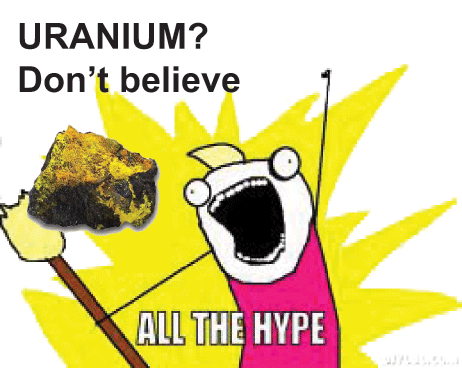
Utah uranium mines being eyed by Australian company
Foreign investors consider $75 million in federal funding that was supposed to boost uranium production in the United States, but the Biden administration indicates it won’t renew the program.
Australian interest in uranium mining in San Juan County. By Zak Podmore Salt Lake Tribune: July 16, 2021
East Canyon • On the flank of a remote mesa in San Juan County, where the abandoned shafts of the None Such uranium mine cut into the hillside amid a yellowing juniper forest, Utah’s uranium boom days seem part of a distant past.
Rusting metal machinery and other trash protrude from eroding, unfenced tailings piles left by operators in the 1970s. Small Bureau of Land Management signs warn passersby — mostly adventurous all-terrain vehicle riders braving washed-out roads — it’s unsafe to enter the mines.
But a few scattered survey stakes along the mesa, located 14 miles north of Monticello, provide a subtle indication that the area’s rich uranium and vanadium deposits may soon be tapped once again.
In May, TNT Mines — an Australian zinc, gold and uranium mining company — acquired dozens of mining claims in the East Canyon uranium-vanadium project area, and according to a recent presentation to investors, the company is currently mapping the geology of the area.
The renewed interest in the region’s uranium deposits, TNT said in the presentation, is being driven by two major factors: East Canyon’s proximity to Energy Fuels’ White Mesa Mill near Blanding (the only conventional uranium mill operating in the United States) and policies implemented by then-President Donald Trump that sought to boost domestic uranium production.
Although there are several fully permitted uranium mines in San Juan County, including Energy Fuels’ Daneros Mine near Bears Ears National Monument, they have remained mostly idle in recent decades due to low global uranium prices………
Trump added uranium to the U.S. “critical minerals list” in 2018, a move that President Joe Biden’s Interior Department recently announced it would reverse this fall.
In December, the massive COVID-19 relief package set aside $75 million to create a stockpile of domestically mined uranium, another Trump administration recommendation that was ostensibly part of the former president’s “American energy dominance” agenda. But the promise of government subsidies and low taxes has drawn the attention of foreign companies such as TNT Mines………..
Congress provided the $75 million in funding to the domestic uranium stockpile this year, and the Trump administration recommended extending the program for 10 years. But under Biden, the Energy Department has reversed course, leaving funding for the uranium reserve out of its 2022 budget request. https://www.sltrib.com/news/2021/07/13/trump-era-policies-entice/
1 This month.

Australians deserve the truth
about
AUKUS – https://aukuspublicinquiry.com/

PETITION – To: Prime Minister Anthony Albanese and the Australian Labor Government

of the week – Australians for War Powers Reform (AWPR)
To see nuclear-related stories in greater depth and intensity
 Antinuclear