Wind and solar could deliver 65 pct of Australia demand by 2030 if built on time — RenewEconomy

Wind and solar projects are queuing up, but short term factors and high coal prices cause us to lift our wholesale price forecasts. The post Wind and solar could deliver 65 pct of Australia demand by 2030 if built on time appeared first on RenewEconomy.
Wind and solar could deliver 65 pct of Australia demand by 2030 if built on time — RenewEconomy
Queensland greenlights $23m renewable energy skills centre — RenewEconomy

Queensland government fast tracks new “state of the art” renewable energy training facility, complete with onsite wind turbine and solar farm. The post Queensland greenlights $23m renewable energy skills centre appeared first on RenewEconomy.
Queensland greenlights $23m renewable energy skills centre — RenewEconomy
Renewables overtake coal and nuclear to become 2nd biggest grid source in US — RenewEconomy

Renewables overtake both coal and nuclear for first time to become second biggest source of electricity generation in US in 2020. The post Renewables overtake coal and nuclear to become 2nd biggest grid source in US appeared first on RenewEconomy.
Renewables overtake coal and nuclear to become 2nd biggest grid source in US — RenewEconomy
Olympic sports were intended as celebration of Fukushima’s ”recovery” from nuclear disaster, but that didn’t work.
Fukushima, intended to celebrate recovery from nuclear disaster, will have an ‘unfortunate’ lack of fans for Japan’s Olympic baseball game, By Blake Essig, Emiko Jozuka and George Ramsay, CNN July 28, 2021
After a 13-year hiatus, baseball is returning to the Olympics — although no fans will be there to witness it.
It’s a particular disappointment for the city of Fukushima, where the Olympics was supposed to celebrate the region’s recovery from a nuclear disaster more than a decade ago……….
………… Iwamura adds that staging the Olympics in Japan is “controversial,” but hopes that a successful Games can “spread the possibilities of overcoming difficulties” — a particularly important message for Fukushima and one the city hopes to embody by hosting global sporting events……. https://edition.cnn.com/2021/07/28/sport/fukushima-olympics-baseball-spt-intl/index.html
Facebook apologises for blocking access to the website of the Scottish Campaign for Nuclear Disarmament (CND), – but does not explain why it happened
The Ferret 27th July 2021, Facebook has issued an apology to the Scottish Campaign for Nuclear
Disarmament (CND) after blocking people from accessing the peace
organisation’s website from its platform. The Ferret reported last week
that Scottish CND was considering a complaint to Ofcom because people
trying to access its website from its Facebook page were advised the URL
breached “community standards”. Facebook has now resolved the issue but
Scottish CND criticised the social media giant for failing to explain why
its site was blocked in the first place. The peace group thinks it may have
been a “malicious complaint” or the word “bomb” in its URL which
proved problematic.
The Ferret 27th July 2021
American public opinion ignored as NASA prioritises colonising Mars, over research to save the climate

63 percent according to a 2018 Pew Research Center survey—believe that NASA should prioritize monitoring Earth’s climate system. Only a minority—18 percent—said that NASA should prioritize sending humans to Mars.
Is using nuclear materials for space travel dangerous, genius, or a little of both? bulletin of the Atomic Scientists , Bulletin of the Atomic Scientists, By Susan D’Agostino | July 28, 2021
The 1977 Soviet satellite Kosmos 954 was supposed to monitor ocean traffic using radar—a technology that works best at short distances. For this reason, the craft traveled in Earth’s low orbit, where solar panels alone could not provide consistent power. And so, the satellite was equipped with a small, efficient, yet powerful nuclear reactor fueled by approximately 50 kg of weapons-grade uranium 235. Within weeks of its launch, Kosmos 954 veered from its path like a drunkard on a walk. The Soviets tried to eject its radioactive core into a higher orbit by way of a safety system designed for that purpose. But the safety system failed. In January 1978, Kosmos 954 burst into the Western Canada skyline, scattering radioactive dust and debris over a nearly 400-mile path. The cleanup and recovery process, which took nearly eight months and started in the subarctic winter, found that virtually all of the satellite fragments were radioactive, including one that was “sufficient to kill a person or number of persons remaining in contact with that part for a few hours.”
Now that the United States has set a goal of a human mission to Mars by 2039, the words “nuclear” and “space” are again popping up together in newspaper headlines. Nuclear propulsion systems for space exploration—should they materialize—are expected to offer significant advantages, including the possibility of sending spacecraft farther, in less time, and more efficiently than traditional chemical propulsion systems. But extreme physical conditions on the launchpad, in space, and during reentry raise questions about risk-mitigation measures, especially when nuclear materials are present.
Why not travel to Mars on a chemically propelled spacecraft? Spaceships that use chemical propellants benefit from tremendous thrust to get the job done. However, they also need to carry fuel and oxidizer to power that incredible upward or forward movement………..
Even if a spacecraft were able to refuel with a chemical propellant in space or magically carry enough chemical propellant for the journey to Mars, the long transit time would present a hazard to the crew……..
In theory, nuclear propulsion for space travel will offer two significant advantages over chemical propulsion. First, since nuclear systems are much more efficient, the amount of fuel required for the journey to Mars is practical. Second, without a need to traverse the shortest path, the flight could take off from Earth and Mars anytime—without delay. The latter would reduce the length of the roundtrip journey and the crew’s exposure to radiation.
Still, attaching what amounts to a nuclear reactor to a human-occupied spaceship is not without risks.
Is the idea of sending nuclear materials into space new? The idea of sending nuclear materials into outer space is not new. And unlike Kosmos 954, many instances have been successful. Since 1961, NASA has powered more than 25 space missions with nuclear materials. The only other practical power option—solar power—is often unavailable in dark, dusty, far-off corners of the solar system.
Likewise, the Atomic Energy Commission launched a nuclear-thermal rocket propulsion research and development program in 1955. …….funding and interest in the programs dried up in the 1970s……
What new plans does the United States have for sending nuclear materials to space? The National Academies’ report released earlier this year recommended that NASA “commit within the year to conducting an extensive and objective assessment of the merits and challenges of using different types of space nuclear propulsion systems and to making significant technology investments this decade.” The report offers a roadmap for developing two different kinds of propulsion systems—nuclear electric and nuclear thermal—for human missions to Mars.
A nuclear electric propulsion system bears some resemblance to a terrestrial power plant. That is, first a fission reactor generates power for electric thrusters. That power positively charges the ions in the gas propellant, after which electric, magnetic, or electrostatic fields accelerate the ions. The accelerated ions are then pushed out through a thruster, which propels the spacecraft.
Alternatively, in a nuclear thermal propulsion system, the reactor operates more as a heat exchanger in which a fuel such as liquid hydrogen is first heated to very high temperatures—up to 4,600 degrees Fahrenheit—that is then exhausted through a rocket nozzle to produce thrust.
“For nuclear thermal propulsion, the challenge is: temperature, temperature, temperature,” Anthony Calomino, a materials and structure research engineer at NASA’s Langley Research Center, said. “There are not many materials that can survive those kinds of temperatures.” ………..
While nuclear electric propulsion systems do not require extreme temperatures, they face a different hurdle. Nuclear electric systems have six subsystems, including a reactor, shield, power conversion, heat rejection, power management and distribution, and electric propulsion systems. The operating power of all of these subsystems will need to be scaled up by orders of magnitude—and in such a way that they continue to work together—before they are ready for space……………..
Why is the United States planning to send humans to Mars anyway? Some argue that the scientific value of a human-crewed Mars mission could be captured by robots at a much lower cost and risk. Others think that humans, whose role in terrestrial climate change is apparent, should first rehabilitate Earth before colonizing other planets. Still others worry that human microbes could contaminate the Red Planet.
Indeed, a majority of Americans—63 percent according to a 2018 Pew Research Center survey—believe that NASA should prioritize monitoring Earth’s climate system. Only a minority—18 percent—said that NASA should prioritize sending humans to Mars……………. https://thebulletin.org/2021/07/is-using-nuclear-materials-for-space-travel-dangerous-genius-or-a-little-of-both/
Can solar and farming co-exist? Dutch trial hopes to prove a perfect match — RenewEconomy

Vattenfall to trial a solar farm that will be combined with Dutch strip farming practices for organic crops. The post Can solar and farming co-exist? Dutch trial hopes to prove a perfect match appeared first on RenewEconomy.
Can solar and farming co-exist? Dutch trial hopes to prove a perfect match — RenewEconomy
Facebook’s disinformation problem is harder than it looks, by Matthew Ingram — Rise Up Times

“finding the right line between disinformation control, public-health awareness, and outright censorship is not an easy task.”
Facebook’s disinformation problem is harder than it looks, by Matthew Ingram — Rise Up Times
New report on the UN Security Council’s work on climate security published — The Center for Climate & Security

This is a cross-post from the Planetary Security Initiative In the past 18 months, the emergence of climate security as a mainstreamed and core risk for national governments and IGOs has accelerated. In particular, the UN Security Council (UNSC) is becoming more cognizant of climate change being a core security risk that should be under…
New report on the UN Security Council’s work on climate security published — The Center for Climate & Security
To 27 July – the week in nuclear news, Australia and more

It has been a funny week in the news, funny not as in ha ha, but as in weird. The news here prioritised the Olympics. Oh goody, my countrymen and women won lovely medals, for doing sporty things, very fast.- so, extensive coverage of all that.
You wouldn’t know that the host city, Tokyo, is now daily getting close to 2000 new cases of coronavirus. You wouldn’t know that megafires are torching U.S. Western States, and North Eastern Siberia. Briefly mentioned – huge floods inEurope and China. Oh, and by the way, I think that the pandemic is still on, world wide, with the highly infectious delta variant.
The second biggest story, after the glorious Olympics, has been the success of the billionaire space playboys – Richard Branson, Jeff Bezos. The media can’t wait until Elon Musk and Bill Gates do their next thing – missile envy bringing great things for the world,(though we”re not quite sure what things)
AUSTRALIA
Opposition to nuclear waste transport through the port of Whyalla, South Australia. Port at Cape Hardy could be the entrance place for radioactive waste transport to Kimba, South Australia. Barngarla native title owners were excluded from decision-making on Kimba nuclear waste plan. A strong convention on radioactive waste safety means that nuclear’s toxic by-products should be kept as close as possible to the point of production
Western Australian site far more suitable than Kimba, South Australia, for nuclear waste dump. Regional site in Western Australia geologically and geographically suited to nuclear waste repository, unlike the Kimba site in S.A. Resources Minister Keith Pitt and his bald-faced lies about the Leonora nuclear waste proposal.
Submissions to the Federal Public Works Committee:
- The Australian Parliament will have to pay attention to David Noonan’s detailed submission on ANSTO’s ill-advised nuclear waste storage plan.
- Submission: Flinders Local Action Group points out the flaws in ANSTO’s nuclear waste plan.
- Submission: Barry Wakelin – ”interim ” storage of nuclear waste at Kimba is a poor plan, with no commitment to planning for a permanent solution.
- Submission: Leon Ashton opposes ANSTO’s flawed plan to set up a stranded nuclear waste dump at Kimba, South Australia.
- Submission: AZARK PROJECT says that Kimba nuclear waste plan is completely unnecessary, and irrelevant to nuclear medicine.
- Submission Noel Wauchope to Federal Inquiry into nuclear waste storage..
- Showdown over millions in mining royalties to Indigenous trust.
INTERNATIONAL.
Moral Intelligence or Nuclear War.
The world’s climate catastrophe – there is little time left to act. All We Can Save”: As Climate Disasters Wreck Our Planet, Women Leaders Are Key to Solving the Crisis. Intergovernmental Panel on Climate Change (IPCC) preparing assessments for COP26.
Climate change, extreme weather, is taking its toll on the nuclear industry. The nuclear industry determined to influence climate talks before COP26.
Racism and the misguided efforts to expand nuclear energy around the world,
After the lab-leak theory, US-Chinese relations head downhill.
Progressive lawmakers join across the world in a Global Alliance For A Green New Deal.
Huge carbon emissions of space tourism, Space tourism: environmental vandalism for the super-rich . Climate change report: Jeff Bezos & the new wild west show. Jeff Bezos and the corporate colonisation of the stars. Perils to austronauts’ health – high radiation and low gravity.
Emerging technologies and nuclear stability. Small Nuclear Power Plants No Use in Climate Crisis. Bill Gates’ fast nuclear reactor ”Natrium’‘ – not so safe and a nuclear weapons proliferation risk.
Why Scientists Plant Sunflowers After Nuclear Disasters.
Submission Noel Wauchope: to Federal Inquiry into nuclear waste storage.
Noel Wauchope 27 July 21, To: Parliamentary Standing Committee on Public Works Inquiry: “ANSTO Intermediate Level Solid Waste Storage Facility Lucas Heights, NSW” Public Submission. I do not write as someone who is opposed to Australia having a plan for the permanent disposal of the nuclear wastes that are generated at Lucas Heights. Quite the reverse. Australia must face up to the necessity for such a plan.
However, ANSTO’s proposal for a temporary storage of these long lasting toxic wastes, at Napandee, South Australia, is NOT such a plan. As the licensing body, ARPANSA, has acknowledged, these highly hazardous nuclear fuel wastes can be safely and securely stored at Lucas Heights. Indeed ARPANSA has licensed this storage for at least 40 years to come. There is absolutely no need to trek this highly dangerous stuff for 1700 km to a small rural community, in a richly agricultural area – for so-called ”temporary” storage . At Napandee, they may well become ”stranded wastes”, while the necessity for permanent disposal remains ”a can kicked down the road”.
ARPANSA is still to consider the licensing application for the Napandee nuclear waste facility plan. ANSTO should not be able to continue with its process for the Napandee plan before this; ARPANSA Approval for proposed indefinite duration above ground nuclear fuel waste and Intermediate Level Waste storage in SA may not be granted.
Therefore, it is up to the Public Works Committee to require and confirm ANSTO public works that will comply with the Contingency to keep
Intermediate Level Wastes at Lucas Heights until a final disposal option is available.
It has not been made clear that there are really two separate proposals by the National Radioactive Waste Management for radioactive waste storage in South Australia
- for Low-Level Waste disposal facility in SA for an indefinite period.
- above ground nuclear fuel waste and ILW storage
ARPANSA will expect separate License Applications for these two proposals.
On transparency. ANSTO has been secretive about its plans regarding Intermediate Level Wastes. At least two significant reports to ARPANSA, required as part of
ARPANSA Licensing Conditions and due to the regulator by 30 June 2020, and ARPANSA’s reply, should be made available to the PWC, and publicly available.
On safety and security. As ARPANSA has noted, the double handling of Intermediate Level Waste in transporting it from one temporary storage to another temporary storage, is not consistent with international best practice. The safety and security problems of course also involve the communities en route, over such a long distance. Yet the NRWM taskforce has not engaged with these communities, surely that engagement must be a requirement for such a plan
On the undemocratic process. The National Radioactive Waste Management plan for this facility at Napandee rides roughshod over the rights of South Australians, who have had no say in this decision. It is an affront to South Australia, with its clear law prohibiting nuclear activitis. THe Eyre Peninsula region ‘s communities have had no say. Importantly, the traditional owners of the area.the Barngarla people, were eluded from the local vote, and are clearly against the dump plan.
On the hypocritical claim of ”medical necessity”. The publicity from ANSTO and from MInister Pitt has portrayed this facility as a ”medical necessity”, which it very obviously is not. As this submission primarily concerns the public works at ANSTO, I won’t go into that issue now. But it is pretty obvious to all but the somewhat brainwashed Kimba supporters of the plan, that the mostly short-lived medical radioactive wastes are dealt with at the local level, with no need for the elaborate centralised plan for Napandee. https://www.aph.gov.au/Parliamentary_Business/Committees/Joint/Public_Works/ANSTOLucasHeights/Submissions
Victoria’s Bayside Council call on Australian government to support the UN nuclear weapons ban treaty
Bayside Council supports nuclear prohibition,, https://www.miragenews.com/bayside-council-supports-nuclear-prohibition-601949/ 26 July 21, Bayside City Council has become the 11th Council in Victoria to join the call for the Australian Government to sign and ratify the United Nations (UN) Treaty on the Prohibition of Nuclear Weapons.
In a unanimous decision at the July 2021 Council Meeting, Bayside Councillors declared their support and are now calling on the Australian Government to sign the Treaty without delay.
Nuclear weapons pose a threat to communities throughout the world, and we believe all people, including our residents, have the right to live in a world free from this threat,” Mayor Cr Laurence Evans said.
“Any use of nuclear weapons, whether deliberate or accidental, would have catastrophic, far-reaching and long lasting consequences for people and the environment.”
Australia has not signed or ratified the Treaty, despite committing to pursue nuclear disarmament under the 1970 nuclear Non-Proliferation Treaty.
“It’s time for Australia to sign and get on the right side of history,” Cr Evans said.
Part of the Council resolution includes writing to the Foreign Affairs Minister, and the local Federal member of parliament, advising of Council’s support to the Treaty.
t was also resolved that Council will take steps to ensure that funds administered by Bayside City Council are not invested in companies that produce nuclear weapons.
Bayside City Council is the 11th Victoria Council to join the International Campaign to Abolish Nuclear Weapons (ICAN) Cities Appeal- a global call from cities and towns in support of the UN Treaty on the Prohibition of Nuclear Weapons.
(ICAN) is a coalition of non-governmental organisations in 100 countries promoting the implementation of the United Nations Treaty on the Prohibition of Nuclear Weapons. Founded in Melbourne in 2007, ICAN was awarded the 2017 Nobel Peace Prize
”Nuclear Games” expose Japanese government’s spin about the Olympic Games.

In the runup to July 23 opening ceremony, the Olympic torch relay was deliberately routed through Fukushima Prefecture, including the towns where the plant is located, and others nearby that were long abandoned in the wake of the disaster. Olympic baseball and softball competitions are also being held in a stadium in Fukushima Prefecture.
Billions will watch the Olympics and get the carefully crafted message that everything in Fukushima is fine, and that nuclear meltdowns are quickly lived down. But that’s dangerous denialism. We need a global education effort to promote basic literacy about nuclear dangers in order to make future nuclear disasters less likely.”
Games for the young coincides with Tokyo Olympics, Saily News, 26 July 21,
Perhaps it was also a reflection of the longstanding cat-and-mouse game played by the world’s nine nuclear powers – the US, UK, France, China, Russia, India, Pakistan, North Korea and Israel – violating the Olympic ideals of peace and humanity with a resurgent nuclear arms race.
The coalition says Nuclear Games shines a light on nuclear issues which are deliberately downplayed by governments, including by Japan as it presents the Olympics with a virtually empty stadium because of Coronavirus restrictions.
Japan experienced nuclear bombings in 1945 and also suffered one of the world’s most devastating nuclear power accidents in 2011 and remains deeply affected by them.Tuesday, July 27, 2021 -Coinciding with the opening ceremony, a coalition of non-governmental organizations (NGOs), anti-nuclear activists and youth leaders launched Nuclear Games, an innovative film and online platform addressing nuclear history and the risks and impacts of nuclear weapons and nuclear energy……………..In a press release, the coalition of NGOs said that nuclear dangers and tensions are rising today. According to the Pentagon, the risk of nuclear war is growing. The Bulletin of Atomic Scientists’ Doomsday Clock advanced this year to 100 seconds to midnight – closer to nuclear war even than during the Cuban Missile Crisis……
Nuclear Games was developed by interactive video books pioneer Docmine, a Swiss-based creative studio, with support from Basel Peace Office, Youth Fusion, Physicians for Social Responsibility, Switzerland and the World Future Council.
It is offered in English and German and aimed at non-usual suspects: people who don’t typically watch political documentaries or engage in anti-nuclear advocacy work, says the coalition.
“It will have particular resonance with younger viewers, many of whom are unfamiliar with the history it conveys of nuclear disasters, near misses, and ongoing threats and impacts.”
Joseph Gerson, President of the Campaign for Peace, Disarmament and Common Security, and Vice-President of the International Peace Bureau, told IDN: “In addition to appreciating the film’s pointing to the ongoing existential nuclear dangers on the eve of the 76th anniversary of the Hiroshima and Nagasaki A-bombings, I am glad that the Games’ press release points to the hypocrisy of the Olympics being held midst the pandemic.”
He said the Japanese Government has cynically spent trillions of Yen to prepare for the Olympics and then insisted on holding them against the opposition of most people in Japan.
“With only a quarter of the Japanese population vaccinated against Covid-19, we should reflect on how many more Japanese people would be alive today and next year were those Yen, and others spent on building one of the world’s most advanced militaries, instead been devoted to developing and purchasing vaccines. I hope that Japanese voters will bear this in mind when it is election time this fall,” Gerson declared.
In the runup to July 23 opening ceremony, the Olympic torch relay was deliberately routed through Fukushima Prefecture, including the towns where the plant is located, and others nearby that were long abandoned in the wake of the disaster. Olympic baseball and softball competitions are also being held in a stadium in Fukushima Prefecture.
“This is government spin, deliberately minimizing and normalizing the disaster, and ignoring Fukushima’s ongoing impacts and threats to public safety,” said Dr Andreas Nidecker, MD, Basel Peace Office president and the originator of the Nuclear Games concept.
Billions will watch the Olympics and get the carefully crafted message that everything in Fukushima is fine, and that nuclear meltdowns are quickly lived down. But that’s dangerous denialism. We need a global education effort to promote basic literacy about nuclear dangers in order to make future nuclear disasters less likely,” he declared. http://www.dailynews.lk/2021/07/27/features/254937/nuclear-games-young-coincides-tokyo-olympics
The fantasy of the Olympic Games as ”recovery” from nuclear disaster, and from Covid-19

Before the COVID-19 pandemic engulfed the world, the Japanese government originally painted the 2020 Olympic Games as the “Recovery Olympics,” meant to showcase how the nation rebuilt in the decade following the cataclysmic triple disaster of 2011
“The government is now talking of an Olympics that could be a sign of humanity’s triumph over the pandemic, but vaccines have not yet been put into practical use, and the world has not yet been freed from the risk of infection,” he added. “There is no chance of success by trying to box in reality to meet the labels the government upholds. The idea of a ‘coronavirus Olympics’ may also likely end as a mere fantasy.”
Discontent over Fukushima nuclear disaster response casts shadow over Tokyo Olympics, Yahoo News, CATHERINE THORBECKE and ANTHONY TROTTER, Mon, July 26, 2021, Some 150 miles from Tokyo’s Olympic venues, calendars that line the walls of empty classrooms remain frozen on a date more than a decade in the past: March 11, 2011.
Images from an abandoned elementary school in Futaba, Japan, are an eerie reminder of the uneven recovery efforts 10 years after a 9.0-magnitude earthquake triggered a catastrophic tsunami and caused the world’s worst nuclear disaster since Chernobyl.
About 164,000 people were forced to evacuate in the aftermath of the meltdown at the now-infamous Fukushima Dai-ichi nuclear power plant. Many never returned home.
As the Japanese government doggedly forges ahead with the delayed and beleaguered Olympic Games this year, some advocates say initial promises that the situation in Fukushima is “under control” are false. Some also say the “Recovery Olympics” branding exploits residents who feel forgotten, and cleanup of the Dai-ichi power plant will take decades longer than government estimates.
Japanese officials insist radiation levels in reopened parts of Fukushima prefecture — which is set to host baseball and softball for the Summer Games — are safe for visitors, and many independent monitors agree. But what many say is a lack of transparency has eroded public trust, and a new debate rages over the what to do with the more than 1 million tons of “treated” radioactive wastewater piling up in storage tanks at the damaged nuclear power plant.
Here is how the legacy of the Fukushima nuclear catastrophe looms large over the Tokyo Olympics.
A ‘Made in Japan’ disaster
Kiyoshi Kurokawa, the chairman of the Fukushima Nuclear Accident Independent Investigation Commission (a group mandated by Japanese legislators to examine what went wrong and make recommendations), told ABC News that recovery efforts are far from complete and a permanent plan for how to dispose of contaminated waste is not in place.
It has a long way to go,” Kurokawa told ABC News of Fukushima’s recovery. “It’s a very tragic thing — and there are just certain people that cannot go back.”
The issue is, what is the long-term prospectus of how to contain Fukushima Dai-ichi, and I’m not so sure TEPCO [Tokyo Electric Power Company] has a clear long-term plan of what to do,”
Kurokawa added. “They’re doing at least their best effort, but I think cleaning up radioactivity is a mess, and particularly with Fukushima Dai-ichi’s issues.”
While the quasi-state-owned power firm that runs the embattled nuclear power plant has suggested a 30- to 40-year timeline for decommissioning, Kurokawa said conflicting research estimates it could take at least “100 years.”
In his team’s scathing report on what went wrong, delivered to Japanese lawmakers in the aftermath of the event, Kurokawa calls the nuclear catastrophe a “profoundly manmade disaster — that could and should have been foreseen and prevented.”
Kurokawa blasted cultural factors in the nation with the world’s third-largest gross domestic product that he says ultimately resulted in more suffering……….
The biggest issue from our point of view has been this historical lack of adequate transparency on the part of TEPCO and also the Japanese government,” Azby Brown, a researcher for the nuclear monitoring nonprofit organization Safecast, told ABC News, “and this is from the beginning and may actually predate the accident.”
“We see some similar things happening regarding the coronavirus response and even among the negotiations or the discussions regarding the Olympics and what measures will be taken to protect the safety of people who come here for that,” Brown added. “So, it’s all part of a similar phenomenon within Japanese institutions and bureaucracies and government.”
Recovery is far from reality’ ahead of so-called ‘Recovery Olympics’
Before the COVID-19 pandemic engulfed the world, the Japanese government originally painted the 2020 Olympic Games as the “Recovery Olympics,” meant to showcase how the nation rebuilt in the decade following the cataclysmic triple disaster of 2011
The global health crisis and mounting costs associated with hosting the international event during a once-in-a-century pandemic has led to dwindling public support for holding the games, but these concerns appear to have largely fallen on deaf ears. Many locals have expressed fears that it could lead to a surge in coronavirus cases as vaccination rates in Japan lag far behind its peers in the developed world.
For some residents or evacuees of Fukushima, however, hosting the Olympics at a cost of some $12.6 billion is a painful reminder of government-spending priorities.
“Some people feel abandoned not only by the government but also by the nation,” Kazuya Hirano, a professor at the University of California, Los Angeles, told ABC News. “They also feel used for the promotion of the government slogan, the ‘Recovery Olympics.'”
Hirano — whose research has focused on the continued social, political and health effects of the disaster — said that the government terminated financial support for evacuees in 2017, but most have not returned home.
“Reconstruction does not make much sense as most former Fukushima residents who were affected by the disaster have not returned or have no intention to return because they are worried about the radiation for their families as well as themselves,” Hirano said. “Most people have already settled in new places.
…….. ”for them to try to use this as a way to showcase recovery, it was a sketchy idea from the beginning and I think now it’s probably certainly backfired,” he said. “Instead, it will only highlight the problems and the lack of recovery.”……….
With “real, concrete things” still not adequately taken care of in Fukushima, Brown said many residents view the billions of dollars pumped into the Olympics as “just misspent funds.”
In his 2013 speech pitching Tokyo as a host city, then-Prime Minister Shinzo Abe told members of the International Olympic Committee that the situation in Fukushima is “under control” and “has never done and will never do any damage to Tokyo.”
His words have drawn ire from Fukushima residents for years.
In July 2020, Katsunobu Sakurai — who was mayor of Minamiosama, Fukushima, at the time of the catastrophe — blasted the “Recovery Olympics” branding in an interview with the one of the country’s biggest newspapers.
“No matter how much you tout the games as a sign of recovery, the overall picture of only Tokyo prospering while the recovery of the disaster-hit areas in the Tohoku region remains undone will not change,” he told the Mainichi newspaper, referring to the region that is home to Fukushima. “I’ve been to Tokyo many times, and saw that there were more crane trucks at the construction site of the athletes’ village than in the disaster-hit areas.”
“It was obvious at a glance where the national government was placing its resources,” he added……..
While the government has assured visitors the designated areas in Fukushima are safe, some independent monitoring organizations, including Greenpeace Japan, have reported finding radioactive hotspots with readings that don’t align with figures released by the officials.
Kurokawa and Brown agreed that the risk of dangerous levels of radiation exposure in reopened areas of Fukushima is low, but residents’ trust in official statements also remains low…………………………………
The Japanese government has prepared for the Olympics while upholding the ‘disaster recovery’ label, even though a recovery is far from reality,” Sakurai said to the Mainichi newspaper in July 2020. “It is superficial to declare a recovery with no actual progress.”
“The government is now talking of an Olympics that could be a sign of humanity’s triumph over the pandemic, but vaccines have not yet been put into practical use, and the world has not yet been freed from the risk of infection,” he added. “There is no chance of success by trying to box in reality to meet the labels the government upholds. The idea of a ‘coronavirus Olympics’ may also likely end as a mere fantasy.” https://www.yahoo.com/gma/discontent-over-fukushima-nuclear-disaster-090220990.html
Floods threaten nuclear power stations: call for endangered reactors to be shut down.
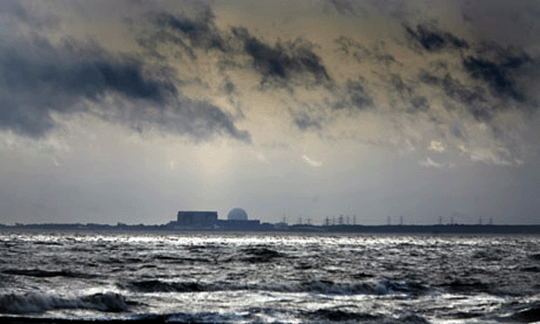
Nuclear power plants threatened by floods, final shutdown required. In the wake of the devastating floods of recent days, the Munich Environmental Institute has called for endangered nuclear reactors in Europe to be shut down.
Due to the advancing climate crisis, the risk of operating nuclear power plants continues to increase. The flood situation in western Germany and the neighboring countries as a result of heavy rainfall is devastating.
The water levels in the rivers had risen quickly. People lost their livelihoods or their lives, their belongings have been destroyed.
Sonnenseite 23rd July 2021
1 This month.

Australians deserve the truth
about
AUKUS – https://aukuspublicinquiry.com/

PETITION – To: Prime Minister Anthony Albanese and the Australian Labor Government

of the week – Australians for War Powers Reform (AWPR)
To see nuclear-related stories in greater depth and intensity
 Antinuclear