Despite the rain, France’s nuclear reactors are still threatened by global heating.
Rhône production still threatened despite the rains. A heatwave and drought could still cause shutdowns of nuclear reactors along the Rhone by the fall, despite unprecedented rainfall in Western Europe in recent weeks which has replenished the flow of the river, said analysts Wednesday.
Montel 21st July 2021
https://www.montelnews.com/fr/news/1240314/-la-production-du-rhne-toujours-menace-malgr-les-pluies
Wind and solar set new production records as they reshape Australia’s grid — RenewEconomy

Wind and solar have set new production records in Australia’s main grid as they continue to reshape the grid and displace coal and gas. The post Wind and solar set new production records as they reshape Australia’s grid appeared first on RenewEconomy.
Wind and solar set new production records as they reshape Australia’s grid — RenewEconomy
AEMO subsidiary to lead planning for NSW’s ambitious clean energy vision — RenewEconomy

AEMO to play a hands on role in planning New South Wales’ electricity transition, after being appointed as the NSW Consumer Trustee. The post AEMO subsidiary to lead planning for NSW’s ambitious clean energy vision appeared first on RenewEconomy.
AEMO subsidiary to lead planning for NSW’s ambitious clean energy vision — RenewEconomy
New wind farms take output to record levels in WA, despite cyclone impact — RenewEconomy

Wind output hits new record in Western Australia grid, but overall generation hit badly after cyclone tore through transmission lines. The post New wind farms take output to record levels in WA, despite cyclone impact appeared first on RenewEconomy.
New wind farms take output to record levels in WA, despite cyclone impact — RenewEconomy
World’s largest floating solar farm – more than 2GW – to supply Singapore — RenewEconomy

Sunseap to build “hyper-scale” floating solar and storage project to supply Singapore with power. What does it mean for Sun Cable? The post World’s largest floating solar farm – more than 2GW – to supply Singapore appeared first on RenewEconomy.
World’s largest floating solar farm – more than 2GW – to supply Singapore — RenewEconomy
Bavarian conservative state premier wants coal phase-out by 2030 after floods — RenewEconomy

In light of the catastrophic floods that hit Germany, Bavaria’s conservative state premier wants coal generation to finish by 2030. The post Bavarian conservative state premier wants coal phase-out by 2030 after floods appeared first on RenewEconomy.
Bavarian conservative state premier wants coal phase-out by 2030 after floods — RenewEconomy
The people have spoken: they want a fairer, greener country — Inside track

This post is by Joshua Emden, research fellow at the Institute for Public Policy Research (IPPR). If you put people at the heart of efforts to solve the climate and nature crises, then opportunity abounds. This is the core message presented by the final report of IPPR’s Environmental Justice Commission, Fairness and Opportunity. But this […]
The people have spoken: they want a fairer, greener country — Inside track
July 23 Energy News — geoharvey

Opinion: ¶ “As The World Burns, California Will Pick Up The Pace On Climate – Maybe” • Reading directives by California’s governor about goals for 2030 and 2035 and 2045, we should think about a report from RMI, whose authors wrote, “The most important year to phase out fossil fuel infrastructure and invest in clean […]
July 23 Energy News — geoharvey
Barngarla native title owners were excluded from decision-making on Kimba nuclear waste plan.
Barngarla people say their votes weren’t counted in Kimba nuclear dump census, The Advertiser 22 July 21
As SA awaits confirmation on a location of a national nuclear waste dump near Kimba, traditional owners say they weren’t included in a vote on the contentious project.
A First Nations people say their voice wasn’t heard in the proposal to create a permanent, national nuclear waste storage facility, despite a census of the nearest township.
The plan cleared a major hurdle in June, with a shortlist of sites passing the Senate on June 21.
Federal Resources Minister Keith Pitt expected to name Napandee farm, near Kimba on the Eyre Peninsula as the likely choice in the coming weeks.
The debate about the facility centres on a 2019 census by the Australian Electoral Commission, which found more than 60 per cent of Kimba residents were in favour of the facility.
However, the body for the local Indigenous community, the Barngarla Determination Aboriginal Corporation said their voices on the proposal were not heard.
Group chair Jason Bilney said the Kimba ballot did not account for the First Nations people, who have a significant stake in the land, and in the Dreaming stories associated with it.
“The simple fact remains that even though the Barngarla hold native title land closer to the proposed facility than the town of Kimba, the First Peoples’ for the area were not allowed to vote,” he said.
“It’s a cop out to say we weren’t on the electoral roll, we had to do a separate vote, but how do we guarantee our votes are combined,” he said.
The bill allowing construction of the facility only passed the senate last month, after a clause was introduced which allows judicial review for those opposed to any decision.
“They tried to take the umpire out in the fourth quarter, so we’re glad to have had that amendment included, it‘s a win for democracy,” Mr Bilney said………….
Mr Bilney said if a proper heritage assessment and consultation with the Barngarla people had occurred, the dialogue could have been less combative.
“It’s about being open and transparent, it should have been put to us and all South Australians affected, what about all the towns who will now have nuclear waste trucked through, where was their say,” he said.
If we’d been consulted and a part of the process from the beginning, it could have been a different story.
“A lot of our people remember the impacts up in Maralinga, my grandfather was from up there and we remember some of the impacts and cancers that came about in the years after.
“They didn’t have a right back then, so we’re fighting for our say now.”
South Australia has a chequered nuclear history, with long term effects of radiation at the Maralinga bomb site and dumping at the Arkaroola mine in the Flinders Ranges marring public confidence in anything nuclear.
Opposition to nuclear waste transport through the port of Whyalla, South Australia
Push for nuclear port no-no, Whyalla News, Louis Mayfield 21
A Whyalla resident passionate about the issue of nuclear waste storage has called for the Whyalla City Council to move a motion against transporting nuclear waste through the steel city’s port.
Andrew Williams, who has written to the Whyalla News on the issue in the past, delivered a presentation to council during their meeting on Monday.
Mr Williams said the federal government intended to override state laws in order to transport nuclear waste through South Australia, with the Whyalla Port being a “target port” for transportation.
“The federal government have said they will ensure appropriate consultation where there is significant public interest,” he said.
It is necessary for more public interest, especially in Whyalla as Department of Industry reports name the Whyalla Port to take shipments of nuclear fuel wastes.”
Mr Williams further outlined his concerns around storing intermediate level nuclear waste (ILW) at a Nuclear Radioactive Waste Management Facility (NRWMF) at the Napandee site near Kimba.
“The intermediate level waste consists of reprocessed spent fuel rods and reactor waste and some legacy waste which must be kept contained and secure from the environment for 10,000 years,” he said.
“Storage will require double handling of ILW which is not world’s best practice. The issue has been presented as a local economic development opportunity rather than a National Dump which will affect many generations to come.”………https://www.whyallanewsonline.com.au/story/7351332/?fbclid=IwAR1Wk-SzqygZroJ14ZA2g4_VmixtphFkTOFKKzTMnJxlHIcxiMQAwotNN4Y
Port at Cape Hardy could be the entrance place for radioactive waste transport to Kimba, South Australia.
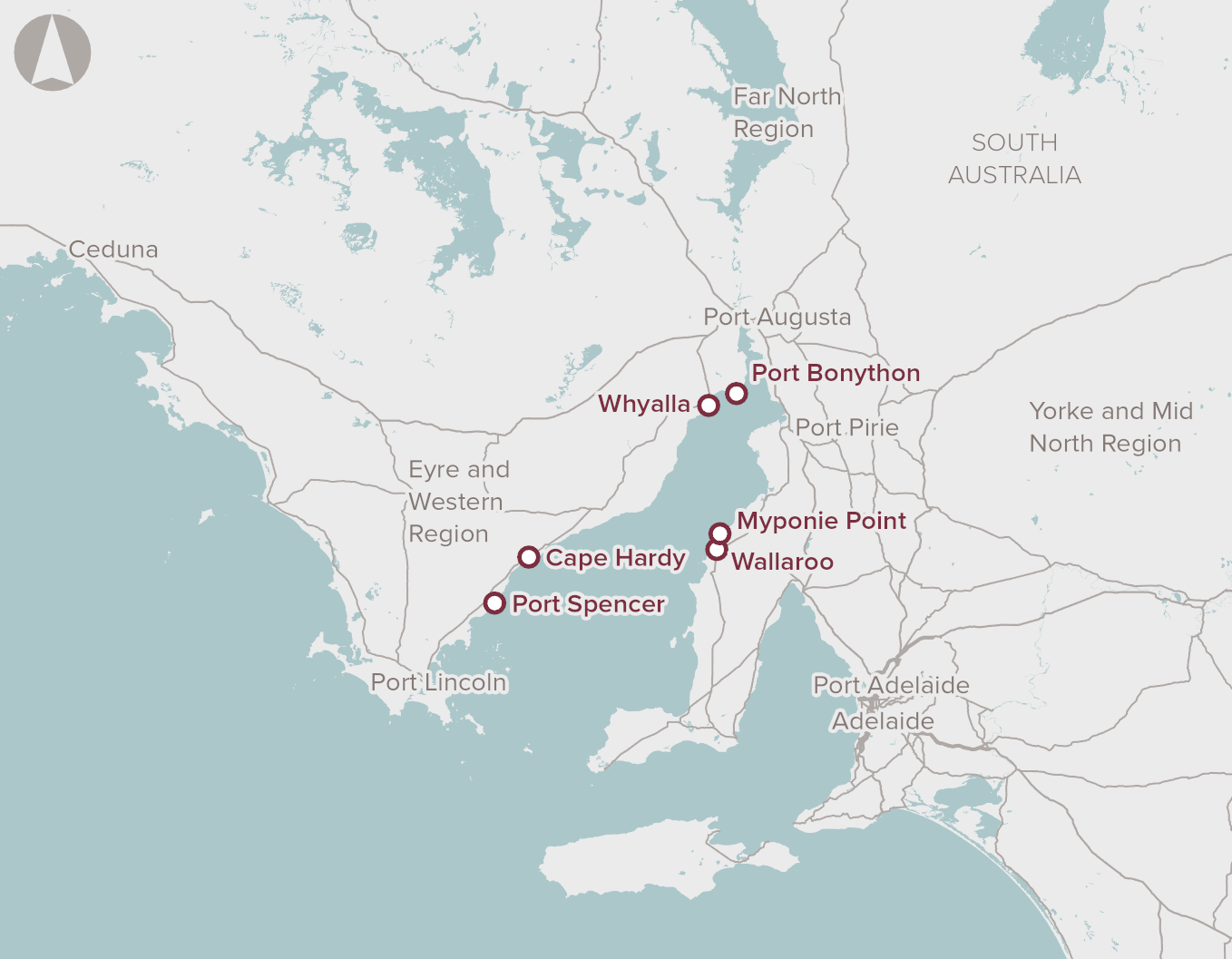
Paul Waldon . Fight to Stop a nuclear waste dump in South Australia, 22 July 21, Fear of Whyalla as a port for receiving ANSTO’s radioactive waste has strongly been suggested recently. Mr Paterson responded to Sarah Hanson-Young’s question by saying that residents of a port town would be consulted before any such plan.
However I for one don’t believe Whyalla is on the cards, I believe the chosen port would likely be Port Hardy.
The Sentient Group (incorporated in the Caymen Islands) is the parent entity of Iron Road Limited. Iron Road put forward a plan to develop Port Hardy as a export terminal. So why would there be two deep water ports to service one region. Yes, there is only 78 kilometers from Iron Roads mining site at Warramboo and Kimba the proposed site for ANSTO’s radioactive waste.
So is there anything in it for the mining industry??? I don’t know, but it has been claimed that Iron Road is the states biggest mining operation outside Olympic Dam.
Moreover, in May 2017 when the Department of Industry, Innovation and Science proposal to burden an unwilling community in South Australia with their radioactive waste was just heating up Iron Road Limited became the beneficiary of a 21 year mining lease for magnetite mining and mineral processing. Which had 127 compliance conditions flagged.
But wait there’s more, the federal government also announced a 25 million dollar grant commitment to support development of Iron Roads Cape Hardy port precinct.
I’m not implying that Iron Road and the government are in bed together, but wouldn’t it make sense that while lanthanides are leaving a port the government would allow actinides to enter. more https://www.facebook.com/groups/344452605899556
Penis envy? Space billionaires and carbon emissions
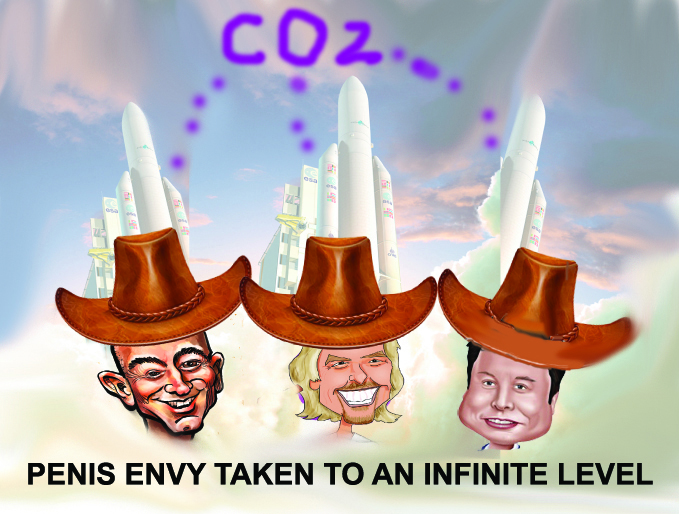
Space tourism: environmental vandalism for the super-rich https://www.sgr.org.uk/resources/space-tourism-environmental-vandalism-super-rich
As billionaires Jeff Bezos and Richard Branson launch the first flights of their space tourism corporations, Dr Stuart Parkinson, SGR, takes a look at the climate impacts.
Responsible Science blog, 20 July 2021 The past few weeks have seen some frightening impacts of climate change – from record-breaking temperatures and major wildfires in western Canada and the USA to unprecedented floods in Germany and Belgium. The hottest temperature reliably recorded on the Earth’s surface – 54.4C – was logged in Death Valley in California on 9 July. [1] Scientists said the heatwave in Canada and the USA at the end of June was “virtually impossible” without human-induced climate change. [2] One thing that is especially striking is that these events are now happening in some of the wealthiest and weather-resilient nations of the world – but even that didn’t stop major death tolls.
The huge threat of global climate disruption is leading to ever more urgent calls for society to rapidly reduce its carbon emissions. It is also clear that technological change alone will not be enough to tackle the problem. A recent report by the Climate Change Committee – the UK government’s main advisory body on the issue – found that 62% of the necessary measures involve societal and behaviour change. [3] Avoiding air travel is one of the most effective changes individuals can make to cut this pollution. For example, the carbon footprint of a return flight from London to Hong Kong – seated in economy-class – is about 3.5 tonnes of carbon dioxide equivalent (tCO2e) [4] – similar to a UK citizen’s average car use for over 10 months. [5] Research by the Institute for Global Environmental Strategies indicates that a globally-sustainable lifestyle carbon footprint in 2020 was 3.9 tCO2e [6] – which gives a clear indication of just how much our society needs to reduce its impacts now (and this figure falls rapidly to 2.5t CO2e by 2030 and then much lower still for 2040 and 2050).
Against this backdrop, we have billionaires travelling in the inaugural flights of their space tourism corporations. On 11 July, Richard Branson flew in Virgin Galactic’s SpaceShipTwo craft, while on 20 July, Jeff Bezos travelled in Blue Origin’s New Shepard. These activities take the climate impacts of flying to considerably more damaging level.
Let’s look at the New Shepard space-craft. Prof Mike Berners-Lee of Lancaster University – a leading expert in carbon footprint analysis – has estimated that a single flight results in emissions of at least 330 tCO2e. [7] With four passengers, this means each one is responsible for over 82 tCO2e – over 20 times the sustainable level for a whole year! And note, this is a conservative estimate. It does not include the additional heating effects of emissions at high altitude, the carbon footprint of developing and manufacturing the space-craft, or the emissions of running the Blue Origin corporation. Furthermore, the fuel combination used by the latest generation of New Shepard craft now includes liquid hydrogen [8] – a higher carbon fuel than those used in Prof Berners-Lee’s calculations.
What about SpaceShipTwo? Although this craft emits markedly less direct carbon emissions per flight than New Shepard, as SGR discussed back in 2016, [9] it uses a fuel combination which emits significant levels of black carbon into the upper atmosphere. Research by the University of Colorado indicates that this can damage the stratospheric ozone layer – not only leading to higher levels of damaging ultra-violet radiation reaching the Earth’s surface, but also causing a global heating effect likely to be considerably greater than that from the carbon emissions alone.
And the aim of these journeys? A few minutes of ‘zero-gravity’ experience and a nice view. It is hard to see this as anything more than environmental vandalism for the super-rich.
Virgin Galactic claims to want to launch a “new age of clean and sustainable access to space” [10]– but they and the others in the space tourism industry clearly fail to understand the level of their own climate impacts, the rapidly increasing severity of the climate emergency, or the scale of action needed to cut carbon emissions to a sustainable level. If governments are serious about trying to prevent ‘dangerous’ climate change, then there is an important step to take immediately: ban space tourism.
Dr Stuart Parkinson is Executive Director of Scientists for Global Responsibility. He has written on climate science and policy for 30 years, and holds a PhD in climate science.
References………
Softball match in Fukushima was intended to showcase ”recovery from nuclear disaster”, but that has fallen flat.
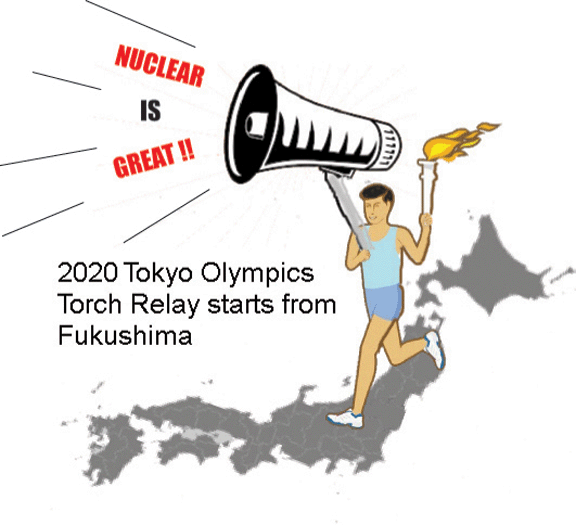
Japan’s prime minister, Yoshihide Suga, was among those clinging to the hope that a softball match would help convince a worldwide TV audience that life in Fukushima had returned to normal. But the opening day of the Tokyo Games, held in the shadow of coronavirus, ended up conveying a different message: that collective trauma unleashed by a nuclear accident, and now by a global pandemic, was never going to be extinguished by the swing of a bat
The Games were supposed to be an opportunity to show the current status of Fukushima
No entry: symbolism in Fukushima as Olympics begin in empty stadium, Guardian, Justin McCurry at Fukushima Azuma Baseball Stadium, Wed 21 Jul 2021
Silence and sadness greets a softball match meant to signal the recovery of a city devastated by earthquake and tsunami in 2011
After a year’s delay and months of rancour, finally some Olympic sport. Few will remember the details of Yukiko Ueno’s opening pitch to Michelle Cox in Japan’s softball match against Australia in Fukushima on Wednesday morning. But her delivery, witnessed by the organising committee president, Seiko Hashimoto, signalled that the most bizarre Games of modern times really are happening.
Depending on how deep the world’s reserves of optimism run, the first action of the 2020 Games could mark a turning point for the troubled Olympics or, more likely, bring only ephemeral relief from the viral cloud that hangs over the host city, Tokyo.
There was, though, a symbolism to Japan’s 8-1 victory over Aussie Spirit that predates the pandemic by almost a decade. In one sense, Japan’s Olympic project came full circle at Fukushima Azuma Baseball Stadium, located in a region whose proximity to tragedy inspired its pitch for the “recovery Games”. Forty miles east of the stadium stands the site of the world’s worst nuclear accident since Chernobyl. On the afternoon of 11 March 2011, a magnitude-9.0 earthquake triggered a towering tsunami that destroyed huge swaths of Japan’s north-east coast, killing more than 18,000 people and sweeping away entire towns.
The same waves crashed into the Fukushima Daiichi nuclear power plant, triggering meltdowns in three of its reactors and forcing tens of thousands of people to flee their homes while plant workers, firefighters and soldiers battled to cool the reactor cores. Ten years on, many are still unable or unwilling to return to their old neighbourhoods.
The decision to award Fukushima softball and baseball matches was intended to prove to the world that the wider region had recovered from the tsunami and the nuclear crisis was “under control,” as the then Japanese prime minister, Shinzo Abe, told the International Olympic Committee in 2013 in a last-ditch effort to rescue Tokyo’s bid. But the virus’s recent surge in the host nation, centred on Tokyo, meant that one convincing sign of recovery – the communal enjoyment of sport – was missing in Fukushima……….
The teams lined up for national anthems observed in near silence, watched by a large contingent of Japanese reporters and officials sheltering beneath a small section of the stadium not exposed to the blazing morning sunshine. After Uchibori overturned organisers’ plans to allow a limited number of spectators, hundreds of local volunteers were told their services were no longer needed. ………….
“The Games were supposed to be an opportunity to show the current status of Fukushima, and we had various plans in mind before the decision to ban spectators,” said Seiichi Anbai, the chairman of the Fukushima city softball association, according to the Kyodo news agency. “Our emotions are polarised because, considering the coronavirus situation, it is sort of understandable but at the same time, we wanted the Games to take place in front of an audience.”
A Fukushima hotelier, who asked not to be named, felt the region had been exploited. “They said they would put on the Olympics for the sake of Fukushima, but I don’t think many people here feel like that’s really happening,” she told the Guardian. “It all comes down to politics.”
“The government has taken advantage of Fukushima right from the start,” she added, referring to the decision to begin the Japan leg of the torch relay at J-Village, a football training complex that functioned for years as a logistics hub for crews working to control and decommission the damaged nuclear plant 12 miles away………
Fukushima has come a long way since wild animals roamed streets where atmospheric radiation made it too dangerous for residents to return. But its recovery will continue long after the softball and baseball Olympians have gone home.
In the next couple of years, the operator of Fukushima Daiichi – Tokyo Electric Power – will begin releasing more than a million tonnes of contaminated water into the Pacific ocean, a move opposed by local fishermen who have spent years repairing the reputational damage to their industry. The plant itself will take decades to decommission, and at a cost of billions of dollars.
Japan’s prime minister, Yoshihide Suga, was among those clinging to the hope that a softball match would help convince a worldwide TV audience that life in Fukushima had returned to normal. But the opening day of the Tokyo Games, held in the shadow of coronavirus, ended up conveying a different message: that collective trauma unleashed by a nuclear accident, and now by a global pandemic, was never going to be extinguished by the swing of a bat. https://www.theguardian.com/sport/2021/jul/21/no-entry-symbolism-in-fukushima-as-olympics-begin-in-empty-stadium
Moral Intelligence or Nuclear War, by Robert C. Koehler
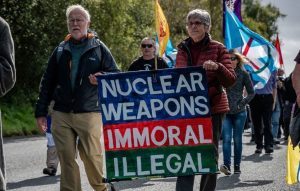
“To declare that nuclear weapons can only “legally” be used in retaliation for a nuclear strike hardly leaves me feeling safe. Are we left with a world continually at war with itself, with our best hope being that all future wars will be waged legally and politely?”
Moral Intelligence or Nuclear War, by Robert C. Koehler — Rise Up Times
Moral Intelligence or Nuclear War, by Robert C. Koehler,
We can no longer create a wasteland and call it peace.
By ROBERT C. KOEHLER Common Dreams Rise UpTimes July 15, 2021
Let’s dance at the border! One of these days, something will give—the rich, the powerful will suddenly look around cluelessly. What’s happening? Awareness will sweep across the planet: We are one, and life is sacred. This consciousness will even invade political life and what I call moral intelligence will find political traction.
This won’t mean that life suddenly becomes simple—anything but! The politics of today, nationally and internationally, is simple: somebody wins, somebody loses; war is inevitable, there are always several on the horizon, and the primary consequence of every war that is waged is that it spurs more wars, a fact that remains officially unnoticed; only some lives matter, those that don’t are collateral damage, illegal aliens or simply the enemy; nuclear weapons (ours, only ours) are justified, necessary and must be continually upgraded; national borders, however arbitrary, are sacred (the only thing that’s sacred); if these norms are challenged, the best response is mockery and cynicism.
The game of war has been going on sufficiently long—a dozen millennia or whatever—and is at its stopping point.
Transcending this mindset requires facing life in all its complexity, which is a necessary part of our personal lives. But could it be that facing the endless complexity of life is also politically possible? This seems to be the question I’ve been given to ponder—and cherish—as I step into my elder years. Come on! Politics requires simplistic public herding, does it not? You can’t steer a country without an enemy.
As a peace journalist, I usually begin by focusing on the media. Consider this recent Washington Post piece regarding the use of nuclear weapons. Even though the article is critical of the Trump administration, which in 2018 “expanded the role of nuclear weapons by declaring for the first time that the United States would consider nuclear retaliation in the case of ‘significant non-nuclear strategic attacks,” the article remains trapped, I fear, in linear, conventional thinking………..
the assumption that “the public” (whatever that is) would be focused on vengeance after a horrific cyberattack is simplistic, to say the least. The public—you, me, and perhaps everyone on the planet—would be in shock, wounded and grieving, and would be primarily focused on healing, help and the heroism of the many who gave their lives in rescue efforts. When I recall the days right after 9/11, what I think about are people lined up to donate blood, not shaking their fists in cartoonlike demands for vengeance against whomever.
But to slide such an assumption—the public is impulsive and stupid—into an article about nuclear weapons removes the possibility of bringing a larger awareness to the discussion, a public awareness that nuclear weapons should never be used and, indeed, should not exist, in our hands or anyone else’s. The Post appears not to want to go that far,….
I fear there are far deeper realities loose in the world: a military-industrial complex that will do whatever it can to prevent the world from transcending war; the possibility of a president in political trouble, seeing war (even the nuclear button) as a solution; and the hidden forces of the deep state, exerting pressures on political leaders the public will never know about.
To declare that nuclear weapons can only “legally” be used in retaliation for a nuclear strike hardly leaves me feeling safe. Are we left with a world continually at war with itself, with our best hope being that all future wars will be waged legally and politely?
Regarding nukes, the Post notes, the Obama administration’s guidance document declares that “the United States “will not intentionally target civilian populations or civilian objects.” And a former head of the U.S. Strategic Command under Obama told the Post the command had developed nuclear delivery “tactics and techniques to minimize collateral effects.”
“Minimized collateral damage” is a phrase you’d use only in regard to people whose lives didn’t matter. And if the weapons involved are nuclear, it sounds like a grotesque lie. All of which intensifies my outrage: We are one, and life is sacred. The game of war has been going on sufficiently long—a dozen millennia or whatever—and is at its stopping point. We can no longer create a wasteland and call it peace. The wasteland it is in our power to create is Planet Earth.
I know the human species has what it takes to reach beyond its artificial borders and refuse to let this happen. The time for the best of us to emerge is now. https://wordpress.com/read/feeds/34005311/posts/3456649903
Huge carbon emissions of space tourism
Space tourism: rockets emit 100 times more CO₂ per passenger than flights – imagine a whole industry https://theconversation.com/space-tourism-rockets-emit-100-times-more-co-per-passenger-than-flights-imagine-a-whole-industry-164601
Eloise Marais Associate Professor in Physical Geography, UCLJuly 19, 2021
The commercial race to get tourists to space is heating up between Virgin Group founder Sir Richard Branson and former Amazon CEO Jeff Bezos. On Sunday 11 July, Branson ascended 80 km to reach the edge of space in his piloted Virgin Galactic VSS Unity spaceplane. Bezos’ autonomous Blue Origin rocket is due to launch on July 20, coinciding with the anniversary of the Apollo 11 Moon landing.
Though Bezos loses to Branson in time, he is set to reach higher altitudes (about 120 km). The launch will demonstrate his offering to very wealthy tourists: the opportunity to truly reach outer space. Both tour packages will provide passengers with a brief ten-minute frolic in zero gravity and glimpses of Earth from space. Not to be outdone, Elon Musk’s SpaceX will provide four to five days of orbital travel with its Crew Dragon capsule later in 2021.
What are the environmental consequences of a space tourism industry likely to be? Bezos boasts his Blue Origin rockets are greener than Branson’s VSS Unity. The Blue Engine 3 (BE-3) will launch Bezos, his brother and two guests into space using liquid hydrogen and liquid oxygen propellants. VSS Unity used a hybrid propellant comprised of a solid carbon-based fuel, hydroxyl-terminated polybutadiene (HTPB), and a liquid oxidant, nitrous oxide (laughing gas). The SpaceX Falcon series of reusable rockets will propel the Crew Dragon into orbit using liquid kerosene and liquid oxygen.
Burning these propellants provides the energy needed to launch rockets into space while also generating greenhouse gases and air pollutants. Large quantities of water vapour are produced by burning the BE-3 propellant, while combustion of both the VSS Unity and Falcon fuels produces CO₂, soot and some water vapour. The nitrogen-based oxidant used by VSS Unity also generates nitrogen oxides, compounds that contribute to air pollution closer to Earth.
Roughly two-thirds of the propellant exhaust is released into the stratosphere (12 km-50 km) and mesosphere (50 km-85 km), where it can persist for at least two to three years. The very high temperatures during launch and re-entry (when the protective heat shields of the returning crafts burn up) also convert stable nitrogen in the air into reactive nitrogen oxides.
These gases and particles have many negative effects on the atmosphere. In the stratosphere, nitrogen oxides and chemicals formed from the breakdown of water vapour convert ozone into oxygen, depleting the ozone layer which guards life on Earth against harmful UV radiation. Water vapour also produces stratospheric clouds that provide a surface for this reaction to occur at a faster pace than it otherwise would.
Space tourism and climate change
Exhaust emissions of CO₂ and soot trap heat in the atmosphere, contributing to global warming. Cooling of the atmosphere can also occur, as clouds formed from the emitted water vapour reflect incoming sunlight back to space. A depleted ozone layer would also absorb less incoming sunlight, and so heat the stratosphere less.
Figuring out the overall effect of rocket launches on the atmosphere will require detailed modelling, in order to account for these complex processes and the persistence of these pollutants in the upper atmosphere. Equally important is a clear understanding of how the space tourism industry will develop.
Virgin Galactic anticipates it will offer 400 spaceflights each year to the privileged few who can afford them. Blue Origin and SpaceX have yet to announce their plans. But globally, rocket launches wouldn’t need to increase by much from the current 100 or so performed each year to induce harmful effects that are competitive with other sources, like ozone-depleting chlorofluorocarbons (CFCs), and CO₂ from aircraft.
During launch, rockets can emit between four and ten times more nitrogen oxides than Drax, the largest thermal power plant in the UK, over the same period. CO₂ emissions for the four or so tourists on a space flight will be between 50 and 100 times more than the one to three tonnes per passenger on a long-haul flight.
In order for international regulators to keep up with this nascent industry and control its pollution properly, scientists need a better understanding of the effect these billionaire astronauts will have on our planet’s atmosphere.
1 This month.

Australians deserve the truth
about
AUKUS – https://aukuspublicinquiry.com/


PETITION – To: Prime Minister Anthony Albanese and the Australian Labor Government

of the week – Australians for War Powers Reform (AWPR)
To see nuclear-related stories in greater depth and intensity
 Antinuclear