Environmental degradation, illness, international tensions – small nuclear reactors had bad results in the Arctic
The U.S. military’s first attempts at land-based portable nuclear reactors didn’t work out well in terms of environmental contamination, cost, human health and international relations. That history is worth remembering as the military considers new mobile reactors
the U.S. still has no coherent national strategy for nuclear waste disposal, and critics are asking what happens if Pele falls into enemy hands.
The US Army tried portable nuclear power at remote bases 60 years ago – it didn’t go well https://theconversation.com/the-us-army-tried-portable-nuclear-power-at-remote-bases-60-years-ago-it-didnt-go-well-164138
Paul Bierman Fellow of the Gund Institute for Environment, Professor of Natural Resources, University of Vermont, 21 July 21
In a tunnel 40 feet beneath the surface of the Greenland ice sheet, a Geiger counter screamed. It was 1964, the height of the Cold War. U.S. soldiers in the tunnel, 800 miles from the North Pole, were dismantling the Army’s first portable nuclear reactor.
Commanding Officer Joseph Franklin grabbed the radiation detector, ordered his men out and did a quick survey before retreating from the reactor.
He had spent about two minutes exposed to a radiation field he estimated at 2,000 rads per hour, enough to make a person ill. When he came home from Greenland, the Army sent Franklin to the Bethesda Naval Hospital. There, he set off a whole body radiation counter designed to assess victims of nuclear accidents. Franklin was radioactive.
The Army called the reactor portable, even at 330 tons, because it was built from pieces that each fit in a C-130 cargo plane. It was powering Camp Century, one of the military’s most unusual bases.
Camp Century was a series of tunnels built into the Greenland ice sheet and used for both military research and scientific projects. The military boasted that the nuclear reactor there, known as the PM-2A, needed just 44 pounds of uranium to replace a million or more gallons of diesel fuel. Heat from the reactor ran lights and equipment and allowed the 200 or so men at the camp as many hot showers as they wanted in that brutally cold environment.
The PM-2A was the third child in a family of eight Army reactors, several of them experiments in portable nuclear power.
A few were misfits. PM-3A, nicknamed Nukey Poo, was installed at the Navy base at Antarctica’s McMurdo Sound. It made a nuclear mess in the Antarctic, with 438 malfunctions in 10 years including a cracked and leaking containment vessel. SL-1, a stationary low-power nuclear reactor in Idaho, blew up during refueling, killing three men. SM-1 still sits 12 miles from the White House at Fort Belvoir, Virginia. It cost US$2 million to build and is expected to cost $68 million to clean up. The only truly mobile reactor, the ML-1, never really worked.
The U.S. military’s first attempts at land-based portable nuclear reactors didn’t work out well in terms of environmental contamination, cost, human health and international relations. That history is worth remembering as the military considers new mobile reactors.
Nearly 60 years after the PM-2A was installed and the ML-1 project abandoned, the U.S. military is exploring portable land-based nuclear reactors again.
In May 2021, the Pentagon requested $60 million for Project Pele. Its goal: Design and build, within five years, a small, truck-mounted portable nuclear reactor that could be flown to remote locations and war zones. It would be able to be powered up and down for transport within a few days.
The Navy has a long and mostly successful history of mobile nuclear power. The first two nuclear submarines, the Nautilus and the Skate, visited the North Pole in 1958, just before Camp Century was built. Two other nuclear submarines sank in the 1960s – their reactors sit quietly on the Atlantic Ocean floor along with two plutonium-containing nuclear torpedos. Portable reactors on land pose different challenges – any problems are not under thousands of feet of ocean water.
Those in favor of mobile nuclear power for the battlefield claim it will provide nearly unlimited, low-carbon energy without the need for vulnerable supply convoys. Others argue that the costs and risks outweigh the benefits. There are also concerns about nuclear proliferation if mobile reactors are able to avoid international inspection.
A leaking reactor on the Greenland ice sheet
The PM-2A was built in 18 months. It arrived at Thule Air Force Base in Greenland in July 1960 and was dragged 138 miles across the ice sheet in pieces and then assembled at Camp Century.
When the reactor went critical for the first time in October, the engineers turned it off immediately because the PM-2A leaked neutrons, which can harm people. The Army fashioned lead shields and built walls of 55-gallon drums filled with ice and sawdust trying to protect the operators from radiation.
The PM-2A ran for two years, making fossil fuel-free power and heat and far more neutrons than was safe.
Those stray neutrons caused trouble. Steel pipes and the reactor vessel grew increasingly radioactive over time, as did traces of sodium in the snow. Cooling water leaking from the reactor contained dozens of radioactive isotopes potentially exposing personnel to radiation and leaving a legacy in the ice.
When the reactor was dismantled for shipping, its metal pipes shed radioactive dust. Bulldozed snow that was once bathed in neutrons from the reactor released radioactive flakes of ice.
Franklin must have ingested some of the radioactive isotopes that the leaking neutrons made. In 2002, he had a cancerous prostate and kidney removed. By 2015, the cancer spread to his lungs and bones. He died of kidney cancer on March 8, 2017, as a retired, revered and decorated major general.
Camp Century’s radioactive legacy
Camp Century was shut down in 1967. During its eight-year life, scientists had used the base to drill down through the ice sheet and extract an ice core that my colleagues and I are still using today to reveal secrets of the ice sheet’s ancient past. Camp Century, its ice core and climate change are the focus of a book I am now writing.
The PM-2A was found to be highly radioactive and was buried in an Idaho nuclear waste dump. Army “hot waste” dumping records indicate it left radioactive cooling water buried in a sump in the Greenland ice sheet.
When scientists studying Camp Century in 2016 suggested that the warming climate now melting Greenland’s ice could expose the camp and its waste, including lead, fuel oil, PCBs and possibly radiation, by 2100, relations between the U.S, Denmark and Greenland grew tense. Who would be responsible for the cleanup and any environmental damage?
Portable nuclear reactors today
There are major differences between nuclear power production in the 1960s and today.
The Pele reactor’s fuel will be sealed in pellets the size of poppy seeds, and it will be air-cooled so there’s no radioactive coolant to dispose of.
Being able to produce energy with fewer greenhouse emissions is a positive in a warming world. The U.S. military’s liquid fuel use is close to all of Portugal’s or Peru’s. Not having to supply remote bases with as much fuel can also help protect lives in dangerous locations.
But, the U.S. still has no coherent national strategy for nuclear waste disposal, and critics are asking what happens if Pele falls into enemy hands. Researchers at the Nuclear Regulatory Commission and the National Academy of Sciences have previously questioned the risks of nuclear reactors being attacked by terrorists. As proposals for portable reactors undergo review over the coming months, these and other concerns will be drawing attention.
The U.S. military’s first attempts at land-based portable nuclear reactors didn’t work out well in terms of environmental contamination, cost, human health and international relations. That history is worth remembering as the military considers new mobile reactors.
Small Nuclear Power Plants No Use in Climate Crisis
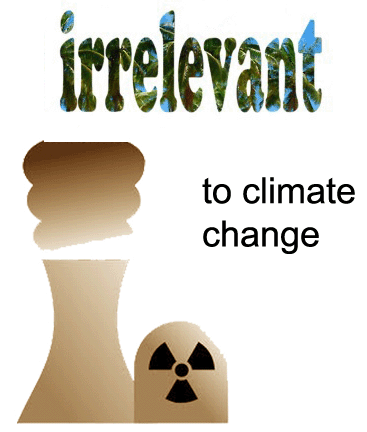
Small Nuclear Power Plants No Use in Climate Crisis
https://goodmenproject.com/featured-content/small-nuclear-power-plants-no-use-in-climate-crisis/
Governments are investing in a new range of small nuclear power plants, with little chance they’ll ease the climate crisis.
July 20, 2021 by Climate News Network By Paul Brown
Claims that a new generation of so-called advanced, safe and easier-to-build nuclear reactors − small nuclear power plants − will be vital to combat climate change are an illusion, and the idea should be abandoned, says a group of scientists.
Their report, “Advanced” is not always better, published by the US Union of Concerned Scientists (UCS), examines all the proposed new types of reactor under development in the US and fails to find any that could be developed in time to help deal with the urgent need to cut carbon emissions. The US government is spending $600 million on supporting these prototypes.
While the report goes into details only about the many designs of small and medium-sized reactors being developed by US companies, it is a serious blow to the worldwide nuclear industry because the technologies are all similar to those also being underwritten by taxpayers in Canada, the UK, Russia and China. This is a market the World Economic Forum claimed in January could be worth $300 billion by 2040.
Edwin Lyman, who wrote the report, and is the director of nuclear power safety in the UCS Climate and Energy Program, thinks the WEF estimate is extremely unlikely. He comments on nuclear power in general: “The technology has fundamental safety and security disadvantages compared with other low-carbon sources.
“Nuclear reactors and their associated facilities for fuel production and waste handling are vulnerable to catastrophic accidents and sabotage, and they can be misused to produce materials for nuclear weapons. The nuclear industry, policymakers, and regulators must address these shortcomings fully if the global use of nuclear power is to increase without posing unacceptable risks to public health, the environment and international peace and security.”
Cheaper options
Lyman says none of the new reactors appears to solve any of these problems. Also, he says, the industry’s claims that their designs could cost less, be built quickly, reduce the production of nuclear waste, use uranium more efficiently and reduce the risk of nuclear proliferation have yet to be proved. The developers have also yet to demonstrate that the new generation of reactors has improved safety features enabling them to shut down quickly in the event of attack or accident.
Lyman examines the idea that reactors can be placed near cities or industry so that the waste heat from their electricity generation can be used in district heating or for industrial processes.
He says there is no evidence that the public would be keen on the idea of having nuclear power stations planted in their neighbourhoods.
Another of the industry’s ideas for using the power of the new nuclear stations to produce “green hydrogen” for use in transport or back-up energy production is technically feasible, but it seems likely that renewable energies like wind and solar could produce the hydrogen far more cheaply, the report says.
In reality the nuclear industry is shrinking in international importance and is likely to continue to do so, Lyman says. According to the International Energy Agency, at the end of 2010, there were 441 operating nuclear power reactors worldwide, with a total electrical power capacity of 375 gigawatts of electricity (GWe).
At the end of 2019, there were 443 operating reactors − only two more than in 2010 − with a total generating capacity of 392 GWe. This represented a decrease of over 20% in the share of global electricity demand met by nuclear energy compared with 2010.
Lyman says the US Department of Energy would be more sensible trying to address the outstanding safety, security and cost issues of existing light water reactors in the US, rather than attempting to commercialise new and unproven designs. If the idea is to tackle climate change, improving existing designs is a better bet.
The report notes that it is not just the US that is having trouble with nuclear technology: Europe is also suffering severe delays and cost overruns with new plants at Olkiluoto in Finland, Flamanville in France and Hinkley Point C in the UK.
Lyman’s comments might be of interest to the British government, which has just published its integrated review of defence and foreign policy.
Military link declared
In it the government linked the future of the civil and defence nuclear capabilities of the country, showing that a healthy civil sector was important for propping up the military. This is controversial because of the government’s decision announced in the same review to increase the number of nuclear warheads from 180 to 260, threatening an escalation of the international arms race.
Although Lyman does not mention it, there is a clear crossover between civil and nuclear industries in the US, the UK, China, Russia and France. This is made more obvious because of the few countries that have renounced nuclear weapons − for example only Germany, Italy and Spain have shown no interest in building any kind of nuclear station. This is simply because renewables are cheaper and produce low carbon power far more quickly.
But the link between civil and defence nuclear industries does explain why in the UK the government is spending £215m ($298m) on research and development into the civil use of the small medium reactors championed by a consortium headed by Rolls-Royce, which is also one of the country’s major defence contractors. Rolls-Royce wants to build 16 of these reactors in a factory and assemble them in various parts of the country. It is also looking to sell them into Europe to gain economies of scale.
Judging by the UCS analysis, this deployment of as yet unproven new nuclear technologies is unlikely to be in time to help the climate crisis – one of the claims that both the US and UK governments and Rolls-Royce itself are making. − Climate News Network
Australia has massive offshore wind opportunity, if only government would get out of the way — RenewEconomy

Despite having some of the world’s best offshore wind resources, Australia is letting an untapped abundance of clean energy go to waste, new research says. The post Australia has massive offshore wind opportunity, if only government would get out of the way appeared first on RenewEconomy.
Australia has massive offshore wind opportunity, if only government would get out of the way — RenewEconomy
Australia lifted fossil fuel subsidies more than any G20 nation, says BNEF — RenewEconomy

Australia had biggest increase in fossil fuel support of any G20 nation over last five years, at nearly $300 per person in 2019. The post Australia lifted fossil fuel subsidies more than any G20 nation, says BNEF appeared first on RenewEconomy.
Australia lifted fossil fuel subsidies more than any G20 nation, says BNEF — RenewEconomy
Plans unveiled for biggest battery storage system in Victoria — RenewEconomy

A two-hour battery storage system on the Mornington Peninsula will be the biggest in the state if built on schedule by the end of 2022. The post Plans unveiled for biggest battery storage system in Victoria appeared first on RenewEconomy.
Plans unveiled for biggest battery storage system in Victoria — RenewEconomy
Gas generation slumps in first half of 2021, as wind and solar continue to shine — RenewEconomy

Gas generation declined again in the first half of 2021, including in NSW where renewables now supply 17 times more electricity than gas. The post Gas generation slumps in first half of 2021, as wind and solar continue to shine appeared first on RenewEconomy.
Gas generation slumps in first half of 2021, as wind and solar continue to shine — RenewEconomy
Flow Power starts production at its first two solar farms in South Australia — RenewEconomy

Retailer Flow Power has begun construction at two small solar farms in South Australia, the first it owns and operates directly. The post Flow Power starts production at its first two solar farms in South Australia appeared first on RenewEconomy.
Flow Power starts production at its first two solar farms in South Australia — RenewEconomy
Australian wind output record smashed after big boost from South Australia — RenewEconomy

Record wind output on Australia’s main grid on Tuesday afternoon, with a big boost from South Australia. The post Australian wind output record smashed after big boost from South Australia appeared first on RenewEconomy.
Australian wind output record smashed after big boost from South Australia — RenewEconomy
Queensland grid needs to double in size for zero emissions, CleanCo says — RenewEconomy

CleanCo CEO says time to seize the huge decarbonisation opportunities available through solar – “the lowest cost energy” ever seen. The post Queensland grid needs to double in size for zero emissions, CleanCo says appeared first on RenewEconomy.
Queensland grid needs to double in size for zero emissions, CleanCo says — RenewEconomy
Queensland to produce 10-year plan for renewables to bring back industry — RenewEconomy

Cheap renewables and a focus on renewable hydrogen production could revitalise Australia’s manufacturing industries, Queensland minister says. The post Queensland to produce 10-year plan for renewables to bring back industry appeared first on RenewEconomy.
Queensland to produce 10-year plan for renewables to bring back industry — RenewEconomy
The Olympic & Nuke Villages: Humiliating People, Ignoring Life — limitless life
Dear Friend, I am almost daily sending out BCC messages to have the Tokyo Olympic Games cancelled. President Thomas Bach is increasingly criticized for ignoring the Japanese public opinion. The Japanese have the impression that the infamous “nuclear village” is little different from the current “Olympic village”. The Japanese are not happy to see Japan thus […]
The Olympic & Nuke Villages: Humiliating People, Ignoring Life — limitless life
Global investors pump hundreds of billions into renewables in shift from fossil fuels — RenewEconomy

A record $US501 billion ($A683 billion) was invested in the clean energy sector in the last financial year. The post Global investors pump hundreds of billions into renewables in shift from fossil fuels appeared first on RenewEconomy.
Global investors pump hundreds of billions into renewables in shift from fossil fuels — RenewEconomy
Battery storage faces two year wait for new rules that optimise its use — RenewEconomy

Battery storage industry happy with new rules that recognise some of their multiple tools, but not pleased with another two-year wait. The post Battery storage faces two year wait for new rules that optimise its use appeared first on RenewEconomy.
Battery storage faces two year wait for new rules that optimise its use — RenewEconomy
Too Much

Too much rain, to much drought, too much fire, too much waste, too much news. The problem is that I went hiking yesterday and, though I had a good time, got behind on some of my projects. Normally, that wouldn’t be a problem–there are certainly things I can say about climate change that don’t take very long to write–but this week doing less than a fully-researched piece seems wrong.
I have seen a photograph of a street in Europe piled with flood debris almost up to the second windows. I have seen a photograph of a pasture in Montana where the grass has died from drought, grass that was meant to be the winter forage of a herd of cattle–a family’s livelihood, gone. It seems important to weave all this together, to understand how it fits, and I am discombobulated by busyness, by mild but real sleep deprivation, by the…
View original post 170 more words
July 21 Energy News — geoharvey

Opinion: ¶ “Scientists Are Worried By How Fast The Climate Crisis Has Amplified Extreme Weather” • Until recently, climate change had been talked about as a future threat. Its frontlines were portrayed as remote places like the Arctic, where polar bears are running out of sea ice to hunt from. But in the past month, […]
July 21 Energy News — geoharvey
1 This month.

Australians deserve the truth
about
AUKUS – https://aukuspublicinquiry.com/

PETITION – To: Prime Minister Anthony Albanese and the Australian Labor Government

of the week – Australians for War Powers Reform (AWPR)
To see nuclear-related stories in greater depth and intensity
 Antinuclear