Proposed New Mexico nuclear waste storage facility is illegal

Nuclear waste director: Proposed New Mexico nuclear waste storage facility is illegal, https://www.thecentersquare.com/new_mexico/nuclear-waste-director-proposed-new-mexico-nuclear-waste-storage-facility-is-illegal/article_5c2497f2-9716-11eb-a1c7-f34c8873c0ba.html (The Center Square) 7 Apr 21, – Safety and economic concerns over a proposed nuclear waste storage facility near Carlsbad have prompted the state of New Mexico to sue the U.S. Nuclear Regulatory Commission (NRC).
To be built by Holtec in southeast New Mexico, the facility would be an above-ground complex for storing spent fuel from commercial nuclear power plants.
The state’s lawsuit is built on legal concerns.
Holtec has stated the federal government is going to fund the facility, but according to federal law, utilities are responsible for storage, said Don Hancock, director of the Southwest Research and Information Center’s Nuclear Waste Program.
The state argues consistently throughout the complaint that this whole facility is illegal because the federal law doesn’t authorize the Nuclear Regulatory Commission to authorize this kind of consolidated facility,” he told The Center Square.
Hancock added that the state’s entire list of complaints is 47 pages long.
“The federal government has said in law that this spent fuel, this irradiated fuel from nuclear power plants, is highly toxic and highly dangerous, and its permanent disposal requires it to be disposed deep underground in stable geologic formations, so that’s the law,” he said. “This facility is none of that.”
Holtec and NRC attempted to circumvent that issue by terming the storage facility as temporary, however, the state pointed out that Holtec and NRC can’t provide a timeframe for when it would be moved and have admitted they don’t have any plans for where it would go, said Hancock.
These legal concerns only compound the economic issues raised.
The facility would be built in the middle of the biggest oil and gas production areas in the state and poses a significant threat to operations.
“In the best of all circumstances it would be disruptive and, the worst of all circumstances, it would close down a multi-million dollar industry,” Hancock said.
Disruption would be caused by global perceptions that New Mexico oil producers are OK with having an illegal nuclear storage facility nearby that could leak into the supply of oil, Hancock said. The worst-case scenario is a leak that leaves New Mexico’s oil supply radioactively contaminated and causes billions of dollars in economic damage.
“If there was a leak or an accident and the nation and the world heard there was a major nuclear accident in the middle of the oil and gas production field of New Mexico or Texas, what do you think people are going to think about that?” he asked.
After failed attempts to get the NRC to consider their concerns, the state turned to the courts to make their voice heard, said Hancock.
“The state feels ignored,” he said.
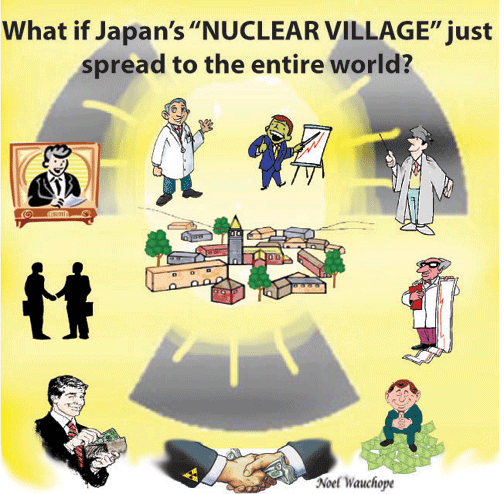
Japanese government continues Japan’s ”Nuclear Village” generous grants to keep ageing nuclear reactors going.
Lucrative grants offered to keep aging nuclear reactors running, http://www.asahi.com/ajw/articles/14326422
THE ASAHI SHIMBUN
April 7, 2021 The central government is offering billions of yen in new grants to Fukui Prefecture to allow a nuclear plant operator to run its aging reactors beyond their operational life span of 40 years.
Fukui is not the only prefecture in Japan that hosts old reactors, and the grants could create momentum toward the restarts of these units.
“As for an expansion of grants, up to 2.5 billion yen ($22.6 million) will be provided per nuclear plant to a prefecture preparing to respond to the extension of the 40-year life of reactors,” the Ministry of Economy, Trade and Industry said in a document presented to the Fukui prefectural government on April 6.
The ministry’s offer is expected to become a key point of discussions as Fukui Prefecture and the prefectural assembly begin to weigh whether they should approve of the restart of three reactors in question there.
Fukui Governor Tatsuji Sugimoto hailed the central government’s offer, calling it “a step forward.”
He had urged the prefectural assembly to discuss the restart issue in February, but the assembly put off the debate, citing a lack of measures to revitalize the local economy.
Osaka-based Kansai Electric Power Co. is pushing to reactivate the three reactors in Fukui Prefecture–the No. 1 and 2 reactors at the Takahama nuclear plant in Takahama and the No. 3 reactor at the Mihama nuclear plant in Mihama.
The Nuclear Regulation Authority has given its one-time permission to operate those reactors for 20 more years beyond their 40-year life spans.
If the local governments approve the restarts, Fukui Prefecture would receive a combined 5 billion yen under the new grant setup.
The town halls of Takahama and Mihama have already given the greenlight to the restarts. The remaining hurdle is whether the governor and the prefectural assembly will approve them.
The maximum 2.5 billion yen will be made available over a period of five years, according to the industry ministry’s Agency for Natural Resources and Energy.
The offer of the funds came in response to the Fukui prefectural government’s request for additional grants concerning the reactors as a measure to stimulate the local economy.
The prefectural government is expected to discuss how to distribute the grants with Takahama and Mihama.
Other prefectures hosting old reactors operated by companies seeking the 20-year extension will be eligible for the new grants.
The only other facility that has gained the NRA’s permission to operate beyond 40 years is the Tokai No. 2 nuclear plant in Ibaraki Prefecture.
Five other reactors in Japan have been in service for more than 35 years.
The decommissioning process has started for other aging reactors because their operators decided that upgrades and additional safeguard measures required to bring them back online would be too expensive.
(This article was written by Kenji Oda and Takayuki Sato.)
“I lost the support of my colleagues”: Kean explains decision to dump Turnbull — RenewEconomy

NSW energy minister Matt Kean says the future of coal mines beyond the remit of new zero emissions advisory board, which is one reason why Turnbull was dumped as chair. The post “I lost the support of my colleagues”: Kean explains decision to dump Turnbull appeared first on RenewEconomy.
“I lost the support of my colleagues”: Kean explains decision to dump Turnbull — RenewEconomy
Do or die moment for market re-design as Taylor takes control of process — RenewEconomy

Plans for a post-2025 redesign of Australia’s main grid delivered to Angus Taylor – but will the Morrison government actually deliver much needed reforms? The post Do or die moment for market re-design as Taylor takes control of process appeared first on RenewEconomy.
Do or die moment for market re-design as Taylor takes control of process — RenewEconomy
April 7 Energy News — geoharvey

Opinion: ¶ “2020 Set A New Record For Renewable Energy. What’s The Catch?” • More than 80% of all new electricity generating projects built last year were renewable, leading to a 10.3% rise in total installed zero carbon electricity generation globally. But in spite of reduced energy demand in 2020 due to Covid-19, fossil fuels […]
April 7 Energy News — geoharvey
Sydney factory to share excess rooftop solar power with employees — RenewEconomy

An 800kW solar system installed on the industrial rooftop of a window furnishing company in Sydney will soon supply power to its employees, too. The post Sydney factory to share excess rooftop solar power with employees appeared first on RenewEconomy.
Sydney factory to share excess rooftop solar power with employees — RenewEconomy
Greenpeace warns European Commission on nuclear energy classification

Greenpeace warns European Commission on nuclear energy classification
Move follows scientific expert group’s conclusion that ‘the fuel qualifies as sustainable’ under green investments, Irish Times, 5 Apr 21,
Kevin O’Sullivan Environment & Science Editor, Greenpeace Europe has warned the European Commission against reinstating nuclear power on the list of activities deemed sustainable by the European Union.
The call was made after the commission’s scientific expert group, the Joint Research Centre (JRC), was reported to have concluded “the fuel qualifies as sustainable” under green investments – notably in the context of making Europe net-zero in terms of its greenhouse gas emissions by 2050.
Greenpeace EU policy adviser Silvia Pastorelli said: “It’s become more and more clear that the nuclear industry cannot stand on its feet without massive funding and that is why they’re desperate for EU support, as nuclear power is too expensive and new projects are evaporating.”
In its report, the JRC “is dangerously optimistic about the renovation of operating nuclear power plants. Independent scientists have already told the EU that the unsustainable environmental hazard of nuclear waste is enough reason to drop the technology”, she said.
“Rather than let a dying industry swallow up vital funding, the European Commission should back real climate action, excluding all fake green ‘solutions’ like nuclear, gas and biomass,” Ms Pastorelli suggested.
In March 2020, the Technical Expert Group on Sustainable Finance established by the commission recommended excluding nuclear power from “the green taxonomy”; a European classification of low-carbon and transitional economic activities designed to guide investment.
Greenpeace noted, however, that after intense lobbying by pro-nuclear stakeholders, the commission asked the JRC to assess “the absence of significant environmental harm of nuclear power”, which it claimed is paving the way to the sector’s reinstatement on the list of activities deemed sustainable by the EU.
According to the environmental NGO, however, the JRC’s structural links with the Euratom treaty, its relations with the nuclear industry and the views expressed publicly by its members on nuclear energy “call into question the JRC’s ability to conduct an objective assessment of the sustainability of nuclear energy”.
The commission should have entrusted this study to an impartial structure and included civil society, it insisted. Two expert committees will scrutinise the JRC’s findings – which were leaked to Reuters – for three months before the commission takes a final decision.
Harm assessment
Achieving climate-neutrality requires compensating by 2050 not only any remaining CO2 but also any other GHG emissions, as set out in its “A Clean Planet for All” strategy, and confirmed by the European green deal.
To facilitate this, establishment of a framework to facilitate sustainable investment that provides appropriate definitions to companies and investors on which economic activities can be considered environmentally sustainable is required.
Given its extensive technical expertise on nuclear energy and technology, the JRC was asked to conduct this analysis and to draft a technical assessment report on the “do no significant harm” aspects of nuclear energy including long-term management of high-level radioactive waste and spent nuclear fuel…….
Brussels’ expert advisers last year were split over whether nuclear power deserved a green label, recognising that while it produces very low planet-warming emissions, more analysis was needed on the environmental impact of radioactive waste disposal………
EU countries are split over nuclear. France, Hungary and five other countries last month urged the commission to support nuclear in policies including the taxonomy. Other states including Austria, and some environmental groups, oppose the fuel, pointing to its hazardous waste and the delays and spiralling costs of recent projects.
“The nuclear industry is desperate for funds as nuclear power is too expensive and new projects are evaporating,” the Greenpeace adviser Silvia Pastorelli underlined…… https://www.irishtimes.com/news/environment/greenpeace-warns-european-commission-on-nuclear-energy-classification-1.4529442
Crookedness, fraud, in 10 years of Fukushima nuclear clean-up
How the Cleanup of the Fukushima Nuclear Accident Got So Expensive, The Asia Pacific Journal Philip Brasor and Masako Tsubuku, April 2921,
Abstract: Drawing on Japanese press and TV reports, the authors explain the extraordinary costs of the decade long cleanup of the 3.11 earthquake, tsunami, and nuclear meltdown, with no end to the process in sight.
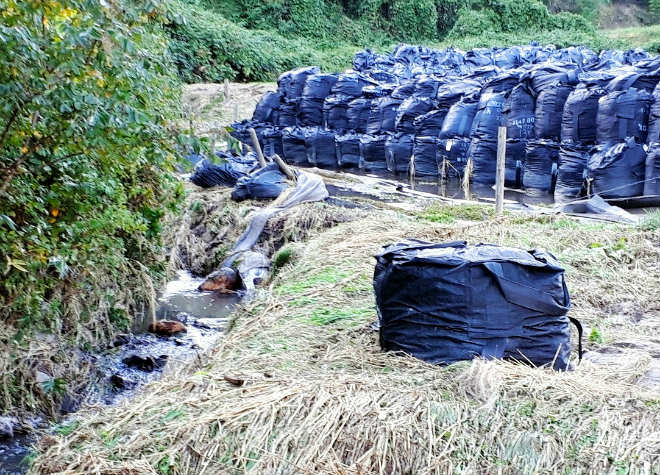
………………………. According to a documentary special that aired on public broadcaster NHK in February, ¥5.6 trillion has so far been spent on decontaminating the areas surrounding the Fukushima Daiichi nuclear power plant, but not all of this money has been spent directly on cleanup activities, the goal of which was to bring the affected area back to “normal” as soon as possible so that evacuees could return to their homes. But ten years later that hasn’t happened, or, at least, not to the degree originally envisioned. After 90% of the work was finished, an estimated 60% of the radiation had been reduced, and the cleanup had become a self-generating public works project with its own profit motives for contractors and sub-contractors.
The central problem was the way the work was allocated. Ideally, the trade or education ministry should have been in charge, since both have experience in the nuclear energy field; or the construction ministry, which has extensive experience in large public works projects. However, the government chose the environment ministry, which has never carried out any large-scale public works. The other ministries, apparently, were loath to take on a job involving “waste.”
Usually, when a government entity orders work to be done, they set up a bidding process. In this case, there were multiple distinct areas targeted for cleanup, as well as various stages in the cleanup process. Under such circumstances, general contractors try to get all the work in a given area in order to maximize profits, and ideally, they will have no competition for bids, which means they can essentially charge whatever they want. When NHK examined the bid documents for the areas targeted for cleanup and related work, they found that 68 percent of the work orders only had one bidder. These sorts of public works normally generate a profit margin of 5%, but in this case, it was about 10%. As one environment ministry official admitted to NHK, they had no real idea about the competitive situation and didn’t know how to oversee the work.
As a result, there was a lot of misuse of funds. NHK looked at one subcontractor headquartered in the city of Iwaki, Fukushima Prefecture, that was investigated by the tax authorities. The company’s president was described by others as being a big-hearted individual who had once worked at the nuclear power station himself and wanted to help his neighbors move back into the area. That’s why he started the company, with the intention of reconstructing the area. The company grew quickly. After only two years, its profits exceeded ¥10 billion, at which point, according to one employee, “the original motivation” for starting the company “disappeared.” The company was freely padding receipts and spending money to entertain contractors who controlled work orders so that they could get even more lucrative jobs.
The president started giving away new cars to valued employees. After six years, one of the contractors discovered that the Iwaki subcontractor had bribed several of its employees and dropped the subcontractor. Subsequently, the subcontractor started laying off people as profits decreased sharply, and they weren’t the only ones. Two employees of another large general contractor were arrested for fraud for having reported fake costs and pocketing the difference. As one subcontractor explained, it was easy to do. The manager of a particular job asks the subcontractor to forge receipts saying that twice as many people worked on the job or asks a company that supplies lodging for workers to inflate the room charge on the receipts. At least 15 employees of one general contractor were accused of fraud or failure to report income. The total amount of money swindled in these cases was about ¥4 billion.
One contractor told NHK that he knew the environment ministry was understaffed so he didn’t worry about getting audited. The ministry asked for more personnel and the government always refused, saying the cleanup was only a short-term project. As initially planned, it would be finished in three years and cost a little over ¥1 trillion, but after 10 years it’s still not finished and actual costs have soared past ¥3 trillion, not counting the money spent for processing waste and constructing storage facilities. The ministry planned to build only two incinerators for waste disposal, but the local governments said they would only allow waste collected within their borders to be burned, so the ministry ended up building 16 incinerators in Fukushima Prefecture alone. And while they were built to last 20 years, half of them have since been demolished in order to alleviate local anxieties, so in many areas the work was not completed, though the cost of waste incineration ended up being more 5 times the original estimate.
Public funds paid for all of this, but direct tax money was used mainly for mid-term storage of irradiated materials. Everything else related to the cleanup is supposed to be paid for by capital gains made from the government selling Tokyo Electric Power Co. (Tepco) stock. NHK says that the government bought ¥1 trillion worth of Tepco stock at ¥300 per share and estimates that in order to pay off the cleanup costs they would need to sell that stock at ¥1,500 per share. Unfortunately, the stock hasn’t gone up in price since the government bought it. As of February 20, it was about one-fourth what it needed to be, so they have simply put off sale of the shares. One expert NHK talked to, a scholar who has done extensive research into nuclear accidents, said that if the stock doesn’t go up in price, then the government will end up using tax money anyway to pay for the cleanup; either that, or Tepco is going to have to cover more of the cost, which means utility bills will go up again. So, the public—more specifically, future generations—pays for it either way.
This pay structure was built into the law quite recently. Originally, Tepco was legally responsible for cleaning up any situations caused by an accident at their facilities, and thus were expected to pay for the Fukushima disaster, but since the job was so huge the government borrowed money and paid for the operations on behalf of Tepco. In turn, all of Japan’s electric power companies were supposed to reimburse the government. But in March 2013, Tepco talked the government into changing the pay structure, convincing it to shoulder more of the burden by saying that making utilities pay for everything is unfair to their shareholders, since nuclear power is a “national policy.”
A letter that NHK uncovered from Tepco to the trade ministry said that Tepco would not be able to “revive” itself if the government didn’t take more responsibility for the cleanup. Nine months later, the Cabinet decided on the capital gains strategy. According to various officials interviewed by NHK, the government knew that the capital gains plan wouldn’t be able to cover the costs of the cleanup, even before it ballooned out of proportion, but that they had to come up with something quickly “on paper.” As one trade ministry official said, the plan puts the government in a double bind, since in order for the stock to go up appreciably, it has to guarantee not only Tepco’s survival, but its success as a private corporation in the short run. And that, presumably, means getting nuclear power plants back online as soon as possible, a task that has run up against a wall of public opposition in the wake of the Fukushima disaster. ………..https://apjjf.org/2021/7/Brasor.html
New report hails the decade of renewables as 2020 hits capacity record — RenewEconomy

Though there’s still far to go, 2020 ended up being a record-breaking year for renewables after predictions of a COVID-19 downturn. What comes next? The post New report hails the decade of renewables as 2020 hits capacity record appeared first on RenewEconomy.
New report hails the decade of renewables as 2020 hits capacity record — RenewEconomy
Opposition to abolishing nuclear weapons—and what could help to overcome it — IPPNW peace and health blog

Public opinion surveys—ranging from polls in 21 nations worldwide during 2008 to recent polls in Europe,Japan, and Australia—have shown that large majorities of people in nearly all the nations surveyed favor the abolition of nuclear weapons by international agreement. People who want to end the nightmare of nuclear destruction that has haunted the world since 1945 should consider widening the popular appeal of nuclear weapons abolition by strengthening the UN’s ability to provide international security.
Opposition to abolishing nuclear weapons—and what could help to overcome it — IPPNW peace and health blog
April 5 Energy News — geoharvey

Science and Technology: ¶ “ARIES: Advanced Research On Integrated Energy Systems” • Advanced Research on Integrated Energy Systems is a research platform for understanding the impacts of the millions of new devices – such as EVs, renewable generation, hydrogen, energy storage, and grid-interactive buildings – that get connected to the grid each day. [CleanTechnica] Solar […]
April 5 Energy News — geoharvey
News this week: the push to call nuclear ”green”
Coronavirus news? I confess to not being able to keep up with the latest on this. More infections in Brazil, other South American countries, Europe, …. USA? Vaccine rollouts happening, amid dissent….
Climate change keeps rolling on – are we near the ”tipping point”, where ocean currents weaken, affected by melting ice in the Norrth Atlantic ?
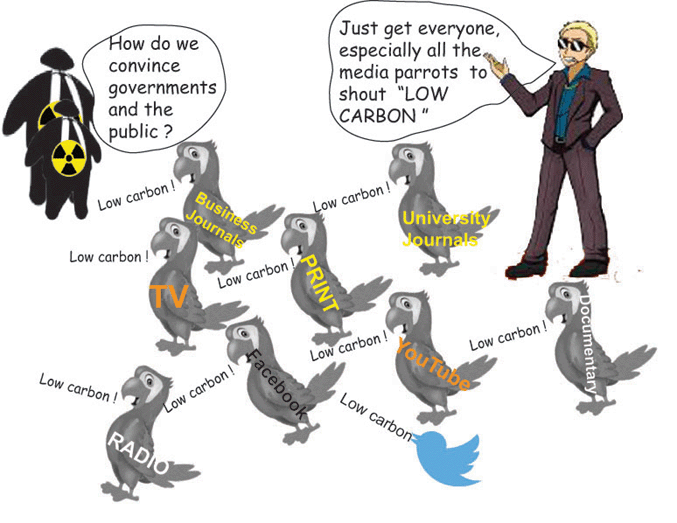
NUCLEAR. It might seem that nothing is happening. BUT, the relentless and well-funded nuclear lobby is now working overtime. They find the media a good sucker. You see, all you need to believe is that ”only the experts can have an opinion on this”. Never mind the fact that blind Freddie could see that ”nuclear power as a cure for climate change” is like ”cigarette smoking as a cure for obesity”. Mainstream journalists just play safe, regurgitating the spin of the nuclear lobby.
As it will be gargantuanally costly to clean up the nuclear industry – politicians find it easier to embrace it instead. Especially in France, where “This atomic energy is like a huge corpse hidden in a family house” see article below – in which France leads the push for a pro nuclear decision by the European Commission by 21st April.
As for America, from the nuclear point of view, Joe Biden could be seen as more sinister than Trump – carrying out the same policies, but with an appealing and decent presentation.
Anyway, it’s a revelation to me, as in every country, journalists are vigourously touting nuclear as essential to fix climate change, -presumably because it’s ”safer for” them to do this, when they really know little about it.
AUSTRALIA.
Labor Party’s platform on uranium/nuclear and radioactive waste issues. Scott Morrison’s $billion missile spend, a gift to foreign war companies and their sponsor, the Australian Strategic Policy Institute, (ASPI). Greenland might reject Australian-Chinese company Greenland Minerals in its bid to mine rare earths.
INTERNATIONAL
No greenwashing’: Fossil gas and nuclear must not be defined as clean, ministers tell IEA summit. Nuclear power, eligible for green investments? An environmental and climatic aberration, based on cynical and dishonest reasoning!.
Fusion nuclear reactors – a boondoggle run by bureaucrats. Every type of nuclear fusion still requires more energy put in than it gives out!
The IAEA is getting worried about nuclear safety, in view of climate extremes, and especially of earthquakes.
SOUTH ASIA. Nuclear weapons potential triggers escalation in South Asia.
EUROPE. By 21st April, will the European Commission be sucked in by a shonky anonymous report that pretends that nuclear power is ”green”?
FRANCE. Nuclear power- the killer of our future. The “Sortir du nuclear” Network denounces the attempts by France and the industrial nuclear lobby to include this technology in the European taxonomy (classification) project supposed to define “green” investments. France’s President Macron leads East European leaders in the pack to get the European leaders to call nuclear power ”green”.
CANADA. Secretive and corrupt plan to make Labrador, Canada, the world’s nuclear toilet. Labrador’s Inuit Regional Government kept in the dark about nuclear waste dump plan. Busting the spin that promotes ‘Small Nuclear Reactors’.
USA.
Joe Biden’s support for the nuclear industry is stated, but it’s not clear. Global nuclear industry delighted that Joe Biden pushes ”new nuclear for jobs”.
The massive tax-payer funding for security of nuclear reactors – and this will be just as bad for Small Nuclear Reactors. U.S. nuclear weapons are aging quickly. With few spare parts, how long can they last? U.S. Democrats introduce Bill to stop nuclear missile funding, switch funding to universal Covid vaccine developmen
Scott Morrison’s $billion missile spend, a gift to foreign war companies and their sponsor, the Australian Strategic Policy Institute, (ASPI)
Foreign war lobby gets a $billion for missiles – media fawns
https://www.michaelwest.com.au/foreign-war-lobby-gets-a-billion-for-missiles-media-fawns/ 4 Apr 21,
Scott Morrison’s latest billion-dollar missile spend was deftly leaked to the media then talked up by ASPI whose sponsors have raked in $51 billion in Defence Department contracts while doling cash to the conflicted “think-tank”. Marcus Rubenstein investigates.
No sooner had Scott Morrison’s new cabinet been sworn in than it was back to business, feeding out distractions to the Canberra press gallery.
Nearly 14 hours before the prime minister announced to the nation that Australia was going to spend a billion dollars on building “our own missiles” Greg Sheridan from The Australian had the scoop—along with The Age/SMH, Nine Newspapers stablemate Australian Financial Review and the ABC. Along with the ranks of metropolitan mainstream media dailies who all fell in line behind the announcement.
And with military precision they all fired off their online reports at 10:30pm… or, to be more precise, 22:30 hrs.
The Age and Sydney Morning Herald both quoted ASPI (Australian Strategic Policy Institute) in their coverage as did The Conversation, along with others they listed potential weapons maker partners for this home grown missile mission.
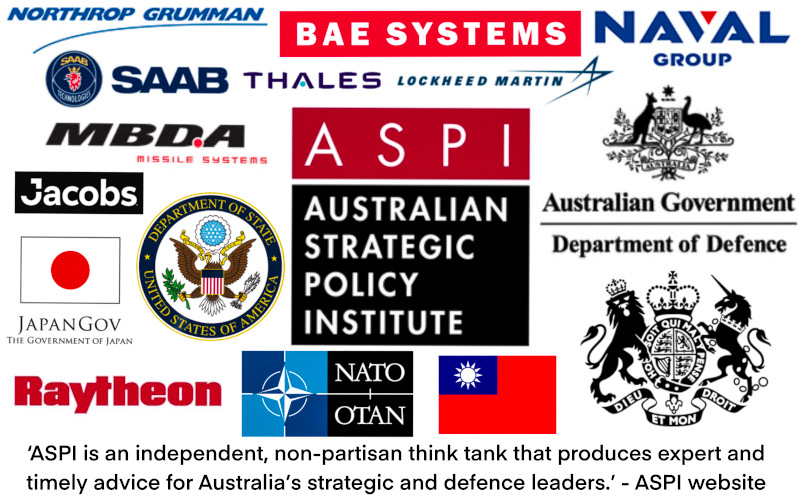
Apart from the glaring fact that none of these companies are actually Australian, most were listed by ASPI in a report it published last year. Of the five potential partner companies being touted by mainstream media— Raytheon (USA), Lockheed Martin (USA), Kongsberg (Norway), Rafeal (Israel) and BAE Systems (UK)—all but one is a long-term financial backer of ASPI.
As is de rigueur there was no mention that ASPI’s enthusiasm for substantial new military expenditure was directed towards spending on weapons made by their sponsors.
A number of media reports included PR handout images from US missile maker Raytheon, which for years was a loyal ASPI sponsor and also the former employer of, recently demoted, Defence Minister Linda Reynolds.
The actual announcement was made by the prime minister, not at Parliament House, but at the South Australian facility of Raytheon.
Government access for weapons makers
Since ASPI’s foundation in 2001, when it was created to challenge the policy direction of Defence, it has become more and more commercialised.
This fact was highlighted by ASPI’s founding Executive Director Hugh White, who wrote on the 15th anniversary of its foundation, “The quality of defence policy slumped… [and] ASPI’s focus inevitably swung round to contributing to public debates not government policy-making.”
Under Hugh White’s leadership, ASPI preserved a great deal of independence and only took an average of $28,000 per year in commercial revenue.
In the last financial year, under the leadership of (former Howard Government adviser) Peter Jennings, ASPI raked in $6,953,000 in commercial revenue. Yet it maintains its façade of independence of outside influence.
ASPI sponsor, French-owned Naval Group was awarded the contract for Australia’s controversial $80 billion future submarine project. It has been in the headlines recently after an independent report released in March found the project was “dangerously off track”.
In 2016, when the contract was awarded Jennings, wrote a glowing opinion piece, about his sponsor, under the headline “Vive Australia’s choice of a French submarine”.
The release of the Future Submarines Report was very critical of the entire project and there were suggestions from highly credentialed defence strategists that Australia should walk away from the deal.
In response, ASPI wrote that not only should Naval Group keeps its contract but the Royal Australian Navy should commission un-maned Orca submarines whilst waiting decades for the French submarines order to be fulfilled.
And who makes the Orca? Another ASPI sponsor, Boeing Defense.
This comes after revelations in March that ASPI had been commissioned to write a report critical of the federal government’s awarding of cloud computing contracts to Australian company Canberra Data Centres (CDC).
As it transpires, ASPI had been commissioned to write the report by lobbying firm Australian Public Affairs (APA); the Commonwealth Lobbyists Register reveals APA represent CDC’s three main commercial rivals.
Last October, ASPI’s Peter Jennings told the ABC, “ASPI’s work as a think tank is genuinely independent” and suggestions it was controlled by sponsors were “frankly nonsense”.
The massive ASPI payoff
ASPI is not an independent think tank, it is in fact a Commonwealth Company which reports to the parliament through the Defence Ministry. In its latest annual report ASPI singled out the then Defence Minister for her “continuing close personal engagement and support”.
In her first speech as Defence Minister, Linda Reynolds boasted of her close friendship with ASPI’s Peter Jennings.
Clearly ASPI’s boss and his board, which is chaired by former Chief of the Army, Lt Gen (Ret’d) Kenneth Gillespie and includes former Liberal Defence Minister Brendan Nelson, has access to the highest levels of government and the Defence Department.
Since ASPI’s inception it has received sponsorship from 12 manufacturers of weapons and weapons systems. Over that period, they have been awarded 9,423 Defence Department contracts with a total value of $51.2 billion.
This does not include another 49 ASPI sponsors who do not manufacture weapons, yet Department of Finance data, reveals have benefitted from more than $30 billion in defence contracts since 2001.
ASPI’s most recent annual report revealed that in the year before the COVID-19 pandemic, it hosted 142 separate events and meetings, many of them bringing together defence policy makers and defence suppliers.
At one such event in 2019, sponsored by Thales, Northrop Grumman and Lockheed Martin, then Defence Minister Linda Reynolds was keynote speaker. Presumably executives from these foreign weapons makers had some level of access to the minister.
Department of Finance figures later revealed that ministerial and department staff were charged $30,723 by ASPI in order to attend that speech.
Greenland might reject Australian-Chinese company Greenland Minerals in its bid to mine rare earths
Telegraph 4th April 2021, AS elections go, it sounds rather minor-league: a contest with just 40,000 voters, triggered by a planning row in one of the most remote, inhospitable corners of the planet. On Tuesday, though, diplomats from Washington to
Beijing will be watching carefully as Greenland holds snap parliamentary polls. With a total of population of just 56,000, its electorate is smaller than some British town councils – yet their vote over the vexed issue of the Kvanefjeld mine project could have implications not just for Greenland, but the global superpower race.
Overlooking the tiny fishing settlement of Narsaq, where locals live mainly off catching whales and seals, the project
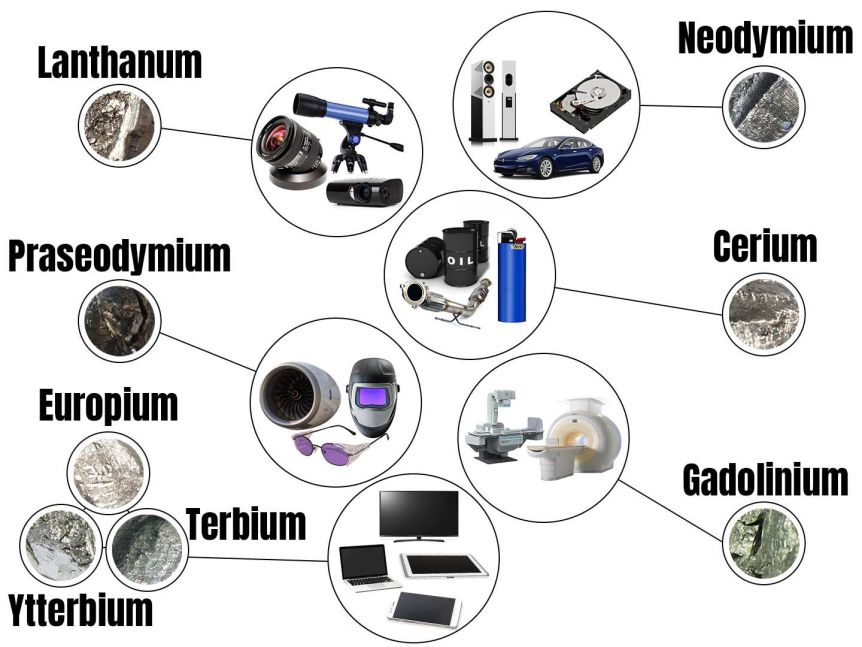
aims to tap into one of world’s biggest deposits of “rare earth” minerals – materials as vital to the 21st-century as oil was to the 20th. Their supermagnetic, superconductive properties are used in everything from i-Phones and solar panels through to hybrid cars and weapons systems.
Yet while they are key to the goals of a high-tech, low-carbon world, extracting them itself can be an environmentally-hazardous process – a point not lost on Greenland’s residents, some of whom are sceptical of promises from the Australian firm behind the project, Greenland Minerals, that strict anti-pollution measures will be enforced.
Frontrunners in the election are the Left-wing, pro-green Inuit Ataqatigiit party, who could throw the mine project out altogether, despite warnings from rival parties that Greenland’s isolated economy must end its dependence on fishing. But for others, the stakes are about much more than even that. Of particular concern is that Greenland Minerals is part-owned by Shenghe Holdings, a Chinese firm with close ties to the Beijing government.
Living with Chernobyl — Beyond Nuclear International

The nuclear disaster 35 years on
Living with Chernobyl — Beyond Nuclear International
1 This month.

PETITION – To: Prime Minister Anthony Albanese and the Australian Labor Government
Chernobyl: The Lost Tapes – A good documentary on Chernobyl on SBS available On Demand for the next 3 weeks– https://www.sbs.com.au/ondemand/tv-program/chernobyl-the-lost-tapes/235274195556

19 May – Webinar- Webinar: No Nuclear Weapons in Australia
Start: 2026-05-19 18:00:00 UTC Canberra, Melbourne, Sydney (GMT+10:00)
End: 2026-05-19 19:30:00 UTC Canberra, Melbourne, Sydney (GMT+10:00)
20 May – Webinar – The dangerous world of AUKUS, US, military occupation and suppression of dissent

National Webinar, 20th May, 2026, 6.30pm AEST. Confronting laws restricting/suppressing protest speech and action
Speakers: Former Sen. Rex Patrick, Lawyer Nick Hanna ,Arthur Rorris ,Jorgen Doyle, Sen David Shoebbridge,
Facilitator Kelley Tranter.

of the week – Australians for War Powers Reform (AWPR)
To see nuclear-related stories in greater depth and intensity
 Antinuclear