The remediation of Ranger uranium mine: will it really restore the environment?
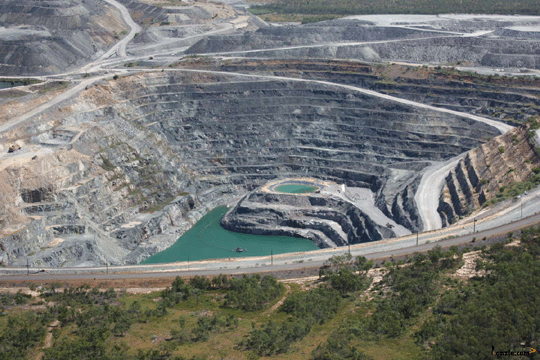
Traditional owners were given land rights in return for their support for the Ranger mine, and Kakadu National Park was born. ……. the land will finally be returned to the traditional owners… the question is, in what state? ……… we could find the site an eroding heap of substandard scrub.
As part of cleaning up the mine site, contaminated buildings and equipment will be buried in one of the mine’s enormous pits.
We’ve been told that burying the equipment and the contaminated material in the mine site is out of step with global best practice in the mining industry.
|
Kakadu in crisis, ABC 22 Feb 2021, Crisis in Kakadu: The turmoil threatening Australia’s biggest national park
“It’s gone downhill. No one basically trusts anybody, no one respects each other anymore. That’s how bad it is here.” Traditional owner Kakadu is one of the great natural wonders of the world. The stunning landscape, teeming with wildlife, is a major tourist destination with scores of Instagram friendly sites. For tourism operators it is an iconic symbol of what Australia has to offer. “It’s one of the most special places in Australia. It’s for so long been one of the reasons why people visit Australia and for Australians, one of their must do life experiences.” Tourism industry representative Despite its beauty, there is trouble inside Australia’s biggest national park. This World Heritage listed site is in crisis. “It’s an absolute mess because the institutions responsible for fixing it up aren’t doing their job.” Traditional owner On Monday Four Corners investigates accusations of mismanagement and neglect which have fuelled a bitter dispute between the park’s traditional owners and the authority that runs the park. |
The media revels in rockets to Mars, ignores the horrible risk of plutonium pollution
|
Plutonium, Perseverance and the Spellbound Press https://www.dailykos.com/stories/2021/2/24/2017916/-Plutonium-Perseverance-and-the-Spellbound-Press
With all the media hoopla last week about the Perseverance rover, frequently unreported was that its energy source is plutonium—considered the most lethal of all radioactive substances—and nowhere in media that NASA projected 1-in-960 odds of the plutonium being released in an accident on the mission. “A ‘1-in-960 chance’ of a deadly plutonium release is a real concern—gamblers in Las Vegas would be happy with those odds,” says Bruce Gagnon, coordinator of the Global Network Against Weapons and Nuclear Power in Space. Indeed, big-money lotteries have odds far higher than 1-in-960 and routinely people win those lotteries. Further, NASA’s Supplementary Environmental Impact Statement (SEIS) for the $3.7 billion mission acknowledges that an “alternative” power source for Perseverance could have been solar energy. Solar energy using photovoltaic panels has been the power source for a succession of Mars rovers. For an accident releasing plutonium on the Perseverance launch—and 1 in 100 rockets undergo major malfunctions on launch mostly by blowing up—NASA in its SEIS described these impacts for the area around the Cape Kennedy under a heading “Impacts of Radiological Releases on the Environment.” Continue reading |
National Farmers Federation want govt to support renewable energy (not coal or nuclear)
released on Tuesday, the NFF makes the call for renewable energy to be part
of new investment to address the $3.8bn annual shortfall in infrastructure
in regional Australia. The paper, which makes no mention of coal or nuclear
energy supporting jobs in the regions, comes as the Nationals push for the
Clean Energy Finance Corporation to invest in those technologies.
Summary of the risks of uranium mining
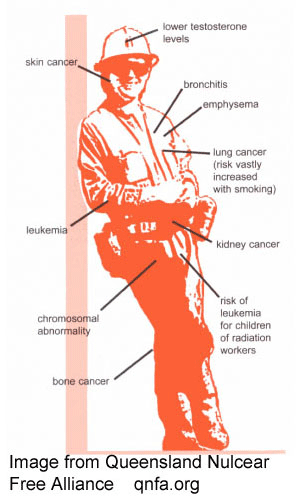 Greg Phillips, 25 Feb 21, This is a very good summary of the risks of Uranium mining:
/catalog/13266/uranium-mining-in-virginia-scientific-technical-environmental-human-health-and
American uranium/nuclear lobbyists fund campaigns of climate sceptics/deniers
|
Campaign contributions, including from a Utah operator, preceded creation of federal uranium stockpile, Salt Lake Tribune, Zak Podmore Feb. 23, 2021
“………….Funding climate skeptics Energy Fuels executives, including Moore, who sits on the board of Friends of Arches and Canyonlands Parks, often promote the important role nuclear energy plays in combating climate change.
A recent sustainability report released by the company states, “The materials that Energy Fuels responsibly produces and recycles are helping to address some of the most daunting health and environmental issues facing the world today: air pollution and climate change.”
But campaign contributions from uranium executives have funded the campaigns of climate change skeptics in Congress. Barrasso opposed the Obama administration decision to sign onto the Paris climate agreement in 2016, and as recently as 2019, he declined to concede human use of fossil fuels is the leading cause of climate change in an interview with the Washington Examiner.
Other recipients of campaign contributions — including then-President Trump, Sen. Cynthia Lummis, R-Wyo., and Gosar — have been even more outspoken in their climate change skepticism.
Moore said the contributions skewed heavily toward the GOP because Republicans are most likely to represent districts where the company has uranium operations, and noted that several Democrats have also received donations. Rep. Henry Cuellar of Texas, for example — a conservative Democrat who last year fended off a high-profile primary challenge from left-wing immigration attorney and climate activist Jessica Cisneros — received $1,000 from an Energy Fuels executive during the primary…… https://www.sltrib.com/news/2021/02/20/campaign-contributions/
|
|
Coal giant AGL again tops list of Australia’s biggest emitters — RenewEconomy

Coal generators and oil and gas producers dominate latest list of Australia’s largest emitters. The post Coal giant AGL again tops list of Australia’s biggest emitters appeared first on RenewEconomy.
Coal giant AGL again tops list of Australia’s biggest emitters — RenewEconomy
Morrison’s media code could be catastrophic for climate and energy news — RenewEconomy

Google’s decision to snub RenewEconomy – apparently because it does not do “public interest” journalism – and include Sky News and a celebrity gossip site on its “showcase, bodes ill for Australian media. The post Morrison’s media code could be catastrophic for climate and energy news appeared first on RenewEconomy.
Morrison’s media code could be catastrophic for climate and energy news — RenewEconomy
Neoen lands $160 million in CEFC finance for Australia’s biggest battery — RenewEconomy

Neoen lands $160 million in finance from CEFC to fund the Victoria Big Battery, which will be the biggest in Australia. The post Neoen lands $160 million in CEFC finance for Australia’s biggest battery appeared first on RenewEconomy.
Neoen lands $160 million in CEFC finance for Australia’s biggest battery — RenewEconomy
“We don’t have a credible climate policy:” Sport stars want stronger targets — RenewEconomy

Australia’s summer of sport under threat from more frequent heat waves and bushfires, sport stars issue a joint call for greater action on climate change. The post “We don’t have a credible climate policy:” Sport stars want stronger targets appeared first on RenewEconomy.
“We don’t have a credible climate policy:” Sport stars want stronger targets — RenewEconomy
February 24 Energy News — geoharvey

Science and Technology: ¶ “A Solar Panel In Space Is Collecting Energy That Could One Day Be Beamed To Anywhere On Earth” • Scientists working for the Pentagon have successfully tested a satellite solar panel the size of a pizza box, that was designed as a prototype for a future system to send electricity from space […]
February 24 Energy News — geoharvey
Kimba radioactive trash Bill stagnates in the Senate, as Right-wing media extols nuclear power
Resources Minister Keith Pitt and Australia’s nuclear schills must be getting a bit desperate. The National Radioactive Waste Management Amendment (Site Specification, Community Fund and Other Measures) Bill 2020 keeps on not getting itself discussed in the Senate.
This could be because (a) it’s likely to be defeated, or (b) if passed, there will be a successful court action opposing it, or (c) the plan would not meet the required international safety standards.
I’m betting on (d) – the Senators just don’t know wotthell to do about it.
Meanwhile Australia’s the prevailing media, the Murdochracy,and commercial media is in a frenzy, in their anxiety about Australia’s huge need to embrace nuclear technology.
Why we need to flick the switch and embrace nuclear power -THE AUSTRALIAN 23 February
NuScale’s small nuclear reactor dream – dead on arrival?
 Even with new technology, we will need to mine uranium—a process that has leached radioactive waste into waterways—and find somewhere to put the spent fuel. (The current practice, which persists at Trojan and will be employed at NuScale’s plants, is to hold waste on-site. This is intended to be a temporary measure, but every attempt to find a permanent disposal site has been stalled by geological constraints and local opposition.)
NuScale was making “an end run around [voters] in their quest for corporate profit.” He also noted the company’s ties to the Fluor Corporation. Fluor has invested $9.9 million in campaign contributions over the past 30 years, with nearly two-thirds going toward Republican candidates. (Fluor is currently under investigation by the Securities and Exchange Commission due to allegedly sloppy accounting practices.)
A decade ago, NuScale suggested it might have a plant in operation by 2018. Now construction won’t begin until 2025 at the earliest. The plant at Idaho National Laboratory won’t be fully operational until 2030.
in order to make advanced reactors accessible within the next few decades—even relatively simple reactors, like NuScale’s—the government would need to provide hundreds of billions of dollars in subsidies …… the nuclear dream looks dead on arrival….
Biden’s Other Nuclear Option, Smaller nuclear reactors might be the bridge to a carbon-free economy. But are they worth it? Mother Jones, 22 Feb 21, BOYCE UPHOLT ”………..
But are these investments worth the money—and the risks? New designs or not, nuclear plants face daunting issues of waste disposal, public opposition, and, most of all, staggering costs. We must ramp up our fight against climate change. But whether nuclear is a real part of the solution—or just a long-shot bid to keep a troubled industry alive—is a debate that will come to the fore in the short window we have to overhaul the nation’s energy portfolio.
Few issues divide us as cleanly as nuclear power. According to a 2019 Pew Research Center poll, 49 percent of Americans support opening new plants, while 49 percent are opposed.
The popular argument against nuclear power can be summed up in a few names: Chernobyl. Fukushima. Three Mile Island. Nuclear dread is palpable. Some formerly pro-nuclear countries, like Germany, began phasing out plants in the wake of the 2011 disaster in Japan. The dangers begin well before nuclear fuel arrives at a plant, and persist long afterward; the rods that fuel today’s plants remain radioactive for millennia after their use. How to ethically store this waste remains a Gordian knot nobody has figured out how to cut.
The argument in favor of nuclear power boils down to the urgent need to combat climate change. [Ed, but nuclear does not really combat climate change.]
But if nuclear power is going to help us mitigate climate change, a lot more reactors need to come online, and soon. Eleven nuclear reactors in the United States have been retired since 2012, and eight more will be closed by 2025. (When nuclear plants are retired, utility companies tend to ramp up production at coal- or natural gas–fired plants, a step in the wrong direction for those concerned about lowering emissions.) Since 1970, the construction of the average US plant has wound up costing nearly three-and-a-half times more than the initial projections. Developers have broken ground on just four new reactor sites since Three Mile Island. Two were abandoned after $9 billion was.. sunk into construction; two others, in Georgia, are five years behind schedule. The public is focused on risks, but “nuclear power is not doing well around the world right now for one reason—economics,” says Allison Macfarlane, a former commissioner of the Nuclear Regulatory Commission. Continue reading
What would go into the Chalk River Mound? — Concerned Citizens of Renfrew County and Area

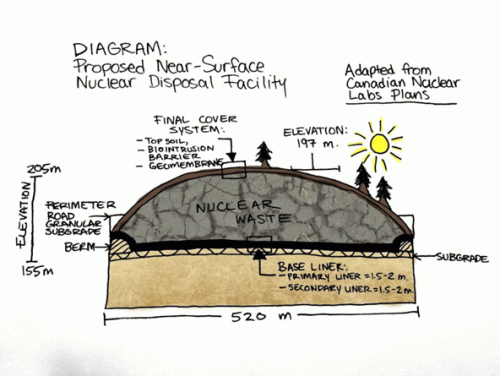
December 2020 Canadian taxpayers are paying a consortium (Canadian National Energy Alliance) contracted by the federal government in 2015, billions of dollars to reduce Canada’s $16 billion nuclear liabilities quickly and cheaply. The consortium is proposing to construct a giant mound for one million tons of radioactive waste beside the Ottawa River upstream of Ottawa-Gatineau. […]
What would go into the Chalk River Mound? — Concerned Citizens of Renfrew County and Area
There is considerable secrecy about what would go into the mound; the information that follows has been derived from the proponent’s final environmental impact statement (EIS) (December 2020) which lists a partial inventory of radionuclides that would go into the gigantic five-to-seven story radioactive mound (aka the “NSDF”). The EIS and supporting documents also contain inventories of non-radioactive hazardous materials that would go into the dump.
Here is what the consortium says it is planning to put into the Chalk River mound (according to the final EIS and supporting documents)
1) Long-lived radioactive materials
Twenty-five out of the 30 radionuclides listed in Table 3.3.1-2: NSDF Reference Inventory and Licensed Inventory are long-lived, with half-lives ranging from four centuries to more than four billion years.
To take just one example, the man-made radionuclide, Neptunium-237, has a half-life of 2 million years such that, after 2 million years have elapsed, half of the material will still be radioactive. At the time of emplacement in the mound, the neptunium-237 will be giving off 17 million ( check, 1.74 x 10 to the 7th) radioactive disintegrations each second, second after second.
The mound would contain 80 tonnes of Uranium and 6.6 tonnes of thorium-232.
2) Four isotopes of plutonium, one of the most deadly radioactive materials known, if inhaled or ingested.
John Gofman MD, PhD, a Manhattan Project scientist and former director of biomedical research at the DOE’s Lawrence Livermore Laboratory, stated that even one-millionth of a gram of plutonium inhaled into the lung, will cause lung cancer within 20 years. Sir Brian Flowers, author of the UK Royal Commission Report on Nuclear Energy and the Environment, wrote that a few thousands of a gram, inhaled into the lungs, will cause death within a few years because of massive fibrosis of the lungs, and that a few millionths of a gram will cause lung cancer with almost 100% certainty.
The four isotopes of plutonium listed in the NSDF reference inventory are Plutonium-239, Plutonium-240, Plutonium-2441 and Plutonium-242. According to Table 3.3.1-2 (NSDF Reference Inventory and Licensed Inventory) from the EIS, The two isotopes 239 and 240 combined will have an activity of 87 billion Bq when they are emplaced in the dump. This means that they will be giving off 87 billion radioactive disintegrations each second, second after second.
3) Fissionable materials
Fissionable materials can be used to make nuclear weapons.
The mound would contain “special fissionable materials” listed in this table (avove) extracted from an EIS supporting document, Waste Acceptance Criteria, Version 4, (November 2020) Continue reading
Coca-Cola Amatil commits to 100pct renewables by 2025, zero emissions by 2040 — RenewEconomy

Coca-Cola Amatil signs on to switch its Australian beverage facilities to 100 per cent renewable electricity by 2025, aiming for net zero emissions by 2040. The post Coca-Cola Amatil commits to 100pct renewables by 2025, zero emissions by 2040 appeared first on RenewEconomy.
Coca-Cola Amatil commits to 100pct renewables by 2025, zero emissions by 2040 — RenewEconomy
February 22 Energy News — geoharvey

Opinion: ¶ “Texas GOP Attacks AOC With False Claims … For Trying To Help Texans, Americans, And The World” • Texas’ GOP Chair, Allen West, rather than working to help Texans in a time of dire need, decided to switch the issue. Rep Alexandria Ocasio-Cortez raised $2 million for Texans, so he attacked her and […]
February 22 Energy News — geoharvey
1 This month.


PETITION – To: Prime Minister Anthony Albanese and the Australian Labor Government
Chernobyl: The Lost Tapes – A good documentary on Chernobyl on SBS available On Demand for the next 3 weeks– https://www.sbs.com.au/ondemand/tv-program/chernobyl-the-lost-tapes/235274195556

19 May – Webinar- Webinar: No Nuclear Weapons in Australia
Start: 2026-05-19 18:00:00 UTC Canberra, Melbourne, Sydney (GMT+10:00)
End: 2026-05-19 19:30:00 UTC Canberra, Melbourne, Sydney (GMT+10:00)
20 May – Webinar – The dangerous world of AUKUS, US, military occupation and suppression of dissent

National Webinar, 20th May, 2026, 6.30pm AEST. Confronting laws restricting/suppressing protest speech and action
Speakers: Former Sen. Rex Patrick, Lawyer Nick Hanna ,Arthur Rorris ,Jorgen Doyle, Sen David Shoebbridge,
Facilitator Kelley Tranter.

of the week – Australians for War Powers Reform (AWPR)
To see nuclear-related stories in greater depth and intensity
 Antinuclear