To 22 February, Covid-19, climate, and nuclear news

- Global Tracker: Cases exceed 111.2 million; deaths pass 2.4 million
- Vaccine Tracker: More than 202 million shots given worldwide
- Pfizer-BioNTech vaccine reduces transmission by 89%, study shows
Climate; disinformation is rampant. –”we have allowed governments around the world to throw away the time when we could have stopped the endless killer heat waves, fires, rising seas, superstorms, dying coral, dying everything. We let governments from Monarchies to Oligarchies to alleged Democracies endanger life on this planet, including our kids future.
If we can’t change that, we really are doomed.” – Alex Smith, Radio Ecoshock.
Nuclear – it is disappointing to me to listen to interviews with Bill Gates- he is not questioned on his statements pushing nuclear power for climate. It seems that being a billionaire entrepreneur qualifies him for a kind of reverent belief and trust . Meanwhile, a real climate expert , Michael Mann, has just published an authoritative book on the subject.
Hunting for good news – but it’s tricky. Lots of good news on things like individuals being kind to homeless people. But there’s a dearth of news about public, government, action to provide homes for the homeless.
AUSTRALIA.
Wise warning to Australian government to withdraw embarrassing Nuclear Waste Dump Bill.
Nothing clean about nuclear, coal or gas – Australian Conservation Foundation. Australian Liberal National Coalition enthusiastic for nuclear power. Nationals add nuclear enthusiasm to the government’s energy bill. Australia a renewables leader – or the ‘‘Saudi Arabia of nuclear energy”– Queensland neeeds job-supplying, clean, renewable energy, NOT antiquated nuclear power. News Corpse fervently promoting nuclear power to Australia.
Solar, storage to take over from Ranger uranium mine. Mediation continuing over rehabilitation of Range uranium mine.
‘Clean coal’ is nothing but a marketing scam: Energy experts.
Federal energy and emissions reduction minister Angus Taylor wants to include dirty energy in Clean Energy Finance Corporation.
INTERNATIONAL
Nuclear lobby planning to take over the U.N Climate Change Conference.
Living longterm in radioactively contaminated areas damages our health.
On nuclear power as climate solution, Bill Gates shows alarming ignorance. Bill Gates’undemocratic approach to climate crisis. New books on climate change; Michael Mann versus (nuclear promoter) Bill Gates.
The “negaWatt” – the best energy is the energy you don’t use.
Wise warning to Australian government to withdraw embarrassing Nuclear Waste Dump Bill
 Peter Remta, 21 Feb 21, to Senator Slade Brockman
I am aware that the Waste Management Amendment (Site Specification, Community Fund and Other Measures) Bill 2020 has been listed in the Senate’s order of business for Tuesday 23 February but with respect suggest that this a completely futile exercise on the part of your government and the responsible minister
The bill will not be passed because of the unwavering opposition by the crossbench and any preceding debate could be extremely embarrassing for your government because of the untoward and disingenuous information previously put out by Pitt and his department and its agencies being raised by the opposing senators
If Pitt then falls back on the existing legislation he will be subject to administrative and judicial and now because of the High Court decision earlier this month in the New Acland Coal case(1) will be completely stopped with his proposals if the opposing community at Kimba start their legal action since their situation is one real and not just apprehend bias as in that case
Should that litigation ensue then practically all written material held by the government in all its guises will be fully disclosed through the litigation procedure of discovery
From my limited personal knowledge of some of that material it will prove extremely embarrassing and your government will not be able to claim any privilege to prevent its disclosure
This is the view of several senior lawyers including some retired superior court judges but ask the attorney should you have any doubts
Perhaps the most pertinent aspect of the whole situation is the proposal for Kimba will in any event fail to get any of the necessary licences as ARPANSA is already being criticised for not carrying out its proper regulatory functions with respect to ANSTO and as a result the licence applications will be subject to an overseas peer review which will completely remove the licensing process from your government and its agencies
In any case ANSTO is already under a cloud due to its dismal performance and awkward responses at the Senate estimates hearing on 29 October 2020 which will I understand be subject to further extensive questioning and explanations
Please bear in mind that I was the source of the information for the questioning senators and the further questions to be asked due to the complete inadequacy of the responses by ANSTO to the notified questions(2)
I therefore suggest that you and Dean Smith as the government whips withdraw the bill before it becomes a further embarrassment to your government in a possible election year
With kind regards
Peter Remta
(1). Oakey Coal Action Alliance Inv v. New Acland Coal Pty Ltd & Ors
High Court Case No.B34/2020
(2). SENATE ECONOMICS LEGISLATION COMMITTEE Estimates
Hansard THURSDAY 29 OCTOBER 2020
Senator Abetz pages 11 to 13 and Senator Carr pages 5 to 11
Haines proposes $483m Local Power Agency to help communities buy in to wind and solar — RenewEconomy

Independent MP Helen Haines introduces legislation to establish a new Australian Local Power Agency to support community ownership of renewable energy. The post Haines proposes $483m Local Power Agency to help communities buy in to wind and solar appeared first on RenewEconomy.
Haines proposes $483m Local Power Agency to help communities buy in to wind and solar — RenewEconomy
Fukushima – radioactive water into the sea – a nightmare for fishermen
I won’t lie — I was a little nervous heading inside the destroyed nuclear plant at the centre of Japan’s 2011 nuclear accident.
It was a rare opportunity to look at how the clean-up effort was going 10 years on.
But weighing on my mind as I headed inside and took a look around was that this was of the most radioactive places on earth right now.
I’ve been inside Fukushima’s no-go zones, where the radiation levels are so high it’s unliveable and overgrown weeds entangle anything in their way — from abandoned homes, cars and even vending machines.
It is always an eerie experience seeing entire towns frozen in time and the stories from those who once called it home are equally chilling.
This is the first time I’ve been in the place responsible for it……..
It’s been 10 years since Japan’s worst nuclear accident, which was triggered by the most powerful earthquake ever recorded in the country and a massive tsunami that wiped out everything in its path.
Yet the aftershocks from the devastating March 11 disaster continue to rattle these parts — the most recent occurring only a week ago.
Japan’s nuclear disaster site is still a hive of activity
When the tsunami hit the nuclear plant in 2011, it cut power and consequently cooling to three operational reactors.
At that point, only flooding the reactors with seawater could have cooled them quickly enough to avoid a meltdown.
But that decision was delayed because of fears it would permanently destroy the reactors.
By the time the government ordered the seawater to be used, it was too late. The nuclear fuel overheated and melted down.
Some of the reactors exploded and the twisted wreckage of the blast is still exposed today.
When I arrived at the Fukushima Daiichi Nuclear Power Plant, I was given a radiation dosimeter and handed a plastic bag containing gloves, a mask and three pairs of socks.
I had been given specific instructions to put on one after the other.
The idea was to prevent any radioactive material from getting onto my pants — if it does, the officials jokingly told me, I’ll have to leave them there.
Once I’m ready, I follow an official through a maze-like path to the Whole Body Counter room.
That’s where I have a scan that measures the existing radiation levels inside my body so they can check how much I have been exposed to throughout the day.
It’s a bustling hive of activity — there are thousands of workers here and as we pass by many say ‘otsukaresama deshita’, a Japanese phrase that loosely translates to ‘thank you for your service’.
We’re accompanied and guided by several officials from the plant’s operator, the Tokyo Electric Power Company (TEPCO)……….
The long process of removing 800 tones of radioactive fuel
TEPCO has spent the last 10 years trying to cool and stabilise the three reactors so that they can eventually start to remove the molten fuel debris that sits inside them.
As we pull up to the destroyed reactors, which contain more than 800 tonnes of highly radioactive molten nuclear fuel, we can see many workers in full protective equipment heavily involved in the decontamination effort.
In the space of just a few steps, radiation levels spike from 80 microsieverts an hour to 100. At the same time, my radiation alarm goes off to tell me I’ve accumulated 0.02 millisieverts of radiation while at the plant.
It’s about the same as a chest x-ray and nothing to be worried about at this stage — but our minders tell us we shouldn’t spend too much more time here.
It’s estimated the full clean-up effort will take another 30-40 years, though some experts feel this is optimistic.
The company was hoping to start removal of the highly radioactive debris this year, but the coronavirus pandemic will prevent that from happening.
“We are planning to remove the fuel debris from Unit 2 using a robot arm and the plan was to make the arm and carry out a performance test in the UK,” TEPCO’s Yoshinori Takahashi told me.
“But because of the coronavirus, the manufacturing process and testing has been delayed.”
The delay could be up to 12 months. But that is not the most pressing issue facing TEPCO.
How do you remove a million tonnes of contaminated water?
All of the water that touches the highly radioactive molten fuel also becomes contaminated.
The water is processed to remove more than 60 different types of radioactive materials from it, but the Advanced Liquid Processing System (ALPS) doesn’t completely purify the water.
The radioactive element, tritium, remains inside all of the stored water, albeit at “low” levels, according to TEPCO.
Currently, 1.2 million tonnes of contaminated water is stored in more than 1,000 tanks spanning the entire power plant facility. But by the end of next year, the tanks and the site will be full.
The Japanese government is now weighing up what to do next.
A panel of experts has recommended disposing of it in the ocean as the most practical option as opposed to releasing it into the air, which TEPCO said would be more difficult to monitor.
Mr Takahashi said tritium was a weak form of radiation and that the water would be released in such limited quantities over such a long period that it would be safe.
But for those who make their living from the part of the ocean where TEPCO is proposing to dump its contaminated water, they fear the damage this poses to their reputation.
That includes Haruo Ono, who has been fishing in Fukushima’s waters for 50 years.
Fisherman worried about what water release will mean for their livelihoods
Although most fishermen are receiving compensation payments from TEPCO to cover their revenue shortfalls, he fears that if contaminated water is released into the ocean, it will finish off the industry for good.
“They say it’s OK to release tritium, but what do consumers think? We can’t sell fish because the consumers say no,” he said.
The 70-year-old is opposed to the scheme and says he’s hoping to watch the decommissioning first-hand over the next 30-40 years…………… https://www.abc.net.au/news/2021-02-21/a-tour-inside-fukushimas-nuclear-plant-10-years-after-accident/13158976
News Corpse fervently promoting nuclear power to Australia
 From THE AUSTRALIAN, 17 Feb 21, ‘‘Think of the deaths that could have been avoided, since installing solar panels and wind turbines is a surprisingly dangerous exercise. The death toll from solar power per unit of energy supplied is more than five times as high as the death toll from nuclear, according to estimates from Cambridge House in Canada. By the same measure, nuclear power is 1000 times safer than coal and 400 times safer than natural gas. Yet still Albanese persists with the lame excuse that nuclear power is too dangerous to consider.”
 Cambridge House doesn’t seem like a credible source for deaths in different power sources.
Maybe not the most reliable source of info, journalist at The Australian.
Some excellent scientists did, in fact, do meticulous studies, and documented illnesses,deaths, birth defects resulting from the Chernobyl disaster. The Russian government happily collaborated with the West in a successful campaign to discredit those scientists. Most notably Alexey V. Yablokov – https://en.wikipedia.org/wiki/Chernobyl:_Consequences_of_the_Catastrophe_for_People_and_the_Environment
New books on climate change; Michael Mann versus (nuclear promoter) Bill Gates
Bill Gates’s faith in a technological fix for climate change is typical of privileged men who think they can swoop in and solve the problems others have spent decades trying to fix.
 Alongside Gates’s book comes The New Climate War, by Michael Mann, a well-known American climate scientist. Mann is the genuine article. He started in the field in the early 1990s as a graduate student at Yale University and has never left it. He is less than convinced by Gates’s relatively late conversion to the climate cause.Gates is a classic example of a “first-time climate dude”, believes Mann. This phenomenon is “the tendency for members of a particular, privileged demographic group (primarily middle-aged, almost exclusively white men) to think they can just swoop in… and solve the great problems that others have spent decades unable to crack”. The result is a mess, “consisting of fatally bad takes and misguided framing couched in deeply condescending mansplaining”.
South Africa: an example of how nuclear waste costs are passed on to grandchildren taxpayers
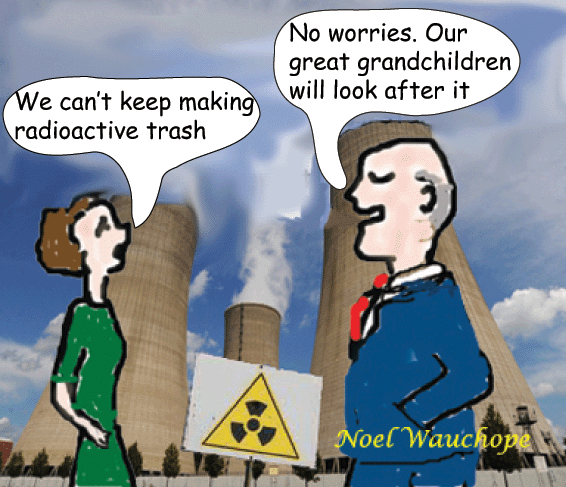
Questions we should therefore all be asking of government, the Department of Energy, the nuclear regulator, Nersa, Nuclear Waste Disposal Institute, Necsa, Eskom and the South African nuclear sector are:
- Who should bear the cost of nuclear plant decommissioning and long-term storage and disposal of high-level nuclear waste – the polluter, the customer or the taxpayer?
- Where are the real asset-based funds set aside within Eskom and Necsa for future decommissioning and long-term storage and disposal of high-level nuclear waste?
- Does the “polluter pays” principle apply in practice, or will the customer and taxpayer end up paying twice through government bailouts?
One can only guess who may end up bearing the real decommissioning, high-level waste storage, disposal and final repository costs in due course – perhaps not the polluter at all, but our children’s children as taxpayers in the next generation.
Page 69 of the 8th National Report prepared by the Department of Energy and the SA National Nuclear Regulator, and presented to the International Atomic Energy Agency (IAEA) in August 2019 in terms of South Africa’s obligations to the Convention on Nuclear Safety, states in respect of Eskom’s Koeberg nuclear power station:
“Financial provision for decommissioning (as well as spent fuel management) continues to be accumulated on a monthly basis since commercial operation of the installation began in 1984. The financial provision is reflected in the annual financial statements of Eskom. These financial statements are audited in accordance with South African national legislation.
“In terms of decommissioning financial plans, the amount of decommissioning and spent fuel provision made each month is determined by the present value of future estimated cash flows. These financial plans are reviewed regularly and adjusted annually, and informed by the South African inflation rate.”
However, the problem with these fine words to the IAEA is that they are misleading, perhaps deliberately so, and that the so-called provision is actually something of a “Potemkin village” to placate and impress the IAEA and the public that all is well and under control.
In fact, no real money, securities or investments of any kind have actually been set aside monthly, annually or at stage and in any fund during operation of South Africa’s nuclear facilities as provision for decommissioning, long-term storage and final disposal of high-level nuclear waste, and/or the construction and operation of a high-level nuclear waste repository. Continue reading
Fukushima spillage raises questions about threat of future earthquakes — Fukushima 311 Watchdogs

A road in Nihonmatsu has been blocked by a landslide on Feb. 14 following a 7.3-magnitude earthquake the day before in Japan’s Fukushima Prefecture. Feb.16,2021 The occurrence of a 7.3-magnitude earthquake in the waters off of Fukushima on Feb. 13 is prompting growing concerns about the safety of the Fukushima Daiichi Nuclear Power Plant, as […]
Fukushima spillage raises questions about threat of future earthquakes — Fukushima 311 Watchdogs
Water leaks indicate new damage at Fukushima nuclear plant — Fukushima 311 Watchdogs

Radioactive cooling water levels inside the wreckage of Fukushima Daiichi units is falling in a least two units. This indicates that new damage from the recent 7.3 M earthquake has created drainage routes for more radioactive contamination to escape to the offsite environment. This Sept. 4, 2017, aerial file photo shows Fukushima Dai-ichi nuclear power […]
Water leaks indicate new damage at Fukushima nuclear plant — Fukushima 311 Watchdogs
Water levels at Fukushima reactor containers falling after quake — Fukushima 311 Watchdogs

A Tepco employee wearing a protective suit and mask gives lectures in front of No. 3 reactor building at the tsunami-crippled Fukushima No. 1 nuclear power plant in Okuma, Fukushima Prefecture, in February 2019. February 20, 2021 Tokyo Electric Power Co. Holdings Inc. has said that the water levels in the containment vessels for the […]
Water levels at Fukushima reactor containers falling after quake — Fukushima 311 Watchdogs
Texas tantrums and anti-wind strawmen — daryanenergyblog

Recently there’s been some blackouts in Texas caused by unseasonably cold weather. In fact its the sort of extreme weather we’d be expecting due to climate change (which doesn’t just lead to hotter weather, it can also cause shifts in weather patterns leading to more extremes of weather, such as more intense rainfall, hurricanes and […]
Texas tantrums and anti-wind strawmen — daryanenergyblog
February 21 Energy News — geoharvey

Opinion: ¶ “Some Are Claiming Blue Gas Is A Tesla Killer. It’s Not” • Blue gas is gasoline or diesel that is a hydrocarbon fuel manufactured from hydrogen and carbon feedstocks instead of being refined from petroleum. This sounds interesting, but there are several questions that need answers. After some study and analysis, here are the […]
February 21 Energy News — geoharvey
Nuclear lobby plans to take over the U.N. Climate Change Conference

Meet the Young Generation Network and its group of nuclear schills who will lead the attempted nuclear takeover of the 26th UN Climate Change Conference of the Parties (COP26) in Glasgow on 1 – 12 November 2021.
Just by chance? They all happen to be ambitious young people who hope to have a big career in the nuclear industry. Well, you can’t blame them for that. But let’s be wary of their advice on nuclear power as the solution for global heating.
Arun Khuttan. End States Engineer at Magnox Ltd.UKAlice Cunha da Silva. Latin America Nuclear Leader | Westinghouse Electric Company
Hannah Paterson, Technology Manager at Sellafield Ltd UK
Matthew Mairinger Technical Engineer with Ontario Power Generation, Canada
Miguel Trenkel-Lopez Assistant Engineer at Magnox Ltd,Bristol, UK
Saralyn Thomas Formerly at AREVAnuclear company, now at Abbott Risk Consulting (ARC) Risk Management consultancy services to the Nuclear Industry
Vicki Dingwall of EDF nuclear company
Queensland neeeds job-supplying, clean, renewable energy, NOT antiquated nuclear power

“What regional Queensland needs is an Australian government that is united on growing manufacturing and delivering cleaner, cheaper, energy.
“Not a Government that is tearing itself apart and proposing antiquated solutions.”
LNP comes clean on plans for Queensland nuclear power, https://statements.qld.gov.au/statements/91502 18 February, 2021
The LNP’s latest thought bubble on energy policy has again exposed the rifts in the coalition party room, Energy, Renewables and Hydrogen Minister Mick de Brenni said today.
Mr de Brenni said the LNP’s latest announcement to bring nuclear energy to Queensland would not be welcome by the public.
“Queenslanders have emphatically rejected nuclear power time and time again and today’s revelation flies in the face of every State and Territory’s nuclear ban,” the Minister said.
“Inner city Liberals are pushing renewables, Nationals are nuclear and the result is the lack of a coherent national energy policy.
“Manufacturing and resources companies are investing in cheaper, cleaner energy to grow jobs in Queensland by investing in renewables, not old fashioned, dangerous options.
“Queensland’s renewable energy zones have been flooded with enough interest to create 60,000 megawatts of extra clean energy, which could create up to 57,000 jobs in construction alone, let alone the influx of load intensive manufacturing jobs…
“This ongoing investment in large-scale renewable energy is only happening because of Queensland’s very clear energy policy.
“What regional Queensland needs is an Australian government that is united on growing manufacturing and delivering cleaner, cheaper, energy.
“Not a Government that is tearing itself apart and proposing antiquated solutions.”
Mr de Brenni said the Queensland Opposition Leader should immediately reject the calls and ask his party for a coherent energy policy.
“He should call his Queensland federal colleagues today to put an end to calls to bring nuclear energy to Queensland,” Mr de Brenni said.
“Any decision to overturn the Australian ban on nuclear by the LNP has the potential to kill off Queensland’s chance to onshore manufacturing and the Palaszczuk Government’s plans to develop a clean, renewable hydrogen sector and thousands of renewable jobs.”
“Queensland’s renewable energy zones have been flooded with enough interest to create 60,000 megawatts of extra clean energy, which could create up to 57,000 jobs in construction alone, let alone the influx of load intensive manufacturing jobs.
“And we have the youngest fleet of coal-fired power stations.
“This ongoing investment in large-scale renewable energy is only happening because of Queensland’s very clear energy policy.
“What regional Queensland needs is an Australian government that is united on growing manufacturing and delivering cleaner, cheaper, energy.
“Not a Government that is tearing itself apart and proposing antiquated solutions.”
Mr de Brenni said the Queensland Opposition Leader should immediately reject the calls and ask his party for a coherent energy policy.
“He should call his Queensland federal colleagues today to put an end to calls to bring nuclear energy to Queensland,” Mr de Brenni said.
“Any decision to overturn the Australian ban on nuclear by the LNP has the potential to kill off Queensland’s chance to onshore manufacturing and the Palaszczuk Government’s plans to develop a clean, renewable hydrogen sector and thousands of renewable jobs.” Media contact: Rosie Gilbert 0466 834 330
Nationals add nuclear enthusiasm to the government’s energy bill
 Nationals’ nuclear flare-up on energy bill https://au.news.yahoo.com/nuclear-ideal-cutting-emissions-joyce-222058648.html?guccounter=1&guce_referrer=aHR0cHM6Ly9uZXdzLmdvb2dsZS5jb20v&guce_referrer_sig=AQAAAG3X514QPdgktFOrKbKPrnzoSz6joD3PVpI6uSj2DBv3oIZTOIzUDZWnifcsw_SXXPYtt3h1orA3QYlShoI_rlgBn5o675_PqDys5-xmgpGOEFmBJ1ooQWfTzK9RMofsPeZk-CfshnVXybppn5h7kGhpqKtNAaeAVwv0YCeavNKn, Thu, 18 February 2021, The Nationals have gone nuclear on energy policy, flagging another amendment to their own government’s plans.
The government wants the bill to pass parliament next week so a raft of projects go ahead.
Former Nationals leader turned backbencher Barnaby Joyce has already wedged his colleagues by introducing an amendment which would allow the Clean Energy Finance Corporation to invest in coal-fired power stations.
Now the Nationals Senate team wants the green bank to invest in nuclear power as well as carbon capture and storage.
The five Nationals senators led by Bridget McKenzie and Matt Canavan fronted a media conference promoting their plan.
“We compete against the world with one hand behind our back while other nations avail themselves of cutting edge, low emissions technologies,” Senator McKenzie said.
There is a longstanding moratorium on nuclear energy generation which has been maintained by both Labor and coalition governments.
The coal and nuclear-pushing Nationals are putting renewed pressure on current leader Michael McCormack.
By introducing amendments to the government’s own bill they are forcing their colleagues to either vote for or against the original plan.
Treasurer Josh Frydenberg said Mr McCormack has been a resilient leader, having already batted off an attempt from Mr Joyce to snatch back the party’s top job.
Mr Frydenberg said the Nationals and Liberals had so far worked effectively on energy under the current leaders.
“It’s a pretty complex area, as I know,” he told reporters in Canberra.
“If I took off my jacket I could show you the scars from being the energy minister.”
Mr Frydenberg was the minister behind the previous coalition government’s National Energy Guarantee, which played a role in Malcolm Turnbull’s downfall as prime minister.
Mr Joyce claims small modular nuclear reactors are ideal to replace decommissioned coal-fired power stations and reduce emissions.
“Nuclear reactors can do it,” he told reporters in Canberra.
“Why not, if you want zero emissions.”
Opposition Leader Anthony Albanese said nuclear energy in Australia doesn’t stack up.
“What we are witnessing here is just a part of the chaos that is the coalition when it comes to energy policy,” he said.
The Nationals argue the $1 billion grid reliability fund to be run out of the CEFC should support small nuclear energy projects and get involved in developing the technology.
The Australian Conservation Foundation says there’s nothing clean about nuclear, coal or gas.
“Nuclear is not a credible climate response and has been repeatedly rejected by the market and the community,” ACF spokesman Dave Sweeney said.
1 This month.


PETITION – To: Prime Minister Anthony Albanese and the Australian Labor Government
Chernobyl: The Lost Tapes – A good documentary on Chernobyl on SBS available On Demand for the next 3 weeks– https://www.sbs.com.au/ondemand/tv-program/chernobyl-the-lost-tapes/235274195556

19 May – Webinar- Webinar: No Nuclear Weapons in Australia
Start: 2026-05-19 18:00:00 UTC Canberra, Melbourne, Sydney (GMT+10:00)
End: 2026-05-19 19:30:00 UTC Canberra, Melbourne, Sydney (GMT+10:00)
20 May – Webinar – The dangerous world of AUKUS, US, military occupation and suppression of dissent

National Webinar, 20th May, 2026, 6.30pm AEST. Confronting laws restricting/suppressing protest speech and action
Speakers: Former Sen. Rex Patrick, Lawyer Nick Hanna ,Arthur Rorris ,Jorgen Doyle, Sen David Shoebbridge,
Facilitator Kelley Tranter.

of the week – Australians for War Powers Reform (AWPR)
To see nuclear-related stories in greater depth and intensity
 Antinuclear