ANSTO gets a blank cheque for its nuclear waste production at Lucas Heights?
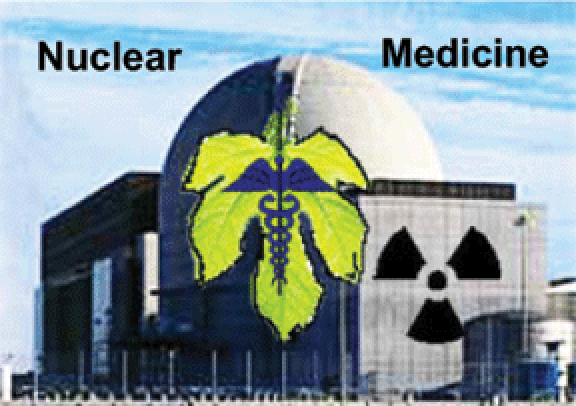 Greg Phillips, No nuclear waste dump anywhere in South Australia , 13 Jan 2021, Congratulations Canada! “Cyclotron-produced technetium-99m approved by Health Canada”. Why rely on a global network of aging, unreliable, toxic spewing nuclear reactors when you can have a local network of clean, reliable cyclotrons? Especially when pandemics hobble global freight networks. From the article: “The process is safe and precise, employing stable targets and producing little to no long-lived radioactive waste. And, with the right target and extraction systems, these cyclotrons can be used to reliably create technetium-99m regionally and without the need for reactor-based materials.”
Because ANSTO shut down cyclotron, Australia has the problem of importing a short-lived medical isotope

|
“……..Australia lost the capacity to make the radioactive isotope iodine-123 – used in the diagnosis and treatment of cancer in the nerve cells of children – just over a decade ago with the closure of the National Medical Cyclotron in Camperdown, NSW. ………
But according to Ansto, iodine-123 is needed in clinical settings by about a dozen patients around Australia at any one time – most of them children with neuroblastoma. This means Australia now relies on imports from Japan. But with a half-life of just over 13 hours – meaning the levels of radioactivity halve every 13 hours – this isotope needs to be distributed to Australian hospitals and health centres very quickly. It expires within 33 hours of being manufactured in Japan. “The challenge with transporting nuclear medicine is the products have a short half-life,” Ian Martin, the general manager of Ansto Health, told Guardian Australia. “We need to get the isotopes from point A to point B before they decay too much to be effective, a complex task when B is in another hemisphere.” ………. https://www.theguardian.com/australia-news/2020/aug/11/australias-nuclear-medicine-agency-chartered-flights-to-deliver-childrens-cancer-treatment?fbclid=IwAR3o8Da64-dDpv0mwYL0K5jaPZreOGOaQCmDdh4ChzfwQLjsv0sFdBBVBVo 11 Aug 2020,
|
|
Scientists must tell the truth on our consumerist, ecology-killing Ponzi culture

Scientists must not sugarcoat the overwhelming challenges ahead. Instead, they should tell it like it is. Anything else is at best misleading, and at worst potentially lethal for the human enterprise.
Worried about Earth’s future? Well, the outlook is worse than even scientists can grasp , The Conversation, Corey J. A. Bradshaw, Matthew Flinders Professor of Global Ecology and Models Theme Leader for the ARC Centre of Excellence for Australian Biodiversity and Heritage, Flinders University. Daniel T. Blumstein, Professor in the Department of Ecology and Evolutionary Biology and the Institute of the Environment and Sustainability, University of California, Los Angeles, Paul Ehrlich, President, Center for Conservation Biology, Bing Professor of Population Studies, January 13, 2021
Anyone with even a passing interest in the global environment knows all is not well. But just how bad is the situation? Our new paper shows the outlook for life on Earth is more dire than is generally understood.
The research published today reviews more than 150 studies to produce a stark summary of the state of the natural world. We outline the likely future trends in biodiversity decline, mass extinction, climate disruption and planetary toxification. We clarify the gravity of the human predicament and provide a timely snapshot of the crises that must be addressed now.
The problems, all tied to human consumption and population growth, will almost certainly worsen over coming decades. The damage will be felt for centuries and threatens the survival of all species, including our own………
academics tend to specialise in one discipline, which means they’re in many cases unfamiliar with the complex system in which planetary-scale problems — and their potential solutions — exist.
What’s more, positive change can be impeded by governments rejecting or ignoring scientific advice, and ignorance of human behaviour by both technical experts and policymakers.
More broadly, the human optimism bias – thinking bad things are more likely to befall others than yourself – means many people underestimate the environmental crisis.
Numbers don’t lie
A bad situation only getting worse
The human population has reached 7.8 billion – double what it was in 1970 – and is set to reach about 10 billion by 2050. More people equals more food insecurity, soil degradation, plastic pollution and biodiversity loss.
Essentially, humans have created an ecological Ponzi scheme. Consumption, as a percentage of Earth’s capacity to regenerate itself, has grown from 73% in 1960 to more than 170% today.
High-consuming countries like Australia, Canada and the US use multiple units of fossil-fuel energy to produce one energy unit of food. Energy consumption will therefore increase in the near future, especially as the global middle class grows.
The danger of political impotence
Our paper found global policymaking falls far short of addressing these existential threats. Securing Earth’s future requires prudent, long-term decisions. However this is impeded by short-term interests, and an economic system that concentrates wealth among a few individuals.
Right-wing populist leaders with anti-environment agendas are on the rise, and in many countries, environmental protest groups have been labelled “terrorists”. Environmentalism has become weaponised as a political ideology, rather than properly viewed as a universal mode of self-preservation.
Changing course
Fundamental change is required to avoid this ghastly future. Specifically, we and many others suggest:
- abolishing the goal of perpetual economic growth………..
Don’t look away………
Scientists must not sugarcoat the overwhelming challenges ahead. Instead, they should tell it like it is. Anything else is at best misleading, and at worst potentially lethal for the human enterprise. https://theconversation.com/worried-about-earths-future-well-the-outlook-is-worse-than-even-scientists-can-grasp-153091
Joe Biden and USA nuclear weapons policies
|
What could Biden’s nuclear policy look like? King County sits only miles away from one-third of the deployed U.S. nuclear arsenal. Courier Herald , By Aaron Kunkler, January 12, 2021 For Leonard Eiger, having the U.S. Navy’s entire Pacific fleet of nuclear-armed submarines only a short excursion away doesn’t sit well with him.
The longtime anti-nuclear weapons activist and former North Bend resident has for decades worked to educate Puget Sound residents about Naval Base Kitsap Bangor, which houses around one-third of the nuclear weapons that are actively deployed. Eight of the 14 Ohio-class submarines, which carry powerful nuclear weapons, are stationed out of the base in Kitsap County. “For me there’s a real futility in thinking of, and preparing to fight, a nuclear war,” Eiger said. “Because any nuclear war, any nuclear exchange between the U.S. and Russia, is game over.” Eiger lived in North Bend for 26 years, before recently moving to the San Juan Islands. He’s been involved with the Ground Zero Center for Nonviolent Action, which stages demonstrations against — and education campaigns about — nuclear weapons. As the Donald Trump administration winds down, he’s hoping that a Joe Biden presidency will mark a turning point in the way the U.S. approaches nuclear weapons. The Trump administration didn’t make significant progress toward renewing the New START Treaty, which expires on Feb. 5 and began deploying “low-yield” nuclear weapons on submarines, he said. The administration also did not subscribe to a “no first use” policy. It also pulled out of the Iran nuclear deal. The Trump administration didn’t make significant progress toward renewing the New START Treaty, which expires on Feb. 5 and began deploying “low-yield” nuclear weapons on submarines, he said. The administration also did not subscribe to a “no first use” policy. It also pulled out of the Iran nuclear deal. And if a nuclear weapon was fired at one country, other nuclear powers wouldn’t know where it was destined, and could launch their own nukes, fearing an attack, he said. These missiles are something that Hans Kristensen, director of the Nuclear Information Project at the Federation of American Scientists, is thinking about. He said that this could make military leaders more comfortable using them from technical and humanitarian points of view because there could be less collateral damage and fallout …….. On the first use of nuclear weapons, Biden’s policy platform states that he believes the sole purpose of the U.S. nuclear arsenal is to deter other countries from attacking the U.S. with nuclear weapons. If he holds to this statement, then he would enact a no first use policy, according to Kristensen………. Treaties Biden is also hoping to resurrect two important nuclear treaties. The first is the Iran nuclear deal, which was negotiated by the Obama administration while he served as vice president. Trump withdrew from the treaty and put additional sanctions on Iran……. The second significant nuclear agreement is the New START Treaty between Russia and the U.S. The treaty limits the number of nuclear weapons that the countries can own, and have deployed, at any given time. It includes all three legs of the U.S. nuclear triad, including submarine, bomber and land-based missiles. Biden’s policy platform states he will try to renew and extend the New START Treaty. The treaty could be extended up to five years, but Kristensen said the administration could choose a shorter term. If Biden chose to go with a longer five year renewal, it would likely have a calming effect on nuclear competition between the U.S. and Russia. However, a shorter term would send signals that the two countries need to address the problems with the treaty and create something stronger, Kristensen said….. ………… For activist Leonard Eiger, the world of today is only here because of a series of fortunate events. He cited the Cuban Missile Crisis, where the U.S. and Russia came close to nuclear war in 1962. “We still live under the threat of either accidental or intentional nuclear war,” he said. “So long as nuclear weapons exist, that threat will continue to exist.”……… https://www.courierherald.com/news/what-could-bidens-nuclear-policy-look-like/ |
|
In USA’s desperate health crisis, Trump orders quick development of small nuclear reactors for military use.
Trump orders DoD to explore use of nuclear power for space, Defense News,
The order, signed Jan. 5 and posted publicly Jan. 12, is not the first time the value of nuclear power for military operations has been studied. There is a long history of the Pentagon considering the issue, which proponents believe could alleviate the department’s massive logistics challenge of keeping fuel moving around the world………
In terms of terrestrial efforts, the executive order requires the defense secretary to, within 180 days, “establish and implement a plan to demonstrate” a micro-reactor at a domestic military installation — in other words, setting up an actual test of a nuclear reactor at a U.S. military location.
However, that doesn’t mean the first test will be on a military base. One location to keep an eye on is the Nevada National Security Site, a Department of Energy location roughly 65 miles from Las Vegas…….
Noted Hans Kristensen of the Federation of American Scientists, “the signing of this at the very last minute of the Trump administration suggests someone is concerned [President-elect Joe Biden] might not support the program.”
Specific to space, the order calls for the defense secretary, in consultation with the secretaries of state, commerce and energy as well as the NASA administrator, to “determine whether advanced nuclear reactors can be made to benefit Department of Defense future space power needs” and to “pilot a transportable micro-reactor prototype.”
In addition, the order directs an analysis of alternatives for “personnel, regulatory, and technical requirements to inform future decisions with respect to nuclear power usage” as well as “an analysis of United States military uses for space nuclear power and propulsion technologies and an analysis of foreign adversaries’ space power and propulsion programs.”
……… While the order speeds up the timetable for a test of a nuclear reactor at a military installation, the idea of using nuclear power is hardly a new one for the DoD. In fact, the Pentagon currently has two different development tracts for small nuclear reactors.
The first is “Project Pele,” an effort to create a small mobile nuclear reactor in the 1-5 MWe power range, being run out of the Strategic Capabilities Office. In March 2020, the department awarded three companies a combined $39.7 million to start design work for Project Pele, with plans to select one firm in 2022 to build and demonstrate a prototype.
The second effort is run through the office of the undersecretary of acquisition and sustainment. That effort, ordered in the 2019 National Defense Authorization Act, involves a pilot program aiming to demonstrate the efficacy of a small nuclear reactor, in the 2-10 MWe range, with initial testing at a Department of Energy site around 2023. If all goes well, the goal is to have a permanent small nuclear reactor on a military base around 2027.
Even if all those timelines are hit, it is unlikely microreactors could proliferate quickly throughout the military………. https://www.defensenews.com/smr/nuclear-arsenal/2021/01/13/trump-orders-dod-to-explore-use-of-nuclear-power-for-space-systems/
Nations capital celebrates strong year for households embracing solar power — RenewEconomy

ACT government celebrates strong uptake of rooftop solar, with more than 4,200 systems added in 2020. The post Nations capital celebrates strong year for households embracing solar power appeared first on RenewEconomy.
Nations capital celebrates strong year for households embracing solar power — RenewEconomy
Media coverage of climate was hit by COVID19 but it’s time for a comeback — RenewEconomy

Did the pandemic hurt climate coverage? Yes – but not for long, and not as much as you might think. And it’s set to come back in a big way The post Media coverage of climate was hit by COVID19 but it’s time for a comeback appeared first on RenewEconomy.
Media coverage of climate was hit by COVID19 but it’s time for a comeback — RenewEconomy
January 13 Energy News — geoharvey

Opinion: ¶ “US Carbon Emissions Fell 10% In 2020, Because Of Covid-19. It’s Up To Biden To Stop Them From Bouncing Back” • US greenhouse gas emissions dropped a lot in 2020, helping the country meet one long-standing climate targets. But experts warn that unless climate action becomes a priority, emissions will bounce back quickly. […]
January 13 Energy News — geoharvey
Increased CO2 levels could be risk to young lungs, Australian scientists find — RenewEconomy

Australian researchers, in a world first study, find predicted future levels of CO2 concentrations could harm the development of young lungs. The post Increased CO2 levels could be risk to young lungs, Australian scientists find appeared first on RenewEconomy.
Increased CO2 levels could be risk to young lungs, Australian scientists find — RenewEconomy
Sand clogs up Australia’s only operating carbon capture project — RenewEconomy

Carbon storage at Chevron’s massive Gorgon LNG plant hampered by sand contamination which may result in increased greenhouse gas emissions. The post Sand clogs up Australia’s only operating carbon capture project appeared first on RenewEconomy.
Sand clogs up Australia’s only operating carbon capture project — RenewEconomy
Energy Security Board outlines plan for fast renewable transition in two major new reports — RenewEconomy

New reports from the Energy Security Board highlight priority focus areas for a grid destined for a high renewable future. The post Energy Security Board outlines plan for fast renewable transition in two major new reports appeared first on RenewEconomy.
Energy Security Board outlines plan for fast renewable transition in two major new reports — RenewEconomy
New government subsidies deepen Australia’s reliance on fossil fuels for transport — RenewEconomy

Morrison government policies are working to grow Australia’s dependence on transport fuels, rather than improving energy security. The post New government subsidies deepen Australia’s reliance on fossil fuels for transport appeared first on RenewEconomy.
New government subsidies deepen Australia’s reliance on fossil fuels for transport — RenewEconomy
The week in nuclear news – Australia
Midst all of the Trumpian circus, and the dire problems of the pandemic, it’s hard to find news about the underlying grave problems of the climate. I did vow to stay off that subject. But that’s hard to do, when global heating has accelerated over 2020, when it should have been a cooler year, with La Nina prevailing. Not only accelerating – climate change is here with us. The Earthbound Report lists 10 big impacts in 2020.
But – to return to the nuclear, it hasn’t been just a background problem lately, as the Washington mayhem raises anxieties about Donald Trump’s finger on the trigger of nuclear war.
A bit of good news – The good news hidden within one of America’s darkest weeks
AUSTRALIA.
Australian govt has quiet nuclear deal with China, but condemns Victoria-China medical research.
The Australian government’s shameful record in the Kimba nuclear dump fiasco. Government’s Kimba nuclear waste dump slush fund – benefit goes straight to Kimba’s mayor.
Treaty – a step on the long path towards nuclear disarmament..
End of an ERA: four decades of radioactive risk come to an end at Kakadu. Clean-up plan for Ranger uranium mine is ”woefully inadequate”.
Scott Morrison should change his mind and call Trump to end bizarre Assange saga.
INTERNATIONAL
Treaty on the Prohibition of Nuclear Weapons: The Road There and the Road Ahead. Beatrice Fihn: How to implement the nuclear weapons ban treaty.
Multinational effort could help solve U.S.-Russia nuclear issue.
Geopolitics Of Nuclear Generation Delayed Renewables By Decades To Fossil Fuel Industry Benefit, Our Detriment.
Ten compelling reasons to stay away from nuclear power .
Judge’s refusal to extradite Julian Assange is still part of cowardly process to deny freedom of information.
Clean-up plan for Ranger uranium mine is ”woefully inadequate”
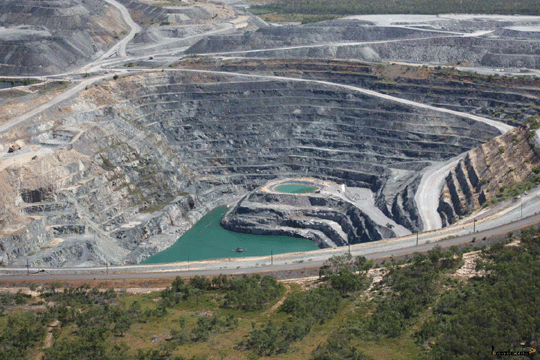
Gundjeihmi and ERA enter negotiations to extend Ranger Uranium Mine rehabilitation
By https://www.abc.net.au/news/2021-01-09/gundjeihmi-era-negotiate-ranger-uranium-mine-rehabilitation/13043076 Matt Garrick
An Aboriginal group in Kakadu National Park says the rehabilitation plan for a decommissioned uranium mine is “woefully inadequate”, and is calling for a 26-year extension to the process.
Key points:
- Mining at the Ranger Uranium Mine wound up yesterday after more than 40 years
- Traditional owners in Kakadu are now calling for an extension of the project’s rehabilitation phase
- The company that runs the mine has signalled its support for the move
Production at the Ranger Uranium Mine, on the outskirts of the national park, drew to a close yesterday after more than 40 years of operation.
Gundjeihmi Aboriginal Corporation, which represents Mirarr traditional owners, has used the closure to demand owner Energy Resources Australia (ERA) rehabilitate the site beyond its current lease expiry in 2026.
Within that timeframe, the company is required to restore the site to its previous pristine state.
“That’s not long enough,” the corporation’s CEO, Justin O’Brien, said.
“We are now awaiting a drafting from the Commonwealth Government for amendments to the Atomic Energy Act such that you can actually put in place an extension to the rehabilitation period.”
Mr O’Brien said traditional owners were pushing for the rehabilitation period to be extended by an additional 26 years, which would carry the process through until 2052.
He said ERA and its parent company, Rio Tinto, had signalled their support for an extended term of rehabilitation — but the timeframe and details of that extension are still being negotiated.
In a statement, the company said it was committed to “achieving all documented rehabilitation outcomes in its Mine Closure Plan (MCP) by January 2026”.
It confirmed negotiations were underway with traditional owners to “determine an appropriate mechanism” to extend the company’s tenure at the Ranger site, which would allow it to continue rehabilitation beyond 2026.
Environmental group the Australian Conservation Foundation yesterday welcomed the end of production at the site, the last active uranium mine in the Northern Territory.
The foundation’s Dave Sweeney, who is an anti-nuclear campaigner, said he was supportive of the push to extend the rehabilitation period.
“The company should not be approaching clean-up asking itself what it can do in five years,” he said.
“It should be approaching clean-up asking ‘What is the best possible way to reduce and address the damage that has happened?’
“What’s the best outcome — not the best outcome we can do in five years.”
The wind-down of production at the mine is expected to prompt an exodus from the nearby town of Jabiru, where ERA holds the lease for about 300 houses.
One hundred and twenty-five ERA staff were made redundant this week.
Could Trump start a nuclear war?- a satchel, a biscuit and a football
A satchel, a biscuit and a football, https://wordpress.com/read/feeds/72759838/posts/3119714732 , Could Trump start a nuclear war? By Linda Pentz Gunter, 10 Jan 21,
All that’s involved is a satchel, a biscuit, and a football.
It sounds so benign, doesn’t it? Like schoolboy games. It’s anything but. If the President of the United States opens that satchel with his biscuit to access the football, that simple action could propel us into Armageddon.
The satchel, which goes everywhere the president does, contains the nuclear “football.” Only the president can open the satchel, using an ID card known as the “biscuit”.
As Time magazine explained it — the first time alarm bells rang around the possibility that an unhinged Donald Trump might “press the nuclear button” — the “biscuit enables him to identify himself to officials at the Pentagon with unique codes letting them know he is authorizing a nuclear strike. He would also need to specify the type of attack he wanted to carry out; the different options are delineated in the nuclear football.
“Once Trump has successfully conveyed his orders, Strategic Command, which has operational control over U.S. nuclear forces, would implement them.”
So while there is no actual nuclear button — Trump’s boasts to North Korea about his big one notwithstanding — it would be all too easy for a petulant madman to start a nuclear war. And we have one in the White House.
No one here needs to be reminded of the eye-stretching scenes of mob violence that unfolded at the Capitol on January 6, egged on by Trump on the day itself, and fueled by the reckless rhetoric and actions of the White House and its Republican lackeys over the past four years.
The events of January 6 in part prompted House Speaker Nancy Pelosi to speak to the “Chairman of the Joint Chiefs of Staff Mark Milley to discuss available precautions for preventing an unstable president from initiating military hostilities or accessing the launch codes and ordering a nuclear strike.
“The situation of this unhinged President could not be more dangerous, and we must do everything that we can to protect the American people from his unbalanced assault on our country and our democracy,” Politico reported Pelosi as saying on Friday.
In a statement issued on January 7, Physicians for Social Responsibility wrote that the scenes of mayhem at the Capitol, brought on by Trump’s “increasingly irresponsible and reckless behavior” should finally “put to rest any doubt about the danger posed by giving any president sole authority for the decision to launch a nuclear weapon. While the incident yesterday did not directly involve that power, President Trump’s alarming conduct demonstrated incontrovertibly why providing a president with the sole authority to launch a nuclear weapon needs to be changed—right now.”
How easy would it be for Trump to launch a nuclear strike? Global Zero explains it, chillingly, in this video, which suggests that starting a nuclear war would be “as easy as ordering a pizza.”
In a January 24, 2018 article in The Straits Times, Mark Fitzpatrick, a nuclear non-proliferation expert at the International Institute for Strategic Studies in Washington, was quoted in an interview he gave to the BBC.
“There are no checks and balances on the president’s authority to launch a nuclear strike,” he said. “But between the time he authorizes one and the time it’s carried out there are other people involved.”
We’ve been saved more than once from nuclear disaster, most notably by Stanislav Petrov, a lieutenant colonel in the Soviet Union’s Air Defense Forces who, on the night of September 26, 1983 just happened to be in charge of monitoring his country’s satellite system that watched for a potential launch of nuclear weapons by the United States. In the early hours, such a launch appeared to have happened.
Petrov had only minutes to decide if the launch was genuine. He was supposed to report the alert up the chain of command. Doing so would almost certainly have led to a counterstrike, triggering a full-on nuclear exchange between the Soviet Union and the U.S. Instead, Petrov decided to check if there was a computer malfunction, later discovered to have been the case. Petrov became known as “the man who saved the world.”
But back at the White House, with only conspiracy-theory believing acolytes left around a man who doesn’t in any case listen to anyone’s advice, we cannot count on there being any Petrovs to save us this time.
Of course, as the PSR statement concluded: “the best way to protect ourselves and the rest of the world from the danger posed by the dysfunctional leadership of a nuclear-armed nation is to eliminate nuclear weapons altogether.
“The incoming Biden administration should embrace the principles of the Treaty on the Prohibition of Nuclear Weapons and lead negotiations that move us toward a nuclear-weapons free world.”
That Treaty will become international law on January 22. Not a moment too soon.
1 This month.


PETITION – To: Prime Minister Anthony Albanese and the Australian Labor Government
Chernobyl: The Lost Tapes – A good documentary on Chernobyl on SBS available On Demand for the next 3 weeks– https://www.sbs.com.au/ondemand/tv-program/chernobyl-the-lost-tapes/235274195556
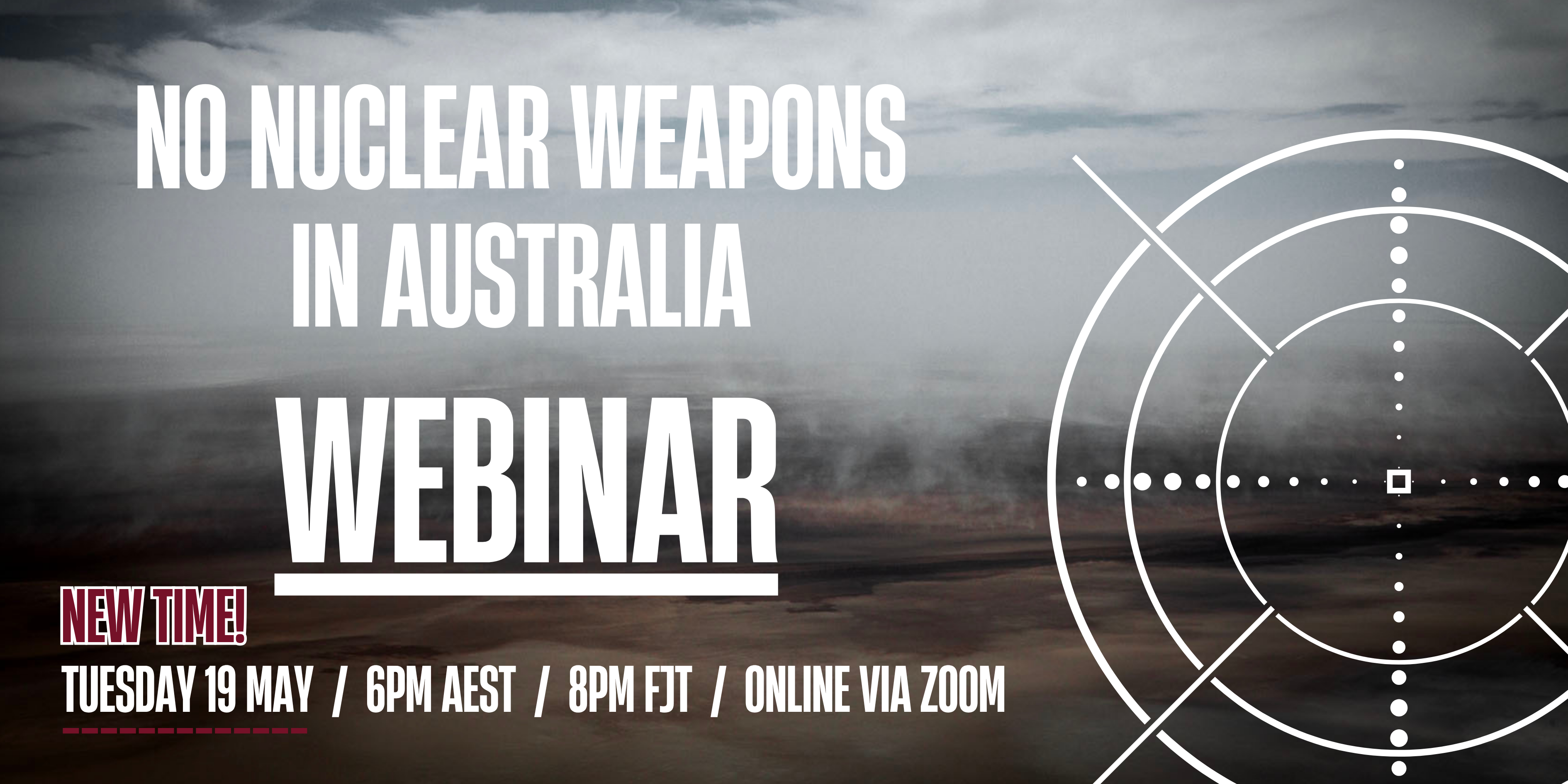
19 May – Webinar- Webinar: No Nuclear Weapons in Australia
Start: 2026-05-19 18:00:00 UTC Canberra, Melbourne, Sydney (GMT+10:00)
End: 2026-05-19 19:30:00 UTC Canberra, Melbourne, Sydney (GMT+10:00)
20 May – Webinar – The dangerous world of AUKUS, US, military occupation and suppression of dissent

National Webinar, 20th May, 2026, 6.30pm AEST. Confronting laws restricting/suppressing protest speech and action
Speakers: Former Sen. Rex Patrick, Lawyer Nick Hanna ,Arthur Rorris ,Jorgen Doyle, Sen David Shoebbridge,
Facilitator Kelley Tranter.

of the week – Australians for War Powers Reform (AWPR)
To see nuclear-related stories in greater depth and intensity
 Antinuclear