Catholics welcome Treaty on Prohibition of Nuclear Weapons
 Catholic advocates welcome treaty banning nuclear weapons coming into force, Crux, Dennis SadowskiJan 17, 2021, CATHOLIC NEWS SERVICE
CLEVELAND — A Holy See-supported treaty banning the possession of nuclear weapons that is coming into force is buoying efforts by nations and nonprofit and church organizations working to abolish such armaments.
The Treaty on the Prohibition of Nuclear Weapons comes into force Jan. 22, three months after the 50th nation ratified the historic document.
Nuclear abolition supporters said the treaty puts the world’s nine nuclear powers on notice that momentum to dismantle arsenals of the world’s most destructive weapons is building.
We have an opportunity to move in a different direction now. We have to convince the nuclear states to take this seriously, to take this as an opportunity to move to a new conversation in the nuclear age,” said Marie Dennis, the Washington-based senior adviser to Pax Christi International’s secretary general.
The treaty resulted from months of negotiations at the United Nations in 2017 led by non-nuclear countries. Dennis described the effort as an example of the Catholic social teaching principle of participation.
“People around the world who live in countries that are not part of the nuclear weapons countries or under the nuclear umbrella have realized more and more clearly that the whole world would be devastated by an exchange of nuclear weapons and the people of the world decided to do something about it,” she explained.
The Holy See was a key participant in the process that led to drafting the treaty, providing encouragement and advice to negotiators, said Jesuit Father Drew Christiansen, a nuclear weapons expert who is professor of ethics and global development at Georgetown University.
He credited Pope Francis for the Vatican’s work on the pact. “I think it’s part of Francis’s agenda to get this out there,” he said. “As Francis begins to elaborate more about this teaching on arms and warfare, he’ll speak out more on this issue.”
The Holy See was the among the first to ratify the treaty, which was approved by 122 U.N. members. Netherlands was the only country to vote against it while Singapore abstained.
The nuclear nations and those under the U.S. nuclear umbrella opposed the measure and played little if any role in negotiations. In addition to the U.S., the countries possessing nuclear weapons are Russia, China, United Kingdom, France, Israel, India, Pakistan and North Korea.
Data from various sources, including the U.S. Department of State and the Stockholm International Peace Research Institute, show that the nine countries hold an estimated 13,440 nuclear weapons. …….. https://cruxnow.com/church-in-the-usa/2021/01/catholic-advocates-welcome-treaty-banning-nuclear-weapons-coming-into-force/
January 17 Energy News — geoharvey

Opinion: ¶ “Worried About Earth’s Future? Well, The Outlook Is Worse Than Even Scientists Can Grasp” • A research paper published this week reviews over 150 studies to produce a stark summary of the state of the natural world. It says that future environmental conditions will be far more dangerous than experts currently believe. [Red, […]
January 17 Energy News — geoharvey
January 16 Energy News — geoharvey

Opinion: ¶ “Cutting Emissions To Zero CAN Halt Climate Change In Our Lifetimes” • Buried under doomsday predictions on climate change, there is newer information from Michael Mann, the distinguished climate scientist. It turns out that if we cut to zero emissions, he tells us, the warming would continue, but only for a few years. […]
January 16 Energy News — geoharvey
How will Entry Into Force of the Nuclear Weapons Ban Treaty impact non weapons states parties, including Australia?
 How will EIF impact non states parties, including Australia? https://icanw.org.au/wp-content/uploads/Australia-EIF-of-the-TPNW.pdf How will EIF impact non states parties, including Australia? https://icanw.org.au/wp-content/uploads/Australia-EIF-of-the-TPNW.pdf16 Jan 21, While non states parties are not legally bound to the terms of the treaty, the norms set out and strengthened by the treaty can shape their behaviour and build pressure for them to join. The entry into force of the treaty puts Australia out of step with international law. While Australia has joined every other treaty that prohibits indiscriminate or inhumane weapons, the Nuclear Non-Proliferation Treaty and the South Pacific Nuclear Free Zone Treaty, it has not yet signed or ratified the ban on nuclear weapons. This position is contested by a growing nationwide movement and at all levels of government. The treaty reveals Australia’s complicity in the problem by including nuclear weapons in its defence posture.
****
As a country with a devastating history of nuclear testing, Australia will be obliged to take action as a state party to assist survivors of nuclear testing and take steps towards remediating contaminated environments. These obligations should be informed by and developed in collaboration with impacted First Nations people, nuclear test veterans, civil society, public health and other experts.
****
Entry into force of previous ban treaties has led to a substantial decrease in the production and deployment of prohibited weapons such as cluster munitions and landmines, both by states parties and non states parties. EIF will also impact the flow of funds to nuclear arms producing companies. Financial institutions often choose not to invest in “controversial weapons,” which are typically weapons prohibited by international law. The entry into force of the TPNW clearly puts nuclear weapons in this category and will likely trigger additional divestment, including by Australian banks and superannuation funds.
****
EIF of the treaty will further stigmatise nuclear weapons, including in Australia, by: Prompting further debate: more than 250 federal, state and territory parliamentarians have declared their support for the treaty and the federal Opposition, the Australian Labor Party, has committed to sign and ratify the treaty in government. Decision-makers will continue to be asked to engage with this new piece of international law.
****
Institutionalisation: entry into force will entrench the treaty’s place in the international legal architecture for nuclear weapons. It is already referenced in international fora as signatories and states parties proudly declare their commitment to nuclear disarmament.
****
Impacting alliances: all states parties in alliances with nuclear-armed states will be required to renounce the use of nuclear weapons on their behalf, and ensure they are not assisting with the use or threat of use of the weapons. Once a state party, Australia will need to cease any policy that countenances and supports the use of nuclear weapons. Other US allies, including New Zealand and Thailand, have already joined the treaty.
****
It will take years to build the necessary political will for some states to join the nuclear weapon ban treaty. Shifting nuclear weapons from a symbol of status to a liability of shame is slow, yet crucial, work. As the signatures and ratifications of the treaty continue beyond entry into force, non states parties will face increasing criticism from their citizens, international organisations and other states. Almost all of Australia’s neighbours in the Pacific and Southeast Asia support the treaty. It is only a matter of time before Australia joins the treaty and thereby becomes part of the solution to these abhorrent weapons.
|
|
The nuclear waste nightmare continues for Kimba, South Australia
 Kazzi Jai Fight to stop a nuclear waste dump in South Australia, 15 Jan 21,
 21 And 22 January NZ Celebrates Global Nuclear Weapons Ban, 2021
 21 And 22 January NZ Celebrates Global Nuclear Weapons Ban, 2021 https://www.scoop.co.nz/stories/PO2101/S00041/nz-celebrates-global-nuclear-weapons-ban-21-and-22-january-2021.htm, 15 January 2021, 21 And 22 January NZ Celebrates Global Nuclear Weapons Ban, 2021 https://www.scoop.co.nz/stories/PO2101/S00041/nz-celebrates-global-nuclear-weapons-ban-21-and-22-january-2021.htm, 15 January 2021, Celebrations in Aotearoa New Zealand to mark the entry into force of the Treaty on the Prohibition of Nuclear Weapons (TPNW) will begin on Thursday 21 January with ICAN Aotearoa New Zealand’s Wellington and online event, and continue on Friday 22 January. Continue reading |
2021 is here: what to watch out for in Australian climate and energy politics — RenewEconomy

2021 is well underway and is already on track to be another year of climate policy shenanigans – here’s what to watch out for this year. The post 2021 is here: what to watch out for in Australian climate and energy politics appeared first on RenewEconomy.
2021 is here: what to watch out for in Australian climate and energy politics — RenewEconomy
Church leaders call on UK to sign nuclear weapons ban treaty
UK is urged to sign UN nuclear-weapons treaty https://www.churchtimes.co.uk/articles/2021/15-january/news/uk/uk-is-urged-to-sign-un-nuclear-weapons-treaty by PAT ASHWORTH, 15 JANUARY 2021 But there is resistance to change, say peace campaigners.
CAMPAIGNERS are urging the UK to sign the United Nations Treaty on the Prohibition of Nuclear Weapons, which will come into effect on 22 January.
The Archbishops of Canterbury and York, with more than 30 Church of England bishops, called on the Government in November to accept the treaty, which, they said, would “give hope to all people of goodwill who seek a peaceful future” (News, 20 November 2020).
It has been signed by 51 states. They will now be required to stop producing, developing, testing, or stationing nuclear weapons, and will be required to help any victims of their testing and use. Their financial institutions will be expected to stop investing in companies that produce nuclear weapons.
The UK, the United States, France, and Russia have not signed the treaty. Clergy and church leaders were reminded in a briefing by the Network of Christian Peace Organisations (NCPO), on Tuesday, of the overwhelming support given to a Lambeth Conference resolution in 1998, which called on the Government and the UN to press for an international mandate for all member states to prohibit nuclear warfare.
Now was the time to fulfil that, Rebecca Johnson, one of the architects of the treaty and a founder member of the International Campaign to Abolish Nuclear Weapons (ICAN), said. Nuclear weapons must be known for what they really were — weapons of mass destruction — and the phrase “nuclear powers” must be replaced with “nuclear-armed states”.
The treaty was a legal one, but it would work by persuasion and not by coercion; it was normative in taking away any status attached to hanging on to nuclear weapons, and in labelling as pariahs those who did. “We all need to think about what we can do to bring this treaty into force in our own countries. There is an important job here for faith leaders to do,” she said.
Although the C of E had a blanket policy of not investing in companies with an interest in nuclear weapons, everyone should examine investment practice in their churches, the policy adviser on international affairs for the ecumenical Joint Public Issues Team, Steve Hucklesby, said.
The treaty brought “a very real possibility of a new norm on nuclear weapons across the whole finance and business sectors; but be clear: there is resistance to change,” he continued. Pressure could be applied to banks and pension providers if individuals saw this as something relating to their own lives. “The issue now becomes compliance with an international treaty, to be applied across the whole of an institution’s business.”
An international meeting to be held in Vienna later this year will establish mechanisms for compliance. It will be open to observers from nuclear-armed states, who will not be able to vote but who should be urged to “attend, listen, and learn,” Ms Johnson said. “It is so important for the UK to join sooner rather than later . . . to be at the table.”
Russell Whiting, who chairs Christian CND, described a world in which President Trump, or even Joe Biden, had their finger on the nuclear button, as “an incredibly dangerous place”. The treaty has been declared dangerous by the Prime Minister, and by the former Foreign Secretary Philip Hammond. These governments had “misrepresented” the treaty wherever they went, saying that it would undermine the existing non-proliferation treaty, Ms Johnson said.
The General Synod called for the elimination of nuclear weapons in July 2018, but it stopped short of urging the Government to sign the treaty. The Government’s refusal to do so was described by the Archbishop of York, the Most Revd Stephen Cotrrell, then Bishop of Chelmsford, as “hugely disappointing” and “a decision that looks like complacency”. He questioned the billions of pounds spent on Trident (News, 13 July 2018).
The general secretary of the Roman Catholic peace movement Pax Christi, Pat Gaffney, said on Tuesday that RC bishops had issued a statement asking the Government to support the treaty — a move that she described as “a huge step forward, because they have habitually said it undermined the existing non-proliferation treaty. Catholics need to write to their bishops affirming what they are doing.”
The NCPO is holding a service online at 11.30 a.m. on 22 January, to mark the treaty. It will conclude with the ringing of the peace bell at Coventry Cathedral.
Business case for small nuclear reactors ‘doesn’t fly’
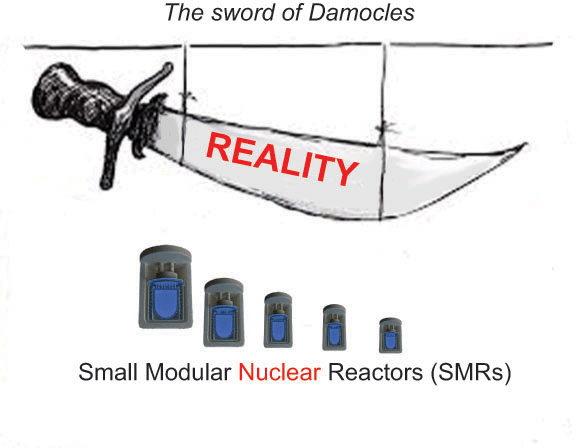 Former U.S. regulator questions small nuclear reactor technology, Business case for small reactors ‘doesn’t fly,’ says expert on nuclear waste, Jacques Poitras · CBC News Jan 15, 2021 A former head of the United States’ nuclear regulator is raising questions about the molten-salt technology that would be used in one model of proposed New Brunswick-made nuclear reactors.
The technology pitched by Saint John’s Moltex Energy is key to its business case because, the company argues, it would reuse some of the nuclear waste from Point Lepreau and lower the long-term cost and radioactivity of storing the remainder.
But Allison Macfarlane, the former chairperson of the U.S. Nuclear Regulatory Commission and a specialist in the storage of nuclear waste, said no one has yet proven that it’s possible or viable to reprocess nuclear waste and lower the cost and risks of storage.
“Nobody knows what the numbers are, and anybody who gives you numbers is selling you a bridge to nowhere because they don’t know,” said Macfarlane, now the director of the School of Public Policy and Global Affairs at the University of British Columbia.
“Nobody’s really doing this right now. … Nobody has ever set up a molten salt reactor and used it to produce electricity.”
Macfarlane said she couldn’t comment specifically on Moltex, calling information about the company’s technology “very vague.”
But she said the general selling point for molten-salt technology is dubious.
“Nobody’s been able to answer my questions yet on what all these wastes are and how much of them there are, and how heat-producing they are and what their compositions are,” she said.
“My sense is that all of these reactor folks have not really paid a lot of attention to the back end of these fuel cycles,” she said, referring to the long-term risks and costs of securely storing nuclear waste.
Moltex is one of two Saint John-based companies pitching small nuclear reactors as the next step for nuclear power in the province and as a non-carbon-dioxide emitting alternative to fossil fuel electricity generation.
Moltex North America CEO Rory O’Sullivan said the company’s technology will allow it to affordably extract the most radioactive parts of the existing nuclear waste from the Point Lepreau Generating Station.
The waste is now stored in pellet form in silos near the plant and is inspected regularly.
The process would remove less than one per cent of the material to fuel the Moltex reactor and O’Sullivan said that would make the remainder less radioactive for a much shorter amount of time.
Existing plans for nuclear waste in Canada are to store it in an eventual permanent repository deep underground, where it would be secure for the hundreds of thousands of years it remained radioactive………..
Shorter-term radioactivity complicates storage
Macfarlane said a shorter-term radioactivity life for waste would actually complicate its storage underground because it might lead to a facility that has to be funded and secured rather than sealed up and abandoned.
“That means that you believe that the institutions that exist to keep monitoring that … will exist for hundreds of years, and I think that is a ridiculous assumption,” she said.
“I’m looking at the United States, I’m seeing institutions crumbling in a matter of a few years. I have no faith that institutions can last that long and that there will be streams of money to maintain the safety and security of these facilities. That’s why you will need a deep geologic repository for this material.”
And she said that’s assuming the technology will successfully extract all of the most radioactive material.
“They are assuming that they remove one hundred per cent of the difficult, radionuclides, the difficult isotopes, that complicate the waste,” she said.
“My response is: prove it. Because if you leave five per cent, you have high-level waste that you’re going to be dealing with. If you leave one per cent, you’re going to have high-level waste that you’re going to be dealing with. So sorry, that one doesn’t fly with me.”
Macfarlane, a geologist by training, raised doubts about molten-salt technology and waste issues in a 2018 paper she co-authored for the Bulletin of the Atomic Scientists………. https://www.cbc.ca/news/canada/new-brunswick/nuclear-waste-reactors-new-brunswick-allison-macfarlane-moltex-arc-1.5873542
Trump’s behavior demonstrates that Biden must change US nuclear policy,
|
Trump’s behavior demonstrates that Biden must change US nuclear policy, Defense News, By: Lisbeth Gronlund and David Wright , 15 Jan 20, President Donald Trump’s role in inciting the shocking events at the Capitol on Jan. 6 and concerns about his state of mind highlight the grave risks posed by the policy that gives presidents the sole authority to order the use of nuclear weapons — without the need for consultation or agreement by anyone. This danger is heightened by a second policy that allows the United States to use nuclear weapons — not just in response to a nuclear attack, but also first during hostilities.
While this arrangement appears especially risky now, giving any one person the authority to order the use of nuclear weapons is inherently risky and completely unnecessary. Any use of nuclear weapons would be devastating and should require both a presidential order and the agreement of two other officials. Unlike decades ago, when sole authority was first established, there is a straightforward way to include other officials in a launch decision. President-elect Joe Biden should make this long-overdue change once in office by limiting his own authority to order a nuclear attack………………. President Biden should move quickly to implement these two policy changes — requiring the assent of two other officials to any nuclear launch order and eliminating the option of using nuclear weapons first. Doing so would make the world safer and demonstrate that the United States is committed to reducing the risk of nuclear use and to moving away from its reliance on nuclear weapons. https://www.defensenews.com/opinion/commentary/2021/01/14/trumps-behavior-demonstrates-that-biden-must-change-us-nuclear-policy/ |
|
”Small Modular Reactors”’- governments are being sucked in by the billionaires’ nuclear club”
 SNC-Lavalin Scandal-ridden SNC-Lavalin is playing a major role in the push for SMRs.
Terrestrial Energy….. Terrestrial Energy’s advisory board includes Dr. Ernest Moniz, the former US Secretary of the Dept. of Energy (2013-2017) who provided more than $12 billion in loan guarantees to the nuclear industry. Moniz has been a key advisor to the Biden-Harris transition team, which has come out in favour of SMRs.
The “billionaires’ nuclear club” …“As long as Bill Gates is wasting his own money or that of other billionaires, it is not so much of an issue. The problem is that he is lobbying hard for government investment.”
Going after the public purse
Bill Gates was apparently very busy during the 2015 Paris climate talks. He also went on stage during the talks to announce a collaboration among 24 countries and the EU on something called Mission Innovation – an attempt to “accelerate global clean energy innovation” and “increase government support” for the technologies.
Gates’ PR tactic is effective: provide a bit of capital to create an SMR “bandwagon,” with governments fearing their economies would be left behind unless they massively fund such innovations.
governments “are being suckers. Because if Wall Street and the banks will not finance this, why should it be the role of the government to engage in venture capitalism of this kind?”
It will take a Herculean effort from the public to defeat this NICE Future, but along with the Assembly of First Nations, three political parties – the NDP, the Bloc Quebecois, and the Green Party – have now come out against SMRs.
|
Mini-Nukes, Big Bucks: The Interests Behind the SMR Push https://watershedsentinel.ca/articles/mini-nukes-big-bucks-the-money-behind-small-modular-reactors/
It’s remarkable that only five years ago, the National Energy Board predicted: “No new nuclear units are anticipated to be built in any province” by 2040.So what happened?
The answer involves looking at some of the key influencers at work behind the scenes, lobbying for government funding for SMRs. |

Broome shopping centre set to host massive solar and battery system — RenewEconomy

The Western Australian town of Broome will become host to one of Australia’s largest shopping centre solar installations. The 1.2MW commercial solar installation will be added to the Broome Boulevard Shopping Centre, owned by ASX-listed property investors Primewest, constructed over the centre’s car park, and is expected supply around 45 per cent of the centre’s…
Broome shopping centre set to host massive solar and battery system — RenewEconomy
January 15 Energy News — geoharvey

Opinion: ¶ “2021: The Year the Rubber Meets the Road for Electric Trucks” • One challenge for trucking fleets looking to electrify is that only limited models of electric trucks have been available. That is changing. Manufacturers have been developing and road-testing vehicles recently, and many are slated to move into commercial production soon. [CleanTechnica] […]
January 15 Energy News — geoharvey
2020 among the top three warmest years on record, along with 2016 and 2019 — RenewEconomy

2020 confirmed as another year ranking amongst the hottest on record. The urgency of reducing emissions only gets higher every day. The post 2020 among the top three warmest years on record, along with 2016 and 2019 appeared first on RenewEconomy.
2020 among the top three warmest years on record, along with 2016 and 2019 — RenewEconomy
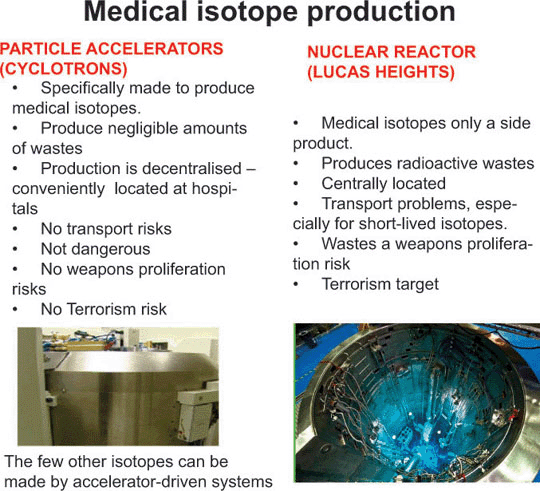
Why did ANSTO shut down National Medical Cyclotron, that made medical isotopes without nuclear waste?
1 This month.


PETITION – To: Prime Minister Anthony Albanese and the Australian Labor Government
Chernobyl: The Lost Tapes – A good documentary on Chernobyl on SBS available On Demand for the next 3 weeks– https://www.sbs.com.au/ondemand/tv-program/chernobyl-the-lost-tapes/235274195556

19 May – Webinar- Webinar: No Nuclear Weapons in Australia
Start: 2026-05-19 18:00:00 UTC Canberra, Melbourne, Sydney (GMT+10:00)
End: 2026-05-19 19:30:00 UTC Canberra, Melbourne, Sydney (GMT+10:00)
20 May – Webinar – The dangerous world of AUKUS, US, military occupation and suppression of dissent

National Webinar, 20th May, 2026, 6.30pm AEST. Confronting laws restricting/suppressing protest speech and action
Speakers: Former Sen. Rex Patrick, Lawyer Nick Hanna ,Arthur Rorris ,Jorgen Doyle, Sen David Shoebbridge,
Facilitator Kelley Tranter.

of the week – Australians for War Powers Reform (AWPR)
To see nuclear-related stories in greater depth and intensity
 Antinuclear