Donald Trump’s dangerous nuclear legacy

David AxeForbes Staff In his single term in the White House, Donald Trump expanded America’s nuclear arsenal and undermined decades of arms-control efforts. While President-elect Joe Biden could reverse some of Trump’s atomic initiatives, it’s highly unlikely he can undo all of them.
And it’s impossible for Biden to travel back in time and seize opportunities for nuclear arms-reduction that Trump squandered—with North Korea, in particular.
For that reason alone, Trump’s atomic legacy will be a meaningful one. “He drove the final few nails in the coffin for the first era of arms-control,” said Jeffrey Lewis, a nuclear expert at the Middlebury Institute of International Studies in California.
Kingston Reif, a missile expert at the Arms Control Association in Washington, D.C., neatly summarized Trump’s nuclear initiatives on Twitter in mid-December. To paraphrase:
1. Trump nudged the Pentagon to double the number of low-yield nuclear weapons, which according to experts raise the risk of nuclear war by making nukes seemingly more “useable” in an armed clash between major powers. At the same time, Trump’s nuclear doctrine expanded the list of external threats that officially justify nuclear retaliation. Perhaps most notably, the list of threats now includes a major hacking event. The U.S. Navy subsequently deployed the low-yield W76-2 variant of its Trident II submarine-launched ballistic missile.
2. At the opposite end of the yield spectrum, the billionaire president accelerated development of high-yield SLBMs and canceled a Pentagon plan to decommission the megaton-class B83-1 gravity bomb.
3. To arm these new weapons, Trump took steps to restart production of plutonium cores for nuclear warheads, despite arguments that the United States already possesses plenty of cores. The core-production falls under a roughly $9-billion budgetary boost that Trump helped push through for the U.S. National Nuclear Security Agency, which oversees America’s nukes.
4. Citing Russian development of banned weapons, Trump withdrew the United States from the 1987 Intermediate-Range Nuclear Forces, which limited ground-launched nukes in Europe. The former reality TV star also pulled America out of the 1992 Open Skies Treaty, which allows the United States, Russia and many European states to monitor each other’s atomic arsenals via photographic-reconnaissance flights. Finally, Trump has been reluctant to approve an extension—due in February—of the 2010 New START, a U.S.-Russian accord that puts a cap on nuclear weapons and helped both countries reduce their atomic arsenals in the years prior to Trump’s presidency. It’s possible Biden could bring the USA back into Open Skies while also scrambling to extend New START, but the INF Treaty almost certainly is dead, as both the United States and Russia now openly are developing intermediate-range nukes.
5. After failing several times to negotiate any kind of enforceable arms limitations with North Korea, Trump became the first president since the 1960s not to negotiate any new nuclear arms-control agreement. Instead, he did the very opposite—loosened controls, encouraged proliferation and, as a result, is “the first post-Cold War president not to reduce the size of the nuclear warhead stockpile,” according to Reif.
“The Trump administration’s nuclear legacy is one of failure,” Reif said. “The administration inherited several nuclear challenges, to be sure, but it has made nearly all of them worse.”
Nuclear power ridiculously expensive an uncompetitive – the market has spoken
 “nuclear is ridiculously expensive and uncompetitive”. So, nothing really needs to happen for renewable energy investment to grow. The reality is that the market has said “no” to nuclear and “yes” to renewables.
The Reality Is that the Market Has Said “No” to Nuclear and “Yes” to Renewables, RIAC, Paul Dorfman PhD, Honorary Senior Research Associate at the UCL Energy Institute University College London; Chair of the Nuclear Consulting Group; Member of the Irish Govt. Environment Protection Agency Radiation Protection Advisory Committee, and Tatyana Kanunnikova– 27 Dec 20,
“………. As for nuclear energy, can it be used to help mitigate climate change? What are the problems associated with nuclear energy?
With mounting public concern and policy recognition over the speed and pace of the low carbon energy transition needed to mitigate climate change, nuclear power has been reframed  as a response to the threat of global warming. However, at the heart of the question of nuclear power, there are differing views on how to apply foresight, precaution, and responsibility in the context of the poor economics of nuclear, the possibility of accidents, the consequences of those accidents, and indeed whether there exists a place for nuclear at all within the swiftly expanding renewable evolution.
When one considers nuclear, it is absolutely important to consider its life cycle in terms of carbon emissions. A study by Prof Benjamin Sovacool looked at 103 different studies and concluded that the average value for nuclear in terms of life cycle emissions was about 66 grams of carbon dioxide for every kilowatt-hour produced. This compares to about 9 grams per kilowatt-hour for wind and 32 grams per kilowatt-hour for solar. This puts nuclear as the third-highest carbon emitter after coal-fired plants and natural gas.
So, in terms of carbon emissions, nuclear is lower than fossil fuel but produces significantly more carbon dioxide in terms of its life cycle than renewable power. And perhaps more importantly, with ramping predictions for sea level rise and climate disturbance, nuclear will be  an important risk, since climate change will impact coastal nuclear plants earlier and harder than is currently expected. Proposed new reactors, together with radioactive waste stores, including spent fuel located on the coasts, will be vulnerable to sea level rise, flooding, and storm surge. These coastal sites will need considerable investment just to protect them against sea level rise, and in the medium term, they will even be subject to abandonment or relocation.
Adapting coastal nuclear power to climate change will entail significantly increased expense for construction, operation, waste storage, and decommissioning. Inland nuclear power plants will do no better. This is because they must be cooled by significant amounts of water and they have to shut down if that cooling water is either too warm or the river flow is reduced. These are two factors that will absolutely happen with increased climate change. We are seeing this  already in France where their reactors stationed by rivers, reliant on river water for cooling, have both diminished river flow and increased water temperatures in the summertime. That implies that there will be a significant inland nuclear station nuclear power shutdown in the future.
The other problem is one of economics, since nuclear is so hugely expensive. Carrying on constructing and prolonging the life of current nuclear plants is enormously costly. New construction is eye-wateringly expensive, which means that if we continue to build nuclear plants, we have much less resource, money, to put into the real solution to climate change, which is renewable power, demand-side management, and storage.
What are the advantages of solar and wind power?
A recent report by Standard and Poor, the key market analyst, found that renewable energy technology global investment has been running at about 350 billion dollars per year for the last few years. But for nuclear, it fell to about 17 billion for last year.
Standard and Poor say that they see “little economic rationale for new nuclear build in the US or Western Europe owing to massive cost escalations and renewables cost-competitiveness, which should lead to a material decline in nuclear generation”. Similarly, Lazard—the world’s leading financial advisory and asset management firm—has just compared the cost of new nuclear, which runs at about $119 to $192 per megawatt-hour, compared to $32 to $42 for utility-scale solar and between $20 and $54 for onshore wind per megawatt-hour. So there is a huge cost difference between nuclear and renewable technologies. Lazard go on to say that the unsubsidized, levelized cost of energy of large-scale wind and solar are at a fraction of the cost of new nuclear or even coal generators, even if the very great cost of nuclear decommissioning and ongoing maintenance is excluded.
Bloomberg New Energy Finance agrees with Lazard’s analysis. The key disadvantage to nuclear power is that it is just too expensive. For renewables, the cost is far lower and continues to fall, which is why what we see is the majority of new nuclear only being constructed with the support of vast state and public subsidy. So, given the reality that funding is limited, we need to make a choice between very expensive nuclear and very inexpensive renewables.
What hinders investments in renewable energy?
In fact, all of the markets are putting all of the money into renewable energy and none of the markets are putting their money into nuclear. There is no market investment in new nuclear. All the investment is going into renewable energy, as I have just discussed. The only problem is, of course, is that if governments via state subsidy put enormous amounts of the low carbon energy budgets into nuclear, they will have less money to invest properly in real low carbon energy technologies such as renewables, storage, and demand-side management.
What initiatives could help promote investments in renewable energy?
I do not think renewable energy needs pushing. The cost of renewables is a fraction of the cost of new nuclear. As Mr. Tanaka, a former director of the International Energy Agency and a former long-standing nuclear advocate, says, “nuclear is ridiculously expensive and uncompetitive”. So, nothing really needs to happen for renewable energy investment to grow. The reality is that the market has said “no” to nuclear and “yes” to renewables……………..
In the journey to manage the decline of fossil fuels, not all low carbon technologies are equal. The reality is that nuclear is far less benign, far more expensive, and far more carbon-intensive than other renewable options. Nuclear will struggle to compete with the technological, economic, and security advantages of the coming renewable evolution. In bidding goodbye to fossil fuels, we should also say goodbye to nuclear. And given the ramping costs and risks that cling to this, essentially late 20th-century technology, it is not before time.
Interviewed by Tatyana Kanunnikova. https://russiancouncil.ru/en/analytics-and-comments/interview/the-reality-is-that-the-market-has-said-no-to-nuclear-and-yes-to-renewables/
Storage of Chernobyl nuclear waste – in reality unsafe for 1000s of years
 Paul Waldon Fight to Stop a Nuclear Waste Dump in South Australia, 28 Dec 20,
 December 27 Energy News — geoharvey

Opinion: ¶ “Combating Climate Change Through High-Performance Districts” • If we are going to keep the global temperature rise below 1.5°C, we need to fix our buildings. They are the largest end-users of energy, generating nearly 40% of our greenhouse gas emissions. But fixing one building at a time won’t work. It has to be […]
December 27 Energy News — geoharvey
Australia’s lying Minister for Resources gets an “F” in assessment of govt ministers

Peter Remta 26 Dec 20, How long can Keith Pitt remain with ministerial responsibility for such nationally important portfolios as water and mining and effectively the nuclear industry
He continues to make statements that are in many instances plainly wrong and show his ignorance and in some cases his complete disingenuity without attracting any parliamentary sanctions or chastising
His comments seem to be aimed purely at gaining public credibility and attempting to sway the senators opposing his ill advised proposals
He cannot rely on his advisers and ministerial staff for his comments as the ultimate authority and control lies solely with him as the responsible minister
No wonder The West Australian newspaper and its allied media sources gave Pitt an F for his ministerial efforts with the highest grading of course being A +
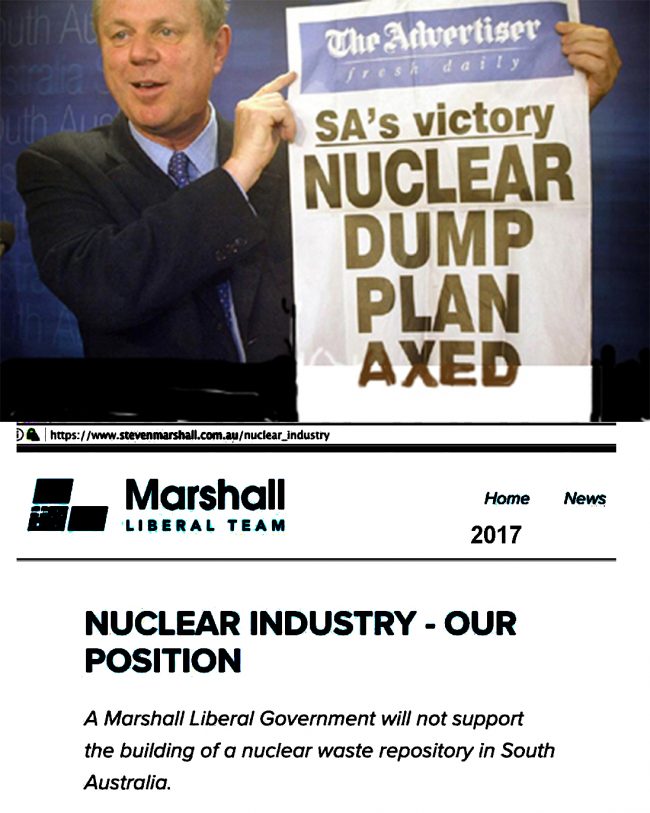
Silent Steven Marshall – cowardly silence from South Australia’s Premier on nuclear waste dump plan
|
SILENT STEVEN
Last week I posted about Minister Dan van Holst Pellekaan threatening me with legal costs in response to a Freedom of information (FOI) request for all correspondence between the Federal and SA State Government on the National Radioactive Waste Management Facility since Steven Marshall had become Premier of SA.
********
In 2016, when in opposition, Marshall stated he would not support the facility. After the SA ‘Citizens Jury’ handed down their verdict on a waste facility to Premier Weatherill, Marshall proclaimed, “Jay Weatherill’s dream of turning South Australia into a nuclear waste dump is now dead”.
********
What I got back under FOI was heavily redacted but shows Marshall, like a good lapdog to the Prime Minister, has remained silent on the issue.
********
It’s the same with keeping Submarine Full Cycle Docking work in SA, as the PM considers sending that work to WA – silence. Its the same with the Federal Government’s appointment of a irrigation supporting former NSW National to the position of Inspector-General of (Murray-Darling) Water Compliance – silence.
********
The Premier is free to determine his political position on these issues which affect South Australia’s interests. But he is obliged as Premier to share his position with South Australians and he should be prepared to defend whatever his view is. That’s what leaders do. Instead, on so many important issues, he’s just Silent Steven.
|
|
A scary reality, Trump still has the nuclear codes

Former Reagan aide: Trump still has the nuclear codes. And that’s genuinely scary. https://www.nj.com/opinion/2020/12/former-reagan-aide-trump-still-has-the-nuclear-codes-and-thats-genuinely-scary-opinion.html By Star-Ledger Guest Columnist By Mark Weinberg, 24 Dec 20
Almost anything Donald Trump does in his last weeks as president can be undone by Joe Biden. Executive Orders can be reversed, regulations can be changed, unnecessary commissions can be disbanded, and (some) political appointees can be removed from their positions. Unfortunately, a few will remain after Trump leaves because of how terms are structured, but their ability and probably their willingness to cause mischief will be severely limited when their man is out of the White House. At least one hopes so.
That’s the good news.
The bad news is that until noon on January 20th Trump will have access to the codes necessary to authorize a nuclear war. That is genuinely scary.
The size, scale and influence of the United States’ economy notwithstanding, what makes the president of the United States the most powerful person in the world is control of our nuclear weapons.
Our two most threatening adversaries, Russia and China, both have significant nuclear arsenals. Vladimir Putin and Xi Jinping are aware that Trump is a wounded and weakened president and will be so until he leaves office next month. Whether they sense that translates into an opening for them to outright attack us — or at least threaten to — is an open question. No doubt they are watching closely for opportunities to enhance their world domination campaigns at our expense, which means we must be super-vigilant. Nuclear war is no joke. It is as serious as it gets. What animated Ronald Reagan most in his efforts to engage the Soviet Union to reduce both country’s nuclear stockpiles was that each nation had the ability to destroy each other. Reagan called this the “MAD” – Mutually Assured Destruction – policy, which he rightly thought was unacceptably dangerous and worked hard to eliminate. He famously said: “a nuclear war cannot be won and must never be fought.” Contrary to opponents’ depictions, Reagan was not a trigger-happy warmonger. Indeed, he was the opposite. A World War II veteran, he knew well of, and worried about, the indescribably deadly potential of nuclear weapons and took very seriously his duties as president in either responding to — or initiating — a nuclear strike.
As with all modern-day presidents, elaborate steps were taken to make certain Reagan always had access to the nuclear codes wherever he was. There was never a time during Reagan’s presidency when his stability or suitability to have the nuclear codes was in question.
So what to do until he is replaced by a more stable, sensible, and sane president?
Tempting and legitimate as it may be, invoking the 25th Amendment to declare Trump “unable to discharge the powers and duties of his office” is not a realistic possibility at this point. For reasons they will have to explain later, most members of Trump’s Cabinet, including Vice President Michael Pence, are either unable or unwilling to recognize Trump’s instability and unsuitability for office and fear that doing anything to upset him could be professional suicide.
Perhaps a solution can be found in the presidency of Trump’s hero, Richard Nixon. It has been widely reported that in the last few days Nixon was in office, then-Secretary of Defense James Schlesinger, concerned that a distraught Nixon might do something rash, issued a directive to the military that if Nixon ordered a nuclear strike, they were to check with him or Secretary of State Henry Kissinger before executing.
Hopefully, acting Defense Secretary Christopher Miller has the wisdom to issue such an order. He needs to. Whether Secretary of State Mike Pompeo has the courage and patriotism to act as a backstop against any reckless Trump order is a question which, with any luck, will never require an answer.
In USA’s economic and health crisis – nuclear weapons spending is booming
Roughly 50,000 Americans are now involved in making nuclear warheads at eight principal sites stretching from California to South Carolina. And the three principal U.S. nuclear weapons laboratories — located in Los Alamos and Albuquerque, N.M., and Livermore, Calif. — have said they are adding thousands of new workers at a time when the overall federal workforce is shrinking.
“the insane idea that after a pandemic and dealing with climate change and in an economic crisis in which people are struggling with massive inequality that we are going to spend this much money modernizing every last piece of our nuclear infrastructure — that would be a failure, a failure of policy and a failure of imagination.”
But major defense contractors and their employees — including many of those making nuclear weapons or running the national laboratories where they are designed — have long influenced budget choices by helping to finance elections of the members of Congress who approve spending for that work. The industry’s donations in the current election cycle to members of the House and Senate Armed Services committees alone had reached $9.4 million as of mid-October; of that amount, the two chairmen took in a total of at least $802,000, according to the Center for Responsive Politics, a nonpartisan research group. These tallies don’t include separate donations by lawyers or lobbyists.
 Under Trump, America’s nuclear weapons industry has boomed, https://www.latimes.com/world-nation/story/2020-12-23/under-trump-americas-nuclear-weapons-industry-has-boomed By R. JEFFREY SMITH, DEC. 23, 2020 Under Trump, America’s nuclear weapons industry has boomed, https://www.latimes.com/world-nation/story/2020-12-23/under-trump-americas-nuclear-weapons-industry-has-boomed By R. JEFFREY SMITH, DEC. 23, 2020
While the country has been preoccupied with the COVID-19 pandemic, economic decline and the election, President Trump’s administration quietly
 and steadily steered America’s nuclear weapons industry to its largest expansion since the end of the Cold War, increasing spending on such arms by billions of dollars with bipartisan congressional support. and steadily steered America’s nuclear weapons industry to its largest expansion since the end of the Cold War, increasing spending on such arms by billions of dollars with bipartisan congressional support.Overall, the budget for making and maintaining nuclear warheads has risen more than 50% since Trump was elected in 2016, substantially outpacing the rates of increase for the defense budget and overall federal spending during his presidency before the pandemic. On Monday, Congress approved Trump’s proposal to increase spending next year for the production of such weaponry by nearly $3 billion. President-elect Joe Biden may embrace other priorities as he confronts the pandemic, tries to steer the country out of a recession, and is pressured to address social programs neglected under the Trump administration, as well as a ballooning deficit created by the 2017 Trump tax cuts and COVID-19 stimulus spending. But the creation of a larger and more modern nuclear warhead complex of factories, laboratories and related businesses is already playing out around the country, despite slowdowns in other federal projects due to the pandemic Four factories in Texas, South Carolina, Tennessee and New Mexico dedicated to producing warheads are being modernized. Four existing warheads are being substantially rebuilt with modern parts, on top of another such upgrade — costing $3.5 billion — that was completed last year. This pace compares with an average modernization of one type of warhead at a time during the Obama administration. “Over the next five years, the [nuclear weapons-related] costs start going up dramatically,” Continue reading |
Extinction Rebellion has much to learn from Angus Taylor, Australia’s “worst” minister — RenewEconomy

Gap between Coalition ideology on climate and energy and the rest of the world is so great that even AFR readers voted Angus Taylor worst minister. The post Extinction Rebellion has much to learn from Angus Taylor, Australia’s “worst” minister appeared first on RenewEconomy.
Extinction Rebellion has much to learn from Angus Taylor, Australia’s “worst” minister — RenewEconomy
What you read in 2020, and why we’re taking a break — RenewEconomy

The RenewEconomy stable topped 20 million page views in 2020 and this is what you read. We’ll be back in 2021. The post What you read in 2020, and why we’re taking a break appeared first on RenewEconomy.
What you read in 2020, and why we’re taking a break — RenewEconomy
December 23 Energy News — geoharvey

Opinion: ¶ “Electrify Everything: The Cost Of Solar Cells Has Nowhere To Go But Down, Down, Down” • Silicon solar cells deserve a pat on the back for ushering in the renewable energy revolution, but now it’s time for more efficient, less expensive technology to take the wheel. If you guessed that means perovskites, run […]
December 23 Energy News — geoharvey
Complete list of electric cars under $75,000 in Australia in 2021 — RenewEconomy

The options for electric vehicle buyers in Australia are growing: Here is the complete list of new models available in 2021 under $75,000. The post Complete list of electric cars under $75,000 in Australia in 2021 appeared first on RenewEconomy.
Complete list of electric cars under $75,000 in Australia in 2021 — RenewEconomy
Planning for chaos: We can’t use the past to predict the future — RenewEconomy

Australia’s regulatory framework needs to catch up with the fact that climate change means that we can’t use the past to predict the future. The post Planning for chaos: We can’t use the past to predict the future appeared first on RenewEconomy.
Planning for chaos: We can’t use the past to predict the future — RenewEconomy
The top 4 climate and energy points of 2020 — RenewEconomy

From bushfires to the Paris agreement, 2020 was the year the federal government started learning the dangers of treading water while others swim hard. The post The top 4 climate and energy points of 2020 appeared first on RenewEconomy.
The top 4 climate and energy points of 2020 — RenewEconomy
To 22nd December – nuclear news this week

‘Tis the season to be jolly. But, honestly, I can’t. If you want to know what’s really going on in this human-species-afflicted planet, I recommend Radio Ecoshock. Here you will learn about Climate Collapse & The Plastic Plague
It’s not about some distant future problem. It’s about now, and how we are living on a trashed planet. And we’re and adding more to this with all our festive junk and unnecessary gifts.
Having said that – there are so many good people trying to clean up, and keep clean, our fragile planet. For some examples – I recommend 99 Good News Stories From 2020 You Probably Didn’t Hear About.
Also, I am reading “The Good Germans – resisting the NAZIs 1933 – 1945“, by Catrine Clay. I find this book a very timely reminder that in very worst of modern times, there were so many people who saw evil being done, and resisted it, and also helped the persecuted, as best they could.
AUSTRALIA
2020 in Australia – a successful year for resistance to nuclear pollution.
Nuclear waste dump plan for Kimba, South Australia. Senator Rex Patrick contests Freedom of Information refusal about Australia’s nuclear waste plan. Federal govt accepted Queensland’s “NO” to nuclear dump. Why not South Australia’s?. Senator Rex Patrick calls on South Australian govt to come clean about nuclear waste dumping. Australia’s Industry Department is bluffing in employing staff for non existent nuclear waste project
Ranger Danger: Rio Tinto Faces Its Nuclear Test in Kakadu Uranium – Unfinished Business: Rehabilitating the Ranger Uranium Mine . Green group raise toxic leak concern at Ranger Uranium Mine
A reminder of the danger of ionising radiation, after theft of a nuclear device.
CLIMATE. The Usual Suspects: oil and gas majors star in Australian tax heist. Australia, the climate laggard, could lead the world: over to you, PM– Hypocrisy on steroids: Frydenberg backs witch-hunt on banks that won’t lend to miners.
INTERNATIONAL.
Sleepwalking Toward the Nuclear Precipice.
The insanity of nuclear power in space.
About writing about the nuclear crisis. We’re in a storytelling crisis”: Advice for writing on nuclear issues, from the author of “Fallout”.
Unveiling New Billboards: “Nukes Are Now Illegal!” (Nuclear Weapons) .
1 This month.


PETITION – To: Prime Minister Anthony Albanese and the Australian Labor Government
Chernobyl: The Lost Tapes – A good documentary on Chernobyl on SBS available On Demand for the next 3 weeks– https://www.sbs.com.au/ondemand/tv-program/chernobyl-the-lost-tapes/235274195556

19 May – Webinar- Webinar: No Nuclear Weapons in Australia
Start: 2026-05-19 18:00:00 UTC Canberra, Melbourne, Sydney (GMT+10:00)
End: 2026-05-19 19:30:00 UTC Canberra, Melbourne, Sydney (GMT+10:00)
20 May – Webinar – The dangerous world of AUKUS, US, military occupation and suppression of dissent

National Webinar, 20th May, 2026, 6.30pm AEST. Confronting laws restricting/suppressing protest speech and action
Speakers: Former Sen. Rex Patrick, Lawyer Nick Hanna ,Arthur Rorris ,Jorgen Doyle, Sen David Shoebbridge,
Facilitator Kelley Tranter.

of the week – Australians for War Powers Reform (AWPR)
To see nuclear-related stories in greater depth and intensity
 Antinuclear