NSW Environment Minister Matt Kean contradicts the Coalition party line – wants climate action and NO nuclear
 It’s time to win climate wars, Kean says https://www.canberratimes.com.au/story/6674567/its-time-to-win-climate-wars-kean-says/?cs=14231, Jodie Stephens, 11 Mar 20, It’s time to win climate wars, Kean says https://www.canberratimes.com.au/story/6674567/its-time-to-win-climate-wars-kean-says/?cs=14231, Jodie Stephens, 11 Mar 20,
Outspoken NSW Environment Minister Matt Kean says it’s time to “win the climate wars” and for the political right to show better leadership on the issue. In the wake of a devastating bushfire season, Mr Kean wants an end to “futile arguments” about whether climate change exists. He told an Affinity Intercultural Foundation event on Wednesday people had weaponised climate change for too long and to the country’s detriment.
He stressed reducing emissions didn’t need to come at the expense of the economy. “That’s something that has been absent from the debate for a long time. The economics have changed dramatically,” Mr Kean said at the Sydney event. “Right now, it presents an enormous economic opportunity for our nation that’d be too good to miss.” Mr Kean said renewables backed up by pumped hydro offered the cheapest way to deliver electricity, adding, “It’s not nuclear, it’s not coal, it’s not gas.” He said the global push to reduce emissions would require trillions of dollars of investment in low-emissions technology and he wanted a big slice of that money coming into NSW. “There’s no country on the planet better placed to take advantage of a low-carbon world than Australia,” he said. “We’ve got masses of land, we’ve got some of the best wind and solar sources anywhere on the planet.” Criticised earlier this year for linking bushfires to climate change, Mr Kean said at the time federal cabinet ministers wanted stronger action. Prime Minister Scott Morrison responded by claiming most of his colleagues didn’t know who Mr Kean was and that he “doesn’t know what he’s talking about”. Mr Kean on Wednesday said he was glad he raised the issue because it demonstrated “that the sensible people in this discussion need to stand up”. “The centre of Australian politics has vacated the field when it comes to climate change for too long,” he said. He said the right of Australian politics hadn’t been showing the leadership they should have for a long time. “It’s time for that to change. “As someone on the right of Australian politics, the reason I’m there is because I believe in the power of markets. I’m a capitalist.” Mr Kean told the event he intended to win the nuclear debate, after Deputy Premier John Barilaro said the Nationals would support a bill to repeal state bans on uranium mining and nuclear facilities. “For the people arguing for nuclear, you’re actually arguing for more expensive electricity which is less safe and dirtier. I don’t think that’s a good argument,” he said. |
|
Australian defence officials and politicians, like Christopher Pyne, rotate quickly between government and weapons industry jobs
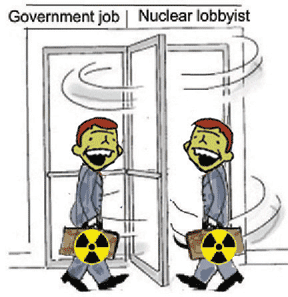 Brothers-in-Arms: the high-rotation revolving door between the Australian government and arms merchants. Michael West Media by Michelle Fahy | Mar 11, 2020 | A disturbing number of Australia’s military personnel, senior defence and intelligence officials and politicians leave their public service jobs and walk through the ‘revolving door’ into roles with weapons-making and security-related corporations. Nowhere is government and industry more fused than in defence. Michelle Fahy reports. Brothers-in-Arms: the high-rotation revolving door between the Australian government and arms merchants. Michael West Media by Michelle Fahy | Mar 11, 2020 | A disturbing number of Australia’s military personnel, senior defence and intelligence officials and politicians leave their public service jobs and walk through the ‘revolving door’ into roles with weapons-making and security-related corporations. Nowhere is government and industry more fused than in defence. Michelle Fahy reports.
The majority of transitions between politics and the Australian defence sector pass unremarked, with only an occasional high profile name making media headlines. It is a career pathway which has been normalised. This despite the sensitive nature of defence and the astronomical size of the nation’s defence spending. A recent example is the 21 February 2020 appointment to the Thales Australia board of one of the nation’s most senior intelligence chiefs, former ASIO boss Duncan Lewis, which barely rated a mention. Nine newspapers were an exception in noting the appointment, but there were no hard questions asked and no analysis by Nine as to the implications of this swift move into the private sector by such a powerful well-connected person: a move into an industry over which Lewis until recently had had oversight. Upon his appointment to the Thales board, Lewis had only been out of ASIO for five months, having spent five years as its Director-General. ASIO was his final public sector role in a long career that also spanned the military, the departments of the prime minister and cabinet and defence, as well as diplomatic roles. Thales is the world’s 10th largest weapons-making corporation; a French multinational that also encompasses cybersecurity and space projects. It also owns 35 per cent of Naval Group, the lead contractor of the $80 billion Future Submarines project. Thales Australia is a multi-billion-dollar contractor to the Australian government. When respected senior leaders such as Lewis leave public service for the weapons industry, they take with them extensive contacts, deep institutional knowledge, and rare and privileged access to the highest levels of government. Their presence in the private sector serves to affirm and entrench the influence of the weapons industry on government decision-making. The public interest risks becoming conflated with corporate interests. In addition to these issues, the well-trodden path from public service into such industry appointments raises the troubling possibility that some senior decision-makers on defence and national security matters, with an eye on possible future board appointments or consulting roles (whether consciously or not), might favour a certain proposal over another, or become hesitant to make decisions that could displease corporate interests. How would the public they serve ever know?
|
|

A nuclear waste dump for Eyre Peninsula conflicts with the Strategic Plan for the Eyre Peninsula Natural Resources Management Region – 2017-2027
Susan Craig shared a No Nuclear Waste Dump Anywhere in South Australia
Resources Minister Keith Pitt shows poor grasp of nuclear waste issues.
From Keith Pitt’s Website…. There are some glaring problems with his understanding of the portfolio including “the people of Napandee”….storage of Low Level Waste when it is Disposal….the inference that waste at the other 100 sites is nuclear medicine related….that nuclear medicine “keeps us well”….just to name a few,
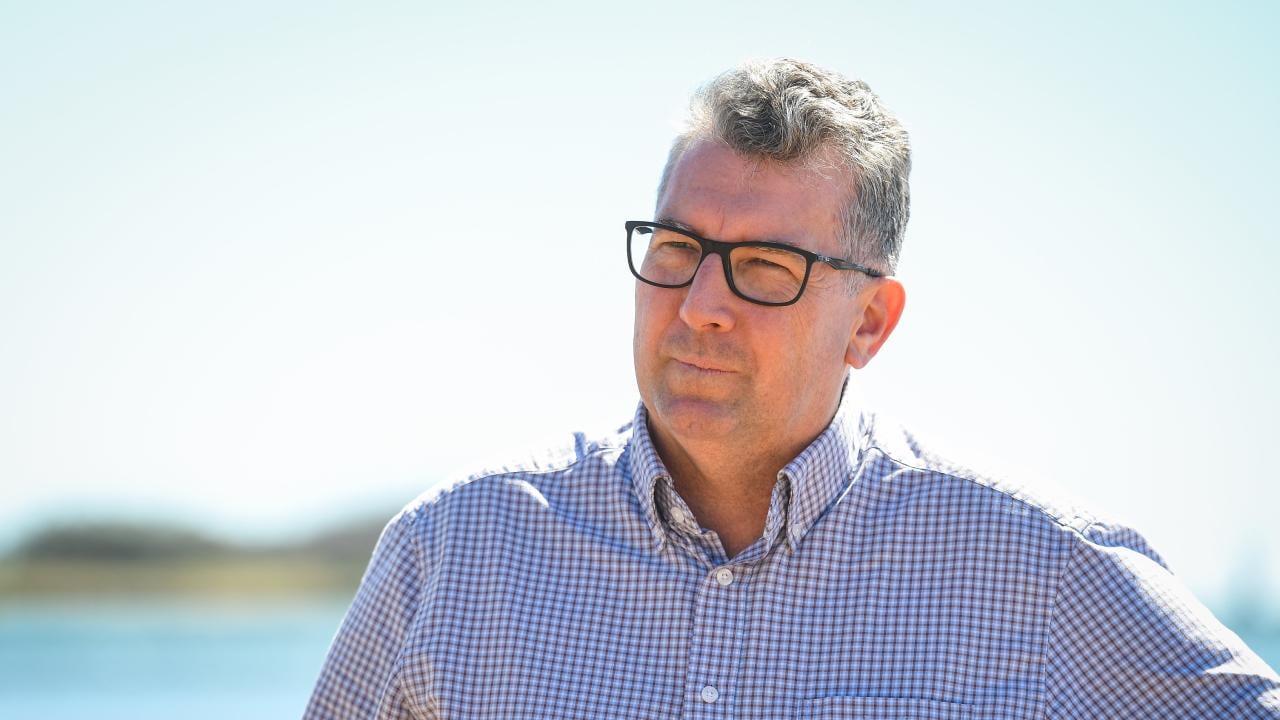 Interview with Paul Culliver, Breakfast program of ABC North and West SA, 4 March 2020
Interviewer: Paul Culliver
Subject: Radioactive waste facility site, community consultation, progress with facility legislation, National Party Government to be built in Kimba. I just asked him: coming to this portfolio, and this process, what his mindset is. ………
PAUL CULLIVER: Obviously, Matt Canavan’s been the face of it for the Government for many years now and it’s now going to be you. Does anything change?
KEITH PITT: ……. really we just want to move forward with the legislation, get it through the system in terms of the House, the Senate, get royal assent and start to deliver for the people of Napandee.
PAUL CULLIVER: ……… Obviously, there’s people still with very strong views about this and very strong concerns about the process. I mean are you interested in hearing from those people still or are you just pushing forward?
KEITH PITT: We’re moving forward. We’ll always continue to consult with the community, but there’s been very broad community support; 61 per cent of the voters in Kimba support the facility; close on 60 per cent of local businesses; close on 60 per cent of submissions supported it; 100 per cent of the direct neighbours that share a boundary support the facility……..
PAUL CULLIVER: And what’s your feeling on the fact that the Barngarla people feel left out of that consultation process when people talk about broad community support? The Barngarla people say well we didn’t get a say in that community vote.
KEITH PITT: Well firstly, we’ve worked very closely with Barngarla people and there’s still an opportunity for us to continue to work closely with them as we’ve said we would both publicly and privately.
PAUL CULLIVER: The legislation’s gone into Parliament now; it’s been referred to a Senate inquiry. Could you just explain sort of what the process is there? What’s going to happen with that legislation?
KEITH PITT: Well firstly, the legislation’s been introduced to the Parliament. It will probably be debated in the House of Reps sometime this week,……. It will be debated in the Senate. Once it passes both the House and the Senate, after the committee process, it goes to what’s called royal assent with the Governor-General and becomes law and then we push on.
PAUL CULLIVER: And what exactly does this legislation do?
KEITH PITT: So effectively, it does make some changes around some pre-existing legislation to identify the site at Napandee as the site. There’s some bits around the community development package. ……….. but one of the points I really want to make is, you know, the low level waste which we stored here, around 80 per cent of that comes from nuclear medicine. ……
PAUL CULLIVER: One criticism from people vocal about this facility is that the intermediate waste is going to have to be moved on again somewhere anyway, so what’s the point of parking it in one place if you’re just going to have to find a new facility for it later?
KEITH PITT: So what we’ve said from the beginning is that this will be a storage facility for low level, and potentially intermediate waste. …….. we just have to be able to deal with the waste in a practical and sensible way.
PAUL CULLIVER: Will you be visiting Kimba?
KEITH PITT: It’s certainly on the list……I’ve spoken with Rowan Ramsey a number of times and I’ll take the first opportunity I can to get down in South Australia and talk to the local community…… https://www.facebook.com/groups/941313402573199/
The continuing cover-up of the Fukushima nuclear disaster
 Japan’s Nuclear Cover-up Continues, Nine Years after the Fukushima Disaster, Fairewinds Energy Education, March 10, 2020 by Arnie Gundersen
The six atomic power reactors at the Fukushima Daiichi nuclear site were severely damaged 9-years ago when a Richter 9 earthquake in the Pacific Ocean occurred at 2 p.m. on March 11, 2011 ravaging the nuclear reactors, flooding safety systems, and causing three atomic power meltdowns.
Fairewinds is using the 9th commemoration of the meltdowns at Fukushima to discuss how the government of Japan, TEPCO (Tokyo Electric Co), the International Atomic Energy Agency (IAEA), and the worldwide nuclear industries have perpetuated their coverup of the tragedy of the Fukushima meltdowns. These corporate and governmental groups and agencies have consistently misinformed the International Press, the citizens of Japan, and people around the world about the true consequences of the Fukushima Daiichi meltdowns.
The Government of Japan, the nuclear industry, and its regulators have “framed” what happened at Fukushima Daiichi and thereby have controlled the Fukushima narrative for 9-years. ‘Framing’ is choosing the right words to portray and control any narrative. George Lakoff and his co-authors explain how controlling that framework of words controls how people view an issue. You may read more in their book that discusses ‘framing’ any issue entitled “Don’t Think of an Elephant!: Know Your Values and Frame the Debate”. …….
The nuclear industry downplayed the radioactive danger being unleashed
While the Japanese government kept denying that meltdowns had even occurred, the rest of the nuclear industry and the governments in the thrall of atomic lobbyists for the nuclear power and nuclear weapons industries actively downplayed the tragedy occurring right before our eyes.
In a brilliant analysis from the UK newspaper The Guardian, reporters uncovered a coordinated coverup that began within two-days of the onset of the Fukushima disaster:
British government officials approached nuclear companies to draw up a coordinated public relations strategy to play down the Fukushima nuclear accident just two days after the earthquake and tsunami in Japan and before the extent of the radiation leak was known.
Internal emails seen by the Guardian show how the business and energy departments worked closely behind the scenes with the multinational companies: EDF Energy, Areva and Westinghouse to try to ensure the accident did not derail their plans for a new generation of nuclear stations in the UK.
“This has the potential to set the nuclear industry back globally,” wrote one official at the Department for Business, Innovation and Skills (BIS), whose name has been redacted. “We need to ensure the anti-nuclear chaps and chapesses do not gain ground on this. We need to occupy the territory and hold it. We really need to show the safety of nuclear.”
On March 18, 2011, seven-days after the disaster began, US Department of Energy Secretary Chu said that Fukushima was at a Level-5 on the nuclear incident scale, which is similar to the level the US Government assessed at Three Mile Island (TMI), but not the level-7 that the world assessed for Chernobyl. On CNN that night, I was the first expert in the world to say publicly on mainstream media that Fukushima and its radioactive releases were already as bad as Chernobyl.
CNN’s John King: “Secretary Chu called it worse than Three Mile Island…”
Arnie: “I actually think it’s at Chernobyl level right now…100 time worse than the worst case we imagined a year ago.”
Every time Fairewinds released a video, podcast, newsletter or I appeared on television or radio, I was publicly slammed and called a liar and fear monger by the nuke industry that I had been directly been employed with for 20-years. I began my career first as a nuclear engineer and reactor operator and later progressed to become Senior Vice President of a nuclear power corporation – until I became a nuclear power whistleblower. After being fired for telling the truth, I took on the role of nuclear safety critic, which I have had for the last 30-plus-years. In Fairewinds opinion, these corporate coverups were obvious to anyone who focused on the real science of nuclear engineering and was not afraid to look behind the curtain, where the Wizard of Oz was manipulating the truth.
Only 11-months after the meltdowns, I was flown to Japan in February 2012 by Shueisha Publishing to unveil the publication of Fairewinds book [entitled Fukushima Daiichi: The Truth and the Way Forward] and to speak at various venues in Tokyo, including the Japanese Foreign Correspondents Press Club. Here is a portion of what I said:
I was an expert on the Three Mile Island nuclear accident, and I see in Fukushima the same mistakes that the Americans made at Three Mile Island. At Three Mile Island and at Fukushima, the plant management – the people in the plant – really understood the severity of the accident. But in both cases, 30 years apart, when the plant management contacted offsite management – it was General Public Utilities in the United States, and of course, it was Tokyo Electric in Japan – the process began to slow down.
What I saw on Three Mile Island was that the corporate office was trying to protect the corporate assets and they actually told the plant manager not to order an evacuation, despite the fact that the plant manager wanted an evacuation. And I see the same thing at Fukushima. I believe that the management onsite in the first day and the first week really understood the severity of it. But senior management working up the chain, for whatever their motivations were, failed to act quickly enough…. it seems to me like the lesson at Three Mile Island and the lesson at Fukushima really are institutional problems in that the corporate officers and corporate offices simply don’t respond quick enough. In addition to the internal problems between the plant and Tokyo Electric offices, there of course were the problems between Tokyo Electric and the Nation of Japan.
Following the triple meltdowns in 2011, I became acquainted with Naoto Kan, the Prime Minister of Japan at the time of the meltdown. At a venue where we were both keynote speakers, I told him that I thought he had not been given the correct information about the meltdowns. He replied,
“The information I received from both TEPCo and METI (Japan’s nuclear regulator) was neither timely nor accurate.”
Please think about the enormity of that single sentence! Any industry so powerful that it does not feel compelled to tell the truth to the leader of a nation is failing its country and their people……….
The bottom line is that in Japan during the Fukushima Daiichi meltdowns, the lives of women and children were sacrificed to create the appearance that TEPCO had the triple meltdowns under control.
Grossly underestimating the cost of the Disaster
People living and working in Japan and the country’s own citizens were clearly deceived about the severity of the meltdowns, the urgent need to evacuate, and the significant health impact for generations of families following the Fukushima disaster. And, these people were also deceived about the astronomical cost to dismantle the four severely damaged reactors at the Fukushima Daiichi site, protect the ocean and surrounding areas from the ongoing migration of radioactivity, and the total cost to complete the partial remediation of Fukushima Prefecture. I say partial remediation, because the remediation [the removal of radioactivity] will always be partial. So much radioactivity blew into the mountains, and the mountains and forests are so contaminated with highly radioactive isotopes including plutonium, that it will take tens of thousands of years for that radioactivity to dissipate [the industry term is decay away].
Every time in rains or the snow melts or the wind blows from or through the mountains, that radioactivity is spread farther away and also back into areas that were allegedly cleaned. The government informed people that these contaminated areas are clean and that they should now move back into their old communities and homes, and that the government stipends they had been receiving were ending and all the evacuee housing was being closed. What are people to do when they have no place to live and no money to live on except to go back to their old community?
A “lowball” price estimate showing that recovery from the meltdowns would be inexpensive was designed to show Japan’s citizens that the meltdowns were not that bad after all. ………https://www.fairewinds.org/demystify/japans-nuclear-cover-up-continues-nine-years-after-the-fukushima-disaster
The ocean as a dump for nuclear wastes
Radioactive dumping ground, The main reason behind the radiation along the northern French coastline isn’t the underwater barrels, but rather the nuclear fuel reprocessing plant at La Hague. It is located directly on the coast and “legally discharges 33 million liters of radioactive liquid into the sea each year,” says Rousselet. He thinks it’s scandalous.
Spike in cancer rates, According to a study by the European Parliament, statistics show cancer rates are significantly higher in the region surrounding La Hague.
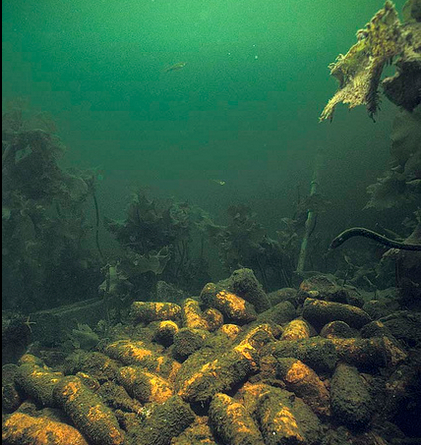
Fukushima: How the ocean became a dumping ground for radioactive waste, DW, 11 Mar 20 The nuclear disaster at Fukushima sent an unprecedented amount of radiation into the Pacific. But, before then, atomic bomb tests and radioactive waste were contaminating the sea — the effects are still being felt today…….
A study from the European Parliament reached a similar conclusion. The research found that “even the smallest possible dose, a photon passing through a cell nucleus, carries a cancer risk. Although this risk is extremely small, it is still a risk.”
And that risk is growing. Radioactive pollution in the ocean has been increasing globally — and not just since the disaster at Fukushima.
Atomic bomb tests
In 1946, the US became the first country to test an atomic bomb in a marine area, in the Pacific Bikini Atoll. Over the next few decades, more than 250 further nuclear weapons tests were carried out on the high seas. Most of them (193) were conducted by France in French Polynesia, and by the US (42), primarily in the Marshall Islands and the Central Pacific.
But the ocean wasn’t just being used as a training ground for nuclear war. Until the early 1990s, it was also a gigantic dump for radioactive waste from nuclear power plants.
From 1946 to 1993, more than 200,000 tons of waste, some of it highly radioactive, was dumped in the world’s oceans, mainly in metal drums, according to the International Atomic Energy Agency (IAEA). Several nuclear submarines, including nuclear ammunition, were also sunk during this time.
Is the ocean a perfect storage site?
The lion’s share of dumped nuclear waste came from Britain and the Soviet Union, figures from the IAEA show. By 1991, the US had dropped more than 90,000 barrels and at least 190,000 cubic meters of radioactive waste in the North Atlantic and Pacific. Other countries including Belgium, France, Switzerland and the Netherlands also disposed of tons of radioactive waste in the North Atlantic in the 1960s, 70s and 80s.
“Under the motto, ‘out of sight, out of mind,’ the dumping of nuclear waste was the easiest way to get rid of it,” says Horst Hamm. Continue reading
Nuclear is too risky – say protestors
ANSTO lies about necessity of nuclear reactor: Nuclear medicines are being made in Adelaide, without dirty nuclear reactor
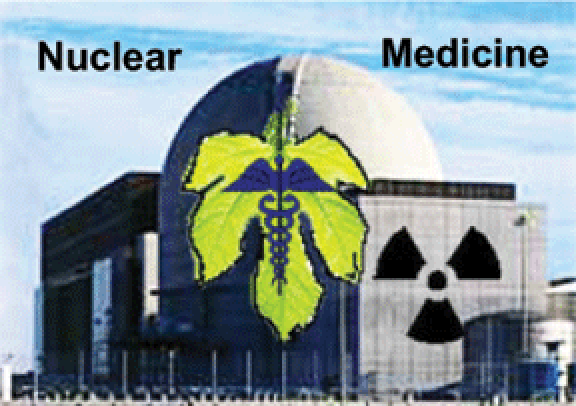 Brett Burnard Stokes No Nuclear Waste Dump Anywhere in South Australia 12 Mar 20 Nuclear medicines are being made here in Adelaide the modern way, with no waste problems.
To say this illegal dump is needed for nuclear medicines – that is deception. https://www.facebook.com/groups/1314655315214929/
|
The Molecular Imaging and Therapy Research Unit (MITRU) is a pharmaceutical production and research unit focused on developing tracers for molecular imaging centred on incorporating radiation. The site began the task of becoming a Therapeutic Goods Administration (TGA) manufacturing facility when the SAHMRI team moved in at the end of 2013. Eight months later they had their first federal inspection and achieved a TGA licence to provide a radiopharmaceutical FDG, a cancer diagnosis imaging tool, for patient administration across Australia. The unit began to provide the FDG for South Australia imaging facilities soon after allowing patients to no longer be reliant on this tracer being imported into the state. The demand for FDG, has begun to grow slowly in South Australia, limited currently by the lack of scanners in the state, however the SAHMRI has been able to obtain smaller scanners to utilise this and future agents through Research funding. Since the initial move to the SAHMRI iconic building on North Terrace at the end of 2013 the team has grown from two persons to a total of 10, awaiting another senior radiochemist to join within the next few months. The unit has expanded its work to include PET-generator based products to ensure expansion further into the radiopharmaceutical field and recently using the particle accelerator, GE Cyclotron, into generating further isotopes that could be provided regularly across Australia forging new research grounds. The unit is currently developing radioactive tracers that have shown promise in neurology in early diagnosis detection of Alzheimer’s, various dementia models and spinal cord injuries as and when funding is secured. It is further involved in commercial process for labelling safely radio-therapeutic drugs for several cancer to allow access across Australia using ANSTO developed materials. MITRU is a commercial facility, able to conduct research when required, that has obtained the highest manufacturing standards to allowing their current and future developments to be moved into clinical practice sooner. The timeframes for projects are often smaller as they have a unique funding model where costs are recuperated through sales once initial funding is obtained to ensure that there is a further demand. Overall this reduces the costs and adds a demand focus to the units’ endeavours. The unit is also involved with pre-arranged tours to the public, high-school and University students, where several of the team lecture on or are associated with South Australian Universities. Currently the unit has a shared supervision of several students developing agents for diagnosis and to increase disease understanding. All the team in unit do not have direct funding from grants and look for funding through either philanthropic or general research opportunities to allow them to development further into new tracer avenues with some small success which has helped the unit to become a centre of excellence for several equipment vendors. The profile in the community has grown through public and peer talks, conferences, radio, TV and newspaper articles, which is hoped to be furthered with the presence on the unit on the internet in the near future. The unit hopes to develop further tracers to ensure small animal trials to understand mechanism of disease and use this to move quickly into human work, as seen with Ga68-PSMA for prostate cancer where in less than 6months from initial donation to patient injection was possible. Work has begun to align and work together with facilities globally by developing satellite radiopharmaceutical and imaging centres using common protocols. The unit continues to expand its TGA licence and it is hoped in the near future will ensure testing of pharmaceuticals used in cold kits for SPECT imaging and implementation of new global diagnostic PET-agents for examination in Australia safely. |
|
Australian govt rejects a report that recommends nuclear submarines
French submarine program ‘dangerously off track’ warns report urging Australia to consider nuclear alternative, ABC News, By defence correspondent Andrew Greene 11 Mar, 20 Australia’s $80 billion Future Submarine Program is “dangerously off track” according to a new report that urges the Government to ditch the controversial project and consider a nuclear option.
Key points:
- The report indicates there are fears the current project is at a high risk of failing
- The Defence Minister denies those fears and maintains the project remains on track
- Under a proposed “Plan B” scenario, the company that designed the Collins class submarines would prepare an updated design
Businessman Gary Johnston, who commissioned and funded the study, fears the current plan to build 12 attack class submarines designed by French company Naval Group is at “high risk” of failing.
His report, prepared by Insight Economics, suggests Australia should instead immediately begin work on a “Plan B” — an evolved version of the current Collins class fleet — before eventually acquiring nuclear-powered boats.
Earlier this year, a report from the auditor-general confirmed the Future Submarine Program was running nine months late and Defence was unable to show whether the $396 million spent so far had been “fully effective”.
“The Government’s own advisory body, including three American admirals, even recommended the Government should consider walking away from the project,” Mr Johnston said.
Under the proposed “Plan B”, Swedish company Saab Kockums, which designed the navy’s Collins class submarines, would be asked to prepare an updated design for the future submarine fleet.
In 2022-23, both Naval Group and Saab will present their competing preliminary design studies for building the first batch of three submarines in Adelaide — based on a fixed price, capability, delivery and local content.
Mr Johnston, along with former naval officers in the Submarines for Australia organisation, argue that over the long term the Government should begin preparing to acquire nuclear submarines……
Government rejects report, issues warning
The Submarines for Australia report will be formally launched by ANU Emeritus Professor Hugh White at the National Press Club today, but it is already drawing fire from the Morrison Government.
“I totally reject the premise that this project is ‘dangerously off track’, as stated in the new Submarines for Australia report”, Defence Minister Linda Reynolds said.
“The delivery of the attack class submarine remains on track, with construction set to commence in 2023.”
Senator Reynolds said the technical feasibility of delivering an evolved Collins class submarine was reviewed in 2013-14, but a review found it would be equivalent to a whole new design, involving similar costs and risks, without a commensurate gain in capability.
“This assessment by Submarines for Australia will only increase cost, delay the delivery, and put at risk our submarine capability.”
The Defence Minister also flatly rejected any suggestion of a nuclear-powered submarine in the future.
“As has been the policy of successive Australian Governments, a nuclear-powered submarine is not being considered as an option for the attack class submarine,” Senator Reynolds said.
https://www.abc.net.au/news/2020-03-11/australia-urged-to-embrace-nuclear-submarines/12043444
AEMC approves Victoria’s request to go it alone on energy reliability reform — RenewEconomy

AEMC approves request from Victoria for ‘enhanced RERT’ powers to allow AEMO to secure multi-year emergency electricity supply contracts. The post AEMC approves Victoria’s request to go it alone on energy reliability reform appeared first on RenewEconomy.
via AEMC approves Victoria’s request to go it alone on energy reliability reform — RenewEconomy
March 11 Energy News — geoharvey

Opinion: ¶ “Why Russia And Vladimir Putin Are Waging An Oil War With America” • Vladimir Putin knows America’s fragile oil industry is built on a mountain of debt. Moscow’s refusal to join with OPEC to mitigate oversupply is aimed in part at drowning US shale oil companies, which compete with Russian oil but rely […]
Japan may have to cancel the Olympics — Fukushima 311 Watchdogs

Covid-19 could scupper Prime Minister Abe Shinzo’s pet project March 7, 2020 IF BANYAN HAD to choose one country in which to ride out a pandemic, it would surely be Japan. Early 19th-century woodblock prints of bathing testify to Japan’s old and admirable cult of cleanliness. Modern Japanese have for years been quick to […]
via Japan may have to cancel the Olympics — Fukushima 311 Watchdogs
Regional community solar and storage projects win NSW government grants — RenewEconomy

NSW government awards seven grants to community solar and storage projects across regional parts of the state. The post Regional community solar and storage projects win NSW government grants appeared first on RenewEconomy.
via Regional community solar and storage projects win NSW government grants — RenewEconomy
Rooftop solar unstoppable as market breaks “all previous records” in February — RenewEconomy

Australia’s rooftop solar market has shown no signs of slowing down so far in 2020, with booming residential installations in February helping to break all previous records and delivering the highest monthly registered capacity of 218MW. The post Rooftop solar unstoppable as market breaks “all previous records” in February appeared first on RenewEconomy.
via Rooftop solar unstoppable as market breaks “all previous records” in February — RenewEconomy
Japan begins solar powered hydrogen production at Fukushima plant — RenewEconomy

FH2R project completed at former nuclear hub, able to produce “green” hydrogen powered by a 20MW solar farm and some grid power. The post Japan begins solar powered hydrogen production at Fukushima plant appeared first on RenewEconomy.
via Japan begins solar powered hydrogen production at Fukushima plant — RenewEconomy
1 This month.
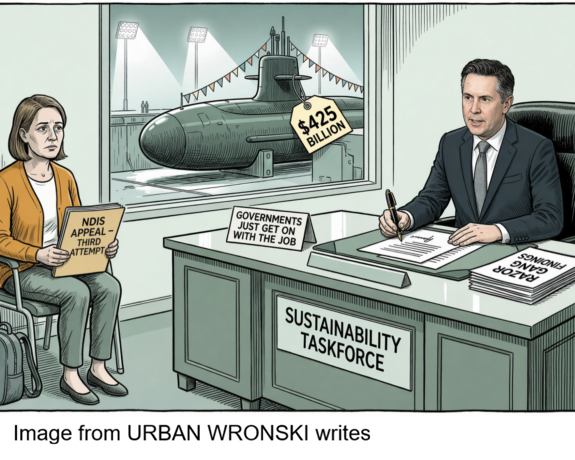

PETITION – To: Prime Minister Anthony Albanese and the Australian Labor Government
Chernobyl: The Lost Tapes – A good documentary on Chernobyl on SBS available On Demand for the next 3 weeks– https://www.sbs.com.au/ondemand/tv-program/chernobyl-the-lost-tapes/235274195556
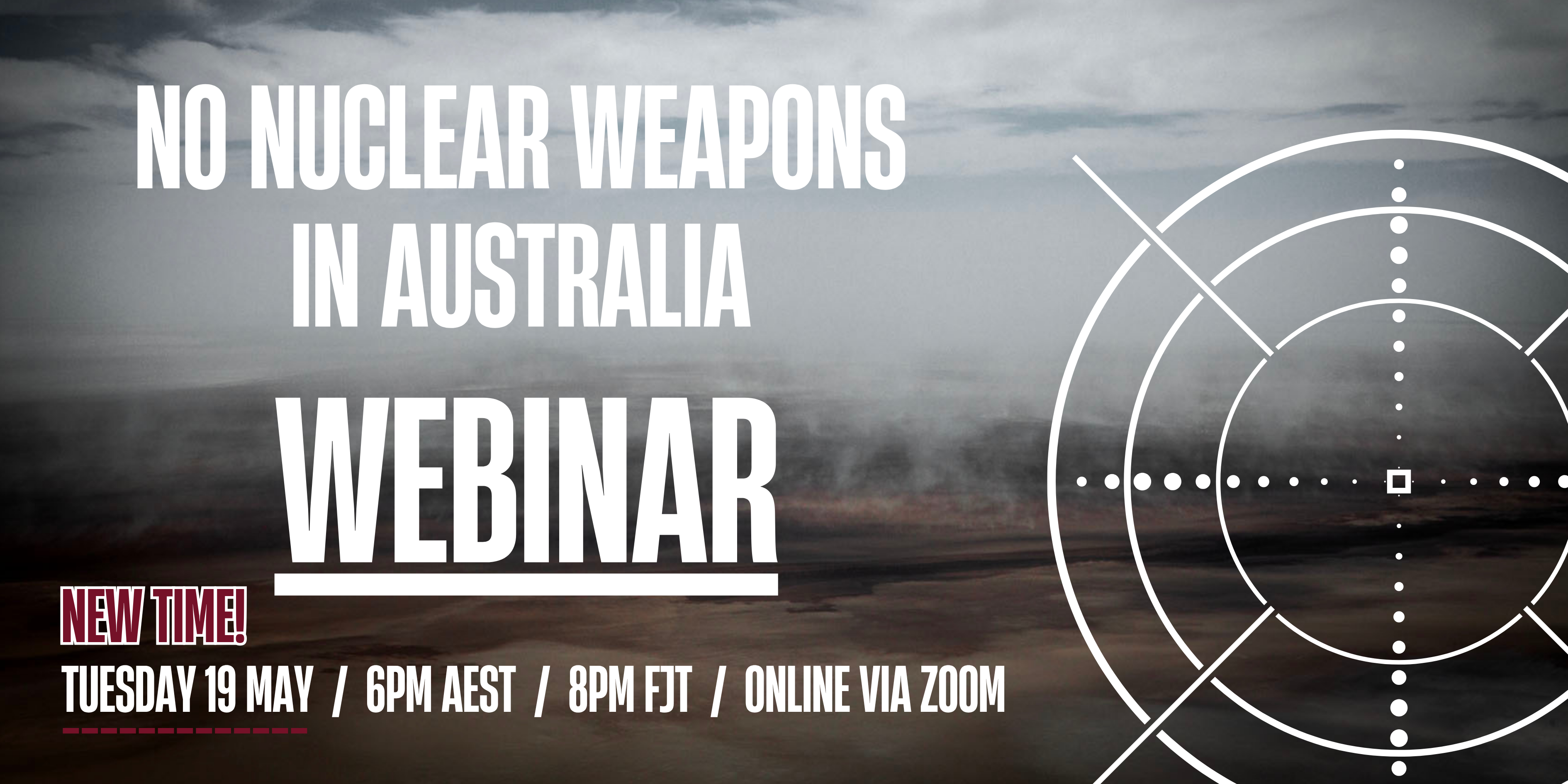
19 May – Webinar- Webinar: No Nuclear Weapons in Australia
Start: 2026-05-19 18:00:00 UTC Canberra, Melbourne, Sydney (GMT+10:00)
End: 2026-05-19 19:30:00 UTC Canberra, Melbourne, Sydney (GMT+10:00)
20 May – Webinar – The dangerous world of AUKUS, US, military occupation and suppression of dissent

National Webinar, 20th May, 2026, 6.30pm AEST. Confronting laws restricting/suppressing protest speech and action
Speakers: Former Sen. Rex Patrick, Lawyer Nick Hanna ,Arthur Rorris ,Jorgen Doyle, Sen David Shoebbridge,
Facilitator Kelley Tranter.

of the week – Australians for War Powers Reform (AWPR)
To see nuclear-related stories in greater depth and intensity
 Antinuclear