Is ocean discharge the best solution to Fukushima No. 1’s water crisis? — Fukushima 311 Watchdogs

A government panel has said that releasing radioactive water accumulating at the Fukushima No. 1 nuclear power plant into the ocean is the most reliable option Feb 25, 2020 The issue of what to do with the treated radioactive water being stored at the Fukushima No. 1 nuclear plant is nearing its boiling point. […]
via Is ocean discharge the best solution to Fukushima No. 1’s water crisis? — Fukushima 311 Watchdogs
The insanity of Angus Taylor’s fossil fuel technology roadmap — RenewEconomy

Angus Taylor’s technology roadmap seems designed to deliberately ignore the obvious choices for abatement. The post The insanity of Angus Taylor’s fossil fuel technology roadmap appeared first on RenewEconomy.
via The insanity of Angus Taylor’s fossil fuel technology roadmap — RenewEconomy
Australia’s first detailed database on household solar, batteries and EVs goes live — RenewEconomy

Australian Energy Market Operator launching nation’s first detailed database of rooftop solar, battery storage, electric vehicles and other consumer-owned resources. The post Australia’s first detailed database on household solar, batteries and EVs goes live appeared first on RenewEconomy.
via Australia’s first detailed database on household solar, batteries and EVs goes live — RenewEconomy
Queensland energy minister “deeply concerned” over Coalition plans for new coal generator — RenewEconomy

Queensland energy minister details concerns over potential negative consequences of a new, unneeded, coal-fired power station in Queensland. The post Queensland energy minister “deeply concerned” over Coalition plans for new coal generator appeared first on RenewEconomy.
Future Battery Industry Strategy powers economic growth and jobs — RenewEconomy

new report has revealed Western Australia’s Future Battery Industry Strategy is driving the creation of new and operational jobs. The post Future Battery Industry Strategy powers economic growth and jobs appeared first on RenewEconomy.
via Future Battery Industry Strategy powers economic growth and jobs — RenewEconomy
Industry joins call for ARENA funding extension, as Taylor ducks commitment — RenewEconomy

Clean Energy Council joins calls for additional ARENA funding, but Taylor avoids further commitments. The post Industry joins call for ARENA funding extension, as Taylor ducks commitment appeared first on RenewEconomy.
via Industry joins call for ARENA funding extension, as Taylor ducks commitment — RenewEconomy
Taylor shifts focus to coal hydrogen and CCS in “technology roadmap” — RenewEconomy

Angus Taylor seeks to replicate expensive brown-coal to hydrogen project as Morrison government shuts the door on support for wind and solar. The post Taylor shifts focus to coal hydrogen and CCS in “technology roadmap” appeared first on RenewEconomy.
via Taylor shifts focus to coal hydrogen and CCS in “technology roadmap” — RenewEconomy
Victoria regulator lowers rooftop solar tariff, says few retailers offering variable rate — RenewEconomy

Victoria regulator makes small cuts to 2020/21 recommended solar feed-in tariff, says only one retailer offering customers both single and time-varying FiT. The post Victoria regulator lowers rooftop solar tariff, says few retailers offering variable rate appeared first on RenewEconomy.
Getting off coal: Orderly exit or last-minute stampede — John Quiggin
I’m one of 10 000 Australian academics who signed an open letter to Unisuper (our industry superannuation fund) calling for a policy of divestment from carbon-based fuels. The first step in such a policy has to be divestment from thermal coal. Purely on fiduciary grounds, getting out of thermal coal is now a matter of…
via Getting off coal: Orderly exit or last-minute stampede — John Quiggin
Keeping Australia nuclear-free: national campaign meeting in Melbourne
 29 February, Melbourne. Anti nuclear campaigners from South Australia, Western Australia, Queensland, New South Wales, Northern Territory and Victoria met today, to discuss the progress of the movement. The Australian Conservation Foundation and Friends of the Earth were prominently represented, among other environmentalists, and representatives from indigenous groups, churches, human rights, and medical organisations.
There was an atmosphere of quiet optimism. The Federal Government, in its Inquiry into nuclear power, has concluded that conventional nuclear reactors are definitely not an option for Australia. Due to their escalating costs, and long delay in building, they are recognised now as a failed technology.
Another encouraging factor for the nuclear-free movement is the fact that Western Australian uranium projects at Kintyre and Yeelirrie are at a standstill, with little likelihood of going ahead.
The federal government’s plan for a radioactive waste facility at Napandee, South Australia faces hurdles, with its plan for dual facilities . Low level waste burial and above-ground temporary storage of intermediate level wastes do not meet standards for international best practice.
Participants returned to their home States with renewed confidence in their work of informing and encouraging local communities in seeking a clean, nuclear-free environment.
In Victoria the goal of the nuclear lobby is to remove Victoria’s Nuclear Activities (Prohibitions) Act
Nuclear lobby takes aim at Victoria to tackle prohibitions, Michael West Media, by Noel Wauchope | Feb 26, 2020 Having dithered on real action to tackle global warming, some in the Coalition are now taking a keen interest in solving it — by going nuclear. Noel Wauchope investigates what’s behind the sudden push to overturn legislation prohibiting the exploration and mining of thorium and uranium and puts a definitive case against a nuclear industry in Australia.
A batch of Coalition MP’s are pushing nuclear power as Australia’s answer to climate change. The group includes Katie Allen inner-city Melbourne Liberal, Ted O’Brien, Queensland LNP, Trent Zimmerman, North Sydney Liberal, Bridget Archer Tasmanian Liberal, David Gillespie Nationals NSW, Rick Wilson West Australian Liberal, and Keith Pitt, LNP from North Queensland, who was this week promoted to cabinet as Resources Minister. Former deputy prime minister and Nationals leader, Barnaby Joyce, is also a staunch proponent of nuclear power.
Arguing that nuclear power is the answer to bushfires and a heating climate when these are conversely nuclear’s greatest threat is akin to an argument by the Mad Hatter and the March Hare. The US National Academies Press compiled a lengthy and comprehensive report on risks of transporting nuclear wastes. They concluded that among various risks, the most serious and significant is fire. And indeed, climate change, in general, carries serious threats to nuclear reactors and the entire nuclear fuel chain.
But any port in a storm when you’re trying to sell a product that is expensive, unpopular, illegal in Australia and has the problem of long-lasting toxic wastes.
The Australian public’s renewed enthusiasm for action on climate change was timely. The nuclear lobby had, coincidentally already geared itself up for a campaign to overturn Australia’s State and Federal nuclear prohibition laws. The current Victorian inquiry is the latest in a spate of Parliamentary Inquiries aimed at removing these laws. Submissions are due by this Friday, 28 February.
The Inquiry’s Terms of Reference (TOR) are narrow:……..
It is clear the goal is to remove Victoria’s Nuclear Activities (Prohibitions) Act 1983. The very first TOR makes the mining of uranium and thorium as the prime concern. Given Victoria could run a nuclear power station with uranium/thorium sourced from elsewhere, it is clear that, after years of pressure by thorium lobbyists, the underlying goal of this inquiry is to overturn the legislation prohibiting the exploration and mining of thorium and uranium in Victoria.
The Victorian legislation was brought in to protect this State’s precious agricultural land and iconic ocean coast from polluting mining industries. South Gippsland is particularly rich in thorium.
Nuclear lobby tries to water down Victorian prohibition
The Terms of Reference are overtly biased: with no qualification, they promote the nuclear industry as undoubtedly beneficial to Victoria. This is ludicrous, as the global nuclear industry is in a state of decline.
Meanwhile, the renewable energy technologies of wind, solar and storage are now recognised by CSIRO and the Australian Energy Market Operator as, by far, the cheapest form of low carbon options for Australia, and are likely to dominate the global energy mix in coming decades
This first Term of Reference assumes that the “exploration and production” will result in nuclear power plants for Victoria, otherwise why do it? It also assumes that nuclear power will be effective in lowering C02 emissions.
However, there is no point in this “exploration and production” as it has been repeatedly demonstrated that nuclear power is no solution to climate change as in Dr. Paul Dorfman et al’s response to James Hansen on 20 December 2019 in the Financial Times.…….
The Terms of Reference are overtly biased: with no qualification, they promote the nuclear industry as undoubtedly beneficial to Victoria. This is ludicrous, as the global nuclear industry is in a state of decline.
Meanwhile, the renewable energy technologies of wind, solar and storage are now recognised by CSIRO and the Australian Energy Market Operator as, by far, the cheapest form of low carbon options for Australia, and are likely to dominate the global energy mix in coming decades
This first Term of Reference assumes that the “exploration and production” will result in nuclear power plants for Victoria, otherwise why do it? It also assumes that nuclear power will be effective in lowering C02 emissions.
However, there is no point in this “exploration and production” as it has been repeatedly demonstrated that nuclear power is no solution to climate change as in Dr. Paul Dorfman et al’s response to James Hansen on 20 December 2019 in the Financial Times.……… .https://www.michaelwest.com.au/nuclear-lobby-takes-aim-at-victoria-to-tackle-prohibitions/
Legislation banning nuclear power in Australia should be retained
| Jim Green, Online Opinion, 27 Feb 2020, https://onlineopinion.com.au/view.asp?article=20758&page=0
Nuclear power in Australia is prohibited under the Environmental Protection and Biodiversity Conservation (EPBC) Act 1999. A review of the EPBC Act is underway and there is a strong push from the nuclear industry to remove the bans. However, federal and state laws banning nuclear power have served Australia well and should be retained.
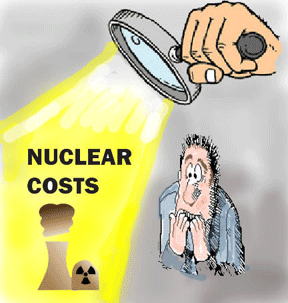
There are many other examples of shocking nuclear costs and cost overruns, including: * The cost of the two reactors under construction in the US state of Georgia has doubled and now stands at A$20.4‒22.6 billion per reactor. * The cost of the only reactor under construction in France has nearly quadrupled and now stands at A$20.0 billion. It is 10 years behind schedule. * The cost of the only reactor under construction in Finland has nearly quadrupled and now stands at A$17.7 billion. It is 10 years behind schedule. * The cost of the four reactors under construction in the United Arab Emirates has increased from A$7.5 billion per reactor to A$10‒12 billion per reactor. * In the UK, the estimated cost of the only two reactors under construction is A$25.9 billion per reactor. A decade ago, the estimated cost was almost seven times lower. The UK National Audit Office estimates that taxpayer subsidies for the project will amount to A$58 billion, despite earlier government promises that no taxpayer subsidies would be made available. Nuclear power has clearly priced itself out of the market and will certainly decline over the coming decades. Indeed the nuclear industry is in crisis ‒ as industry insiders and lobbyists freely acknowledge. Westinghouse ‒ the most experienced reactor builder in the world ‒ filed for bankruptcy in 2017 as a result of catastrophic cost overruns on reactor projects. A growing number of countries are phasing out nuclear power, including Germany, Switzerland, Spain, Belgium, Taiwan and South Korea. Rising power bills: Laws banning nuclear power should be retained because nuclear power could not possibly pass any reasonable economic test. Nuclear power clearly fails the two economic tests set by Prime Minister Scott Morrison. Firstly, nuclear power could not possibly be introduced or maintained without huge taxpayer subsidies. Secondly, nuclear power would undoubtedly result in higher electricity prices.
Former US Vice President Al Gore summarised the proliferation problem: “For eight years in Too slow: Expanding nuclear power is impractical as a short-term response to climate change. An analysis by Australian economist Prof. John Quiggin concludes that it would be “virtually impossible” to get a nuclear power reactor operating in Australia before 2040. More time would elapse before nuclear power has generated as much as energy as was expended in the construction of the reactor: a University of Sydney report concluded that the energy payback time for nuclear reactors is 6.5‒7 years. Taking into account planning and approvals, construction, and the energy payback time, it would be a quarter of a century or more before nuclear power could even begin to reduce greenhouse emissions in Australia (and then only assuming that nuclear power displaced fossil fuels).
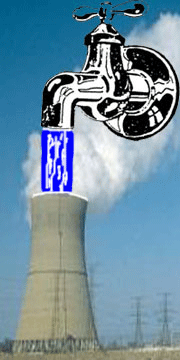
Water consumption of different energy sources (litres / kWh): * Nuclear 2.5 * Coal 1.9 * Combined Cycle Gas 0.95 * Solar PV 0.11 * Wind 0.004 Climate change and nuclear hazards: Nuclear power plants are vulnerable to threats which are being exacerbated by climate change. These include dwindling and warming water sources, sea-level rise, storm damage, drought, and jelly-fish swarms. Nuclear engineer David Lochbaum states. “I’ve heard many nuclear proponents say that nuclear power is part of the solution to global warming. It needs to be reversed: You need to solve global warming for nuclear plants to survive.”
By contrast, the REN21 Renewables 2015: Global Status Report states that renewable energy systems “have unique qualities that make them suitable both for reinforcing the resilience of the wider energy infrastructure and for ensuring the provision of energy services under changing climatic conditions.”
To give one example (among many), the National Radioactive Waste Management Act dispossesses and disempowers Traditional Owners in many respects: the nomination of a site for a radioactive waste dump is valid even if Aboriginal owners were not consulted and did not give consent; the Act has sections which nullify State or Territory laws that protect archaeological or heritage values, including those which relate to Indigenous traditions; the Act curtails the application of Commonwealth laws including the Aboriginal and Torres Strait Islander Heritage Protection Act 1984 and the Native Title Act 1993 in the important site-selection stage; and the Native Title Act 1993 is expressly overridden in relation to land acquisition for a radioactive waste dump. No social license: Laws banning nuclear power should be retained because there is no social license to introduce nuclear power to Australia. Opinion polls find that Australians are overwhelmingly opposed to a nuclear power reactor being built in their local vicinity (10‒28% support, 55‒73% opposition); and opinion polls find that support for renewable energy sources far exceeds support for nuclear power (for example a 2015 IPSOS poll found 72‒87% support for solar and wind power but just 26% support for nuclear power). As the Clean Energy Council noted in its submission to the 2019 federal nuclear inquiry, it would require “a minor miracle” to win community support for nuclear power in Australia. The pursuit of nuclear power would also require bipartisan political consensus at state and federal levels for several decades. Good luck with that. Currently, there is a bipartisan consensus at the federal level to retain the legal ban. The noisy, ultra-conservative rump of the Coalition is lobbying for nuclear power but their push has been rejected by, amongst others, the federal Liberal Party leadership, the Queensland Liberal-National Party, the SA Liberal government, the Tasmanian Liberal government, the NSW Liberal Premier and environment minister, and even ultra-conservatives such as Nationals Senator Matt Canavan.
Australia can do better than fuel higher carbon emissions and unnecessary radioactive risk. We need to embrace the fastest growing global energy sector and become a driver of clean energy thinking and technology and a world leader in renewable energy technology. We can grow the jobs of the future here today. This will provide a just transition for energy sector workers, their families and communities and the certainty to ensure vibrant regional economies and secure sustainable and skilled jobs into the future. Renewable energy is affordable, low risk, clean and popular. Nuclear is not. Our shared energy future is renewable, not radioactive. More Information * Don’t Nuke the Climate Australia, www.dont-nuke-the-climate.org.au * Climate Council, 2019, ‘Nuclear Power Stations are Not Appropriate for Australia – and Probably Never Will Be’, https://www.climatecouncil.org.au/nuclear-power-stations-are-not-appropriate-for-australia-and-probably-never-will-be/ * WISE Nuclear Monitor, 25 June 2016, ‘Nuclear power: No solution to climate change’, https://www.wiseinternational.org/nuclear-monitor/806/nuclear-power-no-solution-climate-change Dr. Jim Green is the national nuclear campaigner with Friends of the Earth Australia. |





The Planet Is Screwed, Says Bank That Screwed the Planet
 The Planet Is Screwed, Says Bank That Screwed the Planet, The New Republic The Planet Is Screwed, Says Bank That Screwed the Planet, The New Republic A report from two economists at JP Morgan Chase pushes back against traditional economic wisdom on climate change. By KATE ARONOFF, February 25, 2020 JP Morgan Chase is the world’s leading financer of fossil fuel projects. And according to a report from within the company, recently leaked to the press, the world is seriously underestimating the adverse effects of climate change.
The 22-page report, entitled “Risky Business: the climate and the macroeconomy” and dated January 14, 2020, has been reported by multiple outlets since Friday as containing a gloomy assessment of the risk presented by climate change in the near future. But it also offers a withering takedown of how economists in particular have tended to think about the climate crisis, criticizing findings from several of the field’s experts by name, including a recent winner of the Nobel Prize in economics.
“We cannot rule out catastrophic outcomes where human life as we know it is threatened,” the report concludes. It’s a stunning bit of cognitive dissonance from a bank that is doing so much to fuel the crisis. It also shows a growing push for a more grounded assessment of the crisis than mainstream economics has offered in recent decades….
Essentially an informational document, the report—written by U.K.-based JP Morgan economists David Mackie and Jessica Murray—reviews a battery of academic literature on climate change. It examines several predictions of climate change’s impact on gross domestic product, including economist Richard Tol’s 2018 survey of 26 different climate models—one of the more comprehensive recent works. While Tol has links to organizations that have cast doubt on the scientific consensus around the climate crisis, as his own research has, the findings listed are not especially controversial. But the JP Morgan Chase report authors push back on those and other prominent predictions. “Most likely,” the authors conclude, “these estimates of the income and wealth effects of unmitigated climate change are far too small.”……..
The JP Morgan report doesn’t include clear recommendations for what the company’s own risk analysts should do with the information presented. “Most likely,” it states, “business as usual will be the path that policymakers follow in the years ahead”—something its authors say “opens the earth to a greater likelihood of a catastrophic outcome” than previously estimated. The report does not discuss the bank’s support for polluting industries, which have spent handsomely to block climate action at virtually every level of government.
“It is depressing that JP Morgan are trying to evade responsibility for this thorough and useful report that restates what climate scientists, Greta Thunberg, and Extinction Rebellion alike have been saying for some time now: that our very future as a species is at stake,” Rupert Read, who originally obtained the report, wrote in an email. “It would be so much better if they owned up fully to what is in this report. But then, that would of course require them to completely transform their business model.”
All that dissonance may be starting to wear thin. Ahead of its annual investor day Tuesday and under persistent pressure from Gwich’in Steering Committee and green groups, JP Morgan Chase said it would stop any new financing of drilling in the Arctic National Wildlife Refuge and expand restrictions on financing coal projects. https://newrepublic.com/article/156657/planet-screwed-says-bank-screwed-planet
|
|
Nuclear power, climate change and water use
 Nuclear lobby takes aim at Victoria to tackle prohibitions, Michael West Media, by Noel Wauchope | Feb 26, 2020 “…………Nuclear power is vulnerable to climate change. Increasing temperatures can result in reduced nuclear reactor efficiency by directly impacting nuclear equipment. It is uniquely vulnerable to increasing temperatures because of its reliance on cooling water to ensure operational safety within the core and spent fuel storage. As the most water-intensive energy generation technology, nuclear reactors are located near a river or the ocean to accommodate hefty water usage, which averages between 1,101 gallons per megawatt of electricity produced to 44,350 gal/MWh depending on the cooling technology.
Inland reactors that use rivers as a source for cooling water are the most at risk during heat waves, which according to the Intergovernmental Panel on Climate Change (IPCC) are “very likely” to occur more often and last longer in the coming decades.
In view of Australia’s growing bushfire threats, the introduction of nuclear power technology of any type is questionable. The safety of the Lucas Heights nuclear reactor was cause for concern when bushfires occurred in its vicinity. The transport of nuclear wastes would also be threatened by bushfires .
Whilst the operation of nuclear reactors themselves release few greenhouse emissions, nuclear power plants require huge amounts of water to prevent fission products in the core and spent nuclear fuel from overheating. Nuclear is the most water intensive energy source in terms of consumption and withdrawal per unit of energy delivered. Unlike thermal power plants, solar and wind power can help alleviate water stress……https://www.michaelwest.com.au/nuclear-lobby-takes-aim-at-victoria-to-tackle-prohibitions/
Barngarla Aboriginal Corporation lobby Senators- to oppose Bill to set up Kimba nuclear waste dump
|
Native title holders will travel to Canberra to lobby senators against the dump, saying they were excluded from community vote on the facility, Guardian, Sarah Martin Chief political correspondent @msmarto, Wed 26 Feb 2020 03.30 The government is pushing ahead with the legislation, despite the ballot being challenged in the federal court by the Barngarla native title holders, who were excluded from the vote because they are not ratepayers. Jason Bilney, chairman of the Barngarla Determination Aboriginal Corporation, said the 200 local native title holders were excluded from the Kimba community ballot despite repeated requests to both the council and the federal government to be included. The corporation is challenging the ballot in the federal court, claiming their exclusion is a breach of the racial discrimination act. The full court of the federal court heard the matter last Friday. “It is a simple truth that had we, as the first people for the area, been included in the Kimba community ballot rather than unfairly denied the right to vote, then the community ballot would never have returned a yes vote,” Bilney told Guardian Australia ahead of a visit to Canberra next month. “Many of our people were born in Kimba, and we have significant native title land near the proposed facility. This native title land allows us to live on and use the land. However, because it is not rateable, we were excluded from the Kimba community ballot on a technicality,” he said. The Barngarla claim the Coalition’s bill has been introduced to make it impossible to challenge the decision to locate a facility at Kimba, even if the court appeal is successful, effectively removing the protections of the Race Discrimination Act. “These amendments would entirely remove any court oversight, right in the middle of existing federal court proceedings. This would entirely deprive any protections for our people,” Bilney said. The group is expected to meet with crossbench senators in Canberra in the current session of parliament, explaining their concerns about the ballot process and pushing for the legislation to be blocked. Centre Alliance has already expressed reservations about supporting the legislation, saying Canavan had not been upfront about what constituted “broad community support” before the results of the ballot were known. “No one goes into a vote without understanding what the pass criteria is,” SA senator Rex Patrick told Guardian Australia. “I support the need for a national facility, but it should only be located where there is broad community support.” Labor discussed the party’s position regarding the legislation in a caucus meeting on Tuesday, with MPs resolving to wait until the bill had been considered by the senate economics committee and until the federal court decision had been handed down. A final decision will then be considered by the shadow cabinet and caucus and will also go through the First Nations caucus committee. Labor’s shadow industry minister, Brendan O’Connor, is expected to outline the party’s concerns when debate gets under way in the House of Representatives on Wednesday, but told MPs that there was a need for Australia to establish a national radioactive waste management facility. ….. https://www.theguardian.com/australia-news/2020/feb/26/south-australia-nuclear-waste-dump-could-face-roadblock-in-senate
|
|

1 This month.

PETITION – To: Prime Minister Anthony Albanese and the Australian Labor Government
Chernobyl: The Lost Tapes – A good documentary on Chernobyl on SBS available On Demand for the next 3 weeks– https://www.sbs.com.au/ondemand/tv-program/chernobyl-the-lost-tapes/235274195556

19 May – Webinar- Webinar: No Nuclear Weapons in Australia
Start: 2026-05-19 18:00:00 UTC Canberra, Melbourne, Sydney (GMT+10:00)
End: 2026-05-19 19:30:00 UTC Canberra, Melbourne, Sydney (GMT+10:00)
20 May – Webinar – The dangerous world of AUKUS, US, military occupation and suppression of dissent

National Webinar, 20th May, 2026, 6.30pm AEST. Confronting laws restricting/suppressing protest speech and action
Speakers: Former Sen. Rex Patrick, Lawyer Nick Hanna ,Arthur Rorris ,Jorgen Doyle, Sen David Shoebbridge,
Facilitator Kelley Tranter.

of the week – Australians for War Powers Reform (AWPR)
To see nuclear-related stories in greater depth and intensity
 Antinuclear