A Brief Study of Molten Salt Nuclear Reactors
A Brief Study of Molten Salt Reactors https://nonuclearpowerinaustralia.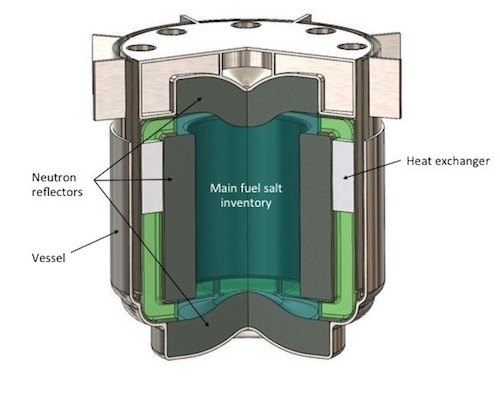 wordpress.com/2020/03/01/a-brief-study-of-molten-salt-reactors/ 3 Mar 20,
Source:
Burning waste or playing with fire? Waste management considerations for non-traditional reactors, Lindsay Krall &Allison MacfarlanePages 326-334 | Published online: 31 Aug 2018 Bulletin of the Atomic Scientists, Volume 74, 2018. Issue 5 at https://www.tandfonline.com/doi/abs/10.1080/00963402.2018.1507791?scroll=top&needAccess=true&journalCode=rbul20
Author information:
Lindsay Krall is a post-doctoral Macarthur fellow at the George Washington University Institute for International Science and Technology Policy. Her research focuses on policies for the back end of the nuclear fuel cycle, particularly as they pertain to radionuclide transport in the environment, systems and organizations for waste storage and disposal, and the long-term behavior of spent fuels from advanced reactors. Allison Macfarlane is Professor of Public Policy and International Affairs at the George Washington University’s Elliott School of International Affairs. She directs the school’s Institute for International Science and Technology Policy Program and is the former chairman of the US Nuclear Regulatory Commission. Macfarlane was a member of the Blue Ribbon Commission on America’s Nuclear Future from 2010-2012.
“Abstract:
Nuclear energy-producing nations are almost universally experiencing delays in the commissioning of the geologic repositories needed for the long-term isolation of spent fuel and other high-level wastes from the human environment. Despite these problems, expert panels have repeatedly determined that geologic disposal is necessary, regardless of whether advanced reactors to support a “closed” nuclear fuel cycle become available. Still, advanced reactor developers are receiving substantial funding on the pretense that extraordinary waste management benefits can be reaped through adoption of these technologies. Here, the authors describe why molten salt reactors and sodium-cooled fast reactors – due to the unusual chemical compositions of their fuels – will actually exacerbate spent fuel storage and disposal issues. Before these reactors are licensed, policymakers must determine the implications of metal- and salt-based fuels vis a vis the Nuclear Waste Policy Act and the Continued Storage Rule.” end quote.Emphasis added for clarity. Mr. O’Brien and Mr. Bernardi need to consider the scientific and technical reality behind the gloss they want to disseminate.
Sign the petition- Fight To Stop A Nuclear Waste Dump In South Australia
 Susan Craig Fight To Stop A Nuclear Waste Dump In South Australia, February 23 NO country so far has succeeded in building a permanent high level nuclear waste dump and no material has yet been invented that can withstand the corrosive action of nuclear materials for more than 100 years, This nuclear waste that “they” want to put in “our” South Australia, is intermediate/high level, 100% lethal and remains radioactive for tens of thousands of years and will be stored above ground in a wheat field less than 300kms from Adelaide as the wind blows. The danger will be with us now and forever and ever and ever and ever. Sign the petition NOW. https://www.markparnell.org.au/no_waste_dump_for_sa https://www.facebook.com/groups/941313402573199/
Greens Senator Hanson-Young calls for Senate Nuclear Waste Inquiry to meet in Whyalla, South Australia
 Nuclear bill referred to inquiry https://www.whyallanewsonline.com.au/story/6653019/nuclear-bill-referred-to-inquiry/?cs=1550&fbclid=IwAR3AvrninZlnLmX8r79QDkQopkBb5hXoWhguw106lCyiisCDdmWMy714MPM, Louis Mayfield 27 Feb 20, Nuclear bill referred to inquiry https://www.whyallanewsonline.com.au/story/6653019/nuclear-bill-referred-to-inquiry/?cs=1550&fbclid=IwAR3AvrninZlnLmX8r79QDkQopkBb5hXoWhguw106lCyiisCDdmWMy714MPM, Louis Mayfield 27 Feb 20,
The formal process for the federal government’s push for a nuclear waste dump in Kimba will be put under the microscope by the Senate Economics Committee, with a Greens Senator calling for hearing in Whyalla. On Thursday the Greens announced they would be referring the government’s legislation for the Nuclear Radioactive Waste Management Facility to a Senate Inquiry for ‘scrutiny of the laws and the process that led to this point’. South Australian Greens Senator Sarah Hanson-Young requested that the committee organise a public hearing in Whyalla and a visit to the federal government’s chosen site for the facility at Napandee.
“I have requested a hearing in Whyalla because it shouldn’t be left to the suits in Canberra to decide, anything less would be offensive to the communities involved,” she said. Senator Hanson-Young also claimed the site selection for the facility had been ‘dodgy from the start’.
“It’s ripped small communities apart and Traditional Owners have vehemently objected to the proposal,” she said. “It’s clear there isn’t broad community support for a nuclear waste dump in Kimba, despite what former Minister Matt Canavan would have everyone believe.”
“Port Augusta, Whyalla, Port Pirie and Port Lincoln and every town living along potential transportation route, should have been consulted and given an opportunity to have their say,” she said. “The Greens aren’t leaving it to the community of Kimba to hold the line on their own. A Senate Inquiry will give the entire proposal the scrutiny it needs.” The committee has resolved to report on the legislation in June, submissions to the committee are now open and will close at the end of March. |
|

International Atomic Energy Agency, run by 5 nuclear weapons nations, backs Fukushima water emptying to the Pacific
UN SC P5 nuclear nations is a fully integrated system inclusive of the Military-Industrial Complex.
An ecosystem that includes weapons of mass destruction, for peace, a leadership group in a state of cultural cognitive dissonance.
Who as a group know gene sheering radionuclides, have an effect on DNA X10 times half-life of any alpha particles out of nuclear reactors.
IAEA backs release of Fukushima water into sea, AsiaTimes, 27 Feb 20,
Most of the radioactive isotopes have been filtered out, but one – tritium, which has long half-life – remains, The world’s nuclear watchdog gave its backing Thursday to Japanese plans to release contaminated water from the damaged Fukushima nuclear plant into the ocean.
Japan has around a million tonnes of contaminated water stored in tanks at the site of the Fukushima Daiichi plant, whose reactors went into meltdown after a huge tsunami in 2011.
A government panel last month recommended the water be released into the ocean or vaporized, but no final decision has been taken, with all solutions deeply unpopular with sections of the Japanese public.
International Atomic Energy Agency (IAEA) director Rafael Grossi told journalists in Tokyo the panel’s recommendations both appeared suitable…….
“Releasing into the ocean is done elsewhere, it’s not something new, there is no scandal here,” Grossi added.
“But what is important is to do it in a way that is not harmful and you need somebody to monitor before, during and after release, to check that everything is okay.”
The radioactive water comes from several different sources – including water used for cooling at the plant, and groundwater and rain that seeps into the plant daily – and is put through an extensive filtration process.
Most of the radioactive isotopes have been removed by the filtration system, but one – tritium, which has a long half-life – remains…….. https://asiatimes.com/2020/02/iaea-backs-release-of-fukushima-water-into-sea/
Climate action? – you simply couldn’t build enough nuclear reactors
 New Scientist 26th Feb 2020, Paul Dorfman, University College London Energy Institute, UK; Tom Burke,E3G; Steve Thomas, University of Greenwich, UK; Jonathan Porritt,
environmental campaigner; and David Lowry, Institute for Resource and
Security Studies. Reporting the decline of nuclear power generation, you
quote Michael Shellenberger’s view that nuclear power is necessary to
prevent climate change (8 February, p 20).
This view is truly dangerous. Climate change poses a number of unique challenges to humanity. One of the most difficult is that the world not only needs to get to a specific place
– a carbon-neutral global energy system – but also must get there by a specific time – the middle of the century. Otherwise the policy fails.
You simply couldn’t build enough nuclear reactors fast enough, even to
replace the existing reactors that will reach the end of their life by
2050, let alone to replace fossil fuels in the existing electricity system
or in the more electricity-intensive global economy we are currently
building. This would be true even if we were willing and able to overcome
all the other unsolved problems that nuclear reactors face. These include
their affordability, accidents, waste management, nuclear weapons
proliferation, the scarcity of talent and system inflexibility.
THE AUSTRALIAN newspaper joins in right-wing media reactions and conspiracy theories surrounding coronavirus
- The Australian, a national newspaper part of Rupert Murdoch’s News Corp., published an anti-trans article on February 9 that compared coronavirus to a “global epidemic” of transgender teens. The outlet has a history of anti-trans reporting and spreading misinformation about trans youth.
A guide to right-wing media reactions and conspiracy theories surrounding coronavirus, MEDIA MATTERS BY KAYLA GOGARTY & COURTNEY HAGLE RESEARCH CONTRIBUTIONS FROM NOOR AL-SIBAI, ALEX KAPLAN, NIKKI MCCANN RAMIREZ & MADELINE PELTZ 02/28/20
-
As the lethal outbreak of coronavirus continues to spread around the world and the U.S. government warns that it will almost certainly also spread within the United States, right-wing media outlets and online accounts are spreading misinformation and conspiracy theories which could have deadly consequences.
The strain of novel coronavirus known as COVID-19 is a respiratory disease that was first detected in the city of Wuhan, China. It swiftly spread and has now been detected in 53 countries, including the United States. So far, the outbreak has led to nearly 3,000 deaths and more than 82,000 cases worldwide, according to The New York Times.
The Centers for Disease Control and Prevention describes the disease behind the current outbreak as part of “a large family of viruses that are common in many different species of animals, including camels, cattle, cats, and bats.” The CDC adds that “rarely, animal coronaviruses can infect people and then spread between people.” Earlier patients in the COVID-19 outbreak appeared to have a link to seafood and animal products, but the virus has since been shown to spread person-to-person.
On January 30, the International Health Regulations Emergency Committee of the World Health Organization declared the outbreak a “public health emergency of international concern,” and on January 31, Health and Human Services Secretary Alex Azar declared a public health emergency in the United States.
As the impact of coronavirus continued to be reported, concerns began to arise that it was driving xenophobic attacks toward people of Asian descent. In New York City, a man assaulted a woman wearing a face mask while calling her a “diseased b****.” On a Los Angeles subway, one man declared that “every disease has ever came from China.” In another incident, a Costco worker in Washington state told an 8-year-old child to “get away” because she believed he may be “from China.” Across the country, there has been an uptick in physical and verbal attacks toward Asian Americans.
In addition to xenophobic sentiments, conspiracy theories and agenda-driven narratives began to arise on the internet and throughout right-wing media, adding more panic and confusion to an already chaotic situation. These conspiracy theories include claims that the Chinese government created coronavirus at a lab in Wuhan; that the United States is using the virus to attack and undermine China from within; and that coronavirus was previously created and patented by former Microsoft CEO Bill Gates.
The virus has also triggered anti-Semitic sentiments, medical and scientific disinformation, and fearmongering from the religious right about the end of the world. In the United States, President Donald Trump and his allies in right-wing media have also absurdly argued that Democrats and the media are politicizing coronavirus for their own gain to make him look bad and cause panic in the stock market, which has plunged in reaction to the potential pandemic. Continue reading
Antarctic ice walls protect the climate
|
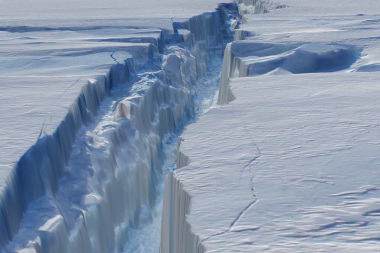
Antarctic ice walls protect the climate, EurekAlert 27 Feb, UNIVERSITY OF GOTHENBURG Inland Antarctic ice contains volumes of water that can raise global sea levels by several metres. A new study published in the journal Nature shows that glacier ice walls are vital for the climate, as they prevent rising ocean temperatures and melting glacier ice.The ocean can store much more heat than the atmosphere. The deep sea around Antarctica stores thermal energy that is the equivalent of heating the air above the continent by 400 degrees.
Now, a Swedish-led international research group has explored the physics behind the ocean currents close to the floating glaciers that surround the Antarctic coast. “Current measurements indicate an increase in melting, particularly near the coast in some parts of Antarctica and Greenland. These increases can likely be linked to the warm, salty ocean currents that circulate on the continental shelf, melting the ice from below,” says Anna Wåhlin, lead author of the study and professor of oceanography at the University of Gothenburg. “What we found here is a crucial feedback process: the ice shelves are their own best protection against warm water intrusions. If the ice thins, more oceanic heat comes in and melts the ice shelf, which becomes even thinner etc. It is worrying, as the ice shelves are already thinning because of global air and ocean warming”, says Céline Heuzé, climate researcher at the Department of Earth Sciences of Gothenburg University. The stability of ice is a mystery Inland Antarctic ice gradually moves towards the ocean. Despite the ice being so important, its stability remains a mystery – as does the answer to what could make it melt faster. Since the glaciers are difficult to access, researchers have been unable to find out much information about the active processes. More knowledge has now been obtained from studying the measurement data collected from instruments that Anna Wåhlin and her researcher colleagues placed in the ocean around the Getz glacier in West Antarctica. The ice’s edge blocks warm seawater……https://www.eurekalert.org/pub_releases/2020-02/uog-aiw022720.php |
|
New Zealand super fund renounces all fossil-fuel investments
On Sunday, Commerce Minister Kris Faafoi announced the country’s ‘KiwiSaver’ accounts would be going green. From next year, default funds will no longer be able include ‘fossil fuel production’ companies in their portfolios.
“This reflects the Government’s commitment to addressing the impacts of climate change and transitioning to a low-emissions economy,” Mr Faafoi said.
“It also makes sense for the funds themselves, given that there is a risk of investing in stranded assets as the world moves to reduce emissions.”
KiwiSaver is New Zealand’s superannuation-style scheme, in which Kiwis are encouraged to put a fraction of their income in a savings deposit, which is then topped by employers and the government…….
Simon Sheikh, chief executive officer of Future Super, Australia’s first fossil fuel-free super fund, said the decision would safeguard the investments of New Zealanders.
“They’ve taken a moral stand but also an important risk stand,” he said.
“The decision is going to protect New Zealand savers, and it’s the same sort of protection that Australians should be looking for.”
With around $A12.2 trillion in funds worldwide that have pledged to sell out of fossil fuel assets, Mr Shiekh said the Australian government should change its own settings to do similarly.
“It makes sense because the vast majority of Australian superannuation savers don’t want to invest in fossil fuels but they unwittingly do,” he said.
“The government has been rather unconcerned … but regulators have all expressed strong concerns about the impact that climate change on Australia’s financial systems.”……“It makes sense because the vast majority of Australian superannuation savers don’t want to invest in fossil fuels but they unwittingly do,” he said.
“The government has been rather unconcerned … but regulators have all expressed strong concerns about the impact that climate change on Australia’s financial systems.”…..https://thenewdaily.com.au/life/science/environment/2020/03/01/nz-super-fund-drops-fossil-fuels/
#ScottyFromMarketing a ‘predatory’ centrist on climate policy with no plans for meaningful emissions reduction
 Wayne Swan Morrison a ‘predatory’ centrist on climate policy with no plans for meaningful emissions reduction, says Swan Wayne Swan Morrison a ‘predatory’ centrist on climate policy with no plans for meaningful emissions reduction, says SwanLabor president says party must work against PM’s PR strategy and get on with ‘solving the bloody problem’, Katharine Murphy Political editor, Sun 1 Mar 2020
Labor federal president Wayne Swan says Morrison does not have a serious climate policy ‘but as you would expect from a marketing guy, [he has] a clearly articulated PR strategy to use climate as a wedge. Labor’s federal president Wayne Swan will accuse Scott Morrison of engaging in “predatory centrism” on climate policy by styling himself as the pragmatist between the extremes of climate emergencies and denialism, when the government has no intention of driving meaningful emissions reduction. In a speech to be delivered on Sunday, Swan will argue Labor will only win the decade-long climate wars if it approaches the challenge with “pragmatic policy and ruthless organisation”. According to speech notes, Swan will say Labor needs to articulate a roadmap for the domestic coal powered industry “which manages its decline”……. https://www.theguardian.com/world/2020/mar/01/morrison-a-predatory-centrist-on-climate-policy-with-no-plans-for-meaningful-emissions-reduction-says-swan |
|
Global heating, rising seas, and the plight of Torres Strait Islanders
It’s our right to be here’: the Torres Strait Islanders fighting to save their homes from a rising sea
An entire way of life is under threat in the Torres Strait, where locals have taken their case to the United Nations, Guardian Jack Banister, 1 Mar 20
Kabay Tamu slows his dusty white ute to walking speed on the dirt road that runs along the south-western shoreline of Warraber, a tiny coral cay in the Torres Strait that is home to about 250 people.
“This was the best spot for a day out,” 28-year-old Tamu says, recalling his childhood.
Most of the beach where Tamu used to play is gone, along with several enormous wongai trees that were a barrier of sorts, protecting the dirt road and the nearby dam, which supplies the island’s drinking water, from the sea.
Warraber is just 1.4km long, and half as wide, but shrinking fast. Some data suggests that sea levels in the Torres Strait could be rising at twice the global rate.
Now, Islanders dump their green waste to hold back the rising sea. The Intergovernmental Panel on Climate Change (IPCC) estimates that by 2100 tides will rise 30–60cm with immediate cuts to carbon emissions, and 61-110cm without…….
The Billy family also live on nearby Poruma island, where Danny spent part of his childhood. Just a 15-minute flight away, Poruma is smaller and thinner. On the western shore, a road and buildings are threatened, and 250 coconut trees – a source of food, shelter and leaves used in traditional ceremonies – have already been washed away.
Local man Phillemon Mosby feels that loss keenly. The picturesque plantation should be a place to share with children and grandchildren, who would ordinarily take over the nurturing of the site.
“That experience was taken away because of climate change, because of the rising sea levels. We’ve seen areas where we used to go fishing that are no longer there. We’ve seen rocks where people used to go diving that are covered.”…….
Tamu, Billy, and Uncle Frank’s cousin, Nazareth Fauid, are among the eight Torres Strait Islanders who lodged a complaint last May with the United Nations human rights committee against the Australian government, alleging that its failure to reduce emissions, or pursue proper adaptation measures across the region impedes their human rights, to culture and life.
Sophie Marjanac, a lawyer with environmental non-profit ClientEarth, is representing the group, who want the government to meet its targets under the Paris Agreement, to reach net zero emissions by 2050 and to phase out thermal coal.
In December, the federal government matched an earlier commitment of $20 million from the Queensland governmentto build new seawalls. But there is widespread scepticism among Islanders about when the new walls will be constructed.
Other islands including Boigu, Masig, and Iama need new seawalls. It is unclear which islands will be prioritised, and if the new funding will cover them all.
Tamu is quick to point out that “sea walls are only to buy us time” – the best fix is emissions reduction.
“The thing that got me was [the federal government] didn’t announce [the new funding] as seawalls to combat climate change. They said it was ‘an infrastructure development in the community’. They’re still trying to cover up climate change and the rising sea levels here.”
Tamu gained international headlines when he asked prime minister Scott Morrison to visit Warraber during the UN climate summit in New York last September. He maintains that the damage visible on Warraber and other islands would shock them into action on climate and coal…….
The invitation was rejected via email in November, and Tamu says that the government is still “hearing, but not listening” when it comes to nationwide pleas for climate action. ……
While the UN complaint won’t be settled until 2021, Danny Billy says islanders won’t stop making noise until Australia finally offers global leadership on climate change…https://www.theguardian.com/australia-news/2020/mar/01/its-our-right-to-be-here-the-torres-strait-islanders-fighting-to-save-their-homes-from-a-rising-sea
Darebin Council, Melbourne – a world first on Climate Emergency
 This Melbourne council declared the world’s first climate emergency – now 28 countries are on board, Local and national governments in 28 countries have declared climate emergencies since Melbourne’s Darebin Council in 2016. Many now hope after this summer’s bushfires, Australia may declare a national emergency. SBS, BY EVAN YOUNG 1 Mar 20, On 5 December 2016, Melbourne’s Darebin Council made history.
Councillor Trent McCarthy put forward a motion that the council vote on declaring a state of climate emergency.
Though it would be merely symbolic, it was thought a declaration could still have practical use.
“Before the vote, residents were very much telling us climate change mattered more than anything else to them,” Darebin Mayor Susan Rennie told SBS News……..
Since 2016, Ms Rennie said Darebin Council has begun work on a number of green initiatives, including programs to subsidise solar panels for residents and businesses, working to make all council operations carbon-neutral, introducing a food waste recycling program and resurfacing roads with recycled material.
Making the declaration in 2016 “set the council on a path” to develop a climate plan, she said.
“Staff in all different parts of the organisation understand that looking at their work through the lens of a climate emergency is critical and it’s a core part of their jobs.”
“Our community expects action … so we also invite them to be much more vocal in what responses they want to see.”……
Where have climate emergencies been declared?
Ninety-four Australian jurisdictions have declared a climate emergency, according to Climate Emergency Declaration and Mobilisation in Action (CEDMA).
The ACT parliament declared a climate emergency in May 2019, becoming the first Australian state or territory to do so, while South Australia’s Upper House followed suit four months later.
More than 800 million citizens across 28 countries are estimated to live in jurisdictions that have declared climate emergencies, according to CEDMA.
Britain, France, Portugal and Argentina are among the national governments to make climate emergency declarations.
Pope Francis also made a declaration in June 2019, while in November, more than 11,000 scientists around the world signed a scientific paper stating that the planet was facing a climate emergency, “clearly and unequivocally”.
Could Australia declare a national climate emergency?
In October 2019, an e-petition calling on the federal government to declare a national climate emergency reached a record-breaking 404,538 signatures.
It received more than three times the number of signatures on a petition which held the previous record, calling for the removal of GST on menstrual products.
The same month, Greens MP Adam Bandt brought a vote to the House of Representatives on whether to declare a national climate emergency. His motion was defeated 72-65, with Emissions Reduction Minister Angus Taylor labelling it a “grand symbolic gesture”…….HTTPS://WWW.SBS.COM.AU/NEWS/THIS-MELBOURNE-COUNCIL-DECLARED-THE-WORLD-S-FIRST-CLIMATE-EMERGENCY-NOW-28-COUNTRIES-ARE-ON-BOARD
Radiation oncology still neglects stray radiation
 Facing up to friendly fire: why radiation oncology still neglects stray radiation Physics World, 28 Feb 2020 Whole-body exposure to stray radiation can now be calculated accurately and efficiently for patients undergoing radiotherapy. Researchers in the US and Germany modified a treatment planning system (TPS) – the software used to predict patient dose distribution – to include unwanted doses from scattered and leaked radiation. The additional calculation, which adds an average of 7% to the computation time required for a standard treatment plan, could lead to better radiation treatments that avoid radiogenic secondary cancers and other side effects later in life. This is especially important for survivors of childhood cancer (Med. Phys. 10.1002/mp.14018)………
as post-treatment lifespans grow longer, late side effects of radiotherapy – such as damage to the heart, fertility issues and secondary cancers – are becoming increasingly prevalent. These side effects can be caused by radiation that is delivered to non-target tissue outside of the main therapeutic beam, much of which is not modelled by clinical TPSs.
To address this shortcoming and model the stray-radiation dose for the whole body, Lydia Wilson at Louisiana State University (LSU) and colleagues (also from LMU Munich, PTB and BsF) set out to modify the research TPS CERR (Computational Environment for Radiotherapy Research)…………
“The biggest challenge to commercialization has been the continuation of a historical focus on short-term outcomes,” says Newhauser. “As disease-specific survival rates gradually continue to increase, patient, clinicians and vendors will eventually become more interested in treatment-planning features that improve long-term outcomes. We could begin to see basic capabilities appear in commercial systems in two to three years.” https://physicsworld.com/a/facing-up-to-friendly-fire-why-radiation-oncology-still-neglects-stray-radiation/
Part 1 of A Study of the “Report of the inquiry into the prerequisites for nuclear energy in Australia” Australian Parliamentary Committee 2020. — The Industry Push to Force Nuclear Power in Australia

The full report of the Full Report of the House of Representatives Standing Committee on the Environment and Energy is available here: https://www.aph.gov.au/-/media/02_Parliamentary_Business/24_Committees/243_Reps_Committees/EnvironmentEnergy/Nuclear_energy/Full_Report.pdf?la=en&hash=2826513C078551487B8265502776DAD5D23EB71D The recommendations made to Government by the Committee on the Environment and Energy include : Recommendation 1 (b) which states: “Adopting a strategic approach to the possibility of entering the nuclear energy […]
March 1 Energy News — geoharvey

Opinion: ¶ “Five reasons why Canada’s ‘shutdown’ is a big deal” • A conflict first sparked over indigenous opposition to a natural gas pipeline project led to rail blockades and protests that have crippled rail lines and disrupted the flow of Canada’s economy. Now it has evolved to include broader complex issues like indigenous governance […]
Releasing radioactive water would further damage Fukushima’s reputation — Fukushima 311 Watchdogs

Fukushima’s fishing industry was one of the prefecture’s hardest-hit sectors following the March 2011 nuclear disaster. Feb 25, 2020 Releasing the treated radioactive water stored at the Fukushima No.1 nuclear power plant risks further damage to the disaster-hit prefecture’s reputation and negates the nine-year effort to dispel negative perceptions about local agricultural produce, fisheries and […]
via Releasing radioactive water would further damage Fukushima’s reputation — Fukushima 311 Watchdogs
1 This month.
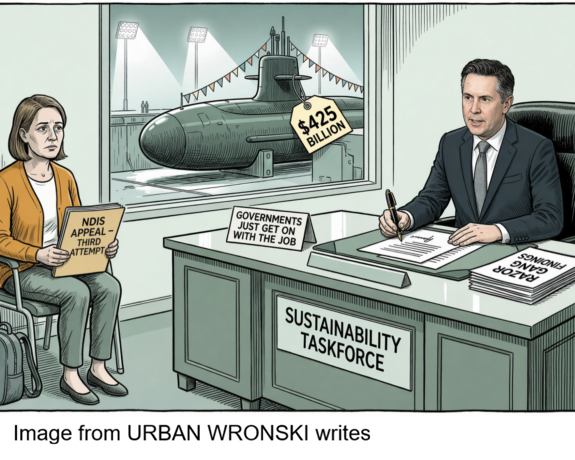
PETITION – To: Prime Minister Anthony Albanese and the Australian Labor Government
Chernobyl: The Lost Tapes – A good documentary on Chernobyl on SBS available On Demand for the next 3 weeks– https://www.sbs.com.au/ondemand/tv-program/chernobyl-the-lost-tapes/235274195556

19 May – Webinar- Webinar: No Nuclear Weapons in Australia
Start: 2026-05-19 18:00:00 UTC Canberra, Melbourne, Sydney (GMT+10:00)
End: 2026-05-19 19:30:00 UTC Canberra, Melbourne, Sydney (GMT+10:00)
20 May – Webinar – The dangerous world of AUKUS, US, military occupation and suppression of dissent

National Webinar, 20th May, 2026, 6.30pm AEST. Confronting laws restricting/suppressing protest speech and action
Speakers: Former Sen. Rex Patrick, Lawyer Nick Hanna ,Arthur Rorris ,Jorgen Doyle, Sen David Shoebbridge,
Facilitator Kelley Tranter.

of the week – Australians for War Powers Reform (AWPR)
To see nuclear-related stories in greater depth and intensity
 Antinuclear