Nuclear waste could ruin Kimba, as asbestos ruined Wittenoom
Paul Waldon Fight To Stop A Nuclear Waste Dump In South Australia,17 Jan 2020
Is Nuclear the new Asbestos?
The naturally occurring mineral Asbestos was touted as miracle product used in clothing, building, toothpaste, eating utensils, just about anything and everything with the ignorance that fueled its demand. However the knowledge of its well known dangers were masked by the industry that prospered from its mining.
The story of Benjamin Franklin and his asbestos coin purse so money would not burn a hole in his pocket is well told, yet the taxpayers $31 million as a DIIS sweetener gifted to a community willing to embrace radioactive waste has at this moment started and will continue to erode the social structure, family ties, property values, tourism, the once good name of the town of Kimba, leaving the cancerous tumor that is a forever nuclear stigma.
No purse is worth embracing radioactive waste https://www.facebook.com/groups/344452605899556/permalink/1200278250316983/

Scott Morrison probably intransigent on climate policy
 If the bushfires won’t force climate policy change, we need to circumvent Scott Morrison. Guardian, Lenore Taylor The cabal of Coalition denialists calling the shots are still impervious to facts. But it’s not yet time to despair @lenoretaylor, Fri 17 Jan 2020 It’s time to face a dreadful truth. If this bushfire crisis, this nation-wide trauma, can’t loosen the denialists’ grip on Coalition climate policy, then maybe nothing will.
That would mean everyone sifting through Scott Morrison’s verbiage for signs that he might really be intending to change direction is searching in vain, because he’s just trying to talk himself out of political trouble.
It would mean everyone patiently pointing out that the prime minister could quite easily “evolve” his current policies into something that actually reduced Australia’s greenhouse emissions could save their breath, because that isn’t the kind of evolution he is considering.
And it would mean there’s no point reprising the facts, that Australia’s emissions are flatlining, not falling, that we could seize an economic advantage in a low-carbon world and at the same time help the globe avoid the all too obvious costs of inaction. The Coalition cabal who apparently still call the shots thinks climate science is “voodoo”. They’re impervious to facts. They are already threatening, via anonymous quotes to the Australian, to “blow the place up”. Again. Just like they’ve been blowing up national climate action for more than a decade.
And as this week’s Guardian Essential poll showed, despite the widespread sense that the fires are a tipping point, despite global outrage at the self-defeating stupidity of our policies, despite the world’s largest fund manager ditching thermal coal, despite the wave of grief and anger from around the world – even from James Murdoch – it’s still not clear that Australian public opinion will force this government to change.
Sure, Morrison’s mishandling of this crisis has cost him. His overall approval ratings have dived but his numbers have held fairly steady in his base. The strategists – who always pay more heed to those numbers than to other benchmarks, like, say, a country in ashes – no doubt believe that, with enough confusing obfuscation about “meeting and beating” targets, enough revising of the figures, enough serious practical efforts to help burnt-out communities, and just enough rhetoric conceding the reality of global heating, all will be well in time, without promising to do anything about it. All will be well for the poll numbers that is. Not for the nation.
This is not, repeat not, an argument for abandoning the arguments in favour of climate action. It is not a counsel to cop out in despair. …………
Maybe, under the current political pressure, something will give. But we’ve been fooled before and there’s no time to be fooled again. So that means it’s time to think of ways around the federal Coalition’s intransigence, because those deniers will never be swayed, and we can’t allow them to dictate our future. https://www.theguardian.com/australia-news/2020/jan/17/if-the-bushfires-wont-force-climate-policy-change-we-need-to-circumvent-scott-morrison
Australia has a carbon industrial complex uniting government and greenhouse emitters
Fifty seven million ways the carbon industrial complex infects Australian politics
A closer look at how fossil fuel companies influence policy making shows that Australia has a carbon industrial complex uniting government and greenhouse emitters. BERNARD KEANE. JAN 14, 2020
Fossil fuel companies and climate denialists have pumped at least $57 million into Australian politics in the last twenty years using our lax political donation laws, and the figure is likely significantly higher…. (subscribers only) https://www.crikey.com.au/2020/01/14/how-a-carbon-industrial-complex-shapes-australian-politics/
January 17 Energy News — geoharvey

Science and Technology: ¶ “Giant Jet Engines Aim To Make Our Flying Greener” • The aerospace industry is under pressure to reduce its environmental impact. Aircraft are getting more efficient, but airline traffic is growing even faster. Rolls-Royce has a solution, which involves building a much bigger, much more efficient jet engine. It is made […]
Victoria’s power system is proving more resilient than people thought — RenewEconomy

The first half of summer suggests that the Victorian grid is already much more resilient that most commentators claim or foresaw. The post Victoria’s power system is proving more resilient than people thought appeared first on RenewEconomy.
via Victoria’s power system is proving more resilient than people thought — RenewEconomy
Australia wind and solar investment plunges as Coalition turns blind eye to transition — RenewEconomy

Investment in large scale renewables in Australia slumped 60% in 2019 as Coalition turned a blind eye to needs of the clean energy transition. The post Australia wind and solar investment plunges as Coalition turns blind eye to transition appeared first on RenewEconomy.
Horizon Power looks to renewable hydrogen to power remote WA town of Denham — RenewEconomy

Remote coastal community of Denham may become host to one of Australia’s first hydrogen storage projects, as Horizon Power overhauls its electricity system. The post Horizon Power looks to renewable hydrogen to power remote WA town of Denham appeared first on RenewEconomy.
via Horizon Power looks to renewable hydrogen to power remote WA town of Denham — RenewEconomy
How much does smoke haze affect rooftop solar production? — RenewEconomy

Solar monitoring company Solar Analytics has found that rooftop PV systems in Sydney and Canberra saw PV output plummet by 15 – 45% on heavy smoke haze days. The post How much does smoke haze affect rooftop solar production? appeared first on RenewEconomy.
via How much does smoke haze affect rooftop solar production? — RenewEconomy
NSW flags imminent release of EV strategy, as feds ignore electric in auto transition report — RenewEconomy

New plan to encourage NSW drivers to adopt electric vehicles to be released soon by the NSW Liberal government, while federal Coalition ignores EVs in new auto industry report. The post NSW flags imminent release of EV strategy, as feds ignore electric in auto transition report appeared first on RenewEconomy.
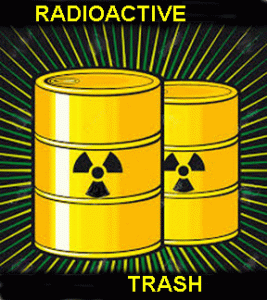
It would be wise to cancel the plan for dumping Lucas Heights’ nuclear waste in South Australia
 Paul Waldon Fight To Stop A Nuclear Waste Dump In South Australia, 16 Jan 2020
Both dichotomies do agree that radioactive waste as Harry D. puts it “needs to be placed in a managed facility that offers the best centralized logistical location,” and that location is ANSTO, Lucas Heights.
Look at a map and you will see Lucas Heights maybe the most central location amounting to the least average travel distance of such waste per volume and it has security, it also has waste on site as long as the reactor keeps pumping out waste and it’s only half full.
Logistically it would have save the taxpayers $55mil over recent years with the cancellation of the program to shift such waste, but that 55 mil may have been just but the tip of the iceberg of what it has cost communities across South Australia. https://www.facebook.com/groups/941313402573199/
Much of Australia might simply become too hot and dry for human habitation
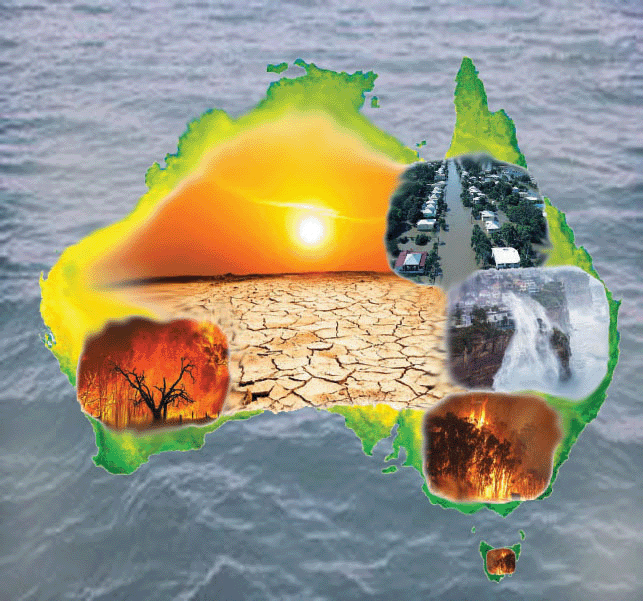 Australians ‘may become climate refugees’ as global temperatures soar: US expert, https://www.sbs.com.au/news/australians-may-become-climate-refugees-as-global-temperatures-soar-us-expert Australians ‘may become climate refugees’ as global temperatures soar: US expert, https://www.sbs.com.au/news/australians-may-become-climate-refugees-as-global-temperatures-soar-us-expertA visiting US climatologist says it’s “conceivable that much of Australia simply becomes too hot and dry for human habitation”. As global temperatures soar, Australia could become so hot and dry that the country’s residents could become climate refugees, US climatologist and geophysicist Michael Mann says. Australia is in the midst of one of its worst fire seasons on record, with bushfires burning since September and claiming nearly 30 lives, killing more than a billion animals and razing forests and farmland the size of Bulgaria. Some fires were so monstrous that they created their own weather pattern causing dry lightning and fire tornadoes as a three-year drought left woods tinder-dry. “It is conceivable that much of Australia simply becomes too hot and dry for human habitation,” Dr Mann, who is director of the Earth System Science Center at Pennsylvania State University, told Reuters. “In that case, yes, unfortunately, we could well see Australians join the ranks of the world’s climate refugees.” Climate refugees, or environmental migrants, are people forced to abandon their homes due to change in climate patterns or extreme weather events. Dr Mann, the recipient of last year’s Tyler Prize for Environmental Achievement, is on a sabbatical in Australia where he is studying climate change. The co-founder of the award-winning science website RealClimate.org said the brown skies over Sydney in recent days were a result of human-caused climate change led by record heat and unprecedented drought. The remarks resonate with his peers who published a review of 57 scientific papers suggesting clear links. Climate change has led to an increase in the frequency and severity of what scientists call “fire weather” – periods with a high fire risk due to some combination of higher temperatures, low humidity, low rainfall and strong winds, the review found. Prime Minister Scott Morrison has repeatedly said his government would “meet and beat” a 26 per cent global emissions reduction target agreed in Paris, albeit with a caveat that such goals should not come at the cost of jobs and the economy. Dr Mann, the author of four books including The Madhouse Effect, said Australia could still “easily achieve” the target by shifting towards renewable energy. “It’s possible to grow the economy, create jobs, and preserve the environment at the same time. These are things that all Australians could embrace,” he said. “They just need a government that’s willing to act on their behalf rather than on behalf of a handful of coal barons.”
|
|
The prosecution of Julian Assange – a travesty of justice
|
The international witch-hunt of Julian Assange, World Socialist Website, Eric London and Thomas Scripps, 14 January 2020 The prosecution of WikiLeaks founder Julian Assange at London’s Westminster Magistrates Court is a travesty of justice that will forever stain the governments of the United States, the United Kingdom, Australia, Sweden and Ecuador, as well as all the individuals involved.Appearing alongside Assange in court Monday morning, Assange’s attorneys revealed that they had been given only two hours to meet with their client at Belmarsh prison to review what lawyer Gareth Peirce called “volumes” worth of evidence.
Expressing the practiced cynicism of British class justice, District Judge Vanessa Baraitser said this was “not an unreasonable position,” citing a lack of space in the prison interview room. With the bang of her gavel, Baraitser sent Assange back to his dungeon at Belmarsh, where he awaits his February extradition hearing under conditions UN Rapporteur Nils Meltzer has called “torture.” At this stage in the near decade-long international witch-hunt of Assange, nobody should be surprised by such shameless lawlessness on the part of the world’s most powerful governments. Ever since Swedish, British and American prosecutors conspired in 2010 to issue a warrant for Assange’s arrest in connection with an investigation into bogus sexual misconduct allegations, these “advanced democracies” have trampled on their own laws and traditions, subjecting the journalist to a pseudo-legal process that would have been deemed unfair even by the standards of the Middle Ages. Monday’s mockery of justice is an escalation of the attack on Assange’s right to counsel. It takes place after the Spanish newspaper El País published a detailed account of how a security firm, UC Global, secretly spied on Assange’s privileged discussions with his lawyers and fed the illegally obtained surveillance to the CIA. UC Global also shared footage from cameras it installed throughout the Ecuadorian Embassy in London, where Assange was forced to seek refuge from 2012 to 2019 to avoid US extradition. El País’ reporting showed that UC Global recorded every word Assange spoke and live-streamed these conversations to the CIA. o 2019 to avoid US extradition. El País’ reporting showed that UC Global recorded every word Assange spoke and live-streamed these conversations to the CIA. Despite the support of a criminally compliant media, it is becoming increasingly difficult for the US and British governments to downplay the profoundly anti-democratic precedents they intend to set through the Assange prosecution. In an opinion article published Monday in the Hill, titled “Will alleged CIA misbehavior set Julian Assange free?” American attorney James Goodale wrote a scathing attack on the CIA’s spying on Assange’s privileged attorney-client communications. Goodale is among the most prominent and well respected attorneys in the US, best known for representing the New York Times when the newspaper was sued by the Nixon administration for publishing the Pentagon Papers in 1971. The Pentagon Papers were leaked by RAND Corporation analyst Daniel Ellsberg, who has also called for the release of Assange and whistleblower Chelsea Manning. The Pentagon Papers revealed how the US government for years lied to the public in expanding the Vietnam War, which led to the deaths of 55,000 US soldiers and 3 million Vietnamese people. Their publication triggered an explosion of public anger and fueled anti-war protests. Goodale wrote: “Can anything be more offensive to a ‘sense of justice’ than an unlimited surveillance, particularly of lawyer-client conversations, livestreamed to the opposing party in a criminal case? The alleged streaming unmasked the strategy of Assange’s lawyers, giving the government an advantage that is impossible to remove. Short of dismissing Assange’s indictment with prejudice, the government will always have an advantage that can never be matched by the defense.” Goodale explained that “the Daniel Ellsberg case may be instructive.” Ellsberg, like Assange, was prosecuted under the Espionage Act for leaking documents to the Times and the Washington Post. During the trial, Nixon’s “plumbers” broke into the office of Ellsberg’s psychiatrist and wiretapped his phone. In that case, Judge William Matthew Byrne ruled that the surveillance had “incurably infected the prosecution” and dismissed the charges, setting Ellsberg free. Goodale wrote that “for similar reasons, the case against Assange should be dismissed.”……https://www.wsws.org/en/articles/2020/01/14/pers-j14.html |
|
|
Environmentalists must stress issues of employment in renewables, and the need for energy conservation
Dennis Matthews, 16 Jan 2020, How should environmentalists deal with the results of the ongoing extremely destructive wildfires? Some points that may help them to decide:
First, in my opinion, the last Federal election was not won but was lost by the ALP and the Australian Greens, because they failed to counter the Morrison  message that stopping coal mining would cost jobs. It would have been so easy to point out that investing in the alternatives to coal would generate jobs.
Second, there has been no attempt to counter environmentally and socially destructive economic growth. The “growth is obviously good” ideology is supported by the two major parties and is not seriously challenged by the Greens.
Third, evidence for human global climate change has been gathering speed for 4 decades. The effects have such momentum that as well as needing a drastic reduction in emissions we now also need urgent action on ways to deal with the effects of more destructive weather. Australians are in the top per capita emitters in the world, if we don’t show leadership then we are in no position to criticise others – the most common target for criticism is China which has about half the per capita emissions of Australia.
 Fourth, in all the discussions and suggestions about the supply and use of energy there is negligible content about using less energy. The debate is almost 100% about increasing energy supply and almost nothing about reducing energy demand. The main reason for this imbalance appears to be that increasing supply is equated with economic growth whilst decreasing the energy demand is equated with the opposite.
Australia’s fire-driven storms are pumping smoke into the stratosphere
Blazes across the country in the past few weeks have been so intense they have generated their own weather. They create rising air mixed with ash and smoke that results in thunderstorm clouds above the fires called pyrocumulonimbus (pyroCbs).
Some of these are strong enough and rise high enough to have channelled smoke into the stratosphere, a plume of which has crossed the Atlantic Ocean in an eastward direction. NASA says this plume has now made a full circuit around the Earth. There were at least 20 pyroCbs between 28 and 31 December, and more on 4 January, some of which injected smoke into the stratosphere.
The scale of the smoke in the stratosphere has now been calculated by David Peterson at the US Naval Research Laboratory, who is presenting his preliminary findings to the American Meteorological Society at a meeting in Boston later today.
“It’s very likely on a volcanic scale,” he says. “The big thing here is really the impact that this is having on the stratosphere.” Although not of the scale of the 1991 eruption of Mount Pinatubo, the largest in modern history, the effect is similar to a more moderate eruption, Peterson says.
In 2017, Peterson found that Canadian wildfires put as much smoke as a volcano into the stratosphere. He is now working to apply the same technique to the Australian fires and thunderstorms. “At this point I can tell you that this event is one of the largest, it’s very near the top. I can’t say for sure if it’s the biggest,” he says, in terms of the amount of smoke injected into the stratosphere.
While it is well known that a volcanic eruption can put enough aerosols into the atmosphere to have a cooling effect, the different chemistry of pyroCbs means the impacts of the fires on global temperatures aren’t yet entirely clear.
They may have a warming or cooling effect, and it isn’t known how long the smoke will persist at heights of between around 10 and 50 kilometres high, which is roughly where the stratosphere starts and finishes. Peterson says the biggest question is what role proyCbs are playing in the climate system. Some of the smoke plumes are also getting high enough to affect the ozone layer.
We may have answers to some of these unknowns soon though, thanks to NASA flying a plane earlier this year through the upper level of a pyroCb generated by US wildfires. “It wasn’t as massive as these Australia plumes but fortunately at an altitude the aircraft could get to it,” says Peterson. The resulting direct observations of the chemistry will, along with satellite measurements, help unlock the answers.
Alan Robock at Rutgers University in New Jersey says any potential cooling effect from the bushfire smoke is unlikely to be huge at a global level, but could cause cooling of several degrees Celsius at a local level. If the Australian pyroCbs produce twice as much smoke as those from Canada in 2017, “it still would not be a large or long-lasting impact on climate,” he says.
However, the smoke can persist in the stratosphere for half a year or longer, as at such heights it can be heated by the sun and lofted even further up, prolonging its lifetime.
“This is the same process we have modelled in our studies of the climatic consequences of nuclear war in which much more smoke from burning cities and industrial areas would be lofted into the stratosphere and last for years,” says Robock. As such, analysis of the smoke from the bushfires could help improve simulations of the impact of nuclear Armageddon.
Our knowledge of pyroCbs is at an early stage. These thunderstorms and the smoke they put into the stratosphere have only been detectable via satellite instruments since the early 2000s, and previously were thought to be the result of volcanic eruptions, until analysis traced them back to wildfires.
World Economic Forum focusses on climate change, Australia snubs the Forum
|
Australia snubs Davos session on Australian fires https://www.politico.eu/article/australia-snubs-davos-session-australian-fires/
A new report, meanwhile, found that the Top 5 global risks are all climate-related. By RYAN HEATH 1/15/20 That marks “the first time in the survey’s history that one category has occupied all five of the top spots,” according to Børge Brende, the WEF’s president.
The WEF surveyed 1,047 members of its networks — 44 percent were from climate-conscious Europe — and asked them to rate 30 possible risks. The organization is so alarmed at governments and companies failing to heed its climate warnings that it decided to invite climate activist Greta Thunberg back to its stage next week, and has begun sharing her slap-downs of global leaders through its official channels. While the WEF survey was concluded October 22, before the worst of the Australian fire season, those fires have brought the three biggest overall risks identified by the WEF to the world’s attention: extreme weather, climate policy failure and biodiversity loss. The fires have decimated an area twice the size of Belgium and killed millions of animals, putting Australia in the Davos firing line next week. There’s only one problem: Canberra isn’t playing ball. The WEF session on the Australian fires doesn’t include any Australian speakers.
|
|
|

1 This month.


PETITION – To: Prime Minister Anthony Albanese and the Australian Labor Government
Chernobyl: The Lost Tapes – A good documentary on Chernobyl on SBS available On Demand for the next 3 weeks– https://www.sbs.com.au/ondemand/tv-program/chernobyl-the-lost-tapes/235274195556
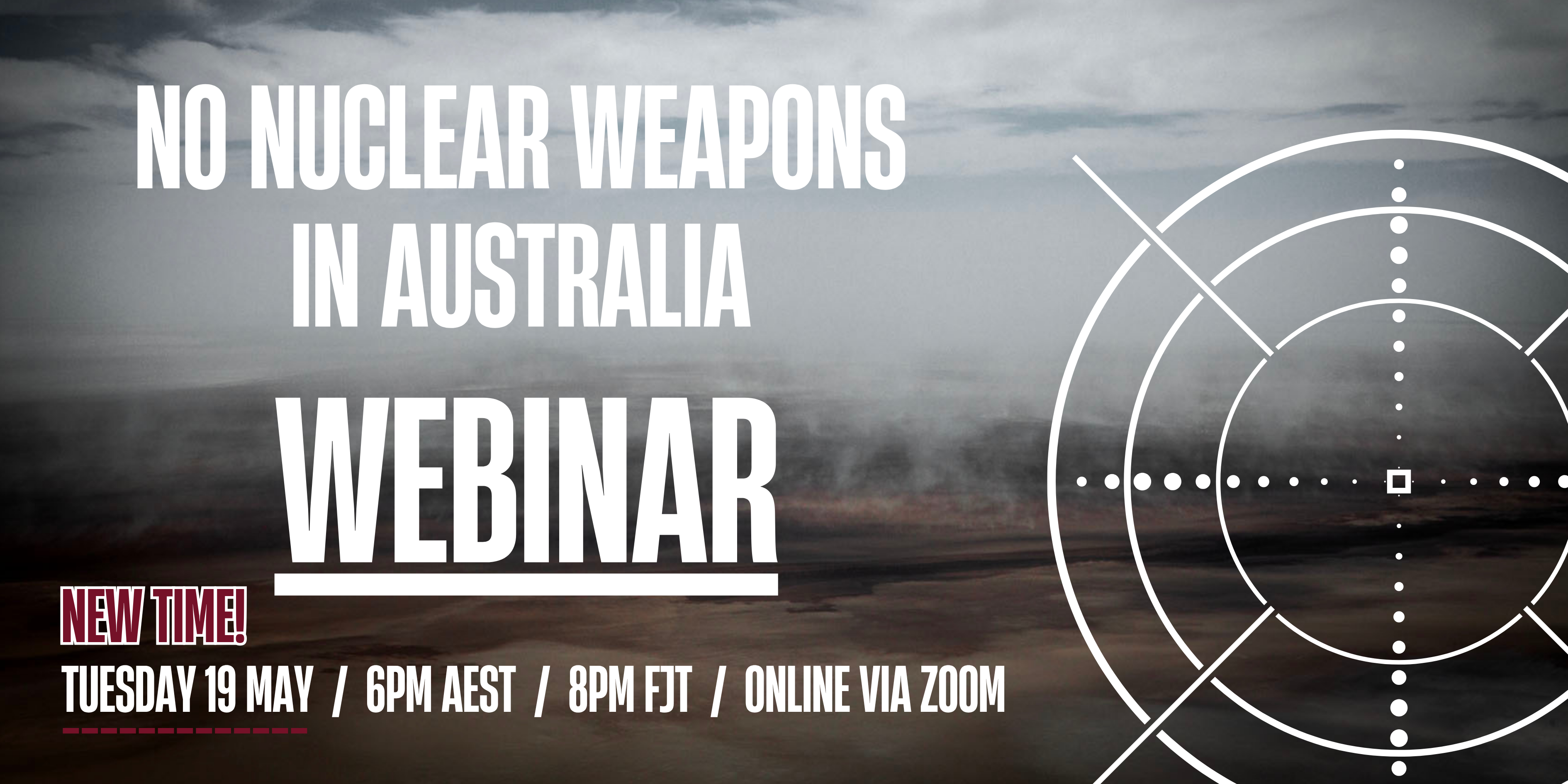
19 May – Webinar- Webinar: No Nuclear Weapons in Australia
Start: 2026-05-19 18:00:00 UTC Canberra, Melbourne, Sydney (GMT+10:00)
End: 2026-05-19 19:30:00 UTC Canberra, Melbourne, Sydney (GMT+10:00)
20 May – Webinar – The dangerous world of AUKUS, US, military occupation and suppression of dissent

National Webinar, 20th May, 2026, 6.30pm AEST. Confronting laws restricting/suppressing protest speech and action
Speakers: Former Sen. Rex Patrick, Lawyer Nick Hanna ,Arthur Rorris ,Jorgen Doyle, Sen David Shoebbridge,
Facilitator Kelley Tranter.

of the week – Australians for War Powers Reform (AWPR)
To see nuclear-related stories in greater depth and intensity
 Antinuclear