Nuclear power in terminal decline – cannot tackle climate change
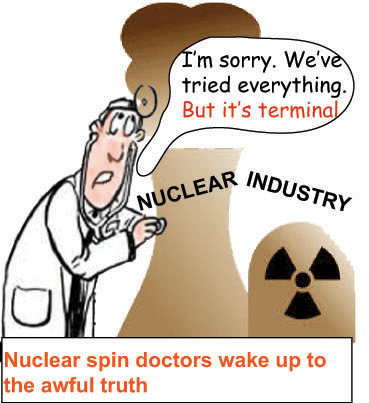 Nuclear Power ‘Cannot Rival Renewable Energy’, https://www.ecowatch.com/nuclear-power-cannot-rival-renewable-energy-2644813982.html?rebelltitem=4#rebelltitem4 By Paul Brown, 15 Jan 2020,
Nuclear power is in terminal decline worldwide and will never make a serious contribution to tackling climate change, a group of energy experts argues.
Meeting recently in London at Chatham House, the UK’s Royal Institution of International Affairs, they agreed that despite continued enthusiasm from the industry, and from some politicians, the number of nuclear power stations under construction worldwide would not be enough to replace those closing down.
The industry was disappearing, they concluded, while the wind and solar sectors were powering ahead.
The group met to discuss the updated World Nuclear Industry Status Report 2019, which concluded that money spent on building and running nuclear power stations was diverting cash away from much better ways of tackling climate change.
Money used to improve energy efficiency saved four times as much carbon as that spent on nuclear power; wind saved three times as much, and solar double.
Amory Lovins, co-founder of the Rocky Mountain Institute, told the meeting: “The fact is that nuclear power is in slow motion commercial collapse around the world. The idea that a new generation of small modular reactors would be built to replace them is not going to happen; it is just a distraction away from a climate solution.”
On nuclear and climate change, the status report says that new nuclear plants take from five to 17 years longer to build than utility-scale solar or on-shore wind power.
“Stabilising the climate is urgent, nuclear power is slow. It meets no technical or operational need that these low-carbon competitors cannot meet better, cheaper, and faster,” the report says.
There was considerable concern at the meeting about the possible danger to nuclear plants caused by climate change. Mycle Schneider, the report’s lead author, said the reason why reactors were built near or on coasts or close to large rivers or estuaries was because they needed large quantities of water to operate. This made them very vulnerable to both sea and coastal flooding, and particularly to future sea level rise.
He was also concerned about the integrity of spent fuel storage ponds that needed a constant electricity supply to prevent the fuel overheating. For example, large wildfires posed a risk to electricity supplies to nuclear plants that were often in isolated locations.
Cost Pressure
Loss of coolant because of power cuts could also be a serious risk as climate change worsened over the 60-year planned lifetime of a reactor. However, he did not believe that even the reactors currently under construction would ever be operated for that long for commercial reasons.
“The fact is that the electricity from new reactors is going to be at least three times more expensive than that from renewables and this will alarm consumers. Governments will be under pressure to prevent consumers’ bills being far higher than they need to be.
“I cannot see even the newest reactors lasting more than a decade or so in a competitive market at the prices they will have to charge. Nuclear power will become a stranded asset,” Schneider said.
Allan Jones, chairman of the International Energy Advisory Council, said one of the myths peddled was that nuclear was needed for “baseload” power because renewables were available only intermittently.
Since a number of countries now produced more than 50% of their power from renewables, and others even 100% (or very close) while not experiencing power cuts, this showed the claim was untrue.
In his opinion, having large inflexible nuclear stations that could not be switched off was a serious handicap in a modern grid system where renewables could at times produce all the energy needed at much lower cost.
Amory Lovins said the UK’s approach appeared to be dominated by “nuclear ideology.” It was driven by settled policy and beliefs, and facts had no connection to reality. “Nuclear is a waste of time and money in the climate fight,” he concluded.
New review confirms that climate change increases the risk of wildfires
|
Climate change increases the risk of wildfires confirms new review https://www.sciencedaily.com/releases/2020/01/200114074046.htm, January 14, 2020, Source: University of East Anglia
|
|
|
Australia will not hit its 2020 emissions reduction target till 2030 — RenewEconomy

Analysis shows Australia won’t achieve its 2020 target to reduce greenhouse emissions by 5 per cent until 2030. The post Australia will not hit its 2020 emissions reduction target till 2030 appeared first on RenewEconomy.
via Australia will not hit its 2020 emissions reduction target till 2030 — RenewEconomy
James Murdoch slams family’s media empire for serving as platform for climate denial — RenewEconomy

Younger Murdoch calls out climate denial spread by his family’s media interests in Australia, the US and UK. The post James Murdoch slams family’s media empire for serving as platform for climate denial appeared first on RenewEconomy.
via James Murdoch slams family’s media empire for serving as platform for climate denial — RenewEconomy
Science minister says climate denial waste of time, but emissions targets won’t change — RenewEconomy

Science minister Karen Andrews says climate science is settled and it’s time to “move on” and do things – but that doesn’t include tighter emissions targets. The post Science minister says climate denial waste of time, but emissions targets won’t change appeared first on RenewEconomy.
South Australia’s biggest wind solar hybrid project gets financial green light — RenewEconomy

320MW hybrid wind and solar project near Port Augusta in South Australia will begin construction in June after its new owner Iberdrola gives final approval. The post South Australia’s biggest wind solar hybrid project gets financial green light appeared first on RenewEconomy.
via South Australia’s biggest wind solar hybrid project gets financial green light — RenewEconomy
January 15 Energy News — geoharvey

Opinion: ¶ “Oppenheimer: Tesla Is An ‘Existential Threat’ To Automakers” • On CNBC’s Power Lunch, Oppenheimer analyst Colin Rusch explained that Tesla has proven to be an existential threat for automakers. The idea that Tesla is an existential threat to other automakers just seems accurate. It is what CleanTechnica has been publishing for many years. […]
The world is planning next step for renewables, while Australia looks backwards — RenewEconomy

It is an avoidable tragedy that the only presence Australia had at the world congress on renewables was as a harbinger of the planet’s worst case scenarios. The post The world is planning next step for renewables, while Australia looks backwards appeared first on RenewEconomy.
via The world is planning next step for renewables, while Australia looks backwards — RenewEconomy
Investors slam hard-line stance by rule-maker that could stop wind and solar projects — RenewEconomy

Group of 25 wind and solar investors slam AEMC for its position on marginal loss factors, saying it has produced no detailed modelling and its decision could halt new projects. The post Investors slam hard-line stance by rule-maker that could stop wind and solar projects appeared first on RenewEconomy.
via Investors slam hard-line stance by rule-maker that could stop wind and solar projects — RenewEconomy
Ready-to-roll wind and solar projects frustrated by delays in Victoria, NSW — RenewEconomy

Wind and solar developers to meet to discuss response to AEMO’s ruling that new projects will be commissioned “one at a time”, causing lengthy delays. The post Ready-to-roll wind and solar projects frustrated by delays in Victoria, NSW appeared first on RenewEconomy.
via Ready-to-roll wind and solar projects frustrated by delays in Victoria, NSW — RenewEconomy
Electric vehicle future being tested in Broome — RenewEconomy

Horizon Power will be kicking off an electric vehicle pilot project in Broome in March. The post Electric vehicle future being tested in Broome appeared first on RenewEconomy.
via Electric vehicle future being tested in Broome — RenewEconomy
Australian Nuclear Technology and Science Organisation, (ANSTO), jumps on the bushfire propaganda bandwagon
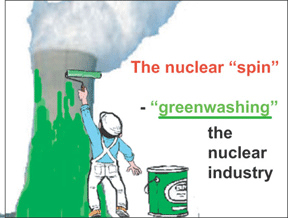
Today, 15 January, there was a ’round table” meeting, (I think in Canberra) of “top scientists” on the urgent need to develop new bushfire adaptation and mitigation techniques.
And guess who’s at the top of the list in these TOP SCIENTISTS ON CLIMATE CHANGE. Why, none other than The Australian Nuclear Technology and Science Organisation, (ANSTO)
Of course, ANSTO is prominent in promoting the lie that nuclear power is the solution to climate change. They’ve put in submissions to parliamentary inquiries, You can bet that they’ve got one in now, to the Victorian Inquiry (submissions close 28 February.) One must admire the timing of the nuclear lobby’s manipulations, and the speed with which they are jumping on the bushfire-fix bandwagon.
New short films show the shocking impact of nuclear waste plan on the Kimba community
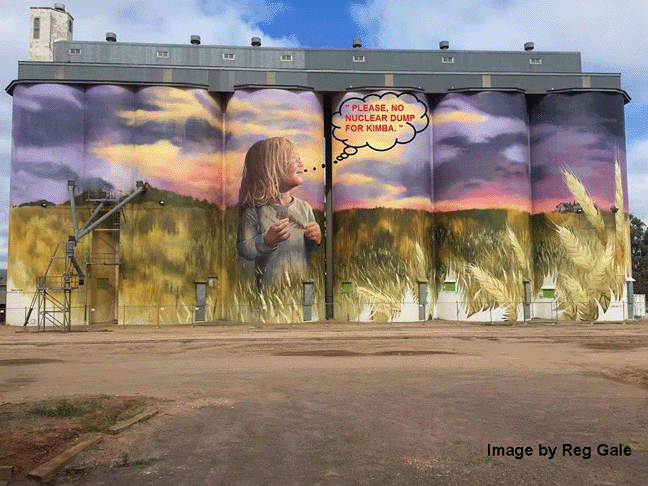
The stories of Kimba farming families and local townspeople opposed to the proposed National Radioactive Waste Management Facility in the district have had their story documented in a message to wider Australia.
Port Pirie filmmaker Kim Mavromatis has released a series of mini-documentaries over the past three months telling the stories of communities impacted by the four-year process to determine whether the facility had broad community support at Kimba or Hawker.
Mr Mavromatis said he had been following the debate around both the waste facility and the SA nuclear fuel cycle process, and he believed the communities involved were only given one side of the story throughout consultation.
“At the end of the day… the government weren’t doing the right thing by the people,” he said.
He said as a member of the Port Pirie community he had also been concerned that his community, which could potentially see the waste transported through their town or port, had not had the same opportunity for consultation as the Kimba and Hawker communities who late last year participated in community ballots to measure support for the proposal.
In one of Mr Mavromatis’s videos, Kimba locals and members of the No Radioactive Waste Facility for Kimba District group spoke about why they remained opposed to the proposal, and the impact the years of uncertainty and community debate has had on them personally.
Among those featured were neighbours of the proposed sites.
Secretary of the group Toni Scott said through the years they had discussed ways of getting their message out to a wider audience, and while it was difficult for many to tell their story there were still many people across the wider Eyre Peninsula and the state who needed to know what was going on as a final decision looms.
“We’re at the stage now where we really want to create as much awareness as we can,” she said.
“We’re hoping people can relate to it.”
Many of the interviewees featured are visibly emotional in the film, which Mrs Scott said was an unintentional outcome of individuals being encouraged to share their stories openly.
“Those raw emotions just came out… I think it’s important for people to see that and realise how affected members of our community actually are,” she said.
Mr Mavromatis said it was “shocking” to see first-hand the impact on the community.
“It’s their livelihood, it’s their future, it’s their kids’ future and it’s permanent,” he said.
The filmmaker has also created a documentary about the impact of the process on the Barngarla people, who in an independent ballot last year voted 0% in favour of the facility.
Mr Mavromatis said the lack of genuine engagement with the traditional owners, who are native title holders of areas neighbouring both proposed sites, was a “total disgrace.”
A rally is planned for Kimba on February 2, with Kimba community members encouraging the wider state to join them.
“We are asking people from Eyre Peninsula and SA to join us in a peaceful protest so the minister (Resources minister Matthew Canavan) can get the message that Kimba is not the right place and farming land is not the right place,” Mrs Scott said.
The video series can be found at vimeo.com/mav17557967.
Scandalous that the Australian government plans a nuclear waste dump on our precious, scarce, agricultural land
 earth would you think Agricultural farmland is a good place to dump radioactive nuclear waste ?????? ARPANSA (the regulator) don’t think so – they state in their own guidelines and Site Selection Criteria, that the proposed Radioactive Nuclear Waste Dumps should not be placed on Agricultural land, in the immediate vicinity of land with significant Natural Resources, or Outdoor Recreational use???
Bureau of Meteorology chart shows how temperatures have soared in Australia over the past century
|
Key points:
A chart produced by the bureau and updated with 2019 figures (shown above) displays a stark transformation over the past century. It shows the anomaly of mean temperature for each calendar year from 1910 to 2019, compared to the average over the standard reference period of 1961–1990. The colours range from dark blue (more than 3 degrees Celsius below average), through blues and greens (below average), yellow and orange (above average), and then brown (more than 3C above average). “Australia’s climate has warmed by more than a degree since 1910, which means very warm years like 2019 are now more likely to occur,” said Karl Braganza, the bureau’s head of climate monitoring.
Dr Braganza said alongside warmer temperatures, we were also seeing a trend in recent decades towards drier winter and spring seasons in some parts of the country. Andrew Watkins, manager of long-range forecasting at the bureau, said the hot 2019 — which had an average mean temperature 1.52C above average — was front of mind for many. “It was the talking point of all last year,” he said. “All the states and territories were in the top handfuls of temperature. Hot everywhere, pretty much. “Almost by definition if they’re records they are unusual.” The bureau has also produced another chart showing rainfall in each year since 1900. [on original]…..https://mobile.abc.net.au/news/2020-01-14/bureau-of-meteorology-chart-shows-how-temperatures-soared/11857404
|
|


1 This month.


PETITION – To: Prime Minister Anthony Albanese and the Australian Labor Government
Chernobyl: The Lost Tapes – A good documentary on Chernobyl on SBS available On Demand for the next 3 weeks– https://www.sbs.com.au/ondemand/tv-program/chernobyl-the-lost-tapes/235274195556

19 May – Webinar- Webinar: No Nuclear Weapons in Australia
Start: 2026-05-19 18:00:00 UTC Canberra, Melbourne, Sydney (GMT+10:00)
End: 2026-05-19 19:30:00 UTC Canberra, Melbourne, Sydney (GMT+10:00)
20 May – Webinar – The dangerous world of AUKUS, US, military occupation and suppression of dissent

National Webinar, 20th May, 2026, 6.30pm AEST. Confronting laws restricting/suppressing protest speech and action
Speakers: Former Sen. Rex Patrick, Lawyer Nick Hanna ,Arthur Rorris ,Jorgen Doyle, Sen David Shoebbridge,
Facilitator Kelley Tranter.

of the week – Australians for War Powers Reform (AWPR)
To see nuclear-related stories in greater depth and intensity
 Antinuclear