World Nuclear Industry Status Report 2019 dispels the illusion of nuclear power as a fix for climate change
 World Nuclear Industry Status Report 2019. (Picture at left is of cover of 2017 report) Tom Burke 8th Jan 2020,
At a time when truth is under systematic political attack and digital technologies are collapsing the public attention span, the publication of long data series such as the Nuclear Industry Status Report becomes
increasingly important.
Nowhere is this more true than when it comes to dealing with nuclear issues where a loss of perspective, a failure of memory, a persistent illusion, can have catastrophic consequences. This remains true whether you arethinking about nuclear energy or nuclear weapons.
high electricity costs for businesses and consumers; a massive waste of
public money; the unproductive diversion of scare engineering talent and
material resources and to an as yet uncounted cost for managing the
back-end of the nuclear fuel cycle.
fuels in the existing electricity system and even more so for the more
electricity intensive global economy we are currently building.

to triple. To build enough to replace fossil fuels would be a global
project far bigger than the Manhattan Project or the us Moonshot.
unsolved problems that nuclear reactors face: affordability, accidents,
waste management, proliferation, special materials and talent scarcity and
system inflexibility. In the real world however, there will not be
unlimited capital and other resources available to deal with climate
change. And there is no time.
policy must adopt energy policies which can deliver the largest reduction
in carbon per year per pound invested. In the UK there is no conceivable
way in which any further investment in nuclear can meet this criterion.
energy investment, every further pound invested in nuclear power will delay
the achievement of the government’s net zero by 2050 goal. The Prime
Minister has begun a review of departmental spending. He is looking to
identify unnecessary or inappropriate projects. Cancelling the remainder of
the current nuclear programme would meet this goal admirably. It would also
free up resources for the manifesto commitment to energy efficiency that
would get both carbon emissions and energy bills down.
The $billions cost of Australia’s climate disasters
Australia’s bushfires to cost billions as climate risks rise Climate Home News 07/01/2020, Australian government announces national bushfire recovery fund, as cost of natural disasters expected to rise in coming years, By Chloé Farand
Bushfires ravaging Australia are expected to cost billions of dollars in recovery efforts and the nation’s bills for tackling natural disasters risk soaring in coming decades with worsening climate change.
Record-breaking temperatures and severe droughts have fuelled the fires which have burnt millions of hectares across the country. At least 24 people and hundreds of thousands of animals have been killed.
Data from the Australian government Bureau of Meteorology shows December’s mean temperature was 3.21C warmer than the average for the month. Ed Hawkins, a professor of climate science at the University of Reading, said the country’s mean December temperature had warmed about 1.4 times faster than the global annual average temperature over the past century.
But pro-coal Prime Minister Scott Morrison has denied the link between climate change and the unprecedented intensity of bushfires across the country, describing it as “misconstrued”.
The costs of wildfires is difficult to estimate due to the indirect costs such as the destruction of wildlife and the environment, damage to public health and harm to tourism.
Swiss Re, one of the world’s largest insurance companies, found direct economic losses only represent a fraction of the true economic impact, which can span years.
Across the world, the economic cost of wildfire has increased in recent decades. In 2017, direct economic losses from wildfires amounted to $21bn worldwide – up from $6bn in 2016, according to Swiss Re
The costs of wildfires is difficult to estimate due to the indirect costs such as the destruction of wildlife and the environment, damage to public health and harm to tourism.
Swiss Re, one of the world’s largest insurance companies, found direct economic losses only represent a fraction of the true economic impact, which can span years.
Across the world, the economic cost of wildfire has increased in recent decades. In 2017, direct economic losses from wildfires amounted to $21bn worldwide – up from $6bn in 2016, according to Swiss Re. https://www.climatechangenews.com/2020/01/07/australias-bushfires-cost-billions-climate-risks-rise/
Nuclear weapons and climate change – twin threats to Creation
At a time when major nuclear arms’ treaties are being orphaned and climate disruption is ballooning, many are asking if there are connections between these twin threats to Creation. The answer is an obvious and uncomfortable yes.
Independent Australia on the Coalition’s toxic denial of climate change
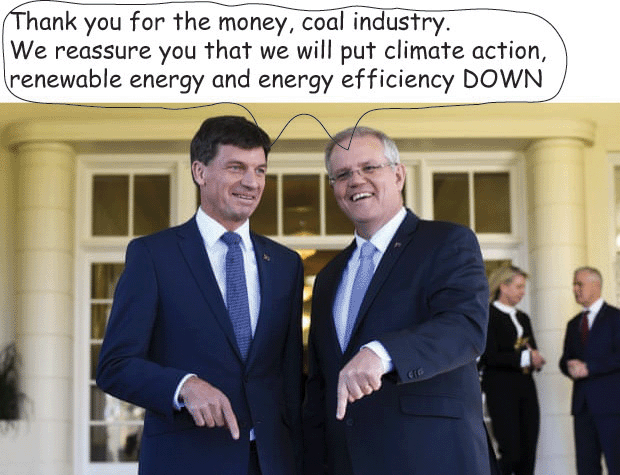 The Coalition’s toxic denial of climate change is destroying us, Independent Australia, By Lyn Bender | 10 January 2020 It was our government’s denial of climate change that has brought so much destruction upon our country, writes Lyn Bender.
AS AUSTRALIA MOURNS enormous losses and experiences the dread and terror of this ferocious summer, the culture of denial attempts to assert itself in this new landscape. The professional denialists continue to promote their toxic climate lies.
Prime Minister Scott Morrison is their klutz villain who seeks to deceive, as the climate reveals its fury.
Perhaps this is the time that we may at last defeat toxic denial. …..
Scott Morrison does not seem to accept the science of the times. If he understands the science, then his response to our climate crisis is homicidal.
Morrison wants to continue to consummate his love affair with coal, even though it means the destruction of our nation and the planet.
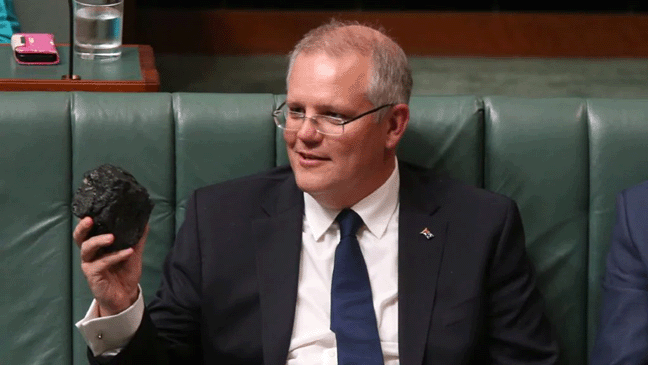
In May 2019, enough voters were in denial of the urgency of climate change to facilitate the election of a climate-denying government. Morrison showed us what he was made of when he fondled a lump of coal in the House of Representatives. It had been lacquered into cleanliness.
“Don’t be afraid, don’t be scared,” he mocked. “This is coal,” Morrison bellowed. He laughed as his sycophantic frontbenchers handled the gleaming black lump with glee.
Optimism is not the same as pretending in the face of evidence to the contrary that all will be well. That kind of optimism exists in the realm of charlatans or fools.
Morrison had a Happy New Year’s Eve party and photoshoot with the cricket team. “Life, as usual, continues” was the message. As people died, houses burned, ecosystems and millions of native animals are incinerated, the Prime Minister was having his summer of beach and cricket. It was like a crass tourism promotion.
This is the bizarre game that the denialist team has been playing for many years. As the planet hotted up and the science grew more insistent of our need to act, the denial team was in full throat. As the birds were silenced, the usual suspects became more shrill in their squawking.
There are too many to name but here are a few of those seated at the have-a-sham table:
- Alan Jones;
- Ray Hadley;
- Steven Price;
- Peter Gleeson;
- Peta Credlin;
- Chris Kenny;
- Andrew Bolt;
- Terry McCrann;
- Rupert Murdoch;
- Ian Plimer, as reported on Media Watch; and
- the Institute of Public Affairs, a pseudo think tank that promotes denial in the interests of its mining founders.
The Government is staffed by saboteurs of climate action. Angus Taylor, the Minister for Energy and Emissions Reductions, has voiced opposition to the U.N. climate processes. Australia, along with Brazil and Saudi Arabia, pushed for a very disappointing outcome at the recent Climate Summit at Madrid. Angus’s performance was slammed by climate scientist Will Steffen. Former Deputy Prime Minister Barnaby Joyce is awaiting divine intervention for the drought, rather than government intervention. As the former Drought Envoy, Joyce failed to produce a single report. https://independentaustralia.net/politics/politics-display/the-coalitions-toxic-denial-of-climate-change-is-destroying-us,13477
Climate change Australia, and the bizarre state of our national political conversation
it apparently isn’t OK to simply say that clearly the climate has changed (even to say that without saying because it’s due to, you know, climate change).
It’s hard not to listen to these interviews [with Scott Morrison] though, and get the sense that he is rattling off an alibi; that he remains on the defensive.
|
|
In the face of a bushfire catastrophe, our national conversation is still run by politics https://www.abc.net.au/news/2020-01-11/australia-bushfire-crisis-just-dont-mention-climate-change/11857590b By Laura Tingle The Eyre Highway reopened on Friday after being closed for 12 days because of bushfires.You might not have driven on the Eyre Highway. But if you want to take the long route north via Kununurra, it is the only sealed highway linking eastern Australia with Western Australia.
The Kings Highway is expected to be closed for most of January. That’s the highway that links Canberra with the south coast. Parts of that road are said to have just melted down the steep sides of Clyde Mountain in fires that have burnt virtually all of the bush from Braidwood to Batemans Bay. Many communities across the country have been told to boil their drinking water because of contamination linked to bushfires — either by ash, such as in Tenterfield, or by the mixing of water supplies during firefighting, as has happened on the NSW south coast. And that’s the case for the communities that have not simply just run out of water. There are concerns that Sydney’s water supply could be severely affected in months to come if the ash from huge areas of burnt out bush around Warragamba Dam, which provides 80 per cent of Sydney’s water, runs into the dam after heavy rainfall. The bizarre state of our national conversationIt’s hard to take pictures of closed highways, or compromised water supplies. But these examples give just some idea of the knock-on effects of fires like those we have seen this catastrophic summer. Continue reading |
January 10 Energy News — geoharvey

Opinion: ¶ “GM And LG Chem’s 30+ GWh Ohio Battery Gigafactory Highlights Rapid EV Industry Progress” • A month ago, GM and LG Chem announced a joint venture to build a 30+ GWh battery factory in Ohio, and drive down battery costs in the process. The announcement shows clearly how much and how quickly the […]
Bushfires – a serious danger to transporting nuclear wastes from Lucas Heights to Kimba

Transporting nuclear wastes across Australia in the age of bushfires, Independent Australia, By Noel Wauchope | IN 2020, the final decision on a site for Australia’s interim National Radioactive Waste Facility will be announced, said Resources Minister Matt Canavan on 13 December.
He added: I will make a formal announcement early next year on the site-selection process.”
With bushfires raging, it might seem insensitive and non-topical to be worrying now about this coming announcement on a temporary nuclear waste site and the transport of nuclear wastes to it. But this is relevant and all too serious in the light of Australia’s climate crisis.
The U.S. National Academies Press compiled a lengthy and comprehensive report on risks of transporting nuclear wastes — they concluded that among various risks, the most serious and significant is fire:…..
Current bushfire danger areas include much of New South Wales, including the Lucas Heights area, North and coastal East Victoria and in South Australia the lower Eyre and Yorke Peninsulas. If nuclear wastes were to be transported across the continent, whether by land or by sea, from the Lucas Heights nuclear reactor in Sydney to Kimba in South Australia, they’d be travelling through much of these areas. Today, they’d be confronting very long duration, fully engulfing fires.
Do we know what route the nuclear wastes would be taking to Kimba, which is now presumed to be the Government’s choice for the waste dump? Does the Department of Industry Innovation and Science know? Does the Australian Nuclear Science and Technology Organisation (ANSTO) know? Well, they might, but they’re not going to tell us.
We can depend on ANSTO’s consistent line on this :
‘In line with standard operational and security requirements, ANSTO will not comment on the port, routes or timing until after the transport is complete.’
That line is understandable of course, due to security considerations, including the danger of terrorism.
Spent nuclear fuel rods have been transported several times, from Lucas Heights to ports – mainly Port Kembla – in great secrecy and security. The reprocessed wastes are later returned from France or the UK with similar caution. Those secret late-night operations are worrying enough, but their risks seem almost insignificant when compared with the marathon journey envisaged in what is increasingly looking like a crackpot ANSTO scheme for the proposed distant Kimba interim nuclear dump. It is accepted that these temporary dumps are best located as near as practical to the point of production, as in the case of USA’s sites.
Australians, beset by the horror of extreme bushfires, can still perhaps count themselves as lucky in that, compared with wildfire regions in some countries, they do not yet have the compounding horror of radioactive contamination spread along with the ashes and smoke.
Fires in Russia have threatened its secret nuclear areas……
Many in America have long been aware of the transport danger:
The state of Nevada released a report in 2003 concluding that a steel-lead-steel cask would have failed after about six hours in the fire and a solid steel cask would have failed after about 11 to 12.5 hours. There would have been contamination over 32 square miles of the city and the contamination would have killed up to 28,000 people over 50 years.
The State of Wyoming is resisting hosting a nuclear waste dump, largely because of transportation risks as well as economic risks. In the UK, Somerset County Council rejects plans for transport of wastes through Somerset.
In the years 2016–2019, proposals for nuclear waste dumping in South Australia have been discussed by government and media as solely a South Australian concern. The present discussion about Kimba is being portrayed as just a Kimba community concern.
Yet, when the same kind of proposal was put forward in previous years, it was recognised as an issue for other states, too.
Most reporting on Australia’s bushfires has been excellent, with the exception of Murdoch media trying to downplay their seriousness. However, there has been no mention of the proximity of bushfires to Lucas Heights. As happened with the fires in 2018, this seems to be a taboo subject in the Australian media.
While it has never been a good idea to trek the Lucas Heights nuclear waste for thousands of kilometres across the continent – or halfway around it by sea – Australia’s new climate crisis has made it that much more dangerous. Is the bushfire apocalypse just a one-off? Or, more likely, is this nationwide danger the new normal? https://independentaustralia.net/environment/environment-display/transporting-nuclear-wastes-across-australia-in-the-age-of-bushfires,13465
Australia stuck in the climate spiral – producing pollution, burning from pollution
|
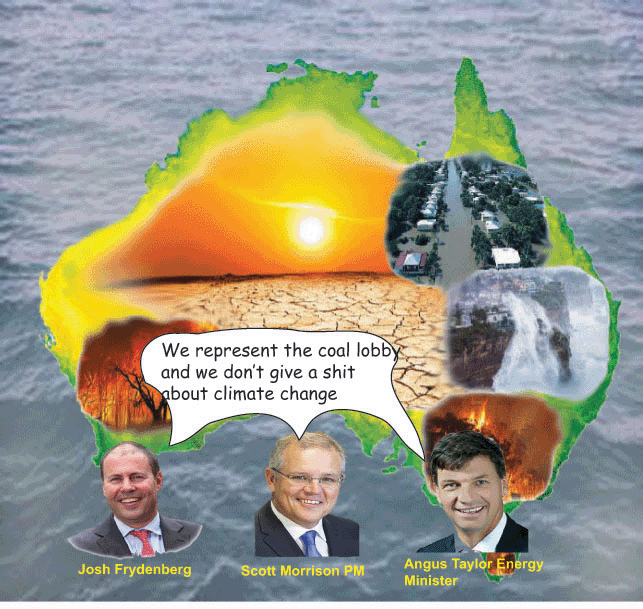
Australia Will Lose to Climate Change https://www.theatlantic.com/science/archive/2020/01/australia-caught-climate-spiral/604423/ Even as the country fights bushfires, it can’t stop dumping planet-warming pollution into the atmosphere.
ROBINSON MEYER
JANUARY 4, 2020 .Australia is caught in a climate spiral. For the past few decades, the arid and affluent country of 25 million has padded out its economy—otherwise dominated by sandy beaches and a bustling service sector—by selling coal to the world. As the East Asian economies have grown, Australia has been all too happy to keep their lights on. Exporting food, fiber, and minerals to Asia has helped Australia achieve three decades of nearly relentless growth: Oz has not had a technical recession, defined as two successive quarters of economic contraction, since July 1991. But now Australia is buckling under the conditions that its fossil fuels have helped bring about. Perhaps the two biggest kinds of climate calamity happening today have begun to afflict the continent.
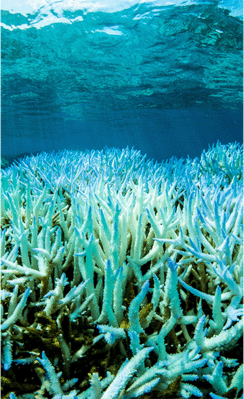
Meeting such a goal will require a revolution in the global energy system—and, above all, a rapid abandonment of coal burning. But there’s the rub. Australia is the world’s second-largest exporter of coal power, and it has avoided recession for the past 27 years in part by selling coal. Though polls report that most Australians are concerned about climate change, the country’s government has so far been unable to pass pretty much any climate policy. In fact, one of its recent political crises—the ousting of Prime Minister Malcolm Turnbull in the summer of 2018—was prompted by Turnbull’s attempt to pass an energy bill that included In fact, it is unprecedented. This season’s fires have incinerated more than 1,500 homes and have killed at least 23 people, Prime Minister Morrison said on Saturday.* There were at least twice as many fires in New South Wales in 2019 as there were in any other year this century, according to an analysis by The New York Times. Climate change likely intensified the ongoing epidemic: Hotter and drier weather makes wildfires more common, and climate change is increasing the likelihood of both in Australia. Last year was both the hottest and driest year on record in the country. Perhaps more than any other wealthy nation on Earth, Australia is at risk from the dangers of climate change. It has spent most of the 21st century in a historic drought. Its tropical oceans are more endangered than any other biome by climate change. Its people are clustered along the temperate and tropical coasts, where rising seas threaten major cities. Those same bands of livable land are the places either now burning or at heightened risk of bushfire in the future. Faced with such geographical challenges, Australia’s people might rally to reverse these dangers. Instead, they have elected leaders with other priorities. Australia will continue to burn, and its coral will continue to die. Perhaps this episode will prompt the more pro-carbon members of Australia’s Parliament to accede to some climate policy. Or perhaps Prime Minister Morrison will distract from any link between the disaster and climate change, as President Donald Trump did when he inexplicably blamed California’s 2018 blazes on the state’s failure to rake forest floors. Perhaps blazes will push Australia’s politics in an even more besieged and retrograde direction, empowering politicians like Morrison to fight any change at all. And so maybe Australia will find itself stuck in the climate spiral, clinging ever more tightly to coal as its towns and cities choke on the ash of a burning world.
|
|
|
Australia needs to talk about, and plan for, our climate-changed future
Catherine Ryland, an urban planner and a bushfire-resilience expert, would like to see more conversation around the idea of planned retreat—rebuilding in low-risk locations, reducing development in high-risk areas, and even relocating existing, unaffected communities, which she describes as the “biggest, bravest, boldest step.”
|
Above – evacuation by sea, from bushfire area How Long Will Australia Be Livable? Facing a future of fire, drought, and rising oceans, Australians will have to weigh the choice between getting out early or staying to fight. The Atlantic BIANCA NOGRADY, JANUARY 7, 2020 “……Australians pride themselves on being battlers, on facing down terrible odds and triumphing against whatever this land of droughts and flooding rains—and bushfires—can throw at us. Yet one of the single most defining moments in modern Australian nationhood was actually a retreat. In one of the greatest military-campaign failures of World War I, the Australian and New Zealand Army Corps—the ANZACs—staged an ingenious escape from the shores of Gallipoli in 1915 after a bitter, futile eight-month battle with Ottoman forces. “This is our Gallipoli; this is our bushfire Gallipoli,” says David Bowman, a professor of environmental change biology at the University of Tasmania. He’s talking about the bushfires that began in the spring of September 2019, that have burned in every state and territory, that have claimed at least 24 lives, that have destroyed nearly 1,800 homes, and that have turned more than 8.4 million hectares of land into lifeless charcoal. They have led to one of the largest peacetime evacuations in Australia’s history, as fire authorities in two states instructed tens of thousands of holidaymakers and residents to remove themselves from the path of several flaming juggernauts. In an echo of the Gallipoli retreat, thousands had to be rescued from beaches by the Australian navy and air force. In the face of these unprecedented fires, Australians appear to be listening less to the inner voice of the Aussie battler, and instead heeding the pleas and warnings of fire authorities.
“This is our Gallipoli; this is our bushfire Gallipoli,” says David Bowman, a professor of environmental change biology at the University of Tasmania. He’s talking about the bushfires that began in the spring of September 2019, that have burned in every state and territory, that have claimed at least 24 lives, that have destroyed nearly 1,800 homes, and that have turned more than 8.4 million hectares of land into lifeless charcoal. They have led to one of the largest peacetime evacuations in Australia’s history, as fire authorities in two states instructed tens of thousands of holidaymakers and residents to remove themselves from the path of several flaming juggernauts.
In an echo of the Gallipoli retreat, thousands had to be rescued from beaches by the Australian navy and air force. In the face of these unprecedented fires, Australians appear to be listening less to the inner voice of the Aussie battler, and instead heeding the pleas and warnings of fire authorities.Eleven years ago, the mind-set of bushfire response was different. Before the devastating Black Saturday bushfires in the southeastern state of Victoria, which killed 173 people over two cataclysmic days in 2009, the accepted wisdom on bushfires was “stay and defend, or leave early.” After Black Saturday, a new category of bushfire warning was introduced, labeled “Code Red” in Victoria, and “Catastrophic” in New South Wales. The unambiguous message of the new warning was “for your survival, leaving early is the only option.”……
what happens after the fires have passed through, and Australians return to either their intact homes or smoking ruins, dead cattle, a blackened moonscape where crops once grew? The lucky ones give thanks and get on with their life. The unlucky ones grieve, rage, shake their fist at Fate—and defiantly rebuild on the same ground. The battler spirit triumphs again, but for how long? Continue reading
|

Australia’s $multi-billion climate whammy: Ross Garnaut was right
|
Ross Garnaut’s climate change prediction is coming true and it’s going to cost Australia billions, experts warn, ABC News,
By business reporter Nassim Khadem 8 Jan 2020,Twelve years ago, economist Ross Garnaut made a prophecy that has devastatingly come true.
Key points:
In the 2008 Garnaut Climate Change Review, which examined the scientific evidence around the impacts of climate change on Australia and its economy, he predicted that without adequate action, the nation would face a more frequent and intense fire season by 2020. Speaking to the ABC about the latest bushfires and the potential economic fallout, Professor Garnaut refrained from taking a direct shot at policymakers who ignored many of the review’s calls for action. But he noted: “If you ignore the science when you build a bridge, the bridge falls down.”
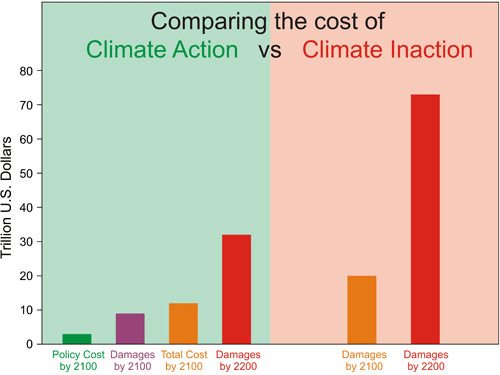
The initial damage bill from Australian bushfires that began in September has risen to $700 million, according to Insurance Council of Australia estimates, and is likely to grow. ICA’s Campbell Fuller told ABC News that 1,838 homes have been destroyed across Australia since September and there have been 8,985 insurance claims for fire-related damage and destruction. But insured losses are just a small part of wider economic losses. The total cost of the 2009 Black Saturday bushfires was estimated at $4.4 billion. Conservative estimates put the final cost of the current Australian bushfires well into billions of dollars, while some analysts say it could cost the economy $20 billion in lost output. Economist says cost could hit $3.5 billionThe head of economic analysis at SGS Economics and Planning, Terry Rawnsley, has done some early estimates on the economic cost of the bushfires. Based on previous modelling of the Tathra fires in 2018, and taking account of $700 million worth of insured losses, the economic fallout from the latest fires could be as high as $3.5 billion, he said. Between $2 billion to $3 billion includes the direct costs to fire-affected regions such as the loss of tourism and retail income, and the impact on agricultural production. He predicts that some of the worst-affected communities will never fully recover. And smoke haze in major capital cities could be an additional $500 million drag on the economy. “These are places not directly impacted by bushfires, but people aren’t out and about, and people are calling in sick with respiratory and asthma illnesses,” he said. Mr Rawnsley said while SGS Economics had modelled the loss of income from livestock such as sheep and cattle being destroyed, it had not modelled the actual loss of the assets (the loss of the sheep and cattle itself). Professor Tom Kompas, one of three chief investigators in the Centre of Excellence for Biosecurity Risk Analysis (CEBRA) at the University of Melbourne, said the economic cost of the bushfires would be “massive”. He said he intended to do precise modelling on the impact later this month. His earlier research on economic impacts of climate change had predicted $1.2 trillion in cumulative damages from now to 2050 assuming a global temperature increase of 3.8-4C by 2100. But the $1.2 trillion in losses looks at infrastructure lost due to sea-level rise, losses in agricultural and labour productivity and limited human health and biodiversity impacts. “It does not include the cost of bushfires on infrastructure and resulting increases in insurance premiums,” he said. “It also does not include damages from human health effects due to pollution and smoke-related illnesses, losses in tourism, losses to major environmental assets … or the costs of emergency management, recovery and relocation.” Estimated $20 billion could be wiped off GDPAMP Capital chief economist Shane Oliver estimated a reduction of between 0.25 and 1 per cent in the level of national economic output as a result of the fires, which he forecast would show up mostly in the March quarter. Based on Australia’s gross domestic product (GDP) of about $2 trillion, a 1 per cent drag could equate to about $20 billion. Still, even a lesser 0.25 per cent hit would be a major drag on economic growth, in an already slowing economy.
Everyone would pay to some degree via higher premiums as insurance claims spiked, he said…….. https://www.abc.net.au/news/2020-01-08/economic-bushfires-billions-ross-garnaut-climate-change/11848388 |
|
Small Modular Nuclear Reactors – no solution to climate change
 Environmentalists Say Small Environmentalists Say Small  Nuclear Reactors Aren’t A Climate Change Solution, https://huddle.today/environmentalists-say-small-nuclear-reactors-arent-a-climate-change-solution/ – 8 Jan 2020 SAINT JOHN – Environmentalists in Saint John are raising concerns over the province’s investments in small modular reactors.Two companies are hoping to develop the new nuclear fission technology at Point Lepreau. Nuclear Reactors Aren’t A Climate Change Solution, https://huddle.today/environmentalists-say-small-nuclear-reactors-arent-a-climate-change-solution/ – 8 Jan 2020 SAINT JOHN – Environmentalists in Saint John are raising concerns over the province’s investments in small modular reactors.Two companies are hoping to develop the new nuclear fission technology at Point Lepreau.
But David Thompson of Leap4ward says the technology is too new and won’t be implemented soon enough to have an impact on climate change. Thompson says the province shouldn’t be investing in “speculative technology” and should instead be focusing renewable energy sources that have been proven to work in New Brunswick, such as wind, solar and hydro. “The renewable sources of energy that we’ve talked about to the premier, some of them can be put in place and operating in maybe three, three and a half years,” he said. Thompson says in comparison, SMRs could take 10 years or more to perfect. “We haven’t got 10 years for something that might work, and another 10 years to build it after it’s proven to work, or even longer than that to put in place enough of it so that it’ll make some kind of difference,” he said. “At the end of it we still have the problem of nuclear waste and we will have the problem of radiation.” Interest in SMR and nuclear energy has been growing in recent months as a green energy alternative, but the modular reactor technology is still in the very early stages. Thompson says climate change is a growing issue and more needs to be done sooner rather than later. “Climate change can’t wait for something that might work, and what if it doesn’t work? What if it isn’t economically feasible after 10 years?” he said. He says not only have wind, solar, and hydro been proven to work, but they’re low-cost and easy to implement. Thompson has sent a letter to Premier Blaine Higgs outlining his concerns and asking him to pull funding from SMRs. “We applaud him for the decision he made to cut all funding to the speculative Joi [Scientific] hydrogen fuel project, but we’re even more concerned about these companies who are getting government money—and attempting to get more—to build these modular reactors,” he said. “By not putting renewable energy in place now in New Brunswick, we’re not doing the right thing. We need action on climate change now.” |
|
Donald Trump sets the scene for a nuclear crisis in Iran
 Trump risks nuclear crisis in Iran, The Hill, BY REBECCA KHEEL – 01/06/20 President Trump is increasingly facing the possibility of a nuclear crisis with Iran, as Tehran takes its biggest step back from the 2015 nuclear deal.Iran’s decision to stop adhering to limits in the Obama-era nuclear agreement comes just days after Trump authorized a drone strike that killed Gen. Qassem Soleimani, posing a major test of the Trump administration’s gambit to withdraw from the international accord.
While Iran hasn’t kicked out nuclear inspectors, and has even left open the possibility of coming back into compliance, experts say Sunday’s announcement by Tehran brings the deal closer to collapse than ever before…….
Iran had set an early January deadline for its next step away from the deal, even before last week’s U.S. strike in Baghdad killed Soleimani, the Quds Force leader. But his unexpected death has ratcheted up tensions between the United States and Iran, stoking fears about a military confrontation and making any step away from the nuclear deal now that much more fraught.
“The degree of their abandonment of the JCPOA may have come about as a result” of Soleimani’s death, Takeyh said, using the acronym for the official name of the deal.
On Sunday, Iran announced it would no longer adhere to the deal’s limits on uranium enrichment.
Trump responded to the news Monday by tweeting in all caps that “Iran will never have a nuclear weapon!”…..
Despite saying it was no longer bound by the deal’s limits, Iran did not immediately announce actions to increase its uranium enrichment and reiterated its pledge to come back into compliance with the deal if it gets sanctions relief. Iran also maintained that its nuclear program is not a weapons program.
Iran also said it would continue cooperating with International Atomic Energy Agency (IAEA) inspectors.
The IAEA said Monday its “inspectors continue to verify and monitor activities in the country.”….https://thehill.com/policy/defense/477047-trump-risks-nuclear-crisis-in-iran
Australia just had its hottest, driest, year on record: Bureau of Meteorology

The BoM made the call as part of its Annual Climate Statement, presented on Thursday morning, calling last year our hottest year with a mean temperature of 1.52 degrees Celsius above average.
Australia’s national average rainfall total was just 277mm – the lowest recorded ever.
“For maximum temperatures, it was a larger departure. It was plus two degrees. So that is the first time we have seen an anomaly that’s two degrees above average and about half a degree warmer than the previous record,” he said.
“We also saw the six hottest days on record peaking at 41.9 and that is temperature averaged over the whole continent.
“I think we saw 11 such days where the national daily temperature went over 40 degrees this summer and that is really quite stark.”
Nation-wide, Australia is experiencing catastrophic bushfires conditions with dangerous blazes burning in New South Wales, Victoria and South Australia.
The BoM report said the link between the fires and record low rainfall and increased temperatures was clear. We were lucky last summer that we didn’t get the sort of fire activity that we’ve seen this year. But this year we weren’t so lucky,” Dr Braganza said.
The report also revealed that evidence pointing to the unprecedented duration of this season’s bushfire became clear two years ago.
“So certainly the combination of extended drought, very low soil moistures in some regions, drier fuels, higher temperatures on most of the outlooks and no meaningful rainfall meant that we had quite early indications that the fire season was likely to be, or include, quite frequent severe fire weather,” Dr Braganza said.
The National Farmers’ Federation said the record warm temperatures are severely impacting the livelihoods of farmers. ……
While it is still early in the new year, Dr Braganza said it is unlikely the weather conditions are going to improve.
“There’s nothing really indicating things will cool down too much over the next few months. We are starting to see some signs that the monsoon is starting to get active.
“At this point I think I’d optimistically say less dry rather than wet if that makes sense so I don’t think we’re seeing an indication that we’ll see significant above-average rainfall.”
He said the science is clear on a link between a warming climate and Australia’s bushfire season over the years.
University students for the Climate Justice group are set to protest on Friday to demand more action on climate change as the country continues to battle dangerous bushfire conditions. HTTPS://WWW.SBS.COM.AU/NEWS/AUSTRALIA-HAS-OFFICIALLY-RECORDED-ITS-WARMEST-DRIEST-YEAR-ON-RECORD-BOM
Murdoch media and climate change denial
 How Rupert Murdoch Is Influencing Australia’s Bushfire Debate, Critics see a concerted effort to shift blame, protect conservative leaders and divert attention from climate change. NYT By Damien Cave, Jan. 8, 2020 WOMBEYAN CAVES, Australia — Deep in the burning forests south of Sydney this week, volunteer firefighters were clearing a track through the woods, hoping to hold back a nearby blaze, when one of them shouted over the crunching of bulldozers.
|
Climate scientists do acknowledge that there is room for improvement when it comes to burning the branches and dead trees on the ground that can fuel fires. But they also say that no amount of preventive burning will offset the impact of rising temperatures that accelerate evaporation, dry out land and make already-arid Australia a tinderbox.Even fire officials report that most of the off-season burns they want to do are hindered not by land-use laws but by weather — including the lengthier fire season and more extreme precipitation in winter that scientists attribute to climate change……. “Leaders should be held to account and they should be held to account by the media,” said Penny D. Sackett, a physicist, astronomer and former chief scientist for Australia……. https://www.nytimes.com/2020/01/08/world/australia/fires-murdoch-disinformation.html?auth=login-facebook&fbclid=IwAR3HGR6KpEAxoU55izrFtdg9O1RUqVF2LtcjHttj8hiHuDJx77RzH_XOarY&smid=fb-nytimes&smtyp=cur |
|
Independent MP Zali Steggall calls on modern Liberals to support her proposed climate change bill
 Zali Steggall urges ‘modern Liberals’ to support her proposed climate change bill: independent MP plans a ‘people-powered’ public campaign for a conscience vote similar to the one for same-sex marriage, Sarah Martin Chief political correspondent, Wed 8 Jan 2020 The independent MP Zali Steggall is calling on self-styled “modern Liberals” to support legislation to establish a new climate change framework, warning them to ignore the views of their constituents “at their peril”.
Steggall, who toppled Tony Abbott in the Sydney seat of Warringah at the May 2019 election, largely on a platform of climate change action, is finalising draft legislation for a “national climate change framework” that sets out a roadmap for Australia to transition to a decarbonised economy.
The legislation is modelled on the UK’s Climate Change Act, passed in 2008, and mirrors framework laws in place in New Zealand and Ireland. Germany and Fiji are considering similar draft legislation.
Steggall aims to begin consultation on the draft bill later this month, and wants to introduce legislation in March, backed by a public campaign calling for a conscience vote in parliament.
Steggall would not reveal full details of the planned public campaign, but said she hoped it would be a similar “people-powered” movement to the same-sex marriage campaign that successfully galvanised support for a yes vote.
Steggall has already begun talking to other independents about the legislation.
1 This month.


PETITION – To: Prime Minister Anthony Albanese and the Australian Labor Government
Chernobyl: The Lost Tapes – A good documentary on Chernobyl on SBS available On Demand for the next 3 weeks– https://www.sbs.com.au/ondemand/tv-program/chernobyl-the-lost-tapes/235274195556
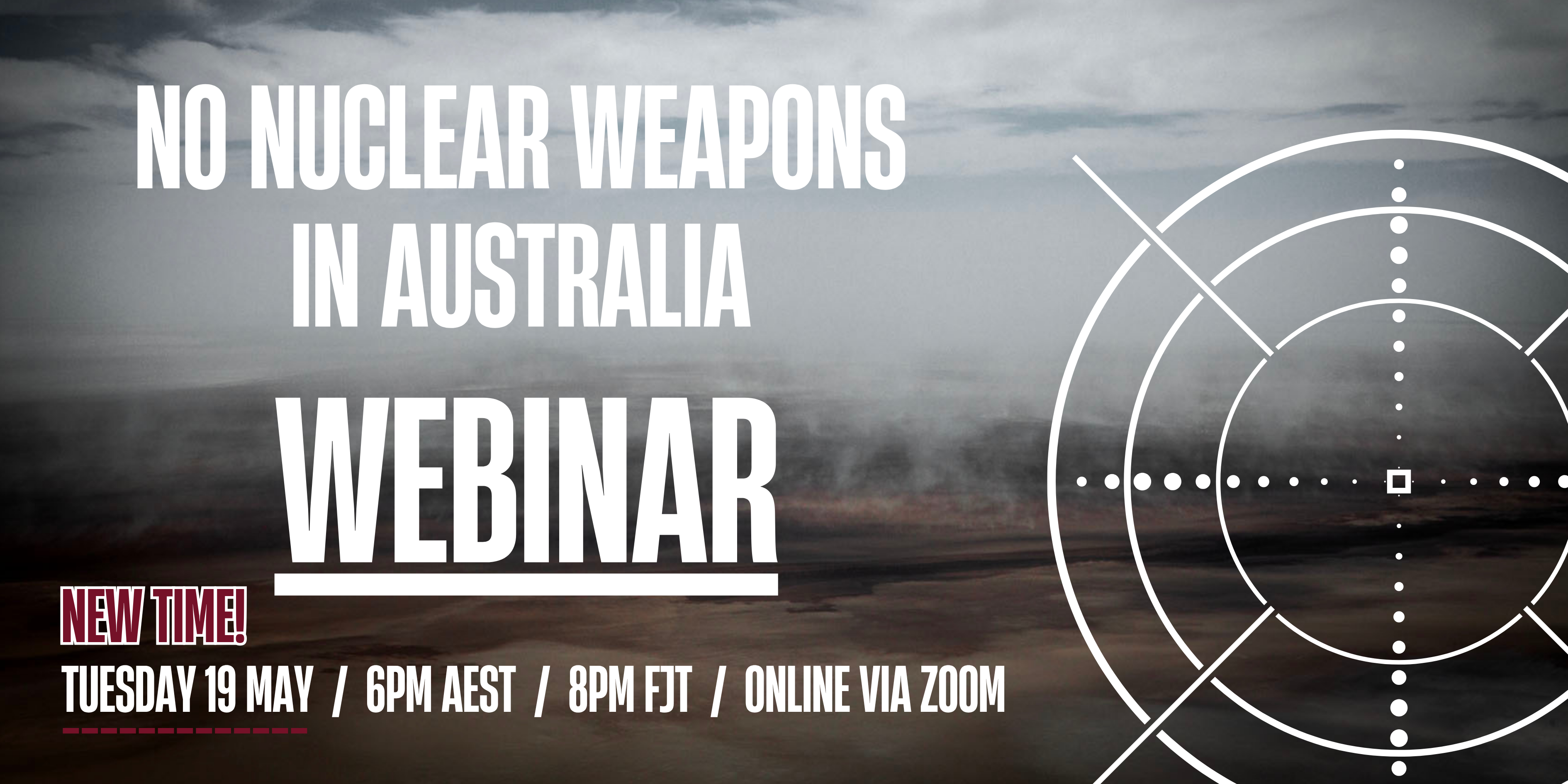
19 May – Webinar- Webinar: No Nuclear Weapons in Australia
Start: 2026-05-19 18:00:00 UTC Canberra, Melbourne, Sydney (GMT+10:00)
End: 2026-05-19 19:30:00 UTC Canberra, Melbourne, Sydney (GMT+10:00)
20 May – Webinar – The dangerous world of AUKUS, US, military occupation and suppression of dissent

National Webinar, 20th May, 2026, 6.30pm AEST. Confronting laws restricting/suppressing protest speech and action
Speakers: Former Sen. Rex Patrick, Lawyer Nick Hanna ,Arthur Rorris ,Jorgen Doyle, Sen David Shoebbridge,
Facilitator Kelley Tranter.

of the week – Australians for War Powers Reform (AWPR)
To see nuclear-related stories in greater depth and intensity
 Antinuclear