Australia has met its renewable energy target. But don’t pop the champagne — RenewEconomy

Energy minister Angus Taylor says investment in renewable energy is not slowing down. This bold claim flies in the face of the evidence. The post Australia has met its renewable energy target. But don’t pop the champagne appeared first on RenewEconomy.
via Australia has met its renewable energy target. But don’t pop the champagne — RenewEconomy
A naturalist warns on the impact of nuclear power on wildlife
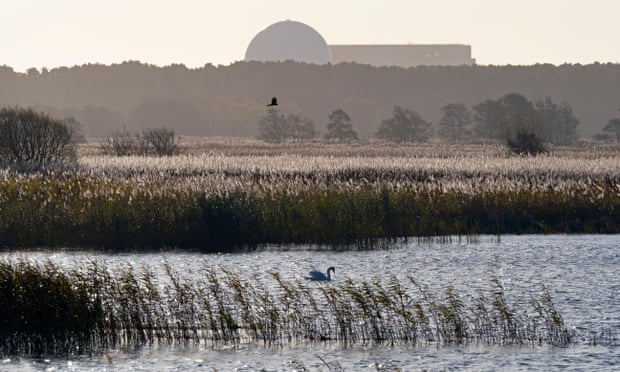
 Nuclear power station could destroy wildlife haven I’ve loved
  since childhood Naturalist Stephen Moss was 13 when he first saw the RSPB reserve in Minsmere, Suffolk. Now he fears plans for Sizewell C could wipe it out, Guardian Stephen Moss@stephenmoss_tv 7 Sept 19 Minsmere and I go back a long way. I can still remember the thrill of my first visit, in 1973, when I was just 13 years old. Later, I made my very first wildlife programme there, with Bill Oddie. And most recently, I presented live programmes from the reserve on the BBC’s red button for Springwatch.
September 8 Energy News — geoharvey

Opinion: ¶ “How Switching To Renewables Impacts Policy In The West” • The rapidly declining cost and increased accessibility of energy storage create a huge opportunity. Whether solar, wind, hydro, geothermal or any other abundant method are the means for energy generation, the concern of maintaining baseload power becomes less important. [The Rising] ¶ “How […]
Greig Myer’s fine submission to Inquiry into the prerequisites for nuclear energy in Australia
 Submission 25 Greig Myer Hopefully this will be the final time that our elected representatives waste time and money on a form of energy that has no public support in pretty much every country on the planet. This has been indicated time and again when the general public has been allowed to have a referendum on the issue. Historically the Australian government has sensibly recognised this in its general moratorium on nuclear power. I will rely on others providing the facts backing up the following broad statements:
There remains no proven long term safe storage facility for nuclear waste anywhere in the world. All facilities to date have experienced increasing leakage risks or actual leakage as time has gone on. The waste also requires ongoing management far beyond the average extent of human planning ability and is based on the assumption of an extraordinarily long stability of government and human affairs that have historically never persisted.
This remains the most basic and fundamental reason that nuclear power should not be considered.
The health and safety risks of nuclear power are massive and exist end to end. From mining uranium, to operating the facility, to dismantling it and storing the waste, at all points humans and the natural environment are exposed to very real risk of radiation exposure, and that is assuming things are operating well.
Nuclear power is currently the most expensive form of electricity generation available, as well as the most dangerous and the most polluting. The estimated costs of generating nuclear power never include the dismantlement of the reactor at the end of its life as well as the multi-generational cost of storage of the waste. These costs must be included in an assessment of nuclear power.
If experts are to be sought to provide an overview of nuclear power then some should be sourced from Germany which is closing down all its nuclear power, and Japan that is currently dealing with the reality of nuclear power when it goes wrong.
Australia as a major supplier of uranium is an enabler of the nuclear waste problem that is going to plague the world for generations. Just because an industry provides profit or jobs does not make it a conscionable activity. Australia could make a major contribution to ensuring that nuclear waste is at least somewhat reduced by shutting down its uranium producing mines. –
Some nuclear proponents raise the red herring of carbon emissions as a reason for nuclear power. Carbon dioxide is only one form of pollution that humanity has to deal with it as a result of its activities. Replacing one form of pollution with a far more toxic alternative is not progress.
There is urgent need for focus on the long-term stabilisation of Australia’s energy grid and this would be a much more appropriate focus for a Parliamentary Inquiry. Solar and wind power are cheap and whatever problems they have they are insignificant compared to the extreme risks that exist with nuclear power
Electric cars are coming and they provide a real opportunity to provide the grid stabilisation that is needed, if the Australian Government provides the appropriate guidelines (universal plug for all cars, all charging to be done between 10am and 2pm??). It is time to focus on the future and leave nuclear power in the past where it belongs. It has had 50 years to prove itself and it has failed comprehensively.
Former Liberal Prime Minister Malcolm Turnbull calls nuclear power a “loopy” fad.
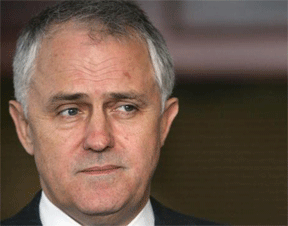 Pressure on PM to rule out nuclear power https://www.9news.com.au/national/pressure-on-pm-to-rule-out-nuclear-power/00c275b4-f3f6-477c-9825-a8c28bd3ba61, By AAP Sep 6, 2019 Prime Minister Scott Morrison is under pressure to rule out nuclear power in Australia, with the opposition saying it’s too expensive and his predecessor calling it a “loopy” fad.
Record warming coming to Eastern states because of sudden warming of air above Antarctica
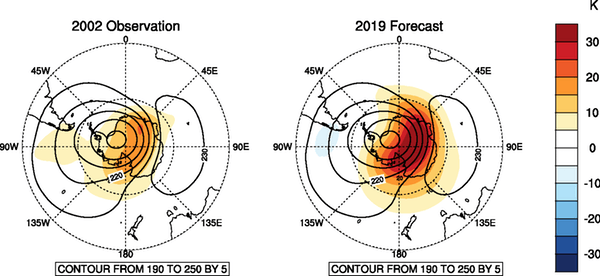
The air above Antarctica is suddenly getting warmer – here’s what it means for Australia The Conversation Senior Principal Research Scientist, Australian Bureau of Meteorology, Manager of Long-range Forecast Services, Australian Bureau of Meteorology, Senior research scientist, Australian Bureau of Meteorology, Senior IT Officer, Australian Bureau of Meteorology, September 6, 2019
Record warm temperatures above Antarctica over the coming weeks are likely to bring above-average spring temperatures and below-average rainfall across large parts of New South Wales and southern Queensland.
In the coming weeks the warming is forecast to intensify, and its effects will extend downward to Earth’s surface, affecting much of eastern Australia over the coming months.
Although we have seen plenty of weak or moderate variations in the polar vortex over the past 60 years, the only other true sudden stratospheric warming event in the Southern Hemisphere was in September 2002.
What can Australia expect?
Impacts from this stratospheric warming are likely to reach Earth’s surface in the next month and possibly extend through to January.
Apart from warming the Antarctic region, the most notable effect will be a shift of the Southern Ocean westerly winds towards the Equator.
For regions directly in the path of the strongest westerlies, which includes western Tasmania, New Zealand’s South Island, and Patagonia in South America, this generally results in more storminess and rainfall, and colder temperatures.
But for subtropical Australia, which largely sits north of the main belt of westerlies, the shift results in reduced rainfall, clearer skies, and warmer temperatures.
Effects on the ozone hole and Antarctic sea ice
One positive note of sudden stratospheric warming is the reduction – or even absence altogether – of the spring Antarctic ozone hole. This is for two reasons.
First, the rapid rise of temperatures in the upper atmosphere means the super cold polar stratospheric ice clouds, which are vital for the chemical process that destroys ozone, may not even form.
Secondly, the disrupted winds carry more ozone-rich air from the tropics to the polar region, helping repair the ozone hole.
‘Bold’ scheme launches to power every property on SA’s Eyre Peninsula with solar
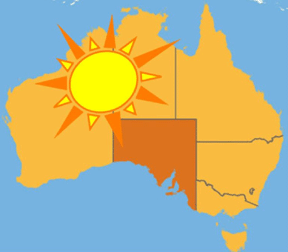 ‘Bold’ scheme launches to power every property on SA’s Eyre Peninsula with solar ABC Eyre Peninsula By Lucy Robinson and Emma Pedler 6 Sept 19, An ambitious plan to power every property in one region of South Australia with solar has been labelled an Australian first — but experts are divided over whether it will work.
Key points:
- The Eyre Peninsula in SA has been plagued by blackouts and a new Community Solar Scheme is rolling out to boost energy security in the region
- The scheme includes finance solutions and free quotes to help people access the technology
- SA Power Networks said the current energy network in SA has “limited capacity to support solar” across the state
Home to around 60,000 people, Eyre Peninsula has been plagued by blackouts in recent years and left without power for several days at a time on multiple occasions.
Its towns were among those hit hardest by the statewide blackouts in September 2016, with Eyre Peninsula businesses wearing a median cost of $10,000 from the event.
The Eyre Peninsula Local Government Association (EPLGA) has released a Community Solar Scheme, put together by Regional Development Australia (RDA), which it says could boost energy security while helping residents save money on power bills…….. https://www.abc.net.au/news/2019-09-06/bold-solar-scheme-launched-to-power-whole-eyre-peninsula/11459992
Storing nuclear waste not economically viable for U.S. State
 Storing nuclear waste would only net Wyoming $10 million annually — raising doubts of its viability Star Tribune Nick Reynolds 307-266-0634, nick.reynolds@trib.com Sep 5, 2019
Local Council rejects transport of nuclear waste through Somerset
 Hinkley Point A nuclear waste transport plans refused, BBC, 5 September 2019 Plans to transport nuclear waste through Somerset and store it at Hinkley Point A, have been rejected by the county council.
Magnox, which manages the decommissioned site, applied for permission to bring waste from three UK power stations to the site by road.
But Somerset County Council voted unanimously to refuse the plans.
Magnox said it was disappointed the council had not agreed with the recommendation for approval.
Under current planning conditions, only waste generated on the Hinkley A site – which is currently under construction- can be stored there.
The company had applied to change the rules so it could transport and temporarily store waste from Oldbury in Gloucestershire, Dungeness A in Kent and Sizewell A in Suffolk.
It had wanted to make a total of 46 deliveries of “intermediate waste”, such as used nuclear fuel containers, by road through Bridgwater.
Despite being recommended for approval, the council’s regulation committee voted unanimously to oppose the application.
‘No benefit’
Councillor Simon Coles said approving the plans would send a message that more of the Hinkley A storage facility could become home to waste from other parts of the UK.
Brian Smedley, of Bridgwater Town Council, said the plans would have “no economic, social or environmental benefit” to the town……. https://www.bbc.com/news/uk-england-somerset-49597817
Labor Party urges Prime Minister Scott Morrison to rule out nuclear power
 Labor is pushing ScoMo to rule out nuclear power https://www.theleader.com.au/story/6370417/pressure-on-pm-to-rule-out-nuclear-power/v Marnie Banger, 6 Sep 19 Prime Minister Scott Morrison is under pressure to rule out nuclear power in Australia, with the opposition saying it’s too expensive and his predecessor calling it a “loopy” fad.
“It is a distraction that will do nothing to solve the energy crisis that is confronting Australian households and businesses now,” opposition energy spokesman Mark Butler told reporters in Adelaide on Thursday.
Australia’s former leader expressed the view on Twitter, in a discussion about the coalition being in line to hit its 2020 renewable energy target.
“I am delighted the target has been met – but I never had any doubt it would be – the challenge now is making sure the storage/firming is in place to make the renewables reliable,” he wrote on Thursday night.
He said ensuring such reliability will require “careful planning and provision”.
But he stressed renewable energy has an edge over coal and “loopy” nuclear power.
“The bottom line is renewables + storage are cheaper than new coal let alone the loopy current fad of nuclear power which is the current weapon of mass distraction for the backbench.”
Energy Minister Angus Taylor asked for the inquiry amid growing calls from coalition backbenchers for the option to be seriously examined.
Last Thursday, the committee was warned by Ziggy Switkowski – who led a Howard government review into the power source – that there was a real risk of “catastrophic failure” if Australia adopted nuclear energy.
‘Up to $12,000 owing to Adnyamathanha girl’: Grandmother
‘Up to $12,000 owing to Adnyamathanha girl’: Grandmother, Transcontinental, Greg Mayfield 4 Sep 19
Indigenous woman Janette Milera is caught between two worlds.
Smart as a whip, and adept with her mobile phone and laptop, she is fighting to bridge the gap between the ancient tribal lands of her forebears and the modern reality of mining royalties.
The royalties flow to the tribal land-owners from an estimated $30-40 million payment so far by Beverley uranium mine in the outback under Native Title.
“There should be some sort of Royal Commission or something into the way Native Title operates,” she said.
She said Aboriginal people faced enough difficulties, without missing out on royalties. On behalf of her grand-daughter, she applied to the association in 2013 for payment of royalties, declaring that her grand-daughter had Adnyamathanha heritage and filling out a membership form for the corporation.
The association had replied that they would look into it.
“I am frustrated considering all the emails saying they were going to sort it out for her,” she said. “We hoped she could use the money to set up her own little house or flat when she moves out. She could have everything. She is missing out.”
Ms Milera, of Plympton Park, is an Arabunna woman who formerly lived in Port Augusta where she helped set up the local Community Development Employment Project, now Bungala Corporation. The association has been contacted for comment. The valuable royalties flow to the association from Heathgate Resources’ Beverley uranium mine on Adnyamathanha land in the outback. https://www.transcontinental.com.au/story/6346351/where-are-the-royalties/?cs=1538&fbclid=IwAR02tzupZOSaQT3oidg05qkwkgLjHIj9jM0YTCB5ndwGjF8HiPN8OTOHDsA
China seeks way to dispose of its growing stockpiles of radioactive trash
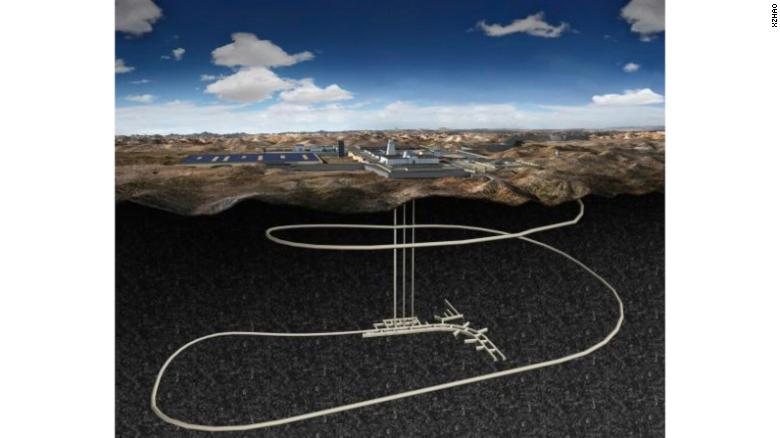
Researchers will conduct tests at the location in Gansu to see whether it will make a viable facility to store highly radioactive waste safely
Scientists say China has the chance to become a world leader in this field but has to find a way to ensure it does not leak, SCMP, Echo Xie September 06, 2019 China has chosen a site for an underground laboratory to research the disposal of highly radioactive waste, the country’s nuclear safety watchdog said on Wednesday.
Officials said work would soon begin on building the Beishan Underground Research Laboratory 400 metres (1,312 feet) underground in the northwestern province of Gansu.
Liu Hua, head of the National Nuclear Safety Administration, said work would be carried out to determine whether it was possible to build a repository for high-level nuclear waste deep underground. …….. [China] needs to find a safe and reliable way of dealing with its growing stockpiles of nuclear waste. …..
Despite broad scientific support for underground disposal, some analysts and many members of the public remain sceptical about whether it is really safe.
China is also building more facilities to dispose of low and intermediate-level waste. Officials said new plants were being built in Zhejiang, Fujian and Shandong, three coastal provinces that lack disposal facilities.
It certainly was a small nuclear reactor that exploded in Russia
It can therefore be stated with certainty that the “isotopic source of energy” referred to by Rosatom was a nuclear reactor.
The Mysterious Explosion of a Russian Nuclear Missile Enginem The BESA CENTER. September 6, 2019 BESA Center Perspectives Paper No. 1,280, September 6, 2019
September 6 Energy News — geoharvey

Opinion: ¶ “Donnie Dim Bulb Channels David Koch To Save The Incandescent Light Bulb” • The latest lunacy from the former coal lobbyist now running the EPA is a proposal to eliminate a regulation scheduled to go into effect next year to halt the sale of virtually all incandescent light bulbs in the US and […]
AEMO looks at role of rooftop solar to help manage EVs on the grid — RenewEconomy

AEMO is looking at the role of rooftop solar, and how that can be used to help solve some of the grid issues that could be raised by the rapid uptake of EVs. The post AEMO looks at role of rooftop solar to help manage EVs on the grid appeared first on RenewEconomy.
via AEMO looks at role of rooftop solar to help manage EVs on the grid — RenewEconomy
1 This month.

Australians deserve the truth
about
AUKUS – https://aukuspublicinquiry.com/

PETITION – To: Prime Minister Anthony Albanese and the Australian Labor Government

of the week – Australians for War Powers Reform (AWPR)
To see nuclear-related stories in greater depth and intensity
 Antinuclear