The fires have forced evacuations worldwide, most recently on Spain’s Canary Islands, where more than 8,000 people have been forced to flee. Smoke from some of the fires is so bad satellites can see it from space, blanketing large portions of South America and the Arctic.
Climate scientists say the fires are partly the result of a world growing warmer, making it easier for flames to spread.
“In these conditions, it is easier for wildfires to grow and to be more long-lived,” said Mark Parrington, a senior scientist in the Copernicus Atmosphere Monitoring Service at the European Centre for Medium-Range Weather Forecasts.
The average global temperature in July was 1.71 degrees F above the 20th-century average of 60.4 degrees, making it the hottest July in the 140-year record, according to scientists at NOAA’s National Centers for Environmental Information.
The previous hottest month on record was July 2016. Nine of the 10 hottest recorded Julys have occurred since 2005; the last five years have ranked as the five hottest. Last month was also the 43rd consecutive July and 415th consecutive month with above-average global temperatures.
Parrington said it’s not possible to draw direct connections between hotter weather and more wildfires, citing human activity. For instance, although there are big fires currently burning in the Amazon, the past 20 years have generally seen a reduction in forest fires there, he said. But now the fires are the worst they’ve been since at least 2010, based on initial data, he said.
Climate experts say there’s always going to be regional variations – the U.S. has had a below-average wildfire year following 2018’s deadly blazes across California – but the overall trend is toward more extreme weather fueled by a hotter climate.
The Arctic’s boreal forests are particularly at risk, said Rick Thoman, a climate specialist with the Fairbanks-based Alaska Center for Climate Assessment and Policy. Like Parrington, he said it’s not a simple connection between hotter weather and more fires, but said the conditions for fires are growing more frequent in the north.
“It’s a reinforcing loop: The more fires you have, the more land you open up, so in future years you’re going to warm that land more because the trees aren’t there to shade it, which will in turn melt permafrost, which will then release carbon and methane, which are greenhouse gases, which contribute to warmer summers and more fires,” Thoman said.
ALASKA: Smoke has once again blanketed Anchorage
Multiple fires are burning near the state’s biggest city, and firefighters have called in assistance from the Lower 48. More than 400,000 acres are currently burning, and one of the biggest concerns is the McKinley Fire, which has destroyed at least 50 structures about 100 miles north of Anchorage. Officials with the Matanuska-Susitna Borough declared a state of emergency, and firefighters hoped that calmer weather predicted for Wednesday could permit evacuees to return.
Experts this spring predicted a long fire season in Alaska because the snow melted several weeks earlier than usual in many parts of the state.
Alaska has had a sweltering summer. July was the state’s hottest month ever, and the long-smoldering Swan Lake Fire roared back up over last weekend, clogging the area with smoke and forcing officials to use pilot cars to lead vehicles through the smoky area on the Kenai Peninsula. Lightning sparked the 138,479-acre fire in June, officials said, and there’s little chance of it being put out until heavy fall rains arrive.
Thoman said Alaskans have become somewhat jaded since this year’s fires have “only” burned 2.5 million acres of land, compared with the 6.6 million acres burned during the worst season on record in 2004. But because this year’s fires burned so close to populated areas, they’ve gotten more attention: “With one-mile visibility in smoke, you can’t get away from it.”
AMAZON: Forest fires are generating smoke that can be seen from space
The sky above São Paulo turned black Monday as wildfires raging more than 1,000 miles away sent smoke pouring over Brazil’s largest city. The smoke resulting from some of these wildfires was also captured in satellite images released by NASA last week.
The Amazon rainforest is burning at a record rate. The fires are no accident, and we need to face it. How does this affect our planet? Just the FAQs, USA TODAY
“The smoke did not come from fires from the state of São Paulo, but from very dense and wide fires that have been going on for several days in Rondônia and Bolivia. The cold front changed the direction of the winds and transported this smoke to São Paulo,” Josélia Pegorim, Climatempo meteorologist, told Globo.
The Twitter hashtag #PrayforAmazonas has been trending as horrified Amazon-watchers share pictures of the devastation.
U.S. scientists say the Amazonian rain forest is typically resistant to fire, but climate changes have left it drier than usual. And while this is the time of year when farmers often set fires in the area to clear off areas for agriculture, Reuters reported the Amazon rain forest has experienced a record number of fires this year, citing new data released by the country’s space agency, the National Institute for Space Research (INPE). The agency said its satellite data detected more than 72,000 fires since January, an 83% increase over the same period of 2018.
The Amazon rain forest fires can be seen from space, and NASA can see these fires from space. Veuer’s Keri Lumm reports. Buzz60
According to an analysis by Copernicus Atmosphere Monitoring Service, the August emissions for the Amazonas area are the highest since 2003, and for the overall Amazonia areas are the highest since 2010.
CANARY ISLANDS: Huge flames force widespread evacuations
A raging wildfire forced large-scale evacuations of residents this week on Gran Canaria, a mountainous volcanic island off northwest Africa. Authorities said the fire burning in forested areas was generating flames up to 160 feet tall in the area of Tamadaba Natural Park, and about 8,000 people had been evacuated. The island is popular with tourists, but officials said the resort areas were so far unaffected, although smoke was widely visible.
Gran Canaria emergency chief Frederico Grillo said recent blazes now are much worse – “nothing like those we used to have” – when families worked in the countryside and forests were kept more orderly, private news agency Europa Press reported.
The Arctic: Areas of normally snow-covered Greenland are burning
The Arctic as a whole has seen unusually high wildfire activity this summer, Parrington said, including areas such as Greenland that typically don’t see fires. One estimate found that the amount of carbon dioxide emitted from fires burning within the Arctic Circle in in June 2019 was greater than all of the CO2 released in the same month from 2010 through to 2018 put together.
While it isn’t uncommon for these areas to see wildfires, there is cause for concern now, Thomas Smith, an assistant professor in environmental geography at the London School of Economics, told USA TODAY last month.
“The magnitude is unprecedented in the 16-year satellite record,” Smith said. “The fires appear to be further north than usual, and some appear to have ignited peat soils.” Peat fires can smolder for months.
The danger of sourcing food and material from the Fukushima region Ground-level nuclear disasters leave much more radioactive fallout than Tokyo is willing to admit Hankyoreh By Seok Kwang-hoon, energy policy consultant of Green Korea Aug.25,2019 International concerns are growing over the Japanese government’s plans to provide meals from the Fukushima area to squads participating in the 2020 Tokyo Olympics. The starting point for the Olympic torch relay, and even the baseball stadium, were placed near the site of the Fukushima Nuclear Power Plant. It seems to be following the model of the Tokyo Olympics in 1964, where Japan’s rise from the ashes of the atomic bombs was underscored by having a young man born the day of the Hiroshima bombing act serve as the relay’s last runner. Here we can see the Shinzo Abe administration’s fixation on staging a strained Olympic reenactment of the stirring Hiroshima comeback – only this time from Fukushima.
But in terms of radiation damages, there is a world of difference between Hiroshima and Fukushima. Beyond the initial mass casualties and the aftereffects suffered by the survivors, the atomic bombing of Hiroshima resulted in little additional radiation exposure. Nuclear technology being as crude as it was back then, only around one kilogram of the Hiroshima bomb’s 64kg of highly enriched uranium actually underwent any reaction, resulting in a relatively small generation of nuclear fission material. Whereas ground-based nuclear testing results in large quantities of radioactive fallout through combining with surface-level soil, the Hiroshima bomb exploded at an altitude of 580m, and the superheated nuclear fission material rose up toward the stratosphere to spread out around the planet, so that the amount of fallout over Japan was minimal. Even there, most of the nuclides had a short half-life (the amount of time it takes for half the total atoms in radioactive material to decay); manganese-56, which has a half-life of three hours, was the main cause of the additional radiation damages, which were concentrated during the day or so just after the bomb was dropped. The experience of Nagasaki was similar. As a result, both Hiroshima and Nagasaki were able to fully resume as functioning cities by the mid-1950s without additional decontamination efforts.
Ground-level nuclear disasters leave much more radioactive fallout than Tokyo is willing to admit
nternational concerns are growing over the Japanese government’s plans to provide meals from the Fukushima area to squads participating in the 2020 Tokyo Olympics. The starting point for the Olympic torch relay, and even the baseball stadium, were placed near the site of the Fukushima Nuclear Power Plant. It seems to be following the model of the Tokyo Olympics in 1964, where Japan’s rise from the ashes of the atomic bombs was underscored by having a young man born the day of the Hiroshima bombing act serve as the relay’s last runner. Here we can see the Shinzo Abe administration’s fixation on staging a strained Olympic reenactment of the stirring Hiroshima comeback – only this time from Fukushima.But in terms of radiation damages, there is a world of difference between Hiroshima and Fukushima. Beyond the initial mass casualties and the aftereffects suffered by the survivors, the atomic bombing of Hiroshima resulted in little additional radiation exposure. Nuclear technology being as crude as it was back then, only around one kilogram of the Hiroshima bomb’s 64kg of highly enriched uranium actually underwent any reaction, resulting in a relatively small generation of nuclear fission material. Whereas ground-based nuclear testing results in large quantities of radioactive fallout through combining with surface-level soil, the Hiroshima bomb exploded at an altitude of 580m, and the superheated nuclear fission material rose up toward the stratosphere to spread out around the planet, so that the amount of fallout over Japan was minimal. Even there, most of the nuclides had a short half-life (the amount of time it takes for half the total atoms in radioactive material to decay); manganese-56, which has a half-life of three hours, was the main cause of the additional radiation damages, which were concentrated during the day or so just after the bomb was dropped. The experience of Nagasaki was similar. As a result, both Hiroshima and Nagasaki were able to fully resume as functioning cities by the mid-1950s without additional decontamination efforts…… http://www.hani.co.kr/arti/english_edition/e_editorial/907055.html
Labor urges more action to protect the Amazon, SBS, Labor is urging the Morrison government to do all it can to encourage Brazil to protect the Amazon as international leaders discuss the issue at the G7 summit. In a joint statement, Labor’s foreign affairs spokeswoman Penny Wong and climate change spokesman Mark Butler said the rainforest fires are increasingly occurring at an alarming rate.
“The Amazon has often been described as the world’s lungs. Its protection matters to the whole international community,” they said.
“We call on the Morrison government to do everything they can to encourage Brazil to respond to this rapidly worsening global disaster.”
BY RAMESH THAKUR HIROSHIMA, 25 Aug !9 – The Hiroshima Round Table held its seventh annual meeting last Wednesday and Thursday. For the first time, in recognition of the uniquely dangerous international security environment since the dawn of the atomic age in this beautiful city, the Round Table issued an urgent appeal to maintain existing nuclear arms control, disarmament and nonproliferation pacts and to build on them in order to deepen strategic stability. Continue reading →
Would the U.S. or Denmark be responsible for cleaning up over 47,000 gallons of Cold War-era radioactive waste?
BY DAN POSSUMATO , 25 Aug 19, BRUNSWICK — President Trump’s flippant yet repeated comments about the possibility of the United States purchasing Greenland – Denmark’s semi-autonomous island, which is 25 percent larger than Alaska – are both amusing and worrisome. Amusing because the comments show an astounding lack of diplomatic decorum, and worrisome because the Russians are paying attention, as they are well aware of previous American attempts to utilize the island for military purposes. Since the early 1950s the U.S. has maintained Thule Air Base on the northwest of the island for the purpose of detecting missiles launched against North America, previously from the Soviet Union and now from Russia.
However, the Russians also are aware that in the 1960s, a top-secret U.S. Army operation code-named Project Iceworm attempted to place up to 600 nuclear missiles at another base underneath Greenland’s thick ice shelf. The location of the missiles, so close to our Cold War adversary, would have had enormous offensive capability. Flight time to their targets in the Soviet Union would have been mere minutes, and, therefore, virtually impossible to stop. The missiles were to be constantly moved over rail lines in a network of tunnels dug deep beneath the ice, a plan intended to foil Soviet intelligence from knowing which of the 2,100 siloswould house the missiles. A Cold War version of the old shell game.
Officially, the Army claimed to be operating a facility named Camp Century, whose purported purpose was to conduct experimentation in Arctic construction techniques and engage in other “research.” The installation that Camp Century concealed – Project Iceworm – was powered by an experimental nuclear reactor, which, according to the Atomic Heritage Foundation, produced over 47,000 gallons of radioactive waste that still lies buried, along with the entire camp, under more than 100 feet of ice. Other estimates put the figure at more than 63,000 gallons. The thinking at the time was that the ice would keep the waste entombed forever.
The whole operation proved impractical, as the Army engineers had miscalculated how fast the ice shelf was shifting. The 21 tunnels began to shift and collapse because of the pressure from the ice, the rail tracks buckled, and the reactor began to melt the ice below and it began to sink. Without fanfare, the whole project was abandoned in 1967.
However, the ice is now melting faster than anyone back then had thought possible. In a 2016 article, Science magazine reported that “melting could begin to release waste stored at the camp, including sewage, diesel fuel, persistent organic pollutants like PCBs, and radiological waste from the camp’s nuclear generator.” Fortunately, even with the effects of climate change, the base won’t be exposed for another 90 years or more. Still, who will take ownership of the problem and expend vast sums of money to remediate the environment: the USA or Denmark?
Project Iceworm was so secret that the Danish government was not formally asked for its permission to allow the establishment of the base; thus, it could disavow any knowledge if the operation were ever exposed. Denmark officially did and still does have ban nuclear weapons there, but the country’s prime minister and foreign minister had tacitly allowed U.S. nuclear weapons to be kept in Greenland, at Thule Air Base and at Project Iceworm. The Danish Parliament was unaware of this clandestine decision. (Ultimately, no U.S. missiles were ever deployed to Greenland.)
If President Trump should ever get Denmark to sell us Greenland, perhaps he could get the former base listed on the National Register of Historic Places, and thus preclude any nuclear-waste cleanup for the purpose of preserving a part of our history.
Opinion: ¶ “Way To Dump All The Good News About Wind Power On A Friday Afternoon, DOE” • Friday afternoon is a time to release information you want everyone to ignore. Last Friday afternoon, the US DOE released three annual reports on the state of US wind power in 2018. Together, they track the rise […]
Submission 11 Keith Thompson (Strange and wonderful arguments) Minimises the importance of Chernobyl and Fukushima disasters.
(Get nuclear power for Australia) by creating wealthy and attractive research prizes to completely eradicate these risks. …
For example, if the Australian federal government created an all comers $10m or $100m prize that invented ways to use all existing nuclear power production waste so that there was none left, I believe that universities and private engineering businesses all over the world would be motivated to engage with the problem. Smaller subsidiary prizes for dealing with parts of that nuclear waste could be crafted to be similarly motivating. I expect that with such incentives, the waste problem could be solved within ten years but would certainly be resolved within fifty years. …
The destructive effects of nuclear power. In one sense this criticism of nuclear power is the response of an ostrich to the unknown or danger. If Newton had stopped pondering gravity because it might lead to the discovery of powered flight and the loss of life in aircraft accidents, or the possibility of anti-gravity and power more destructive than that which we are now considering, we would never have learned how to fly or otherwise stood on the shoulders of his discovery. …
Australia has a duty of comity to the rest of the nations of the world to realise its agricultural potential which could be unlocked with the production of industrial and residential water. https://antinuclear.net/submissions-to-2019-inquiries/
Not one of these published submissions pays attention to renewable energy methods, although a few make slight negative references to solar and wind power.
The major thrusts of these submissions are:
Recommending Small Modular Nuclear Reactors (SMRs)
Recommending Thorium powered nuclear reactors
Minimise the importance of Chernobyl and Fukushima disasters. Minimise health effects of radiation
Other points
Get rid of Australia’s legislation against nuclear facilities
Want a voluntary postal plebiscite on nuclear power for Australia
Australian govt to award $100 million award to find nuclear waste solution
Nuclear waste repository could be a new export industry for Australia
Dr Richard Finlay-Jones Director. EcoEnviro Pty Ltd
EcoEnviro Pty Ltd has been consulting to the renewable energy industry sector in Australia since 2003. Its clients include major utilities, developers and engineering companies. EcoEnviro specialises in project development from greenfield development through to construction, operation and management of wind and solar projects. EcoEnviro is also developing its own wind and solar projects in Northern NSW and is contracting to Pilbara Solar in North West Western Australia.
Addressing the terms of reference:
a. Waste management, transport and storage Nuclear waste is a long term radioactive contaminant for soils, air and water. Nuclear waste is dangerous to many forms of life, including humans. Radiation from nuclear waste has a long half-life, which has the possibility to impact future generations. Nuclear power relies on this energy to function, hence nuclear power should not be considered a sustainable energy option in Australia’s energy mix.
b. health and safety Whilst many nuclear power plants around the world have a strong safety record, there are a string of recorded incidents of failure of plants around the world, most notably Three-Mile Island, Chernobyl and most recently Fukushima. These plants were all considered to be “safe” in their day, and each of them continues to be a radiation and health hazard to the environment. We can no longer afford to risk the safety of our community based on even low probability, especially when cheaper, safer options of energy generation are available. One of the largest nuclear generators in the world (Germany) is now closing and dismantling its power plants in favour of distributed renewable energy and local smart-grids.
c. environmental impacts As in b. above the impacts to the environment from the mining, transport and utilisation of uranium for nuclear generation are avoidable. Cheaper, cleaner options of generation are now available to us on utility-scale wind and solar projects .
d. energy affordability and reliability Nuclear energy will not solve the energy affordability and reliability issues, that we are facing. Nuclear energy has a higher levelised cost of energy (LCOE) than renewables (Bloomberg New Energy Finance 2018), and has a long lead time to development, construction and operation of plant. Better options for affordability include the deployment of more wind and solar generation, in combination with battery storage. Battery storage has already demonstrated its effectiveness in South Australia and Victoria, with home battery storage becoming a fast-developing market due to improving cost effectiveness. Installation of high voltage direct current (HVDC) transmission lines between the Eastern States, and also between the NEM and Western Australia could also prove to be effective in opening up new renewable energy opportunities and increasing the reliability of wind and solar.
The Pilbara has the best solar resource in the world, and the capacity to power all of Australia if there was some connectivity between the National Electricity Market (NEM), the North West Interconnected System (NWIS) and the South West Interconnected System (SWIS). This would be a far better use of funds, providing employment and training opportunities for Northern Australia and releasing opportunities for cheap clean energy generation Australia and possibly SE Asia.
e. economic feasibility Based on a cost per megawatt of installed capacity, nuclear power is more expensive than renewables, which have less impact and less waste (BNEF 2018). The cost of developing nuclear in Australia would be more expensive, would require more land, and extensive community consultation and engagement. The location of any plant would need to be remote and would require significant investment in new high voltage transmission lines to deliver the power to the loads. Investment in such transmission lines would be better served in opening-up new regions with renewable energy opportunities.
f. community engagement Community engagement and participation in new generation projects is always challenging. Obtaining community approval to develop, construct and operate a nuclear facility in any region in Australia will probably be the most challenging project ever seen in Australia. The project will experience community objection from every corner of the country based on cost, risk, safety and health, visual amenity and environmental impact. And rightly so. There will be no social licence for such a plant to operate, without significant and probably excessive compensation to impacted parties and parties at risk from indirect impacts.
g. workforce capability The capability to develop, construct and operate a nuclear power plant in Australia exists, however the costs attached to each of these processes will be significantly higher than the cost to deploy cheaper, cleaner generation sources. There are more employment and training opportunities in renewables than there are for nuclear power.
h. security implications One of the issues of the centralised generation model, that we are now moving away from is the risk of energy security. Recently we have witnessed the impact of failing coal fired power plants which has caused significant market volatility and the need for load shedding. The impact of failure at a nuclear power plant can be multiplied and then multiplied again with respect to: • power pricing • health and safety risk • terrorist threat • grid stability and reliability
i. national consensus There is a school of thought that exists that nuclear could solve our present energy problems. The irony is that this “problem” was forecast over 20 years ago and nothing was done about it. The call for a nuclear solution is a “band aid” fast-fix idea that is fraught with cost and risk issues.
j. other matters The idea that Australia needs a nuclear power industry is laughable. Australia has such rich renewable energy resources that it has the potential to generate power for all of SE Asia. The record deployment of renewable energy in Australia over the past 5 years has reached most parts of regional Australia with grid capacity. This deployment has also caused a reduction in the wholesale price of energy, which has rarely been passed down to the consumer. Consequently, we have witnessed the fastest uptake of rooftop solar in the world, most commonly to the lower income suburbs of Australia. We are now observing the uptake of rooftop solar into the commercial and industrial sectors, in combination with battery storage. Commercial power purchase agreements between renewable energy projects, direct to the customer are now commonplace, and the world is heading toward 100% renewable energy.
The UN Treaty on the Prohibition of Nuclear Weapons has now been signed by 70 nations, and ratified by 25. With this Treaty, the world recognises that nuclear weapons now have the same status as chemical and biological weapons – an inhumane and immoral method of dealing with conflict.
The world’s macho men, the hawks of both genders, the sociopathic leaders in business and politics can scoff, but with this Treaty comes a rational movement essential for the survival of humanity.
The immoral squandering of public funds on nuclear weapons continues apace. benefiting only a few greedy corporate big-wigs, and their government lackeys. Nuclear weapons are useless – there are no winners in nuclear wars, the only result – the unimaginable horror and pain of the people. Hiroshima and Nagasaki showed what this is like.
The folly of the nuclear arms race continues – in the tensions in India, Pakistan, the Middle East, and all now led by the leaders of the most powerful nations. Led by an irresponsible and unhinged US President Donald Trump, they are scrapping the agreements on nuclear weapons control, and feeding the greed of the weapons makers..
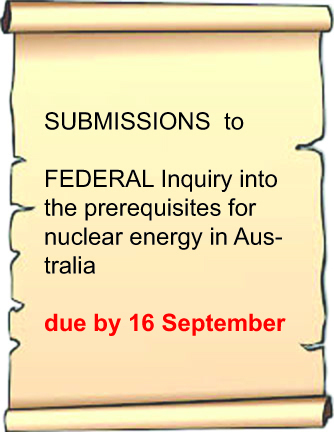
As I mentioned a while ago, the Standing Committee on Environment and Energy of the Commonwealth Parliament is inquiring into the prerequisites for nuclear energy in Australia. There’s a similar inquiry happening in NSW.
All the evidence suggests that this isn’t serious exercise. Rather it’s something intended to appease the National Party or troll the Greens, depending on where you are coming from.
Still, it’s a Parliamentary inquiry on an important issue, so I decided to take it at face value and make a submission. My central recommendation is a combined policy
Introduce a carbon price, rising gradually to $50/tonne of CO2
Repeal legislative bans on nuclear power
I’m pretty confident this package will have close to zero supporters in Parliament, but it ought to appeal to two groups.
First, anyone who seriously believes that nuclear power should be adopted as a response to climate change. That’s a small, but non-empty set, since most nuclear fans are climate deniers. But for those people, it should be obvious that nuclear power is never going to happen except with a carbon price high enough to wipe out coal, and compete with gas.
Second, renewable supporters who want action now, and are prepared to give nuclear a chance in 15-20 years time if it’s needed. The carbon price would push a rapid transition to solar PV, wind and storage, and would be neutral as between these technologies and nuclear. On present indications, that would be sufficient to decarbonize the electricity supply at low cost. But if a fixed-supply technology turned out to be absolutely necessary, one or two nuclear plants might possibly happen.
I looked over the other submissions. The anti-nuclear ones raise the obvious points about waste, accident risk and proliferation.
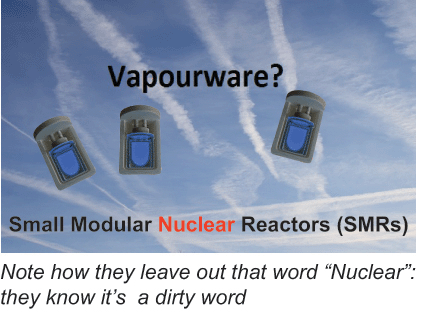
What’s striking about the pro-nuclear submissions is the absence of any mention of existing technologies or the main alternative, small modular reactors, on which I spent a fair bit of time.Rather, the nuclear fans are talking about vaporware such as thorium, Gen IV and even Gen V, described by Wikipedia as ‘ reactors that are purely theoretical and are therefore not yet considered feasible in the short term, resulting in limited R&Dfunding. ‘
Kimba council set a date while Hawker faces further delays, Transcontinental Amy Green 23 Aug19,
Following a week of meetings and debates surrounding the National Radioactive Waste Management Facility, both the Kimba and Flinders Ranges council have reached separate decisions moving forward.
The Kimba community will have its say on the proposal through a long-awaited ballot, which has been delayed for more than 12-months by litigation from native title holders.
The Flinders Ranges Council have resolved to stave off the ballot until a further SWOT analysis has been provided to the community.
While the decision to move forward with the ballot has been appealed by native title holders, District Council of Kimba Mayor Dean Johnson said their was no legal impediment to the ballot proceeding.
“Council’s position has always been to facilitate the ballot on behalf of the Minister for Resources and Northern Australia so our community could have its voice heard, and we reaffirmed that position at our ordinary meeting last week,” he explained.
“We were advised … that the Minister no longer requests that the Kimba and Hawker ballots to be run concurrently, so Council has commenced planning with a view to ballot papers being posted out on 3 October.”…….
Two independent reports have already been commissioned by the federal government, both the Cadence Economic Report and Professor Peta Ashworth’s University of Queensland Socio-Economic Study.
The Flinders Ranges Council is seeking government funding to commission further research.
Mr Slattery said the subsequent report will not be used as a decision making tool for the council…….
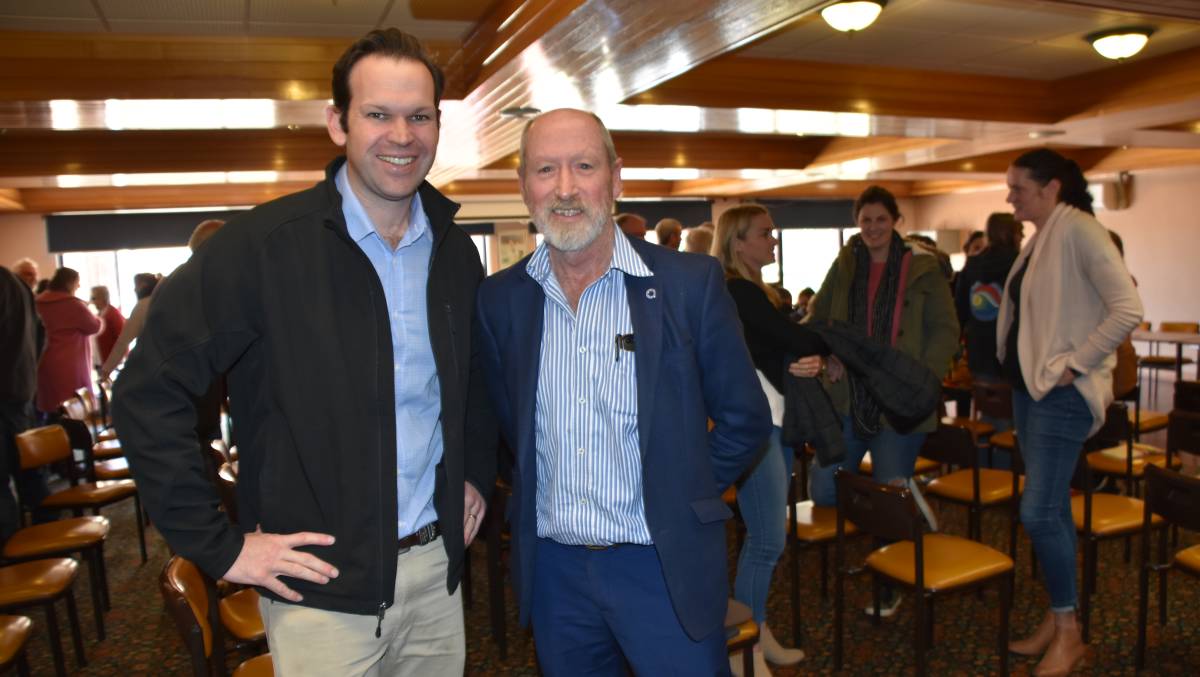
The man on the right liberal politician member for Grey tendered his own property for a nuclear waste dump in his own town with out consulting any one not even his neighbor.
Ballot date set as Resources Minister visits Kimba, Eyre Tribune, Rachel McDonald-22 Aug 19, A date has been set for the Kimba community ballot on the National Radioactive Waste Management Facility (NRWMF) project, opening the door for one of the two proposed Kimba sites to be selected before consultation is complete on a third site near Hawker.
Resources Minister Matt Canavan was in town this week as the Kimba District Council announced the timing of the ballot.
Ballots will be posted to voters in the Kimba district from October 3, with voting set to close on November 7.
Over 80 community members gathered to speak to Mr Canavan at the Kimba Gateway Hotel on Thursday, with the process for determining whether the project had broad community support and the financial support budgeted for the district both major topics of conversation.
Several locals were concerned that no money is currently budgeted to provide support for the community should the project not go ahead.
Mr Canavan said he was committed to providing support for the non host community to transition out of the site selection process.
“I want to do something on that, we just haven’t formally made a decision,” he said.
The process for determining whether the project had broad community support faced criticism from some community members, with several making the point that nearby communities that would not have the chance to vote in the ballot would be impacted by the eventual decision, including some residents in the Wudinna district that live closer to the proposed sites than some in the Kimba district.
Mr Canavan said he would be looking at the possibility of directing some of the financial support available to assist the Kimba community through the site selection process to surrounding communities.
He encouraged anyone affected to make a submission, and said the Department of Industry, Innovation and Science had already received over 1000 submissions to consider in conjunction with the ballot which he would be looking at with their location in mind.
He reiterated that in regards to the community ballot result, he would not be giving a specific percentage figure ahead of time as to what the department would consider broad community support, instead weighing up the result alongside the submissions…..
Mr Canavan indicated the government would be looking for a result “a lot more” than a simple majority in favour.
The Kimba District Council’s decision to proceed with the ballot was not mirrored by the Flinders Ranges Council, which has requested an independent analysis be conducted before their ballot.
Mr Canavan said the Kimba ballot would not be delayed to run concurrently with the Flinders Ranges ballot.
He said it was possible a Kimba site could be chosen before consultation was completed in Hawker.
“That’s a consequence of the Flinders Ranges Council asking for that information,” he said.
Those residing within the Kimba District Council area who are enrolled to vote in federal, state and council elections will be issued a ballot, and out of town ratepayers who enrolled for the proposed ballot in 2018 are still eligible.






 What’s striking about the pro-nuclear submissions is the absence of any mention of existing technologies or the main alternative, small modular reactors, on which I spent a fair bit of time.Rather, the nuclear fans are talking about vaporware such as thorium, Gen IV and even Gen V, described by Wikipedia as ‘ reactors that are purely theoretical and are therefore not yet considered feasible in the short term, resulting in limited R&Dfunding. ‘




 Antinuclear