Production at Australia’s only nuclear medicine facility halted after ‘safety incident’
Production at Australia’s only nuclear medicine facility halted after ‘safety incident’ Production has ceased and an urgent investigation has been launched after two employees at a newly opened Australian nuclear medicine facility at Lucas Heights were exposed to an unsafe dose of radiation late last week.Just two weeks after it was granted a licence to enter into full domestic production, the Australian Nuclear Science and Technology Organisation (Ansto) has confirmed production at its new $168m nuclear medicine facility has been halted after “a safety incident” on Friday morning.
Ansto said three of its workers were “attended to by radiation protection personnel” after the incident, in which contamination was detected on the outside of a container holding 42 millilitres of the radioisotope molybdenum-99 (Mo-99).
Two of those workers received a radiation dose above the legal limit roughly equivalent to a conventional cancer radiation therapy treatment, an Ansto spokesman said……
Located at the Lucas Heights nuclear facility in Sydney’s south, the $168m nuclear medicine facility was announced by the federal government in 2012 with the goal of tripling Australian production of Mo-99, the parent isotope of Technetium-99m. …..
It is the second contamination scare at the Lucas Heights facility in only a few months.
In March three staff at the Lucas Heights nuclear facility were taken to hospital after they were exposed to sodium hydroxide when a cap came off a pipe in the nuclear medicine manufacturing building. https://www.theguardian.com/australia-news/2019/jun/24/two-workers-exposed-to-unsafe-radiation-dose-at-lucas-heights-nuclear-facility
Lithium is valuable for many clean devices, but we can’t just ignore the wastes from its mining
Enormous lithium waste dump plan shows how shamefully backward we are SMH, Emma Young, 25 June 19 Emma Young covers breaking news with a focus on science and environment, health and social justice for WAtoday. We are all – well, all of us who are privileged enough – existing on a spectrum somewhere between “concerned” and “downright panicking” about human impact on the environment.
Western Australia holds some of the world’s richest known lithium deposits and now has an emerging industry to process that lithium here, not just ship it to China as previously done.
It’s part of a plan to make us more than just the world’s quarry; a bigger player in an industry promising big money, and bring jobs and industry to the South West.
But we have run up against a reality, in the very recognisable area of the Ferguson Valley: a reality predictable, yet startling.
Lithium mining will leave its own scars on a landscape already littered with tens of thousands of abandoned mining voids, pits, equipment and piles of tailings – and create its own waste.
In WA’s South West, processing of spodumene ore from the Greenbushes lithium mine will result in 600,000 tonnes per year of waste material being dumped – or ‘stacked’, if you want the euphemism – only 3.5km outside the charming little town of Dardanup.
Let me repeat that: 600,000 tonnes per year.
The application has offended the residents who already put up with dust, rubbish and runoff from the existing and already enormous landfill site.
To them, it’s on the nose.
And it’s not just sand and dirt. It’s waste of a kind so new to Australia that they had to get samples from China to find out what to classify it as.
Cleanaway submitted to the EPA that it was inert and non-toxic waste.
Yet no sustainable market exists for its reuse.
“By storing tailings in dedicated storage cells, in the event a sustainable market for reuse was developed, the material might one day be recovered,” it submitted, optimistically, to the Environment Protection Authority considering its proposal.
Somehow, I find it hard to believe that it is any miner or processor’s priority to find or develop such a market.
Australia is unprepared for the idea of “the circular economy” – but it is already core policy for many countries
 A radical economic shift is coming but Canberra isn’t talking about it, SMH, By Lisa McLean, June 25, 2019 Over the next decade, the Australian economy will be hit with a radical transformation that will forever change our approach to consumption – but no one is talking about it in Canberra yet.
The transition away from our linear economy where we use and then throw away nearly all of the products we buy and consume to a circular economy where we repair, reuse and share is already gaining traction around the world.
When the G20 meets in Osaka this Friday, June 28, this phenomenon – already happening at the grass roots up, kick started by many communities and regions who rely on bartering and communal vegetable patches – is set to be raised as one of the few viable economic pathways out of our global consumption-climate-biodiversity crisis.
The world simply doesn’t have enough virgin resources to support the 10 billion people who will be on our planet by 2050.
We have exceeded our planetary boundaries and as a consequence the rapid and significant destruction of our biosphere is going to impact on health and livelihood of all people. It will lead to collapse of fish stocks, water scarcity, soil erosion, air pollution, global deforestation, biodiversity loss and the list goes on.
The circular economy is now core policy for a growing number of countries with leadership from Finland, the European Union and Canada, but it is also taking a strong hold in Asia as Japan and China implement circular economic policies to transition them to a sustainable inclusive future……… https://www.smh.com.au/environment/sustainability/a-radical-economic-shift-is-coming-but-canberra-isn-t-talking-about-it-20190620-p51ziu.html
Rooftop solar throws massive curve ball to world’s most isolated grid — RenewEconomy

The growth of rooftop solar in W.A. means the world’s biggest isolated grid could be a blueprint for the planning of a distributed energy system. The post Rooftop solar throws massive curve ball to world’s most isolated grid appeared first on RenewEconomy.
via Rooftop solar throws massive curve ball to world’s most isolated grid — RenewEconomy
June 24 Energy News — geoharvey

World: ¶ “Power Purchase Agreements For 1 GW Of Solar Projects Approved In Gujarat” • PPAs for 1 GW of grid-connected solar PV projects tendered and auctioned by the Gujarat Urja Vikas Nigam Limited were approved by the Gujarat Electricity Regulatory Commission. The tariffs ranged from ₹2.44/kWh (3.38¢/kWh) to ₹2.68/kWh (3.7¢/kWh). [Mercom India] ¶ “The […]
Green Hosting, the future of eco-friendly websites — RenewEconomy

Green hosting first emerged at the start of the century, but times have changed and the sector has evolved as consumers awareness increases. The post Green Hosting, the future of eco-friendly websites appeared first on RenewEconomy.
via Green Hosting, the future of eco-friendly websites — RenewEconomy
ACT looks beyond 2020 renewables target, seals community solar off-take deal — RenewEconomy

The ACT doubles down on its renewable energy commitments as Australia’s largest community solar farm moves towards construction after securing funding. The post ACT looks beyond 2020 renewables target, seals community solar off-take deal appeared first on RenewEconomy.
via ACT looks beyond 2020 renewables target, seals community solar off-take deal — RenewEconomy
Queensland’s nuclear cowboy MPs join One Nation’s Marlk Latham to push for nuclear power
 Nationals MPs urge rethink on nuclear, THE AUSTRALIAN GRAHAM LLOYD, ENVIRONMENT EDITOR, 24 JUNE 19, Scott Morrison is being asked to support a full investigation of nuclear energy in Australia.
Queensland Coalition MPs Keith Pitt and James McGrath have drafted a letter to the Prime Minister together with proposed terms of reference for an inquiry, which will be delivered this week.
The letter will call for a review of advances in nuclear energy including small nuclear reactors and thorium technology, both of which could produce less radioactive waste than existing nuclear plants.
Commercial investigation of nuclear energy will require that a ban on considering the technology be removed from the Environmental Protection and Biodiversity Conservation Act.
Mr Pitt said that the nuclear issue was “a debate we are ready to have”.
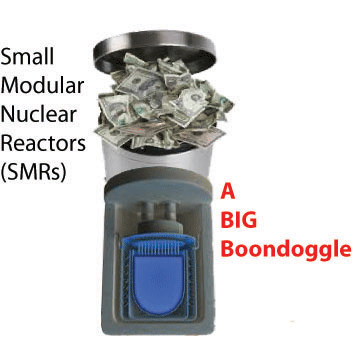 “In our view the technology has moved on and small modular reactors and thorium need to be investigated,” Mr Pitt said.
…….. Critics of nuclear energy claim it would be unable to compete economically with renewable energy and storage.
……. The Morrison government has been reluctant to consider changes to the EPBC Act on nuclear power. But the act in its entirety is up for statutory review this year.
……. The Nationals MPs expect a public review to take from 18 months to two years.
 The call for a national inquiry coincides with a review into the potential of nuclear power in NSW, to include former federal Labor Party leader and newly elected One Nation MP Mark Latham.
Mr Latham has introduced a bill in the upper house of the NSW parliament to repeal the uranium mining and nuclear ban in the state.
A parliamentary inquiry will be held by the eight-member, multi-party Standing Committee on State Development of the upper house. Mr Latham will be a member of the committee.
An issues paper is being prepared by the NSW Parliamentary Research Service for public release. The committee will call for submissions and is likely to conduct public hearings as early as September. https://www.theaustralian.com.au/nation/nationals-mps-urge-rethink-on-nuclear/news-story/4c5c90a4b49f890dba49a10444f1294d
Robert Parker still pushing the fantasy that nuclear power could be viable in Australia
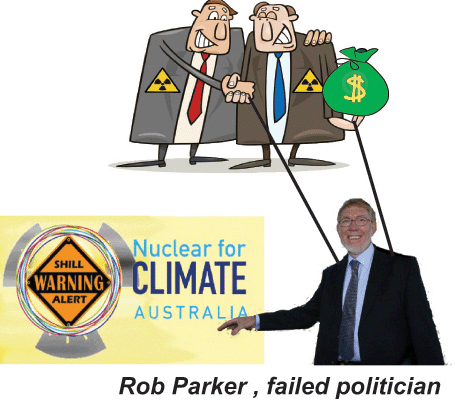
Australian Nuclear Association vice-president Robert Parker joins Jane to discuss the future of the industry in Australia.
Why nuclear energy is not the answer to solve climate change
 There is no such thing as a zero- or close-to-zero emission nuclear power plant. Even existing plants emit due to the continuous mining and refining of uranium needed for the plant. Emissions from new nuclear are 78 to 178 g-CO2/kWh, not close to 0. Of this, 64 to 102 g-CO2/kWh over 100 years are emissions from the background grid while consumers wait 10 to 19 years for nuclear to come online or be refurbished, relative to 2 to 5 years for wind or solar. In addition, all nuclear plants emit 4.4 g-CO2e/kWh from the water vapor and heat they release. This contrasts with solar panels and wind turbines, which reduce heat or water vapor fluxes to the air by about 2.2 g-CO2e/kWh for a net difference from this factor alone of 6.6 g-CO2e/kWh.
In fact, China’s investment in nuclear plants that take so long between planning and operation instead of wind or solar resulted in China’s CO2 emissions increasing 1.3 percent from 2016 to 2017 rather than declining by an estimated average of 3 percent. The resulting difference in air pollution emissions may have caused 69,000 additional air pollution deaths in China in 2016 alone, with additional deaths in years prior and since.
The 7 reasons why nuclear energy is not the answer to solve climate change, https://www.leonardodicaprio. org/the-7-reasons-why-nuclear-energy-is-not-the-answer-to-solve-climate-change/, Mark Z. Jacobson , Professor of Civil and Environmental Engineering, Director, Atmosphere/Energy Program, Stanford University, 21 June 19
One nuclear power plant takes on average about 14-1/2 years to build, from the planning phase all the way to operation. According to the World Health Organization, about 7.1 million people die from air pollution each year, with more than 90% of these deaths from energy-related combustion. So switching out our energy system to nuclear would result in about 93 million people dying, as we wait for all the new nuclear plants to be built in the all-nuclear scenario.
Utility-scale wind and solar farms, on the other hand, take on average only 2 to 5 years, from the planning phase to operation. Rooftop solar PV projects are down to only a 6-month timeline. So transitioning to 100% renewables as soon as possible would result in tens of millions fewer deaths.
This illustrates a major problem with nuclear power and why renewable energy — in particular Wind, Water, and Solar (WWS)– avoids this problem. Nuclear, though, doesn’t just have one problem. It has seven. Here are the seven major problems with nuclear energy:
Australian States taking the lead on energy policy, as renewable energy generates more Queensland jobs than coal does,
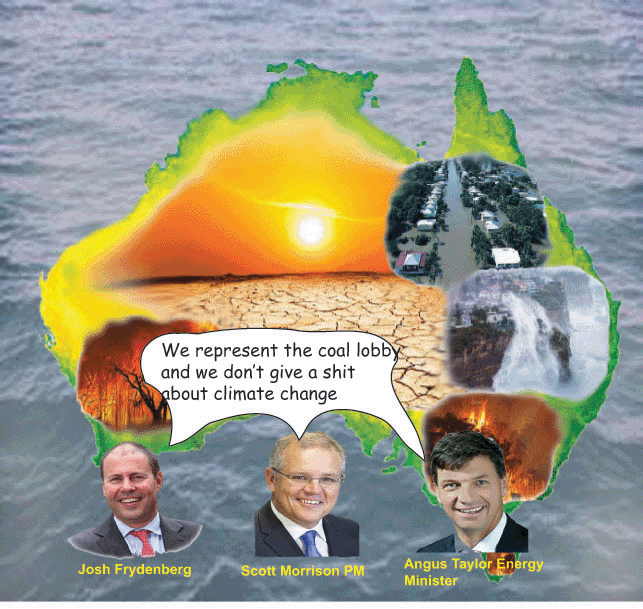
It’s ironic, perhaps, that in an election cycle where a number of regional Queenslanders voted for the promise of blue-collar jobs, backing the party that backed the Adani coal project, renewables generated more than 13,000 actual jobs in construction, with a lot of that activity in north Queensland.
Liberal states in talks to revive Turnbull’s dumped energy policy In Canberra, a month on from Scott Morrison’s election victory, there is talk of feasibility studies for a new Queensland coal plant, and a nascent nuclear debate. But if we shift our vantage point to Adelaide, Australia’s near-term energy outlook looks very different.
Dan Van Holst Pellekaan, the Liberal energy minister, is talking about South Australia hitting 100% net renewables by the 2030s. When asked to explain what that means, he tells Guardian Australia “producing more renewable energy in South Australia than we need for our own consumption and exporting the surplus”.
There is no talk of coal, apart from the inevitability of its displacement.
The South Australian renewables export plan relies on a new interconnector with New South Wales. Van Holst Pellekaan says if the proposed interconnector is approved, there are opportunities to construct large-scale solar and wind farms in the north-east of the state, on pastoral land, adjacent to the transmission equipment. “Then we start to displace coal in NSW,” he says. “It’s not just about a bit of renewable energy making a difference … that’s where you start to get a really big win on emissions reduction.”
But pushing ahead with that kind of progress is much easier if there’s a national framework driving the transition. Post-election, Van Holst Pellekaan wants Canberra back at the table being collaborative, implementing a coherent energy policy.
What the South Australian doesn’t say, but is obvious to people who know how the Coag energy council works, is the states can force this issue if they choose to.
If they can agree among themselves about what needs to happen, they can create a framework setting out the rules of the road even if the commonwealth resists.
Liberal states drive energy policy reboot Continue reading
An American State Opposes Transport of Nuclear Wastes and Federal Waste Dump Plan
 Political opposition grows to nuclear waste storage plan, SF Chronicle, By SUSAN MONTOYA
  BRYAN, Associated Press June 21, 2019 ALBUQUERQUE, N.M. (AP) — Plans by a New Jersey-based company to temporarily store spent nuclear fuel from commercial reactors in the New Mexico desert is running into more political trouble, as some of the state’s top elected officials are raising red flags.
Congresswoman Deb Haaland became the latest member of the delegation to weigh in Friday, sending a letter to the U.S. Energy Department and the Nuclear Regulatory Commission.
The first-term Democratic lawmaker suggested existing railways weren’t built to withstand the weight of the special casks that would be used to transport the high-level waste from sites around the country to southeastern New Mexico.
Haaland said there are no plans for new construction or renovations as part of the project proposed by Holtec International and that cities and states shouldn’t bear the cost of the infrastructure improvements needed to ensure safe transportation.
“I believe such a facility poses too great a risk to the health and safety of New Mexicans, our economy and our environment,” Haaland wrote.
Holtec is seeking a 40-year license from federal regulators to build what it has described as a state-of-the-art complex near Carlsbad……….
n her letter, Haaland pointed to past studies done by the Energy Department when it was considering Yucca Mountain. She said modeling predicted rail accidents at a rate of 1 in 10,000 shipments.
She also said the agency has found that a severe accident involving one cask of radioactive waste has the potential to contaminate dozens of square miles and result in hundreds of millions of dollars in cleanup costs.
State and industry officials also have concerns about potential effects on oil and gas development, as Holtec’s proposed site is located within the Permian Basin — one of the world’s most prolific energy production regions. https://www.sfchronicle.com/news/article/Political-opposition-grows-to-nuclear-waste-14028381.php
Climate change bringing sea-level rise to Victoria’s low-lying towns and suburbs
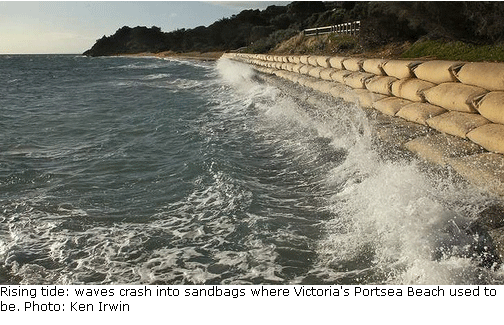 Rising sea, erosion to wreak havoc in low-lying suburbs: report, The Age , By Benjamin Preiss and Adam Carey
Other places at risk include areas around Queenscliff and Barwon Heads on the Bellarine Peninsula; the south-west Victorian towns of Port Fairy and Portland; and Tooradin, Lang Lang and Seaspray in the state’s south-east.
A report tabled in Victoria’s Parliament last week examines the myriad threats to the state’s fragile coastline, painting an alarming picture of damage to the environment and suburban Melbourne if no action is taken.
The Victorian Environmental Assessment Council report cites a 20-centimetre sea-level rise by 2040 and between 40 centimetres and one metre by century’s end.
Sea-level rise will lead to more frequent inundation of low-lying areas, loss of coastal habitat, cliff, beach and foreshore erosion,” the report says.
“Climate change will also put pressure on ageing coastal infrastructure and ultimately impact on feasibility of living in or developing some coastal locations.”
Increasing storm intensity, coupled with rising seas, will cause extensive erosion of the Victorian coastline by 2040, the report says.
“The most extensive area vulnerable to erosion by 2040 is the Gippsland coast,” it says. “Other coasts at risk include west of Portland, beaches in Port Phillip Bay between Mordialloc and Frankston, and the coast between Cape Paterson and Cape Liptrap in South Gippsland.”
China’s new solar thermal power plan to reduce carbon dioxide emissions by 350,000 metric tonnes yearly
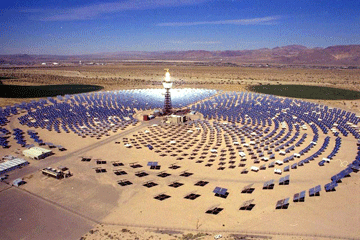 Energy Live News 21st June 2019 China’s first 100MW molten salt solar thermal power plant has
successfully hit its maximum power levels. Built by Beijing Shouhang IHW
Resources Saving Technology, the three billion yuan (£345m) project in
Dunhuang uses 12,000 mirrors to concentrate sunlight onto a receiver, which
is then used to heat the molten salt. It is capable of generating 390
million kWh of clean power each year, enough to reduce carbon dioxide
emissions by 350,000 metric tonnes – engineers at the facility say it has
already reached or exceeded its designed values.
Sydney City Council. Mayor Clover Moore to declare city climate emergency
Sydney Lord Mayor Clover Moore said Australia’s largest city needed to step up and show global leadership, especially given the failure of “successive federal governments (which) have shamefully presided over a climate disaster”.
Liberal Sydney Councillor, Craig Chung, one of two Liberal councillors who plan to oppose the motion, told The Australian while he supported action on climate change, he strongly objected to Ms Moore’s “hysterical, catastrophising” message.
“Language like climate emergency, climate catastrophe and extinction rebellion do nothing to further reasoned and rational debate,” Mr Chung said.
“If we learned one thing from the May 18 (federal) election, polarised fear mongering is not what the community want. The electorate expects us to take action, debate clearly and rationally about solutions, stop weaponising language and to deliver measurable and tangible outcomes for all Australians.”
Mr Chung said he would be proposing an amended version of the lord mayoral motion, stripped of all its “hysterical elements”.
Ms Moore said the nation was now experiencing such extreme weather “91 of the hottest places on Earth were in Australia”.
She said heatwaves across the country were now five times more likely, and “even more alarming — they start earlier, become hotter and last longer”.
“Seventy per cent of the world’s emissions are generated from cities, so the action city governments take is absolutely critical,” Ms Moore said.
Ms Moore has asked Council to call on the Federal Government to respond urgently to the emergency, by reintroducing a price on carbon to meet the Paris Agreement emissions reduction targets, and establishing a Just Transition Authority to ensure Australians employed in fossil fuel industries find appropriate alternate employment.
“Successive federal governments have shamefully presided over a climate disaster, and now we are at a critical juncture — we face a climate emergency,” she said.
“Australia’s greenhouse gas emissions have increased for four consecutive years. It is clear that the current Federal Government’s policies are simply not working and I call on council to declare a climate emergency, step up our efforts to hold the Federal Government to account. “With 96 per cent of NSW still drought affected, our farmers and rural communities are being decimated by drought, suffering from water shortages and extended bush fire seasons, witnessing unprecedented fish kills and the death of once mighty river systems.”
The Lord Mayor, outlining the City of Sydney’s action on climate change since 2008, committed to accelerate work in the development of its strategic plan till 2050.
“We set a goal to reduce our emissions by 70 per cent by 2030, and — following the Paris Climate Agreement in 2015 — we set a more ambitious goal to reach net zero emissions by 2050”, she said.
“We became Australia’s first carbon neutral council in 2007, and as of June 2017, we’d reduced emissions in our own operations by 25 per cent. By 2020, we will be powered by 100 per cent renewable energy, allowing us to meet our 2030 target by 2024 — six years early.”
According to the International Climate Emergency Forum, over 600 jurisdictions in 13 countries have now declared a climate emergency. The Climate Emergency Declaration campaign in Australia is supported by over 50 climate action groups, including the International Climate Emergency Forum, Extinction Rebellion, and Greenpeace Australia.
1 This month.

Australians deserve the truth
about
AUKUS – https://aukuspublicinquiry.com/
Australians deserve the truth
about AUKUS

PETITION – To: Prime Minister Anthony Albanese and the Australian Labor Government

of the week – Australians for War Powers Reform (AWPR)
To see nuclear-related stories in greater depth and intensity
 Antinuclear