Indigenous Canadians fight small reactors on First Nations territory
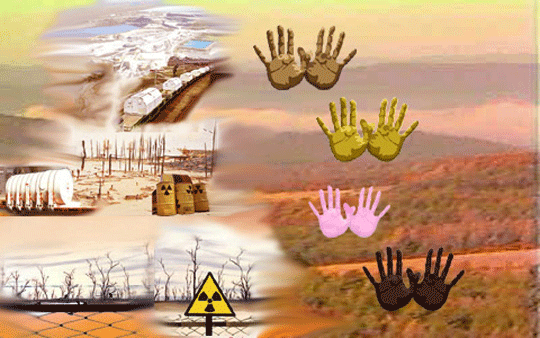 Chiefs oppose small reactors on First Nations territory https://www.thesudburystar.com/news/local-news/chiefs-oppose-small-reactors-on-first-nations-territory Sudbury Star Staff Chiefs oppose small reactors on First Nations territory https://www.thesudburystar.com/news/local-news/chiefs-oppose-small-reactors-on-first-nations-territory Sudbury Star Staff
|
|
USA has large uranium resources, now looking to cease importing uranium from Australia?
 Oil Price 15th June 2019 This month, the United States’ Uranium Committee of the Energy
  Minerals
Division, a group responsible for monitoring the actions and movements of
the uranium industry and the nuclear power industry, released their 2019
Annual Report at the annual meeting of the American Association of
Petroleum Geologists in San Antonio.
The report assessed that the U.S. has
more uranium than we would need to fuel hundreds of years of nuclear power
generation, even if nuclear power was being relied on as a much more
significant source of energy in the U.S. This is great news for nuclear
supporters in the United States, though historically the country has not
mined its own uranium but imported the radioactive metal from other
countries–and there’s a reason for that.
Kyrgyzstan considering law to ban exploration and mining of uranium
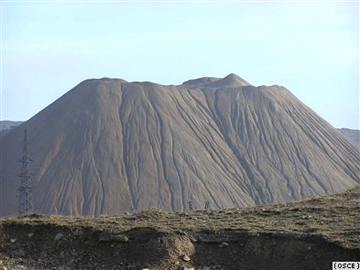
above – uranium tailings wastes in nearby Tajikistan
Parliament committee approves draft law banning geological exploration and mining of uranium deposits in Kyrgyzstan AKIPRESS.COM 17 June 19.- Parliament committee for agrarian policy considered and approved the draft law banning geological exploration and mining of uranium and thorium deposits in Kyrgyzstan in the first reading… (subscribers only) https://akipress.com/news:620767:Parliament_committee_approves_draft_law_banning_geological_exploration_and_mining_of_uranium_deposits_in_Kyrgyzstan/
Rare earths processing – a dirty business, as Lynas has found out
Ores containing these rare earths typically contain radioactive material like thorium. To be useful for industrial purposes, rare earths must be isolated from raw ore through a complex chemical process that leaves behind radioactive waste. “Other countries have been fairly happy to let China take on all that processing,” Rasser says. “It’s a dirty business.”
One of the few rare earth processing facilities outside of China is the Australian owned Lynas Advanced Materials Plant in Malaysia. The facility has long been controversial, though the Malaysian government recently said it will renew Lynas’ license to operate. A prior processing facility shuttered in 1992 due to health and environmental concerns.
|
ARE RARE EARTHS THE NEXT PAWN IN THE US-CHINA TRADE WAR? https://www.wired.com/story/rare-earths-next-pawn-us-china-trade-war/ 17 June 19, SINCE THE TRUMP administration blocked sales by US companies to Chinese telecom giant Huawei last month, the world has waited for Beijing to retaliate.Previously, the trade conflict between the US and China centered on escalating tariffs. While tariffs make things more expensive; they don’t cut off supplies entirely. But when the US Department of Commerce effectively forbade US companies from providing US-made technologies, including chips and crucial software like the Google Play app store, to Huawei, it was a major blow to one of China’s highest-profile companies.
One possible arena for retaliation, in the minds of analysts: rare earth elements. China is the leading producer and processor of rare earths, with about 37 percent of the world’s reserves, according to a US Geological Survey report. The substances are used in a wide range of products including smartphones, airplanes, and medical devices, as well as military gear such as stealth technologies, radar, and night vision goggles. Neodymium, for example, is used to make magnets found in smartphone speakers and haptic feedback devices, while terbium is used to make solid state hard drives. There’s not a lot of money in the rare earth trade. The Geologic Survey report put the value of US imports at $160 million in 2018. But their key role in many products means China could strike a blow against the US without great harm to its own economy. “From a purely dollar standpoint, these exports don’t generate a lot of revenue, so Beijing might be calculating that they could do some harm to the US economy,” says Martijn Rasser, a senior fellow at the think tank Center for a New American Security. Continue reading |
Brown coal generators rated least reliable in the country: report — RenewEconomy

Victoria is home to 20% of the main grid’s coal and gas generation capacity, but is the source of 35% of all power station outages. The post Brown coal generators rated least reliable in the country: report appeared first on RenewEconomy.
via Brown coal generators rated least reliable in the country: report — RenewEconomy
June 17 Energy News — geoharvey

Opinion: ¶ “EU Leaders Face Pressure To Deliver On Climate Change” • By keeping global warming in the public eye, protests helped Green parties in last month’s European elections. They won 74 seats in the European Parliament, up from 52 seats. Their surge, and the boost for liberal parties in the center, will change EU […]
Know your NEM: Coal price collapsing, renewables losing fight in Queensland — RenewEconomy

The international coal price is collapsing, thanks to increase in supply from Indonesia and Australia, while renewables are losing the fight in Queensland. The post Know your NEM: Coal price collapsing, renewables losing fight in Queensland appeared first on RenewEconomy.
via Know your NEM: Coal price collapsing, renewables losing fight in Queensland — RenewEconomy
Gannawarra battery-integrated solar farm – Australia’s largest – officially opened — RenewEconomy

Official opening of Gannawarra solar and storage project, whose 60MW of PV and 25MW/50MWh Tesla battery has already provided “invaluable” services to Victorian grid. The post Gannawarra battery-integrated solar farm – Australia’s largest – officially opened appeared first on RenewEconomy.
via Gannawarra battery-integrated solar farm – Australia’s largest – officially opened — RenewEconomy
The week in nuclear news – Australia
 Nations with nuclear reactors are slowly waking up to the fact that mounting nuclear waste is a global emergency. At the G20 meeting in Japan, Japan proposed setting up an international framework for cooperative research into how to dispose of high-level radioactive waste from nuclear power plants. The first meeting on the framework is planned for October in France.
A bit of good news: First UK Supermarket Chain to Eliminate Plastic From Produce Will Save 1,300 Tons of Plastic From Landfill
AUSTRALIA
Silly talk from Sussan Ley, Australia’s Minister Against the Environment. Pick out the anti-environment statements in Sussan Ley’s spiel!
NUCLEAR. “Chernobyl”s warning: attempts by governments to conceal and manipulate the truth. Energy Minister Angus Taylor contemplates reversing Australia’s nuclear energy ban. In Australia, support for nuclear power is increasingly marginalised to the far-right. In pro nuclear push, Victorian Liberal Democrat David Limbrick (thick as a brick) gets it wrong about nuclear power. Tailings dams at Olympic Dam uranium mine are in the “extreme risk” category.
CLIMATE. Queensland can expect catastrophic heat waves (but then coal is more important than climate, isn’t it?). Australian government’s own data shows that its greenhouse gas emissions policy is failing. Australia’s Federal and State governments keen to frack up the land with coal, gas, nuclear. Queensland clears the way for Adani to begin work on Galilee basin “carbon bomb”. All the same, Adani coalmine: minister loses legal challenge on water pipeline assessment. ‘Stop-Adani’ protest to go global, says Bob Brown. Adani is not about jobs, and never really was. Australia’s governments keen to frack up the land with coal, gas, nuclear. Adani mining project: Court asks Australian govt to look into public concerns. Anti-Adani protests continue in Canberra.
RENEWABLE ENERGY. Australia has to look forward on energy, says Zibelman: “We have no choice”. South Australia’s stunning aim to be “net” 100 per cent renewables by 2030. Record wind output in South Australia, thanks to “butterfly” effect of failed coal plant. NSW promises details of solar and storage interest-free loans program soon. Storage is key to NSW government plans, in race to clean energy . Zali Steggall issues call to arms to renewables sector .
INTERNATIONAL
Nuclear power is far from “emissions free”.
Escalating collapse of global insect populations.
Julian Assange and WikiLeaks, Journalism on trial, Scahill, Hedges, Pilger and more: the charges, the defense, what you can do.s seriously working on nuclear decommissioning system.
Why women should oppose nuclear power — Beyond Nuclear International

Women first raised the alarm about radiation exposure. Why do some still support nuclear?
via Why women should oppose nuclear power — Beyond Nuclear International
Victorian Liberal Democrat David Limbrick gets it wrong about nuclear power
Denmark: 1985 law passed by the Danish parliament, prohibiting power production from nuclear energy in Denmark.
Austria has no nuclear power plants. As a result of a public referendum in 1978,Austria follows a strictly non-nuclear energy policy.
Greece has no nuclear power plants
Iceland has no nuclear power plants
Victorian crossbenchers go nuclear, SBS 17 June 19, A couple of Victorian crossbenchers want to explore lifting the state’s bans around uranium and nuclear power in an effort to tackle climate change.
Two of Victoria’s crossbench want the parliament to explore lifting the state’s bans on nuclear activities in an effort to tackle climate change.
The Liberal Democrats this week in the upper house will table a motion to establish a parliamentary inquiry expand the nuclear industry including uranium mining, exploration and exports, power generation, waste management, industrial and medical applications.
“If we have these issues with climate change we need to look at all the options available to us and at the moment we’ve got laws prohibiting certain options and we think that those options should be on the table,” Liberal Democrats MP David Limbrick told AAP….The minor party is still working to garner support for their inquiry, but would hope if it gets up it would be completed in about 12 months. https://www.sbs.com.au/news/victorian-crossbenchers-go-nuclear
Nuclear energy is NOT emissions free
 Nuclear energy not emissions-free, too lethal https://www.toledoblade.com/opinion/letters-to-the-editor/2019/06/15/nuclear-energy-not-emissions-free-dangerous/stories/20 Nuclear power is not a panacea for climate change and doesn’t deserve bailouts like House Bill 6. It is a catastrophically dangerous, dirty, expensive, deteriorating technology that is not “clean”, “indispensable”, “carbon-free”, or “renewable.”
Gregory Jazcko, former Nuclear Regulatory Commission chairman, warned, “I oversaw the U.S. nuclear power industry. Now I think it should be banned. The danger from climate change no longer outweighs the risks of nuclear accidents.”
Perry and Davis Besse cost a whopping $8.7 billion to build and billions more in maintenance, repairs, and subsidies. Grid operator PJM has determined that closing Perry and Davis-Besse would not destabilize the grid.
The nuclear power life cycle produces copious carbon and other greenhouse gases from uranium mining, milling, refining, conversion, and enrichment; fuel fabrication; transportation; reactor construction, maintenance, decommissioning; and radioactive waste management.
While nuclear generated electricity is low in carbon, it has never been zero emissions. Reactors emit methane, a greenhouse gas, and radioactive Carbon-14, with a 5,700-year half-life. The scientific and medical communities have determined that there is no safe dose of radiation exposure.
Ingested or inhaled radioactive strontium-90 and cesium-137 replace calcium and potassium respectively, irradiating bones and muscles for decades. Carcinogenic radioactive iodine-131 is absorbed by the thyroid which is why potassium iodide is provided to residents near reactors. Cobalt-60 is a liver, kidney, and bone carcinogen. Specks of inhaled plutonium-239, with a half-life of 24,000 years, can cause lung cancer. Miles of buried, inaccessible, deteriorating pipes have leaked tritium, which is radioactive hydrogen; no technology can remove it from contaminated water.
Over 32 years, disasters occurred at Three Mile Island, Chernobyl, and Fukushima. The U.S. has 23 Fukushima-type reactors at 16 sites. The NRC and other researchers postulate a 50 percent chance of another catastrophic accident in approximately the next 20 years.
 To limit utility liability, Congress passed the 1957 Price Anderson Act which caps accident compensation at $12.6 billion; a 1982 NRC study calculated a severe accident could cause 50,000 fatalities and $314 billion in property damage which is $720 billion today.
A 1,000-megawatt reactor contains as much long-lived radiation as 1,000 Hiroshima-sized bombs from which humans and the environment must be protected forever, but the NRC admits that no engineered structure can last the time required to isolate these wastes and that leakage will occur.
Early warnings to resolve radioactive waste before licensing new reactors were ignored. There are 88,000 tons of irradiated fuel “temporarily” stored in problematic pools and casks at 75 environmentally unsuitable reactor sites in 33 states because no permanent repository exists.
In 2012, Ohio was 13th in the U.S. for wind capacity and investment; this virtually ceased due to a 2014 law which mandated the country’s most restrictive wind turbine setbacks and severely impeded Ohio’s 2008 renewable energy and efficiency standards. HB 6 will finish the job.
Even conservative voters prefer solar, wind, and efficiency and oppose fees to keep old nuclear plants operating. Conservative groups testified against HB 6, as corporate welfare and a glorified slush fund.
Ohio needs to strengthen renewable energy and efficiency standards, stop throwing good money after bad, close Perry and Davis Besse as scheduled, and retrain workers in renewable energy jobs.
The writer is past chairman, Ohio Sierra Club Nuclear-Free Committee, of Willoughby Hills, Ohio.
“Chernobyl” TV series – based on the testimony of those who were there
“The official position of the state is that global nuclear catastrophe is not possible in the Soviet Union.”
It was not possible, so in the days and months after the world’s worst such accident, on 26 April, the Kremlin kept up its pretence. It dissembled, deceived and lied. I began investigating Chernobyl in the late 1980s after Ukrainian friends insisted authorities in the USSR were covering up the extent of the human tragedy of those – many of them children – contaminated by radiation when the nuclear plant’s Reactor 4 exploded, blasting a cloud of poisonous fallout across the USSR and a large swathe of Europe.
When photographer John Downing and I first visited, the Soviet Union, then on its last political legs, was still in denial about what happened despite president Mikhail Gorbachev’s new era of glasnost. Continue reading
Queensland can expect catastrophic heat waves (but then coal is more important than climate, isn’t it?)

|
The ‘catastrophic’ effect of increasing heatwaves on Queensland, https://www.brisbanetimes.com.au/national/queensland/the-catastrophic-effect-of-increasing-heatwaves-on-queensland-20190616-p51yaf.html Stuart Layt, June 17, 2019 Queensland’s emergency services are planning for more catastrophic weather events – including 30-day heatwaves and 43-degree peak temperatures – as the effects of climate change turn up the heat on regional parts of the state.
The state government commissioned the Queensland State Heatwave Risk Assessment 2019 following the extended heatwave over much of the state in late 2018, which culminated in “catastrophic” fire conditions. “Over the last few summers we have experienced record-breaking heatwaves and seen how their impacts are intensified when they coincide with another natural disaster,” Health Minister Steven Miles said in his foreword to the report. “We only need to look to the October 2018 bushfires, or the February 2019 North Queensland flooding, to see how heatwaves can cause further distress during times of crisis.” The summer of 2018-19 was the hottest on record for Australia. The report, made public this month and running over 100 pages, comprehensively lays out the various impacts the predicted increases to the length and severity of heatwaves would have on Queensland. It was developed using long-term climate modelling provided by the climate science division of the Department of Environment and Science, and is intended to be used by emergency services and related agencies to develop disaster management plans. The state is staring down the barrel of sweating through 15 per cent of the year in heatwave conditions by 2090, up from 3 per cent in 2018, as well as an increase in the duration of individual heatwaves from four days to nearly 30. The average temperature of heatwaves is predicted to rise from 32.5 degrees to 36 degrees, and the average temperature of the peak of the heatwaves will rise from 34 degrees to 43 degrees.
That extra heat is expected to have a range of effects on everything from people’s personal health and the environment to the multiple industries which would be affected, potentially costing the state billions of dollars. The expected effect on individual Queenslanders is “major to catastrophic”, with increased mortality rates among older people and those with pre-existing conditions. That would have a flow-on effect for hospital and health services, which would be under increasing pressure under this scenario. The report notes heatwaves already result in lost productivity to industry across Australia to the value of $8.8 billion, a figure expected to increase accordingly as heatwaves get longer and hotter. Heatwaves over a certain temperature also bring concerns about the effect on infrastructure, in particular the power grid being overloaded, as well as interruption to transport systems. Livestock is also set to be adversely affected by sustained periods of extreme heat, along with crops. The report offers a range of suggestions to mitigate the effects of heatwaves, while specifically not dealing with the underlying effects of climate change. It recommends electricity providers put measures in place to reduce network demand during periods of system stress, and for future infrastructure projects to take extreme heatwaves into account for their design and planning. It also urges industries to develop clear policies for managing workers’ health and safety during extreme heatwaves and more generally across the warmer months of the year. Between 1900 and 2011, extreme heat was the cause of death for at least 4555 people across Australia, more than the number of deaths attributed to all other forms of natural disaster combined. |
|
Australian government’s own data shows that its greenhouse gas emissions policy is failing
 Australia’s Emissions Reduction Fund is failing to deliver, government data shows, ABC News Australia’s Emissions Reduction Fund is failing to deliver, government data shows, ABC News
Key points:
The Emissions Reduction Fund also appears to be failing in its mission to lower emissions, Government data shows. In 2014, the Abbott government allocated $2.55 billion to the newly established Emissions Reduction Fund, mostly to pay polluters to emit less greenhouse gas. The Morrison Government has extended the program with an additional $2 billion and rebranded it the Climate Solutions Fund. Twice a year, the Clean Energy Regulator holds reverse auctions, where companies bid to win the emissions reduction work. The cheapest good-quality bids win and are awarded Emissions Reduction Fund contracts. Those contracts are for a range of projects, including planting trees, stopping tree-clearing and installing energy efficient appliances. Data shows flatlining of emissions reductionThe ABC examined figures from 10 different datasets published by the Government’s Clean Energy Regulator — a series of auction results published in separate PDFs, as well as two spreadsheets containing information about the status of Emissions Reduction Fund contracts and projects…….. https://www.abc.net.au/news/2019-06-17/australian-emissions-reduction-fund-data-analysis/11164476 |
|
1 This month.

Australians deserve the truth
about
AUKUS – https://aukuspublicinquiry.com/
Australians deserve the truth
about AUKUS


PETITION – To: Prime Minister Anthony Albanese and the Australian Labor Government

of the week – Australians for War Powers Reform (AWPR)
To see nuclear-related stories in greater depth and intensity
 Antinuclear