USA spending $billions in attempt to clean up dangerous nuclear waste sites
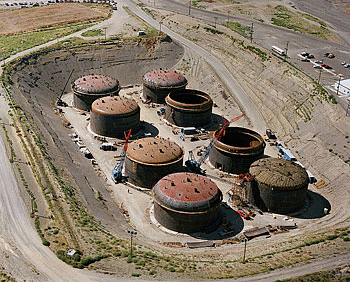
Soaring costs but limited progress in cleanup of “scariest” nuclear sites https://www.salon.com/2019/05/18/soaring-costs-but-limited-progress-in-cleanup-of-scariest-nuclear-sites_partner/
The progress to clean up nuclear waste sites appears to be slowing down though still devouring billions of dollars, PHIL ZAHODIAKIN, MAY 18, 2019 THE PROGRESS OF A DEPARTMENT OF ENERGY PROGRAM TO CLEAN UP THE NATION’S MOST DANGEROUS NUCLEAR WASTE SITES APPEARS TO BE SLOWING DOWN EVEN THOUGH IT’S STILL DEVOURING BILLIONS OF DOLLARS.
That discouraging picture emerges in the latest report by the federal Government Accountability Office on the long-running cleanup effort. Launched in 1989, it was designed to clean up 107 sites engaged in research or production of enriched uranium or plutonium for making nuclear weapons.
Cleanup work at 91 of the Cold War-era sites is finished. But the remaining 16 pose the greatest health risks — especially those with underground storage tanks leaking highly radioactive waste.
Testifying last week before the House Subcommittee on Oversight and Investigations, a GAO official said that for reasons that are unclear, estimated cleanup costs at the 16 ”biggest and scariest sites” have increased by $214 billion despite the Department of Energy (DOE) spending $48 billion since 2011.
David C. Trimble, the GAO’s director for natural resources and the environment, said the soaring costs ”are getting worse as the growth in cleanup liabilities vastly outpaces [the DOE’s] ability to reduce them.”
DOE officials are trying to pin down the reasons for delays and cost overruns, Trimble said, “but they haven’t finished their ‘root cause’ analysis.”
Rep. Jan Schakowsky (D-Ill.) asked Trimble and Ann Marie White, director of the DOE’s Office of Environmental Management how they would “explain to the taxpayers this astonishing cost increase when the number of cleanup sites hasn’t changed.” White replied that the 56 million gallons of radioactive liquids and sludge in the underground tanks at the immense Hanford Nuclear Reservation in southeastern Washington are driving “much of the increase.”
But the GAO has cited other problems, too, including DOE providing Congress with inconsistent and misleading information. For example, Trimble said, legislation passed in 2011 required DOE to annually report on its funding needs, but the reports have been submitted in only two of the years since.
“So, what are [the taxpayers] buying for all this money?” Rep. Joseph P. Kennedy (D-Mass.) asked, observing that the latest estimate to complete the work at all 16 sites has reached $377 billion.
Rep. Ann M. Kuster (D-N.H.) pointed out that, besides costs, the risk of accidents or sabotage at the 16 sites only increases with time. And Trimble drew an analogy to a type of mortgage popular during the housing bubble of the early 2000s.
By spending billions to contain radioactive soil, water, and nuclear materials at their sites of origin without a path to completing cleanups, “There’s a danger that, at some point, the dynamic starts to look like an interest-only loan that doesn’t require you to pay down the principal amount of the loan,” Trimble said.
Trimble said he was encouraged by DOE’s willingness to accept management improvements recommended by GAO
But Ed Lyman, acting director of the nuclear safety project for the Union of Concerned Scientists, told Fair Warning that “GAO issues one report after another about DOE’s mismanagement of the nuclear cleanup program but the reports don’t seem to move the ball.”
Pointing out that the experiments to condense and vitrify (or turn into glass) the liquid wastes at Hanford and Savannah River, S.C., “have not been going well,” Lyman added that the long disposal delays leave the safety of the sites in a nether world of “borrowed time.”
Besides Hanford, where cleanup activities are expected to continue at least until 2070, and the Savannah River Nuclear Reservation, which will keep producing radioactive tritium during its cleanup, some of the other, major sites among the 16 left to clean up include the World War 2-era facility in Oak Ridge, Tenn.; and the gaseous diffusion plants in Piketon, Ohio and Paducah, Ky.: formerly principal source of enriched uranium.
Britain’s Committee on Climate Change calls for challenging climate action from government and community

Sussex Energy Group 17th May 2019 , Another climate report and another urgent call for action, along with a dizzying  array of graphs and figures. The Committee on Climate Change (CCC), who advise the UK government on policies and planning for a low carbon economy, have produced their analysis and recommendations on how to stop UK’s contribution to global warming by 2050.
This follows the “Paris Agreement” signed in December 2015 where the UK, along with 196 other countries, agreed to reduce their nation’s greenhouse gas emissions in efforts to limit global warming to 1.5°C above pre-industrial levels.
The CCC’s excellent and thorough report makes for some tough reading; not for its 277 pages and plethora of statistics and figures, but for the scale of collective effort required. The benign-sounding estimate of costs – 1-2% of GDP – disguises the extent of system change and efforts required, not only of government and businesses, but households as well.
http://blogs.sussex.ac.uk/sussexenergygroup/2019/05/17/net-zero/
Voters feared climate policy more than climate change
A range of polls and surveys had left many analysts, myself included, with the sense that this would be a crucial issue at the ballot box.
The annual Lowy Institute Poll demonstrated stronger support for climate change action in Australia in 2019 than in any previous survey since 2006.
In the survey more than 60 per cent of Australians agreed with the sentiment that “Global warming is a serious and pressing problem. We should begin taking steps now even if this involves significant cost”.
And while a self-selecting sample, those filling out the ABC’s Vote Compass survey consistently emphasised climate change as a crucial issue for them at the election.
Crucially, those identifying it as the most important issue had risen from 9 per cent in 2016 to 29 per cent in 2019.
Advocacy groups and even media outlets also encouraged the view that 2019 was, and should be, Australia’s climate election.
This was prominent in pre-election statements from NGOs like ACF and Oxfam. GetUp! ran this argument strongly before and during the campaign, and The Guardian’s editorial on the eve of the election exhorted all Australians to view the election as an opportunity to vote for substantive action on climate change.
But in the end, we saw a decline in the primary vote for the Labor Opposition, who had announced a more significant reduction target than the Government and a suite of measures — from investment in renewable energy to an energy guarantee — to get there.
And we saw a rise of only around 0.5 per cent of the primary vote for the party with the most progressive and ambitious climate policy: the Greens. More consequentially, of course, we saw the re-election of a Government with limited ambition on emissions reductions.
How did this happen?
While it’s too early for fine-grained analysis, we can draw a few conclusions at this point.
First, the seats where climate change was significant as an issue at the election tells us something. As the most significant political issue for Greens supporters in the election, climate change clearly played a role in the re-election of Adam Bandt in Melbourne, and in strong primary votes for the Greens in nearby electorates of Higgins, Kooyong and Macnamara.
In Sydney, it was clearly prominent in Wentworth (undecided at the time of writing), and most prominently Warringah where Zali Steggall won the seat from Tony Abbott.
In Warringah, not only was the LNP’s position on climate change inconsistent with the views of most in this constituency, but Mr Abbott was (rightly) seen as the chief architect of an extended period of climate inaction in Australia.
Simply put, he was (in Opposition, in Government and in public debate) the chief contributor to the toxic politics of climate change in this country over the past decade.
Mr Abbott’s re-election was, in short, a bridge too far for his constituency.
But in this case and in other inner-city seats, support for climate action looks broadly consistent with a ‘post-materialist’ sensibility.
Here the emphasis on quality of life over immediate economic and physical needs encourages a focus on issues like climate change. But this is a sensibility that speaks to those in higher socio-economic brackets, and principally with higher levels of education.
It isn’t particularly applicable to regional Queensland, for example, especially when constituents in the latter view large scale mining operations as a crucial potential source of income and employment.
Voters feared climate policy more than climate change
Second, the Lowy Institute polling data also tells us something about when climate support rises and falls.
Simply put, climate concern is at its highest in Australia when there’s a perception (eg 2006, 2019) that the government isn’t doing anything about the issue and isn’t taking it seriously. Conversely, climate concern has been at its lowest as the Government began to pursue substantive climate action, bottoming out when the so-called carbon tax was legislated in 2012.
In this election, Australians were suddenly faced with a prospective Labor Government ready with a suite of measures to tackle climate change.
And they were presented with an account of these measures as a devastating economic blow to Australian prosperity and growth.
However discredited much of this modelling ultimately was, and the broader fear campaign about everything from electricity prices to the end of petrol-based cars, it raised the spectre of immediate economic sacrifice for Australian
We’re already in a climate emergency
So what would it take to make climate change a major political concern in Australia, and a crucial issue in future Australian elections?
A climate emergency, perhaps? The problem with this argument is that by most accounts, we’re in one.
The five hottest years on record have been the past five, natural disasters have increased in intensity and frequency, we’re in the midst of an extinction crisis and the average global temperatures suggest that we’ve almost reached the agreed Paris target for warming: no more than 1.5 degrees.
So the issue is not whether there’s a problem. Rather, it’s how to get Australian policy makers and voters to recognise and respond to it credibly and seriously. It should be easier to do.
We’re confronted more than ever with manifestations of climate change.
The five hottest years on record have been the past five, natural disasters have increased in intensity and frequency, we’re in the midst of an extinction crisis and the average global temperatures suggest that we’ve almost reached the agreed Paris target for warming: no more than 1.5 degrees.
So the issue is not whether there’s a problem. Rather, it’s how to get Australian policy makers and voters to recognise and respond to it credibly and seriously. It should be easier to do.
We’re confronted more than ever with manifestations of climate change.
Why do politicians appear to believe shock jock Alan Jones on nuclear power? Scott Morrison has his doubts
Nuclear Fuel Cycle Watch South Australia, Steve Dale 20 May 19, I listened to that Alan Jones, Morrison interview (that Wong’s press release references) – Jones was rabidly pro-nuclear (as usual) and Morrison was trying to point out that nuclear is not cost effective. When Alan Jones goes, I wonder how many pollies will drop their support for nuclear power – I think many say they support it just to get on the right side of him.
“Mr Morrison told broadcaster Alan Jones that he would do whatever it takes to bring electricity prices down but when it came to nuclear power, “I don’t have any issues” but the “investment doesn’t stack up”.
He compared nuclear power unfavourably with Hydro Tasmania’s Battery of the nation – a proposal to develop thousands of megawatts of pumped hydro capacity in addition to the island state’s existing hydro capacity to back up rapidly expanding solar and wind power.”
https://www.afr.com/…/scott-morrison-no-issue-with…
Iran’s top diplomat presses efforts to save nuclear deal
Concerns about a possible conflict have flared since the White House ordered warships and bombers to the region to counter an alleged, unexplained threat from Iran that has seen America order nonessential diplomatic staff out of Iraq……
mposing sanctions while seeking talks is like “pointing a gun at someone and demanding friendship,” said Iranian Gen. Rasool Sanaeirad, according to the semi-official Mehr news agency.
That comment was echoed by Majid Takht-e Ravanchi, Iran’s ambassador to the United Nations.
“They want to have the stick in their hands, trying to intimidate Iran at the same time calling for a dialogue,” Ravanchi told CBS. “What type of dialogue is this?”…..https://www.apnews.com/04eabdee60dc4a399b22a2c6a5f0c672
Environment markets suffer as Coalition win kills emissions, renewable targets — RenewEconomy

Share market surges, but price of renewable energy certificates and Australian carbon credits fall as clean energy transition is delayed. The post Environment markets suffer as Coalition win kills emissions, renewable targets appeared first on RenewEconomy.
via Environment markets suffer as Coalition win kills emissions, renewable targets — RenewEconomy
Edwell to head taskforce to plot Western Australia’s exit from coal — RenewEconomy

W.A. government names economist, energy regulation expert Stephen Edwell as chair of taskforce to lead state’s shift to renewables, EVs – and its exit from coal. The post Edwell to head taskforce to plot Western Australia’s exit from coal appeared first on RenewEconomy.
via Edwell to head taskforce to plot Western Australia’s exit from coal — RenewEconomy
Know your NEM: We may still get to 50% renewables by 2030 — RenewEconomy

We may still get to 50 per cent renewables by 2030, even with the re-election of the Morrison government. The post Know your NEM: We may still get to 50% renewables by 2030 appeared first on RenewEconomy.
via Know your NEM: We may still get to 50% renewables by 2030 — RenewEconomy
Scotland stepped up its response to the Climate Emergency
Business Green 17th May 2019 Scotland stepped up its response to the ‘climate emergency’ earlier this
week as Glasgow and Edinburgh adopted zero-carbon targets in swift
succession and the Scottish Parliament provided further details on how it
plans to meet its new target of building a net zero emission economy by
2045.
ScottishPower pledged on Monday to help make Glasgow the first UK
city to reach net-zero carbon emissions, setting a target for meeting the
goal of 2045. In related news, SSE announced this week that the last of 84
offshore wind turbines was commissioned this week at Beatrice, Scotland’s
largest offshore wind farm. The company said the project – which is a joint venture development led by SSE Renewables, Copenhagen InfrastructurePartners and Red Rock Power Limited – has been completed on time and under
budget after three years of construction. The final 7MW Siemens Gamesa
turbine was installed in the Outer Moray Firth, around 13km off the coast
of Caithness, bringing the site’s total installed capacity to 588MW –
enough to provide clean, low carbon energy to over 450,000 homes.
Independent candidate Zali Steggall’s win in Warringah is a message about need for action on climate change
|
Warringah win a climate message: Steggall, SBS 19 May 19, The Olympian who vanquished Tony Abbott, snatching the Sydney seat he held for 24 years, says his loss means “the handbrake” on climate change action is off.
The independent who defeated Tony Abbott in Warringah says “the handbrake is now off” Australia’s action on climate change, blaming the former prime minister for being a major impediment. Mr Abbott lost his Sydney seat of 24 years on Saturday night to Zali Steggall, a barrister who was the first skier to win a Winter Olympics medal for Australia. Speaking with reporters on Sunday, she congratulated Prime Minister Scott Morrison and described her win as “a message from Warringah … getting away from climate wars”. “Mr Abbott was, I think, very negative when it came to progress on climate change policy and I think now is an opportunity for Mr Morrison to get on with the job,” she said.
“The major person who has been against climate change action, I think, is probably Mr Abbott. “I actually think it is a message from this electorate … the handbrake is now off.” She said climate change had been an important issue for the electorate for some time and the considerable swing against Mr Abbott at the previous election had “just continued” because constituents wanted action….. https://www.sbs.com.au/news/warringah-win-a-climate-message-steggall |
|
British climate activists urge ad industry to use its power for good
Extinction Rebellion urges ad industry to use its power for good, Guardian, Seth Jacobson, 19 May 2019 Letter to senior figures urges them to use their power to influence public opinion on climate change Environmental activists Extinction Rebellion have turned their fire on the advertising industry in a public letter, encouraging it to use its expertise in manipulating public opinion for good or risk mass public protests against it.
Speaking to the Guardian, one of the authors of the letter, which was written by Extinction Rebellion members with decades of experience of the advertising industry, said the group was not “singling out advertising, as we previously disrupted fashion week and are systematically challenging all industries who have the platform, influence and skills to tackle this epoch-defining crisis but are failing to do so in any meaningful way”.
“Though our letter is addressed to the boardroom, we ask everyone within the industry to ‘Tell the Truth’ about the climate and ecological emergency,” he continued. “This is the first of Extinction Rebellion’s demands, to business and governments; the vital step required to wake everyone up and drive action to deal with this crisis……. https://www.theguardian.com/environment/2019/may/19/extinction-rebellion-urges-ad-industry-to-use-its-power-for-good
Don’t like election result? Then go 100 per cent renewables, right now — RenewEconomy

Lies and deceit have taken away the chance for Australia’s energy policy to move into 21st century. But there is still something that people can do right now. The post Don’t like election result? Then go 100 per cent renewables, right now appeared first on RenewEconomy.
via Don’t like election result? Then go 100 per cent renewables, right now — RenewEconomy
Accused of “treason,” one man stands up to the nuclear powers and prevails — Beyond Nuclear International

From nuclear disciple to principled dissenter
May 19 Energy News — geoharvey

Opinion: ¶ “Climate Change: One Man’s Fight To Save A California Tree” • After a huge wildfire killed a forest in San Diego, California, in 2002, Cody Petterson set his heart on replanting the trees. He planted hundreds of Bigcone Douglas-firs, but they are being killed by heat and drought. Their only habitat is California, […]
Comment from USA on Australia’s election result
Trrump is doing it here. I hope people will act.
Jeffrey St. Clair, an old time antinuclear advocate, now says the nuclear issue is more serious, than the climate issue. It is in America for sure.
The northern midwest, has been flooding around several nuclear reactors in Minnesota, Nebraska, and Iowa where there are nuclear reactors. Many close calls this spring . The ground there is saturated with water.
The same for the south. Texas, Louisiana, Tennessee. 5 feet of water in Houston. Small towns wiped out, all the way to the STP reactor on the coast of Texas.
Hurricane season is starting . Many places with reactors have flooded with high and have high, geound saturation levels. Trump and Perry have gutted supervision, of reactors in the USA. A fukushima event or two here, will effect the whole world. It will effect australia too.
1 This month.

Australians deserve the truth
about
AUKUS – https://aukuspublicinquiry.com/
Australians deserve the truth
about AUKUS


PETITION – To: Prime Minister Anthony Albanese and the Australian Labor Government

of the week – Australians for War Powers Reform (AWPR)
To see nuclear-related stories in greater depth and intensity
 Antinuclear