Saudi Arabia has nearly finished building its first nuclear reactor – leading to nuclear weapons?
 Saudi Arabia’s first nuclear reactor nearly finished, sparking fears over safeguards, Riyadh has so far resisted international watchdog’s requests to accept a strict inspection regime, Guardian, Julian Borger in Washington, 4 Apr 2019
Saudi Arabia is within months of completing its first nuclear reactor, new satellite images show, but it has yet to show any readiness to abide by safeguards that would prevent it making a bomb.
The reactor site is in the King Abdulaziz city for science and technology on the outskirts of Riyadh. The site was identified by Robert Kelley, a former director for nuclear inspections at the International Atomic Energy Agency (IAEA), who said it was very small 30-kilowatt research reactor, not far from completion.
“I would guess they could have it all done, with the roof in place and the electricity turned on, within a year,” said Kelley, who worked for more than three decades in research and engineering in the US nuclear weapons complex………
Before inserting nuclear fuel into the reactor, Saudi Arabia would have to implement a comprehensive set of rules and procedures, including IAEA inspections, designed to ensure no fissile material was diverted for use in weapons – something it has so far avoided
The reactor has been designed by an Argentinian state-owned company, Invap SE……..Saudi Arabia joined the Non-Proliferation Treaty (NPT) in 1988 but signed a comprehensive safeguards agreement with the IAEA only in 2005, and at the same time exempted itself from regular inspections, by signing a “small quantities protocol” (SQP), designed for countries with negligible quantities of nuclear material.
Largely because of controversy over Riyadh being shielded from scrutiny under these rules, the IAEA made the SQP more rigorous, but the Saudis resisted making changes…….. https://amp.theguardian.com/world/2019/apr/04/saudi-arabias-first-nuclear-reactor-nearly-finished-sparking-fears-over-safeguards?CMP=share_btn_tw&__twitter_impression=tru
Creative action against nuclear waste
 https://theecologist.org/2019/apr/05/creative-action-against-nuclear-waste Chris Bluemel, Stop New Nuclear Network , 5th April 2019 Campaigners will gather at the Springfields nuclear site in Lancashire to raise awareness on the twin fronts of new nuclear generation and radioactive waste disposal.
In the UK, the costs of nuclear developments have been borne by the taxpayer. Under the ‘Contracts for Difference’ scheme, bills for electricity from the new plant at Hinkley C will be twice what we currently pay.
This does not cover the costs of accidents, which are underwritten by the Government. Nuclear plants typically run overtime and over-budget.
Nuclear waste
The Government’s consultation about burying nuclear waste is about to end, kicking off a five-year search for a willing host community with ‘suitable’ ground conditions.
We are presented with two options: leave the waste in crumbling storage facilities like Sellafield; or bury it and let it contaminate the environment.
In Scotland, new surface-level management facilities are being built but in England this is deemed too expensive. It is clear that we need a solution to managing the waste before we create more of it.
Springfields is where nuclear fuel is produced for both civil and military use, and waste processed from both the UK and abroad.
‘Surround Springfields’ on 27 April is an opportunity to follow the route of radioactive waste and to understand how this issue affects everyone, everywhere.
Creative action
We will even be dressing as barrels of waste in an attempt to break a world record for surrounding a nuclear site.
We will also be having a live conversation with indigenous people in other countries via a webinar about the impacts of uranium mining and nuclear waste. You can join this remotely if you cannot get there – check our Facebook page for details.
Do we choose a long term, socially responsible and ethical energy supply, with a moral commitment to the wellbeing of future generations?
We need to come together and make the Government approach these challenges with vision and creativity, not with the poverty of ambition, opacity and lack of foresight that characterises the nuclear solution.
Take part
Surround Springfields will take place on Saturday 27 April. For more information, contact the organisers.
This Author
Chris Bluemel is a music teacher and campaigner and part of the Stop New Nuclear network. He has been involved in a wide range of campaigning from standing in elections as a Green Party candidate to direct action against road-building, fracking, the DSEI arms fair, and Trident. He is also part of the radical protest-folk band Seize The Day.
How sharing solar, batteries and EVs will make energy system more resilient — RenewEconomy

Electric vehicles and V2G technology will play a key role in helping consumers use their solar and batteries to make their grids more resilient. The post How sharing solar, batteries and EVs will make energy system more resilient appeared first on RenewEconomy.
via How sharing solar, batteries and EVs will make energy system more resilient — RenewEconomy
The shocking regulatory and cultural fail in Australia’s energy transition — RenewEconomy

AEMC gets headlines about renewables it was looking for in its latest reliability review, but it barely covers up its own failings in the shift to clean energy. The post The shocking regulatory and cultural fail in Australia’s energy transition appeared first on RenewEconomy.
via The shocking regulatory and cultural fail in Australia’s energy transition — RenewEconomy
Labor’s emissions reduction policy: Does it really add up? — RenewEconomy

Labor’s 50% renewables target is an excellent electricity transformation policy, but it’s only a one-third reduction in carbon output from today’s level. The post Labor’s emissions reduction policy: Does it really add up? appeared first on RenewEconomy.
via Labor’s emissions reduction policy: Does it really add up? — RenewEconomy
Renewables smashed records in 2018, says report – and truly trumped coal on cost — RenewEconomy

Report details “remarkable” 2018 for Australian renewables, including doubling of investment in large-scale projects, and delivering wind and solar – with storage – at costs cheaper than new coal. The post Renewables smashed records in 2018, says report – and truly trumped coal on cost appeared first on RenewEconomy.
via Renewables smashed records in 2018, says report – and truly trumped coal on cost — RenewEconomy
Renewables provide over half of German net power in March — RenewEconomy

The German renewable energy industry set a new record in March, producing over half of the country’s net electricity generation. The post Renewables provide over half of German net power in March appeared first on RenewEconomy.
via Renewables provide over half of German net power in March — RenewEconomy
Canada replaces largest North American coal plant with solar — RenewEconomy

A 44MW solar facility has been completed in Ontario, built on the site of what was once the largest coal-fired power plant in North America. The post Canada replaces largest North American coal plant with solar appeared first on RenewEconomy.
via Canada replaces largest North American coal plant with solar — RenewEconomy
Incompetent management of CSIRO’s nuclear waste – used by ARPANSA to promote South Australian Hawker waste dump plan?
 This article looks like one of those softening up articles that ANSTO and ARPANSA like
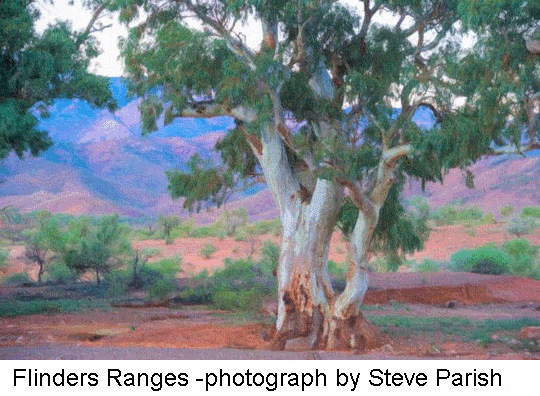 to put out – to persuade the Australian public that a radioactive waste dump is needed, in the beautiful Flinders Ranges.
It’s time that we all really woke up to the fact that the nuclear industry, its ignorant lobbyists and craven politicians, are incompetent simpletons regarding the global nuclear mess, and should not be trusted with their decisions that are aimed at furthering this toxic industry.

Rusted barrels of radioactive waste cost CSIRO $30 million Steven Trask, Canberra Times, 7 Mar 17
CSIRO faces a $30 million clean up bill after barrels of radioactive waste at a major facility were found to be “deteriorating rapidly” and possibly leaking.
An inspection found “significant rusting” on many of the 9,725 drums, which are understood to contain radioactive waste and other toxic chemicals.
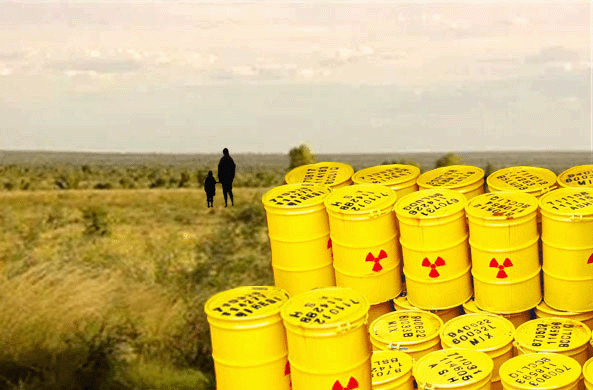
CSIRO flagged a $29.7 million budget provision for “remediation works” at a remote location in its latest annual report. Fairfax Media can reveal the work will take place at a CSIRO facility located on Department of Defence land near Woomera, South Australia.
The Woomera facility is currently one of Australia’s largest storage sites for low and intermediate-level radioactive waste. A damning report of the Woomera facility was issued by the Australian Radiation Protection and Nuclear Safety Agency (ARPANSA) after an inspection in April last year.
“Evidence was sighted that indicates the drums are now beginning to deteriorate rapidly,” read the report, seen by Fairfax Media. “Significant rust on a number of the drums, deterioration of the plastic drum-liners and crushing of some stacked drums was observed.” Tests confirmed the presence of radioactive isotopes at one location and inspectors said there was a possibility the drums were leaking.
“Although unlikely, there is the possibility that the presence of deceased animals such as rodents and birds may indicate that some of the drums, which contain industrial chemicals, may be leaking into the environment.”
The mixture of water and concentrated radioactive material inside some of the drums also had the potential to produce explosive hydrogen gas, inspectors found.
They also noted CSIRO had little knowledge of what was inside many of the barrels, some of which are believed to date back more than 50 years.
“Without full knowledge [of] the contents of the drums, risks cannot be fully identified and risk controls cannot be appropriately implements to protect people and the environment,” inspectors noted in the report.
Many of the drums are understood to contain contaminated soil generated by government research into radioactive ores at Melbourne’s Fishermans Bend throughout the 1940s and 1950s.
The toxic soil was discovered by the Department of Defence in 1989, who sent it to Sydney’s Lucas Heights facility before it was palmed off to Woomera in 1994.
An ARPANSA spokeswoman said the $29.7 million estimate would cover the characterisation, handling, re-packaging and storage of the toxic material.
“As a result of an ARPANSA inspection in 2016, it was recognised that additional work was required to scientifically characterise some of the contents of the legacy materials more accurately,” she said.
“The work that needs to be undertaken is significant.”
A spokesman for CSIRO said the first phase of the three-year clean up would begin next month.
“CSIRO currently has a radioactive waste store located on defence land at Woomera, South Australia. The store currently has 9,725 drums of long-lived waste,” he said…..
The country’s other major radioactive waste storage facility at Lucas Heights, Sydney, is rapidly approaching full capacity. Coupled with issues at the CSIRO site, the revelations highlighted the urgent need for a national radioactive waste storage solution, experts said.. http://www.canberratimes.com.au/national/rusted-barrels-of-radioactive-waste-cost-csiro-30-million-20170307-gusb6v.html
Where do candidates stand on nuclear waste dumping? Friends of the Earth are finding out
 Sounding out candidates on nuclear https://www.whyallanewsonline.com.au/story/5991908/sounding-out-candidates-on-nuclear/?fbclid=IwAR3jlaHvuyECA2gwYQCZOGo6ysCmFwSKSGtyFUA8hD4IEex8CKJg6lK3GkQ, Louis Mayfield 3Apr19
Friends of the Earth National Nuclear Campaigners have been speaking to candidates for the seat of Grey ahead of the federal election to see where they stand on the proposed nuclear waste dump regional SA.
Mara Bonacci and Jim Green were in Whyalla on Tuesday and met with trade unionists and one of the candidates for Grey.
The process of establishing a low-level and intermediate waste dump in Kimba or Hawker is currently delayed because of two court cases brought on by the Barngarla and Adnyamathanha traditional land owners.
“Unless people go out to find the information towns like Whyalla, Pirie or Lincoln don’t get it,” she said
“The Department of Industry, Innovation and Science are still open for submissions. People can still write to the government about this issue.”
Ms Bonacci said the scope of the federal government’s consultation during the site process had been very narrow.
“They’re looking at the sites proposed to house the facility rather than the towns it’s going to impact which is potentially all of the Eyre Peninsula,” she said.
Their visit is also a follow-up on a report from the Department of Industry, Innovation and Science made public last year which named Whalla, Port Pirie and Port Lincoln (among others) as potential nuclear waste ports. “There are communities that haven’t been told at all about being a nuclear port unless NGOs like the ones we work through had trawled through reports and identified these port towns,” Mr Green said.
“They’ve had no say, let alone a meaningful say on whether this goes ahead.”
To make a submission to the Department of Industry, Innovation and Science click here.
Julian Assange, Chelsea Manning, and the campaign to criminalise whistleblowing
Collateral Murder?
Chelsea Manning and the New Inquisition Truth Dig, Chris Hedges, 3 Apr 19
The U.S. government, determined to extradite and try Julian Assange for espionage, must find a way to separate what Assange and WikiLeaks did in publishing classified material leaked to them by Chelsea Manning from what The New York Times and The Washington Post did in publishing the same material. There is no federal law that prohibits the press from publishing government secrets. It is a crime, however, to steal them. The long persecution of Manning, who on March 8 was sent back to jail for refusing to testify before a grand jury, is about this issue.
If Manning, a former Army private, admits she was instructed by WikiLeaks and Assange in how to obtain and pass on the leaked material, which exposed U.S. war crimes in Afghanistan and Iraq, the publisher could be tried for the theft of classified documents. The prosecution of government whistleblowers was accelerated during the Obama administration, which under the Espionage Act charged eight people with leaking to the media—Thomas Drake, Shamai Leibowitz, Stephen Kim, Manning, Donald Sachtleben, Jeffrey Sterling, John Kiriakou and Edward Snowden. By the time Donald Trump took office, the vital connection between investigative reporters and sources inside the government had been severed.
Manning, who worked as an Army intelligence analyst in Iraq in 2009, provided WikiLeaks with over 500,000 documents copied from military and government archives, including the “Collateral Murder” video footage of an Army helicopter gunning down a group of unarmed civilians that included two Reuters journalists. She was arrested in 2010 and found guilty in 2013.
The campaign to criminalize whistleblowing has, by default, left the exposure of government lies, fraud and crimes to those who have the skills or access, as Manning and Edward Snowden did, needed to hack into or otherwise obtain government electronic documents. This is why hackers, and those who publish their material such as Assange and WikiLeaks, are being relentlessly persecuted. The goal of the corporate state is to shroud in total secrecy the inner workings of power, especially those activities that violate the law. Movement toward this goal is very far advanced. The failure of news organizations such as The New York Times and The Washington Post to vigorously defend Manning and Assange will soon come back to haunt them. The corporate state hardly intends to stop with Manning and Assange. The target is the press itself………
Manning has always insisted her leak of the classified documents and videos was prompted solely by her own conscience. She has refused to implicate Assange and WikiLeaks. Earlier this month, although President Barack Obama in 2010 commuted her 35-year sentence after she served seven years, she was jailed again for refusing to answer questions before a secret grand jury investigating Assange and WikiLeaks ……
The New York Times, Britain’s The Guardian, Spain’s El País, France’s Le Monde and Germany’s Der Spiegel all published the WikiLeaks files provided by Manning. How could they not? WikiLeaks had shamed them into doing their jobs. But once they took the incendiary material from Manning and Assange, these organizations callously abandoned them. No doubt they assume that by joining the lynch mob organized against the two they will be spared. They must not read history. What is taking place is a series of incremental steps designed to strangle the press and cement into place an American version of China’s totalitarian capitalism……….
“The internet, our greatest tool of emancipation,” Assange writes, “has been transformed into the most dangerous facilitator of totalitarianism we have ever seen.”
That is where we are headed. A few resist. Assange and Manning are two. Those who stand by passively as they are persecuted will be next. https://www.truthdig.com/articles/chelsea-manning-and-the-silencing-of-the-press/
Nuclear power has no place in USA’s Green New Deal-not a viable method against climate change
 Nuclear power is not a viable solution for Green New Deal https://thehill.com/opinion/energy-environment/437003-nuclear-power-is-not-a-viable-solution-for-green-new-deal, BY DAMON MOGLEN, — 04/02/19 The Green New Deal resolution is a bold and necessary path forward to tackle the climate crisis. To be successful, it must leave nuclear power behind. With just a decade left to stop the worst effects of climate change, we must dramatically transform how we produce, use and pay for energy. And as momentum around the Green New Deal turns into concrete proposals, we must recognize why nuclear power is a discredited and dishonest distraction, not a solution. Nuclear power is not a viable solution for Green New Deal https://thehill.com/opinion/energy-environment/437003-nuclear-power-is-not-a-viable-solution-for-green-new-deal, BY DAMON MOGLEN, — 04/02/19 The Green New Deal resolution is a bold and necessary path forward to tackle the climate crisis. To be successful, it must leave nuclear power behind. With just a decade left to stop the worst effects of climate change, we must dramatically transform how we produce, use and pay for energy. And as momentum around the Green New Deal turns into concrete proposals, we must recognize why nuclear power is a discredited and dishonest distraction, not a solution.
To reduce global greenhouse gas emissions by 40 to 60 percent by 2030, and down to zero by 2050, we need cost-effective, proven energy generation technology that can be scaled up to meet these benchmarks. Nuclear power does not and will not ever meet these criteria. After 60 years, despite massive subsidies, the nuclear industry is dying of its own accord. Why? Because it’s too expensive, too dangerous and dirty, and takes too long to deploy. Reactors are closing across the country, and major corporations have declared bankruptcy. Nuclear power simply cannot compete against safer, cleaner and cheaper renewable energy. Nuclear power is also expensive. Nuclear’s subsidies have been buried in hundreds of spending bills, it’s costs externalized to the environment and future generations, and its bills literally unpaid, defaulted on or passed to taxpayers. Conservative estimates suggest that the nuclear industry has received more than $85 billion in subsidies. A centrist estimate might double that. For 60 years, nuclear power has posed a serious risk to people and our planet. It will be the same for the next 10,000 years. Our children and generations of their children will be forced to endure the radioactive pollution and fallout from devastating accidents like 3 Mile Island, Fukashima and Chernobyl, and the permanent waste that no one can safely store. The risks of nuclear proliferation and the spread of dangerous weapons and technology only adds to this. Nuclear power is too slow to scale up to our current challenge. Far too slow. In 1997, when the historic Kyoto Protocol was signed, nuclear power’s share of electricity generation globally was around 17 percent. Now, after two decades, the aging fleet of reactors account for barely 10 percent of global electricity generation and about 4.4 percent of global commercial primary energy consumption. Even the nuclear industry’s grandiose and preposterously expensive proposal to build two new nuclear reactors a month, from now to 2050, would be far too little and far too late. The endless talk of a new nuclear technology that will magically transform this problem is a pipe dream that has a proven record of failure. Hundreds of billions were spent on “breeder” reactors and other esoteric designs and not a single one has yielded a commercial scale reactor. And continuing to subsidize and retool current reactors will re-direct massive resources that should be put into renewables, while doing nothing to slow global warming. The task ahead is indeed daunting if we are to turn around global greenhouse gas emissions in the time we have. We must move from a 20th-century energy system based on dirty, dangerous and expensive fossil fuel and nuclear power to a 21st-century energy system based on renewables. The solution is a massive commitment to ramping up renewable energy coupled with energy storage while applying modern energy efficiency technologies to decrease demand. Wind and solar are cheap, clean and proven to work. We must focus all resources on scaling those up. Some have suggested that climate change is so dire that all options must be on the table. But that’s an ideology, not a strategy. We must choose the technologies that will not produce greenhouse gases and can be scaled up quickly, safely and at lowest cost. That means the path ahead must be based on renewable energy. If we want to stop the worse of the climate crisis and pull humanity back from the apocalypse, this is the only way forward. Damon Moglen is a senior strategic advisor to Friends of the Earth, with over 30 years experience campaigning on climate and nuclear issues. |
|
Australia gets a very bad environmental report for 2018
 Australia’s 2018 environmental scorecard: a dreadful year that demands action The Conversation, Albert Van Dijk, Professor, Water and Landscape Dynamics, Fenner School of Environment & Society, Australian National University, April 4, 2019 Environmental news is rarely good. But even by those low standards, 2018 was especially bad. That is the main conclusion from Australia’s Environment in 2018, the latest in an annual series of environmental condition reports, released today.
Every year, we analyse vast amounts of measurements from satellites and on-ground stations using algorithms and prediction models on a supercomputer. These volumes of data are turned into regional summary accounts that can be explored on our Australian Environment Explorer website. We interpret these data, along with other information from national and international reports, to assess how our environment is tracking.
A bad year
Whereas 2017 was already quite bad, 2018 saw many indicators dip even further into the red. Temperatures went up again, rainfall declined further, and the destruction of vegetation and ecosystems by drought, fire and land clearing continued. Soil moisture, rivers and wetlands all declined, and vegetation growth was poor.
In short, our environment took a beating in 2018, and that was even before the oppressive heatwaves, bushfires and Darling River fish kills of January 2019.
The combined pressures from habitat destruction, climate change, and invasive pests and diseases are taking their toll on our unique plants and animals. Another 54 species were added to the official list of threatened species, which now stands at 1,775. That is 47% more than 18 years ago and puts Australia among the world’s worst performers in biodiversity protection. On the upside, the number of predator-proof islands or fenced-off reserves in Australia reached 188 in 2018, covering close to 2,500 square kilometres. They offer good prospects of saving at least 13 mammal species from extinction. ……..
A bad start to 2019
Although it is too early for a full picture, the first months of 2019 continued as badly as 2018 ended. The 2018-19 summer broke heat records across the country by large margins, bushfires raged through Tasmania’s forests, and a sudden turn in the hot weather killed scores of fish in the Darling River. The monsoon in northern Australia did not come until late January, the latest in decades, but then dumped a huge amount of rain on northern Queensland, flooding vast swathes of land……. https://theconversation.com/australias-2018-environmental-scorecard-a-dreadful-year-that-demands-action-114760
Coalition signs off with a budget tailored for climate denial — RenewEconomy

Coalition budget ignores climate science and its own mediocre targets – even the climate solutions fund has been reduced to a trickle feed. The post Coalition signs off with a budget tailored for climate denial appeared first on RenewEconomy.
via Coalition signs off with a budget tailored for climate denial — RenewEconomy
April 3 Energy News — geoharvey

Opinion: ¶ “Bold Thinking Needed To Dig Australia Out Of Self-Inflicted Energy Import-Export Dilemma” • Australia’s largest export commodity, coal, is in accelerating structural decline, and liquid fossil fuel imports are expanding, increasing Australia’s exposure to supply chain risks. And it is all carbon-intensive, swimming against a global tide. [RenewEconomy] ¶ “Nuclear Power Is Not […]
1 This month.

Australians deserve the truth
about
AUKUS – https://aukuspublicinquiry.com/


PETITION – To: Prime Minister Anthony Albanese and the Australian Labor Government

of the week – Australians for War Powers Reform (AWPR)
To see nuclear-related stories in greater depth and intensity
 Antinuclear