Huge Pilbara wind and solar project may get even bigger as focus turns to green hydrogen — RenewEconomy

The developers of the massive 11GW wind and solar project proposed in the Pilbara in north west Australia have hinted the project could get even bigger as it eyes huge markets for green hydrogen in the Asia market. The so-called Asia Renewable Energy Hub is the largest project of its type being developed in the……
Australian Mining touts Honeymoon uranium mine, but only IF URANIUM PRICE IMPROVES
 They headed the article “Boss discovers ‘major breakthrough‘ for Honeymoon uranium expansion ” and went on to detail how the Honeymoon uranium mine project restart in South Australia will ramp up production. But even in its enthusiasm, , Australian mining gave a hint about the low prospects for the uranium industry. It will all happen – “ assuming a favourable global uranium price for shareholders is achieved” https://www.australianmining.com.au/news/boss-resources-discovers-major-breakthrough-for-honeymoon-expansion/
March was the hottest month ever recorded in Australia
 SBS News, 3 Apr 19, March was the hottest on record for Australia, the Bureau of Meteorology says, but a wet end to the month saved it from being the driest. Australia has sweltered through its hottest March on record.
The national mean temperature was 27.7C, making it 2.13C above average according to The Bureau of Meteorology’s monthly climate report.
It was particularly warm in the Northern Territory and Western Australia, both of which posted their hottest March on record, while it was among the six warmest for NSW, Queensland and South Australia.
In Rabbit Flat, northwest of Alice Springs, temperatures reached at least 39C for 115 straight days between December 1 and March 25 – smashing the previous record of 106 days at Marble Bar in WA in 1921-22.
A “vigorous trough” and cold front across southern Australia cooled temperatures down towards the end of the month, the report said….https://www.sbs.com.au/news/march-was-the-hottest-month-ever-recorded-in-australia
Effects of low level radiation followed through generations- research in Kazakhstan

Over the years, those who sought care from Dispensary No. 4 or the IRME were logged in the state’s medical registry, which tracks the health of people exposed to the Polygon tests. People are grouped by generation and by how much radiation they received, on the basis of where they lived. Although the registry does not include every person who was affected, at one point it listed more than 351,000 individuals across 3 generations. More than one-third of these have died, and many others have migrated or lost contact. But according to Muldagaliev, about 10,000 people have been continually observed since 1962. Researchers consider the registry an important and relatively unexplored resource for understanding the effects of long-term and low-dose radiation2.
Geneticists have been able to use these remaining records to investigate the generational effects of radiation…….
In 2002, Dubrova and his colleagues reported that the mutation rate in the germ lines of those who had been directly exposed was nearly twice that found in controls3. The effects continued in subsequent generations that had not been directly exposed to the blasts. Their children had a 50% higher rate of germline mutation than controls had. Dubrova thinks that if researchers can establish the pattern of mutation in the offspring of irradiated parents, then there could be a way to predict the long-term, intergenerational health risks.
Much of what’s known about the health impacts of radiation comes from studies of acute exposure — for example, the atomic blasts that levelled Hiroshima and Nagasaki in Japan or the nuclear disaster at Chernobyl in Ukraine. Studies of those events provided grim lessons on the effects of high-level exposure, as well as the lingering impacts on the environment and people who were exposed. Such work, however, has found little evidence that the health effects are passed on across generations.
People living near the Polygon were exposed not only to acute bursts, but also to low doses of radiation over the course of decades (see ‘Danger on the wind’). Kazakh researchers have been collecting data on those who lived through the detonations, as well as their children and their children’s children. Continue reading
Huge Pilbara wind and solar project may get even bigger as focus turns to green hydrogen — RenewEconomy
The developers of the massive 11GW wind and solar project proposed in the Pilbara in north west Australia have hinted the project could get even bigger as it eyes huge markets for green hydrogen in the Asia market. The so-called Asia Renewable Energy Hub is the largest project of its type being developed in the……
Massive 700MW wind farm proposed for Victoria’s south west — RenewEconomy

Victoria’s Moyne Shire is being sized up for what could be a massive 700MW wind farm, in a proposal from locally-based renewable energy developer Wind Prospect. The post Massive 700MW wind farm proposed for Victoria’s south west appeared first on RenewEconomy.
via Massive 700MW wind farm proposed for Victoria’s south west — RenewEconomy
Renewable energy now accounts for a third of global power capacity — RenewEconomy

IRENA says 171 GW of new renewable energy capacity in 2018 means a third of global power capacity is now provided by renewables. The post Renewable energy now accounts for a third of global power capacity appeared first on RenewEconomy.
via Renewable energy now accounts for a third of global power capacity — RenewEconomy
Australia’s biggest customers are abandoning coal-fired power projects — RenewEconomy

Australian government forecasts declining revenue from thermal coal, something they will need to come to terms with. The post Australia’s biggest customers are abandoning coal-fired power projects appeared first on RenewEconomy.
via Australia’s biggest customers are abandoning coal-fired power projects — RenewEconomy
Australia: 100% renewables could be cheaper, quicker and easier than thought — RenewEconomy

Windlab says detailed study of last two years of NEM demand shows that switch to 100% renewables could be cheaper, quicker and easier than previously thought. The post Australia: 100% renewables could be cheaper, quicker and easier than thought appeared first on RenewEconomy.
via Australia: 100% renewables could be cheaper, quicker and easier than thought — RenewEconomy
Bank Australia signs up for 100% renewables, calls on business to lead transition — RenewEconomy

Bank Australia becomes second Australian company to sign up for 100 per cent renewable energy initiative, and calls on other business to lead transition. The post Bank Australia signs up for 100% renewables, calls on business to lead transition appeared first on RenewEconomy.
via Bank Australia signs up for 100% renewables, calls on business to lead transition — RenewEconomy
Fate of big solar projects could ride on May poll, and carbon credits — RenewEconomy

Analyst says federal election critical to fate of large scale solar industry in Australia, and raises prospects of carbon credits playing a role in funding. The post Fate of big solar projects could ride on May poll, and carbon credits appeared first on RenewEconomy.
via Fate of big solar projects could ride on May poll, and carbon credits — RenewEconomy
Climate and nuclear news to 2nd April
 Serious indeed, as the nuclear threat is, the climate change threat is upon the world right now, and it’s accelerating. Paul Beckwith’s videos explain how Every spring, for the past 25 years, the World Meteorological Organization (WMO) releases their State of the Climate report. This years edition clearly shows how dire our climate situation is becoming https://www.youtube.com/watch?v=l4-Cb3bG9Sk
Climate change, while it is, eventually, a threat to everybody, is also very much an issue of injustice. While the rich world braces for future climate change, the poor world is already being devastated by it. youtube https://www.youtube.com/watch?v=lQo5bIp4P5Q. It’s also an issue of generational injustice with the children at the losing end of this betrayal.
AUSTRALIA
CLIMATE. Poll shows Australians increasingly see climate change as human-caused. Government ‘failing’ on climate change: poll . Labor’s climate plan. Bill Shorten’s climate policy, much better than Liberals’; it might appeal to some Liberal voters? Shorten’s climate policy would hit more big polluters harder and set electric car target. Labor sets 50 per cent Electric Vehicle (EV) targets for new vehicle sales and government fleets.
NUCLEAR. – Coalition government rejects Clive Palmer’s call for nuclear power for Australia. Clive Palmer will promise to build a nuclear reactor in South Australia.
The Australian govnt and ANSTO classify spent nuclear fuel from Lucas Heights as intermediate-level nuclear waste. Even in 1998, the nuclear lobby and Nick Minchin, were scheming for an international nuclear waste dump in South Australia. Nuclear waste dump proposal divides rural communities in South Australia.
URANIUM. Western Australian Aboriginal community uses solar hydropanel to solve problem of uranium in water.
RARE EARTHS. Construction begins on Australia’s biggest lithium processing plant. Lynas silent on long-term effects of radioactive waste. Malaysia wants Australia to help remove Lynas’ radioactive trash from rare earths processing. Lynas considers relocating its rare earths processing to Western Australia.
RENEWABLE ENERGY. Australia’s plunging wind, solar, storage costs stun fossil fuel industry. It took just two summers for renewables to replace Hazelwood coal-power station. Huge wind farm planned for Victoria’s coal centre, overlooking closed Hazelwood plant. Bad news. Closing coal-fired power stations costs jobs. We need to prepare. Coalition grants permit for Australia’s first offshore wind farm. AusNet: We’ve been swamped by the solar boom, and we’ve made some mistakes. Queensland delivers first “solar hydrogen” exports to Japan, backs pilot plant.
INTERNATIONAL
The unique role of the Earth Journalism Network (EJN).
Research group finds that ending the USA-Russia arms pact will bring about a nuclear weapons race. The huge financial risks of nuclear incidents.
Age and Gender Bias in Radiation Research.
Coalition government rejects Clive Palmer’s call for nuclear power for Australia
 Clive Palmer’s nuclear power plan for SA knocked back by Coalition, Chris Russell, The Advertiser, March 31, 2019
A push by the United Australia Party for nuclear power has been swiftly rejected by the Federal Government.
A spokesman for the party led by Clive Palmer confirmed nuclear was on the agenda.
“South Australia has a major energy problem and we, as a party, are discussing nuclear,” he said. “Australia has uranium reserves and nuclear is emissions free.
“Kristian Rees, our number one senate candidate is speaking with his SA candidates and party members on major issues like cheaper power, manufacturing and jobs.”
A planned announcement on nuclear power, reported by the Sunday Mail, was revealed early by Professor Adrian Cheok who quit the party despite being the No. 2 Senate candidate in SA.
The party spokesman said it was “disappointing someone who didn’t get what they wanted leaked confidential discussions”.
Federal Energy Minister Angus Taylor rejected the nuclear call.
“Nuclear power remains illegal in Australia and highly expensive to build and operate,” he said.
The Government has short-listed electricity generation projects that could warrant underwriting — but the program specifically excluded nuclear.
Last financial year, SA generated more electricity than it used, exporting the excess to Victoria.
Wholesale prices were 11 per cent lower than the year before, according to the Australian Energy Market Operator’s report on SA electricity.
Mr Palmer is the national leader but has yet to nominate for a seat. His options include his former seat of Fairfax, on the Sunshine Coast, and Herbert, based in Townsville.
The Senate ticket for Queensland also is unresolved.
A party spokesman said Mr Palmer was expected to be endorsed “very soon”.
Western Australian Aboriginal community uses solar hydropanel to solve problem of uranium in water
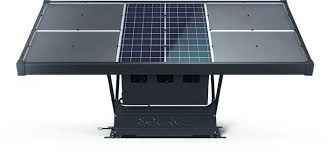 Buttah Windee in remote WA now has clean water thanks to solar hydropanel technology https://www.abc.net.au/news/2019-03-31/solar-hydropanels-fix-water-supply-in-remote-community/10941788?fbclid=IwAR2j446RfOuRIZNBC0K1xY6CWBq3Jnn48zx0b-WiuI8o96Jklb-bL1pfZHQ
Key points:
- Six solar hydropanels have been installed in the small WA community, capturing 900 litres of water a month from the air
- The community had discovered its water supply contained uranium more than twice the national health standard, and the State Government deemed it too expensive to address
- With the help of crowdfunding and technology donated by a WA company, the residents of the community no longer need to live elsewhere
The remote Aboriginal community is 760 kilometres north-east of Perth on the outskirts of Meekatharra.
Almost a decade ago, resident Andrew Binsiar discovered the community’s water was tainted with naturally occurring uranium at more than twice the national health standard.
“I was actually very surprised,” he said.
“You’d imagine people would test the water for human consumption before people are allowed to drink it.”
Unable to drink the community’s tap water, most of the 50 people who lived at Buttah Windee left.
Too expensive to fix: State Government
But for Andrew Binsiar and his wife Janine, leaving the home where they had raised their five children was not an option.
He turned to the State Government for help, but was told fixing the water supply would be too expensive.
“They come out and put up ‘do not drink the water’ signs and that was their solution to it,” Mr Binsiar said.
The State Government offered to move the remaining residents into state housing in Meekatharra, but Mr Binsiar was apprehensive about exposing his family to the town’s social issues.
“We knocked them back … for the simple reason I’d already been there and done that. My life changed when I moved here,” he said.
“I wasn’t a very good father when I lived in Meeka.”
Solar hydropanels pull water from air
Almost a decade on, Buttah Windee is the first remote Aboriginal community in Australia to use innovative technology for its water supply.
Six solar hydropanels have been installed at the outback community, donated by a WA company who heard about the community’s plight and wanted to help out.
Director of Wilco Electrical Frank Mitchell said the units captured water from the air and produced up to 900 litres of water a month.
“Those fans, you can hear them whirring away, are just drawing in air all day, all around, and the piece of material inside collects … the moisture in the air, then condenses down into the tank where it’s got a pump straight out to the tap,” he said.
Mr Binsiar said it was a simple idea, which should be introduced to all remote communities.
“Water is a basic human right that everyone deserves,” he said.
“It could mean better health for your children … I would guarantee that most communities have bad water.”
Crowdfunding rallies support
The near decade-long battle for clean drinking water has not come easily for the Buttah Windee residents, with Mr Binsiar turning to crowdfunding as a last resort.
Word spread quickly when Mr Binsiar began the fundraising campaign last year, and people from across Australia donated nearly $26,000 in three months.
“It was a huge success. The Australian public have been awesome,” he said.
Mr Binsiar used the funds to install a reverse osmosis water treatment plant.
“Reverse osmosis takes out all the contaminants in the water … on the back end of it, it puts the minerals your body needs back into the water,” he said.
“They’ve given us a chance where no-one else would and we are really proud of what we have done here.”
Barramundi fish farm to boost employment
The two separate systems now supply the community with safe drinking water and enough water to run a small barramundi fish farm.
Mr Binsiar and several residents built the fish farm hoping it would eventually provide local employment and a potential source of income. “Hopefully we can continue on and make it bigger and provide this region with fresh barramundi,” he said.
“I’d like to welcome everyone out to Buttah Windee and come and look at the work we do.”
Malaysia wants Australia to help remove Lynas’ radioactive trash from rare earths processing
 Malaysia turns up heat on Australia over Lynas waste, Brad Thompson, Fin Rev, 1 Apr 19, A senior Malaysia politician says the Australian government has been asked to collaborate on the removal of low-level radioactive waste produced by Lynas Corporation’s rare earths processing operations.
Deputy environment and climate change minister Isnaraissah Munirah Majilis said an official letter requesting collaboration had been sent to the Australian government last month, in another sign Malaysia is determined to have the waste removed despite suggestions from Lynas it is close to …… (Subscribers only) https://www.afr.com/business/mining/history-stacks-up-against-wesfarmers-and-rare-earths-plant-20190401-p519q3
1 This month.

Australians deserve the truth
about
AUKUS – https://aukuspublicinquiry.com/

PETITION – To: Prime Minister Anthony Albanese and the Australian Labor Government

of the week – Australians for War Powers Reform (AWPR)
To see nuclear-related stories in greater depth and intensity
 Antinuclear