A return to Greenham Common? — Beyond Nuclear International

US withdrawal from INF could make Europe a nuclear battleground again
via A return to Greenham Common? — Beyond Nuclear International
Psychological aspects of the fact that climate change has arrived in Australia

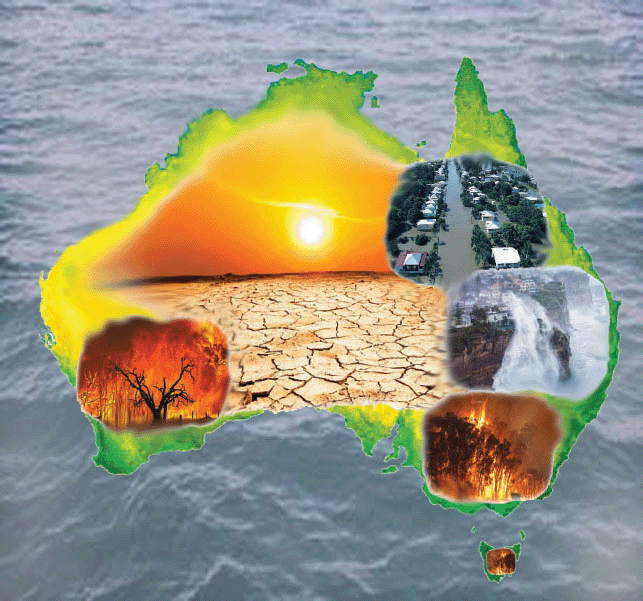 The climate crisis has arrived – so stop feeling guilty and start imagining your future The Conversation, The Conversation Principal Lecturer in Psychology, University of Brighton February 7, 2019
Evidence of the devastating impacts of anthropogenic climate change are stacking up, and it is becoming horrifyingly real. There can be no doubt that the climate crisis has arrived. Yet another “shocking new study” led The Guardian and various other news media this week. One-third of Himalayan ice cap, they report, is doomed.
Meanwhile in Australia, record summer temperatures have wrought unprecedented devastation of biblical proportions – mass deaths of horses, bats and fish are reported across the country, while the island state of Tasmania burns. In some places this version of summer is a terrifying new normal.
The climate disaster future is increasingly becoming the present – and, as the evidence piles up, it is tempting to ask questions about its likely public reception. Numerous psychological perspectives suggest that if we have already invested energy in denying the reality of a situation we experience as profoundly troubling, the closer it gets, the more effort we put into denying it.
When it comes to the climate crisis, the personal is political. I am talking about a politics that grows from opposition and critique of our current systems. This is evident in young people organising school strikes and protesters willing to get arrested for their direct action. But we also need to pay more attention to what is lost, to who and what we care for, to other possible ways of being.
Some conservation scientists, at least, see recent cultural change as a hopeful sign of a growing sense of care and responsibility. So stop feeling guilty, it’s not your fault. Be attentive to what’s going on, so that you might notice what you care about and why. What are you capable of, and what might we be capable of together, when we aren’t caught between knowing and not knowing, denial and distress?
Pentagon’s Secret Underground Nuclear City In The Arctic
The ultimate objective was to place medium-range missiles under the ice — close enough to strike targets within the Soviet Union.
YouTube series “The Real Secrets of Antarctica” revealed how the project came to light in January 1995.
The 2017 documentary detailed: “Some very interesting disclosures were declassified about US military installations in Greenland which took place in the 1960s.
“They fed the American people a highly publicised story about advances in research and building an underground city below Greenland called Camp Century.
Only later did the truth about Project Iceworm surface.
“The Pentagon was attempting to put in place mobile nuclear launching sites to utilise thousands of miles of tunnels.”
Project Iceworm was to be a system of tunnels 2,500 miles in length, used to deploy up to 600 nuclear missiles, that would be able to reach the Soviet Union in case of nuclear war.
The missile locations would be under the cover of Greenland’s ice sheet and were supposed to be periodically changed.
A total of 21 trenches were cut and covered with arched roofs within which prefabricated buildings were erected.
These tunnels also contained a hospital, a shop, a theatre, and a church and the total number of inhabitants was around 200.
From 1960 until 1963 the electricity supply was provided by means of the world’s first mobile nuclear reactor, named PM-2A.
Water was supplied by melting glaciers and tested to determine whether germs were present, including tests for the plague virus.
However, just three years after it was built, ice core samples taken by geologists demonstrated that the glacier was moving much faster than anticipated and would destroy the tunnels and planned launch stations in about two years.
The facility was evacuated in 1965, and the nuclear generator removed.
Project Iceworm was canceled, and Camp Century closed in 1966.
New South Wales Labor announces plan for 500,000 households to get rooftop solar
Labor announces plan for 500,000 households to get rooftop solar, https://www.smh.com.au/national/nsw/labor-announces-plan-for-500-000-households-to-get-rooftop-solar-20190209-p50wrl.html, By Laura Chung,February 9, 2019 NSW Labor has announced it will support a program to help 500,000 households to install rooftop solar, reducing electricity bills in the next 10 years.
Under Labor’s Solar Homes policy, owner-occupied households in NSW with a combined income of $180,000 or less would be eligible for a rebate, to be capped at $2200 per household.
Shadow Minister for Energy and Climate Change, Adam Searle, said the policy could add solar to an additional million homes over the next decade, and could save the average household anywhere between $600 and $1000 a year on electricity bills.
“This is a bold program to push NSW to the front of the energy revolution,” he said. “This will significantly cut electricity bills and carbon emissions.”
“We will have much more to say about energy and tackling climate change.”
The program would be phased in during the 2019-2020 financial year. The policy announcement comes ahead of the launch of Labor’s campaign bus, which will travel around the state from Sunday.
The Smart Energy Council said Labor’s policy addressed two of NSW residents’ main concerns: the cost of living and climate change.
It shows “a strong commitment towards climate change” and is a “sign of confidence in renewable energy, a critical part of NSW’s future,” a spokesman said.
The council said it would like to see a stronger commitment from both the NSW Government and the Opposition to supporting families’ purchases of household solar batteries, which would provide people “with a greater sense of control of power and how they use power.”
In a statement, deputy leader of NSW Liberals Dominic Perrottet said Labor “cannot be trusted” to deliver more affordable, reliable and clean energy, “with a history of energy cost blowouts and blunders”.
The NSW Coalition government “is getting on with the job of taking pressure off electricity prices, while maintaining energy security,” Mr Perrottet said.
February 10 Energy News — geoharvey

Opinion: ¶ “Lessons About The Contemporary State Of Fossil Fuels – Venezuela-Style” • Let’s look at Venezuela, which is in trouble despite vast oil resources, and try to understand why it’s suddenly unable to extract them. The lesson from one country may be instructive to other oil-producing countries around the world – like the US. […]
Nuclear “education” – theme for February 2019
We’re now in the era of “STEM education” – Science Technology, Engineering, Mathematics” – and how the nuclear industry loves this! Don’t get me wrong. I think that everyone should have a good knowledge especially of maths and science.
BUT – alongside the current fervour for STEM, is a very wrong downgrading of the humanities – the so-called “soft subjects”. At this critical time of climate change and nuclear danger, we really need the insights from art, history, culture, sociology – the human studies – to help us to know what to do.
The nuclear industry thrives on this almost religious belief that technology is the answer. And of course, who is to educate us about nuclear technology, and how much we need it etc? That’s a no-brainer. On the whole, education about nuclear power relies on information from the nuclear industry. That is either not forthcoming or is a comfortable ‘we know best’ assurance, allied with technical information – designed to reiterate that only the nuclear experts can really understand it – so don’t bother your pretty little heads about it.
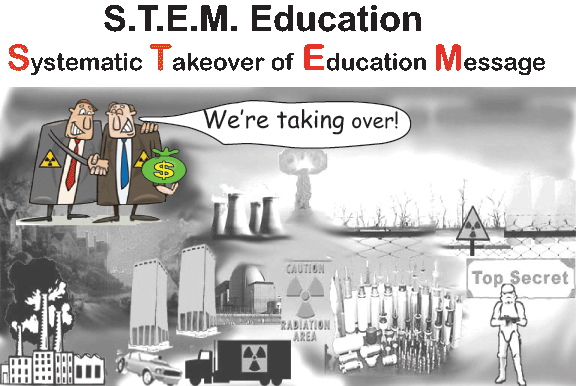
Much of the media mindlessly regurgitates information from the industry, but fortunately, not all of it.
It’s in academia that the nuclear industry increasingly gets a foothold, and of course, 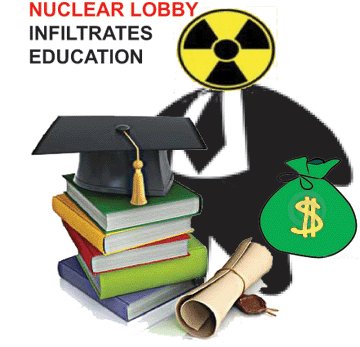 universities like to get the funding grants. Just a few examples: University of Birmingham (UK) University of Bristol; University of Oxford; Kyoto University. University of California. University of Tasmania.
But, of course, the nuclear lobby ‘s “education” is all over the place, with the International Atomic Energy Agency (IAEA) running courses in the Asia Pacific and elsewhere. And Russia, expanding its nuclear propaganda to Asia, Africa, the Middle East.
Community education is a nuclear lobby speciality – to Boy Scouts, many other organisations, and especially to where the industry wants to dump radioactive trash.
Would we trust tobacco companies to control education about healthy lungs, and lung disease? So why rely on the IAEA etc for education about nuclear power?
Contrary to what ANSTO says, nuclear waste returning to Australia IS High Level Waste (HLW)
Gary See Fight To Stop Nuclear Waste Dump In Flinders Ranges SA https://www.facebook.com/groups/344452605899556/,
Scotland’s Environment Protection Agency (SEPA) clearly state that it considers radioactive waste generated at Sellafield in England, and heading to Australia, to be vitrified High Level waste, despite what ANSTO call it. https://www.gov.scot/…/0038…/00389151-pdf/govscot%3Adocument
 Steve Dale To think politicians and the nuclear people here got together to deliberately deceive the Australian public – to call what other countries calls “High Level Waste” something else. It’s the same toxic, corrupt thinking that brought us Maralinga. At left is a picture of High Level Waste from a UK document – looks (and is) the same as the stuff they have at Lucas Heights (same link)
from here:
https://webarchive.nationalarchives.gov.uk/…/radwaste.pdf
The growing danger of the radioactive by-products from the nuclear industry

From mining the uranium rich ore, to nuclear abandonment – a dozen by-products more radio toxic than the ore mined to fuel the reactor are discarded. These products are the raffinates culminating in 85% of the total radioactivity that goes directly into the tailings only to migrate throughout the environment.
Products like Radon gas, Polonium-210 with a 140 day half life, Radium-226, with a 1600 year half life, Thorium-230 with a 76,000 year half life are released , and yet only 1kg of Uranium oxide is recovered in every 4,000 kilos mined.
Uranium-238 subjected to neutron bombardment in the reactor becomes Uranium-239 with a 23 minute half life, then that becomes Neptunium-239 with a 2.3 day half life, and that goes on to become Plutonium-239 with a 244,000 year half life, then this spent fuel finally decays to become Uranium- 235 with a half life of 700 million years.
Moreover, x that by no less than 10 to get the life of the radioactive hazard, which equates to no less than 7 billion years, and here we have only just crossed the nuclear industries threshold within the last 76 years with many thousands of nuclear events, and accidents recorded, and yet this is not the only wastes these machines produce with one Canadian CANDU reactor that recorded 100 trillion becquerels of radiation from the Tritium released in just one year.
The nuclear embracing coterie tell us they can safely manage these radioactive wastes, yet there containment vessels are only guaranteed for 25 years not 7 billion years, and a director of Holtec has stated there is no way to remedy a breach of containment. Moreover these nuclear wastes are a gamble and risk that only grows exponentially with every generation.
Cancer rates increase: the focus must be on prevention, on researching environmental causes
 Laura N. Vandenberg: It’s time to talk about cancer prevention — and the role of the environment https://www.ehn.org/laura-n-vandenberg-its-time-to-talk-about-cancer-prevention-2628192178.html
An inadequate focus on researching and understanding the role of the environment in cancer prevention is a failure for public health. Laura N. Vandenberg 8 Feb 19,
Such funding is crucial to continue tackling the devastating disease. However, missing from the State of the Union—and most other conversations about tackling cancer—is a focus on prevention, specifically the need to research, understand and communicate the role environmental exposures play in cancer risk.
The numbers on cancer incidence and deaths are complex. Although childhood cancer mortality rates have dropped considerably from the 1960s, data from the American Cancer Society shows that incidence rates have increased 0.6 percent per year since 1975.
In this way, childhood cancers are like several others. Between 2005 and 2014, yearly cancer incidence rates rose for several types: thyroid cancer by 4 percent; invasive breast cancer by 0.3 percent in black women; leukemia by 1.6 percent; liver cancer by 3 percent; oral and pharynx cancers by 1 percent in Caucasians; pancreatic cancer by 1 percent in Caucasians; colon cancer by 1.4 percent in individuals younger than 55 years of age; rectal cancer by 2.4 percent in individuals younger than 55; and melanoma by 3 percent in individuals aged 50 and older.
While these cancer rates have increased, overall rates of cancer deaths have started to fall. In fact, since the 1990s, improved detection and treatment, as well as decreased smoking rates, have contributed to significant reductions in cancer mortality.
Reduced deaths from cancer are a great public health victory. These statistics prove that public health interventions like educational programs designed to curb smoking can have dramatic effects.
They also suggest that investments in improved detection and diagnosis are money well spent. A focus on treatments has also improved quality of life for cancer patients and their likelihood of remission.
But where is the call for better cancer prevention? As rates of numerous cancers continue to rise, the failure to identify the causes of cancer remains a disappointment for public health officials and researchers alike.
We know that environmental factors can contribute to cancer risk. Some, like smoking, are avoidable. Others are lifestyle factors that people can change like drinking less alcohol, decreasing consumption of processed meats, using protection from the sun, and increasing exercise.
Yet, other environmental factors like exposures to chemicals in the environment, including endocrine disruptors, have received little attention. While some NIH-funded programs like the Breast Cancer and Environment Research Program have worked to identify chemicals in the environment that promote cancer, funding for cancer prevention initiatives has stagnated.
Despite the limited resources invested in studies of environmental risk factors for cancer, we know enough to take action on some chemicals of concern.
For example, communities contaminated with perfluorinated chemicals, several of which are known to cause cancer, have demanded attention from government officials in addition to asking for more research.
Individuals living in these communities have the right to know how they are being exposed, and what their risks might be – for cancer and other diseases.
It is great that cancer research was raised in the President’s State of the Union speech, and that the difficulties associated with caring for a family member with cancer was mentioned in Stacey Abrams’ rebuttal.
But a failure to focus on prevention, a failure to acknowledge the role of the environment in causing cancer, and a failure to allocate funds to prevention research, are all failures for public health.
Dr. Vandenberg is an Associate Professor of Environmental Health Sciences at the University of Massachusetts Amherst School of Public Health and Health Sciences. Her work on endocrine disrupting chemicals has been funded by the National Institutes of Health including the BCERP program, which focuses on the environmental causes of breast cancer.
Climate change already having drastic effects on Torres Strait islands
 Climate change eats away at Torres Strait islands, prompting calls for long-term solutions, ABC Far North
A flood prevention method that withstood wild weather this week may be rolled out to other vulnerable Torres Strait communities, including Yam Island where families were left homeless after king tides last year.
Torres Strait Island Regional Council deputy mayor Getano Lui said geotextile sandbags were used for the first time in the Torres Strait this week when abnormally high tides impacted Poruma Island, a cultural hub home to just 200 people.
“It’s getting worse every year,” he said.”Climate change is really having a detrimental effect on all the communities.
“When I was growing up the elders could predict the weather but right now it’s unpredictable.
“The worst is yet to come this year, the king tides are predicted [on February 19] and anything could happen, we could end up with the same catastrophe as Yam Island last year.”
Connection to land, culture under threat
Research from the Torres Strait Regional Authority shows sea levels are rising by 6mm each year — double the global average.
“If this trend continues, relocation is an option many of those on the Torres Strait’s 200 islands and coral cays may be faced with,” Mr Lui said.
“What is instilled in us and our ancestors is if the Torres Strait sinks, we’ll sink with it.
“We would be very reluctant to be relocated.
“Most of us would refuse to leave.”
Torres Shire Council mayor Vonda Malone said the region’s two councils would now look at installing the sandbags on other vulnerable islands such as Yam Island, Masig Island and Boigu.
“The weather over the last two weeks has been unpredictable; it has been full on,” she said…..
Sinking cemeteries a concern for State MP
….https://www.abc.net.au/news/2019-02-09/call-for-increased-flood-protection-in-torres-strait/10794696
Bob Brown to lead anti coal mine convoy from Hobart to Queensland’s Galilee Basin, and Canberra
 Dr Bob Brown leads anti coal mine convoy, Examiner, Sue Bailey 7 Feb 19,
About 100 Tasmanians have so far signed up to join an anti-Adani coal mine road convoy which organisers say will be bigger than the protest to stop the damming of the Franklin River.
Environmentalist and former Australian Greens leader Bob Brown says if the Adani coal mine goes ahead a peaceful protest convoy will leave Hobart on April 17 bound for Queensland’s Galilee Basin and then back to Canberra ahead of the federal election.
“Now that’s an economic, employment and environmental win for Tasmania and Australia.
Dr Brown said thousands of people joined the Franklin blockade and hundreds were arrested and he expected many Australians would join the convoy which would travel through Melbourne, Sydney and Brisbane.
He said the Federal and Queensland governments should not tick off the mine and Labor would be foolish to support it.
“Bloomberg says this is the most contentious coal mine on earth,” Dr Brown said.
“Climate change is the big vote changer.
“Adani is a litmus test for common sense in this age of global heating.”
Dr Brown said 1100 people,including 100 Tasmanians, had already expressed interest in joining the convoy which will be led by electric cars and other vehicles…….. https://www.examiner.com.au/story/5892738/dr-bob-brown-leads-anti-coal-mine-convoy/?cs=95
Anti Adani protesters rally outside the Sydney Mining Club
 Anti-Adani protesters outside CEO speech, SBS , 8 Feb 19,
A group of protesters have rallied outside the Sydney Mining Club, where Adani Australia’s CEO was speaking about the company’s Carmichael coal mine. More than 100 people have rallied against Adani’s controversial Carmichael coal mine as the company’s Australian boss spruiked the project to industry figures.
The protesters carried placards and chanted loudly outside the Sydney Mining Club on Thursday as chief executive Lucas Dow delivered his lunchtime speech.
“We’re not going to stop until they listen,” one speaker told the crowd……..
The Queensland government in January appointed an environmental group to review the mine’s management plan, including plans to conserve 33,000 hectares of pastoral land bought near the 1300-hectare site to offset habitat loss for black-throated finch.
The LNP believes the move has put the project at risk. https://www.sbs.com.au/news/anti-adani-protesters-outside-ceo-speech
Antarctic and Greenland melting ice sheets may cause climate chaos

Melting ice sheets may cause ‘climate chaos’: study, Daily Nation, FEBRUARY 7 2019 Billions of tonnes of meltwater flowing into the world’s oceans from the Greenland and Antarctic ice sheets could boost extreme weather and destabilise regional climate within a matter of decades, researchers said Wednesday.
These melting giants, especially the one atop Greenland, are poised to further weaken the ocean currents that move cold water south along the Atlantic Ocean floor while pushing tropical waters northward closer to the surface, they reported in the journal Nature.
Known as the Atlantic Meridional Overturning Circulation (AMOC), this liquid conveyor belt plays a crucial role in Earth’s climate system and helps ensures the relative warmth of the Northern Hemisphere.
“According to our models, this meltwater will cause significant disruptions to ocean currents and change levels of warming around the world,” said lead author Nicholas Golledge, an associate professor at the Antarctic Research Centre of New Zealand’s Victoria University of Wellington.
The Antarctic ice sheet’s loss of mass, meanwhile, traps warmer water below the surface, eroding glaciers from underneath in a vicious circle of accelerated melting that contributes to sea level rise.
Most studies on ice sheets have focused on how quickly they might shrink due to global warming, and how much global temperatures can rise before their disintegration — whether over centuries or millennia — becomes inevitable, a threshold known as a “tipping point.”
But far less research has been done on how the meltwater might affect the climate system itself.
“The large-scale changes we see in our simulations are conducive to a more chaotic climate with more extreme weather events and more intense and frequent heatwaves,” co-author Natalya Gomez, a researcher in the Department of Earth and Planetary Sciences at McGill University in Canada, told AFP.
“By mid-century,” the researchers concluded, “meltwater from the Greenland ice sheet noticeably disrupts the AMOC,” which has already shown signs of slowing down.
This is a “much shorter timescale than expected,” commented Helene Seroussi, a researcher in the Sea Level and Ice Group at the Jet Propulsion Laboratory in California, who was not involved in the study.
RISING WATER LEVEL
The findings were based on highly detailed simulations combined with satellite observations of changes to the ice sheets since 2010.
One likely result of weakened current in the Atlantic will be warmer air temperatures in the high Arctic, eastern Canada and central America, and cooler temperatures over northwestern Europe and the North American eastern seaboard.
The Antarctic and Greenland ice sheets, up to three kilometres thick, contain more than two-thirds of the planet’s fresh water, enough to raise global oceans 58 and seven metres, respectively, were they to melt completely.
Besides Greenland, the regions most vulnerable to global warming are West Antarctica and several huge glaciers in East Antarctica, which is far larger and more stable.
In a second study published Wednesday in Nature, some of the same scientists offered new projections of how much Antarctica will contribute to sea level rise by 2100 — a hotly debated topic………
A special report on oceans by the UN’s Intergovernmental Panel on Climate Change (IPCC), due out in September, will offer a much anticipated estimate of sea level rise.
The IPCC’s last major assessment in 2013 did not take ice sheets — today seen as the major contributor, ahead of thermal expansion and glaciers — into account for lack of data. https://www.nation.co.ke/lifestyle/health/Melting-ice-sheets-may-cause-climate-chaos/1954202-4970670-jhymoo/index.html
Red Cross urges countries to join the UN nuclear weapons ban

 Red Cross warns of ‘growing’ risk of nuclear weapons, urges ban https://www.straitstimes.com/world/europe/red-cross-warns-of-growing-risk-of-nuclear-weapons-urges-ban GENEVA (AFP) – The Red Cross called on Friday (Feb 8) for a total ban on nuclear weapons, warning of the growing risk that such arms could again be used with devastating effect.
The International Committee of the Red Cross (ICRC) and the International Federation of Red Cross and Red Crescent Societies (IFRC) launched a global campaign to raise awareness about the rising nuclear threat facing the world.
In a joint statement, they said some nuclear-armed states were straying from their “longstanding nuclear disarmament obligations” and were “upgrading their arsenals, developing new kinds of nuclear weapons and making them easier to use”. The notonukes.org campaign comes after the United States and Russia ripped up a key arms control treaty, with US President Donald Trump announcing last week that Washington was beginning a process to withdraw from the Cold War-era agreement in six months.
Russian President Vladimir Putin quickly followed suit, saying Moscow was leaving the treatyand would begin work on new types of weapons not permitted under the 1987 deal.
“Seventy-four years after nuclear weapons obliterated the Japanese cities of Hiroshima and Nagasaki, the risk that nuclear weapons will again be used is growing,” the Red Cross organisations warned.
The notonukes.org campaign was launched with a video depicting two friends on a beach discussing whether they would want to live or die if a nuclear bomb were to explode.
One said he would want to live, because life is full of so many beautiful things, like spending time with his family, feeling the sun on his face and falling in love. The other said he would prefer to die, because after the bomb, none of those things would be possible.
The video ends with a call to action: “Let’s decide the future of nuclear weapons before they decide ours.”
The Red Cross said the campaign aimed to shine a light on the “catastrophic humanitarian consequences of a nuclear war”.
It also aims to encourage people to lobby their governments to sign and ratify the UN Treaty on the Prohibition of Nuclear Weapons (TPNW), which has so far been signed by 70 nations and ratified by 21.
“Any risk of nuclear weapons use is unacceptable,” ICRC president Peter Maurer said in the statement, stressing that the TPNW “represents a beacon of hope and an essential measure to reduce the risk of a nuclear catastrophe”. “At this moment of growing international tension, I call on everyone to act with urgency and determination to bring the era of nuclear weapons to an end,” he said.
Electromagnetic radiation from smart phones – measuring the amount
 Here Are ‘Most’ And ‘Least’ Radiation Emitting Smartphones In 2019 Fossbytes, February 8, 2019 Smartphone addiction is real and is slowly turning into an unhealthy obsession that is messing the minds of people. While we consider lengthy exposure to screens as a major issue, we often fail to neglect other harmful effects that smartphones can have on our health. The radiofrequency waves emitted by phones can even cause cancerous tumors, according to cancer.org.
Every smartphone comes with a Specific Absorption Rate (SAR) value that quantifies the amount of radiofrequency waves emitted from a smartphone. Higher the SAR value, more are the chances of users getting exposed to the harmful radiation. You can usually find SAR value of your device at its official website or in the user manual.
But if you are looking forward to purchasing a smartphone in 2019 that emits the least amount of radiation, here is a list you can refer to. The list has been compiled by German Federal Office for Radiation Protection (Bundesamt fur Strahlenschutz) and published by Statista.com. ………..
Samsung Note 8 owners are least prone to radiations and out of the 16 enlisted smartphones, eight are from Samsung.
Now, don’t you want to know the smartphones which emit the highest amount of radiation? Here, is the list you need to see……….. https://fossbytes.com/most-and-least-radiation-emitting-smartphones-2/
1 This month.

Australians deserve the truth
about
AUKUS – https://aukuspublicinquiry.com/
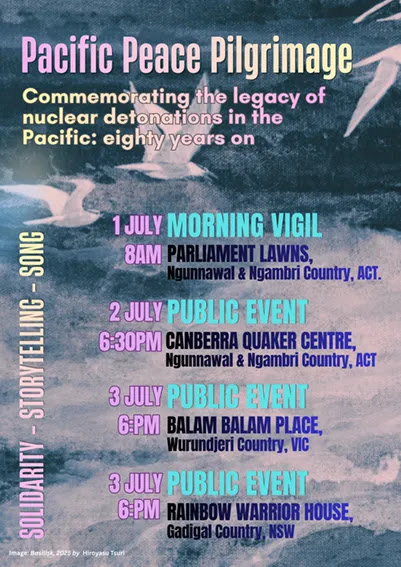


PETITION – To: Prime Minister Anthony Albanese and the Australian Labor Government

of the week – Australians for War Powers Reform (AWPR)
To see nuclear-related stories in greater depth and intensity
 Antinuclear