Auxstralian Foreign Minister Bob Carr gets the prize for hypocrisy about Julian Assange
 Yes indeed – or is it just stupidity? – I don’t think so. It’s the public who are stupid, thinks Carr.
In today’s Age, Bob Carr is quoted: “I’d just say again – if America were interested in Julian Assange they could have sought his extradition from the UK at any time in the last two years.”
So Carr is continuing the Australian Government’s disgraceful line ‘ WE DON’T KNOW NUFFINK ABOUT USA PLANNING ESPIONAGE CHARGES AGAINST JULIAN ASSANGE’
Carr surely knows full well that it is a relatively easy matter for the USA to get Assange extradited from Sweden, but it would be a difficult and embarassing matter for USA to try to extradite him from Britain.
If the Justice Department were actually to issue charges against Mr. Assange while he was still in Britain there could be potentially a decision for the UK government whether to extradite him to Sweden or to the United States, and that could get to be a complicated clash between the two different requests which would put the UK government in a difficult position. – John B. Bellinger III on Fox News
Sweden has not opposed extradition to the US since 2000, SvD, 22 December 2011 . in Assange’s case, he will be put in detention indefinitely upon arrival. Having Assange in custody since 7 December 2010 in the UK (house arrest) and then in Sweden facilitates the extradition procedure once it is put in motion by the United States (although there are suggestions that a sealed indictment has already been issued).
Decision on Ecuador asylum for Julian Assange to be stated soon
 Ecuador grants Assange asylum: report August 15, 2012 – Megan Levy WikiLeaks publisher Julian Assange will be granted political asylum in Ecuador, according to an official in the South American country, British media is reporting.
The Melbourne man, who is wanted in Sweden over sexual assault allegations, has been holed up at Ecuador’s London embassy since June 19, when he officially requested political asylum.
Officials within Ecuador’s government told The Guardian newspaper in London that president Rafael Correa had agreed to give Assange asylum. “Ecuador will grant asylum to Julian Assange,” an official in Ecuador’s capital Quito told the newspaper. Continue reading
ABC Radio reports that Assange may be granted asylum in Ecuador
 UK press fuels Assange asylum speculation http://www.abc.net.au/am/content/2012/s3568031.htm ABC Radio AM Mary Gearin reported this story on Wednesday, August 15, 2012 TONY EASTLEY: There’s speculation in London that WikiLeaks founder Australian Julian Assange will be granted asylum in Ecuador. Continue reading
Japan’s Greens Party about to take off
Scott Ludlam, a lawmaker of the Australian Greens, also expressed support for the first Japanese party to be based on an environmental platform.
Japan Greens hope to ride anti-nuclear wave to parliament, Business Recorder, August 15, 2012 TAKEHIKO KAMBAYASAHI With anti-nuclear sentiment riding high in Japan, a former citizens’ group is trying to make the shift to a full-fledged political party. Greens Japan in late July said it would field candidates in the next elections on an environmental platform that includes weaning the country off nuclear energy. It hopes to become the first officially
recognised national-level green political party. Continue reading
molten salt reactors and Liquid Fluoride Thorium Reactors – a useless dream
Australian government bureau reports that wind and sun will be the cheapest energy technologies
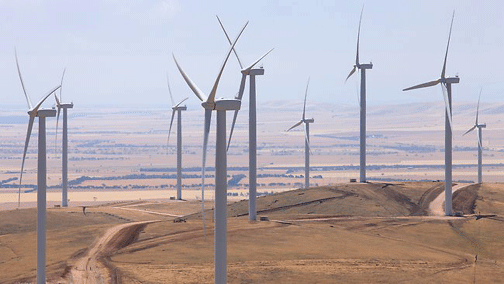 The turning point for renewables has arrived http://www.abc.net.au/environment/articles/2012/08/13/3565263.htm ANDREW BRAYABC 13 AUG 2012 Wind is predicted to be the cheapest form of energy by 2020.
THE BUREAU OF RESOURCE AND ENERGY ECONOMICS provides the Federal Government with all it wants to know about energy. Under the leadership of Energy Minister, Martin Ferguson, it is the last word on energy thinking in Canberra. In its Draft Energy White Paper last year it painted a rosy future for coal, gas and oil, with only a bit part for renewables.
Their message has been simple – when you want real energy, dig it out of the ground.
But recently it did something no one had ever imagined. It covered its latest report (pdf), , the Australian Energy Technology Assessment (AETA), not with pictures of massive coal loaders but with pictures of solar panels.
It was a declaration by this most conservative of government bureaucracies that renewable energy will become Australia’s energy source of choice, not because it is clean, safe and popular – all of which are true – but because it is cheap. The report slashes previous estimates of the cost of a whole range of renewables technologies and in some cases doubles the predicted cost of coal-fired generation. Continue reading
Australia’s Dubbo zirconia project to be significant rare earths producer by 2015, Mineweb, Andrew Duffy, 14 Aug 2012 Alkane Resources is working with ANSTO to produce significant quantities of heavy and light rare earths from its Dubbo zirconia project in New South Wales with first output targeted for 2015……On a tour of its ANSTO pilot plant Alkane managing director Ian Chalmers told Australian Mining the company was aiming to be producing rare earths by 2015…..
Subject to approvals construction is expected to begin in 2013….As Alkane inches closer towards the 2015 production
deadline Chalmers said the company was working on juggling developments and research to keep on schedule.
He marked final government approvals as other major hurdles beyond the research with ANSTO.
And while so far steering clear of local opposition, the company remains mindful of the importance of keeping those outside the industry on side.
Hackers attack Australian spy agency website August 10, 2012 (CNN) — Australia’s national intelligence agency acknowledged Friday that its public website may have encountered problems after hackers said they had subjected it to a sustained campaign of cyber attacks.
The Australian Security Intelligence Organization “is aware that there may have been some technical issues with its public website,” a spokesman for the organization said…. The hackers, who appeared to have links to the loose collective Anonymous, said they had been launching attacks on the ASIO site and those of other Australian government agencies over the past few days, according to Twitter accounts under the namesAnonymous Australia and OperationAustralia.
In recent years, Anonymous has been involved in some of the most high-profile cyberattacks on the Web — hobbling the websites of governments and businesses, hacking into sites to reveal private data and, along the way, getting dubbed cyberterrorists by the authorities in the United States and elsewhere.
The network’s motto is “We are Legion,” and it describes itself as “a decentralized network of individuals focused on promoting access to information, free speech, and transparency.” http://edition.cnn.com/2012/08/10/world/asia/australia-hacking/index.html
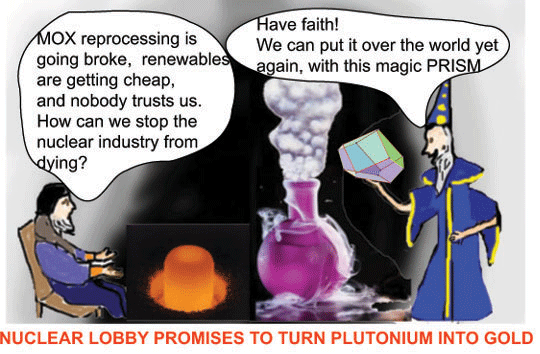
Danger of the UK’s nuclear reprocessing and PRISM projects
the British plant spread radiation into the surrounding environment. Since 1952, fish, shellfish, and sea plants in the Irish Sea, and even the local pigeons, have been heavily contaminated with radioactive waste from Sellafield. The plutonium plant released into the sea 30 billion liters of radioactive waste in a single decade.
The most dangerous result of Sellafield’s reprocessing industry is the arms race it may cause on the other side of the world.
United States Circumvented Laws To Help Japan Accumulate Tons of Plutonium, DC Bureau By Joseph Trento, on April 9th, 2012 “.…..Besides Japan, only France, Russia and Great Britain still regard plutonium as an asset. These countries have invested tens of billions of dollars in their commercial reprocessing industry.
The United States abandoned its only reprocessing facility in Barnwell, S.C., just outside the gates of the Savannah River Site without ever operating the facility. Only huge government-owned plants in La Hague, France, and Sellafield, England, separate tons of plutonium from spent nuclear fuel for foreign customers.
The biggest of these customers is Japan, which, despite its confidence in its ability to build a breeder reactor, had turned to purchasing plutonium from the British and French. Continue reading
1 This month
To see nuclear-related stories in greater depth and intensity
– go to https://nuclearinformation.wordpress.com/


 Antinuclear