Unfinished Business: Rehabilitating the Ranger Uranium Mine
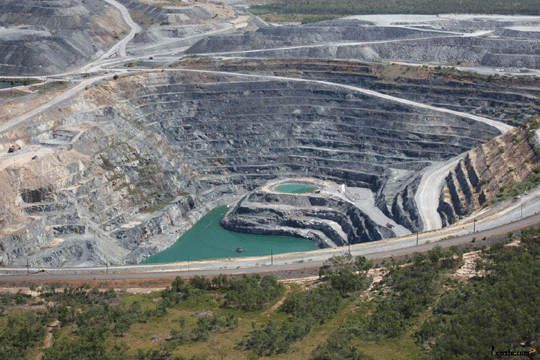 Unfinished Business: Rehabilitating the Ranger Uranium Mine https://sei.sydney.edu.au/publications/ranger-uranium-mine-report/ May 2019 Four decades of imposed uranium mining and milling by Energy Resources of Australia (ERA) and Rio Tinto is about to end at the Ranger uranium mine in Kakadu, leaving a heavily impacted site that requires extensive rehabilitation. Long contested by the area’s Traditional Aboriginal Owners, the Mirarr people, the mine site is completely surrounded by the dual World Heritage listed Kakadu National Park.This report is an independent assessment of the rehabilitation and mine closure process to date. It explores some of the concerns and constraints surrounding the rehabilitation and makes recommendations that seek to address these in order to improve the chances of the successful closure and rehabilitation of the Ranger Project Area. Unfinished Business: Rehabilitating the Ranger Uranium Mine https://sei.sydney.edu.au/publications/ranger-uranium-mine-report/ May 2019 Four decades of imposed uranium mining and milling by Energy Resources of Australia (ERA) and Rio Tinto is about to end at the Ranger uranium mine in Kakadu, leaving a heavily impacted site that requires extensive rehabilitation. Long contested by the area’s Traditional Aboriginal Owners, the Mirarr people, the mine site is completely surrounded by the dual World Heritage listed Kakadu National Park.This report is an independent assessment of the rehabilitation and mine closure process to date. It explores some of the concerns and constraints surrounding the rehabilitation and makes recommendations that seek to address these in order to improve the chances of the successful closure and rehabilitation of the Ranger Project Area.
The background research to this report was funded by FORMAS, the Swedish Research Council for Sustainable Development. Authors: Rebecca Lawrence and Dave Sweeney, Australian Conservation Foundation. |
|
The end of the uranium mining era leaves Jabiru with some social and housing problems
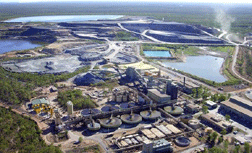 NT mine closure has Jabiru community anxious about an uncertain future, and some are already leaving, https://www.abc.net.au/news/2020-12-13/nt-jabiru-housing-uncertainty-as-uranium-mine-end-nears/12975950, By Matt Garrick
Packing her life away into boxes and preparing to shift out of her small Northern Territory town has had an emotional impact on Denise House — but it’s not the feeling she expected.
Key points:
- The Ranger uranium mine will cease operations on January 9
- Dozens of mining families are expected to leave town in coming months
- Future rental prices and the standard of the town’s housing remains “unknown”
“It’s funny because I don’t feel like I’m leaving yet, although we know we are. There’s a date, we’ve already got our flights booked and everything,” Ms House said.
“But I’m sure there will be tears.”
The House family is among an exodus of families preparing to up stumps and leave Jabiru — a mining town on the edge of Kakadu National Park with a population of just over 1,000 people — as mining operations officially cease on January 9, 2021.
The vision is for Jabiru to eventually be turned into an Indigenous-run tourism town and service hub.
The entity set up to help handle the transition, Jabiru Kabolkmakmen Limited (JKL), is among those conceding the town faces a huge challenge in the coming year. Continue reading
North of Australia is headed for a severe heatwave
 Severe heatwave could break record temperatures in the Top End, ABC By Chelsea Heaney and Amy Culpitt 2 Nov 20, Temperatures across the Top End are set to soar, with the Bureau of Meteorology predicting a severe heatwave is here to stay.Key points: Severe heatwave could break record temperatures in the Top End, ABC By Chelsea Heaney and Amy Culpitt 2 Nov 20, Temperatures across the Top End are set to soar, with the Bureau of Meteorology predicting a severe heatwave is here to stay.Key points:
After sticking out a sweaty weekend, with temperatures climbing up and over 40 degrees Celsius across various parts of the Top End, there appears to be no relief in sight and no concrete signs of any big wet season storms. Senior meteorologist Billy Lynch said the heat and sunny skies were “unusual” for this time of the year. “Darwin got up to 36.3C [on Sunday] and the rural area got up to about 39C. Then in inland parts, we saw Jabiru get to 40C and Katherine 41C,” he said. “Those temperatures are a few degrees above average, the November average for Darwin is 33C. “For Katherine the average is about 37C and we’re looking at 41C and 42C, so it’s nearly 5 degrees above average. “It is a little unusual to see temperatures getting this high at this time of year.
It’s these temperatures that have many outdoor workers worried………. Report reveals NT economically vulnerable to climate change The data comes as new research by Deloitte revealed that Queensland, the Northern Territory and Western Australia would be the most negatively affected economically because of climate change. In the NT, the services, mining and tourism industries would be hardest hit. By 2070, the Territory could see a drop in 12 per cent of its gross domestic product and 5 per cent fewer jobs because of the impacts of climate change, the report states. Heat expert Matt Brearley urged people to reconsider their plans during the current hot spell, especially those involving the outdoors. “Those producing heat, such as people exercising or working, out camping or having a fish in the boat, they’ll lose less heat and potentially cook themselves,” he said…….. https://www.abc.net.au/news/2020-11-03/severe-heatwave-record-breaking-temperatures-northern-territory/12840316 |
|
Clean-up for Ranger uranium mine. Rum Jungle mine still a polluted mess
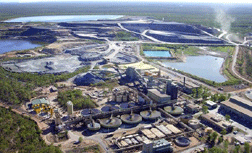 It’s costing a fortune but the Ranger uranium mine is gradually being cleaned up, Canberra Times, Chris McLennan 6 Oct 20 It’s costing a fortune but the Ranger uranium mine is gradually being cleaned up, Canberra Times, Chris McLennan 6 Oct 20
Over the years many people questioned the decision to allow uranium to be mined inside one of Australia’s most famous and largest national parks – Kakadu. But in 1980 that’s exactly what happened, an open-cut mine surrounded by a park famed for its natural beauty made even more famous by the hugely popular Paul Hogan movie, Crocodile Dundee. Now the uranium is gone, dug out and sent off to nuclear power stations around the world and Australia’s longest continually operated uranium mine is almost done.
Nuclear power is making way for renewable energy. Uranium has been mined at Ranger for more than three decades, producing in excess of 130,000 tonnes of uranium oxide. The mine is being closed, Jabiru – the town built to service to the mine workers, is in the process of being handed over to Traditional Owners and the mining company is being closely watched as it delivers on its promise to clean up the site. Cleaning up uranium mines is not something the Northern Territory does well – there is still a huge environmental mess at Rum Jungle closer to Darwin.
That uranium mine is a legacy of the Cold War. Australia’s first large scale uranium mine was dug at Rum Jungle on behalf of our “Allies” in the UK and USA to fuel their nuclear weapon programs in the 1950s. Now water fills that vast open cut, a lake as locals call it, and another attempt is going to have to be made to cap the radioactive tailings left behind, the first attempt, supposed to last a century, failed after 20 years. Energy Resources Australia, a subsidiary of Rio Tinto, says it has spent more than $642 million in the past eight years on rehabilitation of the mountains of tailings complicated by a lake created from a vast flooded pit………. This story It’s costing a fortune but the NT’s uranium mine is being cleaned up, gradually first appeared on Katherine Times. https://www.canberratimes.com.au/story/6955634/its-costing-a-fortune-but-the-nts-uranium-mine-is-being-cleaned-up-gradually/?cs=14231 |
|
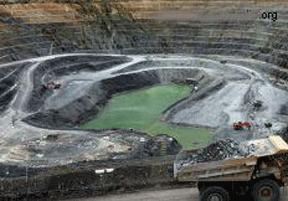
Mirrar people at last have control of Jabiru, as Ranger uranium mining set to end operations

Traditional owners regain control of Jabiru as historic land rights law passes Senate Natasha Emeck, NT News, 3 Sept 20 HISTORIC land rights legislation that will allow the traditional owners of Jabiru to regain control of their township has passed through the Senate.
Amendments to Aboriginal land rights laws passed through the upper house of federal parliament pm Thursday, returning the ownership of Jabiru to the Mirarr people and allowing for a long-term township lease.
The mining town was built in 1982 to service the Ranger uranium mine, which will cease operation in January 2021, heralding a new era for the town and surrounding Kakadu National Park.
Senator Malarndirri McCarthy said today’s historic moment had been a “long time coming” for the Mirarr people, who had been campaigning for this for 20 years.
Senior Mirarr traditional owner and Kakadu resident Yvonne Margarula, pictured in Kakadu National Park.
Mirarr senior traditional owner Yvonne Margarula said her people were glad to see the legal changes finally happen.
“They are essential to ensuring the vibrant post-mining future of Jabiru and the Kakadu region that Mirarr have been planning for,” she said.
“We look forward to welcoming visitors from all around the world to our beautiful country.”
Gundjeihmi Aboriginal Corporation, who represents the Mirarr traditional owners, have crafted a masterplan to turn Jabiru into an Indigenous-led tourism and services town.
“This bipartisan change to the legislation is an essential step to correct the historical exclusion of the town of Jabiru from Aboriginal ownership and allow Mirarr to take the legal control they need to enact their vision,” chief executive Justin O’Brien said.
Remote community loses their court fight to get uranium-free drinking water
Key points:
- The tribunal ruled drinking water uranium levels were not the housing department’s responsibility
- The residents were seeking compensation over the contamination and also tap filters to bring their water in line with guidelines
- The tribunal has called for further submissions relating to claims about housing conditions and repairs
Data compiled by the NT’s Power and Water Corporation had shown there were 0.046 milligrams of uranium per litre (mg/L) in the town’s water supply — close to three times the level recommended in national guidelines.
According to Australia’s national guideline, published by the National Health and Medical Council, uranium levels in drinking water should not exceed 0.017 milligrams per litre.
Residents of Laramba, north-west of Alice Springs, lodged a legal case against the landlord, which in this case is the NT’s Department of Housing.
The case was submitted to the NT Civil and Administrative Tribunal (NCAT) in November last year, highlighting problems with not only residents’ drinking water but also housing repairs and conditions in the town.
Residents sought compensation over the uranium contamination and also asked for a filter system on at least one tap in their household kitchens to bring uranium levels in line within Australia’s drinking water guidelines.
But in the NTCAT’s ruling against the residents, the tribunal member Mark O’Reilly said the uranium in the water was not the responsibility of the landlord.
“In my view the landlord’s obligation for habitability is limited to the premises themselves,” the decision read…….
Appeal of NTCAT decision ‘likely’
Daniel Kelly, lawyer assisting for Australian Lawyers for Remote Aboriginal Rights said the result was disappointing and an appeal was likely.
“We’re in the process of speaking to our clients, but our view is — and the views that we’ve been able to garner from our clients are — that we should seek to have this decision reviewed,” Mr Kelly said.
“The decision leaves the question well who is responsible? Because these people have been exposed to uranium in the drinking water for over 10 years.”
“The Department of Housing is doing nothing about it, Power and Water is doing nothing about it and the Northern Territory Government is doing nothing about it.”
In a statement to the ABC, the NT Department of Housing said it would not be providing comment as proceedings were ongoing.
In relation to the rest of the Laramba case, involving housing conditions and repairs, the tribunal has called for further submissions. https://www.abc.net.au/news/2020-07-14/nt-community-laramba-lose-legal-battle-over-uranium-in-water/12454206?fbclid=IwAR2Vb6AHk4MlypQI-_s8MMuWSLFCVQOViknD4nXc52RY4-i5NyA767hOHYk
ERA’s focus is now on rehabilitating the Ranger uranium mine site.
ERA, operator of Jabiru’s Ranger uranium mine, has held its last AGM as shutdown date looms
The company behind a contentious uranium mine in Jabiru has held its final AGM before production grinds to a halt, telling shareholders its focus is now on rehabilitating the site.
MADURA MCCORMACK, NT News, 31 May 20 https://www.ntnews.com.au/business/era-operator-of-jabirus-ranger-uranium-mine-has-held-its-last-agm-as-shutdown-date-looms/news-story/ad7601dd3ed45def1a63d8286e4b1b6c
THE company behind a contentious uranium mine in Jabiru has held its final annual general meeting before production grinds to a halt, telling shareholders its focus is now on the “successful rehabilitation” of the site. Energy Resources Australia, which has run the Ranger uranium mine since 1980, has seven months left to process remaining ore before it is legally required to shut down the site and commence a rigorous five-year rehabilitation program.Mining giant Rio Tinto, which this week made headlines for legally blasting an ancient Aboriginal heritage site in WA to expand a mine, owns a controlling 86.3 per cent stake in ERA. ERA chief executive Paul Arnold told shareholders on Friday the company had spent $92 million rehabilitating the mine in 2019, made $6 million in profit after tax, and $210 million from the sale of uranium oxide. In February, ERA finalised an offer from Rio Tinto to tip $476 million toward mine rehabilitation obligations in return for a larger shareholding slice, a deal that prevented ERA from collapsing financially.
“Expenditure on rehabilitation will only increase in coming years and this is a major Northern Territory project in its own right,” chairman Peter Mansell said in his address to shareholders. “The strategic priority for ERA now is the successful rehabilitation of the Ranger Project Area.”
Australian Conservation Foundation nuclear free campaigner Dave Sweeney said the rehabilitation standard set for Ranger mine was one “never previously attempted or achieved”, warning mining giant Rio Tinto and ERA that all eyes were on them to get this right. “The challenge is how to rehabilitate the heavily affected mine site and larger Ranger Project Area in a way that reduces adverse impacts and provides confidence that the living and peopled landscape of Kakadu is well protected, now and into the future,” Mr Sweeney said.
Rehabilitation of the mine must conclude in January 2026 and, according to ERA, it will include treating more than 16.5 gigalitres of water and planting 1.1 million trees on site.
Australian govt and ERA squabble over monitoring of Ranger uranium clean-up
|
Ranger Mine locked in stoush over funding for Kakadu uranium rehabilitation monitoring https://www.abc.net.au/news/2020-05-19/nt-kakadu-uranium-stoush-ranger-mine-rehabilitation/12260130 By Jane Bardon,
The Federal Government is locked in a stoush with the company mining uranium on the edge of the Northern Territory’s Kakadu National Park over whether it will continue to fund monitoring of the site’s rehabilitation. Energy Resources of Australia (ERA) has flagged it wants to pull out of paying $2.5 million a year for the Supervising Scientist Branch independent monitoring agency, which it funds with the Commonwealth, at the end of June.
Community members of ERA’s independent technical consultation committee, including Dr Gavin Mudd, an Associate Professor of Environmental Engineering at RMIT University, have been told by the Supervising Scientist Branch its future research is in doubt because of the funding uncertainty. “That funding is no longer guaranteed for next year is a major concern,” Dr Mudd said. “This work is needed to give us confidence that what is done at Ranger actually works, including the restoration of ecosystems, how stable the landform is, the radioactivity and the surface and groundwater water quality issues.” Dr Mudd said failures in the rehabilitation of other Northern Territory uranium mines, including Rum Jungle near Bachelor, have demonstrated that there will need to be monitoring for decades after Ranger’s closure. ERA, which is owned by Rio Tinto, has been forced to close the mine by 2021 after a series of uranium leaks and spills into the Alligator Rivers system during its 35 years of operations. The company has promised the mine site will be returned to a pristine state, suitable for inclusion in the Kakadu World Heritage park by 2026, and that monitoring by the Supervising Scientist will prove that. The Federal Government provides three-quarters of the Supervising Scientist’s $8 million annual operating budget. ERA told the ABC it hasn’t made a final decision on the funding. “There has been no decision that ERA’s contribution would cease. But a spokesman for the Federal Environment Minister told the ABC the Government felt it was “unfortunate that ERA is choosing to dispute its ongoing contribution under the Deed”. “The role of the Supervising Scientist ensures the unique environment of Kakadu National Park, its Indigenous culture and its stunning wildlife are protected from the effects of uranium mining within that rehabilitation process and into the future,” he said. “The Commonwealth view is that ERA needs to continue to make an appropriate contribution to support ongoing research during the rehabilitation phase of the mine to ensure there are no shortfalls.” The spokesman added that the Minister Sussan Ley has asked the Environment Department to mediate with ERA to try to resolve the dispute. |
|
Study finds that New South Wales rivers, lakes and lagoons are warming twice as fast as ocean
 NSW rivers, lakes and lagoons warming twice as fast as ocean, finds 12-year study ABC NSW rivers, lakes and lagoons warming twice as fast as ocean, finds 12-year study ABC
By Amy Greenbank 16 Apr 20, Dominic Boyton’s Merimbula oyster farm in southern NSW has been in the family for four decades.
His father passed it onto him seven years ago but he’s worried about its future viability given the latest findings from the University of Sydney (USYD). Key points:
Researchers discovered the state’s coastal rivers, lakes and lagoons were warming twice as fast as the ocean. The average temperatures in those marine ecosystems were up 2.16 degrees Celsius, making breeding harder for some aquatic life. “Warmer waters could mean we’ll see oysters disappearing up the coast or a new outbreak of algae blooms and disease we haven’t seen before,” Mr Boyton said. Oysters, he said, were sensitive to heat and because they were difficult to relocate it put growers like him in a vulnerable position. The world-first study also posed a big problem for the state’s multi-million-dollar fishing and aquaculture industry, which underpinned the economies of many coastal towns. Marine biologist Elliot Scanes analysed 12 years of data from 166 NSW estuaries and found the composition of those waterways was shifting. “We didn’t expect it to be so fast,” he said.
Acidity also rose in all waterways and at the same time creeks and lagoons were becoming less salty. “This study is the first major evidence we have to show estuaries are changing on this scale,” Dr Scanes said. The marine biologists said coastal ecosystems were being forced to adapt and there would be winners and losers. While some species of fish and prawns are likely to be more resilient, shellfish like oysters could be badly affected…… https://www.abc.net.au/news/2020-04-14/nsw-inland-water-ways-warming-twice-rate-of-ocean-study-finds/12147462 |
|
Uranium prospects poor, but Indigenous Australians Minister Ken Wyatt and Northern Land Council agree on a new mine
|
NT uranium and gold mine exploration a step closer at Devil’s Elbow near Ranger Mine https://mobile.abc.net.au/news/2020-01-25/ken-wyatt-approves-new-nt-uranium-mine-exploration/11896844 BY FELICITY JAMES Traditional owners and the Indigenous Australians Minister Ken Wyatt have signed off on a new exploration proposal for a uranium, gold and palladium mine in the Northern Territory.Key points:
Traditional owners fought hard against the Ranger Uranium Mine in the Northern Territory.
The Eclipse Metals project still needs approval from the NT Resources Minister but the company said in an ASX announcement it was confident approval would be granted. The site earmarked for exploration, known as Devil’s Elbow, is within Arnhem Land’s Alligator Rivers Uranium Field and lies 65 kilometres east of the Ranger Uranium Mine. The area has previously been explored and abandoned by other companies, including Cameco in 2008. Rio Tinto withdrew from a joint venture to acquire a majority stake in Devil’s Elbow, according to Eclipse Metals’ most recent annual report. The deal had been negotiated in 2016. In its announcement, Eclipse Metals said Mr Wyatt consented to the licence after a “long-standing” negotiation with the Northern Land Council and traditional owners resulted in an agreement. “The terms of the agreement are quite viable in the current market economy, allowing us to develop the Devil’s Elbow’s full potential,” director Carl Popal said in the statement. “The company looks forward to working closely with the traditional owners and the NLC in making the most of each exploration field from 2020, with bilateral benefits.” Scientist says venture may not be worthwhileThe supervising scientist branch of the Environment Department is responsible for protecting the Alligator Rivers region from the effects of uranium mining through monitoring and research. Gavin Mudd, an associate professor of environmental engineering at RMIT University who sits on the Alligator Rivers scientific committee, assists with this role. Associate Professor Mudd was sceptical about the proposal, considering market conditions and the fact the region has already been heavily explored for more than 60 years. “Sometimes you find something that other drillers and other explorers have missed, but often that’s not the case, it’s actually pretty rare,” he said. “There’s not a long-term prospect there. “I think when you’re looking at the uranium industry globally the future is not bright at all, that’s certainly how I read the tea leaves.” Associate Professor Mudd was sceptical about the proposal, considering market conditions and the fact the region has already been heavily explored for more than 60 years. “Sometimes you find something that other drillers and other explorers have missed, but often that’s not the case, it’s actually pretty rare,” he said. “There’s not a long-term prospect there. “I think when you’re looking at the uranium industry globally the future is not bright at all, that’s certainly how I read the tea leaves.”
But Associate Professor Mudd said Rio Tinto deserved some credit for committing funds to the rehabilitation of Ranger. “They haven’t just walked away, which is often what you would see a mining company do when you’ve got a mine that’s not making money anymore,” he said. |
|
Rio Tinto appeals Takeovers Panel decision on uranium miner ERA
Rio Tinto appeals Takeovers Panel decision on uranium miner ERA, THE AUSTRALIAN, NICK EVANS, RESOURCE WRITER, 13 Dec 19,
 Rio Tinto has appealed a Takeovers Panel decision preventing it from taking complete control of uranium miner ERA, as the fallout from the company’s hard-ball tactics to fund the clean-up of the Ranger uranium mine continues.
The Takeovers Panel handed dissident ERA investor Richard Magides a moral victory on Wednesday, declaring ERA’s decision to accept a Rio offer to underwrite a $476m equity issue was made in “unacceptable circumstances”…...(subscribers only)
How are Australian States progressing on renewable energy? South Australia way ahead
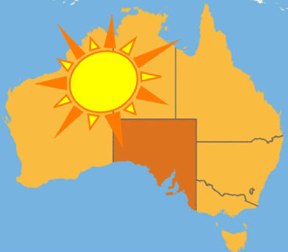 South Australia leading the nation in renewable energy, https://thenewdaily.com.au/news/national/2019/11/25/renewable-energy-winners/ Samantha Dick
South Australia is shifting to renewable energy faster than any other state or territory.
This is despite the federal government’s “lack of leadership” and continued support for major fossil fuel projects, says the Climate Council.
|
Progress is based on how much electricity is derived from renewable energy, proportion of households with rooftop solar, large-scale wind and solar capacity per capita, and policies to support the transition. South Australia earned this year’s top spot for generating more than half of its electricity from wind and solar, and for setting a target of net 100 per cent renewable energy in the 2030s. Following closely in second place was the Australian Capital Territory, which is on track for 100 per cent renewable energy from 2020. The ACT has also announced impressive plans to achieve net zero emissions by 2045 by cutting emissions from transport and cities. Tasmania was in third place for making headwinds toward 100 per cent renewable energy by 2022, and for researching three pumped hydro sites that could supply energy to Victoria over the next 10 to 15 years. Victoria was ranked fourth, winning points for planning the nation’s most ambitious large-scale wind and solar projects, and for legislating a renewable energy target of 50 per cent by 2030. However, more than 80 per cent of the state’s power still comes from fossil fuels, meaning it has a long way to go to catch up to the frontrunners. Further behind in fifth place was Queensland, where nearly half of Australia’s large-scale renewable energy projects were completed last year. But despite making big improvements, the Queensland government lost marks for continuing to support new fossil-fuel projects like the Adani coal mine. The Adani coal mine, backed by the federal government, will put out an estimated 7.7 billion tonnes of greenhouse gases over 60 years through extracting 2.3 billion tonnes of coal. It is also unlikely the Sunshine State will meet its target of 50 per cent renewable energy by 2030.
|
|
Mirrarr people to lead the Kakadu region’s transition from uranium mining

Kirsten Blair, Community and International Liaison, 15 Aug 19, Gundjeihmi Aboriginal CorporationToday GAC chairwoman, Toby’s Gangale’s daughter: Valerie Balmoore signed an MOU with the Federal and NT Governments as well as mining company ERA committing all parties to a Mirarr-led post-mining future for Jabiru.
There is still much work to be done on Mirarr country including cleaning up the immense Ranger uranium mine. GAC and others will continue our diligent work in this area – and there are no guarantees the cleanup will be wholly successful – but restoration of country remains the absolute objective.
Mirarr continue to assert their rights as Traditional Owners and lead the way for people and country, this Jabiru story is evidence of a massive shift. The power in these images speaks for itself. Today is deeply hopeful for the Kakadu region and offers an incredible message for all communities resisting unwanted mining projects.
|
JABIRU FUTURE SECURE AS PARTIES SIGN MoU. A historic Memorandum of Understanding (MoU) to be signed today in Jabiru will secure the town’s future as the tourism heartland of the World Heritage Listed Kakadu National Park. Federal Minister for the Environment Sussan Ley will join Northern Territory Minister for Aboriginal Affairs, Selena Uibo, Energy Resources of Australia (ERA) and Traditional Owners from the Gundjeihmi Aboriginal Corporation (GAC) for the signing of the MoU, which will support the town’s transition from a mining town to a tourist town. ERA is scheduled to cease operations at the Ranger
“This is about working together to ensure that the community will prosper and the mining land is cared for,” Federal Minister for the Environment Sussan Ley said. “The Australian Government has committed $216m to Kakadu with $35m directly supporting Jabiru’s transition from mining to tourism. Importantly, the certainty that comes from this MoU will encourage further private investment.” Selena Uibo, Minister for Aboriginal Affairs, said the NT Government has committed a further $135.5m to the town. “Jabiru is, and always has been, Aboriginal land. The Territory Labor Government will work closely with GAC to support the employment opportunities tourism will present for the Mirarr people, so they can achieve their social and economic aspirations,” Minister Uibo said. “Kakadu is home to the oldest continuous culture on earth. The Mirrar traditional owners, by drawing upon more than 65,000 years of knowledge and wisdom, can improve the visitor experience for those who come to visit this very special part of the Territory.”
Valerie Balmoore, Chair of GAC and a senior Mirarr Traditional Owner, said the Corporation has formed a new partnership with the NT Government, Jabiru Kabolkmakmen Ltd, to guide the postmining move, and developed a Jabiru Master Plan to drive the town’s evolution. “The Masterplan is our vision for the new Jabiru town. We welcome the investment commitments from the Commonwealth and the Northern Territory and ERA in supporting our goals. Jabiru and Kakadu are places where we can share our cultural heritage with future generations,” Ms Balmoore said.
Paul Arnold, Chief Executive and Managing Director, Energy Resources of Australia Ltd (ERA), said ERA will continue to have a presence in Jabiru as the Company undertakes the rehabilitation of the Ranger Project Area to protect Kakadu’s World Heritage values. “I want to acknowledge the leadership of the Mirarr Traditional Owners and the contributions of the Commonwealth and Northern Territory Governments toward creating a future for Jabiru,” Mr Arnold said. “ERA is proud of its role in establishing the town and the contribution of our people to the community over the last 40 years. We look forward to continuing to be a valued member of the community and working closely with the Mirarr and the Commonwealth and NT Governments to support the transition of Jabiru.
Jabiru was established in 1982 to support uranium mining in the region. Today it is a services and tourism hub for Kakadu National Park and the West Arnhem region. ERA will cease processing activities at the Ranger Uranium Mine no later than January 2021, with remediation work to be completed by 2026. As Jabiru transitions from a mining town to a locally-led community, until 2023, the Northern Territory Government will continue to take responsibility for essential services and infrastructure, including education, health, police, fire and emergency
|
|
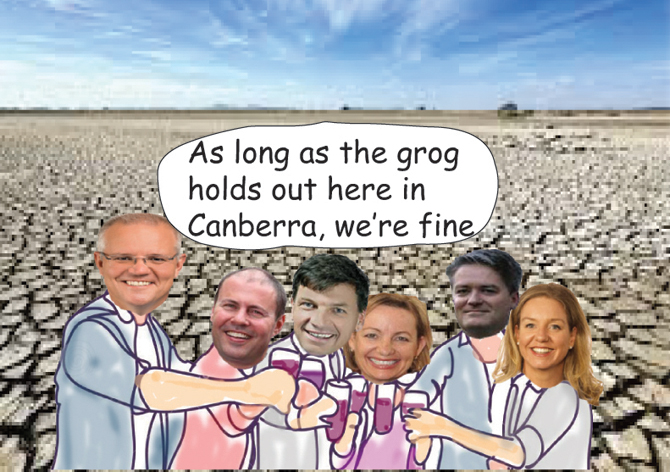
(Officially no climate change in Australia) but Norther Territory towns are running out ofvwater
 NT rural residents face spending thousands to truck in water if
  bores run dry, ABC News, By Sowaibah Hanifie 29 July 19, With groundwater levels critically low and the wet season yet to begin, some rural Northern Territory residents fear they may have to pay thousands of dollars to truck in water for their homes.
Many bores connected to the Berry Springs and Howard Springs groundwater systems have been flagged as critical and could run dry as soon as October due to the driest Territory wet season in decades.
Eddie and Sheryl Kendall’s Berry Springs bamboo business could collapse if their bore runs dry.
“The plants, we’d just have to let them die,” Mrs Kendall said.
“That wouldn’t be very good, but if you have to do it, you have to do it.”
Mr Kendall said while their bore was not critically low yet, they were being conservative with their water use, meaning their plants were not getting the water they needed to thrive.
In the community of Southport, Progress Association president Barry Whalan said he would be forced to pay $400 per week if his community, which has a critically low bore, ran dry before the wet season in December……..
Humpty Doo resident Shannon Griffiths is living near the site of a proposed $2 billion, 4,000-property development in Noonamah Ridge, which would be completed over 30 years.
Mr Griffiths said while he understood the Government wanted to increase the Territory’s population, he was concerned more rural development would put his groundwater at risk.
“How are they going to monitor people running their bores or irrigating their yards at night, which a lot of people do,” he said…..
https://www.abc.net.au/news/2019-07-29/rural-water-bores-running-dry-northern-territory/11354680
Rio Tinto moves to own Ranger remediation
Rio Tinto moves to own Ranger remediation, Matthew Stevens, Jul 26, 2019
https://www.afr.com/companies/mining/rio-tinto-moves-to-own-ranger-remediation-20190725-p52ape
In pushing Energy Resources Australia towards a potentially controversial capital raising Rio Tinto has moved to take greater ownership of what is arguably the most important mine retirement and clean-up in Australian resources history.
The task ahead is the required $830 million remediation of the Ranger uranium mine, which sits in a necessarily excised pocket of the United Nations World Heritage-listed Kakadu National Park.
Ranger has been operated by Energy Resources Australia through its often controversial 40-year life. Through that time ERA has been majority owned by Rio Tinto or its Australian forebear, CRA. Currently Rio owns 68.4 per cent of ERA.
But a plan to fill the $400 million or so gap between what Ranger’s remediation is expected to cost and the cash that ERA has at hand to pay for the big clean-up could quite easily see Rio creep to a position that would see the mine operator fully absorbed by the mother ship.
ERA revealed extended discussion with Rio Tinto over how the funding gap would be filled has ended with its Anglo-Australia overseer insisting the only path was for Ranger’s operator to make a renounceable rights issue.
Rio Tinto has committed to take up its full entitlement and to underwrite the balance of any issuance if alternatives are not available.
The erstwhile uranium miner told its minority owners that it is “considering the size, structure and terms” of any potential rights issue “having regard to the interests of ERA as a whole”.
While that is an appropriate expression of independence, the most unlikely outcome here would be an ERA board populated by Rio Tinto appointees will end up doing anything that does not concur with the parent’s view of the company’s future.
The minority question
The most likely question ahead, then, for minority shareholders is going to be whether or not they double-down on a failed punt and back the rights issue needed to sustain the long, costly wind-up of their business?
Whatever the size, structure and terms of the raising Rio Tinto wants ERA to make, it will be material to the minority owners. ERA’s current market capitalisation is $130 million. So tapping the market for even half the shortfall could prove definitively dilutive for those unprepared to throw funds at a business destined to disappear.
In most circumstances this course might be cause to wonder at whether or not this pathway might represent a level of minority shareholder oppression. Rio Tinto’s pitch though is the exception to the rule.
ERA stopped being a miner five years ago and hopes its future might be extended were dashed a few years later when Rio Tinto found itself unable to support the Ranger 3 underground expansion, a conclusion we revealed first in April 2015.
Presently ERA’s only recourse to income is through processing uranium from stockpiled ore. That production will end in 2021 and ERA has a legal obligation to safely close the operation by 2026. The cost of remediation will endure at least half a decade beyond that and so too will the risk to reputation and social licence of any and all shortcomings of that effort.
Quite sensibly, Rio Tinto assesses it fully owns the risk of any failure or future non-compliance. It is regularly reminded of that inescapable reality by the anti-uranium activists, by the increasingly power ESG lobby and by governments state and federal.
RELATED: Rio Tinto worried about ERA’s Ranger uranium mine
The funding proposal sketched out on Thursday announces those warnings were unnecessary. Rio Tinto really does want to own Ranger’s remediation.
1 This month
7 April – WEBINAR – Australia and the Doomsday Clock – Preventing nuclear war through NoFirstUse and other policies
Online | Tuesday April 7, 4:00-5:30pm, Australian Eastern Time / 8:00-9:30am Central Europe Time
– Access the registration link
15 April – Zoom –Nuclear Power is Not the Solution
Apr 15, 2026 01:00 AM in Canberra, Melbourne, Sydney

Join the International Physicians for the Prevention of Nuclear War (IPPNW) on Tuesday, April 14th for a timely webinar exploring the risks associated with nuclear power and challenging the myth that it offers a simple, safe, carbon-free solution to the climate crisis

21 April Webinar: No Nuclear Weapons in Australia
Start: 2026-04-21 18:00:00 UTC Canberra, Melbourne, Sydney (GMT+10:00)
End: 2026-04-21 19:30:00 UTC Canberra, Melbourne, Sydney (GMT+10:00)
Event Type: Virtual
A virtual link will be communicated before the event.
Host Contact Info: australia@icanw.org

of the week – Australians for War Powers Reform (AWPR)
To see nuclear-related stories in greater depth and intensity
 Antinuclear