BHP, Rio Tinto given carte blanche to export uranium to global hotspots
 Risky Business: BHP, Rio Tinto given carte blanche to export uranium to global hotspots https://www.michaelwest.com.au/bhp-rio-tinto-given-carte-blanche-to-export-uranium-to-global-hotspots/ Risky Business: BHP, Rio Tinto given carte blanche to export uranium to global hotspots https://www.michaelwest.com.au/bhp-rio-tinto-given-carte-blanche-to-export-uranium-to-global-hotspots/by David Noonan | Mar 17, 2021 It has been 10 years since the Fukushima nuclear disaster that was fuelled by Australian uranium but neither the mining industry nor the nation’s leaders have heeded any of the lessons, instead continuing to export uranium to countries with inadequate regulation and nations beset by corruption. David Noonan and Dr Jim Green report. The Fukushima nuclear disaster, fuelled by Australian uranium mined by multinationals BHP and Rio Tinto, was entirely avoidable, as numerous reports have found. Yet neither company has taken any responsibility for the catastrophic impacts on Japanese society that resulted from the use of their uranium in a poorly regulated industry. With numerous warning signs of impending disaster at Fukushima, the mining giants and our leaders could have played an important role by making uranium exports conditional on improved management of nuclear plants and tighter regulation. Yet the uranium companies get tetchy at any suggestion of culpability, with the Australian Uranium Association describing it as “opportunism in the midst of human tragedy” and “utter nonsense”. Uranium accounts for less than 0.3 per cent of Australia’s export revenue and less than 0.1 per cent of all jobs in Australia. One wonders why an industry that delivers so little is given carte blanche by the government to do as it pleases. Australia ignored scandal after scandalWhile the mining companies won’t acknowledge that Australian uranium was used in the Fukushima reactors, the Australian Safeguards and Non-Proliferation Office confirmed Australian nuclear material was at the Fukushima Daiichi site and in at least five of the six reactors. Moreover, the mining companies can’t claim ignorance. Australia’s uranium industry did nothing as the Japanese nuclear companies lurched from scandal to scandal; accident to accident. The uranium industry did nothing in 2002 when it was revealed that TEPCO had systematically and routinely falsified safety data and breached safety regulations for 25 years or more. The uranium industry did nothing in 2007 when more than 300 incidents of ‘malpractice’ at Japan’s nuclear plants were revealed – 104 of them at nuclear power plants. It did nothing even as the ability of Japan’s nuclear plants to withstand earthquakes and tsunamis came under growing criticism from industry insiders and independent experts. And the uranium industry did nothing about the multiple conflicts of interest plaguing Japanese nuclear regulators. Exporting to countries with inadequate regulationInadequate regulation was a root cause of the Fukushima disaster yet Australia has uranium supply agreements with numerous countries with demonstrably inadequate nuclear regulation, including China, India, Russia, the United States, Japan, South Korea, and Ukraine. Likewise, Australian uranium companies and the government turn a blind eye to nuclear corruption scandals in countries with which it has agreements to supply uranium: South Korea, India, Russia and Ukraine among others. Indeed, Australia has signed up to expand its uranium trade to sell into insecure regions. In 2011 ‒ the same year as the Fukushima disaster ‒ the Australian government agreed to allow uranium exports to India. This despite inadequate nuclear regulation in India, and despite India’s ongoing expansion of its nuclear weaponry and delivery capabilities. A uranium supply agreement with the United Arab Emirates was concluded in 2013 despite the obvious risks of selling uranium into a politically and militarily volatile region where nuclear facilities have repeatedly been targeted by adversaries intent on stopping covert nuclear weapons programs. A uranium supply agreement with Ukraine was concluded in 2016 despite a host of safety and security concerns, and the inability of the International Atomic Energy Agency to carry out safeguards inspections in regions annexed by Russia. However, it is obvious that Australia will take action when it wants to. In 2014, Australia banned uranium sales to Russia, with then prime minister Tony Abbott stating: “Australia has no intention of selling uranium to a country which is so obviously in breach of international law as Russia currently is.” Australia’s uranium supply agreement with China, concluded in 2006, has not been reviewed despite abundant evidence of inadequate nuclear safety standards, inadequate regulation, lack of transparency, repression of whistleblowers, world’s worst insurance and liability arrangements, security risks, and widespread corruption. Civil society and NGO’s are campaigning to wind back Australia’s atomic exposures in the uranium trade with emphasis on uranium sales to China. China’s human rights abuses and a range of strategic insecurity issues warrant a cessation of uranium sales. China’s ongoing human rights abuses in Tibet and mass detention and forced labour against Uyghurs in Xinjiang are severe breaches of international humanitarian law and UN Treaties.` China is obviously in breach of international law on numerous counts. Uranium sales to Russia were suspended because of breaches of international law and the same standard should be applied to China. Scant regard for nuclear risksChina has exported nuclear weapons know-how to Pakistan, targets Australia in cyber-attacks, and is causing regional insecurity on the India border, in Hong Kong and Taiwan, and in the Pacific. BHP’s Olympic Dam is the only company still selling Australian uranium into China. There is a case for the ‘Big Australian’ to forego uranium sales overall and an onus to end sales to China. Australia supplies uranium with scant regard for nuclear safety risks. Likewise, proliferation risks are given short shrift. Australia has uranium export agreements with all of the ‘declared’ nuclear weapons states – the US, UK, China, France, Russia – although not one of them takes seriously its obligation under the Non-Proliferation Treaty to pursue disarmament in good faith. Australia claims to be working to discourage countries from producing fissile (explosive) material for nuclear bombs, but nonetheless exports uranium to countries blocking progress on the proposed Fissile Material Cut-Off Treaty and refusing to sign or ratify the Comprehensive Test Ban Treaty. And Australia gives Japan open-ended permission to separate and stockpile plutonium although that stockpiling fans regional proliferation risks and tensions in North-East Asia. Despite liberal export policies, Australian uranium sales are in long-term decline and now represent only 8.9 per cent of world uranium usage. With the Ranger mine shut down and no longer processing ore for uranium exports, there are only two operating uranium mines in Australia: BHP’s Olympic Dam copper-uranium mine and the smaller General Atomics’ Beverley Four Mile operation ‒ both in South Australia. |
|
Time for Australia to clean up uranium mining damage, and end this toxic industry
 It’s time to clean up not start up! https://www.onlineopinion.com.au/view.asp?article=21352 On this 10th anniversary of the Fukushima nuclear disaster, it is time to learn one simple lesson; radioactive risk is more constant than a politician’s promise. It is time to move beyond the risk of opening a uranium mine to safely rehabilitating existing exploration and trial mine sites. If we fail to act and allow small unproven company assurances to take the place of evidence, then we are both failing those affected by Fukushima and increasing the odds of fuelling a future one.
| By Kerrie-Ann Garlick – , 12 March 2021 |
|
The Bluff and the Bribing continue as Minister Keith Pitt spruiks on radio about Kimb nuclear waste dump plan
 Kazzi Jai, No nuclear waste dump anywhere in South Australia, 15 Mar 21,
 New South Wales Energy Minister ”excited about the opportunities” for nuclear power
Energy minister backs nuclear option , Daily Telegraph, 14 Mar 21,
NSW’s energy minister has said the state is “excited about the opportunities” being afforded by nuclear power as he denied climate policies were leading to the closure of coal-powered plants…… (subscribers only)
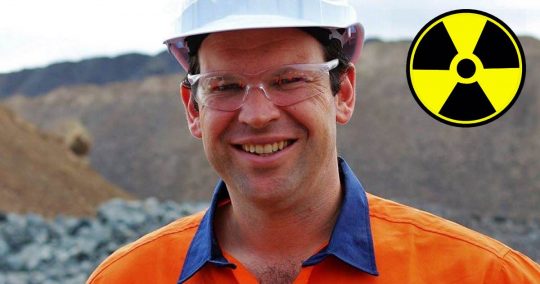
Refuting Senator Matt Canavan’s inaccurate hype about small nuclear reactors
|
Canavan Keeping The Nuclear SMR Vaporware Dream Alive , Solar Quotes ,March 12, 2021 by Michael Bloch ”…… Senator Matt Canavan: ”Keep Nuclear Energy On The Table” It’s probably been a disappointing week for pro-coal Senator Matt Canavan with the news Yallourn Power Station will retire in mid-2028 instead of 2032. But as well as a passion for coal, Senator Canavan is a nuclear power supporter.In an interview with Sky News yesterday, Senator Canavan commented:
A year ago he referred to renewables as the “dole bludgers” of energy, using the same logic. With regard to the Fukushima incident, he stated: “The latest nuclear technology is much safer; more self-contained. Small modular reactors are effectively the size of shipping containers that are much more suited to our country and size and don’t have the same safety issues.” He also managed to squeeze in a mention about instances of fatalities associated with installing solar panels on rooftops just for good measure. But back to the small modular reactors (SMRs). Where are these SMRs he speaks of? The World Nuclear Industry Status Report 2020 released in September last year states:
|
|
Australian uranium fuelled Fukushima
The Nuclear Accident Independent Investigation Commission ‒ established by the Japanese Parliament ‒ concluded in its 2012 report that the accident was “a profoundly man-made disaster that could and should have been foreseen and prevented” if not for “a multitude of errors and wilful negligence that left the Fukushima plant unprepared for the events of March 11”.
The accident was the result of “collusion between the government, the regulators and TEPCO”, the commission found.
Mining
But overseas suppliers who turned a blind eye to unacceptable nuclear risks in Japan have largely escaped scrutiny or blame. Australia’s uranium industry is a case in point.
Yuki Tanaka from the Hiroshima Peace Institute noted: “Japan is not the sole nation responsible for the current nuclear disaster. From the manufacture of the reactors by GE to provision of uranium by Canada, Australia and others, many nations are implicated.”
There is no dispute that Australian uranium was used in the Fukushima reactors. The mining companies won’t acknowledge that fact — instead they hide behind claims of “commercial confidentiality” and “security”.
But the Australian Safeguards and Non-Proliferation Office acknowledged in October 2011 that: “We can confirm that Australian obligated nuclear material was at the Fukushima Daiichi site and in each of the reactors — maybe five out of six, or it could have been all of them”.
BHP and Rio Tinto, two of the world’s largest mining companies, supplied Australian uranium to TEPCO and that uranium was used to fuel Fukushima.
Tsunamis
The mining companies have failed to take any responsibility for the catastrophic impacts on Japanese society that resulted from the use of their uranium in a poorly managed, poorly regulated industry.
Moreover, the mining companies can’t claim ignorance. The warning signs were clear. Australia’s uranium industry did nothing as TEPCO and other Japanese nuclear companies lurched from scandal to scandal and accident to accident.
The uranium industry did nothing in 2002 when it was revealed that TEPCO had systematically and routinely falsified safety data and breached safety regulations for 25 years or more.
The uranium industry did nothing in 2007 when over 300 incidents of ‘malpractice’ at Japan’s nuclear plants were revealed – 104 of them at nuclear power plants.
It did nothing even as the ability of Japan’s nuclear plants to withstand earthquakes and tsunamis came under growing criticism from industry insiders and independent experts.
Vicious cycle
And the uranium industry did nothing about the multiple conflicts of interest plaguing Japanese nuclear regulators.
Mirarr senior Traditional Owner Yvonne Margarula ‒ on whose land in the Northern Territory Rio Tinto’s Ranger mine operated ‒ said she was “deeply saddened” that uranium from Ranger was exported to Japanese nuclear companies including TEPCO.

No such humility from the uranium companies. They get tetchy at any suggestion of culpability, with the Australian Uranium Association describing it as “opportunism in the midst of human tragedy” and “utter nonsense”.
Yet, Australia could have played a role in breaking the vicious cycle of mismanagement in Japan’s nuclear industry by making uranium exports conditional on improved management of nuclear plants and tighter regulation.
Even a strong public statement of concern would have been heard by the Japanese utilities – unless it was understood to be rhetoric for public consumption – and it would have registered in the Japanese media.
Safety
But the uranium industry denied culpability and instead stuck its head in the sand. Since the industry is in denial about its role in fuelling the Fukushima disaster, there is no reason to believe that it will behave more responsibly in future.
Successive Australian governments did nothing about the unacceptable standards in Japan’s nuclear industry. Julia Gillard ‒ Australia’s Prime Minister at the time of the Fukushima disaster ‒ said the disaster “doesn’t have any impact on my thinking about uranium exports”.
Signification elements of Japan’s corrupt ‘nuclear village’ ‒ comprising industry, regulators, politicians and government agencies ‒ were back in control just a few years after the Fukushima disaster. Regulation remains problematic.
Add to that ageing reactors, and companies facing serious economic stress and intense competition, and there’s every reason for ongoing concern about nuclear safety in Japan.
Professor Yoshioka Hitoshi is a Kyushu University academic who served on the government’s 2011-12 Investigation Committee on the Accident at the Fukushima Nuclear Power Stations.
Regulation
They said in October 2015: “Unfortunately, the new regulatory regime is … inadequate to ensure the safety of Japan’s nuclear power facilities. The first problem is that the new safety standards on which the screening and inspection of facilities are to be based are simply too lax.
“While it is true that the new rules are based on international standards, the international standards themselves are predicated on the status quo.
“They have been set so as to be attainable by most of the reactors already in operation. In essence, the NRA made sure that all Japan’s existing reactors would be able to meet the new standards with the help of affordable piecemeal modifications ‒ back-fitting, in other words.”
In the aftermath of the Fukushima disaster, UN secretary general Ban Ki Moon called for an independent cost-benefit inquiry into uranium trade. The Australian government failed to act.
Inadequate regulation was a root cause of the Fukushima disaster yet Australia has uranium supply agreements with numerous countries with demonstrably inadequate nuclear regulation, including China, India, Russia, the United States, Japan, South Korea, and Ukraine.
Overthrow
Likewise, Australian uranium companies and the government turn a blind eye to nuclear corruption scandals in countries with uranium supply agreements: South Korea, India, Russia and Ukraine among others.
Indeed, Australia has signed up to expand its uranium trade to sell into insecure regions.
In 2011 ‒ the same year as the Fukushima disaster ‒ the Australian government agreed to allow uranium exports to India.
This despite inadequate nuclear regulation in India, and despite India’s ongoing expansion of its nuclear weaponry and delivery capabilities.
A uranium supply agreement with the United Arab Emirates was concluded in 2013 despite the obvious risks of selling uranium into a politically and militarily volatile region where nuclear facilities have repeatedly been targeted by adversaries intent on stopping covert nuclear weapons programs. Australia was planning uranium sales to the Shah of Iran months before his overthrow in 1979.
Forced labour
A uranium supply agreement with Ukraine was concluded in 2016 despite a host of safety and security concerns, and the inability of the International Atomic Energy Agency to carry out safeguards inspections in regions annexed by Russia.
In 2014, Australia banned uranium sales to Russia, with then prime minister Tony Abbott stating: “Australia has no intention of selling uranium to a country which is so obviously in breach of international law as Russia currently is.”
Australia’s uranium supply agreement with China, concluded in 2006, has not been reviewed despite abundant evidence of inadequate nuclear safety standards, inadequate regulation, lack of transparency, repression of whistleblowers, world’s worst insurance and liability arrangements, security risks, and widespread corruption.
Civil society and NGO’s are campaigning to wind back Australia’s atomic exposures in the uranium trade with emphasis on uranium sales to China.
China’s human rights abuses and a range of strategic insecurity issues warrant a cessation of uranium sales. China’s ongoing human rights abuses in Tibet and mass detention and forced labour against Uyghurs in Xinjiang are severe breaches of international humanitarian law and UN Treaties.
Weapons
China proliferated nuclear weapons know-how to Pakistan, targets Australia in cyber-attacks, and is causing regional insecurity on the India border, in Hong Kong and Taiwan, and in the Pacific.
BHP’s Olympic Dam is the only company still selling Australian uranium into China. There is a case for the ‘Big Australian’ to forego uranium sales overall and an onus to end sales to China.
A federal Parliamentary Inquiry in Australia is investigating forced labour in China and the options for Australia to respond. A case is before this inquiry to disqualify China from supply of Australian uranium sales – see submission 02 on human rights abuses and submission 02.1 on security risks.
Australia supplies uranium with scant regard for nuclear safety risks. Likewise, proliferation risks are given short shrift.
Australia has uranium export agreements with all of the ‘declared’ nuclear weapons states – the US, UK, China, France, Russia – although not one of them takes seriously its obligation under the Non-Proliferation Treaty to pursue disarmament in good faith.
Carte blanche
Australia claims to be working to discourage countries from producing fissile – explosive – material for nuclear bombs, but nonetheless exports uranium to countries blocking progress on the proposed Fissile Material Cut-Off Treaty.
And Australia gives Japan open-ended permission to separate and stockpile plutonium although that stockpiling fans regional proliferation risks and tensions in North-East Asia.
Despite liberal export policies, Australian uranium sales are in long-term decline and now represent only 8.9 percent of world uranium usage.
With the Ranger mine shut down and no longer processing ore for uranium exports, there are only two operating uranium mines in Australia: BHP’s Olympic Dam copper-uranium mine and the smaller General Atomics’ Beverley Four Mile operation ‒ both in South Australia.
Uranium accounts for less than 0.3 percent of Australia’s export revenue and less than 0.1 percent of all jobs in Australia.
One wonders why an industry that delivers so little is given carte blanche by the government to do as it pleases.
These Authors
Dr Jim Green is the national nuclear campaigner with Friends of the Earth Australia. David Noonan is an independent environment campaigner. For further information on BHP’s Olympic Dam mine click here.
Australia must learn the lessons of Fukushima
Australia must learn the lessons of Fukushima https://www.acf.org.au/we_must_learn_the_lessons_of_fukushima– Dave Sweeney, Australian Conservation Foundation’s nuclear free campaign, 11 March 21,
Ten years ago, the world held its breath, crossed its fingers and learnt a new word.
Fukushima went from being the name of a provincial Japanese city to global shorthand for a costly, contaminating and continuing nuclear disaster.
Fukushima means ‘fortunate island’ but the region’s luck melted down along with its reactors on March 11, 2011.
The Great Eastern earthquake and tsunami which rocked then inundated much of Japan’s eastern seaboard also swamped the defences of the Fukushima nuclear complex run by TEPCO, the Tokyo Electric Power Corporation.
Against a backdrop of wailing sirens and crackling Geiger counters we witnessed mass evacuations, hundreds of billions of dollars in economic loss and radioactive contamination of the air, soil and ocean that continues today.
Japanese and international nuclear authorities have confirmed it will take at least three more decades to stabilise radioactive and waste issues at the site.
The most pressing of these is how to manage a large volume of contaminated water that is stored is hundreds of vast steel tanks and is growing daily.
The preferred company plan – to dump this untreated contaminated water directly into the Pacific – is generating growing concern among Japanese coastal communities, not to mention outrage in Korea and the wider region.
In August 2012, a year after the initial disaster, I joined a delegation of international environmental monitors and public health experts to visit the Fukushima region.
We saw and spoke with ordinary people whose lives had been extraordinarily disrupted.
We drove through countryside and towns that had been emptied of people and hope.
We met with elderly evacuees in temporary housing who understood that they would never return home.
The words of Hasegawa Kenichi, a Fukushima dairy farmer who lost his herd and his livelihood, remain in my head. ‘It is important to make sure that what is happening in Fukushima is not forgotten.’
As pro-nuclear politicians and industry associations seek to distract from their inaction on meaningful efforts to address climate change by once more banging the drum for domestic nuclear power, we need to remember these words – and the deep reality that lies behind them.
Especially in Australia.
In October 2011 the head of the Department of Foreign Affairs and Trade’s nuclear bureau formally confirmed that Australian uranium was routinely sold to the corner-cutting TEPCO and was fuelling the Fukushima complex at the time of the disaster.
Australian radioactive rocks are the source of Fukushima’s fallout.
As home to around 35% of the world’s uranium reserves, Australia has been a significant player in the global nuclear trade.
But, aptly enough, Australia’s uranium sector was hard hit by the market fallout from Fukushima.
In the last 10 years the global commodity price has flatlined, projects have been shelved, abandoned or placed in perpetual ‘care and maintenance’.
Australia’s longest operating uranium mine, the Ranger project in Kakadu, closed forever in January this year.
This brought an end to the controversial Kakadu mining chapter and has left mine owner Rio Tinto with a billion dollar clean up challenge that is attracting scrutiny from across Australia and around the world.
Australia’s uranium sector has long been constrained by political uncertainty, an absence of social license and strong First Nations and wider community resistance.
The industry’s prevailing business model seems to be to get the paperwork in order, cultivate friends in Canberra and wait in hope for better times.
But those times are unlikely to ever arrive.
The sector never really made sense and now it doesn’t even make dollars. The years since Fukushima have seen a dramatic decline in the popularity of nuclear power and a global surge in renewable energy projects and production.
Australia’s uranium sector is high risk and low return.
It leaves polluted mine sites at home and drives nuclear risk and insecurity abroad.
And it fuelled Fukushima – a profound environmental, economic and human disaster that continues to negatively impact lives in Japan and far beyond.
On this tenth anniversary it is time to honour Kenichi-san’s plea that the world not forget Fukushima.
We need a credible and independent review of the real costs and consequences of Australia’s uranium trade.
It is well past time for Australian politicians of all stripes to accept that we are in a period of irreversible transformation and that our shared energy future is renewable, not radioactive.
Read A joint statement from the Australian Conservation Foundation and the Electrical Trades Union.
Time that Australia looks beyond uranium mining, and towards rehabilitation of the environment
K-A, Nuclear Free Community Campaigner, 11 Mar 21, On the 10th anniversary of the Australian uranium-fuelled Fukushima nuclear disaster, it is time for a rethink on uranium Australia wide and for WA to look beyond mining towards rehabilitation.
WA’s four proposed uranium mines and the 85 exploration sites have been unable to develop into and all pose serious environmental, economic and public health risks. Some of the companies involved no longer exist, others are hanging on by a thread.
With a stagnant uranium price and a global nuclear power industry that is struggling to maintain the status quo, we should be looking to clean up Barnett’s failed attempt to establish uranium mines in WA and close that chapter in our history book.
Fukushima, ten years after the devastating Tsunami and subsequent multiple reactor meltdowns at the Fukushima Daiichi nuclear plant is still one of the most radioactive places on earth. It remains a profound human, economic and environmental tragedy that was fuelled by Australian uranium.
In Parliament in 2012 Dr Robert Floyd, Director General, Australian Safeguards and Non-Proliferation confirmed that Australian uranium was in each of the reactors at the time of the meltdown. Following the disaster, the UN Secretary-General urged every uranium-producing country to hold “an in-depth assessment of the net cost impact of the impacts of mining fissionable material on local communities and ecosystems.”
Kimba nuclear dump project is a futile exercise that will be rejected by the International Atomic Energy Agency
Peter Remta, 4 Mar 21
For the past three years I have had to accept the disingenuous and ignorant comments by the federal government including the responsible ministers which quite frankly are at times personally offensive
I have been particularly disappointed by the comments of the present responsible minister Keith Pitt who from shortly after his appointment publicly stated that the whole Napandee community was highly accepting and in favour of the government’s nuclear waste facility in its locality when Napandee is no more than a farm with a population of the owner and his wife who are selling part of the property to the government for the facility.
In reality Napandee is better referred to as Kimba as the actual generic location
Regrettably from then on Pitt has continued with his ill informed and deceptive comments including his endorsement of the senior government officials who have also provided wrong and misleading information for the community
It is quite clear that the Kimba proposal will not get the necessary legislative approval even though Pitt has put implementing bill on the Senate order of business list on several occasions but never brought it on for a vote knowing full well that it would be defeated to the government’s embarrassment
While there are numerous technical and justifiable objections to the government’s proposals perhaps the most important is that the Kimba facility will not get the necessary licences for its construction and operations
It is considered at an international level that the Australian government and the regulatory entity of ARPANSA have fallen down badly on the licensing and other requirements in that regard and hence the International Atomic Energy Agency will demand a peer review by an external group which will take the whole process out of the government’s hands and lead to a swift rejection of the licence applications
No strong and effective relations and connections with leading experts in the field of nuclear waste are available to the government for its waste disposal plans
What is more the general view internationally is that Australia is lacking in any realistic expertise in nuclear engineering covering the storage and disposal of waste despite being so proficient in the mining of uranium and other radioactive materials
The Kimba proposal is a futile and purely politically driven exercise
Australia dodged a bullet in not getting nuclear power – Ian Lowe.
 An obvious conclusion flows from the Fox Report’s 1976 comment about a lack of objectivity. We are not objective observers of the world: we all see reality through the lenses of our values and our experience. We all have a tendency to see what we would like to see…….
The probability that any person will be favourably disposed to the idea of nuclear power can be predicted from their values and from their view of the sort of future they would like to see. Fellows of the Academy of Technology and Engineering tend to favour a high-tech future, while conservationists are much more likely to favour small-scale local supply systems.
This is a reminder that the future is not somewhere we are going, but something we are creating. From my perspective, nuclear power now looks like an intractable problem we were just lucky to avoid. Most developed nations have nuclear power stations with mountains of accumulated waste, for which there is no effective permanent solution. The urgent task of moving to clean energy supply, mostly from solar and wind, is made more difficult when resources have been sunk into the nuclear power industry. I believe we dodged a bullet.
Griffith Review,by Ian Lowe, March 21, ON MY DESK there sits a well-thumbed copy of the 1976 Fox Report, the first report of the Ranger Uranium Environmental Inquiry. I grew up in New South Wales, where most electricity came from coal-fired power stations, but miners were often killed or injured and the air pollution from burning coal was obvious. So as a young scientist I was attracted to the idea of replacing our dirty and dangerous coal-fired electricity with nuclear power.
Transnational Memory and the Fukushima Disaster: Memories of Japan in Australian Anti-nuclear Activism
Transnational Memory and the Fukushima Disaster: Memories of Japan in Australian Anti-nuclear Activism https://epress.lib.uts.edu.au/index.php/portal/article/view/7094
Alexander Brown https://orcid.org/0000-0002-3582-9658, Jan 28, 2021
Abstract
This paper argues for the importance of transnational memories in framing Australian anti-nuclear activism after the Fukushima disaster. Japan looms large in the transnational nuclear imaginary.
Commemorating Hiroshima as the site of the first wartime use of nuclear weapons has been a long-standing practice in the Australian anti-nuclear movement and the day has been linked to a variety of issues including weapons and uranium mining.
As Australia began exporting uranium to Japan in the 1970s, Australia-Japan relations took on a new meaning for the Indigenous Traditional Owners from whose land uranium was extracted.
After Fukushima, these complex transnational memories formed the basis for an orientation towards Japan by Indigenous land rights activists and for the anti-nuclear movement as a whole.
This paper argues that despite tenuous organizational links between the two countries, transnational memories drove Australian anti-nuclear activists to seek connections with Japan after the Fukushima disaster. The mobilisation of these collective memories helps us to understand how transnational social movements evolve and how they construct globalisation from below in the Asia-Pacific region.fic region.
Australia’s purchase of vastly expensive French nuclear-powered submarine design, adapted to diesel, now to be scrapped?
 These submarine designs were adapted from the French nuclear submarines. I thought, at the time, that they were chosen in preference to the more suitable, and more affordable German design, under the pressure of the nuclear lobby. Presumably, it would be practical to later adapt these submarines to be nuclear-powered.
|
Government submarine contract sunk and unlikely to resurface, Independent Australia, 1 Mar 21, The submarine deal France proudly called ‘the contract of the Century’ appears to have collapsed, reports Alan Austin.IF THERE WAS one thing which should unite all media commentators, economic and military analysts, and informed citizens in outrage against the Morrison Government, it is this. The Government has wasted billions of dollars on a deal to buy 12 new submarines which have virtually no chance of fulfilment. As this is written, the head of the French naval construction company Naval Group, Pierre Eric Pommellet, is in Australia meeting federal ministers in an attempt to rescue the contract. Tragically for Australia – and for Monsieur Pommellet – not one of those ministers has the experience or competence to wrangle a successful result. Many informed commentators in France, Australia and elsewhere now expect the much-celebrated deal to be abandoned. If that happens, replacing the current ageing submarines would be delayed many years, depending on the timing of the change of government to a capable administration. Although defence is just one example of Coalition mismanagement, this is where Australia’s losses are arguably most devastating: both in billions of dollars wasted and in the risk to national security. Responsibility for the projectMultiple failures are evident. The most basic is accountability. Since negotiations with France began, Australia has had three prime ministers, three deputy PMs, three failed treasurers, five defence ministers and four ministers for defence industry. Of the 15 individuals to have held these portfolios, seven have left the Parliament. None remaining has the competence to deliver for Australia or the mettle to take responsibility. The current Defence Minister is in hospital on leave. Political priorities paramountA major factor in dashing into the connection with France was the set of promises the Coalition hoped to make chasing votes. In the run-up to the 2019 election, then Minister for Defence Industry Christopher Pyne promised hundreds of new jobs, the “majority of which will be based in South Australia”. Cost and defence considerations were secondary. Many military observers were dismayed at Australia taking the French Shortfin Barracudas over the lower-cost and more suitable alternatives tendered by Japan and Germany. Design and cost errorsSeveral of Australia’s specifications were plain foolish, as Binoy Kampmark summarised for IA. A nuclear submarine with a diesel-electric engine is a fail. An American combat system won’t work in a French vessel because the Americans and the French do not talk. Lead-acid batteries will be obsolete well before the subs are delivered. France’s original tender documents put the cost of the project at between $20 billion and $25 billion. The cost in the initial agreement signed in late 2016 was $50 billion. By February 2020, the Parliamentary Library research service reported that the acquisition cost:
Today, estimates range up to double that quantum. Missed deadlinesDelays so far have pushed back delivery of the first Barracuda from the mid-2020s to the early 2030s and now to the 2040s. The latest missed date was finalising the critical Strategic Partnering Agreement which governs the entire project. This was due before last Christmas………… Excessive secrecy, even from the SenateCompounding all these failures is Morrison’s Cabinet refusing to be answerable to the Parliament. In an ugly confrontation in last month’s Senate Economics References Committee, Defence Department head Greg Moriarty refused point-blank to provide documents which the Committee had the constitutional right to access. Independent Senator Rex Patrick warned Moriarty:
Moriarty steadfastly refused the Committee’s requests, insisting he would do the bidding of the craven Minister and Cabinet. The remedyThus the solution is for the people of Australia to get rid of this secretive bungling regime at the earliest opportunity: to save hundreds of billions of dollars and to ensure effective military capability. https://independentaustralia.net/politics/politics-display/government-submarine-contract-sunk-and-unlikely-to-resurface,14846 |
|
Many people, both inside and outside Kimba, want a judicial review of the government’s nuclear waste dump decision
Commenting on the opinion piece: They have let it come: now build it InDaily
I respect the right of Sean Edwards to express his opinion. However, he makes a number of factual errors which should be corrected.
I will address one: ‘The people of Kimba don’t want judicial review’.
I personally know people from Kimba who do want judicial review.
Furthermore, many outside the Kimba region want judicial review, hence the widespread objection to the proposed amendment. – Andrew Williams https://indaily.com.au/opinion/reader-contributions/2021/03/01/your-views-on-vaccination-sa-nuclear-dump-jobseeker-reviews-and-more/
Australian Strategic Policy Institute – a stooge for weapons industries and China-haters
|
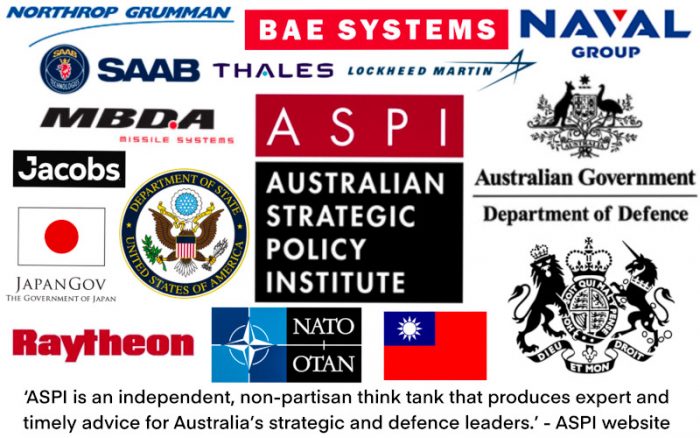
Independent” think-tank ASPI behind push for more defence spending rakes in advisory fees, Michael West Media, 1 Mar 21, by Marcus Reubenstein | Jul 1, 2020 Funded by the Department of Defence, the Australia Strategic Policy Institute collects millions more as it drives the “China threat” narrative. As Marcus Reubenstein reports, while ASPI is the media’s go-to experts for public comment, ASPI is remarkably coy about revealing all its funding sources.
On the day the Prime Minister Scott Morrison announced a $270 billion defence spending plan, the Department of Defence paid the Australian Strategic Policy Institute (ASPI) a $214,500 contract for “management advisory services”. Exactly one year ago today, it was awarded a similar “management advisory services” contract for the considerably larger amount of $614,536. ASPI has pushed hard for boosts to defence spending, in particular an upgrade of Australia’s missile capabilities. The Government says it will spend $800 million on the US-made AGM-158C Long Range Anti Ship Missile, manufactured by Lockheed Martin, which gave ASPI $135,909 in sponsorship funds in 2018-19. Go-to think tank on ChinaThe Australian Strategic Policy Institute is the “go to” think tank for the mainstream media seeking an “independent voice” to make sense of troubled times with China. Its analysts are knowledgeable and articulate, always forthcoming with research pointing to the strategic threat of China. However, it is less forthcoming about the funders of its research, although it is an open secret that foreign governments and multi-billion-dollar weapons makers are generous supporters. What is not widely known is the extent to which taxpayers are propping it up, through dozens of small contracts not listed in its annual reports. Last year, these contracts amounted to more than $2 million and were signed by the chiefs of a small group of government departments which, say ASPI’s critics, have vested interests in promoting China as Australia’s No. 1 strategic threat. On China’s radarTwo weeks ago, ASPI was again thrust into the international limelight after China’s foreign ministry directly named it as the source of claims by Prime Minister Scott Morrison that Australia was the victim of a sustained cyber security attack. Morrison did not name China but, ASPI’s executive director, Peter Jennings did. He told journalists it was a “95%” likelihood that China was behind the alleged attacks. Critics, including former foreign ministers, ambassadors and senior figures within the defence establishment, contend that ASPI is an anti-China lobby that has hoodwinked the media into believing it is independent. Labor Senator Kim Carr, who is pursuing ASPI through a Senate committee, argues it’s a conflicted government-funded body that lacks transparency, particularly in the way it reports who funds its research. It is an Australian government organisation, a Commonwealth company, and they’ve been at the centre of Sinophobia. This is what happened in the Cold War, you set up a front and create a world view that’s unchallengeable. Then you de-legitimize anyone who argues for engagement with China. Ironically, engagement with China remains official government policy”. Disguised defence largesseThe Howard Government set up ASPI in 2001 as an independent think tank that would challenge a supposed culture of stagnated thinking, weighed down by the defence bureaucracy. Its main funding was an annual grant from the Defence Department but over the past decade it has developed more and more revenue streams — and no obligation to reveal exactly who pays it what. Defence remains its biggest benefactor. Before the federal election, the Morrison Government not only increased this funding by more than 13%, it locked in a guaranteed $20 million until 2023. This largesse does not include one-off payments for sponsorship and commissioned reports. In its annual reports, ASPI declares the $4 million annual Defence grant but opaquely refers to this as “core funding”. According to Department of Finance figures, in 2018-19 it received an additional $1,363,002.84 in funding from Defence, which was not publicly declared. According to answers it provided to a Senate Estimates committee in February, ASPI collected $1,158,581.63 (pre-GST) in funding from Defence without clearly declaring the source of those funds. ASPI didn’t explain the discrepancy between its two reported figures. Shrinking support?In its annual report, ASPI splits income into two sources: “Defence funding” and “Sale of goods and rendering of services”. It also produced a gloomy graph [on original] showing how “core” funding had withered away from 100% of its income to a moderate 43%. However, the graph doesn’t take into account its numerous government tenders and contracts that have delivered a financial windfall. In the past five years the value of its government contracts has increased by more than 300%. (second graph on original] Figures from the Department of Finance’s procurement website AusTender show ASPI was awarded $2,133,716.62 in contracts between July 2019 and June 2020. ASPI records all these government payments in its annual reports but muddies the waters by consolidating them with sponsorships and other commercial revenue. ASPI has received 37 government contracts in the past two years. See below [on original] or click here for easier viewing………. Major backersASPI has received funding from the governments of Britain, Japan and Taiwan as well as NATO. Among its corporate supporters are global weapons makers Thales, BAE Systems, Raytheon, SAAB, Northrop Grumman, MDBA Missile Systems and Naval Group. Yet their contribution of over $330,000 last year is dwarfed by that of a handful of government departments and agencies. Disclosures to the Senate revealed that ASPI had at least 56 sources of income in 2018-19 which it categorised as either sponsorships or commissioned income. Critics might accuse ASPI of having a narrow world view, but its views are financially supported by a very broad base of benefactors. Michael West Editor’s Note: This is a special investigation by APAC News, Michael West Media and Pearls & Irritations https://www.michaelwest.com.au/independent-think-tank-aspi-behind-push-for-more-defence-spending-rakes-in-advisory-fees/ |
|
A new motley crew of Australian politicians form “Friends of Nuclear”

Reporter Rosie Lewis, writing in THE AUSTRALIAN (25/12/21) recorded, with that paper’s usual pro nuclear joy and delight, that 21 Australian politicians have signed up to this group. They named only 9 of these MPs, a motley crew indeed, of minor party members, and 5 Labor Party ones.
It gets confusing, as Labor has a clear policy of prohibiting nuclear technology, ( excluding the Lucas Heights Opal reactor). But then, sabotage of Labor policies is not a new thing for Joel Fitzgibbon. He opposes Labor’s climate policy (which is strange, as nuclear’s big push is about purporting to combat climate change)
However, you can bet that the remaining 12 ‘nuclear friends’ would be Liberals and Nationals.
Meanwhile, the 9 mentioned have an odd assortment of views on energy – some support renewable energy, some oppose. There’s some scepticism on climate change, where you’d expect nuclear being touted as the solution. And Pauline Hanson is on record as opposing the nuclear lobby’s plan for a nuclear waste dump at Kimba, South Australia.
“Dr Gillespie and Senator Gallacher said their priority was on educating other MPs — particularly within Labor — about nuclear energy.” “We can introduce the best scientific minds into our parliamentary friendship group and bring them to Canberra.”
Of course, those “best scientific minds” will come from “Australia’s Nuclear Science and Technology Organisation and other government and industry bodies” which function primarily as nuclear promoters, anyway. I don’t think they’ll be inviting Dr Helen Caldicott, Dr Jim Green, or Dave Sweeney fron the Australian Conservation Foundation.
1 This month
17 October, Free Public Talk on Nuclear Issues in South Australia
David Noonan will speak on public interest concerns over the new Roxby Downs Indenture Act 2026 on BHP copper-uranium mining and ore processing in SA, and on how AUKUS may face SA with a High-Level nuclear waste agenda.
Dr Jim Green will discuss international developments in the field of nuclear power including ‘small modular reactors’ and Generation 4 ‘advanced’ nuclear reactor concepts.


Help Aunty Sue Protect Her Land and Sacred Sites From Destructive Rocket Testing.
.

Australians deserve the truth
about
AUKUS – https://aukuspublicinquiry.com/

PETITION – To: Prime Minister Anthony Albanese and the Australian Labor Government

of the week – Australians for War Powers Reform (AWPR)
To see nuclear-related stories in greater depth and intensity

