International Campaign to Abolish Nuclear Weapons (ICAN)- from a tiny group to an International Treaty
 Nuclear weapons treaty backed by 50 nations to become international law https://independentaustralia.net/politics/politics-display/nuclear-weapons-treaty-backed-by-
 50-nations-to-become-international-law,14455
2020 HAS BEEN a very tough year with fires, pestilence and massive economic and human disruption but amid the difficulties, an Australian-born initiative is steadily growing global support and offers our shared planet its best way to get rid of its worst weapons.
In October 2017, the International Campaign to Abolish Nuclear Weapons (ICAN), an initiative born in Melbourne and adopted, adapted and applied around the world, was awarded the 2017 Nobel Peace Prize.
This was in recognition of its:
“…work to draw attention to the catastrophic humanitarian consequences of any use of nuclear weapons and for its ground-breaking efforts to achieve a treaty-based prohibition of such weapons.”
Fast forward to October 2020 and the Treaty on the Prohibition on Nuclear Weapons has just cleared a big hurdle. Despite strong pressure from the nuclear weapons states, especially the U.S., 50 nations have now ratified the ban treaty. It will enter into force and become part of international humanitarian law on 22 January 2021.
At a time when the threat of nuclear war is more explicit than it has been in decades, the ICAN story is timely and shows the power of both the individual and the idea. When ICAN started in 2007, its founders could have fitted in a minibus. Ten years later, there are over 500 ICAN groups and formal partners in more than 100 nations. And a treaty. Continue reading
International team tracks record-setting smoke cloud from Australian wildfires
|
International team tracks record-setting smoke cloud from Australian wildfires, Science Daily , October 29, 2020
|
|
Australia is on the frontline, in the new age of fire
”Covid-19 is more than an illness. It is a symptom of the ailing health of our planet.”.
 Born in the ice age, humankind now faces the age of fire – and Australia is on the frontline Born in the ice age, humankind now faces the age of fire – and Australia is on the frontline The bushfires and the plague are symptoms of something momentous unfolding on Earth – an acceleration of our impact on nature, Guardian, by Tom Griffiths, 1 Nov 20 What has been the most shocking event of 2020? Was it awakening on New Year’s Day to more news of terror in Australia’s southern forests, to the realisation that the future was suddenly here, that this spring and summer of relentless bushfire was a planetary event? Was it the silent transmission of Covid-19, already on the loose and soon to overwhelm the world and change the very fabric of daily life everywhere at once? Or was it the surging race riots and protests, especially across America, where police brutality triggered grief, anger and outrage about the inequality and injustice still faced by black people? Could we even distinguish them from each other, this overlapping sequence of horrors? Fire, plague and racism are always with us, percolating away, periodically erupting, sometimes converging. They came together in the colonisation of Australia when the conquering British brought smallpox, scorned Indigenous rights and fought Aboriginal fire with gunfire. Systemic racism is the virus, declared Black Lives Matter protesters. ………
Throughout 2019, fire experts had pleaded with the federal government to hold a bushfire summit to prepare for the dreaded summer, but the prime minister had refused. The crisis could not be acknowledged in case it gave credence to the need for climate action. As if neglect and omission in the face of the fire threat were not enough, Coalition politicians and their apologists then hastily encouraged lies about the causes of the fires, declaring that they were started by arsonists and that greenies had prevented hazard-reduction burns. Yet these fires were overwhelmingly started by dry lightning in remote terrain, and hazard-reduction burning is constrained by a warming climate. The effort to stymie sensible policy reform after the fires was as pernicious as the failure to plan in advance of them.
There was barely a moment to breathe between bushfires and Covid. Australians had been in lockdown for months even before the year began, fighting fires that had started at the end of winter, cowering indoors from smoke, heat and ash, and wearing masks on their brief forays outside. People spoke courageously of “the new normal” but did not yet understand that “normal” was gone. Just as they finally stepped outside to sniff the clearer autumn air, it was declared dangerous again. Their masks were still in their pockets. Despite the connections between these crises, politicians were keen to separate them, as if one blessedly cancelled out the other, not least because the pandemic gave the prime minister a chance to reset after his disastrous summer. Instead of forcing handshakes he was forced to withhold them. For the beleaguered Coalition government, Covid seemed to provide the escape it wanted from climate politics.
Australians were forbidden from talking about the obvious relationship between bushfires and climate, so how will we manage to interrogate the common origins of climate change and the pandemic? The fires and the plague are both symptoms of something momentous that is unfolding on Earth: a concentration and acceleration of the impact of humans on nature. As the environmental scientists Inger Andersen and Johan Rockström argued in June: “Covid-19 is more than an illness. It is a symptom of the ailing health of our planet.”……..
Covid-19 spilled over from wild animals to humans and became a pandemic because of ecosystem destruction, biodiversity loss, climate change, pollution, the illegal wildlife trade and increased human mobility. “So when you’re done worrying about this outbreak,” Quammen warns, “worry about the next one. Or do something about the current circumstances.” Doing something about it means more than finding a vaccine; it means urgently addressing the causes of the climate emergency and the biodiversity crisis. It means understanding how dire the current rupture is in the long-term relationship between humans and nature……………
It is confirmation that in the 21st century our country remains a colony, still unable to accept (as the Uluru statement puts it) that “this ancient sovereignty can shine through as a fuller expression of Australia’s nationhood”. The deep environmental and cultural inheritance of this continent, with all the wisdom and perspective it might offer about living in this place, about survival, species and cultural burning, about fires, plagues and rising seas, is not yet important enough to Australians. When will it be, if not now? The insidious smoke is coming. • This essay will be part of the anthology Fire, Flood and Plague, edited by Sophie Cunningham and published by Penguin Random House in December https://www.theguardian.com/australia-news/2020/nov/01/born-in-the-ice-age-humankind-now-faces-the-age-of-fire-and-australia-is-on-the-frontline
|
|
$3 trillion and 880,000 jobs to be lost, if Australia continues inaction on climate change
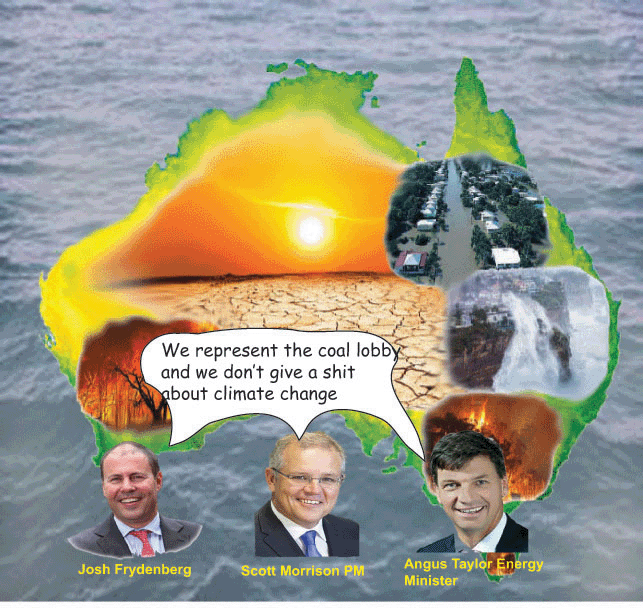 Australia will lose more than $3 trillion and 880,000 jobs over 50 years if climate change is not addressed, Deloitte says, ABC News, By Kathleen Calderwood– 1 Nov 20 The Australian economy will lose more than $3 trillion over the next 50 years if climate change is not addressed, according to a new report from Deloitte Access Economics.Key points: Australia will lose more than $3 trillion and 880,000 jobs over 50 years if climate change is not addressed, Deloitte says, ABC News, By Kathleen Calderwood– 1 Nov 20 The Australian economy will lose more than $3 trillion over the next 50 years if climate change is not addressed, according to a new report from Deloitte Access Economics.Key points:
The report found the economy could shrink by 6 per cent over the next 50 years and 880,000 jobs could be lost. Report author Pradeep Philip, who was a policy director for former prime minister Kevin Rudd, said there was also a lot to be gained if warming was kept below 1.5 degrees and Australia achieved net zero carbon emissions by 2050. “If we do act over the next few years then in just 50 years there is a benefit to the economy of $680 billion,” he said. “We’ll have an economy 2.6 per cent bigger, generating 250,000 jobs, so this tells us if you are pro-growth and pro-jobs then we need to act on climate change now……. Businesses ‘moving despite Government inaction’ Sheep grazier and chair of Farmers for Climate Action, Charlie Prell, says the pressure is already being felt in his industry, but opportunities are available to help agriculture businesses get by if climate change is addressed………. https://www.abc.net.au/news/2020-11-02/australian-economy-lose-$3-trillion-climate-change-inaction/12837244 |
|
|
Bushfire royal commission’s final report issues warning to Australia over climate change,
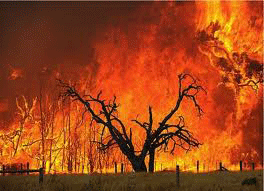 Bushfire royal commission’s final report issues warning to Australia over climate change, ABC News, By national science, technology and environment reporter Michael Slezak, 1 Nov 20, Bushfire royal commission’s final report issues warning to Australia over climate change, ABC News, By national science, technology and environment reporter Michael Slezak, 1 Nov 20, The bushfire royal commission’s final report is a stark warning of a future marked by extreme weather impacts of climate change.The commissioners describe their task at the very top of the report as “looking to the future”. And they are very clear about what that means. “Extreme weather has already become more frequent and intense because of climate change; further global warming over the next 20 to 30 years is inevitable,” they say. And as for what that means for fire regimes, they don’t mince their words. “Catastrophic fire conditions may render traditional bushfire prediction models and firefighting techniques less effective,” they say. The report notes there’s essentially nothing we can do about “locked in” warming set to occur over the next two decades. But what happens after that is up to us. Warming “beyond the next 20 to 30 years is largely dependent on the trajectory of greenhouse gas emissions”, it says. The commissioners also highlight evidence that avoiding or mitigating risks is much more cost effective than responding to disasters after they happen — an approach they unequivocally state is not adequate. “We need to do much more than put out fires. A resilient nation will seek to mitigate the risk of disasters through a wide range of measures, and it will attend to all of the complex and sometimes long-term consequences,” they say. Many commentators, including former fire chiefs, cross bench politicians and conservation groups, have argued the implication from the findings is clear: that greenhouse gas emissions must be quickly reduced to net zero. But of the report’s 80 recommendations, the commissioners do not make any aimed at trying to stop global warming. Their only climate-related recommendation calls for climate models to be created that can provide projections for smaller geographical areas — making them more useful for local disaster preparedness. Arguably, making recommendations about Australia’s greenhouse gas emissions or trajectory was outside the inquiry’s terms of reference. But that hasn’t stopped others drawing their own conclusions. “The Bushfire Royal Commission has laid out the facts in no uncertain terms: climate change drove the Black Summer bushfires, and climate change is pushing us into a future of unprecedented bushfire severity,” said Greg Mullins, former commissioner of Fire and Rescue NSW and founder of Emergency Leaders for Climate Action. “The Federal Government absolutely must act on the root cause of worsening bushfires in Australia, and take urgent steps to reduce greenhouse gas emissions. This clearly means no new coal or gas, and a rapid transition to renewable energy.” ……….. https://www.abc.net.au/news/2020-10-31/bushfire-royal-commission-final-report-a-stark-warning/12835096 |
|
In the Australian Capital Territory, (ACT), Labor to share power with The Greens
 Labor-Greens power-sharing deal set to be revealed on Monday, Canberra Times, Dan Jervis-Bardy, 30 Oct 20, Labor and the Greens are poised to unveil their power-sharing agreement for the next four years of government, following high-level talks between the two parties.
Chief Minister Andrew Barr and Greens leader Shane Rattenbury are aiming to finalise the new parliamentary agreement on Monday, ahead of a ceremonial sitting of the new ACT Legislative Assembly the following day.
Mr Barr and Mr Rattenbury, along with senior staff, have been locked in private talks throughout the week on the parliamentary agreement, thrashing out a list of shared priorities for the two parties and the terms under which the Greens will guarantee Labor’s hold on power……….. https://www.canberratimes.com.au/story/6992019/labor-greens-power-sharing-deal-set-to-be-unveiled-on-monday/?cs=14229
Malcolm Turnbull signs Kevin Rudd’s petition challenging News Corpse media dominance
 Malcolm Turnbull signs Kevin Rudd’s petition challenging News Corp media dominance
Former prime ministers urge others to join push for royal commission into lack of media diversity in Australia, Guardian, Calla Wahlquist, 30 Oct 20, Former Australian prime minister Malcolm Turnbull has signed Kevin Rudd’s petition calling for a royal commission into News Corp’s dominance of the Australian media.Rudd, also a former Australian prime minister, launched the petition to the Australian parliament earlier this month, saying the media company employed tactics that “chill free speech and undermine public debate,” and calling for a royal commission to ensure a strong and diverse news media in the face of “new business models that encourage deliberately polarising and politically manipulated news”.
Both Rudd and Turnbull faced negative campaigns from News Corp during their time in office.
On Sunday, Turnbull shared that he had signed the petition.
“Kevin has done well to get this petition going,” he said on Twitter. “I doubt it will result in a Royal Commission and Murdoch’s print monopoly (since 1987) is only part of the problem. But I have signed it and encourage others to do so.”
In Australia, there is no requirement for the parliament to respond to a petition once it reaches a certain number of signatures. Rudd told Guardian Australia that he knew it was unlikely the current federal government would respond.
“Obviously, the beneficiaries of the Murdoch protection racket, the Liberal National party, will not do that [act],” he said. “It will take some time to convince the Labor party that it’s in their interest as well. That will be influenced directly by the volume of public support.”………. Rudd said News Corp’s owner, Rupert Murdoch, was a “virtual monopoly player” in Australia. In his home state of Queensland, which is currently in a state election campaign, every newspaper is owned by NewsCorp.
“This is a one-newspaper state, not just a one-newspaper town,” he said “And anyone who thinks that’s fair in terms of every side of politics having a fair go has got rocks in their head.”…….https://www.theguardian.com/media/2020/oct/25/malcolm-turnbull-signs-kevin-rudds-petition-challenging-news-corp-media-dominance?CMP=Share_iOSApp_Other
Key findings from the report on Australian’s attitude towards climate change and energy

Climate of the nation 2020, Tracking Australia’s attitudes towards climate change and energy 28 OCT 2020 https://apo.org.au/node/309142, Audrey Quicke, Ebony Bennett, PUBLISHER The Australia Institute
The Australia Institute’s annual Climate of the Nation report details changing attitudes and beliefs around climate change, including its causes, impacts and solutions.
The 2020 report shows more Australians believe climate change is occurring and that humans are the main cause than since 2012. Australians support a range of decarbonisation policies and increasingly want Australia to be a world leader in finding solutions to climate change.
Key findings:
- After the devastating Black Summer bushfires, eight in ten Australians (82%) are concerned that climate change will result in more bushfires, up from 76% in 2019
- Vast majority of Australians (83%) want coal-fired power stations to be phased out
- Only 12% of Australians prefer investment in gas to power Australia’s economic recovery, while the majority of Australians (59%) prefer investment in renewables as a pathway for economic recovery
- Australians overestimate gas industry employment by a factor of 40x, believing, on average, that 8.2% of the workforce is in fossil gas mining when the reality is it represents just 0.2% of the Australian workforce
- Seven in ten Australians (71%) want Australia to be a global leader in finding solutions to climate change, a jump of 9 percentage points from 2019
- More than two in three Australians (68%) believe Australia should have a national target for net-zero emissions by 2050, including majority support across Coalition voters (59%), Labor voters (81%), Greens voters (90%), Other voters (65%).
British Prime Minister urges Scott Morrison on climate action: Morrison twists the message
|
But a statement from Mr Morrison described the call differently, noting that Mr Johnson “welcomed” Australian emissions reduction initiatives and “strongly endorsed” the Australian approach. The UK has a policy of achieving net zero carbon emissions by 2050. A press release from 10 Downing Street following the call said Mr Johnson “stressed that we need bold action to address climate change, noting that the UK’s experience demonstrates that driving economic growth and reducing emissions can go hand-in-hand”. The equivalent statement from the Australian Prime Minister’s office stated: “PM Johnson welcomed our significant increase in emissions reduction programs announced through the Budget, and strongly endorsed our focus on unlocking practical pathways to reducing emissions,” it read. “Both countries agreed to work closely together to accelerate research and deployment of low-emission technologies ahead of COP26.” COP26, the 2021 United Nations Climate Change Conference, will be held next year in Glasgow. Policies to be set locally Labor Senator Penny Wong pressed Foreign Minister Marise Payne over the contrast during senate estimates. “There is no reference to net zero emissions [in Scott Morrison’s statement] there is no reference to bold action and there is no reference to ambitious targets,” Senator Wong said……. https://www.abc.net.au/news/2020-10-28/boris-johnson-scott-morrison-climate-change-bold-action/12817474 |
|

Long-term research shows ocean acidification ramping up on the Reef
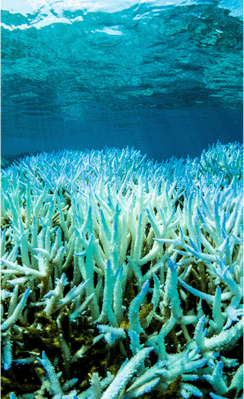 The future is now: long-term research shows ocean acidification ramping up on the Reef The future is now: long-term research shows ocean acidification ramping up on the Reef
A new study has shown ocean acidification is no longer a sombre forecast for the Great Barrier Reef but a present-day reality AUSTRALIAN INSTITUTE OF MARINE SCIENCE https://www.eurekalert.org/pub_releases/2020-10/aiom-tfi102820.phpResearch News Ocean acidification is no longer a sombre forecast for the Great Barrier Reef but a present-day reality, a new study reveals. The study, published in the international Journal Scientific Reports, shows carbon dioxide (CO2) and ocean acidification are rapidly increasing on the Reef. Seawater CO2 has risen 6 per cent over the past 10 years and matches the rate of CO2 increases in the atmosphere, confirming the influence of atmospheric CO2 on seawater CO2 levels. “People talk about ocean acidification in terms of 50 years’ time, but for the first time our study shows how fast ocean acidification is already happening on the Reef,” said Dr Katharina Fabricius, lead author and Senior Principal Research Scientist at the Australian Institute of Marine Science (AIMS). The research, a collaboration between AIMS and CSIRO, drew on over a decade of observations collected as part of Australia’s Integrated Marine Observing System (IMOS) to conclude that the Reef’s rich carbonate seafloor is not buffering against ocean acidification as previously thought. “Our research shows that acidification is rapidly changing the conditions that support the growth of coral on the Reef. It’s never been more important to address ocean acidification in plans to manage the Reef”, said Dr. Bronte Tilbrook, a Senior Principal Research Scientist at CSIRO who leads IMOS’ observational projects for CO2 and ocean acidification. Ocean acidification results from seawater absorbing excess CO2 that has been emitted into the atmosphere. The CO2 dissolves in the seawater where it changes the chemistry. This includes decreasing the water’s pH, and reducing the aragonite saturation state, which is critical for building the skeletons of reef-building coral and other marine organisms. Under reduced pH conditions, their calcium carbonate skeletons take longer to form and weaken, leaving them more susceptible to damage and erosion. While long-term data exist for CO2 and ocean acidification trends in open oceans, there have been very few long-term data on these trends in coastal waters around the world, including the Great Barrier Reef. Biological and physical processes like respiration create large fluctuations in CO2 in coastal areas, making the detection of trends more difficult. The study has filled this important knowledge gap by analysing 10 years of CO2, pH and aragonite saturation state data (2009-2019). These data were collected as part of Australia’s IMOS network at two long-term monitoring stations, located 650 kilometres apart at contrasting locations. The researchers found the minimum CO2 concentrations measured today were likely to already have passed the highest CO2 levels expected 60 years ago, even after accounting for the effects of temperature, nutrients, salinity, and daily and seasonal changes. “We know now that oceans are taking up about 23% of the excess CO2 from the air. They actually provide a service to humanity by slowing climate change. But the price to pay is that the seawater’s carbon chemistry is changing, and we didn’t know it was happening in dynamic coastal waters at such fast rates,” Dr Fabricius said. In another research first, AIMS and CSIRO scientists have used data from 1384 Reef sites to show coastal acidification’s negative impacts on three important indicators of Reef health:
The study, published earlier this year in the journal Global Change Biology, found these baby coral and coralline algae also decreased and seaweed increased as fine suspended sediment increased across the Reef — with the greatest sediment concentration and organism changes observed closer to the shore. The researchers highlighted effective water quality management as an achievable solution to reduce coastal acidification’s impact on the Reef. ### Australia’s Integrated Marine Observing System (IMOS) is enabled by the National Collaborative Research Infrastructure Strategy (NCRIS). It is operated by a consortium of institutions as an unincorporated joint venture, with the University of Tasmania as Lead Agent. |
|
Adani hires spying on activist’s daughter on way to school
|
Private investigator hired by Adani secretly photographed activist’s daughter on way to school
Exclusive: investigator’s affidavit shows he surveilled and followed anti-Adani activist Ben Pennings’ wife and daughter, Guardian, Ben Smee @BenSmee – 28 Oct 20, A private investigator working for Adani took covert photographs of an environmental activist walking his nine-year-old daughter to primary school, court documents have revealed.The affidavit of the investigator – who was instructed by lawyers representing Adani in its civil case against activist Ben Pennings – also revealed he surveilled Pennings’ wife, trawled her Facebook page and followed her to work. Guardian Australia can reveal documents detailing the surveillance of Pennings and his family were tendered to the Queensland supreme court in a recent “Anton Piller” case, in which Adani had sought permission to conduct an unannounced search of the activist’s family home. The Queensland supreme court and court of appeal both rejected the move, saying the search could result in “humiliation and family distress”. An email from the law firm representing Adani against Pennings, Dowd and Co, instructed a private investigator, Garry Andrew Sweet, to conduct surveillance for “the consideration of vulnerable persons … at the time of execution of any search warrant”……… Pennings said: “This is Adani all over. This is what Labor and the LNP actively support. Politicians would go berserk if anyone followed the partner and kids of a mining executive. Adani takes photographs of my daughter walking to primary school but unless anything changes this election Labor and the LNP will still allow them to operate in Queensland. “Queensland Labor has had plenty of opportunity to stand up against Adani’s intimidation of scientists and concerned citizens. It’s absolutely appalling they’ve given Adani a royalty holiday instead.”……. The mining company building the controversial Carmichael coalmine is suing Pennings, from the group Galilee Blockade, for conspiracy, intimidation and breach of confidence. …..https://www.theguardian.com/business/2020/oct/28/private-investigator-hired-by-adani-secretly-photographed-activists-family |
|
|
Labor aims to amend the Nuclear Waste Bill, removing Napandee as the stipulated dump site
Penny Wong office reply to Josephite SA Reconciliation Circle letter before the last Senate session 27 October 2020
From: “Wong, Penelope (Senator)” <Senator.Wong@aph.gov.au>Subject: RE: We plead with Labor Senators to vote NO to the undemocratic, unfair National Radioactive Waste Management Amendment Bill 2020
Date: 26 October 2020Dear Michele,
RE: NATIONAL RADIOACTIVE WASTE MANAGEMENT FACILITY PROPOSALThank you for your correspondence on the proposal for a national radioactive waste management facility in South Australia and the National Radioactive Waste Management Amendment (Site Specification, Community Fund and Other Measures) Bill 2020.Senator Wong is aware of different views in the community about this proposed facility.It is clear the Government’s proposal gives rise to issues surrounding Indigenous heritage, environmental concerns, public safety, as well as differing opinions on necessity of such a facility, all of which must be adequately resolved.Australians depend on nuclear technology for medicines used in the diagnosis of heart disease, skeletal injuries, as well as a range of cancers. Radioactive substances and wastes must be handled safely and with care.One effect of the Bill would be to amend the National Radioactive Waste Management Act 2012 to set aside the existing site selection and approval process, and instead specify the site selected and enable the acquisition of additional land for the facility.On 11 June 2020, the Bill passed the House of Representatives. As you noted, Labor opposed the Bill in the House. As you are aware, the Senate Economics Legislation Committee completed an inquiry into the Bill, and now it is up to the Government to decide when this bill will be debated in the Senate. Senator Wong followed the progress of the committee inquiry, in which Labor senators actively participated. We are pleased to see that you quoted from Labor senator Jenny McAllister’s dissenting report in your correspondence.Senator Wong encouraged members of the South Australian community to engage with the Senate Economics Legislation Committee inquiry in order to ensure committee members and parliamentarians more broadly are aware of community attitudes. Along with consultation that has taken place with stakeholders, as well as community views expressed to Labor parliamentarians in community meetings and through organised petitions and campaign emails, this informed Shadow Cabinet and Caucus as they finalised Labor’s position on the legislation.Labor has decided move an amendment to the legislation in the Senate that will remove the section of the Bill that nominates the site at Napandee, near Kimba, as the location of the national radioactive waste management facility, whilst maintaining the Community Fund established in the Bill for whatever community eventually hosts the site. Should our amendment be unsuccessful, we will oppose the Bill in the Senate.Labor’s proposed course of action does not prevent the Government from nominating the site under the existing legal process, something it could do today. However, retaining the existing process ensures this significant decision will be subject to judicial review so that the community can be assured the decision about where to locate the facility was reached as a result of a fair and properly conducted process. This is something we are aware that the representatives of the Barngarla People have expressed is particularly important to them.Ten years ago, Federal Labor deliberately amended the current legislation to include judicial review so that an affected party could challenge a decision made by the relevant minister. This is a contentious issue and should have the highest levels of scrutiny to ensure that the principles of procedural fairness and natural justice have been applied given the national significance of this matter.Thank you again for your correspondence.Yours sincerely,OFFICE OF SENATOR THE HONOURABLE PENNY WONG
Australia should stop selling uranium to nuclear weapon states and not sell uranium into unstable regions.
—
South Australian Upper House reaffirms the State’s law opposing nuclear waste dump

Mark Parnell MLC , It was a great day back in 2016 when we won the campaign to stop the ill-conceived proposal to turn South Australia into the World’s dumping ground for deadly high-level radioactive waste. However, domestic nuclear waste and other radioactive subjects are still on the agenda of State Parliament.
Proposed Kimba Nuclear Waste Dump
Whilst the Federal Liberal Government seeks to push this unnecessary and divisive project through the Senate, the South Australian Upper House has reaffirmed its commitment to State law by opposing a domestic nuclear waste dump at Kimba or anywhere else in South Australia. Dangerous long-lived radioactive waste currently stored under guard at Lucas Heights should stay there until a permanent solution is found, not shipped 1700kms to another temporary storage site in SA. If this project proceeds, the Greens will ensure that a South Australian Parliamentary inquiry is held that properly consults all stakeholders, including the Barngarla Traditional Owners who were shamefully excluded from the original community ballot.
Banning Nuclear weapons
State Parliament has recognised the 75th anniversary of the dropping of atomic bombs on Hiroshima and Nagasaki. This horror has inspired 47 countries to ratify a 2017 UN Treaty that would ban nuclear weapons forever. Only 3 more nations are needed for the Treaty to become International Law. So far, Australia is refusing to sign, for fear for offending our US allies. You can add your voice here: https://icanw.org.au/
STOP PRESS: We’ve just learnt that the 50th nation has ratified the Treaty, which will now come into effect in 90 days.
Radiation Regulation
The State Government has re-written South Australia’s radiation protection laws. Whilst most changes were administrative, there are still some fundamental problems, not least of which is that BHP’s Olympic Dam mine at Roxby Downs continues to be exempt from most State laws. Both Liberal and Labor joined forces to ensure that BHP’s special treatment continues with their “Indenture” overriding laws that all other mining companies must comply with.
On a more positive note, a number of Green amendments to increase accountability and transparency were accepted. We also secured an amendment that allows South Australia to set its own safety standards for radiation exposure and not be limited to outdated and weak standards applied elsewhere.
The Greens had a remarkable win in Australian Capital Territory elections
 The Green wave that swept the 2020 A.C.T. Election, Independent Australia, By Chris Mordd Richards | 26 October 2020, In a result almost none saw coming, the A.C.T. Greens have tripled their seat count in the A.C.T. Legislative Assembly following the Election on 17 October.
Going from two seats to six, stealing two seats each from A.C.T. Labor and the Canberra Liberals in the process……..
Clearly any party which manages to increase its representation by 300% in a single election has done an excellent job, appealing to the voters not only as a party but as credible individual candidates as well.
Newly elected MLA Johnathan Davis, who was in a very tight race for Brindabella but emerged the victor at the final count, had this to say on behalf of the Greens:
“The A.C.T. Greens are so grateful for the support we’ve received from Conder to Kippax, from Forde to Fraser. Every single Canberran is now represented by the Greens. We commit to working hard and honouring the support offered to us. Together, we’ll work every single day to build a better normal.”….
While Labor did reasonably well in retaining government, it was instead the Greens’ message which most struck a chord with a particular key segment of voters across the entire Territory this time. …….
The Australian Greens will certainly be examining in detail how the local party pulled it off to see how they might replicate this result in other parts of the country. For now, the A.C.T. is once more the greenest jurisdiction in Australia. https://independentaustralia.net/politics/politics-display/the-green-wave-that-swept-the-2020-act-election,14448
1 This month



Help Aunty Sue Protect Her Land and Sacred Sites From Destructive Rocket Testing.
.

Australians deserve the truth
about
AUKUS – https://aukuspublicinquiry.com/

PETITION – To: Prime Minister Anthony Albanese and the Australian Labor Government

of the week – Australians for War Powers Reform (AWPR)
To see nuclear-related stories in greater depth and intensity

