Radioactive Waste Facility Site – Woomera Amendment circulated in Senate
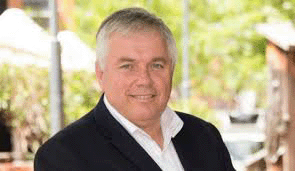 Senator Rex Patrick No Nuclear Waste Dump Anywhere in South Australia, 25 June 20,
The process that led to Kimba being selected as the site was flawed from inception, has bitterly divided the community and ignored the views of First Nations people. Thankfully the process has been stopped and the Parliament has been asked to decide the site. The Government has asked the Parliament to choose prime farmland, I’m asking the Parliament to choose a remote desert Defence secured site (after consultation).
I circulated my Woomera Prohibited Area (WPA) amendment to the Senate yesterday. The Senate Economics Committee looking into the site selection will hold its first hearing on Tuesday in Canberra and then come to SA for a hearing. The Committee has also resolved to conduct a WPA site visit.
I encourage you to participate in democracy and make a submission to the Committee. You’ll find a link to it’s website in the comments. mre https://www.facebook.com/groups/1314655315214929/
There is really no market in India for Australia’s uranium

 No market for Australian uranium in India, 23 June 2020, M V Ramana and Cassandra Jeffery, https://www.eastasiaforum.org/2020/06/23/no-market-for-australian-uranium-in-india/
In 2011, the Australian Labor Party (ALP) voted to overturn a ban on uranium sales to India. The Civil Nuclear Cooperation Agreement between Australia and India was then signed in 2014. The Australian Parliament subsequently passed a bill permitting its uranium mining companies to supply nuclear material to India. These efforts were supposedly intended to allow Australia to profit from Indian uranium purchases.
At the 2011 ALP national conference, then prime minister Julia Gillard argued that India was planning to generate 40 per cent of its electricity with nuclear energy by 2050. ‘Having access to this market is good for Australian jobs’, said Gillard during the conference. The Australian Uranium Association projected that ‘Australia could expect to sell some 2500 tonnes of uranium annually to India by 2030, generating export sales of AU$300 million’ (US$205 million). But nearly a decade later, what is the reality?
Aside from a small shipment of uranium sent to India for testing in 2017, no uranium appears to have been exported to India from Australia. In 2018, India’s Ministry of Atomic Energy stated that the country had signed contracts with firms from Kazakhstan, Canada, Russia and France to procure uranium. And in March 2020, India signed a contract with Uzbekistan. There has been no mention of Australia.
A large order for Australian uranium appears unlikely in the future as well. With a net generating capacity of only 6.2 gigawatts (GW), India does not have a large requirement for uranium in the first place. Further, Australian uranium can only be used for reactors under International Atomic Energy Agency (IAEA) safeguards, which attempt to ensure that no materials are used for nuclear weapons. Such reactors amount to less than 2 GW of India’s capacity.
India’s nuclear fleet will not expand dramatically either. India’s Department of Atomic Energy (DAE) has a long history of setting ambitious nuclear power generation targets and failing to meet them. In 1984, the DAE promised a nuclear capacity of 10 GW by 2000. The actual figure in 2000 was 2.7 GW. By then the DAE had set a new target, 20 GW by 2020. Again, today’s current capacity (6.2 GW) is nowhere close to this target.
Seven more reactors, with a total capacity of 4.8 GW, are under construction. But five of these reactors have been significantly delayed. Four of them were supposed to be commissioned in 2015 and 2016. But these reactors are now expected to start operating in October 2020, September 2021, March 2022 and March 2023 respectively.
The fifth is India’s flagship project, the Prototype Fast Breeder Reactor (PFBR). Construction started in 2004 and the reactor was supposed to start functioning in 2010 but is now ‘expected to commence production of electricity in October 2022’.
Costs have increased, too. The PFBR’s estimate has jumped from Rs 34.9 billion (US$457 million) to Rs 68.4 billion (US$896 million). And the PHWRs will cost around 40–45 per cent more than initially projected.
In contrast, India’s renewable energy sector is a different story. Wind and solar power have only recently been introduced to India’s energy mix, but both technologies are expanding rapidly while becoming significantly cheaper. Between 2016 and 2019, installed solar capacity increased from 9.6 GW to 35 GW, while wind capacity increased from 28.7 GW to 37.5 GW. In 2019, both wind (63.3 terawatt-hours (TWh)) and solar (46.3 TWh) power contributed more to overall electricity generation in India than nuclear power (45.2 TWh).
India’s renewable energy sector is expected to continue growing, while nuclear energy will likely remain stagnant. Recently, the Department of Economic Affairs assembled a task force to ‘identify technically feasible and financially viable infrastructure projects that can be initiated in fiscals 2020–25’. The task force foresaw renewable capacity increasing from 22 per cent of the total installed electrical capacity in 2019 to 39 per cent by 2025. Conversely, nuclear capacity stays around 2 per cent of installed capacity.
Even the Indian government expects the divergence between the growing renewable energy sector and the stagnant nuclear sector to increase as the rapidly falling cost of solar power makes nuclear power redundant.
Australian policymakers who advocated for exporting uranium to India were betting on the wrong energy source. Perhaps there were ulterior motives, including recognising India as a major power. But good policy cannot be made on the basis of false claims.
Australian uranium companies continue to insist that India is expanding its nuclear power capacity. Energy Resources of Australia Ltd’s 2017 annual report claims that ‘India has 22 reactors in operation and plans to generate as much as 25 per cent of electricity from nuclear power by 2050’. Paladin and Yellow Cake made similar claims in 2019.
Nuclear power has never constituted more than a few per cent of India’s electricity supply. Given current trends, it will never amount to much more. Nuclear reactors are expensive and time-consuming to construct, factors that explain why the share of electricity supplied by nuclear power plants globally has declined continuously, from 17.5 per cent in 1996 to 10.15 per cent in 2018. This global trend must be considered by Australian policymakers as they deal with lobbyists for uranium mining and the push there to build nuclear plants.
M V Ramana is Professor, Simons Chair in Disarmament, Global and Human Security, and Director of the Liu Institute for Global Issues at the School of Public Policy and Global Affairs, the University of British Colombia. Cassandra Jeffery is a recent Master‘s of Public Policy and Global Affairs graduate of the University of British Columbia.
Labor reaches for bipartisanship on energy policy, but a DEFINITE NO TO NUCLEAR

Albanese says Labor will not support domestic nuclear power. The Morrison government has flagged examining “emerging nuclear technologies” as part of Australia’s energy mix in the future in a new discussion paper kicking off the process of developing its much-vaunted technology investment roadmap.
Let’s end Australia’s climate and energy warfare, Albanese tells Morrison https://www.theguardian.com/australia-news/2020/jun/24/lets-end-australias-climate-and-energy-warfare-albanese-tells-morrison
Labor leader sets out policy pivot in challenge to PM to display genuine bipartisanship Katharine Murphy Political editor @murpharoo
Wed 24 Jun 2020, Anthony Albanese has dumped Labor’s former backing of Malcolm Turnbull’s national energy guarantee and opened the door for taxpayer support for carbon capture and storage technologies, in a major overture to Scott Morrison to reach bipartisan agreement on energy policy.
The Labor leader will use a speech to the National Press Club on Wednesday to set out his guiding principles for an agreement to end more than a decade of political warfare on climate and energy policy.
In a letter sent to the prime minister before Wednesday’s address, Albanese says Labor is open minded on a new policy mechanism to guide investment as long as the emissions reduction targets are scalable – meaning a future government of either persuasion could dial them up, or wind them back – and as long as the mechanism isn’t the Coalition’s existing emissions reduction fund.
The Labor leader has also told the prime minister the opposition is open to CCS, which remains a controversial technology with many environmentalists, as long as projects are not funded through the national renewable energy bodies the Clean Energy Finance Corporation and the Australian Renewable Energy Agency.
But Albanese says Labor will not support domestic nuclear power. The Morrison government has flagged examining “emerging nuclear technologies” as part of Australia’s energy mix in the future in a new discussion paper kicking off the process of developing its much-vaunted technology investment roadmap.
While Albanese has signalled that Labor cannot accept the Coalition’s emissions reduction fund – the heavily criticised policy that replaced Labor’s carbon price in 2013 – as the bipartisan mechanism, he says a future Labor government would not seek to unwind contracts entered during this parliament, including any contracts involving support for CCS.
Labor’s new position reflects an attempt by Albanese to balance divided views within his own ranks. Some in the right faction believe Labor’s commitment to climate policy ambition has cost the party electorally, and Labor will not win the next federal election unless it reconnects with workers in carbon-intensive industries in New South Wales and Queensland.
But it is also an effort to challenge Morrison to use the post Covid-19 recovery to display genuine bipartisanship in the service of fixing a problem that has festered in Australia for more than a decade. Albanese’s repositioning also comes as the major parties accelerate their campaigns in the marginal seat of Eden-Monaro, where climate change is an issue, with the byelection due on 4 July.
The Coalition has successfully weaponised climate change against Labor at every federal election since 2013, but the government is also under pressure from business groups and major institutions to end the policy uncertainty that is undermining investment in critical infrastructure.
Facing sustained pressure to adopt a 2050 target of net zero emissions, pressure it is continuing to resist despite signing the Paris agreement which has that ambition embedded within it, the government plans instead to develop the technology roadmap as the cornerstone of the Coalition’s mid-century emissions reduction strategy.
Given that the government has launched the roadmap, Labor is taking the opportunity to launch its own pivot on energy policy, and attempt to open the door to a new round of discussions.
A leading Australian business organisation, the AiGroup, has called for the two biggest economic challenges in memory – recovery from the Covid-19 pandemic and cutting greenhouse gas emissions – to be addressed together, saying that would boost economic growth and put the country on a firm long-term footing. A number of other community and investor groups have expressed similar sentiments.
In his letter to Morrison, Albanese says Australia has lacked a national energy policy since the renewable energy target was met in late 2019 and Morrison dumped Turnbull’s Neg shortly after taking the prime ministership. Labor adopted the Neg as policy during the last parliament in an effort to see whether any common ground could be reached between the major parties, but that proved fruitless.
The letter says the lack of a settled mechanism has increased investor uncertainty “and new investment in renewable energy generation fell by 50% in 2019, according to the Reserve Bank of Australia and industry analysis”.
“We have an opportunity to move past partisan approaches to energy policy, to draw on the community’s clear desire for more bipartisan approaches to difficult policy areas, and to finally deliver an enduring, effective and bipartisan energy policy for Australia,” Albanese writes.
Labor has adopted a net zero target by 2050 as policy post-election, but it remains unclear what interim emissions reduction targets will be.
Killing Australia’s democracy – first kill the ABC
Latest $84 million cuts rip the heart out of the ABC, and our democracy, The Conversation, Alexandra Wake, Program Manager, Journalism, RMIT University, Michael Ward, PhD candidate, University of Sydney, 24 June 20
In the latest cuts, wrapped up as part of the national broadcaster’s five-year plan,
- 250 staff will lose their jobs
- the major 7:45am news bulletin on local radio has been axed
- ABC Life has lost staff but somehow expanded to become ABC Local
- independent screen production has been cut by $5 million
- ABC News Channel programming is still being reviewed………
- Clearly the coronavirus pandemic has slashed Australia’s commercial media advertising revenues. But the problems in the media are a result of years of globalisation, platform convergence and audience fragmentation. In such a situation, Australia’s public broadcasters should be part of the solution for ensuring a diverse, vibrant media sector. Instead, it continues to be subject to ongoing budget cuts.
Moreover, at a time when the public really cannot afford to be getting their news from Facebook or other social media outlets, cutting 250 people who contribute to some of Australia’s most reliable and quality journalism and storytelling – and literally saving lives during the bushfires – appear to be hopelessly shortsighted.
The latest Digital News Report 2020 clearly showed the ABC is the media outlet Australians trust the most.[table on original shows this]……
- the end of short wave radio services to the Northern Territory
- a reduction in live concerts on Classic FM
- a contraction of Australian drama
- cut costs for Australian children’s programming
- reductions in women’s and local sport
- an end to the coverage of international events such as the Olympics cancelled
- an end to non-news and current affairs television outside of Sydney and Melbourne
- the closure of ABC Open
- 100 websites shut down.
- ……… It is against this background the latest funding freeze, due to a failure to meet the impact of inflation costs, occurs. While it doesn’t sound like a lot, the three year impact is $84 million, and has resulted in the cuts announced today.But more importantly, these ongoing cuts represent an attack by the federal government on the broadcaster, its role in democracy, and in keeping Australians safe, informed and entertained. https://theconversation.com/latest-84-million-cuts-rip-the-heart-out-of-the-abc-and-our-democracy-141355
Australian govt current energy policies will mean 11,000 renewable energy jobs lost
 Up to 11,000 renewable energy jobs could be lost under Morrison government policies Up to 11,000 renewable energy jobs could be lost under Morrison government policiesThe job losses will be equivalent to the entire local coal industry if the renewable energy target is not replaced, Guardian Adam Morton Environment editor @adamlmorton, Thu 25 Jun 2020 Up to 11,000 renewable energy workers are expected to lose their jobs over the next two years under current government policies, according to a university analysis. If correct, the loss of jobs would be equivalent to the abolition of the domestic-focused coal industry, which employs a little more than 10,000 people in mining thermal coal for local use and running Australia’s coal-fired power plants. Described as the first large-scale survey of renewable energy jobs in Australia, the research from the University of Technology Sydney found the industry would be a major source of jobs in the medium term, but its short-term future would depend on how Covid-19 stimulus packages were deployed. About 26,000 people are employed in renewable energy, but the study found this would fall to about 15,000 by 2022 under existing policies, including the Morrison government not replacing the national renewable energy target. The target, which requires energy companies to source about 23% of electricity from clean sources, was reached last year, triggering a 50% drop in large-scale renewable energy investment compared with 2018. Conversely, renewable energy jobs would be expected to reach about 45,000 by 2025 under a “step change” scenario, set out by the Australian Energy Market Operator, consistent with the goals of the 2015 Paris agreement. The study says on this path employment in renewables would be likely to fall to about 30,000 as construction eased later this decade before rising again after 2030. Chris Briggs, a research principal at the UTS Institute for Sustainable Futures, said up to two-thirds of renewable energy jobs would be expected to be created in regional areas. “It’s a difference of 30,000 jobs in the next few years depending on government policy,” he said. Many of the jobs would be expected to be in identified renewable energy zones. The zones overlap with existing coal regions but are more widespread. Briggs said it suggested renewable energy could play a meaningful role alongside other industries in creating replacement jobs in coal regions as the world reduced reliance on fossil fuels, but only if the transition was well planned and funded……… https://www.theguardian.com/environment/2020/jun/25/up-to-11000-renewable-energy-jobs-could-be-lost-under-morrison-government-policies |
|
Up to 40 Energy jobs to be cut from CSIRO
 CSIRO to pull plug on energy jobs, https://www.miragenews.com/csiro-to-pull-plug-on-energy-jobs/ CSIRO management have announced this week that up to 40 jobs will be cut from its energy team, including key scientists, engineers, and researchers.The union representing the public sector including CSIRO workers, the CPSU, are calling on the government to halt cuts to the CSIRO.
These are the latest in a series of staff cuts to hit the CSIRO, bringing the total number of job losses to 619 this financial year alone, due to the impact of the governments’ Average Staffing Level Cap and continued budget cuts.
Projects that could affected as a result of these Energy job cuts are upstream oil and gas, the Low Emissions Technologies program, and post combustion CO2 capture research.
Four energy sites will be affected including Kensington (Western Australia), Clayton (Victoria), Newcastle and North Ryde (New South Wales).
Quotes Attributable to CPSU National Secretary Melissa Donnelly:
“There is no doubt that these cuts will have an enduring impact on the national capability to develop and implement energy and climate policy. At a time when the government should be focussed on the future of our energy needs, they are more concerned with cutting jobs.”
The CSIRO is on track to lose more than 500 jobs by 1 July and that does not include these latest cuts in Energy. We need to be investing in the CSIRO not cutting hundreds upon hundreds of jobs.”
“It’s time for the government to scrap the ASL Cap and invest in Australia’s scientific resources. If the past 6 months have shown us anything, its that the CSIRO is more important than ever.”
Quotes Attributable to CPSU CSIRO Section Secretary Sam Popovski:
“Job losses of any sort in CSIRO are bad news. CSIRO Chief Executive Larry Marshall needs to do a lot more to protect CSIRO jobs and start to make a case for increased public funding.”
“The recent King Review indicates that Australia’s energy policy remains far from settled and diminishing CSIRO’s specialist capabilities in this area harms government decision-making and future innovation.”
“There are growing concerns that the October federal budget may feature spending cuts and Dr Marshall and the Board must ensure that the case for CSIRO public funding is heard loud and clear over coming months,” Mr Popovski said.
Retain integrity of renewable energy agencies: ACF
Retain integrity of renewable energy agencies: ACF, https://www.miragenews.com/retain-integrity-of-renewable-energy-agencies-acf/ 24 June 20, The Australian Conservation Foundation has welcomed Labor leader Anthony Albanese’s commitment to the integrity of the nation’s key renewable energy agencies, the Clean Energy Finance Corporation (CEFC) and the Australian Renewable Energy Agency (ARENA).
“Any moves to dilute the mandates of ARENA and the CEFC to allow them to invest in fossil fuel projects would be a perversion of their important and very successful clean energy investment functions,” said ACF’s climate program manager Gavan McFadzean.
“Australia is positioned to be a renewable energy superpower – any move to change the direction of ARENA and the CEFC is a step in the wrong direction.
The Australian Conservation Foundation has welcomed Labor leader Anthony Albanese’s commitment to the integrity of the nation’s key renewable energy agencies, the Clean Energy Finance Corporation (CEFC) and the Australian Renewable Energy Agency (ARENA).
“Any moves to dilute the mandates of ARENA and the CEFC to allow them to invest in fossil fuel projects would be a perversion of their important and very successful clean energy investment functions,” said ACF’s climate program manager Gavan McFadzean.
“Australia is positioned to be a renewable energy superpower – any move to change the direction of ARENA and the CEFC is a step in the wrong direction.
“It is important that Anthony Albanese has today closed the door on costly, high-risk, unpopular nuclear energy.
“The CEFC was created with a specific purpose: to help mobilise finance into clean energy.
“The CEFC has made profits and provided great public value by driving down the cost of new clean energy technologies, speeding the transition to clean electricity supply through projects that support reliability of electricity and helping Australia access the enormous benefits available through improved energy productivity.
“The coal and gas lobbies have tried for years to convince the Federal Government to manipulate the CEFC’s mandate to suit the interests of the fossil fuel industry.
“We urge the Federal Government to commit to maintain the remits of ARENA and the CEFC as renewable bodies.
“ACF welcomes moves towards a bipartisan approach to energy and the desire to agree to an emissions reduction mechanism that can be strengthened by future governments.”
Julian Assange’s fiancé calls on the Australian government to secure his freedom
 Julian Assange’s fiancé calls on the Australian government to secure his freedom, https://www.wsws.org/en/articles/2020/06/22/assa-j22.html, By Oscar Grenfell, 22 June 2020Stella Morris, the fiancé of Julian Assange and mother of his two young children, issued a powerful call last night for the Australian government to secure the WikiLeaks founder’s freedom and prevent his extradition to the US, where he faces life imprisonment for exposing American war crimes. Julian Assange’s fiancé calls on the Australian government to secure his freedom, https://www.wsws.org/en/articles/2020/06/22/assa-j22.html, By Oscar Grenfell, 22 June 2020Stella Morris, the fiancé of Julian Assange and mother of his two young children, issued a powerful call last night for the Australian government to secure the WikiLeaks founder’s freedom and prevent his extradition to the US, where he faces life imprisonment for exposing American war crimes.
Morris was featured on Channel Nine’s “60 Minutes” program. The 24-minute segment provided an objective account of Assange’s decade-long arbitrary detention, first in Ecuador’s London embassy where he was a political refugee, and since April 2019 in the maximum-security Belmarsh Prison. The program, presented by Tara Brown, was the first substantive examination of Assange’s plight by the Australian media since the coronavirus pandemic began. Despite the fact that he is an Australian journalist being persecuted by the most powerful governments in the world for his publishing activities, corporate media outlets have maintained an effective D-notice on Assange for more than three months. This has dovetailed with the refusal of the Australian government, the Labor opposition and all of the official parties to defend the WikiLeaks founder. Morris warned that Assange’s incarceration in Belmarsh, which she noted has been dubbed the “UK’s Guantanamo Bay,” is exacerbating physical and psychological health issues stemming from his protracted persecution. “He’s very unwell and I’m very concerned for his ability to survive this,” she said. “Now he’s in the UK’s worst prison. It’s a high-security prison. One in five prisoners are murderers. He shouldn’t be there. He’s not a criminal, he’s not a dangerous person, he’s a gentle intellectual thinker and a journalist. Those people are not the people who belong in prison.” Morris stated that she was “very worried” about Assange’s circumstances. She has been unable to visit him since February, as a result of coronavirus lockdown measures. Despite widespread infections throughout the British penitentiary system, including in Belmarsh, and Assange’s vulnerability to the virus as a result of a chronic lung condition, he has been refused bail. “If you’re separated from your family and you’re alone in a tiny, dark room for 23-hours a day, with no control over your surroundings, I think people can imagine what that is like,” Morris said. Brown stated that in such circumstances, “most people would probably go mad.” Morris responded: “I think any person would get very severely depressed and he is very depressed.” “60 Minutes” showed Morris and her two young children speaking with Assange on the phone. The older of the two asked Assange when he was coming home. Morris, a 37-year-old lawyer, recounted the circumstances of her relationship with Assange. They had grown close when she was working on his legal cases after he had successfully sought political asylum in the Ecuadorian embassy. When the couple’s two children were born in 2017 and 2018, the new Ecuadorian government had initiated closer relations with the US and was increasingly hostile to Assange. UC Global, a Spanish firm contracted to manage the embassy’s security, was surveilling every aspect of Assange’s life and was passing the the material gathered to the US Central Intelligence Agency. When she fell pregnant, Morris informed Assange by writing the news on a piece of paper. They were fearful that any conversation about their personal life would be picked up by the audio recording devices placed throughout the embassy by UC Global. Morris sought to hide her pregnancies from the embassy staff and after the children were born, a friend of Assange pretended to be their father and brought them to the embassy. “The real issue was I thought that our family would be targeted by the same people that were trying to harm Julian,” Morris stated. The program featured news clips of senior US government figures denouncing Assange in hysterical terms and calling for him to be silenced. Morris noted that UC Global had considered stealing the diaper of one of her children to confirm his paternity, and had even discussed plans to kill Assange or allow American agents to kidnap him. Morris commented that it would be difficult for many people to appreciate the lawlessness that had characterised Assange’s persecution. “There’s incredible criminality that has been going on in order to gather information about Julian’s lawyers, and his family, and journalists who were visiting him,” she said. “I’ve been in a permanent state of fear for years and now it’s slowly playing out.” Significantly, the politically-motivated character of Swedish sexual misconduct allegations against Assange was made clear in the program. The allegations were concocted by that country’s police and judiciary, in the midst of a frenzied US campaign against WikiLeaks’ exposure of war crimes in Iraq and Afghanistan. Brown noted that Assange had never been charged with a crime in Sweden, and that the Swedish investigation had been dropped. Australian independent parliamentarian Andrew Wilkie pointed out that documents had shown that the British government used the allegations to enforce Assange’s arbitrary detention in the Ecuadorian embassy. The British authorities had been aware that the Swedish claims were a smokescreen for plans to dispatch Assange to his US persecutors. The program concluded with an appeal from Morris to the Australian government. She said: “I want people to understand that we’re being punished as a family. It’s not just Julian in the prison. The kids are being deprived of their father. I need Julian and he needs me.” Morris declared: “I’d like to ask [Australian Prime Minister] Scott Morrison to do everything he can to get Julian back to his family. If Australia doesn’t step in I’m very fearful this wrong won’t be righted. It’s a nightmare.” Tellingly, Brown stated that Morrison, Foreign Minister Marise Payne and Christian Porter refused to be interviewed. This was in line with the ten-year collaboration of Australian governments in the US-led vendetta against Assange. Beginning with the Greens-backed Labor government of Julia Gillard, they have rejected calls to defend the WikiLeaks’ founder, instead participating in the campaign against him. The official hostility to Assange is bound up with the Australian ruling elite’s unconditional support for the US military alliance and all of American imperialism’s illegal wars and military preparations and dovetails with a domestic assault on democratic rights, including attacks on press freedom and laws increasing punishments for whistleblowers. It is facilitated by the refusal of the Greens, the pseudo-left groups and the unions to mount any campaign for Assange’s rights. This underscores the fact that the fight for Assange’s freedom and for the defence of all civil liberties requires the mobilisation of the working class. The international protests over recent weeks against police violence have demonstrated the objective basis for building such a movement. |
|
The seriousness of mobility of radionuclides in developing the nuclear waste facility at Kimba. South Australia

has the government explained why the reprocessed nuclear waste has been reclassified by ANSTO from high level to intermediate on arrival in Australia ?
has anyone from the community and even the Kimba District Council ever sought any information as to the inventories and movement of the radionuclides in the intermediate level waste for above ground storage at Kimba?
The mobility of radionuclides is probably the prime and initial factor in determining the location and manner of nuclear waste management by storage and disposal
Although nearly thirty years old but still current the Code of practice for the near-surface disposal of radioactive waste in Australia (1992) prescribed radioactive waste hazards as:
The health risk to humans presented by radioactive waste depends upon the radionuclides present, the type of radiation emitted by the particular radionuclides, their concentrations, and their chemical and physical form. The hazard may arise from external irradiation of the body or internally as a result of radioactive substances entering the body by ingestion, inhalation or absorption through the skin. The radioactive waste specifically covered by this code may also present a long-term hazard to the environment and to future generations if disposal is not carried out in a responsible manner.
Even though the Code deals with disposal rather than storage the requirements for both are basically similar with the only difference being the retrieval of the waste as seen from the definitions in the Code being:
Waste disposal means the placement of radioactive waste in a structure and in a manner such that there is no intention of retrieval.
Storage means the emplacement of waste in a facility with the intent and in a manner such that it can be retrieved at a later time.
From this I trust that you understand the seriousness and importance of radionuclides mobility in the selection and development of the management facility at Kimba
IN VIEW OF THIS SOMEONE FROM KIMBA SHOULD FORMALLY IN WRITING ASK THE KIMBA DISTRICT COUNCIL THESE QUESTIONS
COPIES SHOULD BE SENT TO:
THE SENATE COMMITTEE CHAIRMAN
MINISTER PITT
MR ROWAN RAMSEY MP
ANSTO CEO PATERSON
BARNGARLA IF THOUGHT APPROPRIATE
EXCLUDE ARPANSA AS IT MAY BE COMPROMISING TO IT AND IT WILL IGNORE THE LETTER IN ANY CASE
Questions:
(a) whether there have been any discussions or arrangements regarding fire as a risk at the Kimba facility – had this ever been covered by the government in its presentations as one of the main reasons for underground burial of nuclear waste is to avoid any fire risks?
(b) has the government explained why the reprocessed nuclear waste has been reclassified by ANSTO from high level to intermediate on arrival in Australia ?
(c) has the community ever been informed of the radionuclides movement activity of the intermediate level waste to be sent to Kimba?
(d) what explanation was given as to the radionuclides movement and immobilisation in above the ground storage as opposed to geological burial?
(e) has anyone from the community and even the Kimba District Council ever sought any information as to the inventories and movement of the radionuclides in the intermediate level waste for above ground storage at Kimba?
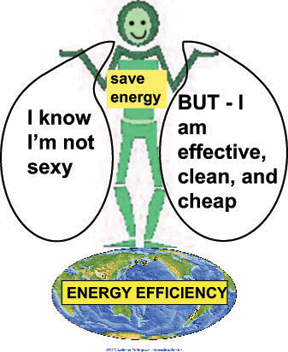
Australia’s best energy measure – to lift energy efficiency – Chief Scientist says
|
Chief scientist joins calls for Australia to dramatically boost energy efficiency
Alan Finkel calls saving electricity the ‘best form of generation’ as groups push for efficiency measures to lead economic recovery, Guardian, Adam Morton Environment editor @adamlmorton, Sun 21 Jun 2020 Australia’s chief scientist, Alan Finkel, has warned the country is not doing enough to lift energy efficiency, and described measures to save electricity as the “best form of energy generation you could possibly ever hope to have”.
Speaking in his role as chair of a panel advising the Morrison government on a low emissions technology statement, Finkel told an industry seminar that Australia had ongoing issues with energy efficiency and productivity, and noted a national energy productivity plan, agreed by federal and state energy ministers in 2015, did not appear on a list of national climate and energy policies. “I don’t think we’re anywhere close to having that nailed,” he said on energy efficiency. “There is no lack of appreciation from myself or my colleagues on the taskforce … that a gigawatt of power not needed because you’ve done an efficiency measure is the best form of energy generation that you could possibly ever hope to have.” Finkel’s view is in line with a raft of groups from across Australian society that are calling for federal and state governments to back an energy-efficiency drive for homes and other buildings to help address both the coronavirus-triggered recession and the climate crisis. Many have called for policies that focus on social and low-income housing. Buildings are responsible for nearly a quarter of national greenhouse gas emissions. The organisations calling for better energy efficiency say it could cut emissions, create tens of thousands of jobs and, unlike some other proposed stimulus measures, be delivered immediately. Household-level energy efficiency measures can include boosting thermal performance by sealing leaks and improving insulation, replacing gas appliances with those run on clean electricity, encouraging better lighting and installing solar panels and a battery to generate electricity onsite. Four separate reports on the issue were released last week. In one, more than 50 social, property, business, environment and other groups called for an energy efficiency and solar package focused on low-income houses. The 50, led by the Australian Council of Social Service (Acoss), said the government’s HomeBuilder stimulus program had helped high-income earners planning expensive renovations, but failed to do anything for those most in need, or to cut emissions. They recommended the federal government match state funding for energy efficiency upgrades and solar panel installations in social housing, work with local government to improve low-income homes, offer grants to landlords to fix inefficient rental properties and subsidise the replacement of inefficient appliances. Kellie Caught, an Acoss climate and energy senior advisor, said a low-income energy productivity program could quickly create more than 60,000 jobs in training, auditing, installation, manufacturing and local retail……… The groups calling for energy efficiency improvements are part of a push including global organisations, banks, major institutional investors and some governments, for a green recovery from the Covid-19 shutdown. A report by the International Energy Agency released last week found governments were planning to spend US$9tn globally on rescuing their economies from the coronavirus crisis, and the stimulus packages created this year would determine the shape of the global economy for the next three years. It warned emissions must start to fall sharply and permanently within that time or climate targets will be out of reach. The Morrison government and its National Covid-19 Coordinating Commission have emphasised gas, a fossil fuel, as being central to pandemic recovery……. https://www.theguardian.com/australia-news/2020/jun/21/chief-scientist-joins-calls-for-australia-to-dramatically-boost-energy-efficiency |
|
Mysterious, manipulative and corrupt process whereby Napandee was selected for nuclear dump site

Name Withheld, National Radioactive Waste Management Amendment (Site Specification, Community Fund and Other Measures) Bill 2020 [Provisions] Submission 39 [Excerpt] “…..So we examine briefly the nomination process in Kimba. When the 28 nominations were received in 2015, the number were then by a mysterious and yet to be released process whereby 6 sites were ultimately deemed suitable by the Federal Government. This announcement occurred in early 2016 and after another round of processes which were just as mysterious, the two sites in Kimba and one site in Hawker were selected to go to the the next round.
But just as quickly as they were announced – Cortlinye (Current MP at that time and now Rowan Ramsey’s land) and Pinkawillinie (Jeff Baldock’s
land) in Kimba, and Barndioota (former senator Grant Chapman and Philip Speakman pastoral lease), suddenly it was noted that Rowan Ramsey’s nomination of Cortlinye was in direct conflict with Section 44 of the Constitution, so his land nomination was withdrawn. Pinkawillinie, which was Jeff Baldock’s nomination was not accepted as suitable because of lack of community support.
So that left Barndioota as the only candidate. That meant Kimba was taken completely off the list as a possible site announced April 29th 2016. And that should have been the end of it.
https://www.eyretribune.com.au/story/3878053/kimba-not-going-nuclear/
Then following the Federal Election in July 2016, just a few months later, the portfolio of Minster of Resources was shifted from Josh Frydenberg and given to Matt Canavan. And then the goalposts for nomination were changed…. and suddenly Kimba was on the list again, with three different nominations – Napandee (Jeff Baldock’s land), Tola Park (Jeff Baldock’s land) and Lyndhurst (Brett and Michelle Rayner).
So effectively Jeff Baldock seemingly pursued this dump and the nomination process if you look at how many sites he submitted! And he became proactive by being an active member of the newly formed Working for Kimba’s Future (in 2016) AND one of the members of the Kimba Consultative Committee!
There was no apparent submissions required for these nominations in this “second intake” or at least it was not advertised! Many people in Kimba assumed that the previous ones submitted when Cortlinye and Pinkawillinie were nominated would be used for these two new sites of Napandee and Lyndhurst. Tola Park was not taken any further after the nominations were announced possibly because it had too many neighbours to deal with.
To bring the point absolutely to point – Jeff Baldock was intent on making this happen, by submitting his land, not once, not twice but three times! And inserting himself into the Working for Kimba’s Future Committee AND an active member of the Kimba Consultative Committee! Rowan Ramsey did not do this when nominating his land. Brett and Michelle Rayner did not do this when nominating their land. (And go to Hawker – Grant Chapman and peter Speakman did not do this when nominating their land – although granted they do not actually live in the area either!)
Why would you allow an OBVIOUS INVESTED PERSONAL INTEREST be on the Kimba Consultative Committee – where the members WERE SELECTED BY THE GOVERNMENT! And it gets worse than that – the required NUMBERS OF PEOPLE REQUIRED – 6 FOR, 6 AGAINST and 6 NEITHER – were not achieved for the committee when the selected names came back, and when questioned why this is so, were told that it didn’t matter because they were a non voting body. However that is not true as the Committee was used to decide the boundaries for the voting.
“5.20 Mrs Toni Scott outlined her concerns with the allocation of places to the Kimba Consultative Committee: Bruce McCleary…informed people at the meeting that the committee would consist of six people opposed, six people supportive and six people who are neutral. That was also again given to members of our group by the Minister—that that’s how the makeup of the committee would be. On the day that the committee was announced, we were extremely concerned that there were only four people who had expressed opposition who were actually on that committee…
Bruce Wilson took my concerns on board and told me that the makeup of the committee didn’t really matter because it’s a non-voting body.15 5.21 However, it does appear that the Kimba Consultative Committee (KCC) has
been asked to make at least on significant decision: We were told by Bruce McCleary that the KCC would be a non-decision making body. However, our concerns probably came to light a bit in the May meeting, when the KCC was asked to vote on whether we should request that the Minister consider altering the boundaries for the ballot.”
https://www.aph.gov.au/Parliamentary_Business/Committees/Senate/Economics/Wastemanageme
ntfacility/~/media/Committees/economics_ctte/Wastemanagementfacility/report.pdf
Which leads to the use of the Local Government Act in the ballot process. It was not an accident of fortune that it was used to conduct the community ballot – as this meant that it could be used also to exclude Traditional Owners as well – particularly the Barngarla people in the case of Kimba.
“5.21 However, it does appear that the Kimba Consultative Committee (KCC) has been asked to make at least on significant decision: We were told by Bruce McCleary that the KCC would be a non decision making body. However, our concerns probably came to light a bit in the May meeting, when the KCC was asked to vote on whether we should request that the Minister consider altering the boundaries for the ballot.16 5.22 By contrast, Dr Susan Andersson explained how the Barndioota Consultative Committee had effectively been sidelined by DIIS and the Minister in relation to defining the boundaries of the community vote: …we spent hours deciding what community is and who will get the vote and whether that includes Quorn, whether outback areas get in and how broad this should be. We had an expert there to help us define community for two sessions. Plus it was on the agenda two or three times: you will get a vote; BCC will be inputting into what area gets a vote.
Then Minister Canavan arrived on his surprise visit and said, ‘The area will be this.’ At a BCC meeting we said, ‘Hang on, we haven’t had our vote yet.’ ‘Oh, haven’t you? You can still have your vote; we’ll listen to it.’ But he’d already made media and public announcements as to what the area was. The BCC had been working towards contributing to what defined the community.17”
https://www.aph.gov.au/Parliamentary_Business/Committees/Senate/Economics/Wastemanageme
ntfacility/~/media/Committees/economics_ctte/Wastemanagementfacility/report.pdf
Although the Act as it stands requires consultation with Traditional Owners, freezing them deliberately out of the community ballot should not the intention of what is considered a right and Australian way of doing things in this day and age – given the scope and timeline of the nuclear waste being considered! Especially when the Local Government Act is only primarily used for Roads, Rates and Rubbish…and electing new council members!
Although the Barngarla people’s Native Title claim was determined on January 22nd 2015, their formal ownership occurred in June 2018, after first being lodged in 1996! Now when was the community ballot originally meant to be conducted for this dump? August 2018. This again is a reason why the Barngarla people are angry. When they conducted their very own ballot in 2019, through an independent ballot agent Australian Election
Company, after being denied one through the Council ballot with boundaries determined by the Minister, their results showed NO VOTES IN FAVOUR OF THE DUMP ON THEIR LAND – 209 eligible to vote, 83 voted NO 0 voted yes! So under Matt Canavan’s loose usage of figures, 100% NO and
0%YES.
But the real kicker are two other points. One that the Baldocks are now actively selling land with three neighbouring famers in Kimba in a large lot called the “Cunyarie Collection”, 9000ha as
advertised February 14, 2020 https://www.adelaidenow.com.au/business/sa-businessjournal/
large-parcel-of-eyre-peninsula-cropping-land-on-the-market/newsstory/
74188105d449d5920685cdd74637780c
So much for all the media gab about it being good for the community! Actions speak louder than words!
And that the historical information about the announced site, as under the AECOM site study used some historical information from Jeff Baldock himself, who had had the land only for less than 10 years! “The soils at the site are a sandy loam on a relatively impermeable calcrete/silcrete layer at a depth of approximately 0.3m with no known localised flooding or water logging issues (source Jeff Baldock 22 Feb 2018). This is based on approximately 6 years on the property.” Page 72
https://www.industry.gov.au/sites/default/files/2019-
04/nrwmf_site_characterisation_technical_report_napandee.pdf
This is a flawed proposal from start to end. Having ONE person nominate their land is not the best way of dealing with nuclear waste. This is not considering the very best geological site for this waste.Nor the very safest site for this waste. Just a lottery for the landowner who would “win” the
nomination!
And the goal posts were forever changing. The neighbouring areas were farcical as the diameter of the inclusion zone became smaller and smaller…until it was only the immediate fence lines and have a road in-between and you’re not a neighbour! That is how the 100% neighbour figure was achieved. There were four immediate or direct neighbours to Napandee, but that became 3 after this ruling was used. And those 3 neighbours agreed with the site. The neighbour with the road in-between did not! https://www.aph.gov.au/DocumentStore.ashx?id=4211af77-bacf-4cb7-b03c-
98ba573b179b&subId=565156
The Conservation Parks nearby Napandee (Pinkawillinie Conservation Park and also the Gawler Ranges National Park) were not allowed a say as “neighbours” as they are State owned…. as determined by the guidelines set up Department of Industry, Innovation and Science, with advice from Geoscience Australia, independent market research company ORIMA Research the Kimba Consultative Committee… “A neighbour cannot be the Crown in any capacity, a district council or any
other State or Commonwealth government body”
https://www.industry.gov.au/sites/default/files/2019-11/nrwmf-neighbour-sentiment-surveyguidelines.
pdf
Senate should reject Nuclear Waste Bill and recommend new consultation involving all Barngarla people.
Carol Faulkner National Radioactive Waste Management Amendment (Site Specification, Community Fund and Other Measures) Bill 2020 [Provisions] Submission 53 . I am totally opposed to any legislative change that would allow a radioactive waste repository to be built on Barngarla traditional land in South Australia. The Barngarla people were not properly consulted. The consultation breached aboriginal regional consultation guidelines in not including all Barngarla people in the consultation process. The limits imposed on the consultation represents a denial of natural justice for the Barngarla people.
The consultation was manifestly flawed by not including all Barngarla people. The Barngarlapeople have a deep connection to their land. The consultation process was flawed in setting an arbitrary government-imposed distance from the proposed repository for the purpose of consultation.The Committee should reject the Bill and recommend a new round of consultation involving all Barngarla people.
In a corrupt and undemocratic process, the Napandee nuclear waste decision has ignored environmental safety dangers
Neville Reid National Radioactive Waste Management Amendment (Site Specification, Community Fund and Other Measures) Bill 2020 [Provisions] Submission 55 I can not believe the Government has not realized how Poorly positioned the Kimba on Eyre Peninsula site proposal is if there is a major leak which there is every chance of it happening with the transporting of old waste containers made of copper concrete and lead full of High Level waste even if the Government thinks naming it intermediate some how make it safer is naive at best and hardly well thought out .
And then storing it above ground near major industrial centers and transport route’s Road and Rail and Export ports is such an ill conceived plan by the LNP, that only understands the needs of commerce but they are putting the whole SA Economy at risk.
A Major leak will shut down these centers as it travels on prevailing winds whichare predominantly from the North West/ South West Whyalla 110km East, Pt Pirie 140km East, transport will be cut through the Eyre Highway then a strong cold front would push it north east to Pt Augusta 160 km North East north south east and west and south to the Eyre Peninsula.
As each cold front and trough passes over the state it will affect the Eyre Peninsula, the Mid North, the Far North, York Peninsula it will make it to Adelaide on a hard blowing North Westerly. Point what these areas contribute to the SA economy if they were affected this state’s would shut down. Get weather maps of prevailing winds and show them it well drift on the wind to Adelaide as well.
I am prepared to help with collating this information with the help of your office ifneed be.I have worked on the waters in this state since I was 14 years old I am now 55 Iknow how the winds prevail in this state.If this dump must go ahead the most logical place to put it is somewhere remoteas possible and stable in the desert some where it cannot affect ground water willnot be affected by Flooding and is safe from any attempt of attack by air fromTerrorists, How could they think in a shed above ground is safe even if they incase it concrete it is still a target.
I do not believe one small town that has been bribed by the Government can make this decision for the whole state this is one of the most corrupt and undemocratic processes I have seen in this country you as members for the people in the Australian Parliament have a duty to prevent such a foolish plan for some one off payments for toxic imported waste look further into their plans there Please protect us My children their Children this is a 50,000 to 100,000 year legacy it must go underground in an ISOLATED PLACE!!!!!If any one would like to discuss any points I have made in greater detail please contact me.
Senator Rex Patrick provides Federal Parliament with another option for nuclear waste storage
|
Nuclear dump debate resumes, Stock Journal , QUINTON MCCALLUM, 18 Jun 2020, HOPEFUL: No Radioactive Waste on Agricultural Land in Kimba or SA secretary Toni Scott said the group were glad Rex Patrick had provided Federal Parliament with another option for the proposed radioactive waste facility.
SA Senator Rex Patrick’s move to allow the Woomera Prohibited Area to be selected as a site for the National Radioactive Waste Management Facility has been welcomed by No Radioactive Waste on Agricultural Land in Kimba or SA secretary Toni Scott, who said it was good he had provided Federal Parliament with another option. “We believe this facility should be in the right place, not the only place that is nominated by an individual,” she said. “The government have looked into the WPA before and it has a lot of suitable attributes, with waste already there, federal security, road and rail access, as well as being remote and not on productive agricultural land. “We believe it’s likely the most suitable place in SA if our state really wishes to pursue the path of hosting a radioactive waste facility.” With a senate inquiry into the Nuclear Radioactive Waste Management Facility ongoing, the dump’s location is still subject to debate, despite the federal government declaring Napandee, 20 kilometres west of Kimba, as the site in February. SA senator Rex Patrick has announced he plans to move amendments to the National Radioactive Waste Management Facility Amendment Bill to allow for the nomination of land within the Woomera Prohibited Area as the site, rather than Kimba. “The Federal Parliament will be given a choice on whether the site should be on prime agricultural land on the Eyre Peninsula, in a community bitterly divided about it being built there, or in the remote and highly-secure WPA where a significant amount of low and intermediate level radioactive waste has been stored for more than two decades,” he said. Mr Patrick described the previous site selection process as “highly-flawed” and one that “pitched local against local”. He also said appropriate location prerequisites of 65 per cent community support, and support from neighbouring landholders and traditional landowners were never achieved. Mr Patrick said Woomera was the obvious choice for the site, being remote, having “enormous tracts of land that are not used for weapons testing” and already storing a significant amount of radioactive waste……..https://www.stockjournal.com.au/story/6796460/nuclear-dump-debate-resumes/?cs=4894&fbclid=IwAR0Q0ch76TbATXYQo5hKuI7fMl12p9Sn9VXBgBu0Dm4A3aZQ5HcHJKVKlMs |
|
|
Pacific leaders do not want the coronavirus pandemic to distract from work on climate change
 Pacific leaders fear climate change campaign will ‘lose momentum’ amid COVID-19 pandemic, ABC, By foreign affairs reporter Melissa Clarke 19 June 20 Pacific leaders fear climate change campaign will ‘lose momentum’ amid COVID-19 pandemic, ABC, By foreign affairs reporter Melissa Clarke 19 June 20
Pacific leaders have said action on climate change “cannot and should not” take a back seat during the COVID-19 pandemic and have appealed for Australia to help rally global support for more emissions cuts.
Key points:
Senior political leaders from both the Fijian and Samoan governments have raised concerns that climate change is being overlooked while global leaders and the media focus on the coronavirus. The Fijian Government, which has been a strong critic of Australia for not doing more to reduce carbon emissions, has said the urgency for addressing climate change has not abated. “It may appear that climate change has taken a back seat, but it cannot and should not,” Fiji’s Attorney-General Aiyaz Sayed-Khaiyum said. Coronavirus update: Follow all the latest news in our daily wrap.Taking part in an online forum hosted by the Australian National University (ANU) on Thursday, Mr Sayed-Khaiyum said the impacts of climate change were being felt every day by Fijians.
Pacific nations regard climate change as an existential threat, with changing weather systems affecting sea levels, fish stocks, water quality and the frequency of severe weather events. Samoa’s Deputy Prime Minister Fiame Naomi Mata’afa, speaking on the same forum, said it is important attention isn’t diverted from climate change. “We’re talking about a pandemic, but… climate change impacts us in all aspects of our lives, including health as well.”…….. Pacific Island nations have been trying to get all countries to agree to register more ambitious emissions reductions targets under the Paris Agreement on climate change. Ms Mata’afa is concerned their campaign could “lose momentum” during the pandemic and appealed for Australia’s help. “I think it is very important for Australia, as a member of the Pacific [Islands] Forum, that it comes in strongly as one of our larger members, with the Pacific and the message: to ensure that the 1.5 [degree] objective that we’ve been advocating for and that we raise the global ambition in regards to [cutting] emissions.” Pacific nations have previously expressed their disappointment that Australia has not fully embraced their calls for more global action……… https://www.abc.net.au/news/2020-06-18/pacific-leaders-fear-coronavirus-distraction-climate-change/12371182 |
|
1 This month


Help Aunty Sue Protect Her Land and Sacred Sites From Destructive Rocket Testing.
.

Australians deserve the truth
about
AUKUS – https://aukuspublicinquiry.com/

PETITION – To: Prime Minister Anthony Albanese and the Australian Labor Government

of the week – Australians for War Powers Reform (AWPR)
To see nuclear-related stories in greater depth and intensity

