#ScottyFromMarketing and his crew – blind to the economics of renewable energy
were at it again, warning that increased climate action would lead to
“higher taxes and higher electricity prices” and implying it was the
desire only of “those in the inner city”. Of course, this is nothing
more than marketing fluff. You could be forgiven for thinking that they
must have missed the memo on the record take-up of ultra-cheap solar and
wind power, now generating nearly 20 per cent of Australia’s electricity
supply, with more than 50 per cent renewables expected by 2030.
Philip White shows folly of nuclear activities for Victoria: Submission No.112
 Submission 112 Philip White to Victorian govt INQUIRY INTO NUCLEAR PROHIBITION
A very brief summary of conclusions that can be drawn from the attached submission with respect
to each of your inquiry’s terms of reference are as follows:
(1)investigate the potential for Victoria to contribute to global low carbon dioxide energy production through enabling exploration and production of uranium and thorium The notion that nuclear energy is low carbon is superficial. A deeper analysis shows that nuclear energy is an obstacle to realisation of a low carbon economy (refer “c. environmental
impacts” in the attached submission). Hence the idea that uranium and thorium exploration and production could make a useful contribution to global low carbon
dioxide energy production is mistaken.
(2) identify economic, environmental and social benefits for Victoria, including those related to medicine, scientific research, exploration and mining.
Nuclear energy related facilities tend to create host communities which are economically dependent
on these facilities and which are therefore under huge pressure to overlook the safety and environmental risks associated with these facilities (refer “b. health and safety” in the attached submission). The safest approach is not to build these facilities in the first place. (I assume the phrase “including those related to medicine, scientific research, exploration and mining” is not meant to exclude nuclear power plants and other aspects of the nuclear fuel cycle.) It is doubtful whether exploration and mining could generate significant
economic benefits given that the long‐term prospects for nuclear energy are so uncertain. Refer
The World Nuclear Industry Status Report 2019: https://www.worldnuclearreport.org/WNISR2019‐Assesses‐Climate‐Changeand‐the‐Nuclear‐Power‐Option.html
(3) identify opportunities for Victoria to participate in the nuclear fuel cycle The attached submission provides many reasons why it would be unwise for
Victoria to participate in the nuclear fuel cycle.
(4) identify any barriers to participation, including limitations caused by federal or local laws
and regulations.
There are many legitimate barriers to nuclear fuel cycle activities, including safety, environmental protection, non‐ proliferation concerns and lack of public acceptance, but ultimately the barrier that is most likely to
stick is that nuclear energy is not economically viable (refer “d. energy affordability and reliability and economic feasibility” in the attached submission- below).
Submission to the Inquiry into the Prerequisites for Nuclear Energy in Australia …….
For reasons outlined below, nuclear energy is not and will not in the foreseeable future be a desirable option to supply Australia’s energy needs. The specific terms of reference are addressed below, with particular attention to issues and perspectives that proponents of nuclear energy are inclined to neglect or downplay:
a. waste management, transport and storage ………
b. health and safety ……
c. environmental impacts …….
d. energy affordability and reliability, and e. economic feasibility …….
f. community engagement and i. national consensus ……..
g. workforce capability …….
h. security implications ……
j. any other relevant matter
Based on the above analysis, it would be unwise for Australia to embark on a nuclear energy program and it is very sensible to declare this in the clearest possible terms. In this regard, I am encouraged to see in the Terms of Reference for this inquiry the statement that “Australia’s bipartisan moratorium on nuclear energy will remain in place.” https://www.parliament.vic.gov.au/epc-lc/article/4348
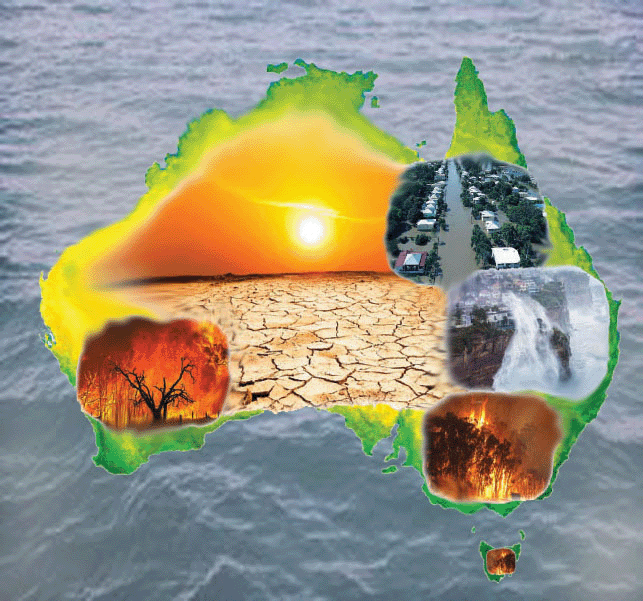
Fires and floods: Australia already seesaws between climate extremes – and there’s more to come
|
Fires and floods: Australia already seesaws between climate extremes – and there’s more to come
Neville Nicholls, Guardian 10 Feb 20, Australians take pride in winning against the odds but we have to move quickly to slow global warming and the extreme weather it creates
Mon 10 Feb 2020 ”Unprecedented” is the word that keeps being tied to the apocalyptic weather Australia has faced over the past few months. Bushfires have always been a reality in Australia, but never recorded on this scale with such widespread damage. It’s estimated that more than 60,000 sq km have been scorched in New South Wales and Victoria alone. Days of smoke have shrouded Sydney, Canberra and Melbourne. And after the fires, flooding at the weekend in NSW and parts of Queensland left thousands without power and dozens of schools closed on Monday. While the country is still grappling with the economic reality and human devastation caused by the fires, it’s easy to think the worst of this disaster is over. But unfortunately other extreme weather may yet occur this summer and these will also require safety preparations and rapid responses. Continental floodsLast year was the driest and hottest year on record in Australia. Some parts of the country have had several years of drought in a row. But all droughts end eventually. At the weekend devastating storms swept through eastern NSW, causing flooding, power outages and commuter chaos. The Bureau of Meteorology says 391.6mm of rain fell over Sydney in the past four days, the most since 414.2mm fell from 2 to 5 February 1990. Historically Australian continental-scale droughts are often broken by widespread heavy rain, leading to an increased risk of flooding, including potentially lethal flash floods. The flood risk from the heavy rains is exacerbated by the bare soil and lack of vegetation caused by the drought and by bushfires that destroy forest and grassland. When a decade-long drought ended in 2009, what followed were two extremely wet years with serious flooding. Flooding also brings the risk that ash might contaminate water supplies. The heavy rain falling on bare soil can also lead to serious erosion……. |
|
Coalition compares wind and solar to “dole bludgers”, pushes for coal, nuclear
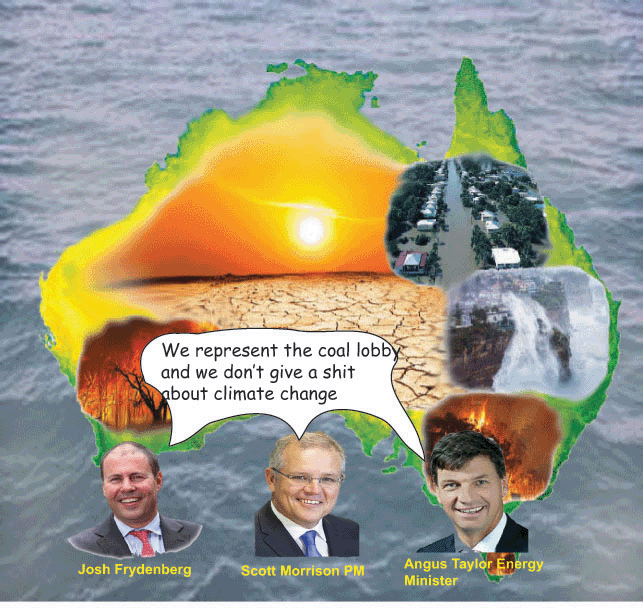
Coalition compares wind and solar to “dole bludgers”, pushes for coal, nuclear https://reneweconomy.com.au/coalition-compares-wind-and-solar-to-dole-bludgers-pushes-for-coal-nuclear-41714/ Giles Parkinson, 10 February 2020 The wind and solar industries are bracing for another verbal assault and an extended period of policy indifference from the federal government, after a senior Coalition MP likened renewable energy to “dole bludgers’, the government funnelled $4 million into a study for a new coal fired power station in Queensland, and so-called government “moderates” declared their support for nuclear.
Despite the plunging costs of solar, wind and storage, the war against renewables is accelerating dramatically as the government comes under pressure to improve its climate policies, and even consider re-instating the long term zero carbon pledge for 2050 that it scrapped, along with the carbon price, in 2014, and which all states have since adopted.
But the language against wind and solar is now being scaled up to levels not seen since the Abbott government, when the prime minister, the then Treasurer Joe Hockey and others railed against the sight of wind farms, including on their drive down to Canberra.
Barnaby Joyce, the former deputy prime minister whose electorate of new England hosts some of the state’s biggest wind and solar projects, ranted against both wind and solar last week after losing his bid to regain the leadership of the LNP.
Matt Canavan, the former resources minister who backed Joyce in that failed leadership bid, and resigned after revealing his membership of a sports club that received a $20 million loan from a government fund that Canavan had responsibility for, went one step further on Monday.
“Renewables are the dole bludgers of the energy system, they only turn up to work when they want to,” Canavan wrote in an opinion piece in the Courier Mail that also got a page one headline. The opinion piece – from the man who likes to describe himself as “Mr Coal” – argued that only coal would support Australia’s mining and manufacturing industries.
The views of the LNP and the hard right of the Liberals are well known, but even so-called “moderate” Liberals are now arguing that wind and solar cannot be relied upon to power a modern economy, and nuclear should be open as a low carbon choice.
Katie Allen,the MP for Higgins, wrote as much in Nine Media over the weekend, repeating a claim she made in her parliamentary debut. Those views are reportedly supported by other Liberals also described as moderates, including Trent Zimmerman, and Tim Wilson, whose previous job was climate policy director for the climate-denying Institute of Public Affairs.
The demonisation of wind and solar also extends to the media. The Murdoch position against wind and solar is well established, but it is infused also into the ABC, which – appallingly – ran as its headline story on radio National on Monday morning a split in the Coalition between “cheap” coal and low emissions technology, as though it was matter a fact.
This is either the result of ignorance, or stupidity. In either case, it is inexcusable, although sadly not atypical. There is no study that points to new coal generators being the cheapest option to replace Australia’s ageing coal, polluting and increasingly decrepit fleet.
AEMO, in its Integrated System Plan, also makes it clear that renewables can power Australia’s modern economy and manufacturing sector. Its 20 year blueprint assumes a 74 per cent share of renewables in Australia’s grid as a minimum by 2040, and up to 90 per cent – a level that will dramatically reduce emissions – by around 90 per cent. The lights will stay on.
The ability of wind and solar to lower prices is now being witnessed in Australia’s main grid, with AEMO citing a 39% increase in wind and solar output in the last quarter, along with a fall in coal output due to outages and coal shortages, for a significant fall in prices to their lowest level since 2016.
The claim that renewables cannot power industry also flies in the face of the experts, including chief scientist Alan Finkel, who has mapped out a hydrogen strategy that could, and should, be fuelled by wind and solar. Others point to the potential of the country going “700 per cent renewables” to give it a global advantage in clean fuel exports and “green metals”.
Those supporters include Professor Ross Garnaut, who says Australia could likely reach 100 per cent reenables by the early 2030s, thereby slashing electricity costs and creating the base for more industrial growth.
Billionaires Mike Cannon-Brookes and Andrew “Twiggy” Forrest are investing tens of millions in one of several massive projects designed to export solar, or wind, to Asia countries. Forrest’s iron ore company Fortescue is investing huge amounts adding solar and battery storage to the Pilbara grid to lower the cost of electricity for his mines and improve reliability.
But it is impossible to name a single federal Coalition MP that recognises the potential of wind and solar, even though the state Liberal government in South Australia, for instance, has a target of “net 100 per cent renewables” by around 2030, and sees its economic future built on becoming a wind and solar energy powerhouse.
UNSW scientist Matt Edwards laments the government’s insistence that lower emissions could only be accompanied by either higher taxes or higher electricity costs. In an opinion piece for the Sydney Morning Herald, he said the Coalition is being “wilfully blind” to the economics of renewables, which “wipe the floor” compared to coal, gas and nuclear.
Edwards pointed to the conclusions of the CSIRO and AEMO studies mentioned above.
“One of the greatest frustrations as a scientist is to see interpretations of data misrepresented by politicians,” he writes. “Unfortunately in Australia, much of this bluster has come from the far-right side of conservatives, part of our broad church, whose members have traditionally prided themselves on prudence and level-headedness.
“We must fight the political expediency of appealing to a voter base spooked by fossil fuel scare campaigns and the denialists in the media, while avoiding getting rolled by rogue elements within the party, those whom Malcolm Turnbull labelled “terrorists” at our Climate Conversations event on Wednesday night, “willing to blow the joint up if they don’t get their way”.
“Our conservative politicians should ideally act according to conscience, free market principles and prudence. They should also seize upon the opportunity for Australia to become a renewables export powerhouse, alleviating global emissions reduction well beyond the 1.6 per cent often quoted as our share, and providing vast economic stimulus at the same time.”
We’ve been waiting for that to happen for more than two decades. There’s still no sign of it.
Why can’t the Australian government do the right thing by the persecuted Julian Assange?
 Bravo Alison Broinowski and Independent Australia . I am utterly fed up with the Australian government, and the mainstream media’s abject failure to even consider the plight of Australian citizens speaking truth – especially re Julian Assange. I did admire Ita Buttrose’s spirited defence of the freedom of the press – UP TO A POINT. But she, and the rest of the media pack were completely hypocritical in pretending that the persecution of Julian Assange had nothing to do with them.
|
Assange, Collaery, Snowden, Smethurst: criminalising truth https://independentaustralia.net/life/life-display/assange-collaery-snowden-smethurst-criminalising-truth,13573#.XkDpbKeRTRw.twitter
By Alison Broinowski | 9 February 2020 Truth-tellers and whistleblowers need our support in Australia and across the globe, says Dr Alison Broinowski.
ENOUGH IS ENOUGH. You’ve often heard that from leaders clutching at their last straw. Australia, you would think, has had enough this year and it’s only February. Enough of a scorched, smoky summer. Enough eviscerating loss of family. Enough people fleeing for their lives from infection. Enough inaction in the face of existential threats. Enough excuses made. Enough blind eyes turned. Enough lies. But no. There’s more to come. In Australia, telling the truth is now a crime. At least four Australians who did so face secretive trials in the coming weeks, three of them in Canberra. Another is imprisoned in the ACT without you knowing what for or at whose orders. You aren’t allowed to know his name, nor the name of Witness K. You are familiar with the other two: Bernard Collaery, K’s lawyer, and Annika Smethurst, a Newscorp journalist whose home was raided by police last July. The fourth Australian is in pre-extradition detention in London’s high-security Belmarsh prison, also for telling the truth. Evidently, this is now a crime in your allies’ system as well, even though the U.S. has its First Amendment and the UK has a Bill of Rights. Revealing the embarrassing truth is what Chelsea Manning is back in a U.S. gaol for, what Edward Snowden is exiled in Russia for, and what Julian Assange did in 2010 when WikiLeaks published documents selected from more than 700,000 U.S. diplomatic cables, assessment files of Guantánamo Bay detainees, military incident logs, and videos from Iraq and Afghanistan. That’s why Assange, having been in diplomatic exile for seven years in London, faces 175 more years for espionage in a U.S. gaol. The absurdity of such a sentence, when the worst war criminals get 45 years, reflects the fury of the U.S. security state at being caught out and the subservience of its UK colleagues. Those on both sides of the Atlantic determined to get Assange are unrelenting and his extradition hearing begins on 24 February. Almost too late, the Guardian has re-discovered its editorial conscience and begun opposing extradition, not wanting justice for Assange, but press freedom. Professor Nils Melzer, the UN Special Rapporteur on Torture supports that, but has gone further, deploring Assange’s mental and physical state. He has written to the UK and U.S. governments pointing out their responsibility for his treatment. He is to raise Assange’s case this week with Sir Richard Dearlove, who was head of MI6 during the Iraq invasion. Good luck with that. Since Kevin Rudd, Australian prime ministers have been silent if not virulently negative about Assange. In recent months prominent individuals, including Bob Carr and Dick Smith, have pointed to the urgency of his case and advocated his release. In November the Greens’ Peter Whish-Wilson presented a petition with 200,000 signatures to the Senate, calling for Assange to be brought back from the UK to Australia. Late last year, Tasmanian Independent Andrew Wilkie formed the “Bring Assange Home” Friendship Group, which he co-chairs with George Christensen of the Liberal-National Party. It has no Liberal Party member. Wilkie and his supporters are seeking appointments in London this week to make the case for Assange. He says UK Prime Minister Boris Johnson, Australian Prime Minister Scott Morrison, and U.S President Donald Trump have made Assange their “political plaything”. Why can’t Morrison ask Trump, as a favour, to ‘do the right thing by this Australian’? |
|
SUBMISSIONS 122 Australians want Victoria’s Nuclear Prohibition Laws to stay
Unlawful and unpopular: Nuclear power and nuclear reactors are prohibited under existing federal, state and territory laws. The nuclear sector is highly contested and does not enjoy broad political, stakeholder or community support.
Disproportionate impacts: The nuclear industry has a history of adverse impacts on Aboriginal communities, lands and waters.
SUBMISSION TO VICTORIAN PARLIAMENT INQUIRY INTO NUCLEAR PROHIBITION
Jessica Lawson and 122 others (list is available) Dear Standing Committee on Environment and Planning,
Victoria’s Nuclear prohibition laws Inquiry – these are the Committee Members
The members of the Environment and Planning Committee are:
Cesar Melhem (Chair)
Clifford Hayes (Deputy Chair)
Bruce Atkinson
Melina Bath
Jeff Bourman
David Limbrick
Andy Meddick
Samantha Ratnam
Nina Taylor
Sonja Terpstra
The participating members of the Committee are:
David Davis
Georgie Crozier
Catherine Cumming
Tim Quilty
Bev McArthur
If you would like any further details on the Committee members or the Inquiry please see: https://www.parliament.vic.gov.au/epc-lc/inquiries/inquiry/983
Climate action distracted by talk of uncosted, unbuilt, unproven and unpalatable technologies such as nuclear.
|
SMH, February 10, 2020 – Chris Danckwerts, Turramurra I thought we’d all realised by now that the nuclear power option was never going to be viable, until I read Katie Allen’s article (“Keep an open mind to nuclear“, February 8-9). She ignores a number of crucial facts. First, the timeframe to build nuclear (a decade at least). Second, the cost (many billions). Third, safety. She says that smaller, more modern reactors will only “moderate” the risks, not eliminate them as most of us would wish. Finally, there would only be “less” nuclear waste to get rid of, which will still continue to be a problem. The sooner we eliminate nuclear, coal and eventually gas power options and move to 100 per cent renewables, pumped hydro, hydrogen et cetera the better off we will be.
Christopher Hill, Kensington, It seems Katie Allen has been electorally charged with selling us nonexistent new-nuclear power technologies and asking us to spend time and taxpayer money on something we never asked for. Sounds familiar. Given the continuing fallout from this government’s self-interested spending of taxpayer money, why not go nuclear? Well, the plea for open minds is all well and good. However, real movement on national energy policy and transition is now on the table. We are at that table and we are hungry for a workable energy and climate change policy. Sure, keep an open mind, but fill it with well-informed realistic debate anchored in the present, not on distracting unwanted promises of uncosted, unbuilt, unproven and unpalatable technologies such as nuclear. – Helen Lewin, Tumbi , If, as Peter Hartcher suggests (“Be amazed by our masters of delusion“, February 8-9), Allen is voicing her pro-nuclear stance in order to drag her conservative Coalition confreres into a world free of fossil fuels, I respectfully suggest she dumps this minority group of Luddites rather than tempting them with nuclear energy. She admits in her article that the “concerns” around the development of nuclear have only “moderated”. I’m afraid that won’t be enough to drag me along with her or many other Australians. – Umbi https://www.smh.com.au/national/nsw/argument-goes-nuclear-in-search-for-energy-solution-20200209-p53z2c.html |
|
Nuclear Stigma is, and will continue to be the cancer that erodes Kimba future.
“Them or us, a shit town and a policeman on the fence.”
Kimba farmer / nuclear profiteer, Andrew Baldock who has recklessly fueled the ongoing promotion to degrade a agriculture region is now pleading for the community to reunite. This maybe seen as Baldock’s failed solicitation to procure redemption, forgiveness or clemency for the irremediable damage ignorantly portrayed upon what is mostly a nobbled and unwilling community.
Sunday the 2nd of February anti-nuclear rally, portrayed attending people as welcome contributing visitors to the town until their views of nuclear were apparent only to find they were treated no better than a leper in Kimba’s colony. One local person and yes I say one, that being of the local constabulary claimed to be on the fence and treated people with regard, where the nuclear embracing dichotomy has failed to welcome.
Nuclear Stigma is, and will continue to be the cancer that erodes Kimba future. https://www.facebook.com/groups/941313402573199/
Barngarla Native Title Holders excluded from vote on Kimba nuclear waste dump
Coalition nuclear stooge MPs line up to push for removing Australia’s prohibition on nuclear activities
Support for nuclear energy heating up across government, SMH, Mike Foley, February 8, 2020 — “……. Coalition MPs have spoken out on nuclear energy as a solution to the need to decarbonise the economy, arguing the government can maintain Australia’s long-held moratorium on nuclear power and take modest steps in early stage research and development of new technologies.
Dr Allen, a paediatrician and medical researcher with a PhD, said “question marks remain” over the potential to use renewables as the sole source to power Australia’s energy grid……
Queensland LNP MP Ted O’Brien, who represents the Fairfax electorate on the Sunshine Coast, chaired a parliamentary committee which last year tabled a report titled Not without your approval: a way forward for nuclear technology, calling for a partial lift in Australia’s 20-year-old nuclear moratorium.
Rather than a total and immediate lift of the moratorium, only a partial lift for new and emerging technologies is proposed, subject to the results of a technology assessment and a commitment to community consent as a condition of approval for nuclear facilities,” it said.
Mr O’Brien said without lifting the moratorium the government could commission assessments recommended by his committee into “economic, technological and readiness assessments” for nuclear energy.
Among the Coalition MPs on the government-dominated committee who endorsed the report were Trent Zimmerman, from inner-city electorate North Sydney, Bridget Archer from Bass in northern Tasmania, Nationals MP for Lyne David Gillespie, West Australian MP Rick Wilson and North Queensland Nationals MP Keith Pitt, who was this week promoted to cabinet as Resources Minister.
Former deputy prime minister and Nationals leader Barnaby Joyce has also promoted nuclear energy.
However, Prime Minister Scott Morrison and Energy Minister Angus Taylor have said they’re not considering lifting the nuclear moratorium due to lack of bipartisan support for nuclear energy.
Mr Taylor said the government is “taking the time to thoroughly consider the [committee’s] recommendations” and it had “no plans to lift the longstanding moratorium”.
Advocates argue nuclear power production costs can fall with new technology, highlighting the emerging technology of small to medium-sized reactors. However, there are no commercial examples of the new technology in operation.
Labor MPs issued a dissenting report which said the inquiry heard from experts who argued renewable energy offered better prospects to replace fossil fuels and the safety record of nuclear energy made it too risky to consider.
“In fact the events [like Fukushima], innovations and advances in renewable energy, and emerging climate and energy system developments of the last ten years have made nuclear power even less relevant and appropriate in the Australian context at a time when nuclear power is already in decline elsewhere,” the report said. https://www.smh.com.au/politics/federal/support-for-nuclear-energy-heating-up-across-government-20200207-p53yru.html
Liberal MP Katie Allen touts nuclear energy for Australia
Katie Allen, a government member of parliament (MP) representing inner-city Melbourne, wrote in a column for Nine Entertainment newspapers that Australia has an opportunity to lead the way on developing “safer and more effective” nuclear energy.
Australia has had a blanket moratorium on nuclear energy for 20 years, but a parliamentary committee chaired by coalition MP Ted O’Brien in December tabled a report calling for it to be partially lifted…….
In December, Prime Minister Scott Morrison and Angus Taylor, the minister for energy and emissions reduction, declared that they were not considering exploring nuclear options.
Any move to lift the moratorium would require the support of the opposition Labor Party, which has previously declared an anti-nuclear stance.
The report from December said that a partial lift would allow the government to conduct recommended “economic, technological and readiness assessments” for nuclear energy.
“Rather than a total and immediate lift of the moratorium, only a partial lift for new and emerging technologies is proposed, subject to the results of a technology assessment and a commitment to community consent as a condition of approval for nuclear facilities,” it said. http://www.xinhuanet.com/english/2020-02/08/c_138765779.htm
Zali Steggall , independent MP for Warringah, luring Liberals towards climate action
A matter of conscience’: Zali Steggall unveils plans for climate change act, https://thenewdaily.com.au/news/national/2020/02/10/zali-steggall-plans-climate-change-act/ Samantha Maiden She stole Tony Abbott’s blue-ribbon seat out from under the Liberal Party’s nose and now Zali Steggall is hoping to lure party dissidents to cross the floor and vote for climate change action.
|
The legislation is modelled on the UK’s Climate Change Act and is designed to provide a national framework for action and mandatory annual reporting of Australia’s trajectory towards meeting reduction targets. “We need to set out a road map for Australia to become a low-carbon economy without all the fear-mongering and misinformation,” Ms Steggall said. “The big question all sensible Australians are asking is how? This is why we need a climate change act to set out a legislative framework.” |
|
Private investors won’t touch new Coalition-backed coal plant, Labor says
Private investors won’t touch new Coalition-backed coal plant, Labor says, Morrison government to spend up to $4m in grant for feasibility study into coal-fired power plant in Queensland, Guardian, Australian Associated Press, Sat 8 Feb 2020 The federal Labor opposition says private investors will not touch “with a barge pole” the Morrison government’s plan to support a coal-fired power plant in Queensland.
The government says it will spend up to $6m in grants for two new Queensland electricity generation projects, including a coal-fired power plant, as part of a bid to lower power prices……..
Labor’s climate change and energy spokesman, Mark Butler, said private investors would not touch a new coal-fired power station “with a barge pole”.
“The government still has no energy policy – just ideological flights of fantasy,” he said in Adelaide on Saturday. The private investment sector had made it very clear it had no appetite for building expensive coal-fired power stations, he said.
Victorian govt Nuclear Inquiry – published Submissions
First published results on the Inquiry website are strongly ANTI-NUCLEAR. But we must remember that there could be many confidential submissions, that we don’t know about.
PRO nuclear
1. Don Hampshire
2 Robert Heron – vaguely
3 Terje- Petesen
116 Leah McDermott
122 Simon Brink
123 CFMMEU Mining and Energy Division
ANTI nuclear
4 Jessica Lawson
5 Pro Forma list of 122 contributors probably anti-nuclear
48 Jaznet Nixon 49 Karen Furniss
63 Graeme Tyschsen
68 Barbara Devine
76 Vivien Smith
77 Lachklan Dow
81 RVS Industries
92 Alan Hewett and Joan Jones
103 Anne Wharton
106 John Quiggin vague
107 Amy Butcher
109 Nick Pastalatzis
112 Philip White
see https://www.parliament.vic.gov.au/epc-lc/article/4348 -to read the submissions
1 This month
.

Australians deserve the truth
about
AUKUS – https://aukuspublicinquiry.com/

PETITION – To: Prime Minister Anthony Albanese and the Australian Labor Government

of the week – Australians for War Powers Reform (AWPR)
To see nuclear-related stories in greater depth and intensity

