Eric Gribble’s submission to the Federal Nuclear Inquiry in favour of nuclear power
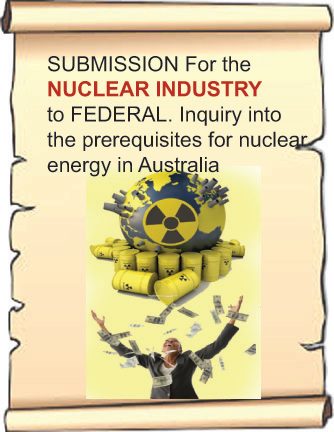 Gribble , Eric (38) addresses the question of ionising radiation – nuclear power development is safe, but held back by “a widespread paranoid concern due to a lack of understanding of what radiation is.”
Goes on to explain that radiation can be beneficial – quotes some dubious science from 2002 and 1992…. “It appears that slightly elevated levels of radiation are beneficial but levels above 100 mSv the risk appears to increase. .. “ Quotes some study showing that radiation decreases incidence of lung cancer. Claims that Fukushima nuclear accident caused only one death due to material falling upon a man. No evidence of cancer caused.
Uses Hiroshima studies to dismiss concerns about radiation dangers…
Says nuclear power “is safe and the only option “
“Renewables do not stack up on a cost basis.”
Raves on about hydroponics and space “… If space travel is to become a reality using existing technology mankind will need a massive amount of energy. Energy to make rocket fuel. ….. Nuclear energy will open up the future. “”
. “Nuclear energy is the energy source of the future, Australia cannot afford to continue to let opportunities slide.”
“It is easy to be a green. You simply oppose everything, dams, nuclear, fossil fuels, the free enterprise system, whatever. Yet there are many people (probably most people) out there who are as concerned about the environment as the most rabid green but do not support the green movement.”
The politics of ANSTO’s nuclear isotopes – mainly for export, not for home use
Kazzi Jai No Nuclear Waste Dump Anywhere in South Australia, 14 Sept 19 So…..according to ABC’s radio AM and then PM reports yesterday – different reports by different reporters…. the whole situation appears as follows…..The BRAND SPANKING NEW, JUST RECENTLY LICENSED $200 million NEW FACILITY at ANSTO which was built to deal with the aim of increasing our output of 10 million doses per year up from the 500,000 doses per year of Molybdenum 99 , which is used to produce Technetium-99m which is used for IMAGING PURPOSES TO DIAGNOSE various conditions, is down. Keep in mind that this increased production is AIMED AT BEING A MAJOR EXPORT PLAYER ON THE WORLD’S EXPORT MARKET – NOTHING TO DO WITH SERVICING AUSTRALIANS.
Anyway, now there seem to be a FAULTY VALVE and the facility has to be closed down to fix it.
Sooooo……we are required now to source our Molybdenum from overseas. No big deal actually – we have done it many times in the past before – in fact that was one of the reasons why people didn’t want OPAL built as we had sourced our supplies from overseas without problems, and our domestic requirements quite small and remains so today.
But our usual – and yes it is “usual” – overseas source is from South Africa – surprise surprise (home country to Adi btw), and they are down for scheduled maintenance for the next week or so. Sooooo….we are only in possession of 31% of what we normally produce before the facility was on line.
Now here comes the interesting bit. In the Senate Estimates committee hearing 2017 Adi Paterson stated that only 28% of production goes to Australian hospitals, and the rest, 72% goes to overseas export. This figure really hasn’t changed since OPAL came on line back in 2006. Sooo…we in Australia aren’t in any hardship at all given what Adi stated then!
But wait…there’s more! Part of the PM report by the ABC was an interview with a Kalgoorlie doctor saying that he will have to ration and decide which patients need to have this now “short in supply” imaging isotope. Remember it is not a medicine – it is an imaging isotope to detect disease and for organ structure diagnosis. He said that the major cities would not be affected as they can use 3 – 4 alternative ways to diagnose these conditions using CT’s etc but he had no access to that equipment in Kalgoorlie. Given that Kalgoorlie only has a population of 29,000 wouldn’t you think that you would then send these patients TO A CITY CENTRE IN THIS CASE PERTH TO DO THE DIAGNOSIS AND THE FOLLOWUP IF REQUIRED????? I mean – yes it is 600 kms from Perth, but those conditions often need more expert care than is often funded to the smaller centres such as Kalgoorlie…….
Potential impact of radioactive wastes on water activities in the Spencer Gulf
Groups in the state’s far north are urging the federal government to consider a report on the impact of a potential nuclear waste facility on the Hookina Floodplain.
Australia’s radioactive waste is currently stored at a purpose-built ‘Interim Waste Store’ at Lucas Heights in new South Wales and has been since 2015.
Flinders Local Action Group member Greg Bannon said a facility on Wallerberdina Station in Hawker could cause major implications for water activities in the Spencer Gulf. Continue reading
Temperatures 10C above average forecast as 130 bushfires continue to burn
 Bureau of Meteorology says stubborn high pressure system will create hot and dry conditions over weekend and next week, Guardian, Josh Taylor@joshgnosis, Sat 14 Sep 2019 Firefighters in New South Wales and Queensland are gearing up for a week of unseasonably warm weather as they continue to battle blazes across the two states.
Media silence on Julian Assange’s imprisonment encourages governments to intimidate journalists
 All around the world, Assange’s treatment seems to have given the green light to governments to intimidate and hassle journalists. Australian police, for instance, recently conducted a raid on journalist Annika Smethurst’s home. Smethurst had not long before that revealed that the Government had been secretly requesting permission to spy on its own citizens.
He must not be extradited’ – Vivienne Westwood on Julian Assange
The media blackout on Julian Assange’s imprisonment https://independentaustralia.net/business/business-display/the-media-blackout-on-julian-assanges-imprisonment,13094 By Mint Press News | 11 September 2019, The same media that has spent years dragging Assange’s name through the mud is now engaging in a blackout on his treatment.
If you are waiting for corporate media pundits to defend freedom of the press, you’re going to be disappointed.
The role of journalism in a democracy is publishing information that holds the powerful to account — the kind of information that empowers the public to become more engaged citizens in their communities so that we can vote in representatives that work in the interest of “we the people.”
There is perhaps no better example of watchdog journalism that holds the powerful to account and exposes their corruption than that of WikiLeaks, which exposed to the world evidence of widespread war crimes the U.S. military was committing in Iraq, including the killing of two Reuters journalists; showed that the U.S. Government and large corporations were using private intelligence agencies to spy on activists and protesters; and revealed how the military hid tortured Guantanamo Bay prisoners from Red Cross inspectors.
It’s this kind of real journalism that America’s First Amendment was meant to protect but engaging in it has instead made WikiLeaks publisher Julian Assange the target of a massive smear campaign for the last several years — including false claims that Assange is working with Vladimir Putin and the Russians and hackers, as well as open calls by corporate media pundits for him to be assassinated. Continue reading
Fear of drought, flood and fires leads farmers to plea for urgent action on climate change
Fear of drought, flood and fires leads farmers to plea for urgent action on climate change ABC, NSW Country Hour, By Tim Fookes 13 Sep 19
The farmer from Larras Lee, in central west New South Wales, has lived through drought before, but not like this.
“The cattle I had were about to start calving, and I just haven’t got enough to feed them,” he said.
“I was proud of those cows that have gone this week; I bred them, and I regret I have to sell them.”
Having already destocked, Mr Lee knows of other farmers destocking because there is a better opportunity for them in southern NSW and Victoria where they have had rain.
“The agents tell me how embarrassed they are with the amount of rain they’ve had in Victoria,” Mr Lee said.
“But it’s great to hear that some people have had [rain] and have got some grass to take on stock that we can’t handle. “With the way the climate is, with warmer-than-average temperatures and lower rainfall, I have to be much more nimble with how much stock I have.”\
Farmers for climate activism
Mr Lee is not alone in his concerns over the climate and has become a member of the lobby group, Farmers for Climate Action.
It involves people from rural Australia pushing for more action on the effects that climate change is having on agriculture. A conference this week in Orange attracted nearly 200 people to discuss ways of lobbying for more action on the effects a warming, dryer climate is having on those who make a living on the land.
Two thirds of those at the conference were farmers who had travelled from around NSW to attend……… https://www.abc.net.au/news/rural/2019-09-13/fear-of-drought-flood-and-fires-leads-farmers-to-plea-for-action/11508834
Julian Assange to remain behind bars
Julian Assange to remain behind bars due to ‘history of absconding’ SBS 13 Sep 19, The founder of Wikileaks has been told he will be kept in jail beyond September 22. Julian Assange has been told he will stay in prison after the custody period finishes on his current jail term because of his “history of absconding”.
In June, then home secretary Sajid Javid signed an order allowing Assange to be extradited to the US over computer-hacking allegations.
A 50-week jail term was then imposed in the UK after he jumped bail by going into hiding in the Ecuadorian embassy in London in 2012. He would have been released from HMP Belmarsh on September 22, Westminster Magistrates’ Court heard on Friday, but the 48-year-old Australian was told he will be kept in jail because of “substantial grounds” for believing he will abscond again……. Another administrative hearing will take place on October 11 following by a case management hearing on October 21, the court heard.
The final hearing in Assange’s extradition case is due in February……https://www.sbs.com.au/news/julian-assange-to-remain-behind-bars-due-to-history-of-absconding?cid=news:socialshare:twitter
John Quiggin sets out a very unlikely course for nuclear power in Australia
The central recommendations of my submission were as follows:
Recommendation 1: A carbon price of A$25/tonne should be introduced immediately, and increased at a real rate of 5% a year, reaching A$50/tonne by 2035.
Recommendation 2: The government should immediately adopt the recommendations of its own Climate Change Authority for a 40% to 60% reduction in emissions by 2030, relative to 2000 levels, and match other leading OECD countries in committing to complete decarbonisation of the economy by 2050.
Recommendation 3: The parliament should pass a motion:
affirming its confidence in mainstream climate science and its acceptance of the key conclusions of the United Nations’ Intergovernmental Panel on Climate Change;- legislating a commitment to emissions reductions;
- removing the existing ban on nuclear power……..There are immediate political implications of my proposal at both the state and federal level. It will be more difficult for the Coalition-dominated committees running the two inquiries to bring down a report favourable to nuclear power without addressing the necessary conditions – including a carbon price. If the government’s hostility to carbon pricing is such that a serious proposal for nuclear power cannot be considered, it will at least be clear that this option can be abandoned for good. ……..Given the urgency of addressing climate change – a task that is best addressed through a carbon price – it makes no sense to reject action now on the basis that it opens up the possibility of nuclear power sometime in the 2030s. And, if renewables and storage perform as well as most environmentalists expect, nuclear power will be unable to compete even then. ……… https://theconversation.com/nuclear-power-should-be-allowed-in-australia-but-only-with-a-carbon-price-123170
Australian government must fund nuclear power- Barrie Hill of SMR Technology
Barrie Hill gives an insight into just what the global nuclear lobby wants from Australia. They want to overturn Australia’ s laws prohibiting nuclear activities, and get the tax-payer to fund the development of the nuclear industry in Australia
His submission (no.60) to the FEDERAL. Inquiry into the prerequisites for nuclear energy in Australia is a fine example of the nuclear-lobby-speak that is turning up in these submissions from nuclear power experts. He’s the Managing Director of SMR Technology, and makes sure to outline his impressive background in the industry.
His is a long submission, in 3 long documents. Here are snatches from his main document.:
*****************************************************
Hill says that for Australia replacing coal with nuclear will be “ the least cost alternative “. He recommends a South Korean type nuclear chain. Says that “the viability and advantages of small modular reactors is fully covered in a separate submission”. Recommends setting up a Federal government authority to lead Australia’s nuclear program. Recommends the South Korean Advanced Power Reactor 1000MWe (APR1000).
“It is recommended that the groundwork for an inevitable future nuclear power program is put in place beginning with the removal of all legislated prohibitions and increased support or familiarisation and training programs.”
“ the government will need to guarantee high level positions with appropriate salaries for qualified persons coming from existing nuclear areas”
Recommends used fuel storage to be ready by 10 years from first plant commissioning “and that storage allow for eventual fuel recovery”. Wants high regulation and documentation, and sites for reactors chosen early.
Outlines his strong background in the nuclear industry.
Discusses the needs for electricity, and limitations of renewable energy. Criticises the electricity marketing structure. All existing subsidies should be removed. Says base-load power is critically needed. Wants a single independent Australian Electricity Commission to be set up.
Goes on at length and in detail about projected.electricity costs. “The development of nuclear reactors for power generation provides a cost effective, safe, and reliable option for the progressive replacement of the current Australian base load generation fleet.” and suggests direct replacement by Small Modular Reactors.
Says that Westinghouse indicated a “good potential for widespread industry involvement within Australia”.
Hill attributes the “difficult acceptance” of nuclear power to “accident outcomes sensationalised by technically uninformed media.”
“At an early point in the process the Federal and State governments should act to remove all legislative bans prohibiting a final decision to proceed so that the work may be developed unobstructed and finally judged on it’s merits. It is clear that the existence of the bans has restricted expenditure on thorough analysis to date particularly by government agencies and has been a severe detriment to the establishment of a coherent energy policy for the nation.”
He moves on to “Stage 2” – a feasibility study, resulting in a “national investment decision”, the forming of a Nuclear Energy Program Implementing Organisation, bring in many experts, including foreign experts for “high level knowledge” . Recommends Government Leadership and Continuous Investment in Nuclear Infrastructure….. “ The Australian government therefore should play a lead role in the program from the initial phase with investment funds, manpower selection, and appropriate planning –
“With the existence of a firm financial guarantee from the government local and overseas companies will actively participate in the national nuclear power construction program with reduced risk. ”.
“Only an Australian government agency can arrange and manage the required level of investment estimated to total $150B to eventually replace all retiring coal fired power stations, to ensure maximum benefit for the Australian community and minimum risk. The Reserve Bank has noted that this time of unprecedented low interest rates is the perfect opportunity for government investment in productive new assets such as power stations.”
Lengthy discussion on need for training and education especially tertiary. International co-operation, especially on safeguards. Need for a standard nuclear design.
[on nuclear wastes)”The work carried out for the Nuclear Fuel Cycle Royal Commission based in South Australia has provided sufficiently detailed pre-feasibility studies to commence final feasibility work for the implementation of used fuel storage in Australia. It is recommended that used fuel storage be available ten years from first plant commissioning and that storage allow for eventual fuel recovery.”
Recommends importing nuclear wastes, as a way to fund nuclear power development :“The economic viability and revenue streams defined for used fuel import storage as part of the work carried out by the South Australian Royal Commission could in the extreme provide sufficient revenue to fund the development of a nuclear power program for all of Australia. This massive economic opportunity cannot be overlooked”
Need for a strong independent regulator.
On insurance, Hill explains why “ beyond a certain level risk had to be socialised. It is now understood that the state needs to accept responsibility as insurer of last resort”
Hill dismisses the idea of any necessary connection between nuclear power and nuclear weapons proliferation.
Discusses how to organise a leadership team, then process for choosing sites for reactors.
Discusses radiation at length, tending to minimise the health effects of Chernobyl and Fukushima, and reassures about the nuclear industry’s good safety culture.
“Recent OECD and local studies suggest that Federal action to introduce nuclear power is the only economically viable option to meet minimum cost of supply, maximum reliability of supply, and key environmental imperatives for the Australian electricity sector.”
Hill gives detail on choosing a reactor type- recommending a Korean one.
On risk analysis – “Humans are poor risk managers, focusing too much on consequences and too little on probabilities – something insurance and lottery salesmen relish.” Gives lengthy detail on risk identification and risk mitigation. He includes not only safety risks, but also financial risks, and ways to mitigate them.
Finally, Hill turns to the issue of climate change, recommending nuclear power for reducing greenhouse gases, and replacing coal power.
“The Federal government will be required to manage the financing, construction and operation of all nuclear power stations for the foreseeable future.
A prerequisite for the investment is the establishment of a government leadership andmanagement control organisation the Australian Electricity Corporation”
“ It is time for the Australian Federal government to lead a strategy for change before all those benefits are
irretrievably lost.”
Up until 7 September, submissions to Federal Nuclear Inquiry were 50/50 pro and con
 Submissions to the Federal Nuclear Inquiry? What are people saying?
Up until 7 September, 38 submissions have been published on the website of the Federal Inquiry into the prerequisites for nuclear energy in Australia
The numbers of submissions for and against nuclear power are almost 50/50. However, as some submissions may be confidential, we can’t really be sure of the numbers.
The main arguments In the pro nuclear submissions.
The topic mentioned most often was – advocating for thorium nuclear reactors. Pro nuclear submissions also tended to focus on a call for public education about nuclear power, and a need to remove Australia’s laws that prohibit the nuclear industry. Several submissions concentrated on the question of nuclear wastes – arguing that this was not such a problem and a solution would be found. Small Modular Nuclear Reactors (SMRs) were recommended, as cost effective.
The main arguments in the anti nuclear submissions
Overwhelmingly, the most selected topic was economics – the costs of nuclear power, and the government subsidies needed. Nearly as often mentioned was renewable energy, and its role in reducing greenhouse gases. Another big concern was the safety risks of nuclearpower. There were several mentions of water use of nuclear power, of radioactive waste problems, and risks of terrorism and of nuclear weapons proliferation.
There were a variety of other concerns raised by both sides. Radiation is a hotly argued issue. Its hazards are discussed by Paul Savi (Submission No 4), but Erlc Gribble (No 38) argues that low dose radiation is not harmful, in fact can be beneficial (radiation hormesis).
The anti nuclear arguments included social and political claims – that nuclear power has no social licence (EcoEnviro Pty Ltd – Richard Finlay-Jones Submisson 6), – that there is historic Australian opposition – hence the ban, (Greig Myer Submission 25), – the undemocratic history of nuclear activities in Australia,(Paul Savi, Submission 4)
Other anti-nuclear claims- that Australia shouldn’t be the first to try out SMRs, that renewables would provide more employment, that Aboriginals’ historic care of the land should be respected, (Trish Frail 32) .
On the pro nuclear side, there’s some exasperation at Australians’ lack of knowledge about nuclear power. Robert Gishubl (Submission 28) rails at “the irrational faith based objections many people have”. Eric Gribble (38) writes of “a widespread paranoid concern” about radiation, – “It is easy to be a green. You simply oppose everything “.
Pro nuclear suggestions in include first getting an international nuclear waste facility in South Australia, which would then fund the development of Generation IV nuclear reactors – (Matthew Gustafson, (20). Keith Thompson (11) suggests that the government offer generous awards for people who produce solutions to nuclear waste disposal. Geoffrey Hudson (37) warns on delay problems for land-based reactors, and advocates reactors on barges at sea. Ian Fischer(No 8) recommends a voluntary postal plebiscite to allow Australians to decide about a nuclear future. Eric Gribble (38) is keen on nuclear power’s ability to further Australia’s role in space research.
Even on the pro nuclear side, there are some reservations, and not all are sceptical of renewable energy. Goronwy Price (35) sees nuclear as a support to renewables. Geoff Billard, (31)’s support for nuclear power is conditional on it being cost-effective.
At this stage, it’s hard to assess the general opinions on ” the prerequisites for nuclear energy in Australia”. Submissions are accepted until September 16th. So there will probably a new rash of submissions published, over the next weeks. . The ones published so far have been relatively short. We can expect some longer and more detailed ones from various companies and organisations.
Malcolm Turnbull says renewables plus storage are cheaper than coal and nuclear for new power generation. Is he correct?
 RMIT ABC Fact Check ABC News, 11 Sept 19, “…… Former prime minister Malcolm Turnbull chipped in to the debate with a recent tweet claiming: “The bottom line is renewables + storage are cheaper than new coal let alone the loopy current fad of nuclear power which is the current weapon of mass distraction for the backbench.”
Is new generation from renewables plus storage cheaper than new coal or nuclear generation? RMIT ABC Fact Check investigates.
The verdictMr Turnbull’s claim is a fair call.
There is some uncertainty around cost estimates for different power generation technologies.
Under current policy settings and economic conditions, it is generally cheaper to produce electricity from wind or solar sources than it would be using a new coal or nuclear plant, with or without “storage”……
The best available data suggests that under current conditions, nuclear energy would not be a cheaper source of electricity than renewables, as Mr Turnbull points out………. https://www.abc.net.au/news/2019-09-12/is-renewable-power-cheaper-than-coal-nuclear-malcolm-turnbull/11495558?fbclid=IwAR0O0BVlxfj11ABHSA1bDdUwB8g3S0DUEABe_08a
Kimba or the Flinders Ranges – nuclear sacrifice zone?
Yet the Federal Government plan to store this nuclear waste indefinitely, above ground, on earthquake prone land, on floodplains in a canister that has a design life of 40 years, with no plans for a permanent facility and hope that future generations will come up with new ideas for a permanent disposal and the financial resources to implement them. This is an unethical neglect of responsibility and dangerous for the people of South Australia.
The Federal Government admits that Australia does not have enough nuclear waste to justify a safe, permanent facility for Intermediate Level Nuclear Waste and they have NO PLANS to build one.
This can only mean one of two outcomes. Leave it indefinitely in Kimba or The Flinders Ranges and expect our children to deal with it. Or, they will offer South Australia to become the International Sacrifice Zone to dispose of the world’s nuclear waste, enabling us to financially deal with our own.
Quote from the office of Kim Carr. “We have to get the nuclear waste out of Lucas Heights, because it’s too dangerous to have it in densely populated metropolitan Sydney.” Well if it’s too dangerous for Sydney, it’s too dangerous for South Australia. Both Steven Marshall and Peter Malinauskashave been asleep at the wheel on this and we need to wake up South Australia now before it’s too late. There is a nuclear waste site ballot taking place in Kimba next month which will likely decide the fate of our state. Only people within those precincts are allowed to vote, 99% of South Australian’s cannot vote on this. Call Steven Marshalll and Peter Malinauskas or your local MP and demand they stop the ballot process and engage with the people of South Australia. We cannot be a Sacrifice Zone
Dr Helen Caldicott on the unsafety of Small Nuclear Reactors (SMRs)
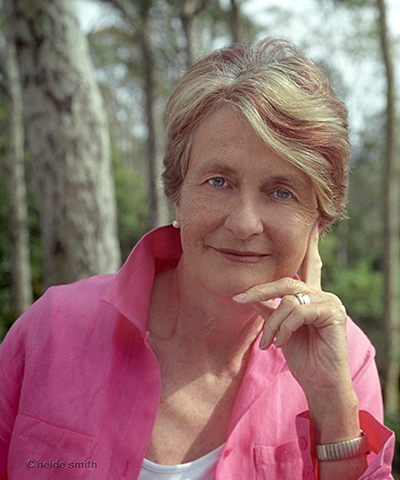
 HELEN CALDICOTT: Small modular reactors — same nuclear disasters https://independentaustralia.net/politics/politics-display/helen-caldicott-small-modular-reactors–same-nuclear-disasters,13087
Now that the “nuclear renaissance” seems dead and buried following the Fukushima catastrophe (one-sixth of the world’s nuclear reactors were closed after the accident), the corporations invested in making nuclear plants and radioactive waste –including Toshiba, Nu-Scale, Babcock and Wilcox, GE Hitachi, General Atomics and the Tennessee Valley Authority – are not to be defeated.
Their new strategy is to develop small modular reactors (SMR), which can be sold around the world without, they say, the dangers inherent in large reactors — safety, cost, proliferation risks and radioactive waste.
There are basically three types of SMRs which generate less than 300 megawatts of electricity compared to the current 1,000-megawatt reactors.
Light water reactor designs
These will be smaller versions of present-day pressurised water reactors using water as the moderator and coolant but with the same attendant problems as Fukushima and Three Mile Island. They are to be built underground, which obviously makes them dangerous to access in the event of an accident or malfunction.
They will be mass-produced (turnkey production) and large numbers must be sold yearly to make a profit. This is an unlikely prospect because major markets – China and India – will be uninterested in buying U.S. reactors when they can make their own.
If a safety problem arises, such as with the Dreamliner plane, all of them will have to be shut down — interfering substantially with electricity supply.
SMRs will be expensive because the cost of unit capacity increases with decrease in the size of the reactor. Billions of dollars of government subsidies will be required because Wall Street will not touch nuclear power. To alleviate costs, it is suggested that safety rules be relaxed — including reducing security requirements and a reduction in the ten-mile emergency planning zone to 1,000 feet.
Non-light water designs
These are high-temperature gas-cooled reactors (HTGR) or pebble bed reactors. Five billion tiny fuel kernels of high-enriched uranium or plutonium will be encased in tennis-ball-sized graphite spheres which must be made without cracks or imperfections — or else they could lead to an accident. A total of 450,000 such spheres will slowly be released continuously from a fuel silo, passing through the reactor core, and then re-circulated ten times. These reactors will be cooled by helium gas operating at very high temperatures (900 C).
The plans are to construct a reactor complex consisting of four HTGR modules located underground to be run by only two operators in a central control room. It is claimed that HTGRs will be so safe that a containment building will be unnecessary and operators can even leave the site — “walk-away-safe” reactors.
However, should temperatures unexpectedly exceed 1600 degrees Celsius, the carbon coating will release dangerous radioactive isotopes into the helium gas and at 2000 C, the carbon would ignite creating a fierce graphite Chernobyl-type fire.
If a crack develops in the piping or building, radioactive helium would escape and air would rush in igniting the graphite.
Although HTGRs produce small amounts of low-level waste, they create larger volumes of high-level waste than conventional reactors.
Despite these obvious safety problems and despite the fact that South Africa has abandoned plans for HTGRs, the U.S. Department of Energy has unwisely chosen the HTGR as the “Next Generation Nuclear Plant”.
Liquid metal fast reactors (PRISM)
It is claimed by the proponents that fast reactors will be safe, economically competitive, proliferation-resistant and sustainable.
They are to be fueled by plutonium or highly enriched uranium, and cooled by either liquid sodium or a lead-bismuth molten coolant creating a potentially explosive situation. Liquid sodium burns or explodes when exposed to air or water and lead-bismuth is extremely corrosive producing very volatile radioactive elements when irradiated.
Should a crack occur in the reactor complex, liquid sodium would escape burning or exploding. Without coolant, the plutonium fuel would melt and reach critical mass, inciting a massive nuclear explosion. One-millionth of a gram of plutonium induces cancer and it lasts for 500,000 years. Yet it is claimed that fast reactors will be so safe that no emergency sirens will be required and emergency planning zones can be decreased from ten miles to 1,300 feet.
There are two types of fast reactors, a simple plutonium fueled reactor and a “breeder”. The plutonium reactor core can be surrounded by a blanket of uranium 238, the uranium captures neutrons and converts to plutonium creating ever more plutonium.
Some are keen about fast reactors because plutonium waste from other reactors can be fissioned converting it to shorter-lived isotopes like caesium and strontium which last “only” 600 years instead of 500,000. But this is fallacious thinking because only ten per cent is fissioned leaving 90 per cent of the plutonium for bomb-making and so on.
Construction
Three small plutonium fast reactors will be arranged together forming a module. Three of these modules will be buried underground and all nine reactors will connect to a fully automated central control room. Only three reactor operators situated in one control room will be in control of nine reactors. Potentially, one operator could simultaneously face a catastrophic situation triggered by the loss of off-site power to one unit at full power, in another shut down for refuelling and in one in start-up mode.
There are to be no emergency core cooling systems.
Fast reactors will require a massive infrastructure including a reprocessing plant to dissolve radioactive waste fuel rods in nitric acid, chemically removing the plutonium and a fuel fabrication facility to create new fuel rods. A total of 15,000 to 25,000 kilos of plutonium are required to operate a fuel cycle at a fast reactor and just 2.5 kilos is fuel for a nuclear weapon.
Thus, fast reactors and breeders will provide the perfect plan for nuclear weapons proliferation and despite this danger, the industry plans to sell them to many countries.
Labor Party highlights Liberal Coalition’s recommended spots for nuclear reactors
Labor demands nuclear be wiped off options, https://www.theadvocate.com.au/story/6368008/labor-demands-nuclear-be-wiped-off-options/ Australian Associated Press 10 Sept 19, Ever enjoyed a holiday to Noosa, Sussex Inlet or French Island? How would you feel if there was a nuclear power station in your idyllic vacation spot?
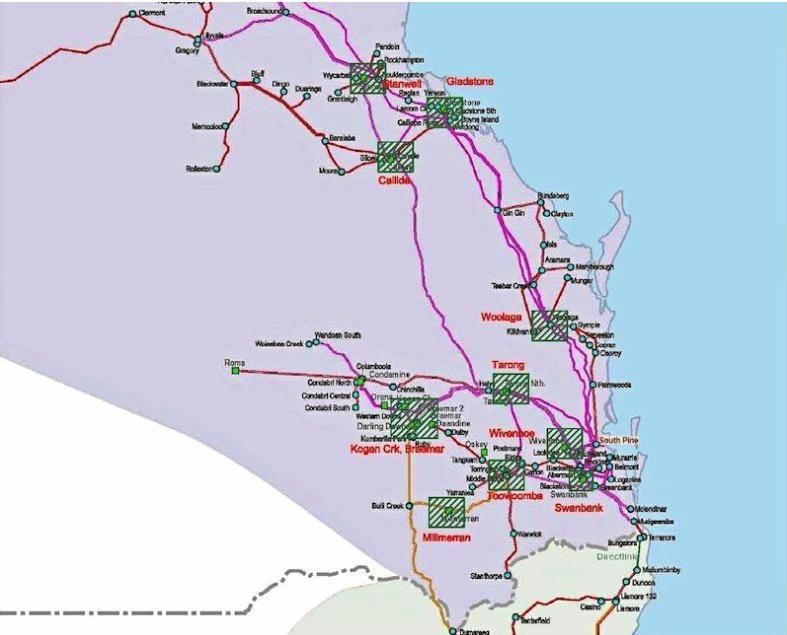
The vast majority are around the country’s beloved coastlines, and almost all are near residential communities. Some sites, like Townsville, Toowoomba and Wagga Wagga have been proposed multiple times, a map collated by the Parliamentary Library shows.
“Instead of indulging the policy fantasies of his restive backbench, (Prime Minister Scott) Morrison should reject the nuclear option or be upfront with Australians about exactly where he wants to build nuclear reactors,” Labor energy spokesman Mark Butler said on Thursday.
A parliamentary committee is looking at whether nuclear is a feasible, suitable and palatable solution for Australia’s future energy needs.
Energy Minister Angus Taylor asked for the inquiry amid growing calls from coalition backbenchers for the option to be seriously examined
Last Thursday, the committee was warned by Ziggy Switkowski – who led a Howard government review into the power source – that there was a real risk of “catastrophic failure” if Australia adopted nuclear energy.
Australians concerned about climate change: few support nuclear power
 The survey indicates nuclear energy, which has been revived as a prospect by some Morrison government MPs, remains divisive with voters.
Only one in five put nuclear in their top three preferred energy sources, and 59% of the survey put nuclear in their bottom three.
Australians increasingly fear climate change-related drought and extinctions
Climate of the Nation survey shows growing support for net zero emissions by 2050 and rapid phase-out of coal power
https://www.theguardian.com/environment/2019/sep/10/australians-increasingly-fear-climate-change-related-drought-and-extinctions?utm_term=RWRpdG9yaWFsX0d1YXJkaWFuVG9kYXlBVVMtMTkwOTEw&utm_source=esp&utm_medium=Email&utm_campaign=GuardianTodayAUS&CMP=GTAU_email Katharine Murphy Political editor
Drought-hit land 40km north-east of Coonabarabran in NSW. More than 80% of Australians are worried about drought and floods linked to climate change.
Australians are increasingly concerned about droughts and floods, extinctions and water shortages associated with climate change, and most people think all levels of government aren’t doing enough to combat the effects of global warming, according to new research.
The annual Climate of the Nation survey, which has been tracking Australian attitudes to climate change for more than a decade, finds concern about droughts and flooding has risen from 74% of the survey in 2017 to 81% in 2019. Continue reading
1 This month
.

Australians deserve the truth
about
AUKUS – https://aukuspublicinquiry.com/

PETITION – To: Prime Minister Anthony Albanese and the Australian Labor Government

of the week – Australians for War Powers Reform (AWPR)
To see nuclear-related stories in greater depth and intensity

