Australia’s Maralinga Nuclear Veterans unrecognised – (Government strategy – wait for them all to die?)
Maralinga nuke test crusader Avon Hudson’s plea for the Australian Nuclear Veterans’ Association getting lonelier, Tory Shepherd, State Editor, Sunday Mail (SA) June 9, 2018 https://www.adelaidenow.com.au/news/south-australia/maralinganuke-test-crusader-avon-hudsons-plea-for-the-australian-nuclear-veterans-association-getting-lonlier/news-story/3a88136d594912f0aa8a12b59b218649
AVON Hudson is still fighting – but his crusade is becoming lonelier.
The Australian Nuclear Veterans’ Association founder has fought for the rights of those exposed to deadly radiation at Maralinga in the 1950s and ’60s.
But the association is crumbling since so many of the survivors of those long-ago explosions have died.
“We had so few members we couldn’t keep going. The members all died,” Mr Hudson, of Balaklava, says.
Describing himself as an OBE – “Over bloody eighty” – Mr Hudson is worried they will all be gone before an apology is offered for what they endured in the British nuclear test program. He reckons there are about 1500 veterans left – but no one really knows.
He wants proper compensation but, more than anything, he wants recognition that the government of the time put them, and their as-yet-unborn children, in danger.
From 1952 to 1963, men in flimsy clothing – such as shorts and singlets – watched mushroom clouds bloom as the British carried out nuclear bomb tests at three sites in Australia. They were military personnel or civilians with little or no idea what radiation could do to them.
Since then, many have suffered cancers and disabilities, and their children have had deformities. There have also been reports of early deaths and high numbers of stillbirths.
Maralinga’s Anangu Pitjantjatjara Yankunytjatjara people were hit by the fallout. They saw a black mist floating across the desert, blocking the sun. Then people started to get sick.
Britain wanted to develop a nuclear capacity, and Australia’s vast outback was the place to test the weapons. The UK’s then prime minister Winston Churchill struck a secret deal with Australia’s prime minister Robert Menzies, who wanted to keep Britain happy.
They called it Project Hurricane, and it started on October 3, 1952.
There were minor trials and major tests.
The Australian Radiation Protection and Nuclear Safety Agency describes the detonations setting off a large fireball. “Everything inside of this fireball vaporises and is carried upward creating a mushroom-shaped cloud,” ARPANSA says. “The material in the cloud cools into dust-like particles and drops back to the earth as radioactive fallout. This radioactive fallout is carried by the wind very long distances away from the site of the explosion.”
Mr Hudson, who worked at Maralinga while in the air force, has had cancer treatments and other health issues.
He is furious that the Government has spent millions on war memorials like the $100 million Sir John Monash Centre at Villers-Bretonneux in France.
“They spend $100 million on the dead but can’t even look after the living,” he said.
“It’s too late for the dead – they’ve got no more pain and suffering like we have.
“Why have we been sidelined? Aren’t we entitled to some compensation?”
Since the tests, there have been decades of court cases here and in the United Kingdom, but all legal avenues are now exhausted and the veterans’ hopes are pinned on the Government.
Last year’s Budget included $133 million for survivors exposed to radiation and they can now get Medicare gold cards – but that has come too late for many.
Part of the problem is the difficulty in ascribing a specific cancer to a specific incident. The Department of Veterans’ Affairs has previously said there is “no significant danger of ongoing health effects for the descendants of participants”, although some research has shown an elevated risk.
The department said there had been “decades-long controversies” over compensation. In a recent Senate estimates hearing, SA Labor senator Alex Gallacher asked if the department was considering further support.
“No,” DVA spokeswoman Lisa Foreman said. “We’re focusing on making known that the gold card is available to those veterans.”
Senator Gallacher asked if they knew how many veterans were still alive. They didn’t.
He then asked if they were tracking deformities or illnesses in the descendants of veterans. They are not.
Meanwhile, Mr Hudson vows to fight on as long as he is able.
“I will not go quietly, I’ll give them hell. They deserve it,” he said.
Nuclear industry bigwig Erica Smyth gets Queen’s Birthday Award – don’t it make ya sick!
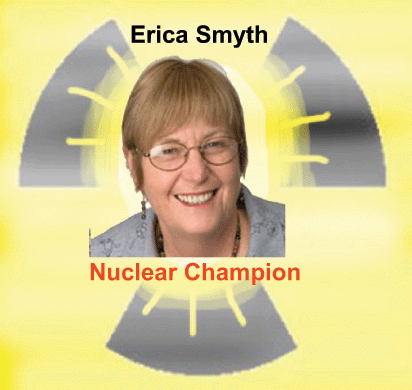
This award sure shows you where the present Australian government’s priorities lie.
Also – it’s on of those master spin strokes that are supposed to tell women that the nuclear industry is good for women
QUEEN’S BIRTHDAY 2018 HONOURS – COMPANION (AC) IN THE GENERAL DIVISION “For eminent service to the community through corporate governance roles with charitable, medical research, higher education, nuclear scientific and technology organisations, to the minerals exploration sector, and to women in business.”
Erica Smyth – Deputy Chair of the Australian Nuclear Science and Technology Organisation Director of the Deep Exploration Technologies CRC
Smyth began her career with BHP (now BHP Billiton) at Newman in the Pilbara region of Western Australia. Her later positions included 7 years as Principal Geologist for BHP Minerals and BHP-Utah Minerals International’s Beenup Project Manager for 4 years. She then moved to BHP Petroleum as their Manager Gas Market Development WA and later joined Woodside Petroleum as General Manager – Corporate Affairs. She has been a professional company director since 2005. S he is a past chair of uranium explorer Toro Energy
“Clean energy ….nuclear can be… an almost immediate part of that solution.” says Erica
Historic Northern Territory treaty agreement means ‘the old way is finished’
Lorena Allam Sat 9 Jun 2018
‘Gunner told the crowd he was proud to have signed the memorandum of understanding,
calling it “the most significant Aboriginal affairs reform in the NT this generation”. … ‘
‘The chairman of the Northern Land Council, Samuel Bush-Blanasi,
said it was “momentous.”
‘“We’ve got a big journey ahead of us.
The MOU gives us high hopes about the future, and
I hope the government stays true to the spirit of the MOU.”
‘That note of hope was echoed by the chairman of the Central Land Council, Francis Jupurrurla Kelly.
‘“I hope a treaty will settle us down together and bring self-determination.
‘“Today we bounced the ball,” Jupurrurla Kelly said,
“but we don’t want to stay the only players in the game.
The next steps must be led by Aboriginal people across the Territory so that
… everyone can have their say.”
‘Tiwi Land Council’s Gibson Farmer Illortaminni was more cautious.
“We’ve got to be careful and understand each other about what we want,
because we don’t want to have the same problems we’ve had in the past.
The MOU is a good start, but we’ve got a long way to go.”
‘The treaty agreement kicked off the annual Barunga festival.
Ruth Tulloch: “community consultation” by National Radioactive Waste Management – ” a huge, expensive marketing exercise “
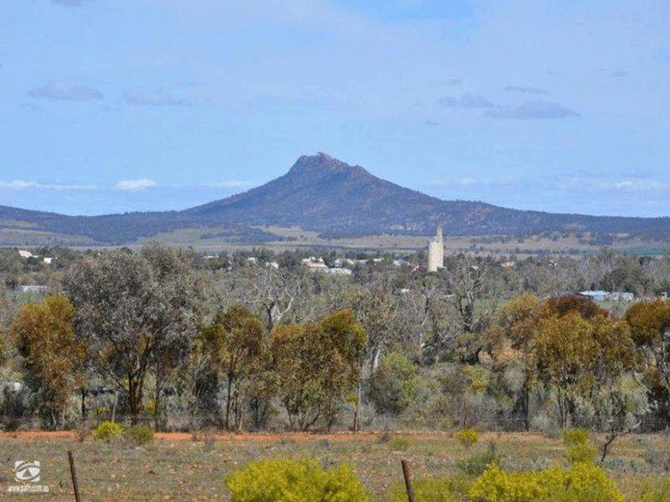
I have found this whole process to be not much more than a huge, expensive marketing exercise by a government department desperate to force this facility on to a small outback community
The information that was being given out was also changing. It started as being a low level waste facility and maybe a small amount of temporary low-intermediate waste, to what we now know to be more about intermediate level waste to possibly higher grade waste.
If this facility is so safe and as low impact as claimed then why not place it nearer to Lucas Heights which would cause less cost in transportation, less chance of accidents en-route and easier access for workers etc.
Ruth Tulloch Submission to the Senate Inquiry into the selection process for a national radioactive waste management facility in South Australia (Submission No. 62)
I have been a resident of Quorn for around 23 years and moved to this beautiful part of the state to get away from the congestion, smog and the increasingly impersonal city. I have been involved in the tourism and hospitality industry during my time in Quorn and believe I have a fairly good idea of what people expect to find when visiting The Flinders Ranges. Generally that is natural, un-spoilt and healthy environs to enjoy outdoor pursuits.
I am writing this submission as I am concerned about the lack of real consultation and information with-in the Quorn community.
I have tried to keep informed as best as I can regarding the siting of the Radioactive Waste Management Facility (Dump) in the Flinders Ranges area and am totally opposed to it as I believe it is the most inappropriate area to place such a facility on several grounds including; –
The way the process has been conducted and is being conducted
– (expenditure and marketing) – Not a suitable area – geologically etc – Aboriginal cultural sensitivities
– How it would affect the image of the area i.e.; tourism and the clean, green agricultural image of South Australia and the local area.
I went to the original meeting at the Quorn Town Hall back in early 2016 and was also included in the phone survey.
I was against the dump in that survey which was very confusing, as they would ask a question and then expect an answer on a variant scale for or against without my having any or very little background information as to what was being asked of me or the facility being proposed. I then went to the information meeting where they had glossy brochures and a power point presentation about how wonderful it would be to have a facility nearby. It seemed to be a purely PR and marketing exercise. I was not convinced and unfortunately (or fortunately for the Dept of Innovation, Industry and Science – DIIS) the SA government was also embarking on their own, now apparently defunct, investigation into a nuclear waste depository which made for quite a bit of confusion for many people, which by the way, still exists in the community.
The DIIS people then started having so called meetings in the Quorn Council chambers on a weekly basis whereby 3 or 4 representatives would come over from Canberra and sit in the office in case some-one wanted or happened to walk in and have a chat to them. I did venture in on a couple of occasions and found it at times quite intimidating with these experts ready to throw all their knowledge at me and assure me that all my questions or fears were basically unfounded and unnecessary with no basis to my doubts. I found this attitude extremely dismissive and often derogatory. They were also holding these ‘information sessions’ during office hours when most younger people are working and unable to get there even if they wanted to. A large percentage also work in Port Augusta (approx 40km away) so couldn’t even drop in during a lunch break etc.
This went on for many months at what enormous cost to the taxpayer? Also if they were compiling visitor stats then I would suggest that they may not be accurate, as many of the people who visited them went multiple times, like myself.
The information that was being given out was also changing. It started as being a low level waste facility and maybe a small amount of temporary low-intermediate waste, to what we now know to be more about intermediate level waste to possibly higher grade waste. This depends on who is saying what and what there grading perceptions are…… who should we believe????
DIIS then arranged for a French delegation to come out to assure us of how safe these types of facilities were and how the equivalent in France was operating.
I duly went to the meeting to find out more. Again it was during the day so the majority of the few people that were able to get there were of the older age bracket. During that meeting the head of the facility run by ANDRA (the French equivalent of ANSTO) made a presentation of their process. ANDRA specified that during their selection process there were four essential criteria for their site selection. They were:
Clay base as a natural barrier,
Low risk related to natural environment,
Low seismic activity,
Low risk of flooding
After his presentation I queried these points and asked if the site had a sand base, constant seismic activity, a sensitive natural and native cultural environment, prone to severe flooding events plus a natural and vital underground aquifer, – all the opposites to what he had stated as essential and which are present at the Barndioota site – would he place a facility there? His simple answer was NO!!! I asked a further couple of questions along this line of thought and also directed them to ( ) the DIIS rep and the discussion was immediately dismissed and firmly shut down as “we are not here to discuss that but to listen to the French delegation’s presentation.” In other words… shut up and don’t ask questions that we can’t or don’t want to answer!!!!!!
DIIS then set up the Barndioota Consultative Committee (BCC) as a liaison link to both Quorn and Hawker communities. I am of the belief that this is not the case as I have asked questions of members and on occasion either not had an answer or no answer or explanation has been forthcoming or they were not allowed to discuss issues.
On one occasion, a couple of people I know who visited one of the BCC meeting as observers – which I believe is normal public meeting procedure – were forced to leave the meeting with no plausible explanation as to why they could not stay.
Another concern of mine is the amount of taxpayer’s money that has been spent – in my view wasted – on this process. The cost of sending people from Canberra every week for months/year, the cost of various committees with paid members that have been formed for spurious reasons, the $2 million community grants, the cost of sending anyone who wants to go to Sydney to visit the Lucas Heights Facility to be assured “how safe it is” – which of course it is safe otherwise people wouldn’t be able to work there, plus NO-ONE would be given access to unsafe and or controlled areas any way!!!! I also believe there was an initial offer for expense paid trips to France to view their facility.
A perfect example of my comments is the forming of an Industry Working Committee (whose members are paid), who are in the process of organising ‘The Hawker Industrial Expo’ for May and in their promotion blurb state –
“This will assist the local community and businesses to better prepare for the potential arrival of the NRWM facility”.
A particularly biased statement!
The only contacts for this event are an events management company in Adelaide (who “specialise in Special Events, Conferences and Incentives for corporate, government and non-profit clients”) and the DIIS. More wasted money????
Considering a vote of the communities involved has yet to be undertaken to determine if this will go ahead or not, I find this arrogant and contemptible that it is even being planned this far out from a decision and it appears to already presume that the building of this dump will go ahead. Selection process for a national radioactive waste management facility in South Australia Submission 62 This, to me, smacks of bribery and a vast marketing campaign to ‘win over the locals’.
There has also been quite a bit of discussion around the facility providing new jobs for the area. Again this appears to be misleading as there is no information or guarantees as to how many jobs, who would be skilled for those jobs, would they be given to locals or just advertised to the general population, whether they would be full time part time etc etc etc…… Many questions to be answered and yet many loose or false promises provided.
We have also been constantly told that the facility would be run on ‘World’s Best Practice Principals’. Whilst this is somewhat reassuring in the short term, there are no guarantees that can be given re natural disasters happening or human error factors which are both more likely than not to happen in the long term. Plus DIIS are talking about long term as this waste has a very long half life (ILW) and even though it is supposed to be a temporary facility there are, at this stage, no plans for a permanent waste disposal facility. I understand this to be a critical requirement of having a license issued by ARPANSA.
Wouldn’t it be a more practicable and sensible idea to find a place for a permanent repository for all waste rather than shift it again some time in the future? As we now know, some of the radioactive waste that was dumped at Woomera (SA) some 20 years ago is now leaking and will need analysis and restoring which will take time and a great expense to re-secure and possibly transport again.
Lastly I would like to address the fact that DIIS has a belief that a majority of people in the area are for this ‘dump’ to progress. Again I believe this to be incorrect as nearly 100% of people I have talked to about this are against having it in the Flinders. They may not be going to meetings or jumping up and down in the streets for many, varied and legitimate reasons but they still care and are not in favour of it going ahead. I also Selection process for a national radioactive waste management facility in South Australia Submission 62 feel it divides the community making people less likely to discuss this issue in case they get into arguments with friends and or family.
In summary…I have found this whole process to be not much more than a huge, expensive marketing exercise by a government department desperate to force this facility on to a small outback community with no consideration for what is here and the likely loss of income that would surely follow from having a radioactive waste facility in what is a relatively pristine, clean, green, beautiful environment which is also on the verge of being placed on the World Heritage List. This would have an enormous impact on agriculture and tourism which are the main income streams for this area.
If this facility is so safe and as low impact as claimed then why not place it nearer to Lucas Heights which would cause less cost in transportation, less chance of accidents en-route and easier access for workers etc. Also why were all the other offered sites so quickly dismissed as being unsuitable without the same processes that we are enduring???
SA also has a law prohibiting any nuclear/radioactive waste facility and transportation of such waste through and in the state. Will this mean that the Federal Government will over-ride the wishes of the people of SA who very recently overturned any and all suggestions of a nuclear waste facility?
This should be a decision for all South Australians, and maybe all Australians, to decide not just a few hundred people in 2 small towns. After all it will affect the whole state and country for hundreds of years to come.
I have one last concern and that is regard to the proposed vote for consent to be put to the community sometime (this also varies) this year. Will it be a simple transparent question or like many surveys contain an ambiguous question that is written to get an outcome favourable for the departments Selection process for a national radioactive waste management facility in South Australia Submission own purposes and will it be able to present an unbiased case that all residents can understand.
This submission is not so much about not wanting this facility in our/my backyard so to speak but rather the lack of suitability of the proposed site and the lack of respect, discussion and research by the people conducting the process (DIIS). I hope you have read this submission and take my concerns seriously. I appreciate the opportunity to make my feelings known.
Sad to see National Geographic promoting the nuclear industry , and with Flinders University support!

National Geographic joins nuclear propagandists — the Australian connection, Independent Australia
A new documentary series is nothing more than a propaganda tool for nuclear power, writes Noel Wauchope.
IN SEPTEMBER THIS YEAR, National Geographic will launch the documentary series, Wild Edens. It’s all about wilderness areas and is also a soft sell for the nuclear industry. And there’s a proud Australian connection, with the Global Ecology Lab of Flinders University, South Australia. Their energy researcher, Ben Heard, was master of ceremonies at the premiere in Spain in April…….
By 2018, things have changed. The argument that nuclear power is cheap has fallen apart. As for the “peaceful atom” and “no connection with nuclear weapons”, that one has fallen through, too. Recent research in UK and the USA make it clear that nuclear energy and developing new reactors are necessary for the continued development of nuclear weapons.
Hans-Josef Fell, president of the global Energy Watch Group, states in the brief titled ‘The disaster of the European nuclear industry’:
‘The driving force behind the UK government’s affinity to nuclear technology is the cross-subsidization of the military nuclear program
In the 21st Century came changes in technology and in the content of propaganda. Enter the “new nukes” — modern designs, especially small modular nuclear reactors (SMRs — they leave out that unpopular word “nuclear”). After much soul-searching – or, rather, much complex research on public opinion – the proponents of new nukes have now finally settled on environment, climate change and also a nod to space travel as the reasons why the world must embrace SMRs.But it’s not only the content of their propaganda which has changed. It’s the style. It’s the copious wrapping around this 21st Century nuclear birthday present.
And here’s where National Geographic comes in — their new documentary series Wild Edens will be gorgeous:
‘…filmed in the world’s most stunning untouched places and their inhabitants — wildlife and fauna alike, endangered by the effects of climate change.’
The PR for nuclear power will be introduced so slightly and subtly you’d hardly notice. This is the strategy of the SMR propagandists. They also do lobby business and government with sophisticated technical arguments. But for the public – us, the great unwashed and especially the young – it is all beautiful touchy-feely stuff ……..
Ben Heard’s speech, on opening the premiere of Wild Edens, talked about climate change but then moved on to a longer panegyric on nuclear power:
…this beautiful and important film from National Geographic, brought to us with the help of Rosatom, represents…recognition that nuclear technologies are crucial to the protection, restoration and expansion of our natural world.
…it is particularly nuclear technologies that will help us find energy at a global scale, without super-charging the climate change of tomorrow.
And one of the greatest, most hopeful signs I have seen that this can happen, is to see a major corporation like Rosatom step boldly forward in this way and claim this issue on behalf of nuclear technologies.
Wild Edens will surely be very beautiful, informative about wild places and worth watching. Just be aware of the underlying propaganda about:
- nuclear power being the essential cure for climate change;
- nuclear power being clean and green; and
- nuclear waste problem being solved now, or will be solved. https://independentaustralia.net/business/business-display/national-geographic-joins-thenuclear-propagandists—the-australian-connection,11577
The Australian government at last giving Julian Assange some help?
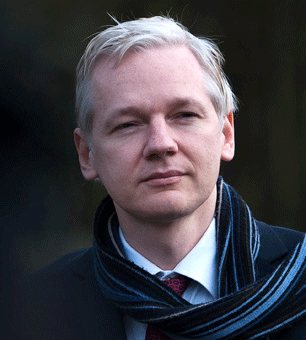 Australian officials spotted in mysterious Assange visit https://www.smh.com.au/world/europe/australian-officials-spotted-in-mysterious-assange-visit-20180608-p4zk7w.html, 8 June 18 London: Australian government officials have paid a mysterious visit to Julian Assange in his Ecuadorian embassy refuge in London, in a sign there may be a breakthrough in the stalemate that has lasted almost six years.
Two officials from Australia’s High Commission were spotted leaving the embassy in Knightsbridge in west London on Thursday.
It is the first time Australian consular officials have visited Assange at the embassy.
They were accompanied by Assange’s lawyer Jennifer Robinson.
Robinson confirmed the meeting to Fairfax but said she could not say what the meeting was about “given the delicate diplomatic situation”. “Julian Assange is in a very serious situation” she said. “He remains in the embassy because of the risk of extradition to the US. That risk is undeniable after numerous statements by Trump administration officials including the director of the CIA and the US attorney-general.”
Assange entered the embassy on June 19, 2012, after he had exhausted his appeals against an extradition order to go to Sweden to face rape and sexual assault allegations.
Swedish authorities have since closed their investigation, saying it couldn’t continue without Assange’s presence in their country.
However Assange still faces arrest if he steps out of the Ecuadorian embassy for breach of his bail conditions, after failing in a legal bid earlier this year to have the warrant cancelled by an English court.
His condition has recently become much worse, with his hosts repeatedly suggesting in public comments that they want the situation resolved and him out of the building. The court proceedings also revealed his worsening health, including serious tooth problems, respiratory infections, depression and a frozen shoulder.
His internet and phone connections were cut off by the Ecuadorian government six weeks ago and he was denied any visitors apart from lawyers, after Ecuador complained he had breached “a written commitment made to the government at the end of 2017 not to issue messages [on social media] that might interfere with other states”.
A spokeswoman from the High Commission said she would have to refer any questions about the meeting to the Department of Foreign Affairs and Trade in Canberra.
The Department of Foreign Affairs and Trade in Canberra confirmed it is providing consular assistance to Assange through the Australian High Commission in London.
Citing privacy obligations, however, DFAT refused to offer further comment.
Assange has complained for years that the Australian government has not offered him consular assistance, despite his being an Australian citizen.
In May last year Assange’s mother Christine Assange called on the Australian Government to give her son a new passport so that he can leave Britain.
“His passport’s been confiscated, the Australian Government should immediately issue him another one and demand safe passage for him to take up legal asylum in Ecuador,” she told the ABC.
‘Safety breaches and lack of management support’ at ANSTO’s Lucas Heights nuclear facility
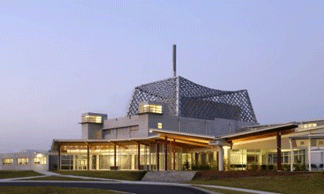 Second radioactive spill in 10 months at ANSTO’s Lucas Heights facility, SMH, By Peter Hannam
A staff member at the Australian Nuclear Science and Technology Organisation facility at Lucas Heights has been involved in a spill of radioactive material, the second such incident in 10 months.
A quality control analyst working in medical production was involved in the spillage of about one millilitre of the radioactive isotope molybdenum-99 early on Thursday morning, an ANSTO spokesman said.
“The staff member was wearing full protective clothing. An occupational health physicist checked the analyst and confirmed no skin contamination,” the spokesman said.
The employee was then cleared to go home and returned to work on Friday.
A source told Fairfax Media, however, that employees at the site “are concerned with the most recent number of safety breaches and lack of management support”.
Medical production at the facility has ceased, pending a thorough investigation into the spill, the spokesman said. “ANSTO is working to minimise impacts on nuclear medicine production.”
ANSTO was keen to stress that Thursday’s incident was “very different” from one last August, when a staffer reportedly spilled a quantity of the MO-99 isotope, causing a “significant radiation dose”.
“Tests show the analyst involved in yesterday’s incident did not receive skin contamination. ANSTO continues to provide support for the employee involved in last year’s incident.”
The site has had other radiation events, such as one reportedly involving four staff in 2012….https://www.smh.com.
South Australian government decides against process towards Aboriginal Treaty
Kyam Maher started the treaty process as Aboriginal affairs minister and is now Labor’s spokesman for the portfolio.
“For far, far too long, policymakers have been doing things to Aboriginal people, not with Aboriginal people.”
A “massive amount of work” had been put in by Aboriginal people towards a treaty, he said.
He said the Premier had done “very, very little consultation” on the issue.
“To decide unilaterally without consultation to not go ahead with the most important reform process in Aboriginal affairs that we’re undertaking, I think there will be a lot of anger and it will be very difficult for the new government to operate with Aboriginal communities … letting them down in this way,” he said.
Yesterday, the Lower House of Victoria’s Parliament voted in favour of negotiating Australia’s first Aboriginal treaty, after the state’s Labor Government won crucial support from the Greens.
SA Government decides not to go ahead with Aboriginal treaties http://www.abc.net.au/news/2018-06-08/sa-govt-decides-not-to-go-ahead-with-aboriginal-treaty/9851166 The South Australian Government has scrapped a process to negotiate treaties with the state’s Aboriginal nations.
It comes on the same day the Northern Territory pledged to work towards a treaty with its Indigenous peoples. Continue reading
Australia’s frontier war killings still conveniently escape official memory
Paul Daley ‘But change is inevitable.
The commemoration of the Myall Creek massacre is emblematic of a broader push for recognition’
@ppdaley 8 Jun 2018
‘This weekend it is 180 years since white stockmen murdered
28 unarmed Aboriginal men, women and children at Myall Creek
in northern New South Wales.
‘The Myall Creek massacre was part of a pattern of violence against Indigenous people;
hundreds of such massacres happened across the continent from 1788
as British soldiers, settlers and pioneering explorers clashed with Indigenous people
resisting pastoral expansion.
By some credible accounts at least 60,000 Indigenous people
– roughly the same number as Australians killed in the first world war – died.
‘Myall Creek was, however, remarkable for another reason.
It was the only time on the colonial frontier that non-Indigenous men
were successfully prosecuted for murdering Aboriginal people.
Seven perpetrators were eventually hanged. …
‘Meanwhile, the NSW Labor opposition has pledged $3m towards
the construction of a Myall Creek Education and Cultural Centre
that would be dedicated to public education of the massacre and frontier war. …
‘But as yet there is no official Commonwealth memorial to the dead
of the frontier wars in Canberra, the capital, whose monuments and
institutions also serve as a national memory.
‘But it will happen, just as inevitably as the date of Australia Day
is bound to change from the day of invasion, 26 January.’
www.theguardian.com/australia-news/postcolonial-blog/2018/jun/08/australias-frontier-war-killings-still-conveniently-escape-official-memory
Jim Green exposes the Warren Centre’s fake “debate” on The Future of Nuclear Energy in Australia
 Jim Green Nuclear Fuel Cycle Watch South Australia, 7 June 18
Dear Warren Centre, re the upcoming nuclear ‘debate’, I would be grateful for responses to these questions.
1. Why is this event called a ‘debate’ given that all speakers are pro-nuclear?

2. Will you amend the bio-note on the Warren Centre event webpage to note that Ben Heard’s so-called  environment group ‘Bright New World’ accepts secret corporate donations?
3. During the ‘debate’, will it be made clear to the audience that Mr Heard’s group accepts corporate donations including secret corporate donations? Is such disclosure not required by the Warren Centre’s ethical guidelines?
4. The Warren Centre event webpage mentions Heard returning to his NGO roots. He has no NGO roots. Will you amend that claim?
5. During the ‘debate’, will you make it clear that Mr Heard’s contribution to the SA Nuclear Fuel Cycle Royal Commission was rejected by the Commission? Specifically, the final report of the Royal Commission said: “[A]dvanced fast reactors and other innovative reactor designs are unlikely to be feasible or viable in the foreseeable future. The development of such a first-of-a-kind project in South Australia would have high commercial and technical risk. Although prototype and demonstration reactors are operating, there is no licensed, commercially proven design. Development to that point would require substantial capital investment.”
6. Will you ensure that the audience attending this ‘debate’ is provided with some basic factual information that Mr Heard and the other two contributors to the ‘debate’ certainly won’t be volunteering, e.g.
— A$40 billion capital cost for two new reactors in the UK (A$20 billion each)
— A$16 billion capital cost for new reactors in France and Finland
— bankruptcy filing of Westinghouse due to catastrophic cost overruns building conventional reactors in the US (including A$13+ billion wasted on reactors in South Carolina that were cancelled last year).
— Westinghouse, Toshiba and a number of other utilities exiting the reactor construction business
— Ziggy Switkowski, head of the Howard government’s Nuclear Energy review, now says he believes “the window for gigawatt-scale nuclear has closed”, and that nuclear is no longer lower cost than renewables and that the levelised cost of electricity of the two is rapidly diverging in favour of renewables
7. Will you ensure that webinar participants are informed that Mr Heard has continued lobbying for the importation of 138,000 tonnes of high-level nuclear waste to SA despite being well aware of the overwhelming opposition of Aboriginal Traditional Owners?
https://www.anfa.org.au/…/Traditional-Owner-statements-SA-d…
8. What steps will you take to ensure that participants are provided with some credible information about high-temperature gas-cooled reactors given that these seem to be Mr Heard’s latest fixation? Some information is copied below.
9. If Mr Heard claims that high-temperature gas-cooled reactors are ‘meltdown-proof’, or other such inanities, what steps will you take to ensure that his falsehoods are corrected? Continue reading
Senate Committee Says Further Regulatory Burden on Charities Unnecessary
The Select Committee into the Political Influence of Donations, chaired by Greens leader Senator Richard Di Natale, released its report on Wednesday.
The committee extensively examined the regulation of third parties – which include charities and not for profits – and noted they were “integral to the political process, providing important context and commentary on the issues being decided on in an election”.
The report comes in the midst of a Turnbull government push to ban foreign donations through its Electoral Funding and Disclosure Reform Bill.
The charity sector has strongly argued that the legislation – which requires registration and disclosure requirements for a broader group of non-party political actors than is the case currently – would stifle advocacy and impose unnecessary red-tape on these organisations.
The Senate committee said much of the evidence it received noted that any further regulation of third parties should reflect their unique role in the political system, and not unfairly burden them.
“The committee received consistent evidence over the course of the inquiry that the recently amended legislation and current legislative proposals before Parliament carry the very real danger of stifling the voice of third parties in delivery of their core purpose to advocate on specific issues,” the report said.
“The committee is of the strong view that only activity by third parties that is seeking to directly influence elections should be regulated.
“The committee therefore recommends that a thorough consultation exercise be carried out by the federal government before any detailed regulatory mechanisms are put in place.”
The report said the committee had heard “almost universal views” that the extensive regulatory regime that governs charities effectively made any recent legislative proposals under electoral law redundant.
The committee therefore recommended that no further burden be placed on charities…….. https://probonoaustralia.com.au/news/2018/06/senate-committee-says-regulatory-burden-charities-unnecessary/
Victorian lower house passes treaty legislation after Greens accept Labor deal
 ‘Bill creates framework for Indigenous body to represent Aboriginal Victorians
 and advance treaty process‘ Calla Wahlquist @callapilla 7 Jun 2018
‘The legislation passed with the support of the Greens after
the Aboriginal affairs minister, Natalie Hutchins, proposed amendments
that went some way towards addressing concerns raised
by Gunnai-Gunditjmara woman and Northcote MP Lidia Thorpe.
‘Thorpe proposed additional amendments on the floor of parliament,
particularly demanding an acknowledgement of Aboriginal sovereignty
by the state of Victoria, but they were not adopted. …
‘The amendments to the Victorian legislation were moved
in response to concerns raised by Thorpe, the only
Aboriginal person in Victorian parliament, who said she was
concerned about a lack of engagement with elders;
a potential sidelining of Victorian traditional owners in favour of
government-appointed people on the representative body; and
the failure of the legislation to explicitly acknowledge the
sovereignty of Aboriginal clans in Victoria.
‘The latter remains a significant concern for Thorpe,
who said in parliament on Thursday that she was disappointed the government
had decided against including a firm acknowledgement in the legislation
that traditional owners in Victoria retained sovereignty over their lands.
‘“Treaties are between two sovereigns, and to talk about treaty
or to go ahead with treaty negotiations and not actually recognise
that Aboriginal people are the sovereign people of this land,
then I think that’s one of the major failures of this legislation,”
Thorpe told Guardian Australia.
“If we can’t start by addressing sovereignty, then that’s a joke.” … ‘
US activist Kevin Zeese calls for demonstrations against the persecution of Julian Assange
https://www.wsws.org/en/articles/2018/06/06/zees-j06.html 6 June 2018
Kevin Zeese, a prominent US activist and lawyer, issued the following statement this week endorsing action in defense of Julian Assange, including the June 17 rally in Sydney and vigils in London and around the world on June 19.
Zeese has spoken out against the escalating censorship of the Internet and the broader erosion of democratic rights. He is a co-director of the Popular Resistance organisation and is on the advisory board of the Courage Foundation which raises funds for the defence of persecuted journalists and whistleblowers.
Statement of Kevin Zeese endorsing protests and vigils in defense of Julian Assange
Julian Assange through his work as editor of WikiLeaks has made major strides toward democratizing the media by creating a vehicle for whistleblowers to share the truth and correct the misinformation of the mass corporate media. Assange and WikiLeaks have given people a precious tool—access to the undeniable truth about what governments and big business are doing. This is a tool we can all use to educate each other about what is really going on around us.
Assange is being persecuted because a democratized media threatens the monopoly over media control of the elites. A democratized media makes it more difficult for them to misinform, mislead and propagandize.
Through WikiLeaks, Assange with whistleblowers like Edward Snowden and Chelsea Manning have exposed war crimes, the truth about the Guantanamo Bay prison, the corporate domination of US policy and the actions of governments around the world and more. This has led to popular revolts around the world that have challenged those who abuse their power.
Freedom of speech and freedom of the press is being defined by the treatment of Julian Assange. Everyone who cares about these freedoms should speak out and take action on his behalf by joining the demonstration in Sydney, Australia on June 17 and the vigils being held in London and around the world on June 19—the anniversary of when Julian sought asylum in the Ecuadorian embassy six years ago. On June 19 at 11:00 a.m. we will be holding a protest in support of Julian Assange at the White House. Please join us to call for an end to his persecution.
Kevin Zeese, co-director of Popular Resistance, member of the advisory board of the Courage Foundation
Chloe Hannan: community mental health is a serious issue that is ignored in the nuclear waste dump site selection process

Chloe Hanan, Kimba : Submission to Senate Inquiry: National Radioactive Waste Management Facility (Submission No. 61)
I have grown up in Kimba on our 3rd generation farm and have lived here for the majority of my 28 years. I choose to live, volunteer and raise my own family here in Kimba and I felt it extremely important to put a personal submission into the Senate Inquiry due to the negative impact the National Radioactive Waste Management Facility process has had not only on my family but the Kimba community. I am also open to provide more information to the senate inquiry surrounding the process in Kimba if required.
I would like to make comment on the following Terms of Reference:
b) how the need for ‘broad community support’ has played and will continue to play a part in the process, including: i) the definition of ‘broad community support’, and ii) how ‘broad community support’ has been or will be determined for each process advancement stage;
Right from the very beginning of the process the Minister and the Department of Industry, Innovation & Science have all consistently stated that siting this facility needs ‘broad community support’ and that it will not be imposed on an unwilling community. However, there has never been a clear definition provided to the community apart from the Minister Canavan stating he would need 65% support which was quickly retracted and ignored once the vote in Kimba did not meet that target. Because there has been no definition or set target provided within this process guidelines it means that there is no accountability of the Minister and the Department. This makes a community feel powerless, especially when throughout the 210 days of community consultation that Kimba has endured, what is deemed as broad community support to progress through different stages of the site selection process keeps changing. I believe strongly that at a minimum 2/3rd majority of a community is needed for the siting of the National Radioactive Waste Management Facility to be considered. Especially due the longevity of such a facility – it cannot be just over half, as this is damaging to a community when people are put against people in such a heated debate.
d)whether and/or how the Government’s ‘community benefit program’ payments affect broad community and Indigenous community sentiment;
I strongly believe these payments are deliberately used to influence community consent with the promise of jobs and money even though there is very little detail of the economic impacts of the facility. This should be upfront factual information, not provided later as you progress through the stages.
e) whether wider (Eyre Peninsular or state-wide) community views should be taken into consideration and, if so, how this is occurring or should be occurring The electoral vote in Kimba didn’t capture people that had properties just outside the boundary lines; however, these families have sent or do send their children to Kimba Area School, play sport for Kimba and shop locally; however they would not be eligible to vote even though they are active community members. These people were encouraged to write letters which would be considered by the Minister; however, these have never been mentioned by the Minister when making his decision when progressing Kimba to the next stage. I strongly believe that wider community support should be assessed especially concerning the two sites Lyndhurst and Napandee where it is clear that people in the neighbouring district council area are closer to the Napandee site than many living in the Kimba District Council area
f) any other related matters. The mental health and well-being of communities is completely ignored in this process and this is a serious issue that needs to be addressed in future frameworks and guidelines. This process makes communities feel powerless – no support is given to those with opposing views, it is a process that is heavily favoured towards those pro-nuclear and when the rules keep changing to suit those in favour it really gives people a sense of hopelessness.
Katrina Bohr is dissatisfied with the National Radioactive Waste Management Facility’s process for “Community Consultation”
 Katrina Bohr Submission to Senate Inquiry Selection process for a national radioactive waste management facility in South Australia Submission 59
My name is Katrina Bohr. I have been a resident of South Australia for 32 years, having lived in regional South Australia for the last 22 years. Nuclear waste and the historical outcomes of radioactive damage has been an ongoing concern of mine for almost 50 years.
In the initial stages of the announcement for site selection at Barndioota, when Josh Frydenberg was Minister for Resources and Energy, a statement was issued from the Government.
‘The Australian Government will also take into account the views of others (outside community zones) as part of the commitment to broad consultation.’ The proposal for low and intermediate waste to be stored in South Australia affects not only myself, but also future generations. Unlike some respondents, I do not live in the Hawker region. Therefore, my views are not driven by benefits, but rather genuine concerns for peoples’ health, our environment, and our local Indigenous communities.
B) How the need for ‘broad community support’ has played and will continue to play a part in the process, including:
i) The definition of ‘broad community support’ I believe the definition of ‘broad community support’ is defined as support given by the majority. Broad support should be determined when the consultation process has been conducted thoroughly and with all persons of interest. The consultation process should offer full disclosure for the proposed site selection process.
ii) How ‘broad community support’ has been or will be determined for each process advancement stage Determining Broad Community support at this stage has involved a number of methods. Surveys, Public Meetings, face to face meetings, a continual presence of Australian Nuclear and Science and Technology Organisation (ANSTO) employees, members of the Australian Radiation Protection and Nuclear Science Agency (APRANSA) and a Heritage Assessment process.
Rowan Ramsey’s June/July 2016 Grey Newsletter states that all all the feedback, including district surveys were considered by the Minister to evaluate whether there was a realistic chance of ‘developing’ broad support. The word ‘developing’ almost implies an action to develop rather than consult.
My understanding of on-going broad community support is for updated and collated material to be honest and transparent, and that all perspectives be
C) How any need for Indigenous support has played and will continue to play a part in the process, including how Indigenous support has been or will be determined for each process advantage stage;
There are local indigenous people who believe that they should have been consulted from the outset. This is due to Yappala Station (next door to the proposed site) having already been classed as a protected area. Yappala Station is heritage listed as an Indigenous protected area due to its cultural and environmental significance. A South Australian Department of State Development spokesperson confirmed that there are three Aboriginal sites that fall within the Barndioota-nominated area. Two of the sites are cultural and the third is archaeological (NITV Posted 2016). The local indigenous people needed to be involved in all aspects of the site selection process. From heritage assessment to cultural importance. Dreamtime stories and Songlines.
Traditional land owner and Elder Eunice Marsh speaks of their love for the land as love for family. Hookina Springs and the surrounding area is significant to the Adnyamathanha women. When the Adnyamthanha Traditional Lands Association met at the end of March 2018, the vote for the NRWMF was overwhelmingly against.
E) Whether wider (Eyre-Peninsula or State-wide) community views should be taken into consideration and, if so, how this is occurring or should be occurring; I believe that wider community views should be considered as the nuclear waste, and in particular, the intermediate waste from Lucas Heights in NSW will be transported through a number of corridors. Therefore, wider community consultation should be considered. Matt Canavan makes reference to a ‘wide’ consultation process to determine whether the site is suitable’-Transcontinental newspaper 22/11/2016.
As far as I am aware, there has been no wider community consultation to date. Wider community consultation could be conducted through relevant forums, surveys and information mail outs.
F) Any other related matters
In the fairness of disclosure, I have referred to the Australian Government Department of Business Initial Business Case (revised) 2014 Page 29 ‘The Capital cost estimates for the project options are based on delivery of given designs at a site in Central Australia’-Page 60 The Business Case also refers to a Timeline where ANSTO is due to run out of space for low and intermediate storage. This is by 2018.
When in Parliament, Grant Chapman chaired the select committee that recommended the country’s low level nuclear waste be stored in a single facility-The Guardian 29/4/16. Grant Chapman is part owner of the proposed site at Barndioota, and has made it quite public that he believed his land would be an ideal site for a NRWMF. He served on three committees including Uranium mining and milling to Radioactive Waste from March 1995 to May 1997. The other from August 2000 to May 2001. Acting as Chair in the first two committees, where in !996 a decision was made to pursue a NRWMF. There is evidence that there may have been a determination over the years by the Australian Government to establish the site at Barndioota.
Images: I am sending three images displaying the ferociousness of historical flooding near the rail lines in the proposed area for the site. ( these are added in an attachment on the original at https://www.aph.gov.au/Parliamentary_Business/Committees/Senate/Economics/Wastemanagementfacility/Submissions)
1 This month.
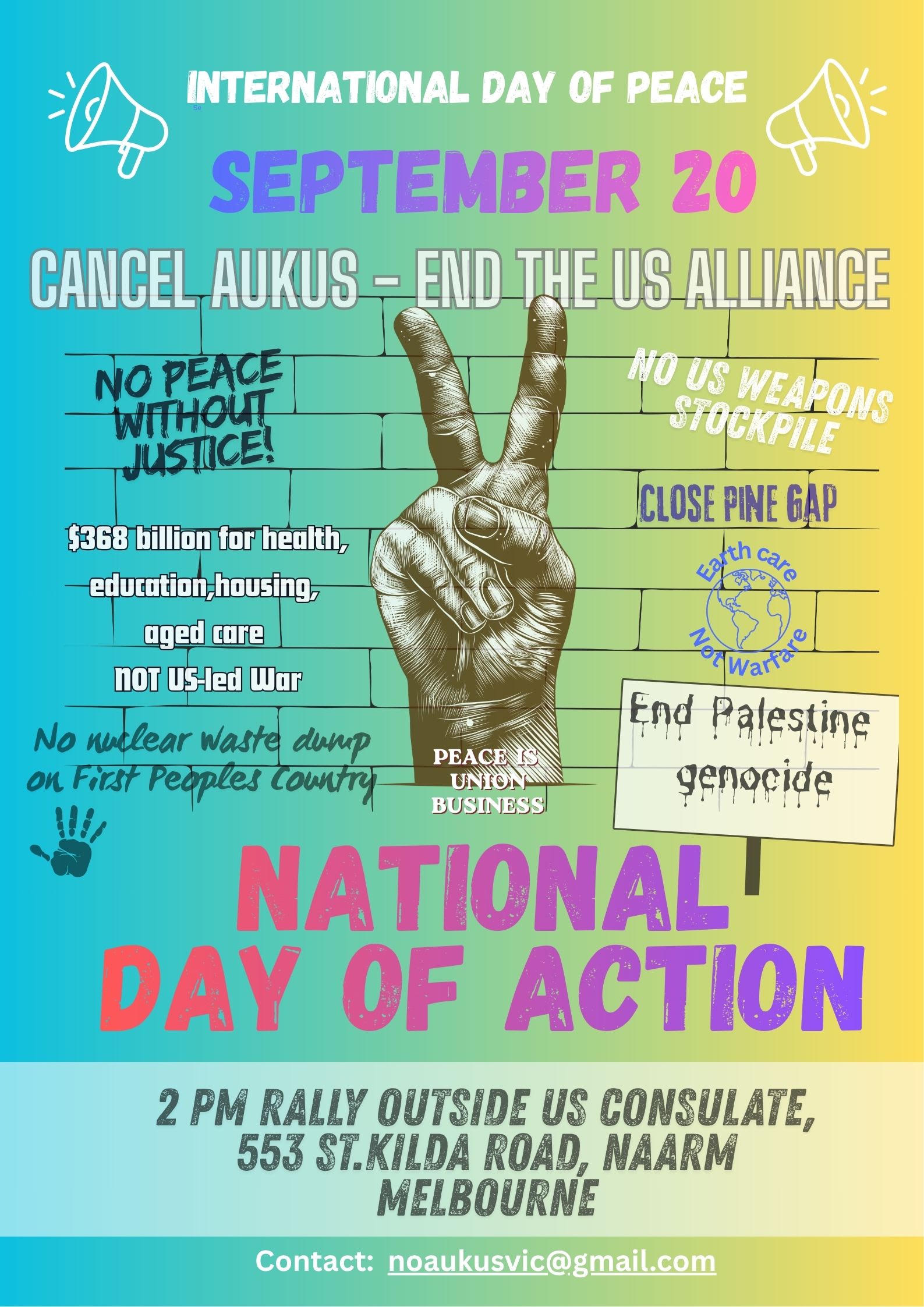
20 September –National Day of Action in Melbourne on the International Day of Peace

Help Aunty Sue Protect Her Land and Sacred Sites From Destructive Rocket Testing.
.

Australians deserve the truth
about
AUKUS – https://aukuspublicinquiry.com/


PETITION – To: Prime Minister Anthony Albanese and the Australian Labor Government

of the week – Australians for War Powers Reform (AWPR)
To see nuclear-related stories in greater depth and intensity
 Antinuclear