Aboriginal people will fight planned Vimy uranium mine, despite EPA’s approoval of it
Indigenous people living in the area have a bad history with uranium developments. It’s a few hundred kilometres from Cundalee, the mission where Spinifex people from the Great Victoria Desert were placed after being pushed off their traditional lands by the British government’s nuclear testing program in Maralinga, South Australia, in the 1950s and 60s
 Pilanguru people to fight on as uranium mine gets environmental approval
Traditional owners say the Indigenous community has not been adequately consulted about Vimy Resources’ planned Mulga Rock open-pit mine, Guardian, Calla Wahlquist, 15 Aug 16, Traditional owners have vowed to fight a proposed uranium mine at Mulga Rock, about 240km west of Kalgoorlie, Western Australia, which was given conditional environmental approval on Monday.
The Environmental Protection Authority of WA recommended the Barnett government approve construction of the open-pit mine and uranium processing plant, operated by Perth-based Vimy Resources Limited, after a three-month public environmental review. Continue reading
Environmental groups put a winning argument against the Yeelirrie uranium project
The winning argument against the mine A joint submission was provided to the Yeelirrie Public  Environment Review by the Conservation Council of WA, the Australian
  Conservation Foundation, Friends of the Earth Australia, The Wilderness Society, the Anti-Nuclear Alliance of WA, the West Australia Nuclear Free
 Alliance and the Australian Nuclear Free Alliance.
Amongst other points, they called for the project to be rejected “on the grounds that  the Yeelirrie Subterranean Community, a Priority 1 Ecological Community (PEC) comprises a series of highly endemic, diverse stygofauna and troglofauna species within multiple calcrete habitats). The impacts of the proposed Yeelirrie uranium mine, predominantly the associated groundwater drawdown, pose an unacceptable risk that could see a number of subterranean species become extinct (particularly 15 species that are currently only known from the direct impact zone).”
The EPA decision was based on the impacts on subterranean fauna, and disregarded other points made in the submission.
The Wongutha Traditional Owners have been fighting this project for over 40 years.
WA EPA rejects proposed Yeelirrie uranium mine, Online Opinion, By Mara Bonacci – posted Tuesday, 16 August 2016 After nearly 3,000 people lodged submissions with the Western Australian EPA in opposition to the proposed uranium mine at Yeelirrie, on August 3 the EPA recommended that the project be rejected. Traditional Owners and environmentalists welcomed the decision, but remain wary……. Continue reading
Industry Minister Greg Hunt attacks renewable energy, but Energy Minister Frydenbereg supports it
Mr Frydenberg has said Friday’s national energy ministers’ meeting will discuss topics including the transformation of electricity markets to ensure a greater use of renewable energy and new technologies, such as battery storage.
In an interview with The Advertiser, Mr Koutsantonis renewed a push for a high-voltage interconnector cable to New South Wales, at a cost of about $700 million, saying this would result in cheaper prices and improved supply by connecting SA to more sources of electricity.
He said competition in SA was limited by the high-voltage transmission link to only one state, while Victoria’s lower prices were explained by cables connecting to three states — SA, NSW and Tasmania.
Mr Koutsantonis said state and federal taxpayers might be willing to fund up to $300 million of the NSW interconnector project if electricity supplies were improved.
 Jackson Gothe-Snape, Paul Starick, The Advertiser August 17, 2016 FEDERAL Industry Minister Greg Hunt has lit the fuse for a fiery national energy summit on Friday by blaming high electricity prices on the failure of some states to plan for the growing use of renewables.
In a thinly veiled attack on SA’s embrace of solar and wind, Mr Hunt will on Wednesday use a speech in Port Pirie to condemn a pretence that integrating renewable energy into power grids is free of cost and other impacts.
Mr Hunt’s comments contrast sharply with those of Cabinet colleague and Energy Minister Josh Frydenberg, whose stated aims in calling Friday’s ministerial meeting in Canberra were to “strengthen co-operation” between governments to ensure energy markets remained “stable and secure”. Continue reading
Western Australia’s EPA approves Vimy uranium mine, but Conservation Council and Aborigines oppose it
Vimy Resources uranium mine east of Kalgoorlie given environmental approval, ABC News, By Laura Gartry , 16 Aug 16, A new uranium mine in Western Australia’s Goldfields has been recommended for approval by the state’s environmental watchdog, just weeks after a similar proposal in the area was knocked back.
The Environmental Protection Authority [EPA] granted the approval for Vimy Resources’ Mulga Rock uranium project, which is 240 kilometres east-north-east of Kalgoorlie, subject to a range of conditions.
Final approval is still required from both the state and federal environment ministers…….
Earlier this month, the EPA rejected Cameco Australia’s Yeelirrie uranium project after it deemed there was too much risk to the area’s subterranean fauna.
The Canadian company had sought to mine up to 7,500 tonnes of UOC per year from the Yeelirrie deposit, about 420 kilometres north of Kalgoorlie-Boulder and 70 kilometres south-west of Wiluna.
The proposal had attracted protests, including from traditional owner and chair of WA nuclear free alliance Kado Muir, who argued there was no broad community support for uranium mining in WA…….
More than 1,000 submissions were received during the 12-week public review period…….
Two other WA uranium projects have received EPA and ministerial approval in recent years, including the Wiluna uranium mine and the Kintyre uranium project, 270 kilometres north east of Newman.
The Conservation Council of WA said it would appeal the proposed mine because it threatened a pristine environmentally and culturally-significant area.……
Vimy Resources faces many hurdles and road blocks and today’s EPA recommendation is a long way from a green light for mining yellow cake at Mulga Rock,” Council campaigner Mia Pepper said.
Pila Nguru Aboriginal Corporation chair Bruce Hogan said the site was culturally significant. “We don’t want that mine to go ahead. We will fight against that mine at Mulga Rock,” Mr Hogan said.
Spinifex Pilki elder Sandra Evans said traditional owners from the Great Victoria Desert area were not consulted properly. “There are a lot of women’s sites there – they didn’t come to talk to the tribal women from there about clearing the grass trees and other special places,” she said.
“Uranium is different to other minerals – it’s dangerous. If it leaves our country and goes somewhere else – that’s still our responsibility, we worry about that.”
The EPA’s report is open for a two-week public appeal period.” http://www.abc.net.au/news/2016-08-15/epa-approves-uranium-mine-near-kalgoorlie/7734798
History of Cameco’s Yeelirrie uranium mining plan
 WA EPA rejects proposed Yeelirrie uranium mine, Online Opinion, By Mara Bonacci – posted Tuesday, 16 August 2016 “…….Yeelirrie is located 420 km north of Kalgoorlie in the mid-west region of WA, the land of the Wongutha people. Yeelirrie is the name of a local sheep station and, in the local Aboriginal language, means “place of death”.
In 1973 Western Mining Corporation (WMC) found a uranium deposit there. The Yeelirrie Mine Proposal was submitted to the WA Department of Conservation and Environment in 1979. The proposal was for the development of an open cut mine, ore treatment plant, town and ancillary services and 850 employees. Environmental approval was given by both state and federal governments.
Trial mines were dug in the 1980s, which found the first large scale calcrete orebody in the world. It is estimated that around 195 tonnes of yellowcake were mined in these trials. WMC spent $35 million preparing to develop the mine until the 1983 federal election and subsequent implementation of the ALPs “three mines policy” in 1984, limiting Australia’s number of uranium mines to three.
In 2005, the mine was acquired from WMC by BHP Billiton, who concluded one stage of exploration mining. Then in 2012, Canadian mining company Cameco bought the deposit from BHP for $430 million….
Cameco’s Yeelirrie mine proposal includes:
- A 9 km long, 1.5 km wide and 10 m deep open pit mine
- 14 million tonnes of overburden
- Using 8.7 million litres of water a day
- Producing 7,500 tonnes per year of uranium (10 percent of annual world demand)
- To be transported by four road trains a week
- It would produce 126,000 tonnes per year of CO2 emissions
- 36 million tonnes of tailings stored in the open pit2,421 hectares would be cleared
- 22 years of operation
- Highly variable work force – average of 300………http://onlineopinion.com.au/view.asp?article=18451&page=1
Media coverage given to serial climate denying pest Sen. Malcolm Roberts
“Campaign of intimidation” One of the academics on the receiving end of Roberts complaints, John Cook, of the University of Queensland, told DeSmog:
Beneath the public attacks on climate science, scientists are also subject to a more insidious campaign of intimidation, otherwise known as the subterranean war on science. This takes the form of complaints to universities to get scientists fired, complaints to journals to get papers retracted and FOIrequests to pick through scientists’ emails.
Sen. Malcolm Roberts: Climate denier, conspiracy nut and serial pest, Independent Australia DeSmog Blog 15 August 2016 One Nation’s Senator Malcolm Roberts has spent countless hours harassing scientists, researchers and politicians with rantings about climate change conspiracy theories. DeSmogBlog‘s Graham Readfearnreports.
MALCOLM ROBERTS is a former Australian mining consultant who thinks the United Nations is using the “scam” of human-caused climate change as a cover story while it builds an all-powerful world government.
He’s also just been elected as an Australian Senator.
Roberts will sit in Australia’s upper house as a member of the far-right One Nation party that wants to ban Muslim immigration and investigate climate scientists for “fraud and corruption”.
Since his election, Roberts has been given blanket coverage in the Australian media, with high profile interviews on flagship shows on the publicly funded ABC. Continue reading
The “heroic” assumptions of the Nuclear Fuel Chain Royal Commission
 Submission to Joint Committee on Nuclear Royal Commission South Australian Parliament, – Mothers for a Sustainable South Australia, August 2016 http://www.parliament.sa.gov.au/Committees/Pages/Committees.aspx?CTId=2&CId=333
The assumptions underpinning the century-long cost-benefit calculation that this proposal relies upon, are heroic.
Price: There is no market for disposing of HLNW, so the proposed ‘price’ is a guess. It is ‘an illustrative benchmark’ (p 293) – but is critical to the $51 billion profit figure. Experts cannot predict the price of gas, coal or iron ore one year ahead – despite well developed markets for all three. How can a century-long price for something that is not yet traded be sensibly predicted? The price used by the RC is much higher than that suggested by Finnish experience. It is nothing more than a guess.
Cost: There is no existing deep geological storage anywhere in the world, so no experience with what it actually costs. The cost estimate – from transport through to maintenance of the site for 100,000 years – is also simply a guess. The Finns who must dispose of about 6,000 tonnes of their own high level nuclear waste have recently granted construction approval for a deep geological dump at Onkalu – after 40 years lead up. This is the first of its kind in the world – expected to be operational in the 2020s. But until it is built, there is no reliable cost experience for the experimental technology. Further, Onkalu is much smaller than that proposed for SA. What are the costs of something 23 times larger likely to be? Who knows? There are no reliable estimates of what it will cost to transport 138,000 tonnes of HLNW or intermediate waste from, say, Korea to Port Augusta – and then to store it and re-transport it to the far north of the state. Such international transport has not been done before.
A single quote from a nuclear industry insider: As we have pointed out, all these rely on a single consultant report by Jacobs & MCM. Jacobs are industry insiders. They have been in the nuclear industry for 50 years – on projects from construction through to clean up. They have a business interest in the nuclear industries expansion. Jacobs’ website prides itself on ‘ongoing business relationships’ with nuclear industry clients, promising ‘to serve as their advocates and support them in their global aspirations’. They are hired consultants who pride themselves on acting in the interests of their hirers – not for an objective critical viewpoint on behalf of the larger community
The nuclear industry consistently overestimates returns and underestimate risk. For example, academic analysis of the cost of building 180 nuclear reactors up until 2014 (for which cost data is known) found that on average they cost double their original estimates – and most took years longer than expected to build, increasing the costs of finance very significantly (Sovacook, Gilbery and 4 Nugent, 2014). The costs of the US Yucca Mountain deep disposal project also blew out very significantly (prior to it being mothballed). The RC offers ‘sensitivity analysis’ on price, costs and quantity but keeps its analysis within parameters that mean it remains profitable on paper. There are many other plausible assumptions about price, cost and amount of waste received, accidents, and changes in legal, contractual, market or community circumstances that make it not only unprofitable, but potentially extremely costly to Governments – who would own and control the project – and who would have to pick up the tab. The financial risks of the project throw the losses of SA’s state bank debacle into the shade.
What happens if the amount of high level nuclear waste does not eventuate? The economics of the project rely on a minimum quantity of high and medium level nuclear waste. What happens if it does not arrive – for any number of reasons? What if China or the US – or companies from anywhere in the world – enter the market for waste disposal? Both countries – and others – plan to build dumps for their own waste. If this is so profitable, why would they not enter the market to take waste, easily undercutting SA’s price and reducing the quantity in the SA facility – which must achieve a very large share of the international market to be viable, let alone profitable? The nuclear industry consistently overestimates returns and underestimate risk. For example, academic analysis of the cost of building 180 nuclear reactors up until 2014 (for which cost data is known) found that on average they cost double their original estimates – and most took years longer than expected to build, increasing the costs of finance very significantly (Sovacook, Gilbery and 4 Nugent, 2014). The costs of the US Yucca Mountain deep disposal project also blew out very significantly (prior to it being mothballed).
The RC offers ‘sensitivity analysis’ on price, costs and quantity but keeps its analysis within parameters that mean it remains profitable on paper. There are many other plausible assumptions about price, cost and amount of waste received, accidents, and changes in legal, contractual, market or community circumstances that make it not only unprofitable, but potentially extremely costly to Governments – who would own and control the project – and who would have to pick up the tab.
The financial risks of the project throw the losses of SA’s state bank debacle into the shade. What happens if the amount of high level nuclear waste does not eventuate? The economics of the project rely on a minimum quantity of high and medium level nuclear waste. What happens if it does not arrive – for any number of reasons? What if China or the US – or companies from anywhere in the world – enter the market for waste disposal? Both countries – and others – plan to build dumps for their own waste. If this is so profitable, why would they not enter the market to take waste, easily undercutting SA’s price and reducing the quantity in the SA facility – which must achieve a very large share of the international market to be viable, let alone profitable?
Mulga Rock uranium plan faces serious opposition
Environment groups and Traditional Owners have vowed to fight the proposed Mulga Rock uranium mine, 260 kilometres north-east of Kalgoorlie, despite today’s recommendation by the state EPA that the Environment Minister approve the mine.
Environment groups and Traditional Owners said the mine threatened the pristine environmentally and culturally significant area.
Bruce Hogan from the Council of Tribal Elders and Chair of Pilanguru Native Title Group said “We use to go out there with our Elders. We can’t see how this mine could go ahead. The seven sister’s tjukupa (dreaming) goes through there and the two wadis (lore men) went through that area too. The elders use to take us there for cultural practice, they would leave us there for a few days and then come back to pick us up. We don’t want that mine to go ahead. We will fight against that mine at Mulga Rock.”
Conservation Council Nuclear Free Campaigner Mia Pepper said “Conservation groups will be lodging an official appeal against this recommendation by the EPA.
“The Mulga Rock uranium proposal is unsafe and unwanted. The company has continually dismissed the cultural values and importance of the area and has failed to properly consult with Traditional Owners.”
“The Mulga Rock area is a rare and significant environment and part of the Yellow Sandplain Priority Ecological Community. The planned mine threatens a number of rare and endangered species. Taking this unique and pristine desert ecosystem and turning it into a polluted, radioactive uranium mine is not a proposal that should ever be entertained” Ms Pepper concluded.
“The planned mine does not enjoy bi-partisan state political support, broad social license or favourable market conditions,” said ACF campaigner Dave Sweeney.
“Vimy Resources faces many hurdles and roadblocks. Today’s EPA recommendation is a long way from a green light for mining yellow cake at Mulga Rock.”
Dr Stan Grant. From Reconciliation to Rights: Shaping a Bigger Australia
Stan Grant Wallace Wurth Lecture: From Reconciliation to Rights ~ UNSWTV, YouTube
“Dr Stan Grant delivers the Wallace Wurth Lecture at UNSW Sydney, a powerful and emotive speech entitled “From Reconciliation to Rights: Shaping a Bigger Australia.’
“The speech comes in the wake of damning allegations about the treatment of Indigenous childrenin the Don Dale Youth Detention Centre in Australia’s Northern Territory.
The Australian Government immediately called a Royal Commission.
“Dr Grant, however, argues the need for a national truth and reconciliation commission “a full reckoning of our Nation’s past that may set loose the chains of history that bind this country’s first and today most miserably impoverished people.”
“He also calls for a treaty with Indigenous Australians, similar to those in New Zealand, the United States.”
Important questions are posed for all Australians to consider including the need to look to the examples of New Zealand, the United States and Canada and negotiate a treaty with the Indigenous population.
“What a damning state of affairs,” he said, “to be the only Commonwealth nation not to enshrine the sovereign rights of its first peoples.”
Cutting clean energy supplement will hit the poor hardest
But for those Australians set to lose between $4.40 and $7.05 a week in one of the 45th parliament’s first legislative acts, many of them living below the poverty line, those small sums will make the dire choices of subsistence budgeting even more desperate. Continue reading
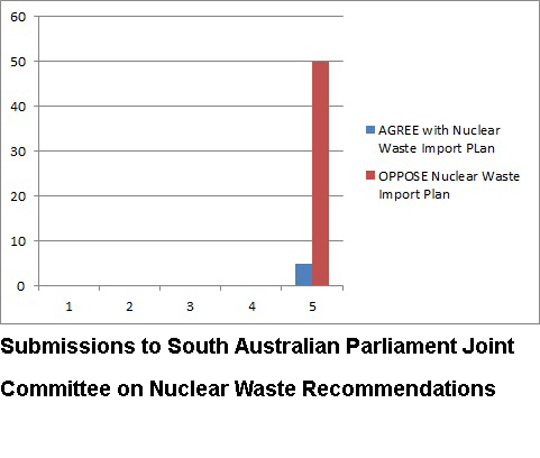
Submissions to South Australia Parliament are overwhelmingly opposed to nuclear waste importing
South Australian Parliament’s Joint Committee on Findings of the Nuclear Fuel Cycle Royal Commission.
This Parliamentary Inquiry is still going on. Transcripts of hearings and submissions can be read at
http://www.parliament.sa.gov.au/Committees/Pages/Committees.aspx?CTId=2&CId=333.
The opinions of those submitting to this Committee are overwhelmingly opposed to the nuclear waste import plan.
However,the Committee itself is hardly neutral:
- Hon Tom Kenyon MP Labor’s “ true believer in SA’s nuclear potential”
- Mrs Annabel Digance MP – Labor party. well, we all know how Labor MPs toe the party line, no matter what the evidence.
- Hon Dennis Hood MLC, of Family First a party that is more interested in matters of personal sexuality, than in wider causes. However, Mr Hood has made his own views clear, in saying ” The stars are aligning for our nuclear future“
- Mr Dan van Holst Pellekaan MP Liberal Local Member for Stuart Dan van Holst. Pellekaan said “all options for the future of the town must be explored and if it can be proven to be done safely, then there would be significant benefits for the community“.
- The Greens’ Mark Parnell will be putting a strong case for opposing the nuclear waste import plan.
In Western Australia Native title win for the Ngurra Kayanta people.
 Native title win in WA’s remote desert https://au.news.yahoo.com/thewest/a/32304974/native-title-win-in-was-remote-desert/#page1 AAP on August 11, 2016,
They first applied for native title over the land, which straddles the Shire of East Pilbara and the Shire of Halls Creek, in December 2012.
Federal Court of Australia Justice Michael Barker said none of the claimants now lived permanently in the area but continued to adhere to traditional laws and customs by visiting and maintaining a physical association with the country, and passing on traditional songs, stories and knowledge of sites to children and grandchildren.
“The claimants have maintained a presence in the determination area since the acquisition of British sovereignty,” Justice Barker said. “In addition, evidence of the continuing physical or spiritual involvement of the claimants in the determination area is accepted to conclude that this connection has not been severed.
“Ultimately, the state is satisfied that the material presented is sufficient to evidence the maintenance of connection according to traditional laws and customs.”
Nuclear waste forum in Port Pirie got a negative response from indigenous community
 Speakers in Pirie raise doubts about nuclear dump http://www.portpirierecorder.com.au/story/4087477/negative-vibes-at-nuclear-forum/ Greg Mayfield 10 Aug 2016, Speakers at an indigenous forum in Port Pirie questioned the merits of proposals for a nuclear waste dump in South Australia.
The forum was hosted by Jason Downs, of the Consultation and Response Agency set up after the Nuclear Fuel Cycle Royal Commission. It was aimed at gathering informal views from the Aboriginal community on the findings of the commission.
Gregory Waldon, of Wirrabara, said radioactive contamination on the leg of a fly could be a “problem dose” amid the scenario of handling nuclear waste. He said the issue of “risk” should be reserved for the casino. Only about $230 for each resident of South Australia would flow, he said, from development instead of an original estimate of $3300, once the Commonwealth became involved.
“It is not our waste. We should not be taking any risk,” he said.
Enice Marsh, 73, of Gladstone, is an Adnyamathanha indigenous woman who was once a coal-miner at Leigh Creek. Mrs Marsh said she was on Adnyamathanha land and was the only person from this group here at the gathering. “There are lots of Adnyamathanha people living here in Port Pirie and the area,” she said.
“I really got very little notice about this gathering. It is my duty to come here to represent my country.
“We have two uranium mines on our land – Beverley and Honeymoon. “It doesn’t matter whether it is low, intermediate or high-level waste, we are saying ‘no’ from day one.”
Neville Reid, who works in Port Pirie, said that if he were not logged into the “no nuclear” website, he would not have known about the event. He queried why there were only 10 country people on the Citizens’ Jury looking at the nuclear issue when the dump was “going to be in a country area”.
He warned that steel and concrete doors on repositories would “rot away”, leading to “another site then another site” being used during the long radioactive life of the waste.
Leader for engagement with the agency Mr Downs said a private research company had been engaged to report to the next Citizens’ Jury in October followed by a report to Premier Jay Weathefill who would “make decisions” in November based on feedback.
Native title claims over Lake Torrens area not extinguished, but were dismissed by Federal Court
SA native title claims dismissed, Valerina Changarathil, The Advertiser August 10, 2016
 THE Federal Court yesterday dismissed three overlapping native title claims near key exploration projects in the state’s mid-north, but the issue is far from resolved with some groups assessing their appeal options.
The claims by the Kokatha, Adnyamanthanha and Barngarla people were over the lands and waters of Lake Torrens — Australia’s second largest salt lake — which is in proximity to OZ Minerals’ proposed Carrapateena copper-gold project, Argonaut Resources’ and Aeris Resources’ jointly proposed Torrens iron-oxide, copper-gold project and BHP Billiton’s Olympic Dam operations.
A native title application is a claim for legal recognition that a group hold rights and interests in an area of land and/or water according to their traditional laws and customs.
Justice J Mansfield yesterday said he was not “persuaded that a determination of native title in favour of any of the three applicants should be made in respect of any part of the claim area”.
“While the archaeological evidence in this matter supports Aboriginal activity and use on and around the western shore of Lake Torrens of considerable antiquity, I have not found the archaeological evidence in this matter persuasive of a particular conclusion directed in favour of one or other of the three applicants,” he said.
He was not satisfied the Kokatha people occupied or possessed the claim area according to their traditional laws and customs at sovereignty and while the ethno-historical records provided some support for the Adnyamathanha (Kuyani) and Barngarla peoples’ connections to part of the claim area, it was difficult to date it back to the time of sovereignty or establish a continual connection to the present time.
SA Native Title Services, a solicitor for the Kokatha people, said that while applications were dismissed, there was no finding that native title rights and interests did not exist or were extinguished……..http://www.adelaidenow.com.au/business/sa-native-title-claims-dismissed/news-story/1b488e017dbd68c515907666b8f61f53
AGL plans green power boost
AGL Energy plans to invest in more large-scale renewables beyond a $2 billion fund it recently set up…..(subscribers only)
http://www.theaustralian.com.au/business/mining-energy/agl-to-expand-renewables-investment/news-story/efc8152d601aa872a2a3639cd68f4d98
1 This month
17 October, Free Public Talk on Nuclear Issues in South Australia
David Noonan will speak on public interest concerns over the new Roxby Downs Indenture Act 2026 on BHP copper-uranium mining and ore processing in SA, and on how AUKUS may face SA with a High-Level nuclear waste agenda.
Dr Jim Green will discuss international developments in the field of nuclear power including ‘small modular reactors’ and Generation 4 ‘advanced’ nuclear reactor concepts.


Help Aunty Sue Protect Her Land and Sacred Sites From Destructive Rocket Testing.
.

Australians deserve the truth
about
AUKUS – https://aukuspublicinquiry.com/

PETITION – To: Prime Minister Anthony Albanese and the Australian Labor Government

of the week – Australians for War Powers Reform (AWPR)
To see nuclear-related stories in greater depth and intensity

