Nuclear “Citizens’ Juries” and new South Australian campaign “Nu-Clear”
( an unfortunate title for the nuclear lobby – “Nu-Clear” – all too close to the UK’s incisive anti-nuclear publication NuClear News )
 Citizens’ juries to consider SA’s nuclear future, The Mandarin, Citizens’ juries show potential as a way for governments to take the heat out of contentious issues, with evidence-informed consideration of contentious policy by regular people having the ability to reshape often staid debates.
So as South Australia is tossing up whether to create a nuclear waste dump to take spent fuel from around the world, the state government has decided to convene two citizens’ juries to consider the future of the nuclear fuel cycle in the state…….
Premier Jay Weatherill says the citizens’ jury deliberations will help South Australians have an “informed discussion” about the nuclear fuel cycle, based on the body of evidence presented in the royal commission report.
The work of the citizens’ juries and other consultation processes “will play a key role in informing the decisions we make”, he stated yesterday:
“I know that some people are worried about safety and the environment whilst others see the economic opportunities. This is why before the government decides, we want South Australians to understand the choices and to be able to put their perspective on this issue.”
Deliberations will begin next month, when a group of about 50 South Australians will be asked to identify the key questions that need to be considered during the debate.
Invitations will be sent this week to 25,000 randomly selected citizens seeking an expression of interest for their participation in the jury, with members selected by an independent, non-political organisation.
Later, in October, a second citizens’ jury of about 350 people will be convened to evaluate the feedback from the state-wide consultation and weigh up the choices and options on the important issues raised by the royal commission.
In November, this second jury will produce a report summarising the community’s position for the government to consider in its response to the royal commission’s report by the end of the year.
New agency to ‘facilitate’ debate
The government will introduce a range of other consultative measures to help it come to a decision.
An independent advisory board to guide the consultation process will soon be appointed, and a state government nuclear fuel cycle agency established to help facilitate the discussion.
A campaign titled “Nu-Clear” was launched on Tuesday to promote discussion and encourage people to explore the facts on the nuclear fuel cycle, with advertisements to be run on radio, television, print and social media.
Citizens are able to comment on the royal commission report on the state’s YourSAy consultation website.
The key questions identified by the citizens’ jury will guide a number of community consultation activities from July, which will include meetings held across the state, as well as social media engagement, information centres and a free call 1800 service.
A specific program of Aboriginal engagement will also be undertaken across SA with the guidance of Aboriginal community leaders. http://www.themandarin.com.au/64738-64738/
Australia’s coming election: climate change policy to be a vote changer
 Election 2016: Climate change policy a vote winner for majority of Australians http://www.smh.com.au/federal-politics/federal-election-2016/election-2016-climate-change-policy-a-vote-winner-for-majority-of-australians-20160513-gouwbf.html May 15, 2016 Fergus Hunter Breaking news reporter Strong climate change policy is a vote-changing matter for a majority of Australians, a new poll shows, establishing the issue as an important battleground one week into the election campaign.
According to the ReachTEL survey of 2400 people, conducted for a coalition of environmental groups, 64 per cent of respondents said they would be more likely to vote for a party seeking 100 per cent renewable energy in 20 years and 48 per cent said they would be more likely to support a party reducing Australia’s net carbon emissions to zero by 2050.
The figures contrast with the Turnbull government’s avoidance of the topic. The Prime Minister did not mention climate change in his speech when kicking off the election campaign.
The Coalition’s policy is a 26-28 per cent cut on 2005 emission levels by 2030 through its multi-billion dollar emissions reduction fund and 23 per cent clean energy production by 2020.
Recently unveiled is Labor’s proposed 45 per cent cut on 2005 levels through emissions trading and restrictions on land clearing.
The Greens want a 63-82 per cent equivalent cut to emissions and 90 per cent renewable energy by 2030.
“The Prime Minister has spoken about the need to transition the economy from one dependent on mining. It is clear from this poll that an increasing number of Australians support that goal on climate change grounds,” Lyndon Schneiders, national director of the Wilderness Society, said.
“It is also clear that the vast majority of Australians recognise that we need new and powerful laws to manage that transition and to protect the places we love from the impacts of climate change.”
The poll also found:
- 56.1 per cent of people would be more likely to support a party phasing out coal-fired power, compared to 27.2 per cent unchanged and 16.6 per cent who would be less supportive.
- 66.9 per cent would be more likely to vote for a party that strengthens environmental laws protecting sites like the Great Barrier Reef, while 23.1 per cent are unaffected and 10 per cent would be less likely to support them.
- 61.9 per cent of people agree that the burning of fossil fuels causes global warming and is destroying the Great Barrier Reef, while 23.2 per cent disagree and 14.9 per cent don’t know.
A squad of environment groups, including the Australian Youth Climate Coalition, the Australian Conservation Foundation, GetUp! and Environment Victoria, are using the election to target 25 marginal seats with a doorknocking and publicity campaign on climate policy.
AYCC national director Kirsty Albion said the organisation is encouraging young people at universities and schools to enrol to vote “so that politicians start taking our future seriously and act on global warming”.
ABC on election issues: climate way down, nuclear waste import doesn’t get a mention
Election 2016: Where the parties stand on the big issues, ABC 15 May 16
“……Environment
The environment has been one of the key battlegrounds in the past two elections, with Tony Abbott’s attack on Julia Gillard’s carbon tax at the heart of his election pitch in 2013.
Despite Malcolm Turnbull previous preference for an emissions trading scheme, which saw him rolled as leader in 2009, since becoming prime minister he has maintained the Government’s direct action policy.
The carbon tax that was designed to address climate change was seen as a key reason for the downfall of the Rudd/Gillard/Rudd government, and consequently, neither party wants to impose a fixed price on carbon.
Both sides of politics have come up with different ways of attempting to reduce emissions while protecting the public and big international companies from feeling too much financial pain.
Climate change
- Both parties agree climate change is a threat and have committed to cutting Australia’s emissions by 5 per cent on 2005 levels by 2020. But from here they differ.
- The Coalition’s goal is to cut by 26–28 per cent on 2005 levels by 2030. Labor wants to cut emissions by 45 per cent on 2005 levels by 2030 and achieve net zero emissions by 2050.
- Their strategies to address climate change also differ. The Coalition opted for a “direct action” approach in which $2.55 billion in taxes is paid to companies to undertake projects which will reduce greenhouse gas emissions.
- Labor wants to introduce two emissions trading schemes — one for electricity generators and one for big industry. Labor says neither is expected to have a large impact on consumer prices.
Renewable energy
- The Coalition introduced the mandatory renewable energy target, which was then raised by Labor under Kevin Rudd.
- The Government and Labor agreed to scale back the target last year, but the Opposition has announced it would seek to increase it again if elected.
- The Coalition has promised more than 20 per cent of electricity will come from renewable sources by 2020. Labor is aiming for 50 per cent renewable energy by 2030. Continue reading
South Australian Premier Jay Weatherill sounding like an old style Liberal!
 Jay Weatherill: governments lost the art of talking to people, The Mandarin by
David Donaldson 18.02.2016 Democracies get into trouble when the judgement of experts supplants listening to the people it is supposed to represent, says South Australian Premier Jay Weatherill.
In an op-ed for DemocracyRenewal, Weatherill says the use of experts — “scientists, specialists in particular fields of knowledge and bureaucrats who come up with ‘rational’ answers to issues that they decide are the problem the community should think about” — is important, but if overzealous can disenfranchise people and create distrust in government……..
“Rather than being a threat to established institutions and reform, our Citizens’ Juries have demonstrated that the involvement of citizens in public decisions enables change and helps to restore faith in the political process. Independent evaluation has shown that the cynicism and suspicion people had felt towards government decreased as a result of being involved in the citizen jury process, with a strong interest in participating again.” http://www.themandarin.com.au/56739-jay-weatherill-governments-lost-art-talking-people/
2016 Earth getting hotter. CO2 levels above 400 ppm
Confirmed: Southern hemisphere CO2 level rises above symbolic 400 ppm milestone, [Excellent pictures, graphs, diagrams] The Age May 15, 2016 –Peter Hannam Environment Editor, The Sydney Morning Herald
NASA | A Year in the Life of Earth’s CO2
A significant marker of rising global greenhouse gas emissions has been passed, with a key monitoring site on Tasmania’s north-west tip recording atmospheric carbon-dioxide exceeding 400 parts per million for the first time.
As foreshadowed by Fairfax Media last week, a baseline reading at the Cape Grim station that exceeded the 400-ppm mark of the primary gas driving global warming was imminent.
As it turned out, “the unfortunate milestone” was reached on Tuesday May 10 at 8am, local time, said Peter Krummel, who heads the CSIRO team analysing data from the most important site in the southern hemisphere.
Atmospheric readings from Cape Grim, along with two stations in Hawaii and Alaska, are closely watched as they date back decades and closely track a range of pollutants from ozone-depleting chemicals to the various greenhouse gases resulting from burning fossil fuels and clearing forests.
Mr Krummel said that while mostly symbolic, the 400-ppm reading “highlights the problem of rising emissions, which are increasing more rapidly than they used to be”.
A report out earlier this year from the World Meteorological Organization noted atmospheric readings of CO2 at the Mauna Loa site in Hawaii rose 3.05 ppm in 2015 alone – the biggest increase in the 56 years of research……
Climate scientists, such as David Karoly at Melbourne University, note that when other greenhouse gases, such as methane, are included, the situation is even bleaker.
The so-called carbon dioxide-equivalent level that takes in the full global warming impact is now about 485 ppm.
Both 2014 and 2015 were record hot years globally in data going back about 130 years. With the effect of a strong El Nino overlaying long-term trends, this year is likely to be even hotter after a scorching start.
As sea levels rise fast, CSIRO sacks world sea level expert !
Global sea-level expert John Church made to walk the plank by CSIRO, SMH May 14, 2016 Peter Hannam “……Accelerating sea-level rises Dr Church’s achievements include developing sophisticated models linking sparse tidal gauge information around the world with satellite data to reveal how much sea levels are rising.
The current mission is retracing previous journeys along the 170 W longitude line to measure precisely how key parameters such as temperature, salinity and acidity are changing As Dr Church notes, including in a Nature paper published last month, sea-level increases are accelerating as a warming planet melts glaciers and swells oceans.
From increases of a few tenths of a millimetre annually in the 1000 years before about 1850, the rate jumped 1.7 mm on average in the 20th century. Since 1993, the rise has quickened to about 3 mm a year, he says.
Despite this trend, CSIRO will slash about half the climate staff – about 70 scientists – in its Oceans & Atmosphere division. New hires will be made in climate adaptation and mitigation, the agency promises but numbers cited so far are much smaller.
As with other CSIRO staff, Dr Church will get a chance to save his job. The sole scientist on board to be told of a pending redundancy, he was granted until June 16 – or three weeks after the voyage ends in Wellington, New Zealand – to argue his case.
Letter of support
Scientists from leading research agencies, such as NASA of the US and France’s CNES, have called for Dr Church’s group to be retained……..
‘Inconceivable to the world’
Rosemary Morrow, one of the letter’s authors, said CSIRO’s undermining of its oceans expertise “is just inconceivable to the rest of the world. Especially for a country at the crossroads of so many evolving climate modes – …of droughts and driving rains.”
Outspoken
Dr Church, who has been among the most outspoken scientists criticising the current round of CSIRO job cuts, was told one reason for his firing was the need to consolidate sea-level change into regional impacts.
“This is essentially a repetition of [chief executive] Larry Marshall’s incomplete, naive and misleading statements, except for a focus on my area of science,” he said.
“Any reading of the literature or of the most recent [Intergovernmental Panel on Climate Change] reports would clearly indicate that the overriding uncertainty in sea level remains the amount and distribution of sea level rise,” he said.
Also mentioned was the cutback of external funds, including the Abbott government’s ending of the Australian Climate Change Science Program that had been funded from 1990 until June this year.
……….”Sea-level rise is a long term issue,” he says, noting that without emissions reductions, the world is committed to seas rising several metres over coming centuries.
“These will become critical issues without major and urgent greenhouse gas mitigation for the many millions of people living near the coast,” he says. http://www.smh.com.au/environment/climate-change/global-sealevel-expert-john-church-made-to-walk-the-plank-by-csiro-20160513-gov0k9.html?utm_source=twitter&utm_medium=social&utm_campaign=nc&eid=socialn%3Atwi-13omn1677-edtrl-other%3Annn-17%2F02%2F2014-edtrs_socialshare-all-nnn-nnn-vars-o%26sa%3DD%26usg%3DALhdy28zsr6qiq#ixzz48lgN8kfP
Alinytjara Wilurara Natural Resources Management Board – response to Nuclear Royal Commission
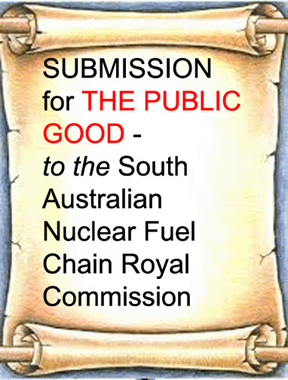
 The Alinytjara Wilurara Natural Resources Management Board – reponse to Tentaive Findings of Nuclear Fuel Cycle Royal Commission
A referendum might be held to decide on nuclear waste import plan
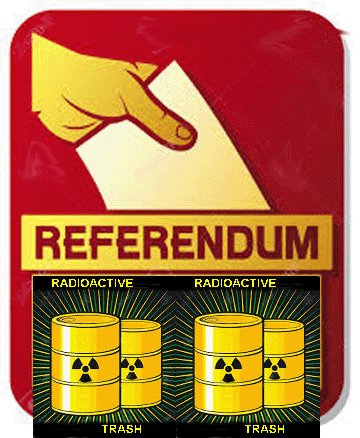 Daniel Wills: Voters’ nuclear reaction can avoid meltdowns in future May 13, 2016 The Advertiser
EVERY South Australian has been assured they can join a grand debate over a high-level nuclear waste dump for the state, but it’s no certainty that voters will get to directly decide.
The Nuclear Fuel Cycle Royal Commission’s final report this week included a strong call for the state to urgently pursue the opportunity and usher in a golden era of new wealth for SA.
Premier Jay Weatherill is holding fire until the end of the year. The State Government’s formal position is that its mind is not made up, and a combination of statewide consultation and two citizens’ juries made up of average people will help chart the course to be taken from here.
But ultimately, he’s indicated the final decision will be taken by the Cabinet, Government and 69 members of State Parliament who are put in place to make decisions on behalf of all.
The prospect of a referendum, which could be held concurrently with the 2018 state election and would effectively offer every South Australian a direct say on what would be an irreversible decision, is not being ruled out at the highest levels either major party.
If it were to occur, the electoral dynamics in two years’ time would be dramatically altered………
if a simple change to an Act of Parliament is all that’s required for a future government in coming decades and centuries to shift course, South Australians have reason to be wary.
A business case penned by Jacobs & MCM for the commission shows the state would be swimming in cash for 75 years, and then serious bills would start rolling in for the next 50……..
It’s easy to imagine a future where short-term politics triumphs over today’s best intentions…..
The next six months — with two citizens’ juries and a statewide consultation process — will shake out some of these questions and may even formally recommend a nuclear referendum…… http://www.adelaidenow.com.au/news/opinion/daniel-wills-voters-nuclear-reaction-can-avoid-meltdowns-in-future/news-story/fae428aedd70a823c06302bf15b92289
Electoral suicide for Labor? The nuclear waste dump plan.
 from “Sanity” “Mr Weatherill is understood to be favouring a political decision taken without the delay and additional hassle of a referendum.” Sorry Jay, but it is reasonable to go to the “hassle of a referendum” when the the decision has such a significant impact upon our state and citizens.
Tom Koutsantonis threatened the Liberal party with a referendum on the issue (a nuclear waste dump in SA) so it would be beyond hyporitical (even for a politician) for him not to require one now.
Daniel, could you publish the results of the ‘Advertiser -Galaxy’ poll here too?
Earlier this week a survey of ‘AdelaideNow’ readers gave the following results:
Are you in favour of a nuclear waste dump in SA?
No: 61.04% (1,648 votes)
Yes: 35.63% (962 votes)
Undecided: 3.33% (90 votes)
Which indicates certain electoral suicide for any party that allows SA to become a nuclear dump.
Corporations rejoice as The Age sacks a top investigative journalist
A pity that I can’t read the full article. Being on a low income, I don’t subscribe to any paid journal or newspaper. Well, I did, until today, subscribe to Fairfax’s The Age. But not any more.
It is a sad sacking of many staff, and I feel for all of them.
However, it says something a bit more about Fairfax, when they pick out a top investigative journalist. Michael West not only has confronted the big end of town with some very inconvenient facts, but – a worse crime – he has written about them in lively language that the peasantry can understand.
Watch now as the Business Pages of the Age become more obscurely written, and even more pro business. And along with that. The Age particpates in the general dumbing down of the Australian media.
Michael West among Fairfax redundancies, Crikey.com, Myriam Robin Media Reporter, May 13, 2016 Hard-hitting business journo Michael West is among those saying goodbye to Fairfax. Senior business reporter Michael West, whose work appeared in the Business Day sections of the Sydney Morning Herald and Age, is leaving Fairfax today.West confirmed his compulsory redundancy, but declined to comment further. In a tweet after this piece was published online, west wrote “told my skillset not aligned with fairfax strategy going forward”….. subscribers only http://www.crikey.com.au/2016/05/13/michael-west-fairfax-redundancy/

Citizens’ Juries can be a valuable guide in nuclear decision-making
 The role of Citizens’ Juries in decision-making on nuclear waste importation, Online opinion, By Noel Wauchope 13 May 2016 On May 10th South Australian Premier Jay Weatherill announced the process by which the state will decide whether or not to host a global nuclear waste import industry, as recommended by the Nuclear Fuel Cycle Royal Commission.
The first step will be to set up a “Citizens’ Jury” of 50 participants randomly selected from 25,000 invitees statewide, to be followed later by another one of 350 participants.
I think that Weatherill might have mistaken his terms here, as a Citizens’ Jury, by definition, means a group of 10 to 12 participants. The Weatherill plan sounds more like a “Deliberative Poll”, which involves a much larger group.
A properly constituted Citizens’ Jury can be a valuable process in participatory democracy. The group of 10 or 12 people serves as microcosm of the public. …… The process depends on having the oversight of a neutral but well informed advisory panel. Questions need to be framed in a way that does not risk influencing the response. Transparency is important, and complete audio or video recordings of all jury hearings should be publicly available, although the actual jury room deliberations should be private.
The citizen jury process can be an empowering one for the participants, and, as long as it is perceived to be fair and transparent, can be a valuable democratic option for assessing public opinion. It also has the advantage of being cost-effective.
The “Deliberative Poll” method is potentially another very useful form of participatory democracy. It is a lot more expensive, and more complicated. The biggest disadvantage of the Deliberative Poll method is probably its cost. Wikipedia notes:
“Imagine how much money is needed to pay for the trips, the hotel and the food for each participant, hiring the research crew and moderators, booking a venue, etc. Additional costs can include paying for participants’ compensation so that people that are randomly selected can put aside their duties to attend the events (i.e. hiring someone to milk a participant’s cow and providing child care”
Some critics insist that funding for either of these processes should not come from on single body.
“Multiple sources of funding help to ensure that the jury’s organisers are not seen as having a financial interest in producing a verdict that supports the interests of a single funding body. To maximise the scrutiny they provide, the two or more funders should have somewhat opposing interests regarding the subject likely to be under discussion.”……
In Japan, in 2012, a Deliberative Poll formed the guide to government decision-making. The Japanese government used the Center for Deliberative Democracy’s Deliberative Polling method to both inform participants and allow them to influence policymakers about the public’s will with regard to energy production issues. As a direct result of the deliberative polling process, Japan’s national government pledged to have zero percent dependency on nuclear energy after 2030. (This decision was overturned by a later government).
The South Australian government’s decision to start with a participatory democracy process is a welcome one, provided that it is done fairly and properly. Neither a Citizens Jury nor a Deliberative Poll can be a substitute for a fully democratic process like a referendum, but either could be a valuable contributor to a wider process of decision making. http://www.onlineopinion.com.au/view.asp?article=18230
South Australian govt will decide on nuclear waste import, but let citizens talk about it anyway
Premier Jay Weatherill Thursday, 11 May 2016 Community views critical to our State’s nuclear future Olympic Dam for nuclear waste? BHP does not agree
 Have these people read BHP’s Submission to the Nuclear Fuel Cycle Royal Commission?
BHP clearly states that it doesn’t want to have any involvement in storage or disposal of nuclear waste:
“Irrespective of whether storage or disposal is preferred, BHP Billiton considers that either option would be inconsistent with our core business of mining and the production of high quality copper and associated by-products at Olympic Dam.” – http://nuclearrc.sa.gov.au/app/uploads/2015/11/BHP-Billiton-03-08-2015.pdf
Olympic Dam mooted as nuke dump site The area around BHP Billiton’s Olympic Dam site has been raised in informal discussions within government as a prospective site for a future high-level nuclear waste dump, InDaily can reveal. INDAILY, Tom Richardson, 12 May 15, While a decision on whether to proceed with an international nuclear repository – as strongly recommended by this week’s Scarce Royal Commission final report – won’t be made until November at the earliest, it’s understood the viability of the Stuart Shelf region of the Gawler Craton, much of which is covered by the Olympic Dam indenture agreement, is “a question that’s been asked” in State Government circles.
The discussions also raised the prospect of an approach to Oz Minerals, whose Prominent Hill operation is around 130km northwest of Olympic Dam…….
It’s understood the Rann Government approached BHP in its first term to canvas using Olympic Dam for a low-level state repository, a suggestion the company declined.
It has since maintained that stance, unsurprisingly given the relatively low financial return of such an enterprise, saying in February that it had not been shortlisted for the national waste repository for low and intermediate level waste “and we expect this process to run its course”……http://indaily.com.au/news/2016/05/12/olympic-dam-mooted-as-nuke-dump-site/
Radioactive waste management is a social justice and environmental issue.
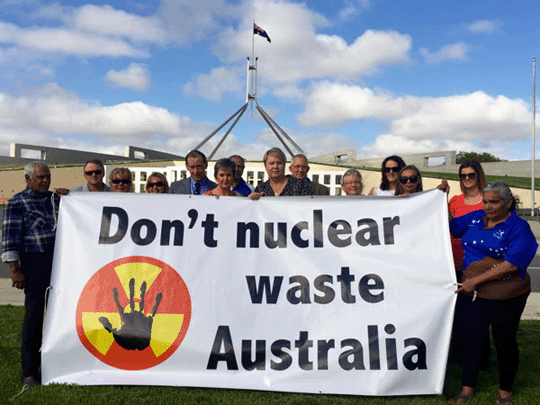 Radioactive waste management is a social justice and environmental issue. Traditional Owners living remotely across Australia have repeatedly refused to allow their country to be used as a sacrifice zone.
Any responsible approach needs to start with a commitment to stop the production of more waste and the phase out of the nuclear reactor at Lucas Heights. We need processes that will transcend election cycles in favour of respect for country and communities, both now and long into the future.
Until then, every attempt to dump the waste ‘out of site out of mind’ on unwilling communities will be met with fierce resistance.
One Adnyamathanha woman Regina McKenzie, who is a direct neighbour to the nominated site, said the community is devastated, “like somebody had rang us up and told us somebody had passed away”. The Australian Conservation Foundation, too, are calling the proposal “disturbingly familiar to past failed federal approaches.”
The nominated site, leased as a pastoral property from the South Australian Government by ex-Liberal Senator Greg Chapman, is located next door to Yappala Station, which was declared an Indigenous Protected Area by the Federal Government in 2014.
There are many thousands of Aboriginal artefacts registered in the area, including an ancient Aboriginal skull fragment. The Adnyamathanha people have been meticulously mapping and registering the storylines and sites. The landscape is stunning, with Hookina Creek on the property framed by the iconic Flinders Ranges. Wilpena Pound is around 30 kilometres away…….. Continue reading
Environment groups slam NSW government attempts to generate interest in uranium trade.
 The future is renewable, not radioactive: Environment groups slam NSW government attempts to generate interest in uranium trade.
Environment groups have slammed attempts by the NSW government to talk up the potential for uranium exploration as well as coal seam gas to international investors.
The Sydney Morning Herald reported yesterday that at a conference held in Toronto in March, Department of NSW Trade and Investment spruiked NSW as a ‘greenfields’ opportunity for uranium, citing areas in the central west around Broken Hill and the New England region as possible hotspots.
Beyond Nuclear Initiative coordinator Natalie Wasley said “Minister Roberts is going head first down a radioactive rabbit hole. The uranium industry is outdated and unsafe and it is flat lining economically.”
“When the uranium exploration moratorium was overturned in 2012, environment groups were joined by trade unions and medical organisations, as well as the state ALP and Greens parties to launch the NSW Uranium Free Charter. There has historically been strong opposition to uranium exploration and mining in NSW and this has not waned over time.”
“Attempts to open a uranium mining industry here will be challenged head on.”
Kerry Laws from Uranium Free NSW added: “NSW has the potential to be a leader in renewables, but the government is instead trying to drag the state back into the dirty dark ages of the uranium trade.”
“Minister Roberts and Premier Baird could give some substance to Turnbull’s innovation bandwagon, by exploring and mapping out renewable options, rather than resorting to an industry that both damages our land and creates by-products that remain toxic for 100,000 years.”
“The future is in regional, renewable industries.”
1 This month
17 October, Free Public Talk on Nuclear Issues in South Australia
David Noonan will speak on public interest concerns over the new Roxby Downs Indenture Act 2026 on BHP copper-uranium mining and ore processing in SA, and on how AUKUS may face SA with a High-Level nuclear waste agenda.
Dr Jim Green will discuss international developments in the field of nuclear power including ‘small modular reactors’ and Generation 4 ‘advanced’ nuclear reactor concepts.


Help Aunty Sue Protect Her Land and Sacred Sites From Destructive Rocket Testing.
.

Australians deserve the truth
about
AUKUS – https://aukuspublicinquiry.com/

PETITION – To: Prime Minister Anthony Albanese and the Australian Labor Government

of the week – Australians for War Powers Reform (AWPR)
To see nuclear-related stories in greater depth and intensity

