Climate change harming wine industry (nuclear power would, too)
 I think that it is criminal of Australia’s government to deny action on climate change. And for a “pro business” government, what can they be thinking? Abbott’s “go slow” policy on climate action is harming so many businesses, and so many jobs. Now it’s the wine industry! Sacré bleu !
When Abbott finally decides that climate change matters, (i.e when he openly touts nuclear power), let’s not forget that nuclear power endangers the wine industry, too!
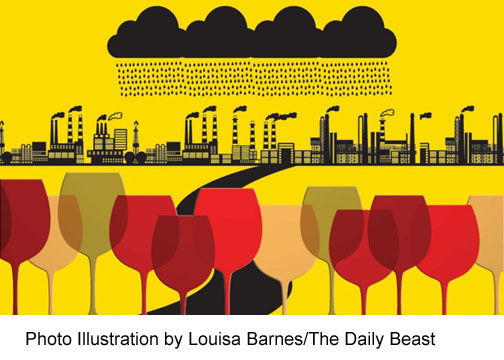
Climate change hitting where it hurts: your wine, The Age, 27 July Michael Pascoe BusinessDay contributing editor Spend a day at a wine grape growers’ summit and, among many other things, you’re left with no doubt about the reality of climate change.
Spend another day with a savvy grape grower touring the Barossa and you’re left with no doubt about the cost of it and the uncertainty about where it’s heading.
That’s not news for those who follow the wine industry closely at the production level, but for those of us who concentrate on consumption, the matter-of-factness of the change is rather startling.
Grapes ripening a month earlier, the compression of what were the usual different ripening times of different varieties, the search for varieties capable of handling hotter weather, the hunt for new terroir as climate bands move, the threat to traditional varieties in regions whose reputations depend on them.
Sweden, an important customer for Australian wine makers, now has a fledgling wine industry as a result of longer, warmer summers.
But you don’t have to go to the other end of the earth to see the story. Turns out climate change is a force in developing the Tasmanian industry as warmer weather leads mainland producers to invest in the island’s cooler climate. There’s no end of science on the issue, if that counts any more……….
And this is climate change, not just global warming. The heat is there, but the Scholz fields copped a frost that they hadn’t seen before, wiping out the crop. OK, it was a 1-in-100-year event – except that it happened again the next year. Now giant $55,000 electric fans increasingly dot vineyards, automatically triggered into action by a thermometer to suck in higher, warmer air and blow it across the vines to fight the killing drop of cold air. http://www.smh.com.au/business/the-economy/climate-change-hitting-where-it-hurts-your-wine-20150726-gikmuc.html#ixzz3h334o3XH
Federal Labor frontbencher Anthony Albanese opposes Australian further involvement in nuclear fuel chain
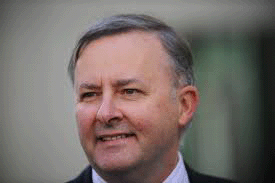 Premier Jay Weatherill at loggerheads with senior Labor members over nuclear industry, GST, Perth Now July 24, 2015 PETER JEAN CHRIS RUSSELL The Advertiser “…….Federal Labor frontbencher Anthony Albanese yesterday declared his opposition to any further Australian involvement in the nuclear fuel cycle and to the importation of nuclear waste, while Labor leader Bill Shorten reiterated his hostility to raising the GST.
Mr Albanese – who unsuccessfully stood for the Labor leadership after the last federal election – yesterday said it was too dangerous for Australia to become more involved in the nuclear fuel cycle.
“My position on the nuclear fuel cycle is clear,’’ Mr Albanese told an anti-nuclear weapons event held on the sidelines of the ALP conference.“Until the issues of nuclear waste and nuclear proliferation are satisfactorily solved, I oppose any further Australian involvement in the nuclear fuel cycle.“Nuclear waste created today, remains an issue for generations to come.’’
Mr Albanese’s opposition to nuclear energy is heavily influenced by his close friendship with former Labor MP Tom Uren, who died earlier this year. As a prisoner of the Japanese in 1945, Mr Uren saw the mushroom cloud from the atomic bombing of Nagasaki……..
Labor’s platform commits the party in government to prohibiting “the establishment of nuclear power plants and all other stages of the nuclear fuel cycle in Australia.’’
An anti-nuclear section of the Federal Labor policy platform will be left in place at Labor’s national conference in Melbourne this weekend……..
Rear Admiral Kevin Scarce, the head of South Australia’s Nuclear Fuel Cycle Royal Commission, said yesterday if he was to recommend an expansion of the industry, national support would be crucial.“There would be no opportunity - in my view – without bipartisan support both at the federal and state level to make the investment that would be necessary,” he said………http://www.perthnow.com.au/news/national/premier-jay-weatherill-at-loggerheads-with-senior-labor-members-over-nuclear-industry-gst/story-fnii5yv8-1227456054891
Dr Helen Caldicott’s Submission on all 4 Nuclear Royal Commission Issues Papers
 Submission to the Nuclear Fuel Cycle Royal Commission, by Helen Caldicott on July 24, 2015 I begin my submission to the Nuclear Fuel Cycle Royal Commission by posting an article which I wrote for the Australian Medical Student Journal, which outlines in some detail the medical implications of the whole nuclear fuel chain.
The impact of the nuclear crisis on global health
Due to my personal concerns regarding the ignorance of the world’s media and politicians about radiation biology after the dreadful accident at Fukushima in Japan, I organized a 2 day symposium at the NY Academy of Medicine on March 11 and 12, 2013 … [ to read the full text of this article, click on this link: http://www.helencaldicott.com/the-impact-of-the-nuclear-crisis-on-global-health/. The link will open in a new tab or window. Close it to return to this page ]
Now to answer some of the questions posed by the Royal Commission Continue reading
Nuclear Royal Commission back from overseas jaunt
Nuclear commission takes overseas experiences on board as SA considers uranium industry expansion, ABC News By Nicola Gage, 24 July 15, South Australia’s nuclear royal commissioner Kevin Scarce says he is “nowhere near” making a recommendation to government on the potential for an expanded industry in the state after a research trip to Asia, Europe, the United States and Canada…….The commission received 90 submissions from companies and individuals in its first round of public feedback, which has now closed…….[n.b second round of submissions closes on August 3rd]
Public hearings are expected to commence from September, with a final report due in May.http://www.abc.net.au/news/2015-07-24/sa-nuclear-commission-takes-overseas-experiences-on-board/6647018 https://www.youtube.com/watch?v=a6swqTljXeE
50% renewable energy goal will effectively bring Australia up with world leaders
 50% renewable energy would put Australia in line with leading nations, The Conversation, John Mathews Professor of Strategic Management, Macquarie Graduate School of Management at Macquarie University, 25 July 15, Opposition leader Bill Shorten told the Labor Party conference this morning that the party’s policy should be for 50% of electricity to come from renewables by 2030.
This would bring Australia abreast with its international competitors such as California, with its recently announced target of 50% of electricity from renewables by 2030, and Germany, where the Energiewende(“energy transformation”) will see the country commit to 40-45% non-nuclear green power by 2020, and 55-60% by 2035.
Shorten’s move is a major break with previous ALP policy, and promises to be so effective in building a new power sector to eclipse the present fossil-fuelled sector that it already has the conservative side of politics foaming at the mouth. Continue reading
Northern Territory development : Aboriginal owners asked to agree to extinguish native title
 Northern Land Council calls for major rethink of northern development amid concerns about Ord expansion talks PM By Sara Everingham ABC New, 25 July 15, The head of the Northern Land Council (NLC) has said a major rethink of northern development is needed and he fears one of the Northern Territory Government’s key strategies for boosting agriculture will lead to little but heartache for Indigenous people.
Chief executive officer Joe Morrison said traditional owners were being asked to agree to extinguish native title to allow for the expansion of the Ord Irrigation Scheme from the East Kimberley into the Northern Territory but he said he was worried there would be few lasting benefits in return.
Points for #NuclearCommissionSAust Submission to Issues paper 2 – “Further Processing” – theme for this week
Submissions on this Issue are due by August 3rd. Check tips on submitting.
Questions.2.2 and 2.4. – (feasible for South Australia to make more radioactive substances? What will be future demand for conversion, uranium enrichment, nuclear fuel processing?)
It would not be economically, socially or environmentally feasible for South Australia to further manufacture radioactive substances.
On economics, South Australia would be producing a product whose market is declining.
In Canada, Cameco’s failed laser uranium enrichment project added to its losses in 2014.(1).
“The nuclear industry is in decline: The 388 operating reactors are 50 fewer than the peak in 2002, while the total installed capacity peaked in 2010 at 367 GW before declining to the current level, which is comparable to levels last seen two decades ago.” (2)
Socially, people are becoming more aware of the hazards of uranium enrichment plants. Even in China – Jiangmen residents protested against proposed uranium processing plant (3)
Massive amounts of depleted uranium are created by uranium enrichment, causing social concern a social problem as well as an environmental problem.
Most of the byproducts (garbage) “from uranium enrichment (96%) is depleted uranium (DU)… There are vast quantities of depleted uranium in storage. The United States Department of Energy alone has 470,000 tons.[1] About 95% of depleted uranium is stored as uranium hexafluoride (UF6).” (4)
2.5. (South Australia to get involved in emerging nuclear technologies)
As to new and emerging technologies, it is becoming ever clearer that the untested technologies, such as Liquid Fluoride Thorium Reactors, will not be developed for very many years, during which time renewable energy technologies, including battery storage, are racing ahead. By the time the “Generation IV nuclear reactors are developed, (if they ever are), they will have no appeal in the 21st Century modern energy scene. Even now, their cost is astronomic, and they cannot attract investment. Their only hope is tax payer funding. No Generation IV nuclear reactor will be ready before 2050 (5) .
2.6 (What are the specific models for best practice in these activities?)
As to specific models – there is the failed Mixed Oxide Fuel (MOX facility) at USA’s Savannah River site – an environmental and financial disaster (6)
2.11 (What are the security implications?)
From uranium enrichment, and further processing, danger arises not only from the depleted uranium waste produced, but also from the transport of enriched uranium, – the danger of accidents or of terrorist attacks:
“The transportation of UF6 is dangerous, both because of what it is – a hazardous chemical and radioactive substance; and what it is a part of – the production process of nuclear reactor fuel, nuclear bombs, and uranium ammunition. It is documented that a release of UF6 in a populated area could have catastrophic consequences. Cylinders used to transport UF6will result in quantities of uranium and hydrofluoric acid (HF) in the immediate vicinity far exceeding levels dangerous to health (both chemically and radiologically).
Despite the danger, the dominant belief within governments and the nuclear industry is that UF6 transport is safe. This belief, regrettably, is mainly based on two assumptions shown to be false. These assumptions are that UF6 does not present a significant radioactive hazard, and cylinders used to transport UF6 are built strong enough to survive accident conditions. It is noted, however, that deciding whether or not the transportation of UF6 is dangerous involves qualitative moral and ethical decisions as well as analysis of quantitative, technical data.” (7)
2.13. (How to estimate the financial benefit to South Australians?)
This question is a joke. Given the unfathomable costs and the disastrous history of U.S. Enrichment Corporation (USEC) , it is ludicrous to expect any accurate assessment of the costs, let alone the very hypothetical benefits.(8)
2.14.(What impacts on other sectors of the economy?)
 Whereas in the past, countries like France and USA were complacent about setting up nuclear industries, and not worried about the effects on clean industries – farming, vineyards, fisheries, those days are over.
“The increased exposure of contaminants to crops and livestock, and the natural environment and cumulative “food chain” events of unregulated agricultural products, have the potential for significant safety and health risks to consumers. Perhaps more importantly, the public perception of risk or danger from uranium may also result in serious negative repercussions for the marketability of agricultural products from the nearby regions” (9)
“A nuclear facility in Washington State’s prime wine country is leaching radioactive groundwater….the DOE report released last year that indicated trace amounts of the radioisotope tritium were found in wine samples collected”. (10)
Any nuclear facility – from uranium mining through to waste facility poses a real impediment to tourism, as well as to agriculture. In England, the Lake District is currently facing this threat – Tourism, Milk and Cheese or Nuclear? (11)
All uranium/nuclear activities bring the danger of radioactive leakage to groundwater, with impacts on all agricultural industries. (12_)
So far, I have considered only the effects on industries of the normal operations of advanced uranium and fuel fabrication processes. But what if there’s an accident? (13) Chernobyl and Fukushima give an illustration here, of what happens to farming and fishing industries.
Fukushima’s fish industry is yet to recover. (14) Chernobyl: “Agriculture was hardest hit, with 784 320 hectares taken from production. Timber production was halted in 694,200 hectares of forest. Remediation made “clean food” production possible in many areas but led to higher costs in the form of fertilizers, additives and special cultivation processes.
Even where farming is safe, the stigma associated with Chernobyl caused marketing problems and led to falling revenues, declining production and the closure of some facilities. Combined with disruptions due to the collapse of the Soviet Union, recession, and new market mechanisms, the region’s economy suffered, resulting in lower living standards, unemployment and increased poverty. All agricultural areas, whether affected by radiation or not, proved vulnerable”. (15)
- http://www.starnewsonline.com/article/20141103/ARTICLES/141109942/-1/topic24?Title=Uranium-producer-Cameco-reports-a-third-quarter-loss-
- http://www.worldnuclearreport.org/WNISR2014.html
- The Standard July 12, 2013
- http://en.wikipedia.org/wiki/Nuclear_fuel_cycle
- http://www.no2nuclearpower.org.uk/nuclearnews/NuClearNewsNo74.pdf
- http://io9.com/failed-nuclear-weapons-recycling-program-could-put-us-a-1586851270
- Some Problems And Hazards Associated With The Transportation Of Uranium Hexafluoride by Miles Goldstick
- http://ecowatch.com/2013/uranium-titan-tumbles/
- Maggy J. Lewis http://scholarship.law.wm.edu/cgi/viewcontent.cgi?article=1015&context=wmelpr
- http://www.thedailybeast.com/articles/2015/03/28/hanford-nuclear-site-could-be-threatening-washington-state-s-best-vineyards.html
- https://miningawareness.wordpress.com/2015/02/13/tourism-milk-and-cheese-or-nuclear/
- . SLAC Scientists Search for New Ways to Deal with U.S. Uranium Ore Processing Legacy New Field Project Tests Link Between Organic Materials and Persistent Uranium Contamination http://www.newswise.com/articles/slac-scientists-search-for-new-ways-to-deal-with-u-s-uranium-ore-processing-legacy
- Possible Effects of Nuclear Radiation Accidents on Agriculture http://trace.tennessee.edu/cgi/viewcontent.cgiarticle=1439&context=utk_agbulletin?
- http://www.unisdr.org/archive/43503
- http://www.who.int/mediacentre/news/releases/2005/pr38/en/index1.html
Inaccurate information in #NuclearCommissionSAust’s Issues Paper 1
the public are making submissions based on inaccurate information provided in the Issues Paper. The dismissive response of the Royal Commission undermines any confidence that the Issues Papers are accurate overviews of the nuclear industry.”
PUBLIC CONSULTATIONS BASED ON MISINFORMATION:
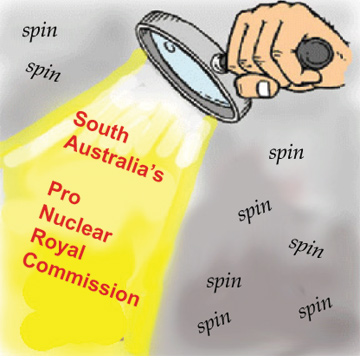 ROYAL COMMISSION ON THE NUCLEAR FUEL CYCLE FAILS TO CORRECT FACTUAL ERROR IN ISSUES PAPER
Friends of the Earth Adelaide have recently informed the Royal Commission into the Nuclear Fuel Cycle of a factual error in Issues Paper 1, concerning the regulation of Aboriginal Heritage matters in South Australia. Issues Paper 1, which deals with the exploration, extraction and milling of uranium, states that Aboriginal sites of significance are protected by the Aboriginal Heritage Act 1988.
“The Royal Commission was informed in writing that this is not the case for BHP Billiton, South Australia’s biggest miner,” said Nectaria Calan of Friends of the Earth Adelaide. “Under the Indenture Act, which applies solely to BHP Billiton, the company’s Olympic Dam mine and some 15, 000 square kilometres of the surrounding Stuart Shelf are exempt from the Aboriginal Heritage Act 1988. This exemption would carry through to any future expansion of uranium mining by BHP Billiton at Olympic Dam or in the surrounding area.”
In his recent response to Friends of the Earth Adelaide Royal Commissioner Kevin Scarce insisted that in the event of an expansion of uranium mining Aboriginal Heritage matters would be regulated by the Aboriginal Heritage Act 1988.
“This is simply not the law throughout the state,” said Ms Calan. “Friends of the Earth Adelaide have supplied the Royal Commission with referenced information regarding the Roxby Downs (Indenture Ratification) (Amendment of Indenture) Amendment Act 2011, which amends the current Indenture Act to apply to any expansion formally announced by the company up until October 2016. If it was an honest mistake to begin with, it is negligent not to correct it.” Continue reading
How will the Australian government handle voluntary hosting of radioactive trash?
If the federal Government’s intention of following a voluntarist approach is sincere, it will have to take these factors into account – plus a number of other points that have proven essential and are outlined in the report. The next 12 months will show if we will once again witness a forceful attempt to deal with Australia’s radioactive waste or if the Government is taking its promise of voluntarism serious – and how willing it is to learn from others and its own past.
 Can Australia learn from international experience in managing radioactive waste? http://www.onlineopinion.com.au/view.asp?article=17536 Since over twenty years the Australian Government has been trying to declare sites to host our radioactive waste in a centralised facility: first in South Australia and then the Northern Territory. All of these attempts were flawed and ultimately failed – most recently the attempt to dispose of Australia’s low-level radioactive waste and store the intermediate level waste in Muckaty, NT. In 2014 the sustained opposition by Traditional Owners and a broad alliance of civil society organisations finally resulted in the Commonwealth abandoning its aggressive pursuit of the site.
With it came the conclusion that imposing nuclear dumpsites on communities apparently does not work and that a shift is needed towards a voluntarist approach. This is current international best practise and indeed a very welcome change in attitude.
In March this year, Industry Minister Ian Macfarlane called on landowners across Australia to nominate their land to host a radioactive waste management facility. The two-month nomination period ended in the beginning of May. It is currently followed by a desk-study to evaluate the nominated sites’ suitability to host the facility according to a number of social, environmental and economic factors. The resulting shortlist of sites, as well as a complete list of all nominations received, is expected to be released shortly, as Mr Macfarlane repeatedly announced it for the month of July.
It is therefore timely to have a look at what a voluntarist siting process should actually encompass and how Australia’s new approach rates against that.
In a new report titled ‘Wasting time? International lessons for managing Australia’s radioactive waste’, commissioned by the Australian Conservation Foundation, I analyse international experience in siting radioactive waste activities in regards to preconditions for their success. The lessons that can be drawn from this experience are of direct relevance to the currently ongoing Australian National Radioactive Waste Management Project.
Apart from other critical factors, the key characteristics of a successful and truly voluntarist siting process are community consent, continuous engagement with the local community throughout the duration of the project and a flexible timeframe. Continue reading
Labor leader Bill Shorten foresees a climate change election
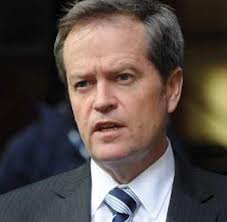 Bring on a climate change election, says Bill Shorten, SMH, July 24, 2015 Michael Gordon Political editor, The Age
Bill Shorten has challenged Tony Abbott to fight the next election on the issue of climate change, declaring: “I’ve got a three-word slogan for him: Bring it on.”
Describing climate change as “an economic and environmental cancer”, the Labor leader has vowed to build an emissions trading scheme and not be intimidated by “ridiculous scare campaigns”.
In a speech to be delivered at the party’s national conference in Melbourne, Mr Shorten says only Labor can save Australia’s renewable energy industry. While Tony Abbott has been a scathing critics of wind farms, Mr Shorten will tell the conference: “I want more Aussie farmers earning more money by putting wind turbines on their land.” Continue reading
Bjorn Lomborg’s Climate Consensus Centre for Flinders University?
The Abbott government has held talks with Flinders University about hosting a major policy centre in Adelaide based on the methodology of controversial Danish academic Bjorn Lomborg.
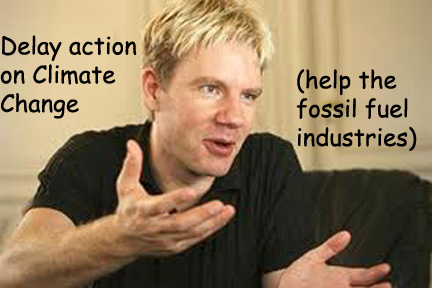
Education Minister Christopher Pyne has been searching for an institution willing to host the so-called Australia Consensus Centre, with $4 million in federal funds, since the University of Western Australia pulled out of its contract in May………
Dr Lomborg has attracted controversy for suggesting that the dangers of climate change have been overstated and that the world faces more pressing challenges, such as poverty.
A spokesman for Mr Pyne confirmed last night that talks with Flinders were at an early stage.
He said that the Adelaide-based university had recently approached the government about the establishment of the Copenhagen Consensus methodology in Australia.
A Flinders spokeswoman confirmed the approach and said the university was yet to make a decision……..
Flinders is led by vice-chancellor Colin Stirling, who took up the position in January. Professor Stirling was formerly the senior deputy vice-chancellor at Curtin University in Perth and a research fellow at the University of California, Berkeley.
The university’s chancellor — or chairman of the board — is leading Adelaide businessman Stephen Gerlach, a former chairman of oil company Santos……..
The federal opposition has questioned the political motivation of the $4 million government grant to set up the centre. It questioned how the centre was given the grant at a time when other universities were facing significant funding cuts.
In May, Professor Johnson said that many UWA academics had complained about Dr Lomborg’s integrity in the area of climate change research and were concerned that these alleged shortcomings might extend into other policy fields to be examined. http://www.theaustralian.com.au/higher-education/flinders-university-in-talks-on-lomborg-plan-for-consensus-centre/story-e6frgcjx-1227454548253
Tony Abbott’s sly way of stopping action on climate change
 Tony Abbott and his mates’ new path of climate change obstruction, Independent Australia, Patrick Keane 22 July 2015 Tony Abbott and opponents of action on climate change have determined a new path of obstruction, writes Patrick Keane: instead of doubting the science they will thwart the solution.
2015 is a momentous year in the story of climate change; never has the world been hotter and never has the Government of Australia done more to thwart action on Climate Change.
The Abbott Government has engaged in an unprecedented attack on renewable energy. …….
The answer is because the fossil fuel industry has married themselves to political interests and only death will them part. The Abbott Government, amongst others, provides a clear example of who – and what – stands in the road of action on climate change with their attacks on renewable energy……..https://independentaustralia.net/environment/environment-display/tony-abbott-new-path-of-climate-change-obstruction,7969
Labor pro nuclear heavies will keep pushing to overturn Labor’s anti nuclear policy
Gary Gray, the ALP’s shadow resources minister, is very clear on the importance of the Royal  Commission as very much connected to Federal nuclear policy — even though the Commission pretends that it is only about the State of South Australia.
Gray and the other nuclear enthusiasts will continue to push for pro-nuclear changes to policy.
Labor veers towards the nuclear option https://independentaustralia.net/environment/environment-display/labor-veers-towards-the-nuclear-option,7965 21 July 15 The SA Nuclear Royal Commission, the ALP’s postponement of its National Conference nuclear debate and the machinations of the Nuclear For Climate Declaration could herald Australia’s deeper involvement in the nuclear industry, writes Noel Wauchope.
 1. July 24: Closing date for Stage One submissions to SA Royal Commission on the Nuclear Fuel Cycle… … on the subject of ‘Storage and Disposal of Nuclear Wastes’ (for South Australia) We can be confident that the global nuclear lobby will have put in wonderful submissions proposing South Australia to lead the world in inviting in nuclear wastes and setting up the (as yet non-existent) “Generation IV” nuclear reactors.
2. July 24: ALP’s National Conference begins in Melbourne There was a plan to hold a vigourous debate on reversing the party’s anti-nuclear policy. Australia is contractually bound to take back the very small amounts of wastes that originated from the Lucas Heights research nuclear reactor. That is being used as a “foot in the door” for expanding our uranium industry and taking back more radioactive wastes, plus getting the promised (geewhiz!) Gen IV reactors.
In a last ditch move to avoid a possible uproar about this, Labor’s pro-nuclear push has pulled back from this plan. For the moment only, one suspects.
3. Signing of the Nuclear For Climate Declaration This was done by Australia’s Rob Parker, President of the Australian Nuclear Association, in Paris. Continue reading
Do not let the Nuclear Industry ruin beautiful South Australia’s Tourist Industry
Wilderness and nature photographer Steve Parish rates South Australian landscape best in country 891 ABC Adelaide By Brett Williamson 22 July 15 Celebrating more than four decades as a freelance nature photographer, Steve Parish rates South Australia as the best place he has ever shot.
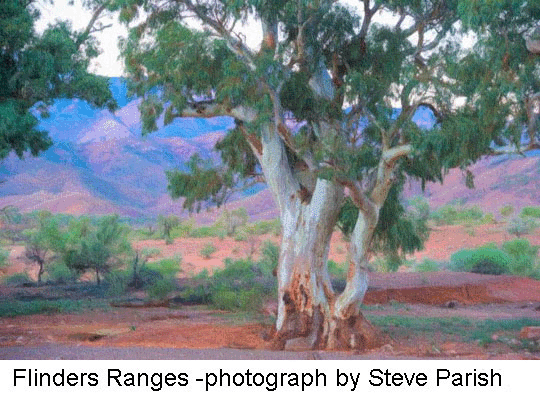
Mr Parish, who grew up in the eastern Adelaide suburbs of Norwood and Burnside, said he found his love of nature when exploring the local coastlines…….
After leaving the Navy at 29, Mr Parish joined the Queensland National Parks and Wildlife Services as a wildlife photographer for five years before working freelance across the country.
“My favourite landscape is northern-central South Australia, [Kati Thanda] Lake Eyre up to Innamincka, that beautiful channel country, the Gibber Desert,” Mr Parish said.
“The most glorious light and aerial photography I have done in my whole life was around [Kati Thanda] Lake Eyre in 2010, the second time the lake filled.”
Mr Parish said South Australians were spoilt by the beautiful, natural light experienced across the state during winter as weather systems rolled across the state……..
“Instead of bland, empty skies that we tend to get more in the north in the different times of the year, you get that wonderful shafting, golden light,” he said.
“You have the wonderful granite coasts, Kangaroo Island, thethe Flinders Ranges– you get that wonderful light, and photography is very much connected to your emotions, feelings and the light that paints the scene.”……http://www.abc.net.au/news/2015-07-21/photographer-steve-parish-rates-south-australia-landscape-best/663423
Some points on #NuclearCommissionSAust Issues paper 3
Roger Sowell , Sowell’s Law Blog 22 July 15 .It is interesting indeed that the questions for Paper 3 did not specifically mention renewable energy as providing supply to the grid. It is perhaps not surprising, given the Commission’s charter to examine the Nuclear Fuel Cycle. However, questions 8, 12, 15, 16, and 17 have wording that is sufficiently broad that one could include renewable energy in the answer.
A more encompassing grid planning study would (and many do) include various forms of energy generation. The advantages and disadvantages of each form are assessed. An excellent example is from the California Energy Commission, at http://www.energy.ca.gov/2009publications/CEC-200-2009-017/CEC-200-2009-017-SF.PDF, Comparative Costs of California Central Station Electricity Generation, published in 2010. However, even this study is confined to a comparison of costs, both initial and operating costs. Safety, impacts on the grid, fuel supply and price volatility, environmental impacts, and reliability are not included.
 I would not anticipate the nuclear power industry being able to kill renewable energy, in fact, quite the opposite is very likely to occur. Most forms of renewable energy have a decreasing unit cost over time, most especially wind turbines over the past decade. Meanwhile, nuclear-based power has an increasing unit cost. The only examples I can find where nuclear power plants can be built for approximately $4,000 per kW are those countries where labor rates are still very cheap, such as China. But, labor costs increase over time so that small advantage will disappear. Finally, the grid-storage problem has been solved technically, with under-sea storage and hydroelectric power as described by MIT. As offshore wind-turbines decline in installed cost, and the under-sea storage costs also decline with experience, truly sustainable and inexhaustible clean power on demand will finally exist. The electricity may not be too cheap to meter (the big lie of nuclear power), but it will be relatively cheap and not subject to price increases due to fuel availability. http://sowellslawblog.blogspot.com.au/
1 This month
17 October, Free Public Talk on Nuclear Issues in South Australia
David Noonan will speak on public interest concerns over the new Roxby Downs Indenture Act 2026 on BHP copper-uranium mining and ore processing in SA, and on how AUKUS may face SA with a High-Level nuclear waste agenda.
Dr Jim Green will discuss international developments in the field of nuclear power including ‘small modular reactors’ and Generation 4 ‘advanced’ nuclear reactor concepts.


Help Aunty Sue Protect Her Land and Sacred Sites From Destructive Rocket Testing.
.

Australians deserve the truth
about
AUKUS – https://aukuspublicinquiry.com/

PETITION – To: Prime Minister Anthony Albanese and the Australian Labor Government

of the week – Australians for War Powers Reform (AWPR)
To see nuclear-related stories in greater depth and intensity

